Home Blog Page 9426

DoubleDragon targets P11B in maiden REIT listing

By Denise A. Valdez
Reporter

DOUBLEDRAGON Properties Corp. is finalizing plans for its maiden real estate investment trust (REIT) listing as it targets to raise about P11 billion every year in the next six years through the investment vehicle.

In an e-mail to BusinessWorld over the weekend, DoubleDragon Chairman Edgar “Injap” J. Sia II said the company is “very happy” with the REIT guidelines released by the government last week, and it wants to firm up the size, asset composition and timeline for the REIT listing within the first quarter.

“As of now, DoubleDragon is looking at possible REIT listing of about 1/4 of its currently completed leasable GFA (gross floor area) portfolio. We aim to do REIT listing for a total of about 200,000 sq.m. leasing asset every year…,” he said.

He added the move “should enable DoubleDragon to generate about P11 billion of new capital annually in the next six years starting from 2020 to 2025 at an estimated cap rate of 6%.”

“We intend to choose the most mature assets for the first tranche of REIT listing on the first year, and then the following year choose another batch of leasable space that has ripened and matured on that specific year,” he said.

DoubleDragon had completed 603,000 square meters (sq.m.) of leasable space in its portfolio as of end-2018. In the nine months to September 2019, its recurring revenues jumped 41% to P2.9 billion, pushing it closer to its goal of sourcing 90% of its total revenues from recurring revenues by 2020.

Mr. Sia said he is confident of the company’s portfolio of diversified leasing assets, which he noted are “sunrise real estate hard assets” and will not be affected by “foreign-owned online digital e-commerce platforms that are expected to reach its inflection growth points in the Philippine market soon.”

DoubleDragon’s assets are comprised of mall spaces, office spaces, hotel rooms and industrial spaces. It is targeting to hit 1.2-million sq.m. of leasable space within the year, which will be comprised of 700,000 sq.m. from CityMalls branches; 300,000 sq.m. from office spaces in DD Meridian Park and Jollibee Tower; 100,000 sq.m. from hotel rooms in Hotel 101 and Jinjiang Inn Philippines; and 100,000 sq.m. from industrial spaces in CentralHub.

“We believe the availability of REIT in the Philippines came just in time for DoubleDragon to begin this year harvesting the fruits from the seeds that [it] has strategically planted across the country in the past five years,” Mr. Sia said.

“…REIT is a very efficient way for recurring income generating portfolio holders like DoubleDragon to raise new equity capital,” he added.

Shares in DoubleDragon at the stock exchange gained 16 centavos or 0.90% to P18 each on Friday.

The approved REIT guidelines allow a minimum public ownership of 33%, a minimum paid-up capital of P300 million and tax exemption for the transfer of property into a REIT vehicle. Proceeds from a REIT listing must be reinvested in a real estate or infrastructure project in the Philippines within a year.

The Philippine Stock Exchange, Inc. (PSE) said in a statement the new guidelines had sparked excitement from property developers, noting one company had already met with PSE President and Chief Executive Officer Ramon S. Monzon last week to discuss its plans.

“[J]ust days after the momentous signing event, the President of the biggest property firm in the country met with us to discuss their REIT listing plans and timetable,” Mr. Monzon was quoted in the statement as saying.

“When a one trillion peso company wants to be the first to have a REIT listing and a sizeable first one at that, you know that the confidence in this new asset class and the support it will get from property companies will be remarkable,” he added.

Property giant Ayala Land, Inc., which has a market value of P609 billion as of Friday, had previously disclosed plans to raise about $300 million from its maiden REIT offering involving its office assets in Makati.

Other companies that have expressed interest in REIT before are Megaworld Corp., Robinsons Land Corp., SM Prime Holdings, Inc. and Century Properties Group, Inc.

Toyota unveils ‘Woven City’

By Manny N. de los Reyes

TOYOTA has rolled out its crystal ball and showed a glimpse of the future with the unveiling of plans to build a prototype “city of the future” on a 70-hectare site on no less than the base of spectacular Mt. Fuji in Japan.

Called the Woven City, it will be a fully connected ecosystem powered by hydrogen fuel cells.

Envisioned as a “living laboratory,” the Woven City will serve as a home to full-time residents and researchers who will be able to test and develop technologies such as autonomy, robotics, personal mobility, smart homes and artificial intelligence in a real-world environment.

“Building a complete city from the ground up, even on a small scale like this, is a unique opportunity to develop future technologies, including a digital operating system for the city’s infrastructure. With people, buildings and vehicles all connected and communicating with each other through data and sensors, we will be able to test connected AI technology… in both the virtual and the physical realms… maximizing its potential,” said Akio Toyoda, president, Toyota Motor Corporation.

Toyota will extend an open invitation to collaborate with other commercial and academic partners and invite interested scientists and researchers from around the world to come work on their own projects in this one-of-a-kind, real-world incubator.

“We welcome all those inspired to improve the way we live in the future, to take advantage of this unique research ecosystem and join us in our quest to create an ever-better way of life and mobility for all,” said Mr. Toyoda.

For the design of Woven City, Toyota has commissioned Danish architect, Bjarke Ingels, founder and creative director of Bjarke Ingels Group (BIG).

His team at BIG have designed many high-profile projects: from 2 World Trade Center in New York, and Lego House in Denmark, to Google’s Mountain View and London headquarters.

“A swarm of different technologies are beginning to radically change how we inhabit and navigate our cities. Connected, autonomous, emission-free and shared mobility solutions are bound to unleash a world of opportunities for new forms of urban life. With the breadth of technologies and industries that we have been able to access and collaborate with from the Toyota ecosystem of companies, we believe we have a unique opportunity to explore new forms of urbanity with the Woven City that could pave new paths for other cities to explore,” said Ingels.

The masterplan of the city includes the designations for street usage into three types: for faster vehicles only, for a mix of lower speed, personal mobility and pedestrians, and for a park-like promenade for pedestrians only. These three street types weave together to form an organic grid pattern to help accelerate the testing of autonomy.

The city is planned to be fully sustainable, with buildings made mostly of wood to minimize the carbon footprint, using traditional Japanese wood joinery, combined with robotic production methods. The rooftops will be covered in photo-voltaic panels to generate solar power in addition to power generated by hydrogen fuel cells.

Toyota plans to weave in the outdoors throughout the city, with native vegetation and hydroponics. Residences will be equipped with the latest in human-support technologies, such as in-home robotics to assist with daily living. The homes will use sensor-based AI to check occupants’ health, take care of basic needs and enhance daily life, creating an opportunity to deploy connected technology with integrity and trust, securely and positively.

To move residents through the city, only fully-autonomous, zero-emission vehicles will be allowed on the main thoroughfares. In and throughout Woven City, autonomous Toyota e-Palettes will be used for transportation and deliveries, as well as for changeable mobile retail.

Both neighborhood parks and a large central park for recreation, as well as a central plaza for social gatherings, are designed to bring the community together. Toyota believes that encouraging human connection will be an equally important aspect of this experience.

Toyota plans to populate Woven City with Toyota Motor Corporation employees and their families, retired couples, retailers, visiting scientists, and industry partners. The plan is for 2000 people to start, adding more as the project evolves.

The groundbreaking for the site is planned for early 2021.

Isuzu PH to donate vehicle to Philippine Red Cross

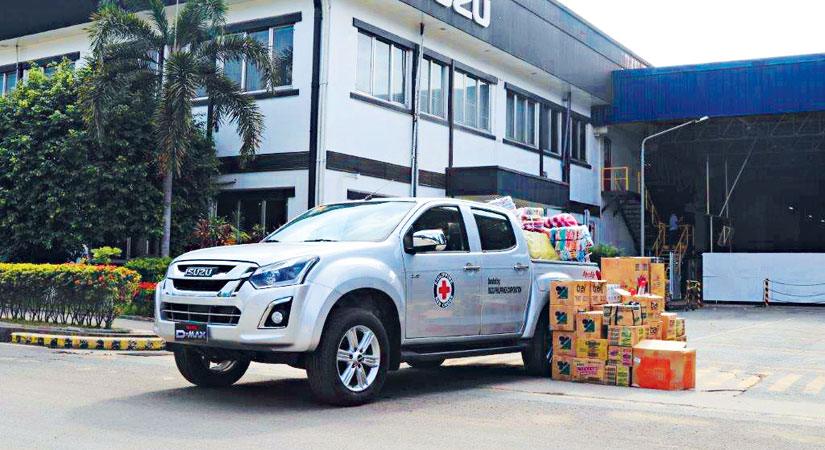
ISUZU PHILIPPINES Corporation (IPC) early this week donated one unit of Isuzu D-MAX 4×4 LS MT to the Philippine Red Cross (PRC), Laguna Chapter, at the IPC Plant in Biñan Laguna, for the Taal Volcano eruption relief efforts mobilization. Additional supplies were also provided such as bottled water, toiletries, clothes and other essentials to alleviate the condition of evacuees and affected individual.

The donation is earmarked to support Philippine Red Cross’s mission to provide life-saving services that protect the life of Filipinos in vulnerable situations.

IPC is delighted to be able to help bridge volunteers like PRC, and people affected by the Taal Volcano eruption.

During the interview, IPC Executive Vice-President Shojiro Sakoda said, “Isuzu D-MAX 4×4, being a utilitarian pickup, is surely essential in bringing relief goods and aiding victims of Taal Volcano eruption.”

The Isuzu D-Max 4×4 LS MT donated to Philippine Red Cross

“Isuzu D-MAX is a combination of power and performance and is equipped with Blue Power technology that can withstand any roads, from the toughest terrain to the slickest street all in style and comfort,” he added.

Local residents are encouraged to support humanitarian organizations and to do initiatives in helping the victims of the recent eruption.

For more information on Isuzu’s commitment to improving communities nationwide, visit www.isuzuphil.com.

Alphaland plans stock market return

ALPHALAND Corp. owner Roberto V. Ongpin is considering a return for the operator of Balesin Island Club to the stock market soon, its incoming president said.

Dennis O. Valdes told reporters last week that the five-year ban for Alphaland to list had been lifted last year, opening the opportunity for the company to return to the equity market as it seeks the expansion of Balesin.

“I think he wants to list again… I think he will re-list Alphaland this year or next,” he said, referring to Mr. Ongpin. “The five-year ban is done. He’s free to re-list. He’s just waiting for the right timing.”

Mr. Valdes is set to begin his role as president of Alphaland on Feb. 1, leaving his post in formerly Ongpin-led company PhilWeb Corp.

In 2014, Alphaland was involuntarily delisted from the Philippine Stock Exchange (PSE) for violating disclosure rules involving the company’s alleged “simulated sale” of shares to increase its public float.

But after more than five years, Mr. Valdes said he thinks “it makes sense for Alphaland to re-list,” as the company is also embarking on the expansion of its flagship Balesin Island Club in Polillo, Quezon.

In an April 2018 note signed by Mr. Ongpin on Alphaland’s website, he said the company had acquired 789 hectares of the Patnanungan Island close to Balesin Island Club, which he wants to turn into an airport to be called the Balesin International Gateway.

The project involves a 2.5-kilometer runway that can handle international flights, an aerodrome, a hotel, a championship golf course and hundreds of villas.

“Balesin Gateway will take us at least five years to complete, but it is an exciting project…,” Mr. Ongpin said in the note. Unlike the 500-hectare Balesin Island Club, Balesin Gateway will not be exclusive to members.

Mr. Valdes estimates the project to cost about P10 billion, which is why he signaled the timeliness of re-listing at the PSE to raise additional funding.

“I think Patnangunan is a huge deal… [I]t’s a huge development in an area of the Philippines that nobody has really invested in. So imagine if you had an airport there, at some point you’re bringing development to such an under-resourced area of the country. There’s got to be a lot of people who would benefit from that,” he said.

Aside from Balesin Island Club, Alphaland also owns Alphaland Makati Place, Alphaland Baguio Mountain Lodges and The Alpha Suites in Makati City. — Denise A. Valdez

Government probe of contracts drags down stock price of Ayala Corp.

THE government’s review of its contracts with diversified conglomerate Ayala Corp.’s units prompted investors to sell the stock, making it one of the most actively traded issues last week.

Data from the Philippine Stock Exchange showed a total of P1.32 billion worth of 1.82 million Ayala Corp. (AC) shares were traded from Jan. 20 to 24, making it the fourth most actively traded issue last week.

Ayala Corp. dropped 7.8% on a week-on-week basis to P740 per share last Friday from P803 apiece on Jan. 17. Since the start of the year, the stock is down 3.9%.

COL Financial Group, Inc. Senior Research Manager Richard G. Laneda said in an e-mail interview attributed the decline to the “negative investor sentiment” amid a proposed government review of its contract with Ayala-linked companies such as Manila Water Co., Inc., Ayala Land, Inc. (ALI), and Light Rail Manila Corp. (LRMC).

PNB Securities, Inc. President Manuel Antonio G. Lisbona shared this view, saying that “the current focus is on AC’s Ayala Land, Inc. (ALI), which was allegedly paying significantly lower lease rates to the University of the Philippines (UP) on the UP-Ayala Land Technohub.”

“ALI is responsible for 41% of AC’s income, thus if the allegations prove true, ALI’s income (and consequently AC’s) will be affected negatively,” he said in a separate e-mail interview.

In December last year, President Rodrigo R. Duterte threatened to file economic sabotage cases against water companies, which included Manila Water, over alleged onerous provisions in their contracts with the government. New contracts are being drafted by the government.

Meanwhile, Mr. Duterte said in a speech in Davao on Jan. 17 that separate companies led by Fernando Zobel de Ayala and Manuel V. Pangilinan were getting the most of their contracts with the government. Rep. Eric G. Yap filed a resolution last Monday that seeks to investigate the alleged onerous agreement between the government and LRMC.

Following this, LRMC, the operator of Light Rail Manila that operates the Light Rail Transit Line 1, last week said it was ready to cooperate with the government should it push through with an investigation into an alleged irregularity in its concession contract.

LRMC is a joint venture company of Pangilinan-led Metro Pacific Investments Corp.’s (MPIC) Metro Pacific Light Rail Corp., Ayala Corp.’s AC Infrastructure Holdings Corp., and the Philippine Investment Alliance for Infrastructure’s Macquarie Infrastructure Holdings (Philippines) PTE Ltd.

After Malacañang Spokesman Salvador S. Panelo floated the idea of a UP-Ayala Land Technohub contract review in a radio interview on Jan. 19, ALI said it welcomed a transparent review of its partnership with UP.

Mr. Panelo said on Tuesday that Mr. Duterte approved the review of that agreement.

Ayala Corp., the holding company of the Ayala group, has business interests in real estate and hotels; financial services and insurance; telecommunications; water infrastructure; electronics solutions and manufacturing; industrial technologies; automotive; power generation; infrastructure; health care; education; and technology ventures.

In the third quarter last year, the conglomerate’s net income attributable to equity holders of the parent company went up 6.8% to P8.32 billion, taking the nine-month tally to P46.16 billion.

For this year, COL Financial’s Mr. Laneda expects Ayala Corp. to reach a bottom line of P37.8 billion due to higher earnings from ALI, Globe Telecom, Inc., Bank of the Philippine Islands and AC Energy, Inc.

PNB Securities’ Mr. Lisbona sees the conglomerate to net P55 billion in 2020.

“This translates to an earnings per share of about P87.90 which works out to price to earnings ratio of 8.41 times at current price of P740 per share,” he said.

For this week, Mr. Laneda placed the stock’s support and resistance at P690 and P804, respectively.

Mr. Lisbona gave its support levels between P700 and P695.50 and resistance at P800. — Edwin C. Aruta, Jr.

Hyundai sustains position among top car companies in 2019

HYUNDAI Asia Resources, Inc. (HARI), the official distributor of the leading Korean automotive brand in the Philippines, ended the year strong with 2.9% growth in December 2019 or 3,163 units sold versus the same month last year.

December marked the third month in 2019 that HARI breached the 3,000-unit sales mark.

For the full year, Hyundai sales reached 33,763 units, enabling it to maintain its position in the market as one of the leading brands in the Philippine market. This is equivalent to a 6.1% drop from 2018 mainly due to the company’s non-participation in some market segments, such as pickups.

“We rose to the challenges in 2019 and have sustained our position as one of the preferred brands in the market. We are very excited to start the new decade with the introduction of innovative models that will disrupt certain segments and offer customers more and better choices. We shall also carry on with our aggressive PC and CV network expansion to serve high-growth corridors across the country,” HARI president and CEO Ma. Fe Perez-Agudo said.

HARI President & CEO Ma. Fe Perez-Agudo assures Hyundai will remain to exceed customer expectations with newer models, innovations in After-Sales, more convenient ownership, and relevant CSR engagements this 2020 and beyond.

Month-on-month, the Passenger Cars (PC) segment rose by 8.5%, from 1,516 units in December 2019 to 1,645 units in January this year. This was prompted by the Hyundai’s “golden pair” — the Hyundai Reina (PC A-Segment) and the Hyundai Accent (PC B-Segment). The Reina, despite being launched only in early 2019, is now No. 2 in the A-segment in total sales while the venerable Accent remains in the Top 3 in the B-segment. Both models are known for fuel-efficiency, segment-topping performance, and design. The company sold a total of 17,761 PC units in 2019.

Light Commercial Vehicle (LCV) sales increased by 2.9% in December 2019 to 1,399 units compared to the same month last year spearheaded by the durable and versatile Hyundai H-100 (Light Truck) and the globally awarded Hyundai Kona (subcompact SUV). Both models are No. 1 in their respective segments. Overall, Hyundai LCV sales declined by 2.6% with 15,095 units sold.

Hyundai Commercial Vehicles (CV) continued to be the best performing segment for the year with a 63.4% full-year growth, or a total of 907 units sold led by the Hyundai County bus. HARI CV sales are expected to further surge in 2020 due to higher demand generated by government programs to improve the existing public transportation. Late last year, HARI rolled out its Class-2 and Class-3 Modern Jeepneys (built on the Hyundai HD50S platform) to serve the needs of transport cooperatives while the Hyundai H-100 Class-1 Modern Jeepney was launched earlier in the year. Both Class 1 and 2 Modern Jeepneys were granted their Certificates of Compliance by the Department of Transportation in October 2019. Finally, in 2019 alone, HARI inaugurated five dedicated CV dealerships.

“For 2020, you can trust that Hyundai will continue to exceed customer expectations with newer models, innovations in After-Sales, and more convenient ownership, and relevant CSR engagement through H.A.R.I Foundation, Inc.’s flagship programs in health, education, and environmental sustainability. Ultimately, we want to be an integral part of our customers’ lives as we give them better products, better services, and better journeys,” Agudo added.

Founder’s DNA placed front and center in Paris Haute Couture Week shows

By Joseph L. Garcia
Reporter

IT’S A season of change as the earth seeks to shrug off the snows of winter — the same can be said about the appointment of two new names at two fashion powerhouses. BusinessWorld saw the shows at Paris Haute Couture Week last week (via a video stream), and chose three shows that shared something in common. While each is a flex of their maison’s muscles, the haute couture shows also dictate where fashions might go. Yes, trickle-up inspirations and Hollywood exist to do the same, but you might expect a few fast-fashion factories to copy these looks, thus bringing them to the middle classes. The collections revert to a sort of innocence and a return to basics — a timely response to the complications of our world.

FLOWERS FOR SPRING
“Florals? For spring? Groundbreaking,” Miranda Priestly loftily pronounced in The Devil Wears Prada. I’d dare you to say that straight to Givenchy’s Artistic Director Claire Waight Keller’s face. Ms. Keller, according to an article from Vogue, envisioned Givenchy’s Haute Couture collection based on the love letters between Virginia Woolf and Vita Sackville-West, and how that love blossomed in English gardens and contributed to Woolf’s novel, Orlando.

This translated into loose, tailored suits in white, reflecting a sort of polite, patrician glamor. Next came separates with tops made to resemble flowers, petals represented by ruffling and ruching. Dresses followed in the same vein, reflecting blooms like foxglove, tulips, and carnations (a black pantsuit, totally wearable with white appliques on the shoulder might reflect Queen Anne’s Lace). It is as if the model isn’t wearing flowers, but becomes a flower herself.

Lacy white garments reflecting opulent and comfortable English prewar summers were also on the runway, though conventional florals were also there, seen printed on skirts (coupled with large hats also evocative as petals).

Shimmering gowns in metallic colors like silver and rose gold were also seen (I guess we haven’t completely killed rose gold, and that’s fine).

The show ended with a stunning white lace piece, positively bridal: made completely with lace, loose-fitting and off-the-shoulder, and coupled once again with an enormous hat shaped like a rose petal that in its structure serves like a veil.

(To see the show, visit https://www.youtube.com/watch?v=FlQg2jcpKCQ)

UNEASY SURREALISM
Elsa Schiaparelli served as a foil to Chanel in the early 20th century. When Chanel was stark and grew up in poverty, Schiap (her nickname) took to her work her privileged upbringing: an attachment to fine art, fine clothing, and a disregard for rules.

After the war, it seemed that Schiaparelli lost her battle with Chanel, closing her doors in the 1950s. The house was revived in 2007 by Italian businessman Diego Della Valle (of Tod’s fame), but Marco Zanini jumpstarted the brand’s return with its first couture show in 2014.

People came and went, and Daniel Roseberry sits now as Artistic Director for the maison, entering just last year. His show opens with a relatively plain black pantsuit with a cutout blouse that reveals more than hides (causing unease with its juxtaposition with a relatively conservative garment).

A black double-breasted pantsuit appeared on the runway, with its left lapel suddenly blooming up and above the model’s head, perhaps reflective of Schiaparelli’s fondness for surrealism. Schiap then created unease, sometimes plumbing into the human fear of mortality: think about a dress embroidered in gold (a similar black dress does the same) that sits where a model’s bones would be. According to Vogue, it reflects a design from Elsa Schiaparelli herself (a skeleton evening dress from 1938). If anything, this runway look is the most Schiaparelli (a single adjective cannot be placed for the multifaceted woman) — her playfulness and attachment to Surrealism can be seen in a pair of spectacles designed to look like a person’s eyes, complete with lashes and pearl tears. These glasses were seen throughout the show, and I suppose multiple viewings become a way of educating the audience of what Schiaparelli is all about.

For some classic Schiap moments, there’s also a dress in shocking pink (a color she practically invented), with a sweetheart neckline that called to mind her muse, Mae West.

Mr. Roseberry has his work cut out for him. Elsa then was a woman way ahead of her time, seeing that fashion was art and blurred the lines between the two disciplines. I’m sure if he released any old design of Elsa’s from the 1930s, it would still make tongues wag now as they did before.

(To see the show, visit https://www.schiaparelli.com/en)

A PSYCHOLOGICAL ANALYSIS
The Grand Palais of Paris was transformed into the cloister garden of the convent at the commune of Aubazine for Chanel’s Spring 2020 Haute Couture presentation. It’s an important detail, because the maison’s founder, Gabrielle “Coco” Chanel, at 12, was left there by her father after her mother’s premature death.

Coco Chanel died in 1971. Karl Lagerfeld, chief designer of Chanel since 1983, may have dug into the highs of Chanel for inspiration. The house since then has created its own language as interpreted by Lagerfeld. Perhaps it’s telling that his replacement after his death last year, Virginie Viard, has chosen to plumb into the formative years of Coco Chanel the person (perhaps an effort to find her own footing within the brand?).

In a way, the show becomes a psychological analysis of Chanel as the person who would shape an institution. In this convent, Chanel learned how to sew. The black, white, deep reds, and the chain belts seen on the convent’s nuns and indigent children would inspire her in the future. While the stay may have contributed to her career immensely, her impoverished and lonely situation within the convent also lit a flame within her to rise above her station — no matter what.

The show was opened and was immediately summarized by black and white tweed suits with an almost virginal aesthetic teetering on the prissy. The tweeds form collars, and according to an article from Vogue, patterns in the collars reflect patterns on the convent’s floor.

There are also skirts patterned after the windows at the Aubazine convent, which may have inspired Chanel’s logo of interlocking C’s.

The collection is incredibly wearable, totally classic, and totally Chanel. The final look is a simple, white schoolgirl-inspired bridal outfit (if one accounts for the veil trailing behind).

(To see the show, visit https://www.youtube.com/watch?v=3IbXHJkDxKA)

Public works chief to review contracts for ‘onerous’ clauses

SECRETARY Mark A. Villar of the Department of Public Works and Highways (DWPH) has expressed willingness to look into existing concession contracts for possible “onerous” provisions in line with President Rodrigo R. Duterte’s order.

“Definitely if we find something onerous, we will investigate,” Mr. Villar said in Malabon City on Friday on the sidelines of the inspection of NLEX Harbor Link Segment 10 C3-R10 Section when asked to comment on Mr. Duterte’s order to review government contracts with the private sector.

“We are always looking [at the contracts]. So far, wala pa kaming nakikitang onerous (so far, we have not yet seen any onerous provisions) … If we can see anything. But of course, as far as the road projects, so far wala pa kaming nakikita na onerous (we don’t see anything onerous),” he said.

Mr. Duterte, who ordered the review of all government contracts in April last year, approved recently the review of Ayala Land, Inc.’s (ALI) contract to develop a 20-hectare site on Commonwealth Avenue opposite the UP Diliman campus in Quezon City, a site which became the UP-Ayala Land Technohub.

The deal becomes the second contract of the Ayala group contract under review by the government for alleged “onerous” provisions, after state officials questioned the water contracts for Metro Manila’s water distribution agreed with two providers in 1997, including Ayala-controlled Manila Water Co., Inc.

Mr. Duterte also said recently that he wanted a review of the government’s contract with Light Rail Manila Corp. (LRMC), the operator of Light Rail Transit Line 1 (LRT-1).

LRMC is a joint venture company of Metro Pacific Investments Corp.’s (MPIC) Metro Pacific Light Rail Corp., Ayala Corp.’s AC Infrastructure Holdings Corp., and the Philippine Investment Alliance for Infrastructure’s Macquarie Infrastructure Holdings (Philippines) PTE Ltd.

Mr. Duterte said he had learned that the separate companies led by businessmen Fernando Zobel de Ayala and Manuel V. Pangilinan “are getting most of the contracts.”

A congressman then filed a resolution seeking to investigate the alleged onerous concession agreement between the government and LRMC.

MPIC is one of three Philippine subsidiaries of Hong Kong’s First Pacific Co. Ltd., the others being PLDT, Inc. and Philex Mining Corp.

Hastings Holdings, Inc., a unit of PLDT Beneficial Trust Fund subsidiary MediaQuest Holdings, Inc., maintains an interest in BusinessWorld through the Philippine Star Group. — Arjay L. Balinbin

Ph auto industry powerhouses join the growing MG family

SINCE MG came under the distributorship of The Covenant Car Company, Inc. (TCCCI) in October 2018, the brand’s nationwide dealership network has experienced a rapid expansion. In just over a year, MG Philippines has opened a total of 18 dealerships throughout Luzon, Visayas, and Mindanao. And to open a new year and decade, MG Philippines is proud to announce the latest dealer principals to sign on with MG, demonstrating their trust and the confidence in this British heritage brand, its modern, stylish, and attainable products, the growth and foreseeable potential of the MG brand, and the very capable team at TCCCI behind it all.

It is MG Philippines’ honor to continue partnering with the biggest and most respected names in the local auto industry. This continues with MG Philippines newest dealer partners: Ark Diversified, Inc., The ANC Group, Advan Motor, Inc., Autohub Group, and Magnum Group, Inc.

Ark Diversified Inc., led by its President and CEO Ray Jarina, brings years of commercial vehicle sales success. This time around, the group continues that same success with the inauguration of MG Commonwealth in Quezon City.

The ANC Group is widely considered as one of the biggest and most influential local automotive groups. Under president and CEO, Anthony Cheng, the group is slated to open MG Makati to offer car sales and aftermarket services in a main business center.

Advan Motor Inc. and its president, Ramon Sison, will pioneer MG’s expansion in the eastern side of the Metro as it opens MG Marikina.

The Autohub Group, along with president, Willy Tee Ten (who is recognized as one of the 33 most influential personas in the automotive industry in 2019), is geared to add MG Shaw to its growing list of auto dealers.

Magnum Group Inc., led by Managing Director Eduardo Bangayan, graces the Zamboanga peninsula with the opening of MG Zamboanga — ensuring the brand’s expanded market reach in the southern Philippines.

Magnum Motors Corporation, under its president and CEO Roger Chiu, launches MG Cagayan De Oro in this burgeoning, high-potential, economically progressive city.

Each dealership will also be equipped to amplify the aftersales offerings of MG Philippines, including parts, service, and customer relations.

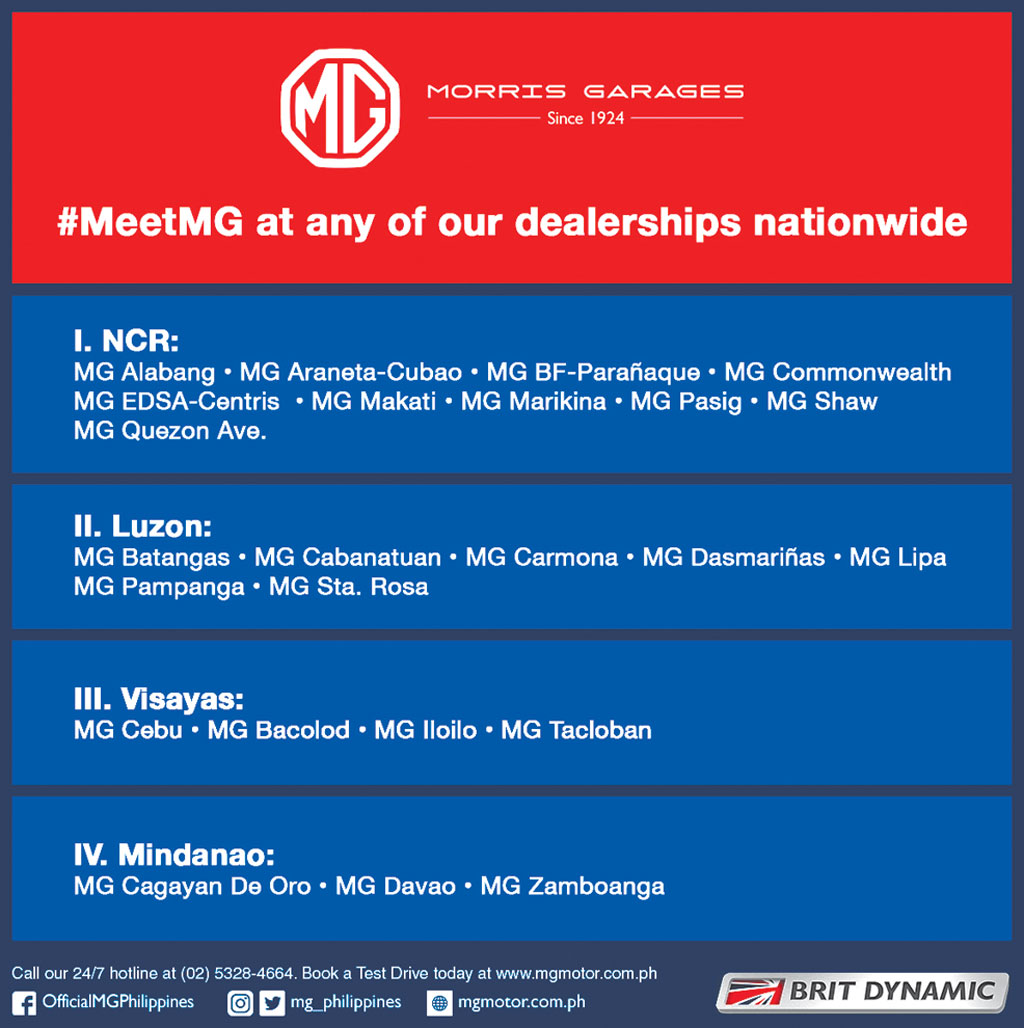
For now, come and #MeetMG at any of the twenty-four (24) operational dealerships nationwide. MG Philippines continues to grow its network of dealerships to ensure access to these great, British-bred rides, as well as genuine parts and aftersales services to keep them in top condition.

Follow MG Philippines on social media: OfficialMGPhilippines (Facebook) @mg_philippines (Instagram and Twitter) for more updates. You may also call the 24/7 MG Philippines hotline at (02) 5328-4664 for more inquiries.

Maasin bamboo industry highlighted in Iloilo festival

ALEX HOLYOAKE/UNSPLASH

ILOILO CITY — The town of Maasin, Iloilo, which is being positioned as a center of the bamboo industry, supplied most of the kiosks for this year’s Ilonggo Food Festival in a bid to highlight the town’s design talent.

Phillipp Chua, chairman of the Iloilo Festivals Foundation Inc.’s (IFFI) committee on kiosks, said the organization tapped the local government of Maasin for the construction of 330 out of 500 food stalls that were set up for the Dinagyang Festival.

“The design of the 330 kiosks (was) by the people of Maasin so that we can also showcase their craftsmanship,” Mr. Chua said in a news conference last week before the Dinagyang weekend.

Maasin Mayor Francis A. Amboy said the town signed a P1.2-million contract with IFFI for the project, which used about 3,000 bamboo poles and employed 100 carpenters from the town.

“It (included) the construction of the kiosks and their installation at the venue. They (were) inspired by the typical bahay kubo,” Mr. Amboy said.

“This opportunity is really a big help for us because first, it creates employment for the people of Maasin and second, we can showcase our products. We are really proud that we have been tapped to create the kiosks,” he added.

The 330 IFFI-accredited stalls were set up at the Downtown Triangle.

The 170 other food stalls participated in other food fairs organized by the Iloilo Hotel Restaurants & Resorts Association (IHRRA), Association of Barangay Captains in City Proper District, and the ‘Kaon Ta, Iloilo’ Facebook group.

Maasin, located about 30 kilometers northeast of Iloilo City, has a 5,000-hectare bamboo plantation.

The Department of Environment and Natural Resources, along with the Philippine Council for Agriculture, Aquatic and Natural Resources Research and Development (PCAARD), has been assisting the town’s KAPAWA people’s organization for the development of bamboo woven products. — Emme Rose S. Santiagudo

Fine jewelry is forever

FILIPINO designer Josie Natori wore a minimalist black outfit that showed off her statement jewelry perfectly — dangling dragon earrings in midnight silver accented with a white gemstone at the center.

“We just launched it. I haven’t got the chance to try everything,” Ms. Natori told BusinessWorld speaking of her new jewelry line.

The Natori Company, Inc. launched its first fine jewelry collection in a licensed partnership with direct-to-consumer and supply chain pioneer Angara.

“Growing up, I have always loved fine jewelry — diamonds,” Ms. Natori, who established the brand in 1977, said at the launch on Jan. 23 at Rustan’s Makati.

“I went into accessories with fashion jewelry first. It was a question of time in doing fine jewelry,” she said.

The Natori x Angara collection features the designer’s signature East-meets-West aesthetic with Angara’s gemstone and jewelry expertise. The jewelry — earrings, pendants, necklaces, rings, and bracelets — found their inspiration from Indochine, dragons, and the Kamon family crest.

“We strategized this collection with direct-to-consumer top of mind,” Ken Natori, President of Natori, said in a press release. “Customers will be able to order from our expansive fine jewelry collections; pieces are made to order, constructed and shipped within two days. This is truly a game-changing partnership for us.”

Ms. Natori noted that designing jewelry is as challenging as clothing.

“You work with different materials. It’s complicated. But the beauty about it is that it is forever,” she said. “It’s no different in clothes, you have to make sure that it fits.”

The collection is made of materials such as yellow gold, rose gold, midnight silver, diamonds, and pearls.

It will be available at Silver Vault at Rustan’s Makati for a limited period — until Jan. 31. Afterwards, the collection will be officially launched in retail stores in New York City.

Prices for the Natori jewelry range from $300 to $58,000. For information, visit angara.com and natori.com.Michelle Anne P. Soliman

Property firm’s P1.7-B taxes canceled

By Vann Marlo M. Villegas
Reporter

THE Court of Tax Appeals (CTA) affirmed the cancellation of the P1.73 billion alleged tax deficiencies of real estate firm Fort 1 Global City Center, Inc.

In a six-page resolution on Jan. 23, the court’s second division denied for lack of merit the motion for reconsideration of the Bureau of Internal Revenue (BIR).

The court reiterated that the bureau did not comply with Section 3.1.4 of Revenue Regulation No. 12-99 on the personal service of assessment notices for 2009 and 2012.

“While it is true that some of the BIR notices appear to have been received by the people named therein, however, no statement regarding their designation and authority to act for and in behalf of petitioner were mentioned by respondent,” the court said.

It noted that “substantial irregularities” in the alleged personal service of the notices show its failure to comply with laws and regulations and also denies the taxpayer’s due process.

“Accordingly, this Court correctly held that no valid assessment was issued by respondent as petitioner did not receive the same. And since an invalid assessment bears no valid fruit, the assessments and the FDDA [final decision on disputed assessment] issued against petitioner for taxable years 2009 and 2012 should, therefore, be cancelled for not properly observing petitioner’s right to due process of law,” it said.

The court in September last year granted the petition of Fort 1, canceling the BIR’s tax assessments against it worth P134.1 million and P1.6 billion for 2012 and 2009, respectively, as the bureau delivered the notices to different address and was received by individuals.

However, the BIR failed to present evidence that the recipient of the notices were Fort 1’s authorized representatives.

In the motion for reconsideration, the BIR said the petitioner is barred from questioning the authority of those who received the assessments as the issue was never raised in the administrative level and it allowed the taxpayer to substantiate its contentions before the case was brought to the court.

The court, on the other hand, said the Revised Rules of CTA provided the court “may not limit itself to the issues stipulated by the parties but may also rule upon related issues necessary to achieve an orderly disposition of the case.”

It also cited a previous ruling of the Supreme Court that the appellate court may take into consideration issues the parties did not raise or was ignored by the lower court.

The resolution was penned by Associate Justice Cielito N. Mindaro-Grulla and concurred in by Associate Justices Juanito C. Castañeda, Jr. and Jean Marie A. Baacorro-Villena.