Home Blog Page 9332

National task force organized to contain ASF

MALACAÑANG has ordered the creation of a national task force to deal with animal diseases following the spread of African Swine Fever (ASF) in domestic pigs.

President Rodrigo R. Duterte signed Executive Order (EO) No. 105 on Feb. 21 authorizing the creation of the National Task Force on Animal Borne Diseases, which will take charge of preventing the entry of such diseases as well as containing their spread.

“(T)o effectively address the current outbreak and to prevent or resolve similar incidents in the future involving other animal-borne diseases, there is an urgent need to create an inter-agency task force which will formulate, oversee and implement effective and coordinated policies and strategies to manage, contain, and control the spread of such diseases,” according to the EO, which was released Thursday.

ASF was first detected in domestic swine in September.

The Secretary of Agriculture was appointed to chair the task force with the Secretary of Health as Vice-Chair.

Mr. Duterte signed earlier this month another executive order that orders stakeholders to follow the national zoning plan drawn up to contain ASF.

Earlier this month, Agriculture Secretary William D. Dar said that the losses due to ASF at P7 billion. — Gillian M. Cortez

Doctors contest guidelines for denial of PhilHealth accreditation

DOCTORS said health insurance fraud is not as prevalent as the Philippine Health Insurance Corp. (Philhealth) suggests, after the latter issued a circular outlining the grounds for denying or withdrawing PhilHealth accreditation.

In a position paper published Thursday in the Philippine Daily Inquirer, doctors’ associations said that PhilHealth Circular 2020-0003 which sets guidelines for the denial or withdrawal of accreditation is “insulting the health profession.”

“The circular’s focus on preemptive penalties for noncompliance gives the unintended impression that violations are more often the rule rather than the exception in our profession which is far from the truth,” the associations said.

The paper was signed by the Philippine College of Physicians; Philippine College of Radiology; Philippine College of Surgeons; Philippine Obstetrical and Gynecological Society; Philippine Pediatrics Society; Philippine Society of Pathologists; Philippine Society of Anesthesiologists; Philippine College of Chest Physicians; Philippine College of Geriatric Medicine; Philippine College of Hematology and Transfusion Medicine; Philippine Heart Association; Philippine Rheumatology Association; Philippine Society of Allergy, Asthma and Immunology, Inc.; Philippine Society of Endocrinology, Diabetes and Metabolism; Philippine Society of Gastroenterology; Philippine Society of Hematology and Blood Transfusion; Philippine Society of Medical Oncology; Philippine Society for Microbiology and Infectious Diseases; Philippine Society for Nephrology; Diabetes Philippines; Philippine Dermatological Society Philippine Neurological Association; and the Philippine Society for Nuclear Medicine.

Based on the Circular, PhilHealth claims the authority to control the accreditation of health care providers participating in the National Health Insurance Program (NHIP).

The grounds for withdrawal or denial of accreditation include any of the following: noncompliance with any accreditation requirement; pending cases with the PhilHealth’s Prosecution Department; committing fraud or any crime related to the NHIP; or any other validated monitoring findings. — Gillian M. Cortez

Bukidnon flood warning system deal signed

THE National Irrigation Administration (NIA) signed an agreement Wednesday with the government weather service, PAGASA, to build a flood warning system in Bukidnon serving Northern Mindanao.

The Memorandum of Agreement (MoA) covers a Telemetered Rainfall and Water Level Gauging Station near the NIA Bubunawan Irrigation Intake Facility in Baungon, Bukidnon.

NIA Administrator Ricardo R. Visaya and PAGASA Administrator Vicente B. Malano agreed on the station, which will keep track of hydrological conditions in the Cagayan de Oro River Basin while automatic rainfall.

The works include installation of water level gauging equipment and repeater and relay towers for faster transmission of hydrological data.

The data will go to the Cagayan de Oro River Basin Flood Forecasting and Warning Center (CDORBFFWC) and the Main Operations Center of the Hydrometeorology Division (HMD).

Under the memorandum, PAGASA will shoulder the expense of constructing and installing the equipment, and operate and maintain the station.

The data will become part of public domain.

The national government is seeking to build early warning systems in all of the Philippines’ major river basins. — Revin Mikhael D. Ochave

PEZA declares opposition to new ecozone authorities

THE Philippine Economic Zone Authority (PEZA) declared its opposition to measures in the House of Representatives proposing new economic zone and freeport authorities.

The investment promotion agency (IPA) submitted Wednesday a position paper to the House’s Committee on Ways and Means.

“There is no need to legislate another or more ecozone and freeport authorities. It is unnecessary for this will just burden our bureaucracy, add cost to government operations, and create internal competition (among) ecozone authorities… instead of having a united IPA,” PEZA Director-General Charito B. Plaza said in a statement Thursday.

She said PEZA supports the creation of more economic zones regulated by PEZA.

An act creating a Mega Cebu Development Authority has been pending with the House Committee on Local Government since Feb. 24.

The bill to create the Eastern Visayas Development Authority was approved by the House Committee on Government Enterprises and Privatization on Feb. 19, while several more are pending, including the Visayas Development Authority, the Taal Lake Development Authority, and the Metro Cagayan de Misamis Development Authority.

The establishment of a special defense economic zone in Bataan and special economic zones in Occidental Mindoro, Oriental Mindoro, Cagayan de Oro, Cavite, Surigao del Sur, Camarines Sur, Ilocos Norte, Ilocos Sur, Cebu, Palawan, Bohol, and others are also pending in the House.

The National Economic and Development Authority also declared its opposition, saying that additional bodies would create overlapping roles, leading to inefficiencies. NEDA director-general Ernesto M. Pernia said the authority supports private sector-led initiatives instead of publicly-owned ecozones and freeports.

PEZA said it believes the government should not compete with the private sector, noting government challenges in budgeting and procurement.

“The law creating PEZA gave it the mandate to establish special economic zones which are suitable to the land in the area and to strategic locations in the country. The creation of ecozones do not need to be from government coffers, but through options like joint venture, or Public Private Partnership (PPP) either with foreign or domestic entities,” Ms. Plaza said.

The Special Economic Zone Act of 1995 gave PEZA the authority as the principal government agency to operate and develop export-oriented economic zones.

PEZA said that it is pushing for private sector-led development and focuses on its role as a regulatory agency and “enabler of business” to increase the number of ecozones. The authority added that the house bills proposing new ecozone authorities propose P2 billion from national government.

“In sum, the new ecozone/freeport authorities will just be replicating what PEZA is doing in the entire country. And worse, funding the development of these proposed new ecozones and free ports will require allocation of huge capital outlays from the government,” Ms. Plaza said. — Jenina P. Ibañez

NLEX projects traffic volume growth of 7% in 2020 amid new construction

TOLL ROAD OPERATOR NLEX Corp. said it expects this year’s traffic volume at the North Luzon and Subic-Clark-Tarlac Expressways (NLEx, SCTEx) to grow 7%. Luigi L. Bautista, president and general manager of NLEX Corp., told reporters Friday that daily traffic volume in 2019 at NLEx-SCTEx, which are interconnected, was 340,000 vehicles.

“This year the projected increase is 7%,” he said.

NLEX Corp. said in August that it was investing P7.7 billion on road enhancements to help ease road congestion in Metro Manila and key cities outside the capital.

The company launched several road development projects last year to build interchanges, bridges and new lanes in its toll road network.

Among the projects are the 2.6-kilometer extension of the NLEx Harbor Link Segment 10 from C3 in Caloocan City to R10 in Navotas City; capacity expansion at the Subic Freeport Expressway, which covers the construction of new lanes and bridges; and road extensions at the Bulacan portion of NLEx.

The Malabon Exit, which is part of the 2.6-kilometer C3-R10 Section of the NLEX Harbor Link Segment 10, was officially opened last week.

NLEX said about 20,000 motorists are expected to benefit from the Malabon Exit.

The section of C3-R10 from Caloocan City to Radial Road 10 (R10) in Navotas City will be opened to motorists next month. It will connect to the NLEX Harbor Link Segment 10.

The 5.65-kilometer NLEX Harbor Link Segment 10 is an elevated toll road that traverses Karuhatan, Valenzuela City, Governor Pascual Avenue in Malabon City, and 5th Avenue/C3 Road, Caloocan City.

NLEX said the project will likewise benefit the transport logistics industry, noting that cargo trucks will have “24/7 access from the port to NLEX, sparing them from the truck ban and congested local roads.”

NLEX Corp. is controlled by Metro Pacific Tollways Corp., a unit of Metro Pacific Investments Corp., which is one of the three Philippine units of Hong Kong-based First Pacific Co. Ltd. The two others are PLDT, Inc. and Philex Mining Corp. Hastings Holdings, Inc., a unit of PLDT Beneficial Trust Fund subsidiary MediaQuest Holdings, Inc., maintains an interest in BusinessWorld through the Philippine Star Group, which it controls. — Arjay L. Balinbin

Peso rebounds amid virus fears

THE PESO bounced back despite lingering fears on the virus outbreak. — BW FILE PHOTO

THE PESO bounced back to the P50-per-dollar level on Thursday despite investors’ flight to safe havens amid the coronavirus disease 2019 (COVID-19) scare.

The local currency strengthened by 22 centavos during Thursday’s trading session to end at P50.815 against the greenback from the P51.035 close seen on Wednesday, based on data from the Bankers’ Association of the Philippines.

The peso started the session at P51.02 against the greenback, appreciating to as much as P50.78 per dollar while weakening to as low as P51.04.

Total volume of dollars traded yesterday inched down to $1.42 billion from the $1.43 billion recorded on Wednesday.

UnionBank of the Philippines, Inc. Chief Economist Ruben Carlo O. Asuncion said he was expecting the peso to weaken further yesterday despite 2019 budget deficit turned out to be bigger than the full-year target.

“I was expecting the peso to extend its weakness today, but it has moved the other way. Its resilience is largely supported even as the budget deficit was bigger that what was targeted,” Mr. Asuncion said on Thursday.

Government data showed the budget deficit widened to P660.2 billion in 2019 to breach the P620-billion program for the year and posting a 18.27% increase from the P558.3-billion gap seen in 2018.

The budget gap translated to 3.55% of gross domestic product (GDP), which was past the 3.25% ceiling for the year and also higher than the 3.2% gap recorded the year prior.

A trader attributed the stronger peso to “profit-taking by market participants near the 51-peso level after few days of safe-haven demand which drove the peso to recent lows.”

Mr. Asuncion said despite the outbreak scare around the globe, the peso still remained “resilient” as investors perceive the economy to be less vulnerable to the impact.

“The local currency might weaken (today, Friday) ahead of likely firm US durable goods and GDP growth reports overnight,” the trader added.

For today, Mr. Asuncion expects the peso to trade within P50.80-P51.10 per dollar, while the trader sees it ranging from P50.70-50.90 against the greenback. — Beatrice M. Laforga

Index rebounds as investors pick up bargains

By Denise A. Valdez, Reporter

THE MAIN INDEX ended its three-day losing streak on Thursday, lifted by activity from bargain hunters, but still failed to break into the 7,000 level.

The 30-member Philippine Stock Exchange index (PSEi) picked up 58 points or 0.83% to 6,967.84 yesterday, while the broader all shares index added 20.30 points or 0.49% to 4,149.67.

“Local shares held onto earlier gains even as investors braced for potentially another day of losses on Wall Street sparked by the spread of the coronavirus epidemic outside of China,” Regina Capital Development Corp. Head of Sales Luis A. Limlingan said in a mobile message.

As the coronavirus disease 2019 (COVID-19) spreads to more countries and infects more people, the US Food and Drug Administration has warned the country is “on the cusp of the pandemic,” Bloomberg reported yesterday.

The Dow Jones Industrial Average and S&P 500 indices closed 0.46% and 0.38% lower on Wednesday, while the Nasdaq Composite Index gained 0.17%.

“Investors are starting to dismiss the possibility of a global economic recovery from easing US-China trade tensions as the virus remains out of control,” AAA Southeast Equities, Inc. Research Head Christopher John Mangun said in an e-mail.

For Philstocks Financial, Inc. Research Associate Claire T. Alviar, the growth in the local bourse is attributable to bargain hunting.

“PSEi had a technical rebound…as bargain hunters positioned in the market after the selloff in the last three trading days,” she said in a text message. “Investors participation is still decent, with value turnover of P8.45 billion, much higher than year-to-date average of around P6.00 billion, showing conviction of buyers to pick up some shares at a bargain level.”

Some 682.76 million issues valued at P8.45 billion switched hands yesterday, down from Wednesday’s 1.35 billion issues worth P10.06 billion.

Most sectoral indices ended in green territory. Financials rose 20.95 points or 1.27% to 1,670.51; property climbed 40.29 points or 1.09% to 3,737.10; services added 11.27 points or 0.82% to 1,381.55; holding firms went up 29.44 points or 0.43% to 6,790.83; and industrials increased 14.95 points or 0.17% 8,431.17. Mining and oil was the sole decliner, losing 16.75 points or 0.24% to 6,753.57 at the close of Thursday’s session.

Decliners edged out advancers, 95 against 91, while 45 names ended unchanged.

Net foreign selling was trimmed to P1.40 billion yesterday from P3.08 billion on Wednesday.

“The PSEi is currently down 3.2% for the week despite today’s gains. Markets across the globe remain weak and we expect our local bourse to reflect the same sentiment,” AAA Southeast Equities’ Mr. Mangun said.

“We may see it continue lower in the medium term and lean against the 6,800 support level,” he added.

What is to be done

By Benjamin R. Punongbayan

(First of Three Parts)

FROM THE END of the World War II to the early 1970s, the Philippines was commonly reported to be in a pole position economically among the neighboring countries constituting the present Association of Southeast Asian Nations (Asean). Since then, however, we have sharply lagged behind. We are now near the bottom of the pack.

Fortunately, in recent years, the country’s economy has grown at a comparatively high rate.

As shown on the Bangko Sentral ng Pilipinas (BSP) website (statistical information in this commentary is from this source, unless otherwise indicated), the Gross Domestic Product (GDP) annual growth from 2012 to 2018 has been higher than 6%, but there was a clear deceleration from 6.9% in 2016 to 6.7% in 2017 and 6.2% in 2018. The growth went down further to 5.9% in 2019, as reported in January 2020. The growth is good, although the deceleration is worrisome.

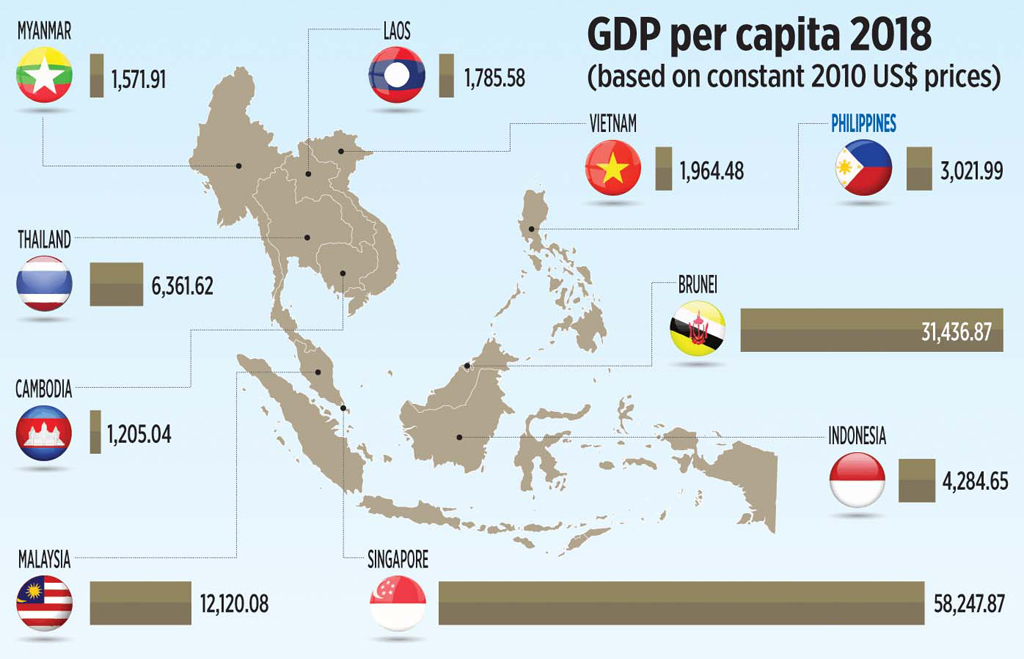
In terms of per capita GDP, the annual growth rate is slower than the total GDP growth, because of the effect of our ever-increasing population, which is currently estimated at 108 million. GDP per capita is a measure of how our economy translates to the economic welfare of the individual Filipino and how we compare with the citizens of other countries. Our per capita GDP in 2018 of $3,095 (from the International Monetary Fund, at current prices) is low and, as such, we are still not a middle-income country. Compared with our Asean neighbors, we have a lower per capita GDP than Singapore, Brunei, Malaysia, Thailand, and Indonesia. Clearly, this comparison portrays a lamentable reversal of position of several decades ago. Our per capita GDP in 2018 surpasses only those of Laos, Vietnam, Cambodia, and Myanmar. In sum, it is not an exaggeration to say that we have lost several decades of economic development potential. This is the reason the current relatively high rate of growth must be sustained and further increased to enable us to catch up with our neighbors.

Our slower growth per capita GDP indicates the widespread poverty that persists in the country. The latest available information from the Philippine Statistics Authority shows that the poverty incidence for 2018 is 16.6%, which translates to about 17.6 million Filipinos or around 3 million families who lived below the poverty line in 2018. This statistic is computed based on a monthly income of P10,727 for a family of five. Whether this measure of poverty is a reasonable basis is, of course, debatable. However, one thing is sure. If one raises that threshold to P12,000 for a family of five (an increase of 11.8% from the official threshold), which is not unreasonable, that will include many more millions of Filipinos living in poverty.

In terms of self-rated poverty, which is regularly surveyed by Social Weather Stations, it was reported at 54% for December 2019. Whatever is the reasonable number, Filipinos numbering from 17.6 million to 58 million are living in poverty. I view any number towards the end of that range to be the number indicator that reasonably reconciles with the extent of physical poverty that we see around us — the slums in the cities and the picture of poverty in the countryside. Indeed, tens of millions of Filipinos are suffering from poverty!

When analyzing the components of our GDP (all at constant prices), as shown in BSP data, a number of things stand out that we need to be concerned about. On the supply side of the economy, agriculture has continuously lagged behind. Its growth has been really low. For the period mentioned, the growth rate never reached 3%, except in 2017 at 4%; there was even a negative growth — in 2016 of 1.2%. Although agriculture is a small chunk of the economy — only 8.1% of GDP in 2018 — it is the sector where most of our poor citizens earn their living.

On the demand side, external trade is a big worry. We have been in a trade deficit for the entire period of this analysis, except in 2012, when there was a surplus of very slightly more than zero. In 2018, the trade deficit was 10.5% of GDP. It does not require much imagination to see that, if we can overturn this chronic trade deficit by increasing our exports, we can boost our economy quite a bit.

There is a peculiar characteristic of our exports. More than a quarter of our exports, specifically during Q3 2019, are electronics products. This is an illusion, however. Most of the value included in these exports are electronics parts that we import. The Philippine value added to these exports is practically just Philippine labor. If we deduct the import components from the value of these exported electronics products, our total exports are actually small.

On the demand side, the largest component of GDP is household consumption, which represents 68.5% of GDP in 2018. This proportion has not changed much over the years since 2012, when it was 70.5%. There is no doubt that much of the contribution to this portion of the pie comes from cash remittances from our Overseas Filipino Workers (OFWs) and the earnings of Filipino residents employed in activities outsourced from other countries, particularly from the United States, to Philippine shores. While these two income sources are welcome, we need to keep in mind that, with the advent and increasing development of robotics and artificial intelligence, we would gradually lose much of these income sources sooner than later, particularly from jobs outsourced to the Philippines.

Moreover, while OFW money is now very important to our economy, it carries with it a huge social cost. A recently published book, A Good Provider is One Who Leaves by Jason DeParle, which centrally focuses on Filipino migrants, narrates these social costs very well. Moreover, the fact that we ourselves cannot provide work for our own people creates a bad image for us.

In sum, a great number of our people are still living in poverty, of which a substantial proportion are homeless or living in slums. Our economic foundations are weak such that these may not be able to sustain our economic growth. We have lost several decades of economic growth potential that we need to recover to put us, at least, at par with our stronger neighbors. We, therefore, should not be lulled by the current relatively good economic growth.

What is to be done? We need to leapfrog.

(To be continued next Friday.)


Benjamin R. Punongbayan is the founder of Punongbayan & Araullo, one of the Philippines’ leading auditing firms.

ben.buklod@yahoo.com

How sweet it is

To most Filipinos who have become only too, too familiar with dishonesty in government, it may look like just another symptom of the corruption that is still metastasizing throughout the civilian and military bureaucracy that then candidate for president Rodrigo Duterte promised to end in 2016.

But the “pastillas” scheme in which visitors from China receive special treatment once they pay immigration personnel and their travel agencies P10,000 is more than that. It is also one more indication of how the Duterte regime’s “pivot to China” that, among others, allows, and in fact encourages, Chinese nationals to enter the country, is worsening and bringing in its wake a host of problems to this already troubled land.

Some two million Chinese nationals are estimated to have entered the country over the last three years, with 2,000 arriving daily to work in Philippine Offshore Gaming Operations (POGOs) and other enterprises. Only when the COVID-19 crisis forced the Duterte regime to restrict the entry of Chinese visitors to the country early this month was the practice of granting such visitors visas-on-arrival stopped, presumably together with allowing those with tourist visas to work here. As several Congressional hearings found out, this far from rigorous monitoring has led to the high visibility of Chinese visitors in the Philippines, many of whom end up working in high paying jobs and buying or leasing condominiums and posh residences, while Filipinos scramble for scarce jobs and leave for other countries in search of employment. Most Filipinos thus welcomed the promise of tighter controls on the entry of all foreign visitors including those from China.

But suspicions abound that exemptions are still being made, and that despite Mr. Duterte’s ban on visitors from China, some are still entering the country. Two weeks ago, for example, a Philippine Daily Inquirer report by journalist Nestor Burgos found that hundreds of tourists from China and its special administrative regions of Hong Kong and Macau had managed to enter Boracay and nearby municipalities in Panay. It could not have happened without either lapses in the implementation of the ban, or Bureau of Immigration (BI) and other personnel’s deliberately allowing them in, for, of course, the usual “considerations.” The latter possibility now seems more likely in the context of the exposure at the Senate of the “pastillas” racket at the country’s airports and other ports of entry.

Named after the milk and sugar sweet that’s a favorite token of thanks for welcomers among arriving travelers, this latest brainchild by personnel of one of the most scandal-ridden agencies of government meshes perfectly with the current government policy of looking the other way when it is China or Chinese nationals who are involved in any enterprise or wrong-doing such as online gaming, entering the country illegally, ramming a Filipino fishing boat, or destroying coral reefs in the Philippines’ Exclusive Economic Zone.

The scheme is apparently well-planned and executed, and seems to have been going on for some time, so organized and efficient has it become. A video from the whistleblower who exposed it shows an immigration officer escorting arriving Chinese nationals into an office where their identities and flight numbers, and whether they have paid the bribes required, are verified. It is apparently no secret among BI personnel and cannot be dismissed as merely the doing of a few lower-bracket employees. It is likely to be part of a system-wide conspiracy among BI and other airport and dock personnel the perpetrators felt they could get away with. There is, after all, the undeclared but de facto policy of relaxing visa and other entry requirements for the citizens of imperialist China, whose interests Mr. Duterte has been protecting even at the expense of the country of his birth. Not only has the Duterte China policy had among its consequences the surge in the number of prostitution dens, restaurants, and amusement centers that cater solely to Chinese visitors and workers, and in the incidents of violence such as kidnappings amongst themselves. The irony is that rather than foster closer relations based on people-to-people friendships, it has fed the anti-Chinese racism that despite the Philippines’ long history of trade and other relations with China is still latent among many Filipinos.

What is unfortunate is that among most of the Southeast Asian countries, such as, say, Indonesia, where anti-Chinese sentiment has often found expression in violence, the Philippines has been one of the least discriminatory against Chinese people despite its long history of anti-Chinese isolation, pogroms, and suppression when it was a colony of Spain.

The other side of the anti-Chinese racism his China policy has helped awaken, is the hardening of most Filipinos’ faith and trust in the United States despite Mr. Duterte’s fulminations against that country. That form of reverse racism is in fact likely to erode Mr. Duterte’s support due to his abrogation of the US-Philippines Visiting Forces Agreement (VFA). The US is still the country most trusted by Filipinos while China, to which many had been benignly indifferent, has become the least trustworthy.

Some may think Filipino racism against non-Whites less dangerous than the misogyny, homophobia, hate speech, intolerance, disinformation, anti-intellectualism, and worship of violence that social media trolls, the government media system and its hacks in the tabloids, broadsheets, and broadcast networks, and various Duterte regime accomplices in and out of government have implanted into the psyches of the clueless millions.

They are grievously mistaken. The Filipino brand of racism is part of the same brain-rot and anti-reason syndrome that can’t understand but nevertheless despises human rights, applauds the use of State violence against protesters and government critics, equates criticism of government with subversion, and echoes the Duterte mantra of “kill, kill, kill.” The long and the short of it is that the same benighted constituencies on whom the current regime depends for support are turning against the country and the people it is counting on to protect and advance its political and economic interests, and the BI “pastillas” scheme isn’t helping any.

But Mr. Duterte is quite typically hardly doing anything about it. He has expressed confidence in and declared the head of BI innocent of any involvement in the scheme while he once more goes through the motions of “relieving” unnamed BI personnel for unspecified reasons. Neither has he gone beyond telling Filipinos not to succumb to “xenophobia” (the fear or hatred of anything foreign) in response to the COVID-19 threat. He has done nothing to dispel fears that under his watch the country is turning into a Chinese province and protectorate, in the belief that his constituencies will remain mindlessly supportive of what he is doing to the country.

It is apparently too much to expect him to do anything meaningful even about the racist drift of the growing cynicism over the major plank of his foreign policy, as busy as he is with resting in his Davao lair in-between hurling profanities at and threatening the independent press, free expression, the opposition, the Church, and anyone else who doesn’t agree with him, and turning parts of rural Philippines into local versions of Cambodia’s killing fields. As Filipinos and the media are distracted by other issues, expect the “pastillas” scheme to persist — and to morph into something even sweeter for every one of the crooks involved, including, as the whistleblower revealed, “a high government official.”


Luis V. Teodoro is on Facebook and Twitter (@luisteodoro).

www.luisteodoro.com

Restraint

Moderation and restraint are alien concepts in a consumer society. People are calibrated (by others) according to a status rating scale. Material things in glittering packages are impressive. Form over substance. Everything is quantified according to a price index.

The mindset of the aspiring nouveaux riches and arrivistes is fixated primarily on carat value and the quantity of acquisitions. They are obsessed with impressing the impressionable.

The mantra is money. If you’ve got, flaunt it. The louder, the better.

Society gossip, scandal, and frivolous trivia, the glamorous and superficial lifestyle attract media mileage. Positive or negative, it provides a form of “entertainment” for the “have not’s.” This is the modern version of the bread-and-circuses of the ancient Romans. (We could learn some vital lessons from history or be doomed to repeat all those mistakes.)

Marketing mavens proclaim that luxe and deluxe are “in.” The “A list” of what’s hot and what’s hotter always trigger a mad stampede to buy. The “must haves” are the elite designer brands — clothes, accessories, cars, homes, exotic pets, safaris, Antarctica and chasing the northern lights trips. The recent addition to the list is a trip to outer space. That would be the ultimate luxury. All these belong to the conspicuous consumption category.

The high profile (but sometimes irrelevant) “civic” activities could be self-promotional gimmicks disguised as charitable fundraisers. They could be used to show off the frivolous frou-frou, feathers, and frippery.

Philanthropy and charity used to be more relevant and meaningful when they were done privately, anonymously. Too much exposure somehow diminishes the act of giving. However, things have changed in this new era of social media and the selfie phenomenon. Anything goes.

For the self-important VIPs, it is never enough to have wealth. Some individuals go the extra mile to make the huge spurge and splash.

To illustrate, a young tycoon throws a lobster-caviar-and-champagne party on a ship docked near a popular resort. The blinding lights and blaring music upset the nature lovers and scare away the fish. The “TH” (trying hard) matron entertains her trophy guests in a new showcase mansion. There are fireworks, a live band, and local and foreign multi-media coverage (plus IG and FB). The hosts present dazzling, enviable perfection to their newly acquired set of friends. Everyone is entitled to “15 minutes of fame,” to paraphrase artist Andy Warhol. After that, the novelty wears off.

What an exciting life!

The game of one-upmanship and keeping up with the Joneses is anxiety provoking and expensive.

One wonders whether or not living on a grandiose scale is appropriate or politically correct in the current environment of tension. The mood on the spectrum is somber gray.

We live in interesting times. People are anxious, restless. Agitated. We worry about the practical and essential things for our families — survival, security, stability, peace and order, health, education and jobs. Now the global issue is the pandemic.

It is not “PC” to show off the status symbols of success — the yacht, jet, helicopter, and sports cars. Flashy behavior rubs people the wrong way and gives the wrong signals. It is like waving a red flag at a raging bull.

In contrast, the true-blue well-bred individual is low-key, elegant, low profile. He is a subtle presence and she speaks in a whisper. (The louder the voice, the lower the class. Volume of noise is inversely proportional to social rank.)

In the rarefied circles, certain things are not done. For example, one does not talk about money, flaunt possessions, flout the rules, or upstage one another. Civilized and genteel individuals are always poised, polite, courteous, well mannered, proper, considerate, gracious, and soft-spoken.

No one needs to prove a point. No one needs anything.

One is born, bred, and belongs. One simply is.

The amount of one’s wealth does not matter as much as one’s breeding lineage or pedigree, education, and background. Family and old friendships are precious and carefully protected. Delicadeza, honor, discretion, and propriety are the qualities of class — the old school.

The mode of behavior has radically changed over the past years. The young Turks and the social mountaineers scoff at the gentleman and lady as archaic relics of the past century.

The new set (with the exception of a few well-bred members from the old families) tends to be brash, abrasive, self-indulgent, more materialistic, and hedonistic.

Too much hype, overexposure can exacerbate the simmering situation.

Luxury, per se, is not bad. In small, tasteful doses, it is the well-deserved treat, the little indulgence and reward for hard work. People should earn that privilege.

Feeling entitled, being insensitive to others, and having many luxuries are considered capricious.

During a crisis or a disaster, one needs restraint.

The Lenten season has begun.


Maria Victoria Rufino is an artist, writer and businesswoman. She is president and executive producer of Maverick Productions.

mavrufino@gmail.com

Don’t believe them: getting old is horrible

Don’t believe what they say: 50 is not the new 40. Fifty is just 50. It sucks. Sucky. Just downright pure suckage.

One tries convincing oneself by remembering that George Clooney is in his 50s (58). So is Tom Cruise (57), Robert Downey, Jr. (54), and even Keanu Reeves (55). But so what? They’re gazillionaires who can afford all the medication and physical trainers and therapists to hide the fact they’re well past middle age.

Reading Leslie Weatherhead’s table regarding a person’s age. The theme was what would your age be if your life was just one day. So, if your age is:

15, the time is 10:25 a.m.

20, the time is 11:34 a.m.

25, the time is 12:42 p.m.

30, the time is 1:51 p.m.

35, the time is 3:00 p.m.

40, the time is 4:08 p.m.

45, the time is 5:16 p.m.

50, the time is 6:25 p.m.

55, the time is 7:34 p.m.

60, the time is 8:42 p.m.

65, the time is 9:51 p.m.

70, the time is 11:00 p.m.

I’m at 6:25 p.m., which means that most of my life is behind me. What’s left are the remains of the day. Which is a poetic way of saying it. It’s also stolen from Kashiguro. Mine is more like the remains of the dregs.

The average life expectancy of a Filipino male is 66 years, which means that I have — if am lucky (or unlucky) — 16 years left or 5,840 days. I celebrated my birthday more than a week ago so make that 5,832 days.

Apparently at this age one has most of the freedom to do one wants. But at this age, what’s the point? It’s like finally getting a car, tank filled, spending money in the wallet. But really with nowhere to go. Or nowhere you want to go.

You can finally order in a restaurant without bothering to look at the prices in the menu. But it doesn’t matter because any food that’s delicious will most likely kill you. So the doctor says.

At 50, everything really feels like it’s on borrowed time. Drink wine, you know you’ll pay for it; puff a cigar, you know you’ll answer for it one day.

Going out has no appeal anymore. Not that I have the energy for it. By 9 p.m., I am happily ensconced in my bed, watching cat videos on YouTube. And if I do go out, all I can think of is wanting to go home.

The bars are too loud, cocktail parties are too boring, conferences are inutile. I don’t even understand the music anymore: it’s either all “toog toog toog” or in Korean. Nothing wrong with Korean but I don’t understand the language. Which leaves me with the melody, but as I said, they all sound like “toog toog toog” to me.

Drunken conversations are not as fun as they used to. Nowadays, it’s just a matter of exchanging notes on who’s more miserable with what ailments treated by the more expensive drug. A world away from when talk was about Matchboxes or trading Game and Watches.

Perhaps it’s apt that the recent Oscar winner is the Korean movie Parasite, which has [Spoiler alert! Do not read this sentence. Proceed to next paragraph.] a crazy old man living in the basement. I sympathize with that old man.

Nothing seems worth getting out of the house anymore. Particularly when you have streaming services, food delivery, and two happy dogs.

Depleted energy is a consolation, really. At least one doesn’t have the restlessness to go out and do something idiotic. But it also means not doing the things needing to be done: like retirement planning, organizing one’s own funeral service, or digging one’s own grave. That takes energy. Just thinking about it makes me want to take a nap.

The incredibly annoying thing about being 50 is that everybody considers you old but apparently not old enough to have a senior citizen’s card. With today’s rising prices, having a 20% discount would be a treat.

And having a 20% discount is the only treat one gets while eating out as the food doesn’t taste as good as before. Is it the cooking or the ingredients? Likely it’s just me as everyone seems happily wolfing their food down. I gain 10 pounds just staring at a picture of a plate of pasta.

Now Jonathan Rauch, citing research, says being 50 makes you wiser and happier. I don’t know about that. Some say it’s probably because you know yourself more. But even likelier is Kyle Smith’s point, which is “you’ve given up on improving yourself.”

“Things they do look awful cold, hope I die before I get old,” said Pete Townsend.

Neil Young’s was better: “It’s better to burn out than to fade away.”

Failing all that, then TS Eliot: “I grow old… I grow old… I shall wear the bottoms of my trousers rolled.”


Jemy Gatdula is a Senior Fellow of the Philippine Council for Foreign Relations and a Philippine Judicial Academy law lecturer for constitutional philosophy and jurisprudence.

https://www.facebook.com/jigatdula/

Twitter @jemygatdula

Don’t blame Capitalism for shrinking airline legroom

By Noah Smith

A VIRAL VIDEO of a man punching the back of a women’s reclined airline seat got Delta Air Lines Chief Executive Officer Ed Bastian’s attention. But he made things worse, when he asked flyers to be polite and check with the passengers behind them before hitting the recline button. This angered many people who have watched seats shrink over the years, as airlines try to raise profit margins by packing ever-more paying customers onto their planes.

Why, observers asked, should flyers be forced into a vicious zero-sum battle over physical comfort just to fatten the coffers of companies that already earn billions of dollars a year? Some blamed the capitalist system itself.

Defenders of the system will tend to retort that airlines are just giving people what they want; smaller seats, they argue, are simply the price consumers have chosen in exchange for cheaper airfares. It’s hard to tell how airfares have changed over time, because just looking at ticket prices isn’t an apples-to-apples comparison; the average flight distance changes, and customers nowadays pay fees for things such as checked baggage and meals that once were included in fares. But the data from the Bureau of Labor Statistics, which tries to account for all of these factors, suggest that flying has indeed gotten cheaper during the past 20 years.

This decline has happened in spite of a slight rise in real oil prices.

What’s more, air travel today offers consumers a bigger menu of choices. They can go with a discount airline and less leg room in exchange for a cheaper ticket. They can upgrade to premium seats with more space. In 2016, each extra inch of legroom in the North Atlantic region cost about $33.

There are still some customers who will fall through the cracks in this system — if you want just a little more legroom than coach provides, for just a little more money, you might not be able to find a seat. But overall, for customers who are willing to do a little shopping, today’s free-market air-travel system makes it easier for people to optimize their own personal mix of legroom and ticket price.

And as always when discussing the short-comings of capitalism, it’s important to think about what the alternative would be. In this case, that would mean nationalization of the industry. That’s not as crazy a notion as it might sound; Qatar Airways and Singapore Airlines, rated the top two carriers in the world in 2019 by consulting firm Skytrax, are both state-owned.

But it’s far from clear that American Airlines or United Airlines could match the performance of those champions under state ownership. Very high US infrastructure costs suggest that the federal government may have problems in its decision-making processes that make cost control difficult.

In most developed nations, the trend has been toward privatization. Most European airlines, once owned by national governments, have been privatized; Korean Air was privatized in 1969 and Japan Airlines in 1987. This was generally a result of financial distress. Meanwhile, the vast majority of remaining state-owned carriers are in developing countries, with Singapore and Qatar being the exceptions.

Proponents of nationalization might argue that without the need to make a profit, airlines could reduce fares or increase leg room while holding fares constant. A wave of big airline mergers has increased the industry’s profitability since 2005, and common ownership may also be reducing competition. But airlines were operating on the edge of bankruptcy before the consolidation wave; now, their margins are merely up to the normal level for a US business. So there’s not a lot of profit to be squeezed out of the system — perhaps only $20 per flight, or less than one inch worth of leg room.

Nationalized airlines could also be run at a loss, subsidized by tax money, but this would likely lead to the airlines becoming a political bone of contention, with eventual privatization as the result. Or salaries could be cut and the savings passed on to flyers, but this would likely degrade operational efficiency and quality.

So although no one likes having to choose between paying an upgrade fee and being shoe-horned into a tiny seat, it’s unlikely that nationalization would improve matters.

With only limited scope to increase comfort while also keeping costs low, airlines should try to improve the flying experience by making it more egalitarian. That makes being told how to behave while flying by a man who makes a multimillion-dollar salary by packing more people onto planes particularly galling. So, yes, airline CEOs should avoid seeming like they’re talking down to passengers.

Meanwhile, it might be a good idea to offer flights with identical seats — no premium economy, business class and so on — as well as no preferred boarding. Eliminating those visible inequalities might make flyers feel better about the air-travel experience. Who knows — they might even be willing to pay a little more for the pleasure.


BLOOMBERG OPINION