

Home Blog Page 9175

Yields on 7-day term deposits decline as bids climb further

YIELDS on the central bank’s term deposit facility (TDF) declined as more investors sought to park their money amid the pandemic and as the market awaits further monetary easing.

Bids for the seven-day term deposits of the Bangko Sentral ng Pilipinas (BSP) totaled P137.159 billion on Wednesday, surpassing the P50 billion auctioned off and also higher than the P119.288 billion in tenders seen last week for a P30-billion offer.

Yields sought by banks for the one-week papers ranged from 2.25% to 2.375%, a slimmer band compared to the 2.295% to 2.5% margin seen on April 22. With this, the average rate for the seven-day papers clocked in at 2.3133%, decreasing by 12.36 basis points (bp) from the 2.4369% fetched a week ago.

Meanwhile, auctions for the longer 14- and 28-day term deposits continue to be suspended.

To support the banking system and financial stability, the central bank suspended its TDF auctions at the onset of the enhanced community quarantine in Luzon last month.

The TDF is the central bank’s primary tool to shore up excess liquidity in the financial system and to better guide market interest rates.

Rizal Commercial Banking Corp. Chief Economist Michael L. Ricafort said the fact that the seven-day term deposit offer was more than twice oversubscribed is a sign of strong liquidity in the market.

“Relatively huge bids manifested increased liquidity in the local financial system,” Mr. Ricafort said in an e-mail.

He said the lower yields may be due to the market factoring in further easing from the central bank.

“The latest week-on-week decline in the 7-year TDF auction average yield could be largely due to expectations of further cuts in the local policy rates and banks’ RRR (reserve requirement ratio) amid the sharp decline in global oil prices recently that could further lower inflation,” Mr. Ricafort said.

The strong demand and lower yields showed investors are worried over the current situation and want to “tie up their money for longer periods of time,” said UnionBank of the Philippines, Inc. Chief Economist Ruben Carlo O. Asuncion.

“This may mean that investors are really concerned about the near-term market and economic performance. Obviously, these signals come from the eventual economic impact of the COVID-19 (coronavirus disease 2019) pandemic,” Mr. Asuncion said in an e-mail.

BSP Governor Benjamin E. Diokno said earlier this week further easing is “still in the agenda” but said they will first assess the effect of its previous policy loosening on the banking industry.

The central bank fired off a 50-bp rate cut in an off-cycle meeting on April 16 to bring down borrowing costs to record lows. The overnight reverse repurchase rate now stands at 2.75%, while overnight ending and deposit rates are at 3.25% and 2.25%, respectively.

The Monetary Board (MB) has already slashed rates by 125 bps for this year alone, following the 75 bps in reductions done in 2019. This means they have fully reversed the 175 bps in hikes implemented in 2018.

Meanwhile, the reserve requirement ratio (RRR) of universal and commercial banks was cut by 200 bps in early April in a move to boost liquidity during the lockdown.

The MB has authorized Mr. Diokno to bring down RRR by up to 400 bps this year.

The government now sees flat growth or up to one percent contraction in gross domestic product (GDP) this year due to the economic impact of the virus.

Before the pandemic, the government targeted GDP growth of 6.5% to 7.5%, higher than the upward-revised six-percent expansion in 2019. — L.W.T. Noble

Illegal bets, match-fixing, doping: the dark side of electronic sports

LAST AUGUST, police in Australia’s Victoria province arrested six young men competing in the popular online video game Counter-Strike: Global Offensive. The authorities, who had tracked the suspects for six months, said they had deliberately lost at least five tournament matches after illegally betting on their own defeats, in Australia’s first police investigation into esports match-fixing. If convicted, the men face up to 10 years in prison.

With most sports on hold because of the coronavirus pandemic, watching the world’s most talented gamers do battle online has never been more popular. The average number of viewers on Amazon’s Twitch platform has roughly doubled in April from a year ago. Fans use Twitch and rival services such as Google’s YouTube and Microsoft’s Mixer to watch professional gamers clash in anything from Electronic Arts’ best-selling FIFA soccer franchise to Activision Blizzard’s violent Call of Duty shooter.

As money pours into the nascent industry, the temptation for players to break the rules is growing. Corruption is rife, with gamers caught cheating and illegal betting syndicates trying to fix matches. Because much of the action takes in a virtual world that spans multiple jurisdictions, it can be harder to stamp out than graft in regular sporting competitions.

“It won’t be possible to fully eliminate illegal betting and match-fixing,” said Stephen Hanna, an Australia-based director at the Esports Integrity Commission, or ESIC, which was set up by the industry to fight corruption in its midst. “It’s about limiting its position in the market to the greatest extent possible.”

Esports has developed from a narrow community of enthusiasts doing battle via PCs in suburban bedrooms into a global business. Major sponsors including Coca Cola, Louis Vuitton and BMW are piling in, drawn by the opportunity to reach the kind of young audiences who have been turning away from traditional media. The ethnic diversity at the top of esport leagues and their truly global audience add to the appeal for big brands.

Tournaments such as The International and Fortnite World Cup are usually live-streamed from big arenas, and the winners can earn several million dollars. Most of the money, however, is made from betting: Wagers on esports are expected to surge to $13 billion this year from $5.5 billion in 2016, according to a report by research firm Eilers & Krejcik Gaming and advisers Narus. That makes it one of the biggest sources of growth in a sports betting market that Zion Market Research estimates is worth about $135 billion.

Betting firms including Betway, Hillside Sports ENC and Tipico are already active in esports, one of the few things that are still open for bets — if you’re not into Belarussian soccer. While most stadium tournaments are off the cards for now, you can still place money on dozens of competitions that are streamed live, with players competing remotely.

Just as in traditional sports, there are many ways to game the system. Players have been bribed or pressured into losing matches on purpose by illegal betting syndicates. Nikhil Kumawat, an Indian gamer known as “Forsaken,” used software to cheat and improve his winning chances. Lee “Life” Seung-hyun, one of South Korea’s best gamers, was banned for life in 2016 and sent to prison for 18 months after throwing two professional matches.

Governments have been trying to stamp it out. Sweden last year introduced a regulation to fine betting firms that offer odds on matches in which the majority of players are younger than 18, to protect the integrity of the sport and reduce the incentive to fix matches. Similar measures are in effect in Spain and the US. (Many successful competitive gamers are teenagers — last year’s Fortnite World Cup winner was 16 years old).

The industry is under pressure to become more professional and transparent as media companies deepen their involvement. — Bloomberg

BSP eases credit weight of banks’ MSME loans

BSP
THE CENTRAL BANK rolled out more relief measures for banks. — BW FILE PHOTO

THE CENTRAL BANK will ease the weight of loans extended by banks to small businesses until end-2021 to free up capital which can be used for lending amid the pandemic.

In Memorandum No. M-2020-034 signed April 28, BSP Governor Benjamin E. Diokno said banks’ exposure to qualified micro-, small-, and medium-sized enterprises (MSMEs) will only be assigned a credit risk weight of 50%, down from 75% previously.

“The foregoing provisions shall apply until Dec. 31, 2021,” Mr. Diokno said.

Under the Basel III Risk-Based Capital Adequacy Framework and the Basel 1.5 Risk-Based Capital Adequacy Framework, these loans include MSME exposures that meet the criteria of a qualified MSME portfolio as well as current MSME exposures that do not qualify as a highly diversified MSME portfolio.

“This move will free up some portion of banks’ capital which they can use for lending. This will also incentivize banks to lend to the MSME sector,” BSP Deputy Governor Chuchi G. Fonacier said in a text message.

“[This] would further encourage banks to book more MSME loans with less worries about effects on capitalization in view of relatively higher credit risks involved in lending to smaller companies,” Rizal Commercial Banking Corp. Chief Economist Michael L. Ricafort said in an e-mail.

The move follows the BSP’s move to include lenders’ credit to MSMEs in computing banks’ compliance with reserve requirements. This is also effective until the end of 2021.

Republic Act No. 9501 or the Magna Carta for Micro, Small and Medium Enterprises (MSMEs) requires banks to allot 8% of their total loanable funds as credit to micro and small enterprises.

On the other hand, two percent should be set aside for medium-sized businesses as the central bank seeks to boost credit to the sector which they can use for production and expansion.

Data from the Philippine Statistics Authority showed that MSMEs totaled almost one million in 2018, accounting for 99.52% of businesses.

These MSMEs generate 63% of the country’s total employment and are mostly engaged in wholesale and retail trade as well as repair of motor vehicles and motorcycle industries. MSMEs are seen to be among those hardest hit as the coronavirus disease 2019 outbreak continues to disrupt economic activity. — LWTN

Discounts, cheaper iPhone to cushion Apple from virus blow

SHANGHAI — Apple Inc.’s discounts on the iPhone 11 in China and the release of a new low-price SE model have put the company in a better position than rivals to weather a coronavirus-related plunge in global smartphone demand.

While China, which accounts for roughly 15% of Apple’s revenue, appears to be a rare bright spot, investors will be keen to get a picture of global demand when the Cupertino, California-headquartered company reports second quarter results on Thursday.

The iPhone maker has shut retail stores in the United States and Europe following the COVID-19 pandemic, and China is the only major market where it has been able to reopen all shops.

Consumer spending is expected to be muted as the pandemic has crippled economies and Apple, the world’s second-most valuable tech company, is better armed with the launch of its new price-conscious iPhone model, analysts said.

“Apple is better positioned than most to experience a rapid recovery in a post COVID world,” Evercore analyst Amit Daryanani said in a research note. “We see demand as pushed out, not canceled.”

He added that the launch of the $399 iPhone SE suggested that Apple’s supply chain was getting back on its feet after weeks of shutdown earlier this year.

Analysts expect Apple to report a 6% drop in revenue and an 11% fall in net income in its fiscal second quarter, according to Refinitiv data.

On the other hand, Chinese brands such as Oppo and Vivo who have steadily moved to offer high-end models to challenge iPhones, stand to lose marketshare as bargain hunters choose Apple.

Earlier this month, several online retailers in China slashed prices of the iPhone 11 by as much as 18% — a tactic Apple has used in the past to boost demand. And while initial social media reaction to the new iPhone SE was muted, analysts said they were seeing a pick up in demand.

The cheaper iPhone SE could tempt iPhone owners to opt for a newer device, something they might have otherwise delayed in a weak economy, said Nicole Peng, who tracks the smartphone sector at research firm Canalys.

“People want to avoid uncertainty in a downturn,” she said. “Having a brand like Apple that can showcase quality and make people less worried about breakdowns or after-sales service can bring in buyers.”

CHEAP IS GOOD
Early data suggests that the Chinese smartphone market is recovering rapidly in the aftermath of the virus, and Apple has emerged relatively unscathed.

Sales of iPhones in China jumped 21% last month from a year earlier and more than three fold from February, government data showed, meaning March-quarter sales in the country were likely to have slipped just 1%.

To be sure, a recovery in Chinese demand won’t offset sales lost in the United States and Europe. And the company is yet to launch a smartphone enabled with 5G wireless technology like those offered by Asian rivals, a disadvantage for Apple so far.

But those same expensive 5G models may not sell well in the current climate of frugality, analysts said.

“If there are no massive subsidies (in China), I doubt there will be many smartphone users who will be eager to upgrade to 5G,” said Linda Sui, who tracks the smartphone sector at research firm Strategy Analytics.

Sui expects iPhone shipments in 2020 to be down 2 percentage points at the most, versus double digit declines at Chinese firms.

Apple also has revenue from its services business to fall back on. It has leveraged its large iPhone customer base to boost services revenue from music, apps, gaming and video.

“Apple’s Services segment should remain resilient in today’s work from home environment, thereby demonstrating the durability of Apple’s model,” Cowen analyst Krish Sankar said. — Reuters

Canned goodness

YOU can’t possibly think you can just get away with serving corned beef and onions seven times a week, can you? We asked for help from restaurateur, cookbook author, and morning show chef Myke “Tatung” Sarthou on how to convert canned goods and pantry staples into dishes that even you can look forward to serving and eating.

These recipes come from Mr. Sarthou’s YouTube channel, Simpol (www.youtube.com/user/Cheftatung), and his Facebook page (facebook.com/lutongsimpol/). Links to the instructional videos can be found at the end of the recipes.

HEROES’ MAC AND MEATLOAF

Ingredients:
1 tbsp. margarine
1 tbsp. chopped onion
1 tbsp. minced garlic
1 cup chicken stock
3/4 cup elbow macaroni
1 can Angel KremQueso
1/2 can Argentina Meatloaf
1/2 can UFC Whole Kernel Corn
1/2 cup grated cheese
Salt and pepper

Procedure:

  • Heat up a small pot and add margarine.
  • Sauté onion and garlic then pour in the chicken stock.
  • Add the elbow macaroni and season with salt. Let it simmer until the liquid is absorbed by the macaroni.
  • Pour in the evaporated milk, stir and continue to simmer.
  • Season with black pepper and add the meatloaf and corn. Wait until the pasta is cooked and the liquid is fully absorbed.
  • Remove from the pot and transfer to a serving plate. Garnish with grated cheese on top.

MEATLOAF PUFFS

Ingredients:
1 cup all-purpose flour
1 tbsp. cornstarch
1 tbsp. baking powder
1 tbsp. salt
2 tbsps. sugar
1 cup water
1/2 can Argentina Meatloaf
1/2 can UFC Whole Kernel Corn
Cooking oil

Procedure:

  • In a medium bowl, combine flour, cornstarch, baking powder, salt, sugar, and black pepper. Add water to make a batter.
  • Add the meatloaf and corn and mix until well incorporated. Set aside.
  • Heat up the oil in a pan. Portion about a tablespoon of the meatloaf batter and drop it in the hot oil and fry until golden brown. Repeat the process for the rest of the meatloaf batter.
  • Remove the fried meatloaf puffs from the pan and transfer to a serving plate.

Link to video: https://www.youtube.com/watch?v=SyOkNDi9J40

SPICY CORNED CHICKEN GISING-GISING

Ingredients:
Cooking oil
3 cloves garlic
1 pc. onion
1 tsp. minced ginger
1 pc. siling haba (green long chili)
1 cup coconut milk
1 can Argentina Spicy Corned Chicken
1 cup kangkong (water spinach)

Procedure:

  • Heat up a pan and pour in the coconut milk.
  • Add the garlic, onions, and ginger. Cook until fragrant.
  • Put in the canned corned chicken. Mix and let it simmer until the coconut milk has reduced.
  • Add the kangkong and season with fish sauce and black pepper.
  • Add some green chilis.
  • Transfer to a serving plate.

HEALER’S CHICKEN NOODLE SOUP

Ingredients:
1 pack sotanghon noodles (cellophane noodles)
1/4 cup sliced carrots
Spring onions
1/4 cup sliced cabbage
1 can Argentina Corned Chicken
1/2 cup sayote (chayote)
Fish sauce
Cracked black pepper
Water

Procedure:

  • Heat up oil in a pan and sauté the ginger.
  • Add carrots, sayote, and water. Bring to a boil.
  • Put in the corned chicken and cabbage and stir.
  • Add the sotanghon noodles. Let boil for another two minutes.
  • Season with fish sauce and black pepper.
  • Transfer to a serving bowl and garnish with spring onions.

Link to video: https://www.youtube.com/watch?v=NIXpQAslyZw

CHICKEN HALANG-HALANG

Ingredients:
1 can Argentina Spicy Corned Chicken
1 pc. chopped onion
1 tbsp. chopped ginger
2 cloves minced garlic
1/2 cup sayote (chayote)
1 cup shredded cabbage
2 tbsp. fish sauce
2 cups water
Cracked black pepper
1 tsp. spring onions
Cooking oil

Procedure:

  • Heat up oil in a pot and sauté onions, ginger, and garlic until fragrant.
  • Add water and bring to a boil.
  • Put in the corned chicken and let it simmer for about two minutes.
  • Season with fish sauce and black pepper.
  • Add the cabbage and simmer for about 30 seconds or less.
  • Transfer to a serving bowl and garnish with spring onions.

BEEFLOAF CURRY

Ingredients:
1 can sliced Argentina Beefloaf
1 cup cornstarch
1 pc. potato, quartered
1 pc. cubed carrot
2 tbsp. chopped onion
1 tbsp. minced garlic
1 tbsp. chopped ginger
2 tbsp. curry powder
1 cup coconut milk
1 pc. seeded and cubed red bell pepper
1 tbsp. fish sauce
1 tbsp. hot chili sauce
1 tbsp. sugar
Black pepper

Procedure:

  • Dredge the sliced meatloaf in cornstarch and fry.
  • Add the carrots and potatoes in the same pan and fry together with the meatloaf.
  • Add onion, garlic and ginger in the pan and sauté.
  • Put in the curry powder and coconut milk. Let it simmer.
  • Season with fish sauce and add bell peppers.
  • Put in the hot sauce and sugar and continue to simmer until the sauce thickens slightly .
  • Season with black pepper.
  • Transfer to a serving plate.

Link to video: https://www.youtube.com/watch?v=Gpv8dY3zro4

CREAMY SPAGHETTI WITH MEATLOAF

Ingredients:
1 can Argentina Meatloaf
1 cup Angel Kremdensada
1 cup spaghetti sauce
2 cloves minced garlic
1 pc. chopped onion
3 tbsp. diced cheddar cheese (for garnish)
1 tbsp. butter or margarine
2 tbsp. cooking oil
3 cups cooked spaghetti noodles

Procedure:

  • Heat up oil in a large pan. Fry the meatloaf and set aside.
  • Put margarine in the same pan and sauté onion and garlic.
  • Pour in the spaghetti sauce and the sweetened thick creamer. Stir.
  • Season with black pepper and let it simmer for about three to five minutes.
  • Toss the cooked spaghetti noodles into the sauce until the noodles are fully coated.

Link to video: https://www.youtube.com/watch?v=06XDDlkXT04

Gov’t sets sweeper flights for stranded local tourists

THE Department of Tourism (DoT) said it would arrange sweeper flights for qualified stranded local tourists.

The department made the announcement on Wednesday after the Inter-Agency Task Force on Emerging Infectious Diseases (IATF-EID) approved its request “to undertake necessary measures to charter and fund sweeper flights for qualified stranded local tourists from other regions to the National Capital Region and vice versa.”

Flag carrier Philippine Airlines and budget carriers Cebu Pacific and Philippines AirAsia told BusinessWorld via phone message that they continue to mount sweeper flights for stranded travelers.

“As of 27 April 2020, the DoT Regional Offices nationwide have listed about 2,267 remaining domestic tourists. The DoT assures the public that it will do everything within its mandate to bring qualified stranded local tourists home as it works on mounting sweeper flights from Palawan, Cebu, Siargao and Davao,” the department said in a statement.

It added: “A stranded local tourist may be eligible for the assistance if registered with the DoT Regional Office and has a confirmed return land, air, or sea ticket to his/her home province, city or municipality but was cancelled due to the implementation of the community quarantine.”

The department said it would announce the dates of the departure schedules of the said sweeper flights.

Stranded local tourists will also have to communicate with the nearest DoT Regional Office in their respective locations.

PAL Spokesperson Cielo C. Villaluna said: “We continue to carry out domestic sweeper flights and international special flights to carry stranded foreign nationals to their home countries.”

Philippines AirAsia Head of Communications David F. de Castro said the budget carrier would continue to mount sweeper flights in coordination with requesting government agencies.

For her part, Tourism Secretary Bernadette Romulo-Puyat said of the IATF-EID’s approval of her department’s request: “This is a positive development that will complement our on-ongoing efforts in the Department to assist qualified stranded local tourists, which include the provision of one-time financial assistance.” — Arjay L. Balinbin

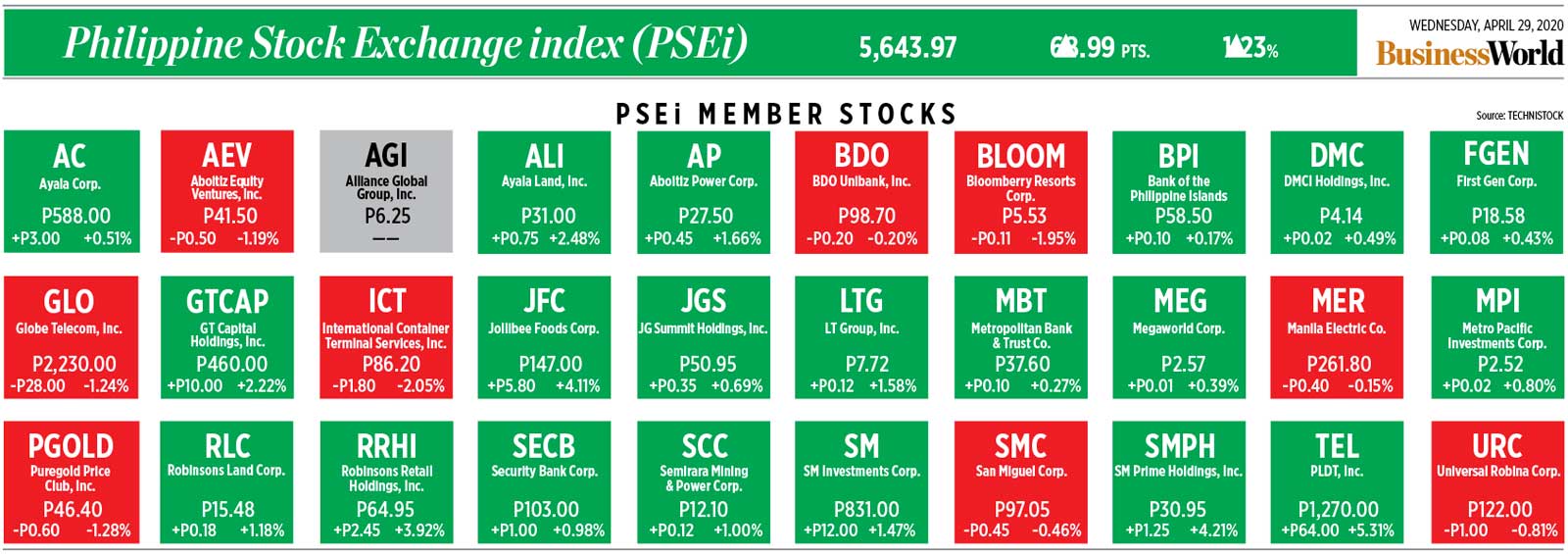
How PSEi member stocks performed — April 29, 2020

Here’s a quick glance at how PSEi stocks fared on Wednesday, April 29, 2020.


Filipinos delay large purchases due to COVID-19

Filipinos delay large purchases due to COVID-19

Peso climbs as more economies begin to reopen

THE PESO strengthened for the third consecutive day on the back of market optimism on prospects of a gradual reopening of some economies as well as expectations of a dovish stance from the US Federal Reserve.

The local unit closed at P50.51 per dollar on Wednesday, surging by 16 centavos from its P50.67 finish on Tuesday, according to data from the Bankers Association of the Philippines.

The peso started the session at P50.62 versus the dollar. Its weakest showing was at P50.64, while its strongest was at its finish of P50.51 against the greenback.

Dollars traded increased to $498.5 million on Wednesday from the $363.53 million seen on Tuesday.

A trader said the peso’s strength came amid market optimism due to the gradual lifting of lockdowns in some parts of the world.

“Dollar-peso was sold off today on back of weaker dollar given the risk-on sentiment across the market with some countries slowly opening their economies,” the trader said in a phone call on Wednesday.

Reuters reported that Spain unveiled a four-phase plan on Tuesday to lift its lockdown as deaths related to the virus begin to subside.

According to Spanish Prime Minister Pedro Sanchez, the lifting of some restrictions will start on May 4 and its effectivity will vary per province.

The Spanish government said remote working will be recommended where possible until reaching the last phase of the plan towards the end of June, when beaches would also be able to reopen with the support of local authorities.

Spain joins other countries that have bared plans to gradually lift lockdown including France and Italy as well as some states in the US.

Meanwhile, another trader said the peso’s gain came ahead of another policy decision from the Fed this week.

“The peso appreciated today from profit-taking ahead of likely dovish cues from the US Federal Reserve policy meeting later this week,” the second trader said in an e-mail on Wednesday.

The Federal Reserve is widely expected on Wednesday to lift the interest rates that influence its fed funds target, a technical move that could keep interbank lending running smoothly and help prevent financial market disruption should the benchmark rate fall below zero.

The effective fed funds rate dropped as low as 0.04% twice in the past week. That matched the level set in December 2011, two years after the economy emerged from the last recession, heightening concerns among some investors that it could go negative for the first time in the wake of the Fed’s aggressive moves to limit market damage from the coronavirus outbreak.

The fed funds rate declined despite the $1.35 trillion in Treasury bills brought to the market in the past four weeks, as low rates on repurchase agreements and depressed yields on Treasury bills resulted in more inflows into the fed funds market.

A negative effective fed funds rate would imply that banks are willing to pay to lend funds overnight to each other, and indicate the market expects the Fed to take interest rates below zero.

The first trader sees the peso playing around the P50.40 to P50.70 levels versus the dollar, while the second trader gave a forecast range of P50.40 to P50.60. — L.W.T. Noble with Reuters

Shares extend climb ahead of Fed policy meeting

LOCAL SHARES sustained their gains on Wednesday, moving in step with regional peers, as investors reacted to the gradual reopening of economies and the meeting of the US Federal Reserve.

The benchmark Philippine Stock Exchange index (PSEi) picked up 68.99 points or 1.23% to close at 5,643.97 yesterday. The broader all shares index added 30.53 points or 0.89% to 3,425.28.

“Market continued to rebound today together with most of the regional markets on easing lockdowns that would start to reopen the economy and optimism on the US Fed meeting tonight to continue to maintain low interest rate so as to support their economy,” Diversified Securities, Inc. Equity Trader Aniceto K. Pangan said in a text message on Wednesday.

Some areas in the Philippines will be on their last day of enhanced community quarantine (ECQ) today, April 30, as the government moves them to a general community quarantine (GCQ) by May 1 for showing signs of being low-risk or medium risk to the coronavirus disease 2019 (COVID-19) pandemic.

This resulted in optimism among investors that the jumpstarting of economies in these areas will signal the recovery of the country after more than a month of lockdown in Luzon.

Philstocks Financial, Inc. Senior Research Analyst Japhet Louis O. Tantiangco also said investors are keeping a close watch on the Fed meeting.

“Investors are waiting for clues from the US’ monetary authority on how their policy stance would be and what would this mean for the US economy, one of the major economies of the globe,” Mr. Tantiangco said in a text message.

Most Asian stocks closed in green territory on Wednesday. Japan’s Topix index climbed 0.13%, China’s Shanghai Shenzhen CSI 300 Index added 0.46%, South Korea’s Kospi index grew 0.70%.

Back home, all sectoral indices at the local bourse ended the session with gains. Property rose 82.50 points or 2.94% to 2,887.73; mining and oil gained 57.30 points or 1.23% to 4,692.94; services improved 11.23 points or 0.83% to 1,349; holding firms increased 44.66 points or 0.81% to 5,509.37; industrials picked up 50.20 points or 0.67% to 7,465.39; and financials climbed 0.52 point or 0.04% to 1,169.87.

Value turnover stood at P4.54 billion with 584.34 million issues switching hands. Mr. Tantiangco said this is lower than the bourse’s year-to-date average of P5.78 billion, “showing that the rally lacks conviction.”

Advancers outran decliners, 110 against 78, while 49 names ended unchanged.

Foreign investors remained net sellers for the 31st straight day with net outflows worth P726.05 million, up from the previous day’s P471.71 million.

“(Today) is the last trading day for the week because of the Labor Day holiday. We may see some profit taking (today) which will limit its gains for the week,” AAA Southeast Equities, Inc. Research Head Christopher John Mangun said in an e-mail. — Denise A. Valdez

Stimulus bill’s test kit budget seen at P20-B

LEGISLATORS will propose a P20 billion budget to procure test kits which will allow a semblance of normalcy to return to many public areas like businesses and airports and help restart the economy.

Representative and House committee on economic affairs chair Sharon S. Garin of the AAMBIS-OWWA party list said at webinar hosted by the Shareholders’ Association of the Philippines Wednesday that the test-kit budget component of the proposed Philippine Economic Stimulus Act (PESA) is being firmed up in order to help build consumer and business confidence after the lockdown.

“We are proposing a P20 billion allotment for test kits. Massive siya (It will be massive), you can use it in airports and LGUs (local government units) can have it. Until we have a vaccine, then we still have to build up consumer confidence and business confidence as well. So it is kind of a way a stimulus because it will encourage people to go out. If you go to a hotel, you can oblige (visitors) to have tests,” she said.

Presidential Adviser for Entrepreneurship Jose Maria A. Concepcion III said at the same forum that business models will need to change after the coronavirus disease 2019 (COVID-19) pandemic.

“So many business models will really change and consumer confidence as well because if they don’t have confidence in the health situation, they’re not going to go out to the stores, to the restaurants… they’re going to stick to the very basics until they realize we’re over this virus or we have better control of our health situation,” he said.

Rep. Jose Maria Clemente S. Salceda, the House ways and means committee chairman from Albay estimated easing community quarantine (CQ) standards will allow labor participation to increase to 50% will also still dampening keep consumer, labor and business confidence.

“Without testing, a modified CQ will allow labor participation to increase from 23% to 50% but keep consumer, labor and business confidence stuck in the cave while risking a second wave that would compel another lockdown which both the economy and the government can no longer afford,” he said.

Eastwest Banking Corp. Vice Chairman, President and Chief Executive Officer Antonio C. Moncupa, Jr. said that the economic stimulus bill proposed in the House of Representatives “will help a lot,” but added that it is important to ensure that the financial system remains “sound, willing and able to finance the economy.”

“We need to keep the aggregate demand flowing. And for that to happen, financing has to continue flowing. It is the lifeblood that ensures that businesses are able to operate. The fiscal intervention is very good, but the question I have in mind is that of magnitude. It is the question of how sufficient or not sufficient those fiscal interventions will be,” he said.

The latest draft of PESA proposes to inject about P1.3 trillion to P1.4 trillion in the first year of the intervention period of 2020–2022 to help workers and businesses deal with the effects of COVID-19.

In a Viber message to BusinessWorld Tuesday, Rep. Stella Luz A. Quimbo of Marikina, who co-chairs the economic stimulus cluster of the Defeat COVID-19 Committee, said PESA will protect workers by “aiding businesses in augmenting their working capital so payroll costs are maintained and workers are retained.”

“Many businesses have become illiquid as a result of paying salaries and overhead despite not having revenue. Even firms that were profitable pre-COVID but have become illiquid post-COVID are unable to continue paying salaries. Thus, they could end up retrenching employees,” she said.

She said that micro, small and medium enterprises will be the priority, but large firms are also eligible and can avail of assistance “if funds are sufficient.”

“If large firms fold, more workers are at risk of lay-offs. The effect on unemployment could be large too, especially if the firms have strong linkages with other productive sectors of the economy. We hope to protect workers of businesses critically impacted by COVID, regardless of size. These subsidies and loans come with the condition that workers are retained,” she said. — Genshen L. Espedido

DTI to recommend optional COVID-19 testing for asymptomatic workers

TRADE SECRETARY Ramon M. Lopez said he will recommend coronavirus disease 2019 (COVID-19) testing priority for workers exhibiting symptoms, while offering testing as an option for “healthy” workers after the lockdown is lifted.

“’Yung medyo may sinat, masama ang pakiramdam — and therefore kung suspect — sila po ‘yung kailangan sigurong i-test bago sila mag-report for work. But those who are healthy — optional po ‘yun (Those who feel unwell — and are therefore suspect — should probably be tested before they report for work. But those who are healthy — that’s optional), Mr. Lopez said over DZMM radio Wednesday.

He said the post-pandemic workplace practices might involve having employees making a health declaration, recounting their travel history and possible contact with COVID-19 patients or with persons under investigation or monitoring.

Mr. Lopez said private companies can decide on whether or not to require all workers to be tested prior to restarting operations.

“As you all know, we are coming from a quarantine period… kung hindi tayo nagkasakit, malaki ‘yung chance naman na wala ho talaga tayong sakit (If we did not get sick, there’s a big chance that we don’t have COVID-19),” he said during the Laging Handa briefing Wednesday.

He said the trade and labor departments will soon release guidelines on minimum health requirements for businesses.

Areas like Metro Manila and CALABARZON remain under enhanced community quarantine until May 15, while moderate and low-risk areas have been placed under a more relaxed general community quarantine.

Presidential Adviser for Entrepreneurship and Go Negosyo founder Jose Ma. A. Concepcion has launched Project ARK (Antibody Rapid-test Kits), a private sector-led project to increase COVID-19 testing. — Jenina P. Ibañez
