Home Blog Page 90

Iran wants ‘serious review’ of Gulf ties, denies role in Saudi oil attacks

Iran’s new supreme leader, Mojtaba Khamenei, the second son of late Iran's Supreme Leader Ayatollah Ali Khamenei, attends a rally in Tehran, Iran, May 31, 2019. — via REUTERS/HAMID FOROOTAN

RIYADH — Iran’s relations with Gulf states will require a “serious review” in light of the US-Israeli war on Iran, limiting the power of external actors so the region can become prosperous, Tehran’s ambassador to Saudi Arabia told Reuters on Sunday.

Asked if he was concerned that relations would be harmed by the war, Ambassador Alireza Enayati said: “It’s a valid question, and the answer may be simple. We are neighbors and we cannot do without each other; we will need a serious review.”

“What the region has witnessed over the past five decades is the result of an exclusionary approach [within the region] and an excessive reliance on external powers,” he said in a written response to questions, calling for deeper ties between the Gulf Cooperation Council’s six members, along with Iraq and Iran.

Gulf Arab states have faced more than 2,000 missile and drone attacks since the outbreak of the war on February 28, with targets including US diplomatic missions and military bases but also critical Gulf oil infrastructure, ports, airports, hotels, and residential and office buildings.

The United Arab Emirates, which normalized relations with Iran’s arch-foe Israel in 2020, has faced the brunt of the attacks. But all Gulf Arab states have been impacted, and all have condemned Iran.

Behind the scenes, analysts and regional sources say there is also growing frustration at the US, long their security guarantor, at dragging them into a war they did not endorse but for which they are paying a hefty price.

In Saudi Arabia, attacks have been concentrated on the eastern region where most of the kingdom’s oil is produced, as well as the Prince Sultan Airbase hosting US forces east of Riyadh, and the Diplomatic Quarter on the Saudi capital’s western edge, according to Saudi defense ministry statements.

Saudi Arabia and Iran re-established full diplomatic relations in 2023 after years of enmity that saw them back rival political and military factions across the region.

IRAN ‘NOT RESPONSIBLE’ FOR ATTACKS ON SAUDI OIL SECTOR
Mr. Enayati denied that Iran was responsible for the attacks on Saudi Arabia’s oil infrastructure, including the Ras Tanura refinery on the east coast and dozens of attempted drone attacks on the Shaybah oil field in the desert near the UAE border.

“Iran is not the party responsible for these attacks, and if Iran had carried them out, it would have announced it,” he said. He did not say who had carried out the attacks.

Saudi Defense Ministry statements have not assigned blame for individual incidents. Mr. Enayati said Iran was only attacking US and Israeli targets and interests.

Mr. Enayati said he personally was in ongoing contact with Saudi officials, with relations “progressing naturally” in many areas. He highlighted Saudi cooperation regarding the departure of Iranians who were in the kingdom for religious pilgrimage and the provision of medical assistance to others.

He said Tehran was in contact with Riyadh regarding Saudi Arabia’s publicly stated position that its land, sea and air would not be used to attack Iran, without elaborating on the discussions.

His message to Gulf states was that the war “has been imposed on us and the region.”

To resolve the conflict, the US and Israel must halt their attacks and regional countries should not be involved, while international guarantees must be secured to prevent their recurrence, he said.

“Only then can we focus on building a prosperous region,” he said. — Reuters

Trump warns NATO, presses China to help reopen Strait of Hormuz, FT reports

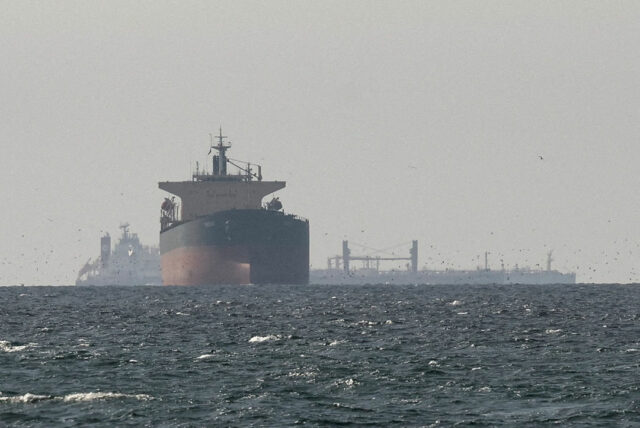
Tankers sail in the Gulf, near the Strait of Hormuz, as seen from northern Ras al-Khaimah, near the border with Oman’s Musandam governance, amid the US-Israeli conflict with Iran, in United Arab Emirates, March 11, 2026. — REUTERS

US PRESIDENT Donald Trump warned NATO of a “very bad” future if allies do not help open up the Strait of Hormuz and said he may also delay a planned summit with Chinese President Xi Jinping, in comments published by the Financial Times on Sunday.

“I think China should help too because China gets 90% of its oil from the Straits,” Mr. Trump told the newspaper, adding he would prefer to know Beijing’s position before the planned visit.

“We may delay,” he said of the trip.

US Treasury Secretary Scott Bessent and Chinese Vice Premier He Lifeng wrapped up the first of two days of talks in Paris on Sunday to iron out kinks in their trade truce and clear a path for Trump’s trip to Beijing to meet with Xi at the end of March.

The US president said countries that benefit from the shipping route should help secure it.

“It’s only appropriate that people who are the beneficiaries of the Strait will help to make sure that nothing bad happens there,” he told the FT.

Mr. Trump on Saturday called on nations to send warships to keep the narrow waterway open for shipping as Iranian forces continue attacks following US and Israeli strikes on Iran, saying he hoped countries including China, France, Japan, South Korea, Britain would send ships to the area.

When asked to specify the assistance he wanted, Mr. Trump told the FT that it could include minesweepers and other military assets to counter drones and naval mines.

“We’re hitting them very hard,” Mr. Trump said of Iranian forces, according to the FT. “They’ve got nothing left but to make a little trouble in the Strait … these people are beneficiaries and they ought to help us police it.”

Iran effectively shut the strait after the United States and Israel launched attacks against it more than two weeks ago. About a fifth of global oil and liquefied natural gas normally passes through the Strait of Hormuz, a narrow passage of water between Iran and Oman.

Mr. Trump also warned Washington could launch further strikes on Kharg Island, Iran’s main oil export hub, saying US forces could target its oil infrastructure if needed.

“We can hit that in five minutes,” he said. “And there’s not a thing they can do about it.”

Mr. Trump also criticized Britain’s response after speaking with Prime Minister Keir Starmer.

“The UK might be considered the number one ally… and when I asked for them to come, they didn’t want to come,” Mr. Trump told the Financial Times, adding that Britain only offered to send ships after the US had already reduced Iran’s military capabilities.

The White House and the Chinese foreign ministry did not immediately respond to a Reuters request for comment. — Reuters

US, China seek to wrap Paris talks on managed trade, agriculture deals for Xi-Trump summit

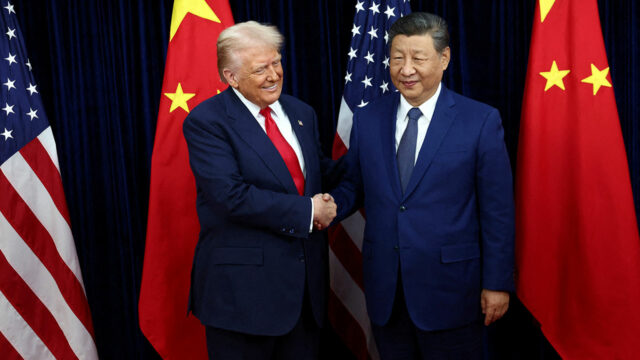
US PRESIDENT Donald J. Trump shakes hands with Chinese President Xi Jinping as they hold a bilateral meeting at Gimhae International Airport on the sidelines of the Asia-Pacific Economic Cooperation (APEC) summit in Busan, South Korea, Oct. 30, 2025. — REUTERS/EVELYN HOCKSTEIN

PARIS — Top US and Chinese economic officials were due to conclude talks in Paris on Monday, with potential areas of agreement in agriculture, critical minerals and managed trade that could be taken up by US President Donald Trump and Chinese President Xi Jinping in Beijing, sources familiar with the discussions said.

The sources told Reuters that the “remarkably stable” talks led by US Treasury Secretary Scott Bessent and Chinese Vice Premier He Lifeng would set in motion possible “deliverables” for Mr. Trump’s expected trip to China at the end of March to meet with Mr. Xi.

But they added that the leaders would have the final say on the proposals.

Mr. Trump, however, told the Financial Times in an interview published on Sunday that he could also delay his summit with Mr. Xi later this month as he presses Beijing to help unblock the crucial Strait of Hormuz closed by Iran.

“We may delay,” he said of the trip.

The US and Chinese delegations met for more than six hours on Sunday at the Paris headquarters of the Organization for Economic Cooperation and Development, a club of mostly wealthy democracies that does not count China as a member.

During those discussions, the Chinese side showed openness to potential additional purchases of US agricultural goods including poultry, beef, and non-soybean row crops, one of the sources said, adding that China was still committed to buying 25 million metric tons of American soybeans for each of the next three years under the Trump-Xi October 2025 trade truce.

Spokespersons for the US Treasury and the US Trade Representative’s office declined to characterize the discussions, while Chinese officials left the talks on Sunday without speaking to reporters.

“Meaningful” progress in Sino‑US economic cooperation could restore confidence to an increasingly fragile global economy, China’s state-run Xinhua news agency said in a commentary on Sunday.

The Paris talks follow several meetings to ease tensions last year between Mr. Bessent, Mr. He, US Trade Representative Jamieson Greer and Chinese chief trade negotiator Li Chenggang.

MANAGED TRADE MECHANISM
The two sides discussed the establishment of new formal mechanisms to help manage trade and investment between the world’s two largest economies that may be considered by Mr. Trump and Mr. Xi in Beijing, the sources said. Technical talks on the proposed US-China “Board of Trade” and “Board of Investment” were expected on Monday.

One of the sources said that the Board of Trade was the more developed of the two proposals, and would be aimed at finding products and sectors where the US and China could grow trade in a balanced way without compromising each other’s national security or critical supply chains.

The Board of Investment would not set broad investment policies but would address “discrete investment issues” that may arise between the countries, the source said.

CRITICAL MINERALS, ENERGY
The sources also said US officials discussed the flow of Chinese-produced critical minerals to US companies and raised concerns about the US aerospace industry’s lack of access to yttrium from China, which is used in jet engine turbines, among other applications.

One of the sources said the two sides “found some ways to loosen up” more challenging areas in critical minerals, but did not provide specifics.

Before the talks, Mr. Greer had told CNBC on Friday that the US wanted “to make sure that we continue to get the rare earths we need for our manufacturing base, that they keep buying the kinds of things they should be buying from us, and that the leaders have a chance to get together and make sure that the relationship is going the way we want it to go.”

Mr. Greer and Mr. Bessent also emphasized in the talks the US desire for China to increase purchases of Boeing jetliners and US coal, oil, and natural gas, which could be further discussed on Monday, the sources said.

But with little time to prepare and Washington’s attention focused on the US-Israeli war on Iran, prospects for such major trade breakthroughs were limited, in Paris or at the Beijing summit, trade analysts said.

“Given that the leaders may meet up to four times this year, these deliverables maybe can be spread out, rolled out over the year,” said Wendy Cutler, a former US trade negotiator who now heads the Asia Society’s Washington policy center.

These meetings include a potential visit to Washington for Mr. Xi, a China-hosted APEC summit in November and a US-hosted G20 summit in December. — Reuters

ADB to cut PHL growth projection

GASOLINE STATIONS display prices for various fuel products along Kalayaan Avenue in Quezon City, March 15, 2026. — PHILIPPINE STAR/MIGUEL DE GUZMAN

By Katherine K. Chan and Sheldeen Joy Talavera, Reporters

THE ASIAN Development Bank (ADB) is looking to cut its growth forecast for the Philippines amid risks from the escalating war in the Middle East and the lingering effects of the flood control graft mess last year.

ADB Lead Economist for Southeast Asia James P. Villafuerte said they will likely revise their initial estimate of 5.3% Philippine gross domestic product (GDP) growth for this year to account for the impact of the Middle East war on inflation, remittances and tourism.   

“We are revisiting the number because of this new Middle East conflict, which will certainly affect our growth forecast,” he told reporters at a briefing in Taguig City on Thursday. “We are also tracking the progress in terms of the corruption scandal, which has affected confidence in investment flows.”

The ADB’s current 5.3% growth forecast for 2026 is still faster than the 4.4% expansion in 2025 when slow investments as well as household and government spending due to governance issues from the flood control corruption scandal took a toll on the economy.    

The projection likewise falls within the Development Budget Coordination Committee’s 5%-6% target for the year.

ADB Chief Economist Albert Park said the ongoing war in the Middle East may have already trimmed 0.1% off of Southeast Asia’s GDP growth.

He added that the Philippines would see a similar degree of growth impact if the war lasts only around a month.

Meanwhile, Mr. Park said oil shocks may drive inflation to pick up about half a percentage point by yearend.

“Given how important energy is in the consumer basket of many consumers in the region, even if the war ended today, I think we would see higher inflation this year by about half a percentage point relative to what it would have been without any conflict,” he said.

Still, he noted that this remains manageable as most inflation prints in the region, including the Philippines, remain well within the central banks’ target range.

Headline inflation has accelerated since December last year and has settled within the Bangko Sentral ng Pilipinas’ (BSP) 2%-4% target for two straight months.

In February, higher oil prices pushed up inflation to 2.4%, the fastest in over a year.

Mr. Villafuerte noted that the Philippines may see a similar inflationary impact seen in late 2022 or when Russia’s invasion of Ukraine jolted global oil markets if the Middle East war lasts as long as the former.

Inflation accelerated to as much as 8.1% in December 2022, bringing the full-year average inflation to 5.8% before picking up further to 6% in 2023.

“So, I think there’s actually a good comparator if this conflict becomes a bit prolonged and the price of oil stays above $100, I think that kind of impact of inflation might be felt by the Philippines,” Mr. Villafuerte said.

Asked if the looming risks raise the possibility of stagflation, the ADB economists said it may be “too early to speculate,” noting that the current situation remains a short-term supply shock.

“I think it would have to be quite prolonged. I mean, yes, in principle, the war is causing slower growth and higher inflation, but I’m not sure that means stagflation, which is often like recession. So again, I think it would depend on the duration,” Mr. Park said.

DIESEL AT P100 PER LITER?
Meanwhile, some oil firms are still mulling whether to stagger the implementation of another potential double-digit hike in pump prices this week, which could push diesel above P100 per liter.

“We’re aligned with the advisory of the DoE (Department of Energy) and are prepared to support a staggered implementation just as we did last week,” Brigitte Carmel C. Lim, senior vice-president and chief operating officer of Cebu-based Top Line Business Development Corp., told BusinessWorld.

Ms. Lim said that while there is an upward pressure in fuel prices due to continuing geopolitical developments, it is still early to confirm the final adjustment.

Independent oil firm Jetti Petroleum, Inc. is still assessing how to implement the price adjustment for this week.

“We may be implementing the increase one-time. Or probably in two tranches. Nothing final as of now,” Jetti President Leo P. Bellas said.

An industry source told BusinessWorld that diesel prices may increase by P18 per liter starting March 17. Gasoline prices, on the other hand, may jump P12 per liter.

The estimates were based on the five-day trading on the Mean of Platts Singapore, a benchmark used for refined oil products.

The intensifying conflict among Israel, United States, and Iran has paralyzed maritime traffic through the Strait of Hormuz, which has “severely disrupted supply chain due to the loss of crude feedstock from the Middle East,” the source said.

As a result, some refineries have closed or run cuts, as well as lead to force majeure within Asia, given the region’s heavy dependence on supply from the Gulf, the source added.

Last week, the Philippines had its highest single-week adjustment as kerosene price ballooned to as much as P38.50 per liter. Some oil companies heeded the government’s call to stagger big-time price adjustments by implementing the increases in two to seven tranches.

Top Line’s Ms. Lim said the company continues to offer programs that help customers and transport partners manage costs, such as per-liter discounts and priority fueling access.

IBON Foundation Executive Director Jose Enrique “Sonny” A. Africa said that revisiting the Republic Act No. 8479, or the Downstream Oil Industry Deregulation Act is “immensely justified,” given that the country has had nearly three decades of overdependence on oil and imports.

Enacted in 1998, the law allows oil companies to set and adjust pump prices based on global oil prices and other market factors, instead of awaiting government approval.

“The very premise of deregulation of such a strategic commodity with such far-reaching impact has to be overturned, the law repealed, and a new law regulating the oil industry enacted,” he told BusinessWorld.

Mr. Africa said that the government has to be given powers to make pricing transparent.

“Oil firms should disclose its import prices, freight and storage expenses, refining and blending costs, inventory costs, wholesale and retail margins, and any transfer pricing to the government and the public,” he said.

REMITTANCES, TOURISM AT RISK
Meanwhile, Mr. Villafuerte said the Middle East conflict, especially if prolonged, also poses threats to remittances and tourism in the Philippines.

“So, my worry is if this really gets prolonged and Filipino workers in the Middle East are affected, that would have an impact on remittances. Although historically, remittances have been very robust,” he added.

According to the National Government, over 2.4 million Filipino migrants and laborers are based in the Middle East.

BSP data also showed that OFW remittances rose by 3.3% year on year to hit a record high of $35.634 billion in 2025, with 18.19% or $6.481 billion sent home from the Middle East.

Mr. Villafuerte said homebound OFWs from the Middle East bringing their earnings back to the country could drive a short-term increase in remittance inflows but noted that repatriation could have some negative impact in the long run.

For this year, the BSP expects remittances to climb by 3% to $36.6 billion.

Philippines’ current account gap narrows to $16.3B in 2025

A drone view shows shanties and containers at the Port of Manila in Manila, Philippines, Aug. 11, 2025. — REUTERS

STRONG EXPORTS growth and remittance inflows led the Philippines’ current account deficit to narrow at end-2025, the Bangko Sentral ng Pilipinas (BSP) reported.

Central bank data showed that the country’s current account posted a $16.291-billion gap last year, 12.3% narrower than the $18.565-billion deficit seen in 2024.

This was equivalent to -3.3% of Philippine gross domestic product (GDP).

However, the year-end balance was wider than the BSP’s projected $15.5-billion deficit or -3.2% of GDP for the year.

In the fourth quarter alone, the country’s current account deficit narrowed by 49.5% to $2.471 billion (-1.8% of GDP) from $4.894 billion (-3.8% of GDP) in the same year-ago period.

“This was supported by an improved trade-in-goods balance on the back of robust export growth as well as higher income receipts from overseas Filipinos, consistent with record full-year cash remittances in 2025,” the BSP said in a statement released late on Friday.

Preliminary data from the Philippine Statistics Authority showed that the country’s trade gap stood at a four-year low of $49.17 billion last year, down 9.5% from the $54.33-billion deficit in 2024.

This came as goods exports grew by 15.2% to $84.41 billion, well above the BSP’s projected 9% growth to $60 billion.

In the October-to-December period, the country’s trade in goods balance posted a $16.1-billion deficit, narrowing by 14% from the $18.7-billion gap seen in the fourth quarter of 2024, “as export growth substantially outpaced the modest uptick in imports.”

Exports rose by 23.8% to $15.8 billion from $12.8 billion a year earlier due to increased shipments of electronic products, machinery and transport equipment, BSP data showed.

Meanwhile, goods imports stood at $31.9 billion, up 1.3% year on year from $31.5 billion.

“The uptick was driven primarily by higher outlays for telecommunication equipment and electrical machinery, consistent with ongoing upgrades in the country’s information and communications technology infrastructure,” the central bank said.

The central bank also noted that remittances boosted household consumption last year, which helped cushion the current account against external pressures.

In 2025, remittances from Filipinos abroad climbed by 3.3% year on year to hit a record high of $35.634 billion from $34.493 billion in 2024, according to separate BSP data.

“At the same time, the business process outsourcing (BPO) sector remained a reliable source of services export earnings, with sustained industry expansion and firm global demand for digital and outsourcing services helping offset softer receipts in other services segments during the year,” the BSP added.

Higher receipts from BPOs brought the net trade-in-services up by 2% to $4.1 billion in the fourth quarter from $4 billion a year ago. 

On the other hand, net receipts in primary income plunged by an annual 46.5% to $765 million in the fourth quarter from $1.4 billion previously, while net receipts in the secondary income account were up 4.5% to $8.8 billion from $8.4 billion.

The current account measures the country’s trade in goods and services, as well as primary and secondary income.

Primary income refers to flows of labor and financial resources between resident and nonresident institutional units, while secondary income accounts for transfers between the country and abroad, such as remittances from overseas Filipino workers.

For 2026, the central bank expects the current account deficit to narrow to $15.3 billion or -3% of GDP. — Katherine K. Chan

NG debt service bill hits P2.1 trillion in 2025

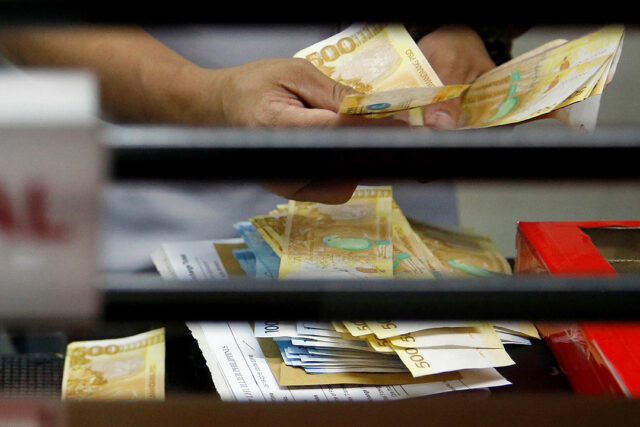
A Philippines peso note is seen in this picture illustration on June 2, 2017. — REUTERS

By Justine Irish D. Tabile, Senior Reporter

THE NATIONAL GOVERNMENT (NG) debt service payments jumped to P2.1 trillion in 2025, surpassing the government’s own program which signals mounting fiscal pressures.

Data from the Bureau of the Treasury showed that NG’s debt repayments rose by 4.08% in 2025 from the P2.02 trillion recorded in 2024. It also exceeded the P2.05-trillion full-year program for debt payments by 2.6%.

Debt service refers to payments made by the NG on its domestic and foreign debt.

More than half, or the bulk, or 58.91% of total debt payments came from amortization payments.

Principal payments slipped by 1.46% to P1.24 trillion in 2025 from P1.26 trillion in the previous year. This was 3% higher than the P1.2-trillion program for the year.

Amortization on domestic debt dipped by 0.26% annually to P1.015 trillion in 2025 from P1.018 trillion in 2024.

Principal payments on foreign debt went down by 6.53% to P223.669 billion last year from P239.293 billion in 2024.

On the other hand, interest payments went up by 13.2% to P864.139 billion in 2025 from P763.313 billion in 2024. It was 1.9% higher than the P848.031-billion program for the full year.

Interest paid on domestic debt went up by 17.6% to P634.846 billion in 2025 from P539.829 billion in 2024.

Broken down, P416.77 billion went to interest payments for fixed-rate Treasury bonds, P162.74 billion for retail Treasury bonds, and P44.97 billion for Treasury bills.

For external debt, interest payments went up by 2.6% to P229.293 billion in 2025 from P223.484 billion in the year prior.

DECEMBER DEBT SERVICE
In December alone, debt repayments increased by 18.6% to P78.642 billion from P66.3 billion in the same month in 2024.

Month on month, debt repayments fell by 12.6% from P89.97 billion in November.

Amortization payments surged by 80.4% to P15.01 billion in December last year from P8.32 billion in December 2024.

Amortization on domestic debt totaled P6.25 billion in December. There were no payments made on domestic debt in December 2024.

Meanwhile, principal payments on foreign debt went up by 5.22% to P8.754 billion in December from P8.32 billion a year prior.

On the other hand, interest payments increased by 9.75% to P63.63 billion in December from P57.98 billion in the same month in 2024.

Interest paid on domestic debt increased by 11.59% to P41.779 billion from P37.44 billion in 2024.

Broken down, interest payments on retail Treasury bonds stood at P19.18 billion, fixed-rate Treasury bonds at P17.47 billion, and Treasury bills at P3.76 billion.

Interest payments on external debt jumped by 6.41% year on year to P21.86 billion in December from P20.54 billion in 2024.

“The rise in debt service reflects more expensive borrowing from higher rates and heavier repayments,” Reyes Tacandong & Co. Senior Adviser Jonathan L. Ravelas said in a Viber message.

“In 2026, pressures should stay high but may stabilize if rates ease — so the priority is smart debt management: lock in better rates, extend maturities, and borrow only for growth‑driving projects,” he added.

Rizal Commercial Banking Corp. Chief Economist Michael L. Ricafort said the higher debt servicing reflects increased NG outstanding debt in recent years.

For the coming months, he said that the country can expect to make bigger debt payments.

“Geopolitical risks, especially in the Middle East since Feb. 28, which led to higher global crude oil prices, could lead to higher inflation and interest rates, which could lead to higher interest payments and debt servicing costs,” he said in a Viber message.

“A higher US dollar-peso exchange rate… would lead to a higher peso equivalent of foreign debts that, in turn, would lead to higher principal servicing costs of foreign debts,” he added.

PHL bank asset growth eases in Q4 as lending momentum weakens

Peoples walk past automated teller machines in Makati City, June 23, 2016. — REUTERS

By Heather Caitlin P. Mañago, Researcher

THE PHILIPPINES’ largest banks saw asset growth ease in the fourth quarter of 2025 as lending expanded at its slowest pace in nine quarters, reflecting the broader economic slowdown.

The latest edition of BusinessWorld’s quarterly banking report showed that the aggregate assets of 44 universal and commercial banks grew by 8.54% year on year to P28.92 trillion in the October-to-December period from P26.64 trillion a year earlier.

This was slower than the 10.02% growth in the fourth quarter of 2024, but faster than the 7.42% logged in the third quarter.

Asset growth of big banks during the period was the strongest in two quarters or since the 9.05% expansion in the second quarter of 2025.

Meanwhile, the aggregate loans of the country’s biggest lenders went up by 10.12% year on year to P15.36 trillion in the October-to-December period.

This expansion was slower than the 13.59% growth in the same period in 2024 and the 10.91% recorded in the third quarter of 2025.

Lending growth was also the weakest in the nine quarters or since the 7.01% recorded in the third quarter of 2023.

The banks’ modest performance in assets and loans aligned with the weaker economic activity and benign inflation in the last quarter of 2025.

In the fourth quarter, the country’s gross domestic product (GDP) expanded by an annual 3%, slower than the 5.3% growth in the same period last year and the revised 3.9% print in the third quarter of 2025, amid a corruption scandal.

This brought GDP growth to 4.4% in 2025, slowing from the 5.7% growth in 2024.

Meanwhile, inflation in December picked up to 1.8%, faster than 1.5% in November. Still, this was slower than 2.9% in December last year. The December print brought average inflation to 1.7% in 2025, easing from 3.2% in 2024.

At its December meeting, the Bangko Sentral ng Pilipinas (BSP) delivered a 25-basis-point rate cut to bring its key rate to 4.5% — the lowest level in more than three years.

NPL RATIO EASED
Data also showed the share of bad loans to the total loan portfolio, also known as the nonperforming loan ratio (NPL), eased to 3.07% in the fourth quarter.

This was also lower than 3.11% a year earlier and 3.49% in the third quarter.

Loans are considered nonperforming if any principal and/or interest are left unpaid for over 90 days from the contractual due date or accrued interests for more than 90 days have been capitalized, refinanced, or delayed by agreement.

Meanwhile, the banks’ median return on equity (RoE), which is an indicator of profitability, dipped to 6.97% in the fourth quarter from 8.98% in the fourth quarter of 2024. The RoE measures the amount that shareholders make on every peso they invest in a company.

Additionally, the largest banks’ median capital adequacy ratio — which reflects the lender’s ability to absorb losses from risk-weighted assets — stood at 21.21% during the period.

This was higher than the 20.73% recorded in the same period last year and the 20.32% a quarter earlier.    

The ratio remained well above the regulatory minimum of 10% set by the BSP as well as the international minimum standard of 8% under the Basel III framework.

The leverage ratio, which gauges the institution’s ability to absorb shocks by measuring the bank’s capital relative to total exposure, stood at a median of 11.73% as of end-December. The current figure exceeded the central bank’s 5% guideline as well as the international standard of 3%.

Meanwhile, the net interest margin (NIM) of these big banks stood at 3.99%, higher than the 4.13% a year earlier.

NIMs are an indicator of banks’ investing efficiency by dividing annualized net interest income by average earning assets.

During the period, the return on assets, which measures the profit generated per peso of an asset, dipped to 1.44% from 1.55% in the fourth quarter of 2024.

LARGEST BANK
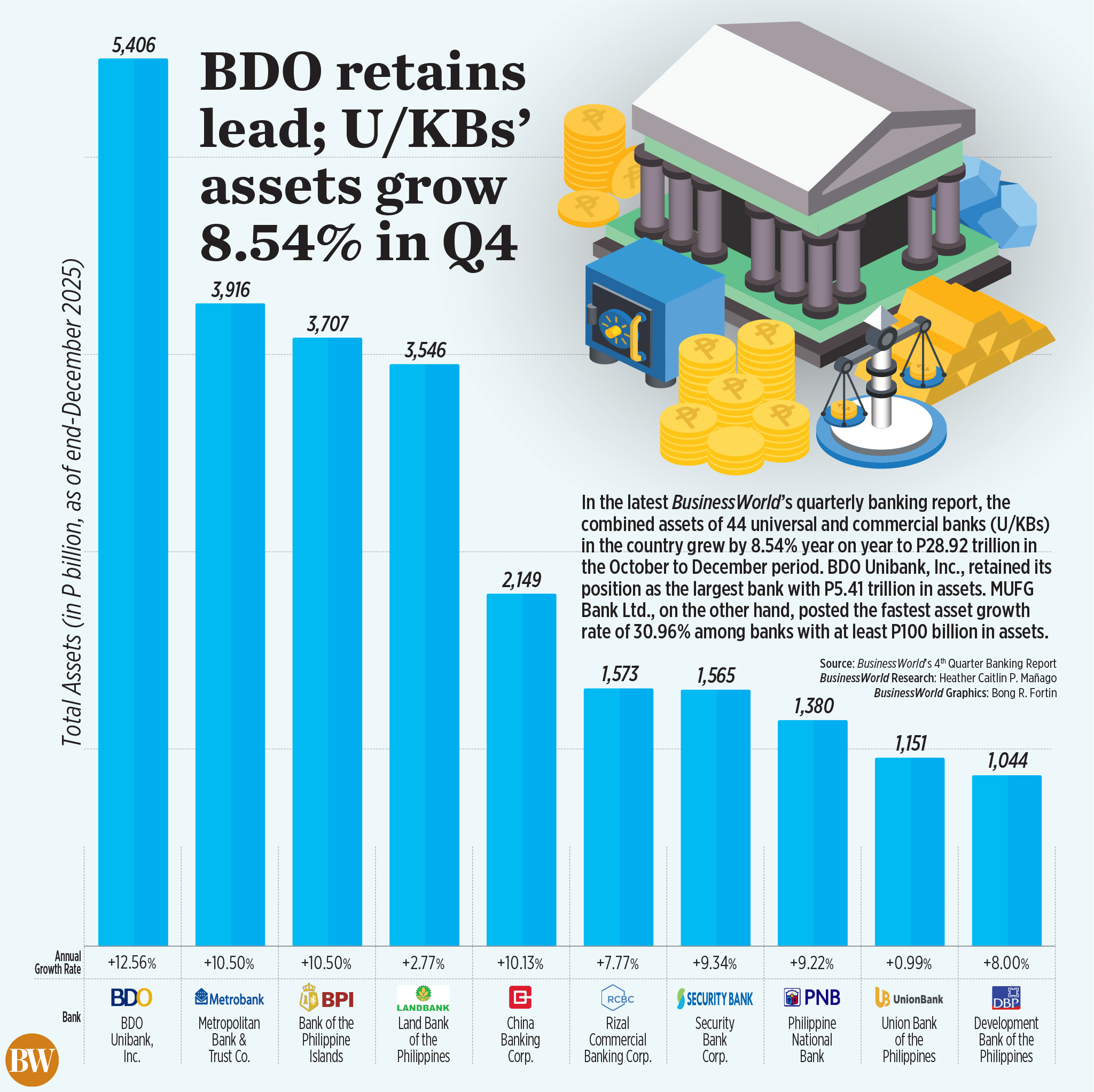
In the October-to-December period, BDO Unibank, Inc. (BDO) remained the largest bank in terms of total assets with P5.41 trillion, followed by Metropolitan Bank & Trust Co. (Metrobank) with P3.92 trillion and Bank of the Philippine Islands (BPI) with P3.71 trillion.

In lending, the Sy-led bank also led the industry with P3.64 trillion worth of loans issued, followed by BPI with P2.6 trillion and Metrobank with P1.97 trillion.

In terms of deposits, BDO also has the biggest amount of deposits with P4.19 trillion, followed by Land Bank of the Philippines with P3.12 trillion and BPI with P2.84 trillion.

Among banks with at least P100 billion assets, MUFG Bank Ltd. posted the fastest year-on-year asset growth with 30.96%, followed by Philippine Bank of Communications (17.68%), and Asia United Bank Corp. (12.72%).    

On the other hand, MUFG Bank Ltd. was also the most aggressive lender with a year-on-year growth of 19.57%, followed by Bank of Commerce with 19.43% and East West Banking Corp. with 15.04%.

BusinessWorld Research has been tracking the financial performance of the country’s large banks quarterly since the late 1980s using banks’ published statements.

Oil shock from Iran war may push T-bill, bond yields higher

STOCK PHOTO | Image by iiijaoyingiii from Pixabay

By Aaron Michael C. Sy, Reporter

YIELDS on Philippine Treasury bills (T-bills) and Treasury bonds are expected to rise this week as surging oil prices linked to escalating war in the Middle East dampens investor appetite for government debt.

The Bureau of the Treasury plans to auction P27 billion in Treasury bills on Monday, offering P9 billion each in 91-, 182-, and 364-day securities.

On Tuesday, the government will offer P20 billion to P30 billion in reissued 10-year Treasury bonds with a remaining life of nine years and 11 months.

Yields might track the sharp increase in the secondary market late last week after global crude prices climbed above $100 per barrel, Michael L. Ricafort, chief economist at Rizal Commercial Banking Corp., said in a Viber message.

“Higher global crude oi prices could lead to faster inflation and slower economic growth,” he added.

Oil prices surged as markets reacted to the intensifying conflict between the US and Iran. Front-month West Texas Intermediate crude futures settled at $98.71 per barrel, up 3.11%, whilst Brent crude rose 2.67% to $103.14, settling above $100 per barrel for the first time since August 2022, according to Reuters.

Higher energy prices tend to push inflation expectations upward, which in turn raises bond yields as investors demand higher returns.

At the secondary market on Friday, yields on short-term government securities jumped sharply. The 91-day Treasury bill rose 32.1 basis points (bps) to 4.858%, the 182-day paper climbed 26.35 bps to 4.8516%, and the 364-day bill increased 36.39 bps to 5.0297%, based on data from the Philippine Dealing System using PHP Bloomberg Valuation Service Reference Rates as of March 13.

The 10-year bond yield also climbed 30.66 bps to 6.6248%, signaling higher borrowing costs for the government if weak demand persists.

A trader said demand at this week’s auctions could remain subdued amid uncertainty over the geopolitical situation and the outlook for oil prices.

“I expect tepid demand on the bills and bond auction next week as the Middle East war continues to escalate,” the trader said in an e-mailed reply to questions, adding that the 10-year bond could fetch an average rate of around 6.625% to 6.675%.

The market reaction follows comments from Donald J. Trump that the US would hit Iran “very hard over the next week,” raising fears of a wider conflict that could disrupt global energy supplies.

Higher oil prices could also complicate the economic outlook. Arsenio M. Balisacan, secretary of the Department of Economy, Planning, and Development, earlier said inflation could exceed 7% and economic growth could slow by as much as 0.3 percentage point this year if the oil price shock linked to the conflict intensifies.

Last week’s Treasury bill auction already reflected weaker demand. The government raised P19.2 billion, falling short of its P27-billion target, after total bids reached P31.536 billion, far below the P76.546 billion recorded in the previous week.

The Treasury awarded P8.15 billion in 91-day bills, P6.3 billion in 182-day securities and P4.75 billion in 364-day debt, all below their P9-billion programs.

Average yields also climbed sharply, with the three-month bill rising 36.6 bps to 4.677%, the six-month paper increasing 37.8 bps to 4.795% and the one-year security gaining 28.5 bps to 4.849%.

The 10-year bonds to be offered on Tuesday were first issued on Feb. 23, when the government raised P297.94 billion at a 5.925% coupon rate and an average yield of 5.893%.

For March, the Treasury aims to raise P248 billion from the domestic market, composed of P108 billion in Treasury bills and P140 billion in Treasury bonds.

The government taps both local and foreign borrowing to help finance its fiscal deficit, which is capped at P1.647 trillion or 5.3% of gross domestic product this year.

SN Aboitiz boosting battery storage capacity to 160 MW

The Ambuklao hydroelectric power plant in Benguet. — ABOITIZPOWER.COM

SN ABOITIZ Power Group (SNAP), a joint venture between Aboitiz Renewables, Inc. and Norwegian firm Scatec, plans to expand its battery energy storage system (BESS) portfolio to 160 megawatts (MW) by next year through pipeline projects.

Speaking to reporters last week, SNAP President Joseph Yu said the company has started constructing 80 MW of BESS capacity, which is scheduled for completion by the middle of this year.

The company is developing a 40-MW BESS co-located with its Binga hydroelectric power plant in Benguet, as well as a 16-MW energy storage expansion of its 24-MW facility adjacent to the Magat power plant in Isabela.

Both projects are scheduled to begin commercial operations later this year.

“We issued a notice to proceed to another 80 megawatts. So, that should also come on stream by hopefully next year,” Mr. Yu said.

The 80-MW project pipeline includes a 40-MW expansion of the Binga BESS and a new 40-MW BESS at the Ambuklao hydroelectric power plant in Benguet.

Both systems are designed to provide ancillary services to the Luzon grid through the reserves market.

A BESS stores electricity from the grid and releases it when needed to augment supply or improve power quality, helping stabilize the grid and manage fluctuations in renewable energy generation.

Mr. Yu said the company is continuing to explore additional projects and sites for energy storage development. “We’ll always look for more opportunities, whether it’s hydro.”

“You have an economy that’s growing. And that economy is going to need power. And so, we need more megawatts and more steel on the ground. And at the same time, we really want to do it in a way that doesn’t compromise the environment for the future,” he said.

SNAP currently operates 673 MW of installed capacity, primarily from hydropower assets in Northern Luzon. — Sheldeen Joy Talavera

Peso may hit P60 a dollar this week amid escalating Iran war

REUTERS

By Aaron Michael C. Sy, Reporter

THE PHILIPPINE PESO may weaken to the P60-per-dollar level this week as surging oil prices and escalating war between the US and Iran drive demand for the greenback.

Higher oil prices could worsen inflation and weigh on economic growth in oil-importing economies such as the Philippines, analysts said.

“Higher global crude oil prices could lead to higher inflation and slower economic growth,” Michael L. Ricafort, chief economist at Rizal Commercial Banking Corp., said in a Viber message.

The peso closed at a record low of P59.735 a dollar on Friday, according to Bankers Association of the Philippines data posted on its website. The local currency fell 35 centavos from its P59.385 finish on Thursday.

During the session, the peso touched P59.75, surpassing its previous record low of P59.50 posted on March 9. The intraday low on that day was P59.71.

Week on week, the peso depreciated 73.5 centavos from its P59-a-dollar close on March 6, reflecting sustained pressure on the local currency as global markets react to rising geopolitical risks and higher commodity prices.

A trader said the peso weakened as investors sought the safety of the US dollar amid escalating tensions in the Middle East and rising oil prices.

“The dollar-peso continued to trade higher to reach a new record low still on higher oil prices and higher demand for the safe-haven dollar because of the escalating tension in the Middle East,” the trader said by telephone.

Oil prices have surged as markets brace for possible disruptions to global supply. West Texas Intermediate crude futures settled at $98.71 per barrel, up 3.11%, whilst Brent crude rose 2.67% to $103.14, settling above $100 per barrel for the first time since August 2022.

Earlier, Arsenio M. Balisacan, secretary of the Department of Economy, Planning and Development, said inflation could exceed 7% and economic growth could slow by as much as 0.3 percentage point this year if the oil price shock linked to the Middle East conflict intensifies.

The US dollar also strengthened broadly on Friday as markets pushed back expectations for interest rate cuts by the US Federal Reserve amid inflation risks tied to higher energy prices.

The dollar index, which measures the greenback against a basket of major currencies, rose 0.7% to 100.35, bringing its weekly gain to 1.5%. The euro slipped 0.6% to $1.14395.

The trader expects the peso to weaken further this week if oil prices continue to rise and geopolitical tensions escalate.

The trader sees the peso trading at P59.50 to P60 per dollar, while Ricafort expects a range of P59.30 to P59.90.

Cebu Pacific reviews fuel costs, routes amid rising oil prices

CEBUPACIFICAIR

BUDGET CARRIER Cebu Pacific said it is reviewing jet fuel costs and network strategies to cushion the impact of rising global fuel prices despite growth in passenger volume.

“[W]e remain cognizant of the ongoing crisis and uncertainty in the Middle East, and the impact of sharply increasing fuel prices on our business,” Cebu Pacific Chief Executive Officer Michael B. Szücs said in a statement last week.

For the first two months of the year, Cebu Pacific logged 5.07 million passengers, up 7% from 4.74 million in the same period in 2025.

Domestic passengers accounted for the majority of the total at 3.74 million, while international passengers reached 1.33 million during the period.

“Our operating fundamentals — including our robust domestic network, modern fuel-efficient fleet, and low-cost structure — provide us relative advantages as we navigate these headwinds. We will continue to review pricing and network strategies to ensure we minimize the negative impact of the higher fuel prices,” Mr. Szücs said.

Cebu Pacific said its fuel-efficient fleet gives the airline some advantage in navigating challenges from rising global fuel costs.

The airline operates Airbus NEO aircraft, which are known for enhanced fuel efficiency. These represent the latest generation of Airbus planes designed to be highly compatible with sustainable aviation fuel (SAF).

According to monitoring by the International Air Transport Association (IATA), jet fuel prices rose 58.4% week on week to $157.41 per barrel as of March 6. On a yearly basis, jet fuel prices increased by 74.8%, data from the airline trade association showed.

On Friday, the Department of Transportation (DoTr), together with the Civil Aviation Authority of the Philippines (CAAP) and the Civil Aeronautics Board (CAB), ordered the reduction of passenger service charges, or terminal fees, for all government-operated airports in the country.

The Transportation department said the initiative aims to ease a possible increase in airfares as jet fuel prices climb. Based on its recent monitoring, jet fuel prices nearly doubled to $188.20 per barrel as of March 9 from $90.87 per barrel on Feb. 19.

Last year, CAAP approved the collection of new passenger service charges and other fees for all CAAP-operated airports.

Under Memorandum Circular 019-2025, CAAP raised terminal fees to P900 for international flights from P784. For domestic flights, the terminal fee is set at P350 if the passenger departs from an international airport. It is set at P300 for departures from a principal class 1 airport, P200 from a principal class 2 airport, and P100 for departures from community airports.

CAB has also shortened the evaluation period and implementation of the fuel surcharge to 15 days from one month to ensure that jet fuel prices are reflected more quickly and allow passengers to book tickets at more affordable prices.

The passenger fuel surcharge has remained at Level 4 since January. At Level 4, the surcharge ranges from P117 to P342 for domestic flights and from P385.70 to P2,867.82 for international flights originating from the Philippines. — Ashley Erika O. Jose

All things great and Filipino

JOSEPH L. GARCIA

(that you can customize this month)

SPATIO, Robinsons Retail’s concept in its Opus mall, is positioning itself as the new place to get your artisanal Filipino hit. If you regret missing something at the big artisanal fairs in the country (for example, Habi, ArteFino, and MaArte), you’re bound to find them at Spatio, all year round.

This March though, they’re launching the Made For You campaign featuring Filipino brands that can offer customization services. These include charms and trinkets from Studio MG.88, Style Isle, and Casa Inez, and custom engraving in brooches and necklaces from Alchemista. Piesa introduces a jewelry making experience inspired by halo halo. Viajecito also invites guests to mix and match bags and straps, allowing shoppers to create combinations that match their own style. Stations include Vesti, where guests can customize their own bag, and Boop MNL, which offers scarves for dogs and cats that can be personalized with the names of the pets.

Chief among these brands is the limited time only customization services by Revibe Culture. The brand takes a clothing base, then adds upcycled touches from damaged designer goods. This is one of the latest brands to join Spatio’s permanent display (more on them in the sidebar).

Martin de Leon, deputy general manager for Spatio, told BusinessWorld what they look for in a local brand. “It depends on the category and the mix that we already have. If they can fill in a gap — of course, it’s a given that the branding has to be strong; the products that they carry have to meet a certain standard.”

According to him, they currently have 300 local brands in the store, a jump from 30 when they first opened in 2024. Of course, he says, they have international brands too (we saw some at their beauty selection on the third floor, but these share space with a large display of local beauty brands). “We deliberately placed them right beside each other,” he said. “I feel like the consumer behavior has really shifted. There’s really more support towards local brands. They see that the quality that we have to offer, and also in terms of design, is really at par with international brands,” he said.

“That’s pretty much the goal of Spatio. It’s to provide a home and opportunity for local brands to thrive, and also to promote their creativity — to promote the country, pretty much.”

The beauty and the problem of artisanal craft is that no two items are ever the same — it becomes a problem when one thinks of the consistency needed in commercial operations in mall stores such as Spatio. “I think a lot of the brands are already starting to experience the possible long-term volume that this platform can provide,” said Mr. De Leon. “They’re already incorporating planning in terms of their production and also capacity.”

Asked if Spatio’s Filipino-forward model can be replicated in other locations, he said, “Definitely, that’s something that’s in the works.”

“There’s definitely opportunity for that in the future,” he said. “We’re seeing a lot of growth from this particular store.”

Mr. De Leon noted that the Spatio platform gives something more concrete to many young brands, as opposed to their usual strategy of going online, or appearing only in pop-ups. “There are a lot of brands who are already reaching out, because they want to be able to introduce their brands in a different format,” he said. “There’s really that opportunity for them to really engage and see the products up close,” he said about the customer.

“We want to grow the brands. We want to groom them, and we want to make sure that we can sustain the business,” he said. “Hopefully, the plans will push through in terms of possibly expanding the brands beyond just this location.”

Spatio is also offering exclusive in-store promotions throughout March. From March 13 to 31, shoppers using their BPI credit cards (Visa Signature, Amore Platinum Cashback, and Robinsons Cashback Card) with a minimum spend of P10,000 can receive a P1,000 Spatio gift certificate for their next lifestyle purchases. Guests can also enjoy a special offer with GoTyme Bank: shoppers who use their GoTyme Card with a minimum purchase of P3,000 will receive a free GoTyme umbrella or tote bag. Spatio also rolled out special rewards for Go Rewards members this past weekend. — Joseph L. Garcia