Home Blog Page 8876

[B-SIDE Podcast] Private equity in light of the pandemic

Follow us on Spotify BusinessWorld B-Side

Bain & Company, a management consulting firm based in the United States, said that the Philippines might benefit in global efforts to diversify supply chains and focus on business process outsourcing to cope with the economic decline brought about by the COVID-19 pandemic.

Last year was a challenging year for private equity firms in Southeast Asia, with deal value slipping to $12 billion from $14 billion a year ago. Alessandro Cannarsi, a partner at Bain, said the COVID-19 pandemic may change the situation in favor of countries like the Philippines.

In this episode, Mr. Cannarsi speaks with BusinessWorld reporter Denise Valdez about the country’s prospects in tech-driven sectors.

TAKEAWAYS

The Philippines might be able to close at least two private equity (PE) deals this year.

“I think there’s going to be a slowdown [in PE deals] in 2020, but possibly, we’ll come out of this year with a couple or three deals in private equity in the Philippines and possibly go back up from there in 2021,” said Mr. Cannarsi.

“I don’t think the deal flow will completely dry up. In fact, we’ve seen that in the past five years, private equity firms that generated the best returns were those that kept investing during the down cycle,” he added.

The Philippines is poised to benefit from the growth of technology-driven industries and the diversification of global supply chains after the COVID-19 pandemic.

“If you think about it, we’re going through a large experiment in doing things remotely,” Mr. Cannarsi said. This is expected to result in the growth of online shopping and digital healthcare, sectors where the Philippines can play a role.

“Sectors that have revenues in markets like the US such as BPO, IT (information technology) services, where the Philippines is strong, could get a leg out in attracting private equity investments interest,” he said.

The increasing tension between US and China — and Japan’s plans to pull out companies in China — could benefit the Philippines.

“[The Philippines has] a flourishing services sector, which is strategically well-located to diversify some of the supply chain for western and Japanese companies. And because of the high English communication skills in the Philippines compared to other Southeast Asian countries, it is very advertised in the west,” Mr. Cannarsi said. “I think it’s a candidate for actually benefitting from some diversification of the supply chain.

In order to attract PE firms into the country, Mr. Cannarsi said the Philippines can work on enhancing corporate governance standards, on the company level, and increasing transparency on deal flows, on the country level.

Recorded remotely on May 4. Produced by Nina M. Diaz, Paolo L. Lopez, and Sam L. Marcelo

Follow us on Spotify BusinessWorld B-Side

Rep. Villar calls for more funding for small business loans

Deputy Majority Leader and Las Piñas Lone District Rep. Camille Villar today called on the government to provide more funding to help small businesses as they grapple with the pandemic.

In a televised interview, Villar stressed the importance of supporting micro, small and medium enterprises (MSMEs) as they are considered the lifeblood of the domestic economy.

“We hope that more funding is given to MSMEs especially because they do comprise about 99.6% of all the businesses here and they provide 70% of jobs in the Philippine workforce. So it’s very important that we give them all the support that they need,” said Villar.

The Small Business Corp. (SB Corp.), the financing arm of the Department of Trade and Industry, had announced it was opening a loan program for MSMEs to help them recover. Under the P1-billion facility, enterprises with asset size not exceeding P3 million may borrow between P10,000 and P200,000 while those with assets not bigger than P10 million may borrow up to P500,000.

Initially, SB Corp. was to impose a 0.5% interest per month, but later scrapped the interest and would only charge 6% service fee. MSMEs that availed of the loan also have a six-month grace period before they can pay the loan for up to 30 months.

It was reported, however, that SB Corp. stopped accepting new loan applications last week as the fund was not enough to cover small businesses still reeling from the effects of lockdowns and movement restrictions imposed more than three months ago.

Villar, who also sits as vice-chair of the House committee on MSME development, said “one of the things that we noticed is that P1 billion is really not enough” to help a big chunk of MSMEs hurt by the pandemic since many of them are still clamoring for some form of relief. She added information dissemination is key to address MSMEs’ concerns.

“One of the reasons why it’s very important to discuss the plight of MSMEs is because now you have different sectors really in need of help during this pandemic. Sometimes we overlook MSMEs and the needs of our MSMEs and we focus on the other sectors,” Villar added.

To address funding concerns, the House of Representatives, for one, had passed last June 4 the proposed Accelerated Recovery and Investments Stimulus for the Economy (ARISE) Bill to boost economic recovery. Under the measure, P50 billion will be allocated to SB Corp. for existing loans programs for MSMEs for this year and another P25 billion next year while the Philippine Guarantee Corp. will get P20 billion this year and another P20 billion in 2021.

“This (ARISE Bill) would have addressed the additional funding for SB Corp. and other government financial institutions like Landbank, Philippine Guarantee Corp. which have programs to help MSMEs. We’re hoping to pass this in August to give help and support to our MSMEs,” Villar said, but conceded that it may be difficult to pass the measure since the government may not be able to fully finance a total of P1.3 trillion in recovery programs under the measure.


Future-proofing for a ‘better normal’

By Adrian Paul B. Conoza, Special Features Writer

First leg of BusinessWorld Insights SparkUp Entrep Series shared how businesses can brace for future crises

The direct hit of the coronavirus disease 2019 (COVID-19) crisis to businesses further highlighted the need for them to be ‘future-proof’, or resilient against future crises, whether natural or man-made.

This point was further driven in the first leg of “BusinessWorld SparkUp Entrep Series: Innovating Towards A ‘Better Normal'”, where industry experts and startup founders shared their experiences and insights from the previous months under lockdown.

Moderated by BusinessWorld digital platform editor Santiago Arnaiz, the online forum last June 24 had Lope Doromal, chief technology officer of IBM Philippines; Roland Ros, founder of Kumu; Miko David, co-founder of David and Golyat; and Gorby Dimalanta, co-founder and head of business development at BukidFresh, in the panel.

A chance to adapt


Mr. Dormal of IBM Philippines highlighted the importance of transforming and adapting for organizations of all sizes, given the uncertainties in the new normal.

While their scenario planning made pre-COVID likely “goes out of the window”, he recognized, organizations can take advantage of the crisis to innovate and prepare themselves to face future challenges.

“It’s important for every organization to understand where they sit today and what they need to do to be able to adapt to this new normal,” he said.

Moreover, Mr. Dormal laid out six initiatives organizations should look at to become stronger as they come out from the current situation: empowering a remote workforce, engaging customers virtually, remote access to everything, accelerating agility and efficiency, cybersecurity, reducing operational cost, and enhancing supply chain continuity.

Mindset at the core


As the head of a digital strategy consulting firm, Mr. David of David & Golyat has observed some shifts within the space companies share, which he finds are opportunities for both startups and companies. While many have seemingly acted on these shifts, some have not been able to leverage such opportunities. “I think the leaner, more agile companies will have greater opportunities to capture market share,” he said.

Moreover, he pointed out that organizations should start with a change of mindset before taking in any business process.

“Talking to multiple MSMEs in our country, we’ve always found that it’s not really the companies with the largest budget to spend who do phenomenally well,” he explained. “It’s really those with the mindset to accept changes and say ‘Hey, we’ve got to do this’.”

With starting at the mindset and thereafter plotting the action steps a company needs to achieve, the processes, technologies, and people will follow.

“Whenever you look at winning within the market, it’s a function of people, process, and technology working all hand-in-hand; but that is focused on mindset at the core,” he added.

Driven by passion and community

Sharing his experiences with the Filipino-tailored mobile platform during the crisis, Mr. Ros of Kumu noted that the current situation heightened Kumu’s concept of building and scaling up authentic connections, as the mobile app likely has dealt with the spike in boredom and loneliness.

“Right when COVID hit [there] was about a half a million downloads per month. Now, closer to about a million downloads a month,” he noted.

Furthermore, Mr. Ros shared that the ‘passion economy’ must be growing further during these times. “A lot of times we say a content creator would need to generate millions of views or hundreds of thousands of likes to earn an income. But what we’ve learned, through passion economy, it’s really just gaining the attention span of a couple hundred people who believe in your passion.”

He likens ‘passion economy’ to busking, albeit in a digital and spanning from various interests like wellness, financial coaching, and even cooking—done by thousands of people in Kumu. To illustrate, he recalled a certain user who earned a lot from the platform.

“I know one particular user in the province. She just made half a million pesos in income last month just because of all these busking gifts she’s receiving from Filipino users in the US, Canada, Middle East, Singapore, and Japan who definitely have the discretionary income to support creators,” Mr. Ros noted.

With the Kumu app gathering people and even businesses through these means, its founder has observed the rise of a community-driven approach to commerce.

“What we’ve noticed in Kumu is [users] call themselves family, tribes, nations, tropa, squads. And we’re starting to see [them] come together as a family or community to engage and support each other through e-commerce and through microtransactions. Because of that, it forced the product team to start thinking about how to do community-driven experiences for commerce,” he said.

Increased engagement


Sharing his experience with BukidFresh, pre-selling initiative that disrupts traders’ systematic means of dictating low-prices to farmers, Mr. Dimalanta has observed that they have been actively responding to the crisis.

“We do have a once-a-week delivery, but we had to ramp it up to twice-a-week because people were already demanding so much. Farmers also needed to have some kind of leeway for us to order from them,” BukidFresh’s founder shared.

Listening to their customers, checking the data, and assessing how fast they could move goods are important moves BukidFresh took, Mr. Dimalanta added. “We really need to check the data to inform our farmers this is what the market demands now,” he said.

Being data-driven
From their insights and experiences, the panel agreed that there is a more pressing need to be data-driven.

Mr. Ros finds it important for Kumu to make sure they look at the data they have and act on it. “We really need to take a look at the data and be able to prepare so that when you’re making those orders you don’t find yourself in a situation where you’re making expensive purchases and end up losing a lot of revenue that way,” he shared.

Organizations with a data-driven philosophy and a data-driven culture are geared towards success at present, he added.

Mr. David, meanwhile, finds that there is an opportunity nowadays to adopt a data-driven philosophy, having observed that there are companies that actually have a lot of data internally yet have not integrated or analyzed it yet.

“Apparently for one project we worked on, [we found that] the output of one department is the perfect input of another department,” Mr. David shared. “It’s just that if they knew that they could connect these two dots together, they could have saved up to 30% of costs.”

For Mr. Dormal, even if they don’t have any infrastructure or expert to help them make sense of their data, there are many technologies available that will allow them to take these data, integrate them into a single platform, and generate insight. “It’s really just a matter of attitude among organizations that they want to do it, that they want to spend some time learning some new skills to be able to leverage on that,” he said.

Mr. Dimalanta, meanwhile, said that practical solutions are as sufficient for organizations as modern technologies to advance into being data-driven.

“We can use whatever is in the cloud and remove the use of pen and paper…It’s really shifting to a more digital economy,” he explained. “You just need to get more information from your customers, and customers should be able to input it in the company’s database, as basic as Google Sheets or whatever tool that can be uploaded in the cloud.”

Lifting the ‘bayanihan spirit’ higher
The Philippine startup scene is often described as evoking the spirit of bayanihan or collaboration; and this has been further stressed by the crisis, as some in the panel have observed.

“It’s just this community, this bayanihan spirit, that has been forged together because of this crisis. We’re seeing platforms being built on the fly, with social media platforms where communities are getting together, where people now find market to sell products and services.”

Being in one of those platforms bringing people together, Mr. Ros expressed his excitement over the sense of community of people coming together to help each other during the crisis

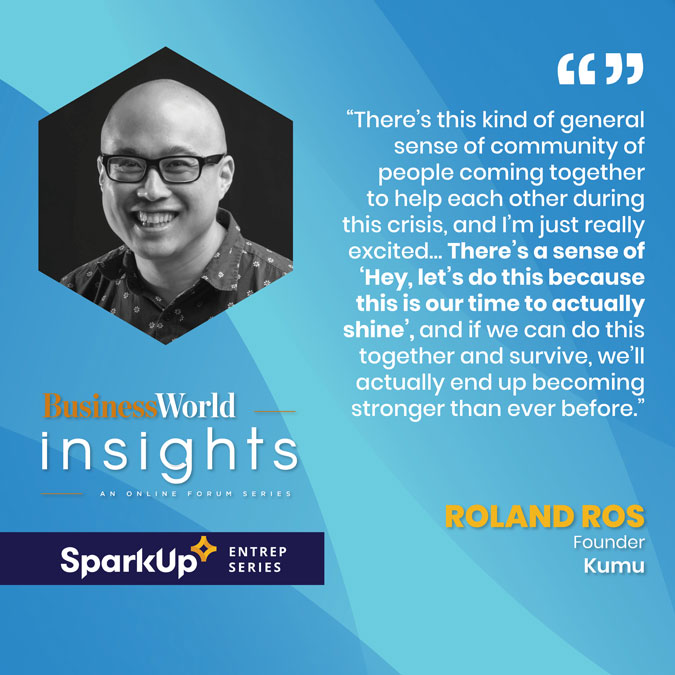
“It feels a lot different than ‘This is a business deal, whatever,” he said. “There’s a sense of ‘Hey, let’s do this because this is our time to actually shine’; and if we can do this together and survive, we’ll actually end up becoming stronger than ever before.”

The next leg of BusinessWorld Insights SparkUp Entrep Series will discuss the topic “The Next Frontier in Innovative Business” on June 30 at 11 a.m., streaming live on BusinessWorld‘s, SparkUp‘s and The Philippine STAR‘s Facebook pages.

#BUSINESSWORLDINSIGHTS x #SPARKUPENTREPSERIES is made possible by Globe, SM Supermalls, BusinessWorld, www.olern.com and The Philippine STAR with the support of IdeaSpace Foundation, Impact Hub Manila, Kickstart Ventures, QBO Innovation Hub and StartUp Village.


POGOs start to exit PHL — regulator

REUTERS

TWO Philippine offshore gaming operators (POGOs) have exited the country, according to the industry regulator, with more expected to follow suit as they face difficulties in securing tax clearance from the Bureau of Internal Revenue (BIR).

In a text message to reporters, Philippine Amusement and Gaming Corp. (PAGCOR) Chairperson and Chief Executive Officer Andrea Domingo said Macau-based casino operator SunCity Group has closed its POGO operations in the country.

“There are others more that are leaving the Philippines,” Ms. Domingo said over the weekend.

PAGCOR Assistant Vice-President for Offshore Gaming and Licensing Department Jose S. Tria, Jr. told reporters Don Tencess Asian Solutions, Inc. also asked the regulator to have its license canceled.

“I’ve heard there are other (POGO) companies that also plan to cancel their licenses, but I haven’t received their official letters so I can’t name them yet,” he said.

According to Mr. Tria, POGOs are now leaving the Philippines largely due to the stringent tax rules from the BIR, particularly on the franchise tax. POGOs are also hurting as they face huge overhead costs despite an ongoing ban on some gambling activities.

“There are other jurisdictions that have opened up offering better tax rates and friendlier environment. Some [POGOs] also can no longer take the criticisms they get each day that make them feel unwelcome in our country,” he said.

So far, around 13 POGO service providers have closed their shops, Mr. Tria said.

Finance Assistant Secretary Antonio G. Lambino II said in mid-June the BIR faced difficulties in collecting the five percent franchise tax from licensed POGO companies based overseas. These companies have stood firm that they are not required to pay this franchise tax since they are not based in the Philippines.

The BIR and the Department of Finance (DoF) also maintained the tax, which is on top of the two percent franchise fee imposed by PAGCOR, should be settled by POGOs.

PAGCOR’s Mr. Tria said the regulator is “working on ways” to help POGOs resume their operations.

“But we can only do so much. We are regulators, we have to do everything in accordance with the law,” he said.

However, Mr. Tria said POGOs still have the option of elevating the franchise tax issue to the courts if they want to clarify the issue.

“We’re not tax experts. It is for POGOs to question the applicability of the franchise tax. Whatever the court decides, we follow. If they don’t want to question the tax, then, they should pay it,” he said.

Payment of franchise tax is one of the requirements needed for a licensed POGO to secure tax clearance from the BIR.

Operations of POGOs and their service providers have been allowed to resume since early May, provided they observe minimum health standards and submit the tax clearance.

Officials from the BIR have not disclosed how many POGOs have received tax clearances.

Mr. Lambino had said around 10 out of 60 licensed POGO companies have offices in the Philippines and the rest are based offshore, while there are more than 200 POGO service providers.

The government collected P6.42 billion in taxes from the POGO industry last year, up 170% from the P2.38 billion generated in 2018. — B.M.Laforga

Another rate cut still on the table — analysts

By Luz Wendy T. Noble, Reporter

THE surprise policy rate reduction from the central bank may not be the last, as it takes an aggressive and accommodative stance while waiting for the fiscal stimulus measures to catch up, according to analysts.

Nomura Global Markets Research analysts Euben Paracuelles and Rangga Cipta said in a report on Friday the continued manageable inflation environment will afford the Bangko Sentral ng Pilipinas (BSP) with more space for further easing in the near term.

“We maintain our forecast that BSP will cut its policy rate by 25 bp (basis points) in Q3 to 2%, although we acknowledge a rising risk that it could still deliver more. We think the inflation outlook will become more supportive of further easing in the near term,” the Nomura analysts said.

On Thursday, the central bank slashed its benchmark interest rate by a bigger-than-expected 50 basis points. This brought down the overnight reverse repurchase, lending and deposit rates to new record lows of 2.25%, 2.75%, and 1.75%, respectively.

BSP Governor Benjamin E. Diokno said the Monetary Board considered the deteriorating global economy, the extent of the health crisis, and the “protracted” and “uneven” recovery track in their “accommodative stance.”

“There remains a critical need for continuing measures to bolster economic activity and support financial conditions, especially the effective implementation of interventions to protect human health, boost agricultural productivity and build infrastructure,” Mr. Diokno said on June 25.

He said the benign inflation environment allowed them to cut rates again to support the economy and lift market confidence.

“The policy statement, in our view, was clear in citing that because the inflation outlook continues to be benign, the monetary stance can be more accommodative amid BSP’s rising concerns about the deteriorating growth outlook as a result of the COVID-19 (coronavirus disease 2019) pandemic,” Nomura said.

The BSP on Thursday has also revised its inflation outlook for 2020 and 2021 to 2.3% and 2.6%, from 2.2% and 2.5%, respectively. Both estimates are nearer the lower end of the 2-4% target set by the central bank.

“The main factor that led to the revision of the forecast is the increase in global oil prices, but this was partly offset by the weaker economic growth both domestically and globally, as well as the continued stability of the peso,” BSP Deputy Governor Francisco G. Dakila, Jr. said on June 25.

In May, headline inflation settled at 2.1%, slower than the 2.2% in April and the 3.2% a year earlier. With this, average inflation from January to May stood at 2.5%.

LAST CUT?
On the other hand, Fitch Solutions Country Risk and Industry Research sees the rate cut as the last for a while as the BSP is likely to deploy other monetary policy tools to provide further support for the battered economy.

“We expect the BSP to maintain its key policy rate and a dovish bias over the coming quarters, leaning on other monetary tools and macroprudential measures to ensure credit conditions remain favorable,” Fitch Solutions said.

Aside from rate easing worth 175 bps so far this year, the central bank unveiled regulatory relief measures to help affected sectors. These include an allowance for alternative reserve compliance in the form of lending to micro-, small-, and medium-sized enterprises (MSMEs) as well as large enterprises, and the reduction of credit risk weight for loans disbursed to MSMEs.

Fitch Solutions said the BSP may, however, look to bring down rates further “if their expected increase in fiscal stimulus fails to materialize.”

It warned the country may suffer a deeper slump if containment measures will be renewed in the second half of the year.

“As such, monetary stimulus may need to take even more unconventional steps to support MSMEs and lower income households,” it said.

Meanwhile, Nomura is pricing in a reduction in the reserve requirement ratio (RRR) of lenders in the latter part of the year.

In April, RRR of big banks was reduced by 200 bps to 12%, while reserve requirements for thrift and rural lenders were kept at four percent and three percent, respectively. The Monetary Board has authorized Mr. Diokno to cut RRR by a total of 400 bps this year.

“[W]e push out the timing of our call that BSP will cut the RRR by 200bp to 10% to later in the year, particularly when some of BSP’s earlier emergency measures start to expire and may lead to an unintended tightening in liquidity,” Nomura said.

Prior to the outbreak, Mr. Diokno vowed to bring down RRR to a single digit by the end of his term in mid-2023 to be in line with regional neighbors.

Amid the crisis, Mr. Diokno has said the country’s liquidity position has improved.

Domestic liquidity or M3, which is seen as the broadest measure of money supply in an economy, rose by 16.2% to P13.6 trillion in April, faster than the 13.3% pace in March. On the other hand, bank lending grew by 12.7%, slower than the 13.6% in March.

Collection of additional oil tariff ends

Pump prices have increased in the past seven weeks, reflecting the movement of prices in the global market. — REUTERS

By Adam J. Ang

THE collection of the additional oil import tariff to raise funds for the government’s pandemic response has ended with the lapse of the Bayanihan law, the oil bureau of the Department of Energy (DoE) said on Sunday.

According to Section 7 of the Executive Order No. 113, the temporary imposition of the said duty shall cease to take effect upon the expiration of the Republic Act No. 11469 or the Bayanihan to Heal As One Law, or when a trigger price is breached, whichever is earlier of the two. The law’s effectivity ended on June 25.

Tama, end na po as it is now (Right, the tax collection already ended),” Rino E. Abad, director of the DoE-Oil Industry Management Bureau (DoE-OIMB), said in a text message.

Oil companies only started to charge the additional 10% tax on imported crude oil and refined petroleum products to consumers a month after the executive order was signed on May 2. The higher duty raised pump prices by P1.50 to P1.60 per liter (L).

Recent data from the Department of Finance showed the government has generated P1.214 billion in revenues from the temporary tariff on imported oil, as well as value-added tax, from May to mid-June.

Additional revenue from liquified natural gas totaled P283.06 million, while naphtha reached P3,325.

Meanwhile, in preliminary data, the Bureau of Customs (BoC) reported a 72.5% decline in imported oil products to 437.89 million kilograms (kg) in May from 1.592 billion kg in the same month in 2019.

Earlier, the DoE estimated the government could expect to earn as much as P6.78 billion from the tariff hike by the end of 2020.

The order increasing the tax on imported oil was passed to “augment the government’s resources to sufficiently finance the programs and measures to mitigate the effects of the COVID-19 situation, and launch the country towards recovery and rehabilitation.”

The Bayanihan law, which was passed in March, declared a national public health emergency due to mounting number of cases of coronavirus disease 2019 (COVID-19) and gave emergency powers to President Rodrigo R. Duterte in order to manage the country’s response to the pandemic.

House Speaker Alan Peter S. Cayetano told reporters on Friday that Congress will be holding a special session to pass House Bill No. 6953 or the proposed Bayanihan to Recover as One Act, which seeks to extend the effectivity of the Bayanihan law.

“We will wait for any extension [of the law],” Mr. Abad said when asked if the collection of the additional import duty will likewise be extended.

Pump prices have increased in the past seven weeks, reflecting the movement of prices in the global market.

The uptick was primarily due to the rebalancing of supply and demand after oil-producing countries have cut output to resolve the supply glut.

Domestic oil companies have yet to report their fuel price adjustments for this week.

Last week, the DoE reported that since January, price rollbacks amounted to P5.67/liter for gasoline, P9.14/liter for diesel, and P13.39/liter for kerosene.

LGUs’ share from tobacco tax can reach P21 billion

Excise taxes on tobacco products collected in 2018 and 2019 will be distributed to local government units in 2020 and 2021. — REUTERS

TOBACCO-PRODUCING provinces may receive up to P21 billion in 2022, as their share in collection of excise taxes on tobacco products this year, the Budget department said.

The Department of Budget and Management (DBM) and the Department of Agriculture (DA) issued on June 25 a Joint Memorandum Circular (JMC) No. 2020-1 that sets out guidelines on the allocation, release and use of local government units’ (LGU) share from 2020 excise tax collections on tobacco products.

The circular, which was published over the weekend, stated that LGUs will get five percent of the revenues collected from excise taxes on tobacco products but not exceeding P4 billion.

Fifteen percent of revenues generated from excise taxes on locally produced Virginia-type cigarettes but not exceeding P17 billion will go to the beneficiary LGUs.

Excise tax collections in 2020, the first year of the implementation of Republic Act. No. (RA) 11346, will be distributed to the LGUs in fiscal year 2022.

Meanwhile, excise taxes on these tobacco products collected in 2018 and 2019 will be distributed to LGUs in 2020 and 2021, respectively.

The circular stated the share of LGUs from tobacco excise taxes should be used exclusively to fund programs promoting “economically viable alternatives” for burley and native tobacco farmers as well as those that will “further advance self-reliance and expand” alternatives for Virginia-tobacco farmers.

Programs may be in the form of training and financial assistance, as well as through cooperative, livelihood, infrastructure and agri-industrial projects.

“Moreover, beneficiary LGUs are highly encouraged to allocate at least 25% of their total share for cooperative programs, livelihood projects and financial support for registered tobacco farmers,” the circular said.

Their share will be treated as a special account under the LGUs’ general funds.

LGUs will have to report on how the funds were used and the status of programs every quarter to DBM, DA and the Bureau of Local Government Finance.

RA 11346 was signed into law in July 2019, increasing the excise tax on tobacco products. — Beatrice M. Laforga

Major beauty brands drop ‘whitening’ labels, products

LONDON — L’Oreal, the world’s biggest cosmetics company, will remove words referencing “white,” “fair,” and “light” from its skin-evening products, a spokeswoman said on Friday, a day after Unilever made a similar announcement in the face of growing social media criticism.

Unilever and L’Oreal are two big players in the global market for skin whitening creams used in many Asian, African, and Caribbean countries where fair skin is often considered desirable.

Unilever, in particular, came under fire for its “Fair & Lovely” brand at a time of worldwide focus on racial injustice following weeks of protests sparked by the May death of George Floyd, a Black man, in police custody in the United States.

L’Oreal’s products include Garnier Skin Naturals White Complete Multi Action Fairness Cream.

Johnson & Johnson went a step further, saying it would stop selling skin whitening creams sold in Asia and the Middle East under its Neutrogena and Clean & Clear brand.

UNILEVER CHANGING PRODUCT NAME
Unilever Plc said that it plans to rename Fair & Lovely, a melanin-suppressing face cream that’s one of its best-sellers in India, as the backlash against branding that trades off racial stereotypes spreads beyond the US.

The Anglo-Dutch conglomerate, which derives more than $500 million in annual revenue from the brand in India alone, will also remove the terms “fair,” “whitening,” and “lightening” from Fair & Lovely’s packaging and marketing material and feature women of all skin tones in future advertising campaigns. The brand is also sold in Bangladesh, Indonesia, Thailand, Pakistan and elsewhere in Asia. Unilever will continue to produce and market the cream.

Triggered by incidents of police brutality against Blacks, the Black Lives Matter movement has gained traction around the world and spurred companies to reassess their businesses and marketing for signs of discrimination. Johnson & Johnson said last week that it would retreat from its skin-whitening business, which includes the Clean & Clear Fairness brand in India and its Neutrogena Fine Fairness line in Asia and the Middle East.

“We recognize that the use of the words ‘fair,’ ‘white’ and ‘light’ suggest a singular ideal of beauty that we don’t think is right, and we want to address this,” said Sunny Jain, President of Unilever’s beauty and personal care division.

The company is awaiting regulatory approvals for the new product name and expects the change to go into effect in a few months, Unilever’s India unit said in a statement Thursday.

Unilever’s Fair & Lovely range appeases to deeply entrenched concepts of beauty in India — the company’s second largest market — where darker skin is viewed as undesirable. Matrimonial advertisements in India’s largest newspapers routinely specify the need for a “fair” bride.

Unilever’s move comes after it was repeatedly called out on social media in recent months for its whitening cream, first launched in 1975. Global campaigns on social media like #unfairandlovely have also been critical of beauty stereotypes since 2016.

In defense of continuing the cream, Unilever said it had never been a skin bleaching product and offered consumers an alternative from harmful chemicals that they were using.

RENAMING IS NOT ENOUGH
“For years I‘ve been saying that ‘Fair & Lovely’ needs to pack their fake cosmetics and GO!!” Padma Lakshmi, cookbook author and Top Chef host, said in a tweet earlier this month adding that it hurt her self-esteem as a young girl. “Anyone else out there sick and tired of being told that fair=lovely? Because I sure as hell am.”

Fairness creams also play off the country’s caste system — an ancient code of social stratification which prescribes how people should earn a living and who they marry in many parts of India. It views those with fair skin as superior while discriminates against those with darker skin. Popular Indian film stars with vast fan followings have also endorsed such products over the years, perpetuating these beliefs.

For some, simply renaming the brand isn’t enough especially if the product itself continues to service the same bias. “The products need to go away, they should be taken off the market,” said Mahima Kukreja, a Mumbai-based writer and activist. “Every company that’s selling products making the claim that it will make you whiter and fairer needs to go, because it’s telling every brown-skinned person in India that you’re not good enough.”

In Asia, where lighter skin can be associated with wealth and status, cosmetics companies — including L’Oréal, Shiseido, and Procter & Gamble — have long devoted a big part of their business to marketing creams and lotions that promise to lighten skin tones. Some refer to their products as skin brighteners instead, and promote the idea they can help hide freckles and cover dark blemishes.

J&J DROPS PRODUCTS
Earlier this month, Johnson & Johnson decided to stop selling its skin whitening creams which are popular in Asia and the Middle East after such products have come under renewed social pressure in recent weeks amid a global debate about racial inequality.

Johnson & Johnson will stop selling its Clean & Clear Fairness line of products, sold in India, a spokeswoman told Reuters on June 19. News that it would pull its Neutrogena Fine Fairness line, available in Asia and the Middle East, was reported earlier.

“Conversations over the past few weeks highlighted that some product names or claims on our dark spot reducer products represent fairness or white as better than your own unique skin tone,” Johnson & Johnson said. “This was never our intention — healthy skin is beautiful skin.”

The health care company said it would no longer produce or ship the products, but that they might still appear on shelves for a while as stocks run through. — Reuters/Bloomberg

Cavite gov’t allows more time for Sangley airport requirements

By Arjay L. Balinbin, Reporter

CAVITE GOVERNOR Juanito Victor “Jonvic” C. Remulla has approved a request from Lucio C. Tan’s MacroAsia Corp. and its Chinese partner for a further 90-day extension to complete the documentary requirements to post-qualify their bid for the $10-billion Sangley Point International Airport.

Cavite’s Public-Private Partnership Selection Committee (PPP-SC) Legal Officer Jesse R. Grepo told BusinessWorld in a phone message on Saturday that Mr. Remulla already approved the consortium’s request.

Mr. Grepo said on June 15 that the group was able to make a partial submission, but it asked for a 90-day extension to complete the remaining requirements.

The province’s PPP selection panel evaluated the request on June 16.

“Per deliberation of the PPP-SC, the PPP-SC is constrained to recommend to the Provincial Governor to grant the request for extension of 90 days or until September 9 within which to submit the lacking documents in view of the ongoing COVID-19 pandemic we are all facing, with firm reminder that the consortium must submit said documents on or before the said period granted,” Mr. Grepo said in a phone message.

The Cavite government had approved the first request of MacroAsia and its partner China Communications Construction Co. Ltd. to extend the due date for post-qualification documents, originally due 60 days after they received the notice of award on Feb. 14.

The province initially gave the consortium until the second week of June to process and submit the documents before a joint venture development agreement can be signed.

Mr. Remulla has said the province was hoping to break ground with its joint venture partner for the first phase of the airport project by the second quarter of the year.

The first phase of the project, which will cost $4 billion, includes the construction of the Sangley connector road and bridge to connect the Kawit segment of the Manila-Cavite Expressway to the international airport.

Phase 1 also involves the construction of the airport’s first runway. The airport is rated at 25 million passengers yearly, and is intended to help decongest the Ninoy Aquino International Airport.

Cavite expects the airport to start fully operating by 2023, with partial operations to start a year earlier. The fourth runway will be opened after six years.

The same consortium will work on the other two phases of the project, but there may be contract renegotiations, according to the Cavite government.

The second phase, which will cost about $6 billion, involves the construction of two more runways, giving the airport an annual capacity of 75 million passengers.

The last phase is the expansion to four runways, bringing capacity to 130 million passengers.

L’Oreal goes green

Beauty company reveals targets for renewable energy and recycled packaging use

FRENCH personal care company L’Oreal has announced its sustainability initiatives which include using only renewable energy in 2020 or only using recycled or bio-based packaging by 2030.

“[The COVID-19] crisis has shown to everyone how a systemic global crisis around the world can be absolutely devastating and it has show us how also more devastating a climate crisis could be so we have to do everything to prevent it,” Jean-Paul Agon, chairman and CEO of L’Oreal, said in a digital press conference on June 26.

He added that L’Oreal, arguably the largest cosmetics company in the world, is now on the second phase of its sustainability “revolution” after making headway during the first phase between 2013 and 2020 where it introduced sustainability and responsibility to its brands.

L’Oreal’s brands include Garnier, Nyx Cosmetics, Lancome, La Roche-Posay, CeraVe, among many others.

The first phase saw the company reduce its carbon emissions by 78% in 2019, and it is expected to reach 80% by 2020, outperforming its initial 60% target, said Alexandra Palt, chief corporate responsibility officer, in the same conference.

The group has 35 “carbon-neutral sites” in 2019 which will increase to 42 in 2020. It has reduced water consumption by 51%.

“Another target which was very important for us is the improvement of the environmental and social profile of our products, because if you want to be serious about sustainability and corporate responsibility, you have to tackle the core of your business, you have to tackle the products and services yourself,” Ms. Palt said, adding that it has started to use more sustainable packaging and has employed “more than 90,000” by hiring people from underprivileged communities in 2019, a number which will increase to over 95,000 in 2020.

The second phase of the sustainability program, called L’Oreal for the Future, aims to achieve carbon neutrality and using 100% renewable energy by 2025, using only recycled or bio-based plastic by 2030, and reducing by 50% (per finished product compared to 2016 levels) its “entire greenhouse gas emissions” by 2030, according to a company release.

It will also have a new labelling system for its products where it will indicate the product’s environmental impact on a scale of A to E where A is best in class. The first brand in its portfolio to have these labels was Garnier’s hair care products in 2020.

The company will also be allocating 150 million euros “to address urgent social and environmental issues,” with 100 million euros allocated to “impact investing” to act upon key environmental challenges, while 50 million euros will be used to finance “damaged natural marine and forest ecosystems” through L’Oreal’s Fund for Nature Regeneration, according to a release.

A separate 50 million euros will be allocated to an endowment fund which will support organizations and local charities in their fight against “poverty, help women achieve social and professional integration, provide emergency assistance to refugee and disabled women, prevent violence against women, and support victims,” said the release.

“L’Oréal’s sustainable revolution is entering a new era. The challenges the planet is facing are unprecedented, and it is essential to accelerate our efforts to preserve a safe operating space for humanity. We do so in our own business operations and in our contribution to the society at large. We know that the biggest challenges remain to come and L’Oréal will stay faithful to its ambition: operate within the limits of the planet,” Mr. Agon said in the release.

Aside from its sustainability goals, L’Oreal also announced in a separate statement that it will stop using words such as “whitening” and “fair” on its products amid the ongoing anti-racism protests sparked by the death of George Floyd.

Personal care company Johnson and Johnson also announced in the same week that it discontinued its whitening products while the Indian and Bangladeshi unit of Unilever dropped the word “Fair” on its “Fair and Lovely” brand, also in response to the protests. — Zsarlene B. Chua

G2G rice imports no longer needed, Dar says

GOVERNMENT-TO-GOVERNMENT (G2G) rice imports are no longer necessary, Agriculture Secretary William D. Dar said, after Vietnam lifted its restrictions on rice exports.

In a statement, Mr. Dar said he wrote Trade Secretary Ramon M. Lopez on June 24 recommending that the government no longer pursue the plan to import 300,000 metric tons (MT) of rice, and will rely on private imports instead.

The Philippine International Trading Center (PITC), an arm of the Department of Trade and Industry (DTI), was originally tapped to strike a G2G deal with Vietnam, but announced the abandonment of import plans Friday.

In March, the Inter-Agency Task Force for the Management of Emerging Infectious Diseases (IATF-EID) approved plans to import 300,000 MT, after Vietnam suspended the signing of new rice export contracts while it assessed its own requirements in light of the coronavirus disease 2019 (COVID-19) pandemic.

“The situation, however, has been properly addressed with the lifting of the rice export ban by Vietnam and the rice import arrivals of around 1.3 million MT as of the third week of June,” Mr. Dar said in the letter to Mr. Lopez.

According to the DA, the Philippines imports between 7% to 14% of its rice requirements, with Vietnam accounting for 90% of that total.

The DA evaluated 10 scenarios for rice supply by the end of the year, with the best-case scenario leading to a year-end stock equivalent to 100 days’ consumption requirements. The worst case was 78 days.

Mr. Dar said he is confident that private-sector imports will be sufficient to meet demand in the last half of the year.

“With the DTI, through the PITC, no longer proceeding with the planned imports, the government will be able to generate P8.5 billion in savings, a sum which can be tapped to support productivity-enhancing activities in agriculture that can assist in ensuring food security for the country,” Mr. Dar said.

The Rice Tariffication Law, or Republic Act 11203, had removed the National Food Authority’s rice import functions and left the international trade in rice to private firms, who are obliged to pay import duties of 35% on Southeast Asian grain. The tariffs generate revenue for the government instead of leaving it with the need to set aside cash for G2G purchases. The tariffs in turn fund government efforts to make domestic rice production more competitive. — Revin Mikhael D. Ochave

SEC warns against two fraudulent investment operators

THE SECURITIES and Exchange Commission (SEC) has issued warnings to the public against investing in groups named E-Work Online Digital Marketing Services (Ework) and Quick Options.

The corporate regulator posted advisories on its website for investors to be cautious of representatives of the two groups, which it said are soliciting investments without authorization from the government.

Ework, which the SEC said it found operating online, is enticing the public to open an account in its platform by paying P1,000 for every account. A member may open up to 31 accounts and earn not less than 156% of his investment after 16 days.

Profits come through watching videos and recruitment, priced differently whether they are direct referrals or matching/pairing.

The SEC said this scheme is equivalent to selling securities, which requires that operators register with the commission in order to be legal.

Ework is not registered with the SEC and did not acquire the secondary license to sell securities, making it a violator of the Securities Regulation Code.

Quick Options is also operating online and uses the pseudonym “Prince Toh Reez” in dealing with investors. The SEC noted it is the same group that runs Ethmarket Llc/Ethmarket Llc Ph, against which it had previously issued an advisory.

Quick Options offers investment packages requiring a deposit of $10–400 and promises an income of 200% after about seven days. Additional earnings may also come from referral bonuses.

Like with Ework, the SEC said Quick Options’ scheme is equivalent to selling securities in the form of investment contracts. To be legal, an operator must obtain a license from the government to solicit investments from the public.

The SEC said neither Quick Options nor Prince Toh Reez are registered with the commission and have a secondary license to operate an investment scheme.

For violating the Securities Regulation Code, the two groups may be penalized with a fine of up to P5 million, imprisonment of up to 21 years, or both.

The names of everyone involved in Ework and Quick Options will be reported to the Bureau of Internal Revenue for appropriate penalties.

The SEC is advising the public to stop investing in both groups and to be cautious in engaging with their representatives.

“The public must be wary that any promise of ridiculous rates of return with little or no risks is an indication of a Ponzi Scheme where monies from new investors are used in paying fake ‘profits’ to earlier investors. Also, any promise that defies the normal financial logic is surely unreliable and sketchy,” it said. — Denise A. Valdez