Home Blog Page 8694

Regional Updates (08/17/20)

Sevilla Bridge reopens

THE renovated Sevilla Bridge, connecting Shaw Boulevard in Mandaluyong City and Sta. Mesa in Manila, fully reopened its four lanes on Aug. 17. The bridge reconstruction, a joint undertaking of the Department of Public Works and Highways and San Miguel Corp., gave way to construction works of the Metro Manila Skyway Stage 3. Public Works Secretary Mark A. Villar said the renovation was also intended to improve San Juan River’s flow to mitigate flooding.

Senator questions designation of Cabinet members as local government overseers

A RESOLUTION has been filed in the Senate seeking to look into the “micromanagement” by some Cabinet members of certain local governments by designating them as overseers of the local coronavirus response. Senate Resolution No. 495 was filed by Senator Risa N. Hontiveros-Baraquel after members of the national Inter-Agency Task Force (IATF) on the coronavirus response were assigned to monitor cities in the capital Metro Manila and neighboring provinces, the area considered as the country’s epicenter of the coronavirus outbreak. “The IATF members, while arguably experts in their respective fields, are not experts nor do they have any experience in health system performance, critical care capacity, and surveillance, isolation, and treatment protocols,” Ms. Hontiveros said in a statement on Monday. She questioned, for one, the reason for the assignment of Health Secretary Francisco T. Duque III in Quezon City, when he is tasked to lead the Philippines’ overall COVID-19 response. “The members of the IATF, many of whom have no background in local governments or pandemic response, are unnecessarily overstepping,” she said, “What the LGUs need is a coherent national COVID management strategy, not undue interference.”  — Charmaine A. Tadalan

DoTr targets partial operation of Mindanao railway by Q4 2021

TRAINS BETWEEN the cities of Davao and Tagum in Davao del Norte are targeted to start running by the fourth quarter 2021, based on the Department of Transportation’s latest timeline for the Mindanao Railway Project. Full operation of the railway’s first phase — covering Tagum, Davao, and Digos City in Davao del Sur — is seen by the 2nd quarter of 2022. MRP Project Manager Clipton J. Solamo said they remain on track with the adjusted project schedule with the shortlist of project management consultants already under review. The shortlist for the design-and-build contractor is still being finalized by the Chinese government, which will provide official development assistance to partly fund the P82.9-billion first phase. “It’s (the railway project) undergoing procurement process. It’s a long process. We will follow RA 9184,” Mr. Solamo said in a text message. He is referring to Republic Act 9184, the Government Procurement Reform Act, which prescribes rules and regulations for the modernization, standardization, and regulation of procurement activities, including for project consultants. The railway, among the first priority projects listed under the Build, Build, Build program of the Duterte administration, has faced several delays due mainly to right-of-way issues. The first phase will span 102 kilometers, with three stations in Davao del Norte (Tagum City, Carmen, Panabo), three in Davao City (Mudiang, Davao central, Toril), and two in Davao del Sur (Sta. Cruz, Digos). A 10-hectare depot will be built in Tagum. The full MRP is envisioned to around the entire Mindanao mainland. — Maya M. Padillo

 Possible typhoon may affect northern Luzon this week

A LOW pressure area (LPA) east of Cagayan may become a tropical depression within 48 hours from Monday morning, weather bureau PAGASA reported. “Owing to its proximity to land, Tropical Cyclone Wind Signal #1 may be immediately raised over some provinces in northern Luzon in the initial Severe Weather Bulletin. This may result in disruption of maritime travel in these areas,” PAGASA said in its 10 a.m. bulletin on Aug. 17. The LPA at that time was about 25 kilometers east of Calayan, Cagayan. Once declared a typhoon, it will be named Helen, the 8th to enter the country this year. The last three typhoons did not make landfall and had minimal effect. With the low pressure area and prevailing southwest monsoon, rains are expected in most parts of the country until Tuesday.

Nationwide round-up

Gov’t officials downplay 45.5% unemployment in SWS survey; labor groups call for better response

GOVERNMENT OFFICIALS have downplayed a survey indicating a 45.5% joblessness rate, representing 27.3 million adult Filipinos, with half of them losing their livelihood during the still ongoing coronavirus crisis. Labor Secretary Silvestre H. Bello III said while the survey result “seriously concerns” his department, he noted a difference in the definition of jobless and unemployed. He said the official source of employment information comes from the Philippine Statistics Authority (PSA). Data released by PSA on June 5 show a 17.7% unemployment rate in April 2020, accounting for 7.3 million Filipinos. “This is a record high in the unemployment rate reflecting the effects of coronavirus disease 2019 (COVID-19) economic shutdown to the Philippine labor market. Unemployment rate in January 2020 was 5.3% while in April 2019, it was recorded at 5.1%,” PSA said. The survey, on the other hand, was conducted by the  Social Weather Stations on July 3 to 6. “We hope that a vaccine can be made available soonest so that we can bring back the confidence of our people. Also, with the anticipated enactment of the Bayanihan to Heal as One Act, the government can provide the much needed assistance to workers in the formal and informal sectors, including affected OFWs (overseas Filipino workers), to restart the economy,” Mr. Bello said.

‘COULD HAVE BEEN WORSE’
Presidential Spokesperson Harry L. Roque, meanwhile, said the survey result “could have been worse” and that he is glad that not 100% lost their jobs. “Ako po ay nagagalak na hindi 100% ang nawalan ng trabaho. Dahil po sa lockdown (I am glad that it isn’t 100% that lost jobs. Because of the lockdown), I am surprised by the resilience,” he said in a virtual briefing Monday. Labor groups expressed disappointment over the survey results as well as the government’s reaction. “The government as well as the capital should now accept the reality that the ‘whole of nation approach’ must have the frontliner and backliner workers as main element of the pandemic response. We need to preserve jobs. We need to generate new employment,” Nagkaisa Labor Coalition Chair Sonny Matula said in a statement. Another group, Sentro ng mga Nagkakaisa at Progresibong Manggagawa (SENTRO), said Mr. Roque’s statement showed a lack of compassion for the labor sector.  SENTRO Secretary General Josua Mata said in a message to reporters, “This is a time when we need a government that is truly decisive and compassionate. One that can assure its citizens that they will not be abandoned and that action is on the way. Roque’s statement gave neither.” — Gillian M. Cortez

Private sector, local governments to conduct pooled testing for COVID-19

THE PRIVATE sector is partnering with local governments for the conduct of coronavirus pooled testing, Presidential Adviser on Entrepreneurship Joey A. Concepcion announced Monday. He said 18 companies have already committed to support the program, which will start in Makati City then expand to the 15 other cities and one municipality in the National Capital Region. Pooled testing involves taking swab samples from several individuals and testing them all together using one kit. If the test result is negative, everyone in the pool is cleared; if positive, then each one will have to be tested individually. Mr. Concepcion said they plan to start with a pool of five swabs. — Gillian M. Cortez  

11 courts designated for expropriation cases on national infra projects

THE SUPREME Court has designated 11 regional trial courts to handle expropriation cases involving national government infrastructure projects. These are located in the cities of Imus, Trece Martires, Dasmariñas, and Tagaytay in Cavite, Manila, and Caloocan City. “(T)o address the impending volume of expropriation cases to be filed before the courts, eleven RTCs may be initially designated as ‘Special Expropriation Courts for Public Roads’ to hear, try, and decide expropriation cases involving national government infrastructure projects in their respective territorial jurisdictions,” the high court said in its memorandum. More courts may be assigned upon the recommendation of the Department of Public Works and Highways (DPWH). The memo was prompted by a letter from DPWH Secretary Mark A. Villar in June seeking assistance on the possibility of expropriation proceedings for the acquisition of right-of-way for priority projects under the Build, Build, Build program. Mr. Villar, in his letter, informed the Office of the Chief Justice that two projects — the Cavite-Laguna Expressway Project and North-South Luzon Expressways Connector Road Projects — have a combined 308 expropriation cases pending in local courts. Over 900 more cases are expected to be filed in courts relating to the two projects. The Supreme Court said several Regional Development Councils have made a similar request on assigning courts for expropriation cases. — Vann Marlo M. Villegas

New round of budget cuts in July as pandemic expenses mount

THE Department of Budget and Management (DBM) has once more reduced the budgets of government agencies last month, with the agencies leading the infrastructure program giving up the most to the pandemic containment effort.

The Transportation department budget was reduced by P7.6 billion in July, bringing down its total to P82.912 billion, while that of the Department of Public Works and Highways was reduced once more by P3.2 billion to P454.555 billion. Budget reductions ordered for the two departments totaled P16.483 billion and P126 billion, respectively.

Some 20 national government agencies experienced budget cuts while two got higher allocations.

The Department of National Defense’s (DND) budget was cut by a further P2.44 billion, bringing the total reduction to P12.387 billion. The Department of the Interior and Local Government (DILG) gave up P2.2 billion, bringing the total clawed back to P5.53 billion. The DND and DILG budgets are now at P179.357 billion and P234.317 billion, respectively.

The budgets of the Department of Foreign Affairs (DFA), Department of Science and Technology (DoST) and the Department of Trade and Industry (DTI) were trimmed by P1.36 billion, P1.28 billion and P1.1 billion respectively, bringing their allocations to P22.02 billion, P19 billion and P15.8 billion.

The Department of Agrarian Reform (DAR), Civil Service Commission, and the DBM received fresh budget cuts worth P332 million, P15.8 million and P5.1 million that month, respectively.

Other agencies whose budgets were further lowered last month were: the Department of Tourism (DoT), P792 million; Department of Environment and Natural Resources (DENR), P367 million; Department of Justice (DoJ), P319 million; state universities and colleges, P310 million; the National Economic and Development Authority (NEDA), P246 million; the Department of Information and Communications Technology (DICT), P196.26 million; the Office of Presidential Communications, P161 million; the Office of the Vice-President, P51 million; the Legislative Executive Development Advisory Council (LEDAC), P26 million; and other executive offices, P129 million.

Receiving additional budget allocations were the Department of Agriculture (DA) and the Department of Education (DepEd).

The DBM did not outline how much was added to their budgets, but said the DA budget as of July was P48.43 billion compared with P48.42 billion in June. The DepEd’s budget was listed at P499.43 billion in July against P497.16 a month earlier.

The DBM has adjusted agency budgets four times this year. — Beatrice M. Laforga

Aerospace firms back fiscal incentives for manufacturing sector

THE aerospace sector backed calls for fiscal incentives to prop up manufacturers and the construction industry to help the economy recover from the coronavirus disease 2019 (COVID-19) pandemic.

The Department of Trade and Industry (DTI) has proposed to Congress incentives for companies that retain their workers and relocate to the provinces, addressing areas not tackled by the Bayanihan II stimulus bills now being harmonized in bicameral conference sessions.

The Aerospace Industries Association of the Philippines (AIAP), in a letter dated Aug. 12 to Senator Juan Edgardo M. Angara and Representative Luis Raymund F. Villafuerte, Jr.,  said that they support the DTI proposals, including income tax holidays for companies that retain 90% of their workers.

The business group representing aerospace parts manufacturers and suppliers said that the manufacturing sector has been “badly affected” by the pandemic.

“Some of our members have repurposed their equipment to help in fighting the pandemic. The Bayanihan II can help the country recover faster since there is a huge decline in air travel thereby affecting the whole aerospace industry,” the group said.

The group supports proposals to relax nationality restrictions for foreign investors relocating production facilities to the Philippines, ease requirements for industrial and service facilities that meet certain requirements to be proclaimed as export zones, and extend preferential treatment to domestic suppliers in government procurement.

AIAP also backed the expansion of government loan programs for micro, small, and medium-sized enterprises as well as the year-long grace period on loan payments.

Finance Secretary Carlos G. Dominguez III asked to further shorten the proposed grace period to 45 days, after the Bicameral Conference Committee working on the Bayanihan to Recover as One Act (Bayanihan II) bill agreed to cap it at 60 days.

AIAP said that a loan payment freeze would help the sector recover while it waits for demand to return.

The group also supports a state bank’s involvement in a joint-venture special holding company to help companies affected by the pandemic to address solvency issues.

“As of now, most airline-associated supply chains are greatly affected and this provision can maintain and sustain the industry so it can get back on track if there is a need for the government to be part of that company to ensure the survival of certain companies deemed strategic,” AIAP said.

Separately, the Chemical Industries Association of the Philippines also supported the Trade department’s proposals.

In a letter to Secretary Ramon M. Lopez on Aug. 12, the group said that a resurgence of the manufacturing sector would help create employment opportunities.

“We fully support the inclusion of the Manufacturing Sector and the Construction Industry in the funding allocations provided for in the consolidated bill that will be deliberated on by the Bicameral Committee of the Philippine Congress,” it said. — Jenina P. Ibañez

Reducing ASEAN trade barriers seen key to EU investments

THE Philippines’ prospects for attracting European investment in the post-pandemic period could hinge on regional partnerships and the reduction of non-tariff barriers among ASEAN member states, the EU-ASEAN Business Council (EU-ABC) said.

Businesses are more likely to invest in the Philippines if it expands its market beyond its 100 million population to the 650 million within the Association of Southeast Asian Nations (ASEAN), EU-ASEAN Business Council (EU-ABC) Executive Director Chris Humphrey said in an online interview Tuesday.

“If these non-tariff barriers continue to exist between the ASEAN member states, you are naturally restricting your markets and therefore your attractiveness,” he said.

Non-tariff barriers include some sanitary and phytosanitary measures, pre-shipment inspections, complex regulations, and quantity and distribution restrictions, among others.

Mr. Humphrey said that ASEAN must harmonize its trade standards, simplify customs procedures, and reduce restrictions on business ownership.

“I don’t think any one country in the region can achieve what is needed coming out of this pandemic. It needs all 10 working together, and working faster together. If you get the regional approach right first then at that point the 10 countries can compete like crazy for the investments that they’re all going to be seeking going ahead,” he said.

“The economies of each country are not going to be big enough to attract the levels of investment that are required. They need to be moving as a bloc of 10.”

Mr. Humphrey said that he expects a redistribution of supply chains to minimize disruptions after the pandemic, which could create opportunities for the Philippines.

“You’ve got a young, dynamic, fairly well-educated population there as well, so there is a big chance here for the Philippines moving forward and attract more investment. But it needs to drag its ASEAN partners along with it.” — Jenina P. Ibañez

NCR wholesale price growth of construction materials eases

GROWTH in wholesale prices of construction materials in Metro Manila slowed in June, the Philippine Statistics Authority said Monday.

The construction materials wholesale price index (CMWPI) in the National Capital Region (NCR) grew 1.2% year on year in June, against an increase of 1.3% in May.

The June reading was the lowest since December, when it also posted a gain of 1.2%.

The deceleration in the CMWPI was driven by the decline in plumbing fixtures and accessories/waterworks at 0.5% compared to May’s 0.8% growth. Contractions were also noted in the prices of fuels and lubricants (-10.5% from -21.3%) and plywood (-0.4% from -0.9%).

Also posting slower price growth were hardware (3.2% in June from 4.7% in May); galvanized iron sheets (1.5% from 2.8%); tileworks (16.5% from 17.5%); doors, jambs, and steel casements (0.1% from 0.4%); electrical works (0.9% from 1.1%); and polyvinyl chloride (PVC) pipes (6.8% from 7.5%).

The year-on-year growth in other commodities remained unchanged from the previous month: sand and gravel (1.3%); and glass and glass products (7.1%).

Meanwhile, price growth accelerated for concrete products and cement (0.8% from 0.7%); lumber (3.9% from 3.3%); reinforcing and structural sheets (0.4% from 0.3%); and painting works (0.9% from 0.7%).

Price growth was flat for asphalt and machinery and equipment.

“The decline in the wholesale price index for construction materials may reflect the poor demand for construction projects at this time given the pandemic,” ING Bank N.V. Manila Senior Economist Nicholas Antonio T. Mapa said in an e-mail.

“As noted in (the second-quarter) gross domestic product (GDP), the gross value added (GVA) in construction was down by double digits from the same period last year due to restrictions in movement and the general slowdown in economic activity,” he added.

GDP declined 16.5% in the second quarter — the worst quarterly performance based on available government quarterly data dating back to 1981. Construction, in particular, declined by 33.5% year on year during the period.

“Given the dire outlook for construction and the economy as a whole, we expect wholesale prices for construction to remain on the downtrend for the next couple of quarters,” Mr. Mapa said. — Michelle Anne P. Soliman

No urgency to explore in West PHL Sea while pandemic depresses prices — academic

WEAK OIL PRICES during the pandemic serve as a disincentive to joint exploration with China in the West Philippine Sea, a maritime law expert from the University of the Philippines said.

Jay L. Batongbacal, head of the University of the Philippines Institute for Maritime Affairs and Law of the Sea, said in a virtual forum Monday that although global oil demand is starting to pick up, prices remain low, undercutting the case for exploration.

“With lower oil prices, (the) incentive to explore is not as high or not as urgent at this point,” he said.

“It’s a kind of a disincentive for us to really push hard and fast on joint exploration because ‘di ganoon ka-urgent ‘yung need (the need is not really urgent) and the market is not favorable right now,” he said.

Exploration typically needs to be supported by buoyant prices to offset the added expense and risk of prospecting. The oil industry works on the basis of tapping fields that cost least to produce from, which can be profitable even when prices are low. Such fields return high margins when prices are high. Marginal areas that are in deep waters, are hard to reach, or are subject to territorial disputes become more attractive as high prices make them profitable.

Representatives from China and the Philippines have yet to meet to discuss exploring the disputed sea, according to Energy Undersecretary Felix William B. Fuentebella, speaking at the same briefing.

“The legal groups between China and Philippine will still meet to discuss the details (of the joint exploration); that’s the latest for now,” he said.

Prof. Batongbacal claimed that foregoing the opportunities in exploring the WPS won’t have “as big of an impact on our energy needs for now” as the need for it is not yet high.

The suspension of discussions has given the Philippines more time to study and to come up with a legislative framework required for exploration and development of the contested waters, the lawyer said.

“‘Yung rules kasi natin naka-set up na (Our rules are set up in a way that the) government is contracting to the private sector, at ‘yung government-to-government, na may isyu pa ng pakikipag-agawan ng teritoryo, ay hindi covered (and they do not cover government-to-government deals where territory is disputed),” Mr. Fuentebella said.

“As it is right now, we have to update the exploration laws,” he said, referring mainly to Presidential Decree No. 78 or the Oil Exploration and Development Act of 1972.

China is not receptive to deals structured as partnerships between a government and a foreign private firm, in which the company is subject to the laws of the government.

The Department of Energy’s Philippine Conventional Energy Contracting Program seeks investments from both local and foreign entities who can either choose to bid among the 14 predetermined areas for exploration offered by the country or to nominate other areas.

The department has received offers from undisclosed investors to survey three oil prospects in the WPS under this program.

According to Mr. Batongbacal, there must be a framework that recognizes the equal legislative powers of two states entering into a joint agreement, which does not bind them to each other’s laws.

Another crucial issue in the ongoing deal is the perception of surrendering the country’s sovereign rights to its territory.

“The legislation has to make it very clear na (that) any action or agreement into, like this, wala talaga siyang prejudice sa ating position (it’s without prejudice to our position),” he said.

He also proposed a treaty governing state-to-state partnerships. “It’s basically another treaty with its own special legislation to implement that treaty,” he said. — Adam J. Ang

Palay farmgate prices decline 1.2% in late July

THE AVERAGE farmgate price of palay, or unmilled rice, fell 1.2% week on week to 18.63 per kilogram in the fourth week of July, with the price up 4.2% year on year, according to the Philippine Statistics Authority (PSA).

In its weekly update on palay, rice, and corn prices, the PSA said the average wholesale price of well-milled rice fell 0.1% to P39.34 while the retail price rose 0.1% to P42.63.

The average wholesale price of regular-milled rice rose 0.1% to P35.74 while the retail price rose 0.1% to P38.51.

The farmgate price of yellow corn grain fell 0.1% week on week to P12.77.

The average wholesale price of yellow corn grain rose 0.6% to P21 while the retail price was flat at P25.72.

The farmgate price of white corn grain fell 0.1% to P14.

The average wholesale price of white corn grain rose 0.7% to P17 while the retail price was flat at P28.10. — Revin Mikhael D. Ochave

Senior citizens out-of-pocket 59% on health expenses in 2018

SENIOR CITIZENS accounted for more than a fifth of total health expenditures in 2018 and were out-of-pocket on 59% of their expenses, the Philippine Statistics Authority (PSA) reported Monday.

According to the PSA’s Philippine National Health Accounts, health spending for individuals aged 60 and above amounted to P171.55 billion, or 22% of the P779.22 billion in health expenditures in 2018.

Individuals aged 60-64 spent P66.94 billion, or 8.6% of total health spending. In the 65 and over age bracket, spending was P104.61 billion, or 13.4% — the largest of any age group.

Philippine Institute for Development Studies (PIDS) Senior Research Fellow Michael Ralph M. Abrigo said the elderly are the most likely to get sick, with expensive levels of care required.

“Medical afflictions towards the end of life are usually the most expensive,” Mr. Abrigo said in an e-mail.

Of the P171.55 billion in health spending for the elderly, around P44.45 billion were spent by the population segment with comorbidities — existing conditions that make them more vulnerable to illness.

Out-of-pocket payments by households in this segment amounted to P101.17 billion, or around 59% of the bill.

The remainder was financed by the Philippine Health Insurance Corp. or PhilHealth, which provided P32.51 billion (19% of the total). Also providing funds were “domestic revenue-based or central government schemes,” P16.33 billion (9.5%); “state/regional/local government schemes,” P10.06 billion (5.9%); health maintenance organizations, P8.05 billion (4.7%); insurance, P2.81 billion (1.6%); enterprise financing schemes, P359 million (0.2%); and government-based voluntary insurance, P250 million (0.1%).

University of Asia and the Pacific (UA&P) School of Economics Senior Economist Cid L. Terosa said in a separate email: “The fledgling state of our national health insurance system explains in part the higher share of out of pocket spending among senior citizens.”

“The health expenditure data clearly show the spending burden of most Filipinos for health. The data can be used to buttress the national social security and health insurance systems in ways that will ease the health spending burden of most Filipinos and improve their social protection and quality of life,” Mr. Terosa said.

PIDS’ Mr. Abrigo noted that private spending has been growing faster compared to public spending on healthcare over the past 25 years.

“This could be for a number of reasons, including improving purchasing power among households, increasing private health care costs (especially in-patient care), complementarities between private and public spending, and, sadly, limited social health insurance coverage,” he said.

“On complementarities between public and private spending, we have a number of papers at PIDS where we document that enrollment in PhilHealth increases total health expenditures, which is not necessarily a negative thing. It just means that people are demanding more health care because it is cheaper to access them with social health insurance,” he further explained.

Mr. Abrigo expects health spending for senior citizens to have increased in 2019 given the increasing number of the elderly and costs of hospital care, as well as stronger demand that arose from improving household purchasing power.

However, he noted expenditures for this year “would be difficult to predict.”

“(E)ven without COVID-19, the elderly are still more likely to get sick compared with the rest of the population so they will still require health care services. Also, the elderly population is still growing,” he said.

“But now the economy is on the downturn because of COVID-19, which may dampen household purchasing power. Also, it is quite difficult to access health care services with all the community quarantine being imposed and the restrictions on travel and public transportation. Add in risk aversion among the population who would rather wait out the pandemic instead of visiting health care providers… The final outcome depends on which effect is bigger,” he added.

UA&P’s Mr. Terosa said out-of-pocket spending may have gone higher this year due to “extreme pressure on the country’s finances during the pandemic.”

“Given the state of our social security and health insurance systems, it is possible that those receiving pensions have been spending more for health concerns,” Mr. Terosa said. — Marissa Mae M. Ramos

Agriculture and rural push?

COVID-19 or no COVID-19, agriculture needs continuous improvement. It has a long history of mediocre performance. Food manufacturing is underdeveloped, agri-food exports are low and rural poverty is high. The productivity of the country’s major crops lags its ASEAN neighbors. Low productivity has long-term ramifications.

This article highlights the urgency of addressing long-term productivity. Productivity plus quality and scale affect competitiveness.

FARM YIELD AND AREA
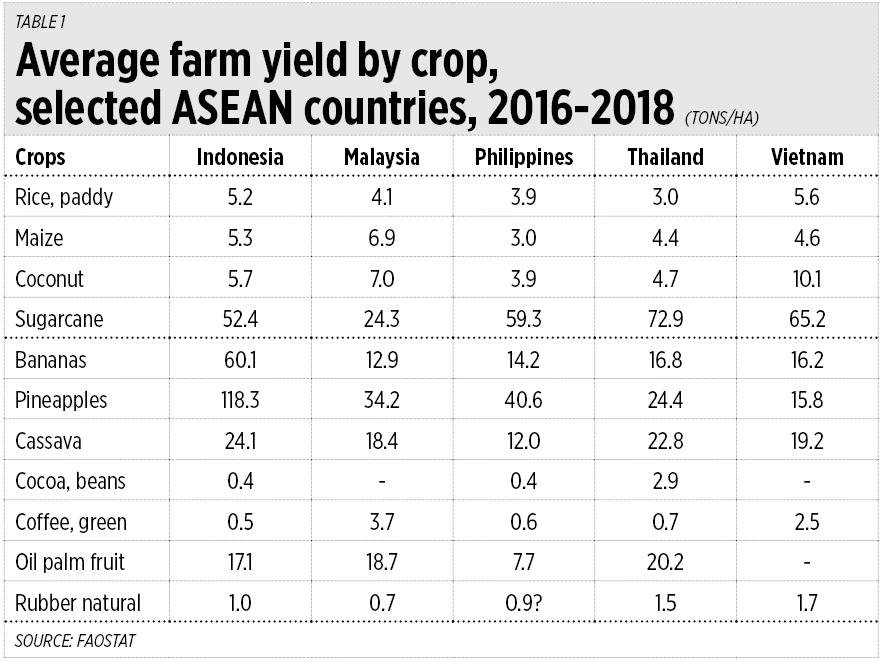
Across many crops, the Philippines lags. Vietnam and Indonesia are ahead. Thailand is low-yielder but it produces high-quality rice for export. Even in coconut, the Philippines is behind. Pineapple and banana are competitive. Cavendish banana comes at higher yields. On oil palm, Indonesia, Malaysia and Thailand are global leaders. On rubber, Thailand, Vietnam and Indonesia are the main players while coffee is dominated by Vietnam. (See Table 1.)

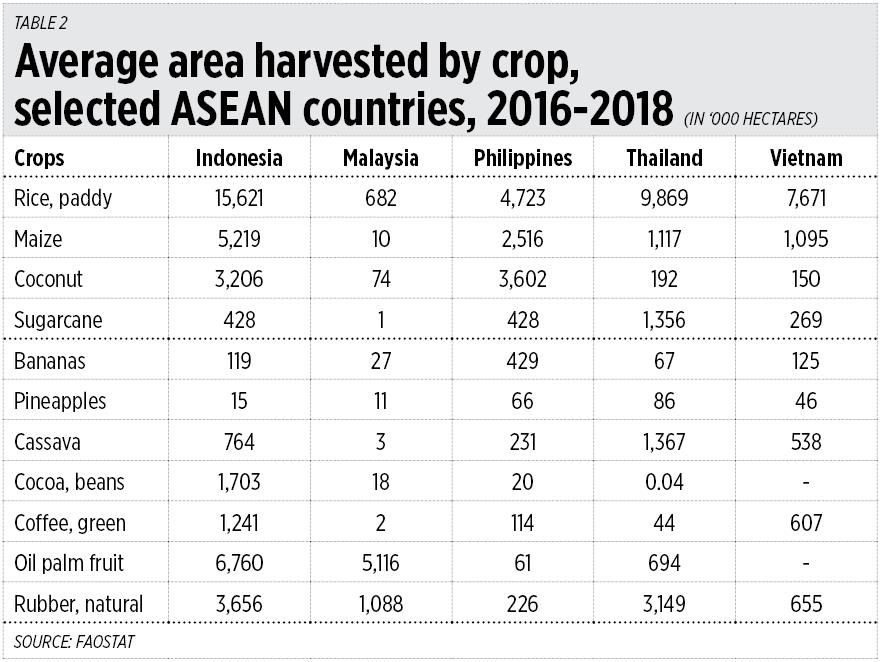
By area, palay — unmilled rice — dominates in most of ASEAN but other crops, like maize, coconut, sugarcane, cassava, coffee, oil palm and rubber, also have significant hectarage. (See Table 2.)

AGRICULTURAL EXPORTS
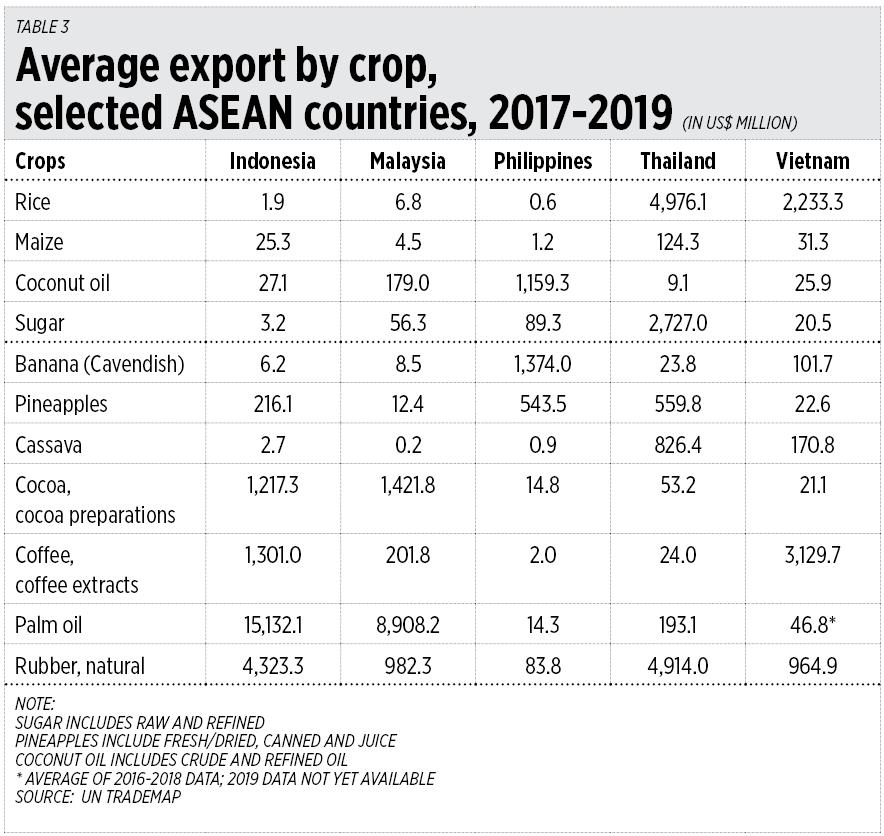
Every country’s agricultural export has global competition. However, the crop shifts and diversification instituted by our ASEAN peers have served to enhance their agri-export competitiveness:

  • The Philippines has coconut oil as a mainstay. Cavendish banana and pineapple have smaller areas but are world players.
  • Malaysia has palm oil, rubber and cocoa preparations. It boosted its palm oil because of comparative advantage over rubber due to higher yield and low labor inputs. The country is the manufacturing center of cacao products while importing beans from Indonesia and Africa.
  • Indonesia is the global player in palm oil, rubber, cocoa and coffee.
  • Thailand is in rice, rubber, sugar, cassava and pineapple.
  • Vietnam is a world player in rice, Robusta coffee and rubber. Cashew nuts and pepper have smaller areas but high yield and export earnings. (See Table 3.)

POVERTY
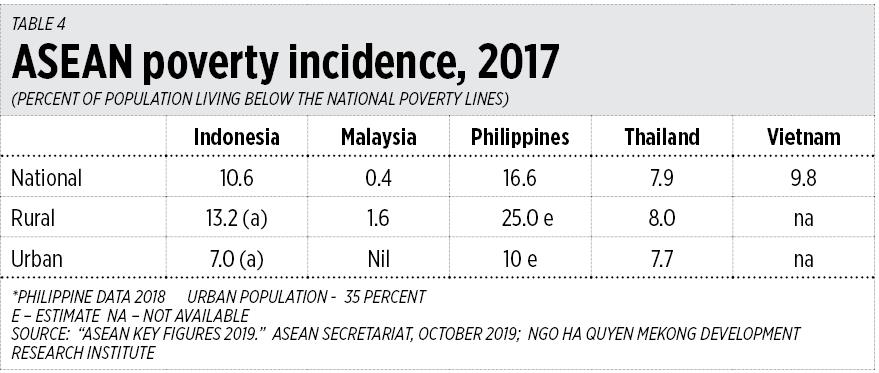
The Philippines severely lags in poverty measures in the ASEAN. Is it due to low productivity and poor diversification?

Such factors plus the lack of employment generation, among other things, contribute to high rural poverty. (See Table 4.)

Agriculture plays a crucial role in transforming the development economy and addressing poverty. The Food and Agriculture Organization cites that “the growth in agriculture has been more poverty reducing than growth in other sectors, having bigger impacts on the rural extreme poor.”

For rural areas, reducing poverty requires generating decent employment, both in the agricultural and non-agricultural sectors, and promoting participation in off-farm activities to diversify their livelihoods.

In the case of the Philippines, what must it do to reverse the long-term agricultural stagnation?

There has to be deep appreciation of the long-term causes of dismal agriculture performance — poor extension system, lack of meritorious bureaucracy, and limited land access.

The extension system should shift from the weak municipal local government units to the provincial level in order to achieve critical mass. A group of experts (CAMP) based in Los Baños is vigorously advocating this.

A merit-based bureaucracy must be re-engineered to introduce professionalized career service and continuity. This is a challenge in every administration as some key positions are not vetted on competence.

Freeing the land market is a running, contentious issue over the past 34 years. Land alone will not solve poverty. Lack of investment in the farms is a universal concern. Land markets must also be freed now to allow long-term leasing. The five-hectare ceiling must be lifted to achieve economies of scale to attract investors looking for economies of scale. While the country debates, our neighbors have advanced.

The most scarce commodity: good management. In my 40 years in agriculture development, I have observed this in Indonesia, Malaysia, Thailand and Vietnam. The Philippines’ status quo must be challenged here and now. Or else, the country’s agriculture will continue to be behind 20 years from now.

This article reflects the personal opinion of the author and does not reflect the official stand of the Management Association of the Philippines or the MAP.


Rolando “Rolly” T. Dy is the Co-Vice Chair of the MAP AgriBusiness Committee and the Executive Director of the Center for Food and AgriBusiness of the University of Asia & the Pacific.

map@map.org.ph

rdyster@gmail.com

http://map.org.ph

PhilHealth far from ready to administer universal health care program

Bahala na si Batman.

Kahit si Superman paupuin mo dito, baka hindi niya kaya.” (Even if you put Superman in my place, he might not be able to cope with the task.) That is what General Ricardo Morales, president and chief executive officer of the Philippine Health Insurance Corporation (PhilHealth), said as a way of explaining why the alleged irregularities in the state insurance firm cannot be fixed.

In reaction, Senate President Vicente Sotto III, who is leading the Senate investigation into the alleged corruption within PhilHealth, said in a tweet, “Tanggalin mo lahat ng corrupt, hindi kailangan si Superman!” (“Get rid of all the corrupt people, you don’t need Superman!”) PhilHealth is facing separate investigations on alleged corruption. The firm itself is investigating 20,000 cases of alleged fraudulent transactions involving P4.5 billion funds.

But even if you rid PhilHealth of corrupt officers and staff, there would still be tremendous wastage of funds due to incompetence and inefficiency on the part of the officers and staff. The operating system required by universal health care is too enormous and complex for PhilHealth to run as it does not have the competent and experienced people to operate such a system.

Then, there is the external factor of moral hazard. In health insurance, moral hazard occurs when the behavior of the insured person changes in a way that raises costs for the insurer since the insured party no longer bears the full costs of that behavior. In health insurance moral hazard is multiplied threefold as the professional and the healthcare facility may be parties to the misbehavior.

An example is the insured with a common cold asking a physician to recommend his hospital confinement. The insured gets a valid excuse for absence from work or school, the professional and the owner of the facility are paid by the insurer for their token care.

With 38 million indigents enrolled in PhilHealth, moral hazard takes on greater magnitude. Faked hospital confinement means free meals and a real bed for the indigent enrollee and revenue for the healthcare providers.

In a way, General Morales is right. Superman as head of PhilHealth would not be able to cope with the task even if all the corrupt people from the highest echelons down to the rank-and-file were removed. Handling moral hazard is beyond Superman’s capability.

The population of the Philippines is 109 million. Under a universal health care scheme, all 109 million are insured by PhilHealth.

According to the Department of Health (DoH), the 10 leading causes of morbidity in 2010 were: acute respiratory infection 1,289,168; acute lower respiratory tract infection and pneumonia 586,186; bronchitis/bronchiolitis 351,126; hypertension 345,412; acute watery diarrhea 326,551; influenza 272,001; urinary tract infection 83,569; TB respiratory 72,516; injuries 51,201; and diseases of the heart 37,589.

Morbidity is defined as “any departure from a state of physiological or psychological well-being.” In plain language, morbidity means “disease, injury, and disability.”

The DoH does not show the morbidity caused by the diseases of the kidneys, intestines, liver, pancreas, reproductive organs, sense organs, nervous system, muscles, bones, blood, the newborn, complications of pregnancy, mental disorder, and many others. It can be validly assumed that the total morbidity caused by these diseases runs in the millions.

Anyway, for the 10 leading causes of morbidity, the total for the year 2010 is 3,415,319. The population in 2010 was 93,970,000 million. In 2019 it was 108,310,000. By simple projection the total morbidity in 2019 is estimated to be 3,927,616. That translates into 3,927,616 PhilHealth members filing claims for reimbursement. That is a formidable processing job.

Spread over 365 days, that is 10,760 incidents a day. Spread over the 30 offices of PhilHealth all over the country, it means each office is receiving 358 claims a day. Validating one claim properly requires examining several documents like the physician’s diagnosis and the hospital or laboratory’s bill. That could take at least eight minutes.

In an eight-hour working day, a claims processor (in the insurance business the term is adjuster) has 480 working minutes. That means she can process at most 60 claims a day out of the 358 she is probably given to process that day. That is not counting the claims for the diseases other than the leading ones. Yes, even Superman would find processing all those claims intimidating.

The Constitution of the World Health Organization (WHO) states that “The enjoyment of the highest attainable standard of health is one of the fundamental rights of every human being without distinction of race, religion, political belief, economic or social condition.”

The right to health for all people means that everyone should have access to the health services they need, when and where they need them, without suffering financial hardship. No one should get sick and die just because he is poor.

In observance of the WHO declaration of healthcare for everyone, many countries launched universal health care programs. The Cuban government operates a national health system and assumes fiscal and administrative responsibility for the health care of all its 11.4 million citizens. There are no private hospitals or clinics as all health services are government-run.

In the United Kingdom, all aspects of medical services for all residents are covered by the National Health Service (NHS), which runs hospitals and pays doctors as employees. All medications associated with hospital visits are free of charge. The NHS is funded through taxation.

Many Filipinos migrating to another country choose Canada because its national health insurance system provides free care to all residents regardless of their ability to pay. The government keeps hospitals on a fixed budget to control costs, but reimburses doctors on a fee-for-service basis.

A country may have a basic level of universal health care. In reality though, the majority of its citizens still pay out of pocket for quality care or buy health insurance to defray the cost of appropriate standard of care.

In the ASEAN region, Singapore’s national health insurance plan, which is funded by payroll deductions and government subsidies, ensures its citizens affordable healthcare services.

Thailand’s universal healthcare scheme gives the members a gold card that they use to access services in their health district, and, if necessary, get referrals for specialist treatment elsewhere. The bulk of finance comes from public revenues.

On Feb. 20, 2019, President Rodrigo Duterte signed a Universal Health Care (UHC) Bill into law, Republic Act No. 11223. An Act Instituting Universal Health Care for All Filipinos, Prescribing Reforms in the Health Care System, and Appropriating Funds Therefor. The law automatically enrolled all Filipino citizens in the National Health Insurance Program, giving access to the full continuum of health services they need, while protecting them from enduring financial hardship as a result.

When implemented effectively, the Act will mean all Filipinos get the health care they need, when they need it, without suffering financial hardship as a result. However, there is much work to be done to implement the UHC Act.

PhilHealth, a government corporation attached to the DoH for policy coordination and guidance, was mandated to administer the National Health Insurance Program. This is the colossal weakness of the country’s universal healthcare system — PhilHealth administering the program.

PhilHealth is far from ready to manage such a massive and complex undertaking. First, it does not have people with formal training and substantial experience in health insurance to be able to formulate and promulgate policies for the sound administration of the program.

Morbidity rates are very important in health insurance. They are used in estimating the amount of funds to be set aside to cover benefits and claims for their customers. They are also used in determining the premium or price for its policies. It is obvious morbidity rates are not used by the people managing the funds.

The advancement payment of millions of pesos to a number of healthcare facilities is a reflection of the lack of competence in fund management and of knowledge of the concept of insurance. An insurance company generates additional funds by judicious placement of the enrollees’ aggregate fees in the money market. What the PhilHealth fund manager does is divert a large portion of the investable funds to non-interest earning placements.

Advance payment also goes against the cardinal principle of insurance — to compensate the insured for his loss. The insured person is paid only after he had incurred an expense.

The benefits set for each disease are unrealistic, making many sick Filipinos ruined financially.

Neither does PhilHealth have the required number of people with the technical know-how to validate the thousands of claims and thus ensure the proper use of the funds. There are many patients who were confined in the hospital for common cold but were paid an amount allotted for cases of pneumonia. That only means the processors of the claims are not knowledgeable of healthcare protocols.

In many countries universal health coverage is a political choice. It is in the Philippines. The legislators behind R.A. 11223 were motivated by political reasons. They rushed the formulation of the bill and pushed for its enactment into law in time for the 2019 elections but before the infrastructure for the program was ready.

There is a Filipino expression that goes, “Bahala Na ang Diyos” (“It’s up to God”). A person says it when he thinks he has done what can be done and leaves to God if there is anything else to be done. Actually, he feels not enough has been done but he is tired or he has a deadline to meet. The present generation, having been exposed to many Batman movies, has changed the expression. That must have been what the authors of the Act Instituting Universal Health Care expressed, “Bahala na si Batman.”


Oscar Lagman, Jr. was once country manager for a multinational health insurance company and at another time head of Healthcare Consulting at a large consulting firm. On a USAID grant, he attended an executive program on Managed Care in the US and observed several HMOs there.


How to make the UAE’s deal with Israel truly historic

By The Editors

The dramatic and welcome decision by the United Arab Emirates (UAE) to normalize relations with Israel is indisputably a win for both countries and for the Trump administration, which helped broker the deal. There’s an even bigger victory to be had, though, if all sides seize this opportunity to promote real peace in the region.

The three parties involved will be tempted to bask in this moment. Though Israel’s informal ties with the UAE have been strong for years and the deal merely brings them into the open, it’s nevertheless a breakthrough: proof, especially if others such as Bahrain and Oman follow the UAE’s lead, that Israel can establish relations with Arab countries before a final settlement with the Palestinians. Beleaguered Israeli Prime Minister Benjamin Netanyahu will gratefully accept the reprieve from his political difficulties. So will US President Donald Trump, who is eager to showcase some evidence of his dealmaking skills ahead of the November election.

For its part, the UAE has earned itself goodwill on both sides of the aisle in Washington — which will be useful in the struggle against its real geopolitical foe, Iran — as well as the chance to buy advanced weaponry from the US. But the leader of the UAE, Crown Prince Mohammed bin Zayed, could achieve much more. He traded recognition for a promise from Netanyahu to suspend his threat to annex a third of the West Bank, as originally envisioned under the Trump administration’s Middle East peace plan. Furious Palestinian leaders say that was merely a fig leaf. It doesn’t have to be.

The UAE now has a real chance to play peacemaker. Though Netanyahu says annexation has only been suspended temporarily, the fact is that he cannot afford to alienate MBZ, as the ambitious crown prince is known. If the latter is interested in pursuing peace, he should have little difficulty coordinating with Egypt and Jordan, the only other Arab countries to have normalized relations with Israel, and most important, with the US. MBZ already has good relations with the Trump administration. A Biden White House should be even more supportive of a real peace effort.

Israeli hardliners will say the deal shows that they don’t need to make peace with the Palestinians — that joint interests in technological and economic development, and especially in thwarting Iran’s ambitions, will inexorably push Arab nations and Israel together. They’re wrong. Normalizing ties with other Arab countries will not eliminate the Palestinian problem. In fact, by giving up on annexation, Netanyahu is effectively admitting that Israel cannot simply impose its will in the West Bank. Any move now to restart the process of annexation, or even to stonewall peace efforts, would risk a break not just with the UAE but its partners.

Palestinian leaders, too, should see that they have to deal with the Israel they have, not the one they want. Rather than continuing to fulminate, they should work with the UAE to develop concrete and realistic counter-proposals to the Trump plan, and push to reinvigorate talks in which they’re full and constructive partners. If they do, what might otherwise be a limited bilateral agreement could herald a real breakthrough.

BLOOMBERG OPINION