

Home Blog Page 8644

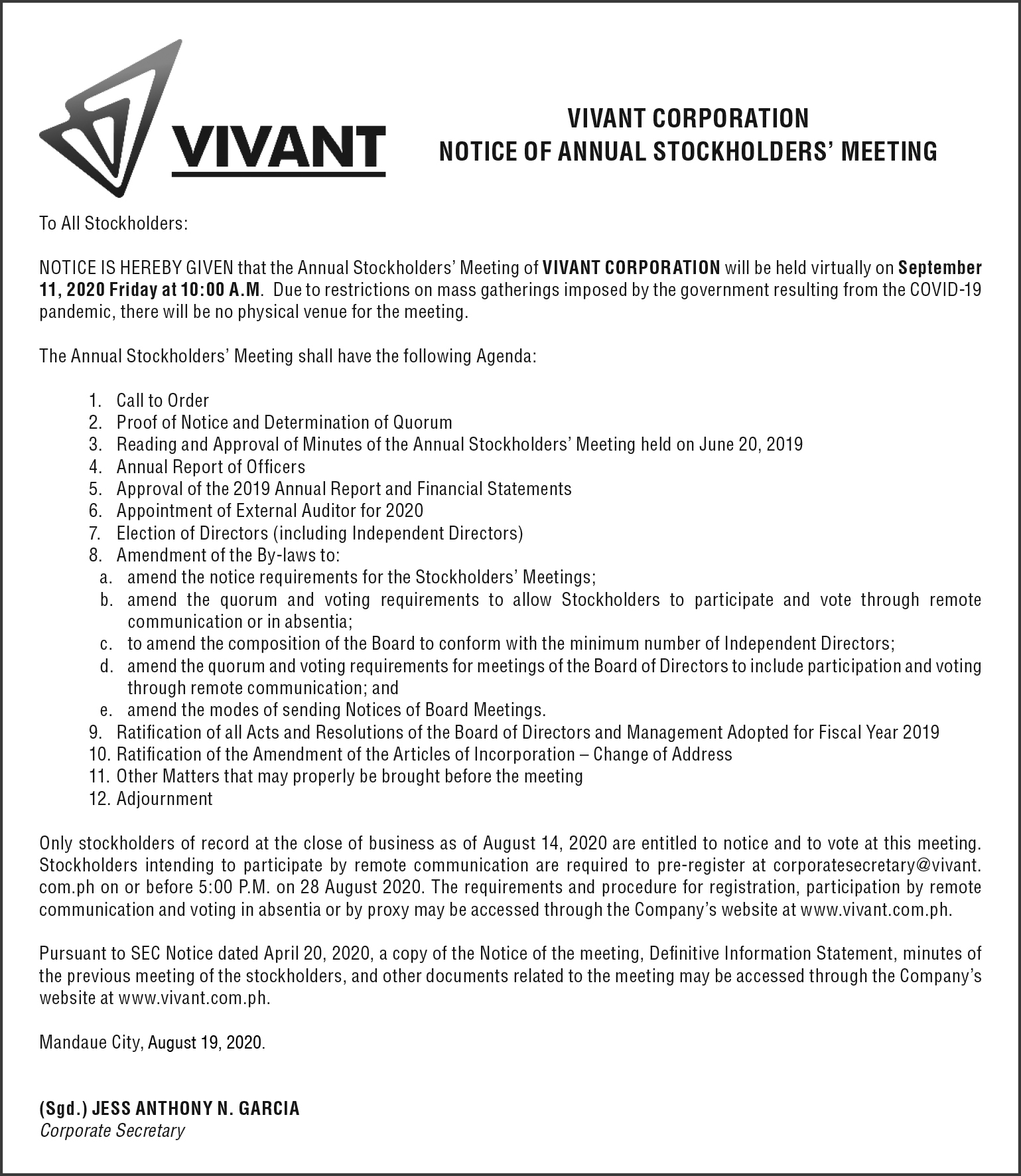
Vivant Corporation sets virtual annual stockholders’ meeting on September 11

How high is the Philippines’ ‘market potential’ compared with other economies?

How high is the Philippines’ ‘market potential’ compared with other economies?

How PSEi member stocks performed — August 19, 2020

Here’s a quick glance at how PSEi stocks fared on Wednesday, August 19, 2020.


Peso rallies as market expects dovish Fed signals

THE PESO continued to strengthen against the dollar on Wednesday on risk-off sentiment due to expectations of a dovish stance from the minutes of the US Federal Reserve’s latest meeting.

The local unit closed at P48.575 per dollar on Wednesday, appreciating by five centavos from its P48.625 finish on Tuesday, data from the Bankers Association of the Philippines showed.

This was the peso’s strongest finish in more than three years or since its P48.48-per-dollar close on Nov. 4, 2016, said Rizal Commercial Banking Corp. Chief Economist Michael L. Ricafort.

The peso started the trading session at P48.61 versus the dollar, which was also its weakest showing for the day. Meanwhile, its intraday best was at P48.525 against the greenback.

Dollars traded slipped to $794.5 million on Wednesday from the $875.4 million recorded on Tuesday.

The peso gained on the back of market expectations of dovish signals from the US Federal Reserve, a trader said.

“The peso appreciated on expectations of dovish guidance from the US Federal Reserve policy meeting minutes,” the trader said in an e-mail.

The US central bank in July left policy rates untouched at near-zero levels, with Fed Chairman Jerome Powell saying they will do what they can “for as long as it takes” to mitigate the impact of the pandemic and to foster growth.

The minutes of the Federal Open Market Committee’s July policy review will be released on Aug. 21.

The peso also continued to strengthen versus the dollar after the easing of restriction measures in Metro Manila, Mr. Ricafort said.

“[T]his helps improve economic recovery prospects and valuations,” he added.

Metro Manila and surrounding provinces Bulacan, Cavite, Laguna and Rizal are back under general community quarantine until Aug. 31 after two weeks under a tighter lockdown.

For today, the trader gave a forecast of P48.45 per dollar while Mr. Ricafort expects exchange rates to move within the P48.45 to P48.60 levels. — L.W.T. Noble with Reuters

Shares drop on profit taking ahead of BSP decision

STOCKS dropped on Wednesday as investors booked profits after the shift to relaxed quarantine protocols and ahead of the central bank’s policy-setting meeting.

The benchmark Philippine Stock Exchange index (PSEi) fell 114.33 points or 1.85% to 6,042.12 while the broader all shares index retreated 44.42 points or 1.22% to 3,591.36.

Philstocks Financial, Inc. Research Associate Claire T. Alviar said in a mobile phone message that the market declined after last-minute profit taking dragged the market to negative territory.

“Right after the optimism yesterday from the announcement of more relaxed quarantine measures, investors booked profits already, following some adjustments on the guidelines that have made it a little stricter; including but not limited to the suspension of operation of gyms and internet cafés,” Ms. Alviar said.

For Timson Securities, Inc. Head of Online Trading and Trader Darren Blaine T. Pangan, the local market declined due to the upcoming decision of the Bangko Sentral ng Pilipinas’ (BSP) Monetary Board on benchmark interest rates.

“Investors may have chosen to stay on the sidelines and wait for the decision to come out before they reposition on local stocks,” Mr. Pangan said in a mobile phone message.

The Monetary Board will hold its fourth policy-setting meeting for the year on Aug. 20. The BSP cut policy rates by 50 basis points (bps) in June, bringing the rates on its overnight reverse repurchase, deposit and lending facilities to 2.25%, 1.75% and 2.75%, respectively.

A BusinessWorld poll last week showed most economists expect the BSP to keep borrowing costs steady following signals from BSP Governor Benjamin E. Diokno.

All sectoral indices registered declines on Wednesday except for services, which rose 10.14 points or 0.69% to close the session at 1,460.20.

Meanwhile, property retreated 75.84 points or 2.54% to 2,905.21; holding firms went down 140.29 points or 2.19% to 6,261.18;  mining and oil declined 90.74 points or 1.53% to 5,820.56; financials dropped 16.90 points or 1.45% to 1,146.01; and industrials shrank 108.80 points or 1.37% to 7,819.44.

Decliners outpaced advancers, 95 to 92, while 42 names ended unchanged.

Value turnover stood at P5.47 billion with 1.36 billion shares changing hands, against Tuesday’s P5.96 billion on volume of 9.76 billion shares.

Net foreign selling amounted to P850.23 million on Wednesday, wider than the net P229.36 million that left the market in the previous session.

“Tomorrow (Thursday) being the last trading day of the week, we’ll have to see if the market manages to end above the 6,000 level for the second consecutive week, or if it fails to hold at this level,” Timson’s Mr. Pangan said. — Revin Mikhael D. Ochave

Senate ends PhilHealth corruption probe

PHILSTAR/MICHAEL VARCAS

THE PHILIPPINE Senate ended its investigation of corruption at the Philippine Health Insurance Corp. (PhilHealth) and has begun drafting a report that will be endorsed to anti-graft and prosecutorial agencies.

“We are done with the carousel of denials and lies,” Senate President Vicente C. Sotto III said in a statement on Wednesday.

PhilHealth President Ricardo Morales and other officials accused of pocketing billions of pesos in taxpayers’ money should get ready with their defense at the Ombudsman and Justice department, the lawmaker said.

“I’m formulating the committee report soon and will forward all findings to the Department of Justice,” Mr. Sotto said. “Enough is enough.”

“Filipinos don’t deserve a state health insurance that is so corrupt, made possible by officials entrusted with mandatory monthly deductions from hard-earned salaries of ordinary employees,” Senator Panfilo M. Lacson said in a separate statement.

He said Health Secretary Francisco Duque III, who is PhilHealth chairman, has stayed too long at both agencies in different capacities and has admitted in a public hearing that he had given his best but it wasn’t good enough, Mr. Lacson said.

“More than public interest, public health is imperiled with Secretary Duque at the helm of the Department of Health (DoH),” he said.

“Notwithstanding the trust and confidence reposed on him by the appointing authority, Filipinos deserve a good, competent, honest and capable DoH secretary,” he added.

Mr. Lacson said documentary and testimonial evidence from whistleblowers and resource persons were enough to indict corrupt officials responsible “for the systematic corrupt practices and malevolent acts that have practically dragged PhilHealth to its present financial death bed.”

The Senate committee found gross overpricing of equipment bought by PhilHealth and favoritism in the release of so-called interim reimbursement mechanism funds.

The mechanism allowed the agency to grant advance payments to health institutions by up to three months during the pandemic, even if only P1 billion had been liquidated.

Former PhilHealth anti-fraud legal officer Thorsson Keith earlier told senators at a hearing the agency’s top officials had pocketed P15 billion through fraudulent programs.

He said the sum came from overpriced equipment the agency had bought, as well as from a program that gave financial aid to health facilities amid a coronavirus pandemic. Mr. Keith called PhilHealth executive committee officers in-house mafia members.

Meanwhile, Senator Juan Miguel F. Zubiri filed a resolution asking the Office of the President to suspend top PhilHealth officials immediately.

This would stop them from tampering with evidence vital to separate probes by the National Bureau of Investigation, Commission on Audit (CoA) and Office of the Ombudsman.

“PhilHealth’s unwillingness to cooperate with regard to the submission of records could qualify as obstruction of justice that prevents the NBI from carrying out its responsibilities,” Mr. Zubiri said in the resolution.

He also cited the agency’s refusal or delay in the submission of documents and refusal to grant audit access to their record system.

PhilHealth officials on Tuesday admitted lying about the agency’s anomalous IT procurement program to avoid Senate detention for contempt.

During a Senate hearing, Mr. Lacson moved to cite PhilHealth Senior Vice-President Jovita V. Aragona and Acting Senior Manager Calixto I. Gabuya, Jr. for lying under oath.

He withdrew the motion after the officials admitted that they lied at the first hearing, where lawmakers found that PhilHealth officials had tried to buy obsolete network switches that were five times the price of newer models last year.

Former PhilHealth board member Alejandro L. Cabading said he had repeatedly flagged questionable budgetary items for the IT department, including a P2.1-billion budget proposal without details.

The agency nearly bought 15 units of an older model of a Cisco device used to manage computers in a local area network for P420,000 when a newer model costs only P62,000 each, Etrobal Laborte, who resigned as head executive assistant of PhilHealth President Ricardo Morales said earlier. 

PhilHealth officials including Mr. Morales have denied the allegations.

Mr. Duque, who attended the hearing for the first time on Tuesday, said the program was not exclusive to coronavirus facilities. He denied that some hospitals had been favored by the scheme.

Senator Ralph G. Recto questioned the request to allocate P10 billion under a bill seeking to give President Rodrigo R. Duterte special powers in the battle against the pandemic for coronavirus testing.

PhilHealth does not need more budget because it has about P200 billion in financial assets, Mr. Recto said, citing Deputy Treasurer Sharon P. Almanza.

Mr. Duterte earlier vowed to “finish off” PhilHealth officials involved in irregularities at the agency even if he had no plan to fire its chief.

He created a task force headed by the Department of Justice to investigate PhilHealth, including doing lifestyle checks and audits of its officials and employees.

The President also ordered the Office of the Special Assistant to the President Undersecretary Jesus Melchor Quitain to conduct a separate probe.

Mr. Morales earlier filed for a medical leave after he was diagnosed with cancer in February.

The PACC has said it had recommended the filing of charges against three dozen PhilHealth officials, which the Senate may adopt in its committee report.

PhilHealth Vice-President for Operations Augustus de Villa earlier quit his job but promised to cooperate with the congressional probe. — Charmaine A. Tadalan

COVID-19 infections nearing 174,000 as death toll hits 2,795

THE Department of Health (DoH) reported 4,650 new coronavirus infections on Wednesday, bringing the total to 173,774.

The death toll rose by 111 to 2,795 while recoveries increased by 716 to 113,481, it said in a bulletin.

There were 57,498 active cases, 91.4% of which were mild, 6.5% did not show symptoms, 0.9% were severe and 1.2% were critical, the agency said.

Of the new cases 3,092 came from Metro Manila, 249 from Cavite, 194 from Laguna, 189 from Rizal and 136 from Bulacan, DoH said.

Fifty-two of the new deaths came from Metro Manila, 29 from Central Visayas, 11 from the Calabarzon region, six from Central Luzon, four each from the Zamboanga Peninsula and repatriates, two from Western Visayas, and one each from Bicol, Davao, and the Bangsamoro Autonomous Region in Muslim Mindanao.

More than 1.9 million individuals have been tested for the virus, DoH said. The new cases came from tests done by 97 out of 105 licensed laboratories, it added.

President Rodrigo R. Duterte this week relaxed the lockdown in Manila and nearby cities and provinces despite a fresh surge in coronavirus infections. — Vann Marlo M. Villegas

Court urged to order palace disclosure of Duterte health state

A LAWYER has asked the Supreme Court to compel the government to disclose the health condition of President Rodrigo R. Duterte.

In a manifestation, lawyer Dino S. de Leon asked the court to act on his appeal after it rejected his petition to disclose Mr. Duterte’s health condition. He also asked the court to hold oral arguments on his plea.

Mr. De Leon said rumors about Mr. Duterte’s health could have been avoided if the government had divulged his health condition.

The matter could be put to rest if the tribunal orders the Office of the President to disclose the state of Mr. Duterte’s physical and mental health to the public.

Mr. De Leon said the health of the President must be disclosed as the country deals with a coronavirus pandemic.

“The need for the nation to be protected from a feeble government is more pronounced in the middle of this pandemic,” he said. “If the country is to hope for any measure of success, its people must necessarily be able to depend on its highest leader to steer the country through these times and produce proper results, not just provide weekly talks filled with hubris and empty promises.”

“At the very least, our people deserve to know if we have a leader who is still fit to lead the country,” according to a copy of his pleading.

Mr. De Leon cited rumors about a medical jet landing in Davao City and a return flight to Singapore that allegedly carried a “high-profile person,” whom the presidential palace denied to be Mr. Duterte.

He also cited Mr. Duterte’s exposure to Interior Secretary Eduardo M. Año, who had tested positive for the COVID-19 (coronavirus disease 2019) virus.

Senator Bong Go, the president’s former aide, released a photo of the President in his home in Davao and a video showing that Mr. Duterte was going to a meeting with the inter-agency task force.

Mr. De Leon said Mr. Duterte appeared “lethargic and edematous” in the photo, “with his right eyelid visibly drooping,” contrary to Presidential Spokesman Harry L. Roque’s claim that he was fine. — Vann Marlo M. Villegas

Most provinces still reluctant to admit buses from Metro Manila

THE LAND Transportation Franchising and Regulatory Board (LTFRB) said Wednesday that the reopening of provincial bus routes is running into continued opposition from most provinces, who remain unwilling to open their borders to travelers from Metro Manila.

“It has always been a concern. In fact, we already had a meeting with the umbrella organization of locally elected officials kung saan nagsabi sila na (where they stated that) a large majority of the provinces are still not willing to open up their borders,” LTFRB Chairman Martin B. Delgra III said in a virtual briefing.

He said the LTFRB is looking forward to the reopening of provincial bus routes, but it should come with the consent of local government units (LGUs).

Nangunguna po ‘yung public health consideration natin dito (Public health considerations remain the priority),” he noted.

“Among the preparations (for restoring bus service) are the consultations and dialogues with integrated bus terminal operators para mapaghandaan nila yung mga terminals nila (to get their terminals ready),” he said.

He said the Transportation department, the LTFRB and the Metropolitan Manila Development Authority have identified the integrated terminals for buses that will be coming from provinces.

Meron pong mga lugar na kung saan pinapayagan na po ng kanilang respective LGUs ‘yung inter-regional routes, gaya sa Mindanao, kung saan meron na pong byahe galing sa Caraga going to Davao City, or from Cagayan de Oro to Caraga. So sa mga lugar kung saan nagbubukas na po ang mga LGU ng kanilang mga border, pinapayagan na po natin ang mga provincial buses, but then again in a calibrated manner (Some inter-regional routes are running, like Caraga to Davao City or Cagayan de Oro to Caraga. Provincial buses are allowed in a calibrated manner in some LGUs that admit them),” Mr. Delgra added.

He said the LTFRB may propose to LGUs common pick-up and drop-off points for provincial buses.

Tinitingnan natin… kung okay ba sa LGU na doon sa integrated terminal sa kanilang lugar o kaya doon malapit sa hospital in case there will be some health emergencies that need to be addressed o kaya malapit sa kanilang quarantine or isolation facility (We’ll see if they agree to integrated terminals or points near hospitals or isolation facilities in the event of an emergency),” he said.

The government added more routes and allowed more public vehicles to operate after Metro Manila and nearby cities went back to a more relaxed form of lockdown Wednesday.

The LTFRB said the number of traditional jeepneys allowed to operate in areas under general community quarantine (GCQ) had risen by more than half to 12,443 from the previous lockdown.

The number of UV Express units allowed to operate also increased by almost two-thirds to 1,621.

The regulator increased the routes of UV Express units to 51 from 47, while traditional jeepney routes rose to 126 from 63.

More than 3,600 public utility buses have been allowed to operate, along with 364 point-to-point buses. — Arjay L. Balinbin

Senate backs separating measures for financial industry from Bayanihan II legislation

THE SENATE prefers to legislate pandemic relief measures specific to financial institutions separately from the Bayanihan II bill, as opposed to the House of Representatives’ more integrated proposal, Senator Grace S. Poe-Llamanzares said at an online briefing Wednesday.

The Bicameral Conference Committee is now reconciling versions of the Bayanihan to Recover as One Act, also known as Bayanihan II, under House Bill No. 6593 and Senate Bill No. 1564. The bill is a pillar of the government’s stimulus plan.

Provisions that need to be harmonized in conference committee were the inclusion of key features of the Financial Institution Strategic Transfer (FIST) and Government Financial Institutions Unified Initiatives to Distressed Enterprises for Economic Recovery (GUIDE) bills in the House version.

“That is actually a point of contention between some members of the House and the Senate,” Ms. Poe-Llamanzares said.

“This is very bank-specific. What we did instead and this is the suggestion of the Senate… is not to include FIST and ARISE in Bayanihan 2,” she said.

Ms. Poe-Llamanzares noted that the panel will tackle the FIST provision today, adding that she hopes to conclude meetings in time for ratification next week.

The GUIDE bill calls for the creation of an entity to be known as Accelerating Recovery to Intensify Solidarity and Equity, Inc. (ARISE, Inc.) which will assist companies address solvency issues. The FIST bill allows for the transfer of bad loans to asset management companies, in order to keep banks healthy.

Ms. Poe-Llamanzares is  a member of the panel and chairs the Senate Banks and Financial Intermediaries committee.

She added that while the Senate wants a separate bill for financial institutions, the chamber supports an injection of P50 billion to the Land Bank of the Philippines and the Development Bank of the Philippines for lending to micro, small, and medium enterprises.

Asked how the government will fund the other measures, Ms. Llamanzares said “Yesterday, when I was discussing this…, if we’re going to have a separate bill, will we have money for that? The answer of some of our colleagues was the DoF wants this bill to happen, so they will find money for that.”

The panel has also agreed that there will be no jeepney phase out during the pandemic.

Funding will be allocated for the service contracting of public utility vehicles, granting of allowances to  displaced drivers and fuel vouchers to other affected drivers.

Bayanihan II will grant special powers to President Rodrigo R. Duterte to realign items in the 2019 and 2020 national budget for the coronavirus containment effort. — Charmaine A. Tadalan

Pandemic side businesses driving digital banking shift — UnionBank

NEW SIDE businesses that emerged during the pandemic are leading the charge in adopting digital payments, UnionBank said.

“People have now become chefs and bakers and selling on Viber and Facebook groups,” Ana Maria A. Delgado, the bank’s chief customer care experience officer and an executive Vice-President, said in an online briefing Wednesday.

Among more established e-commerce businesses, “We’ve also seen the emergence of livestream selling where you are using videos to explain products further and get people to interact,” she said.

She added these trends are part of a broader shift in consumer behavior during the coronavirus disease 2019 (COVID-19) pandemic.

“For example, you might have held face-to-face events and have a captive audience for an hour. Now on digital, people are more distracted by other things, right? So what you would have said in an hour, you now need to say in maybe 10 minutes,” she said.

People staying at home have been relying more on digital bank transactions.

Ms. Delgado said UnionBank online transactions have since surpassed in-branch dealings by a wide margin, which she quantified as “in the millions.”

She added that a partnership with the 7-Eleven chain of convenience stores which allows cash-in transactions to UnionBank has gained traction not only for personal purposes but also for business transactions. The bank is also exploring allowing cash-out withdrawal transactions through 7-eleven stores.

During the lockdown, UnionBank launched an app to allow money transfers to remittance centers.

UnionBank’s net profit declined 26.9% to P1.86 billion in the second quarter on increased loan provisions. In the first half, net earnings fell 5.6% to P4.5 billion.

UnionBank finished trading at P54 Wednesday, gaining five centavos or 0.09%. — Luz Wendy T. Noble

Increased joblessness expected to pressure insurance premiums

THE INSURANCE industry will likely take a hit from rising unemployment as jobless policyholders direct their money to other needs instead of staying current on their premiums.

The industry is bracing for a wave of clients abandoning their policies after losing their jobs, Singapore Life (Singlife) Philippines President Rien Hermans in an interview last week.

In the Philippines, Mr. Hermans said many Filipinos buy insurance products as a way to save up for future needs such as education and retirement, or to build up investments through variable universal life insurance products.

“You can imagine that if you lose your job, you don’t have money coming in… so people may surrender their policies to get the money, so that will be a big challenge for insurance companies,” Mr. Hermans said.

The unemployment rate rose to 17.7% in April from 5.1% a year earlier, equivalent to 7.25 million out of work, compared with 2.27 million in April 2019.

He said another challenge is that insurance agents cannot hold meetings or attend events and conventions to sell products as mass gatherings are still banned, while clients are still wary of going out because of the virus.

However, he said companies like the fully-digital Singlife Philippines are in a more favorable position as clients are now becoming more open to the use of technology.

He added that the sector should be “okay” even with some uptick in claims given the nature of the business while investments should still provide some returns as insurers are required by law to hold safe investments like government bonds.

“Looking at the longer term, the challenge would be how quickly is the economy bouncing back,” he said.

“Driven by the demographics, young educated population, and the ambition to make the economy one of the fastest-growing in Asia, I think we will get back (to a growth trajectory) and that also means that people would want more insurance. They will put money away for their kids’ education or set up a business,” he added.

Singlife Philippines hopes to introduce its flagship insurance savings plan, known as “Singlife Account,” by early next year.

Its initial products will be launched this year through the mobile wallet firm GCASH.

It obtained its license from the Insurance Commission in February to become the first fully digital life insurance company in the country. Its target is 500,000 clients in the next five years. — Beatrice M. Laforga