Home Blog Page 8244

Shares rise on vaccine rollout, bargain hunting

COURTESY OF PHILIPPINE STOCK EXCHANGE, INC.

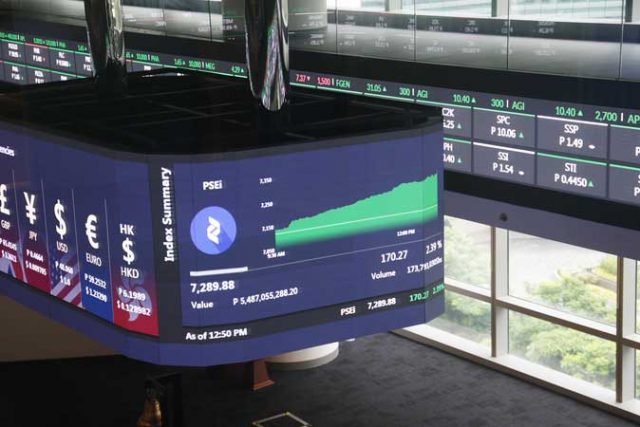
LOCAL shares closed in the green on Tuesday as investors went bargain hunting amid progress in the country’s coronavirus disease 2019 (COVID-19) vaccinations and the peso’s strength versus the dollar.

The benchmark Philippine Stock Exchange index (PSEi) went up by 40.66 points or 0.62% to close at 6,500.42 on Tuesday, while the broader all shares index increased by 19.81 points or 0.49% to 3,988.83.

“Market has risen today on bargain hunting on optimism brought about by continued vaccine rollout, easing of restriction, and stable peso,” Diversified Securities, Inc. Equity Trader Aniceto K. Pangan said in a text message on Tuesday.

Meanwhile, First Metro Investment Corp. Head of Research Cristina S. Ulang said in a Viber message that the index improved due to positive economic data, such as the growth in remittances from overseas Filipino workers in February, the relaxation of mining rules, and a pause in the rise of the yield on the benchmark 10-year US Treasuries.

For his part, AB Capital Securities, Inc. Junior Equity Analyst Lance U. Soledad, equity analyst at AB Capital Securities, Inc., attributed the PSEi’s climb to last-minute buying.

“Trading was still thin and foreigners remained net sellers for the 13th straight session despite the rally,” Mr. Soledad said via Viber message.

Net foreign selling slowed to P486.97 million on Tuesday from the P704.45 million seen on Monday.

“The market is in equilibrium as buyers and sellers have balanced each other out,” AAA Southeast Equities, Inc. Research Head Christopher John J. Mangun said in an e-mail.

“Optimism on the economy’s recovery and inoculation progress was canceled out by soaring new COVID-19 cases and tighter restrictions,” Mr. Mangun added. “Several mining issues advanced as investors’ speculate potential developments while taking advantage of the broader market’s advance.”

All sectoral indices posted gains on Tuesday. Mining and oil improved by 197.23 points or 2.17% to close at 9,259.99; industrials went up by 141.24 points or 1.64% to 8,703.89; property rose by 20.71 points or 0.65% to end at 3,203.25; financials gained 6.95 points or 0.49% to finish at 1,400.48; holding firms increased by 16.56 points or 0.25% to 6,593.84; and services inched up by 3.30 points or 0.23% to 1,439.21.

Value turnover increased to P5.52 billion on Tuesday with 5.84 billion issues traded from the P4.89 billion with 6.26 billion shares switching hands in the previous day.

Advancers outperformed decliners, 106 versus 84, while 56 names closed unchanged.

AB Capital Securities’ Mr. Soledad said he expects the PSEi to finish between 6,400 to 6,700 before the release of data on the country’s first quarter gross domestic product next month. — K.C.G. Valmonte

Imported car sales rise on weak year-earlier base

REUTERS

IMPORTED CAR sales nearly doubled in March after coming off a weak year-earlier base, with March 2020 marking the start of that year’s lockdown, the industry association said.

In a report Tuesday, the Association of Vehicle Importers and Distributors, Inc. (AVID) said its 21 members carrying 26 global brands sold 5,193 units in March, up 95% jump from a year earlier.

In March 2020, the Luzon-wide lockdown shut down auto dealerships.

In the first quarter of 2021, sales rose 9% year on year to 15,857 vehicles.

Month-on-month sales however declined 4%.

Passenger car sales rose 34% to 1,372 units in March, led by Suzuki Philippines, Inc. The category’s year-to-date sales were down 7% at 4,241.

“The slow uptick of PC (passenger cars) is a result of continued low consumer confidence,” AVID President Ma. Fe Perez-Agudo said.

“But let us not discount the commendable performances of LCV (light commercial vehicles) and CV (commercial vehicles), and the hard-working teams that drive them. We see these two segments as our industry’s lifesavers as they lend indispensable support to the country’s revitalized infrastructure development programs.”

Light commercial vehicle sales rose 125% year on year to 3,676 units in March led by Ford Group Philippines, Inc. First quarter sales rose 13%.

Commercial vehicle sales by Hyundai Asia Resources, Inc. in March rose sharply to 145 units from six a year earlier. First quarter sales totaled 418 units from 92 a year earlier.

Other car industry groups reported March sales gains of 88%. These automakers sold 20,702 vehicles in March compared with 11,029 in the same month last year, according to a joint report issued by the Chamber of Automotive Manufacturers of the Philippines, Inc. (CAMPI) and Truck Manufacturers Association (TMA), reflecting the performance of automakers that manufacture in volume domestically.

Imported car sales growth in 2021 is expected to come in at between zero and 20%, depending on the government’s final decision on safeguard duties, Ms. Perez-Agudo said last month.

The Trade department imposed 200-day provisional safeguard duties on imported cars to protect domestic-industry jobs after it found a link between a decline in employment and higher imports, following a petition from an auto parts industry union. — Jenina P. Ibañez

Supply and prices of fish stabilize, Agri dep’t says

PHILIPPINE STAR/ MICHAEL VARCAS

THE SUPPLY and prices of fish sold in the so-called “NCR plus” quarantine area, consisting of the National Capital Region and Cavite, Laguna, Rizal, and Bulacan provinces, have stabilized, the Department of Agriculture (DA) said.

Agriculture Secretary William D. Dar said in a statement Tuesday that the normalization of the fish market coincides with the peak season at the country’s main marine fishing grounds.

“(Between) April 8 and 14, total volume of marine fish catch unloaded at the Navotas Fish Port Complex amounted to 3,760 metric tons (MT), 200 MT more than the previous week,” Mr. Dar said.

Mr. Dar said 2,280 MT consisted of galunggong, (round scad) while the remainder consisted of species known by their local names such as turay, tulingan, tunsoy, tamban, pusit (squid), matambaka, gulyasan, dalagang bukid (yellowtail fusilier), and shrimp.

He said these fish were sourced from Eastern and Northern Palawan, the Zamboanga Peninsula, and the Visayan Sea.

“Supply of bangus (milkfish) and tilapia were also abundant from fish pens and fishponds of Bulacan, Pangasinan, Taal Lake in Batangas, and Laguna de Bay,” Mr. Dar said.

Mr. Dar said the prevailing retail prices of in-demand fishery products were stable in most public markets in Metro Manila and nearby provinces.

He added that the price of galunggong ranged from P180 to P240 per kilogram, tilapia P120 to P130, and bangus P180.

“These were an improvement compared to prices during the latter part of 2020 and first quarter of 2021, when prices of galunggong were as high as P300 per kilogram, bangus P220 per kilogram, and tilapia P160 per kilogram,” Mr. Dar said.

“In the months ahead, we will continue to make fishery products and food, in general, accessible and affordable to all consumers, particularly in the ‘NCR plus’ area and in other urban communities, where the threat of hunger looms,” he added.

At a virtual briefing on Tuesday, Agriculture Undersecretary Cheryl Marie Natividad-Caballero said the DA continues to provide support and assistance to keep fishermen safe all over the country, especially in the West Philippine Sea.

Ms. Natividad-Caballero said the Bureau of Fisheries and Aquatic Resources is conducting patrols with the help of the Philippine Coast Guard and the National Task Force for the West Philippine Sea.

“We continue to strengthen our capability to monitor our commercial fishers as well as those fishers involved in the West Philippine Sea and even in the high seas such as the installation of transponders for better tracking,” Ms. Natividad-Caballero said.

Recently, Chinese ships have been sighted in parts of the Sea which the Philippines claims as part of its exclusive economic zone. — Revin Mikhael D. Ochave

Hog farmers say lower tariffs not necessary

THE hog raising industry said lowering tariffs on pork imports is not needed to resolve the pork shortage.

Samahang Industriya ng Agrikultura Chairman Rosendo O. So said in a mobile phone message that the pork shortage can be addressed even with the previous tariff rates, while still allowing importers to charge P200 to P250 per kilogram.

“Increasing the minimum access volume (MAV) quota and lowering tariffs will only increase the profits of importers at the expense of Filipino consumers who will not benefit from lower pork prices,” Mr. So said.

In an address to the nation late Monday, President Rodrigo R. Duterte said his economic managers are in favor of temporarily lowering import tariffs and raising the MAV quota for pork imports.

He added that Executive Order (EO) No. 128, which lowered the tariffs on pork imports, can be withdrawn once market conditions improve.

Kapag malakas na ‘yung domestic market and there is movement, we can always withdraw the EO that I signed. Madali naman iyan. (Once the domestic market is stronger and there is movement, we can always withdraw the EO that I signed. That is easy),” Mr. Duterte said.

“It is just a temporary measure to bring down prices,” he added.

Mr. Duterte signed EO 128 on April 7, which set the tariff on pork imports within the MAV quota at 5% in the first three months, increasing to 10% over the following nine months. The tariff for out-of-quota pork imports was set at 15% for the first three months, rising to 20% in the succeeding nine months.

Previously, pork imports within the MAV quota were charged 30% tariffs, while out-of-quota pork imports paid 40%.

Mr. Duterte also recommended that Congress increase the MAV quota by 350,000 metric tons (MT) on top of the current allocation of 54,210 MT, in order to address the estimated pork deficit as estimated by the Department of Agriculture (DA) of 400,000 MT. Hog numbers have dropped because of the African Swine Fever outbreak. 

Edwin G. Chen, president of the Pork Producers Federation of the Philippines, Inc., said in a mobile phone message that the lowering of tariffs will not result in cheaper pork prices.

“The lowering of tariff will not only flood the market with imported pork, but it will also harm the local producers,” Mr. Chen said.

Nicanor M. Briones, Agricultural Sector Alliance of the Philippines, Inc. president, said in a mobile phone message that the pork supply may further deteriorate with more imports as hog raisers will be discouraged from growing their herds.

“Backyard hog raisers and small commercial raisers will be forced to stop their operations. This will worsen the supply situation,” Mr. Briones said.

Meat Importers and Traders Association President Jesus C. Cham said in a mobile phone message that Congress should not object to the EO, adding that the issues affecting the hog industry are separate from the need to lower pork prices.

“The issues should be decoupled — provide affordable pork to consumers and help the hog sector recover,” Mr. Cham said.

“Congress should not object to the EO and they should fund the DA appropriately,” he added.

The President’s spokesman Herminio L. Roque, Jr. said in a virtual briefing Tuesday that the EO is subject to revocation if Congress wants to make changes.

Mr. Roque said that under the Constitution, Mr. Duterte only exercised his authority over tariffs while Congress is not in session.

“Once Congress resumes session and they convene and decide to override the EO, they can do so since that is within their power,” Mr. Roque said.

Resolutions were recently adopted both in the Senate and the House of Representatives seeking either the withdrawal or cancellation of EO 128.

In a separate statement Tuesday, Finance Secretary Carlos G. Dominguez III said he recommended the temporary lowering of pork tariffs and increasing import volumes. The same conclusion was reached by the Economic Development Cluster after extensive consultations and deliberations.

Mr. Dominguez said the proposed pork import program will only account for 22.8% of total consumption.

“To allay the fears of our local hog raisers, the MAV Management Committee can also issue additional rules and regulations for the MAV allocation to be subject to a quarterly review as an additional measure to avoid imported pork flooding the market and depressing local prices below profitable levels,” Mr. Dominguez said.

Meanwhile, the Land Bank of the Philippines (LANDBANK) is increasing its loan support to pork producers and feed millers to P30 billion, from the original P15 billion, to assist in repopulation efforts and keep millers afloat.

The bank is expanding its loan window for hog raisers after a directive from Mr. Dominguez to double its support to the industry.

“LANDBANK is doubling its funds available for financing swine repopulation, feed milling operations and facility upgrades in order to help address at the soonest the supply shortfalls and subsequent retail price spirals affecting both hog producers and pork consumers,” Mr. Dominguez said. — Revin Mikhael D. Ochave

Credit access for small firms still unreliable, study finds

BW FILE PHOTO
BW FILE PHOTO

SMALL-BUSINESS access to credit in the Philippines remains irregular during the pandemic, according to a survey conducted by CPA Australia.

The survey, which took in input from 300 small businesses, CPA Australia found that 64% of respondents sought external financing last year to either grow their businesses or survive the pandemic.

The study took in the responses of 4,227 small firms in 11 markets across the Asia-Pacific last year, including the Philippines, Australia, China, Hong Kong, India, Indonesia, Malaysia, New Zealand, Singapore, Taiwan, and Vietnam.

Only 13% of Filipino respondents said accessing external funding was easy or extremely easy — the lowest rate in the entire survey. CPA Australia said 21% opted to tap their family and friends rather than go to banks for loans. Only 15% chose formal financing.

It said only 16% of Filipino respondents expect to have easy access to external financing this year. The survey average was 28%.

“Difficulties in accessing external finance may hinder business plans to hire more employees, invest in technology or expand to new markets. Small businesses in the Philippines should consider seeking professional advice to maximize their success in obtaining external finance,” Mark Chau, regional general manager of business development international at CPA Australia said in a statement.

However, Mr. Chau said the study also revealed that small firms in the Philippines are willing to innovate and connect with their customers through social media.

He said the young workforce and growing demand supported small Filipino companies last year.

Around 62% of respondents in the Philippines said their businesses grew last year, higher than the regional average of 46%.

The online boost that these companies experienced was mostly higher than average, with 56% of small businesses in the Philippines saying their operations were more profitable after investing in technology. The regional average was 48%.

Around 62% earned 10% of their total income from online sales, above the 58% average, while 61% of small companies in the Philippines generated 10% of their sales through online payments, against the survey’s 64% average.

This year, 73% of respondents in the Philippines are expecting growth, 52% are likely to grow their headcount, 31% will launch new products and services, while 22% are projecting more revenue from overseas clients.

“Pending the effectiveness of the rollout of COVID-19 vaccinations and the control of COVID-19 cases, the dynamism of Filipino small businesses should help drive an economic rebound this year as restrictions are gradually eased and global economic activity returns to normal,” Mr. Chau said. — Beatrice M. Laforga

Safety nets for poor seen raising buying power by up to 50%

EXPANDING SOCIAL protection programs such as universal child benefits, disability benefits and old-age pensions for the poor in the Philippines could boost their purchasing power by up to 50%, a United Nations (UN) agency said.

In a report issued Tuesday, the UN Economic and Social Commission for Asia and the Pacific (ESCAP) said the pandemic has exposed gaps in social protections across Asia and the Pacific, pointing to the need for governments to expand their coverage to lift more families out of poverty.

“Simulations for 13 developing countries in the Asia-Pacific region show that if governments offered universal child benefits, disability benefits and old-age pensions, at conservative benefit

levels, more than one-third of people would be lifted out of poverty,” according to the report, “Beyond the Pandemic.”

Applying such measures to the poorest households in the Philippines could increase their purchasing power by 50%, ESCAP said, an effect also observed in Indonesia, the Maldives, and Sri Lanka.

However, the report noted that expanding social protections means governments need to boost their investment in such measures to as much as 6% of gross domestic product (GDP).

“Almost all countries in the region can afford this, especially when they consider the cost of doing nothing,” ESCAP said.

It estimated that many governments’ budgets for social protection are currently at just 2% of GDP. The Asia Pacific average was 5%, much less than the global average of 11%.

In the Philippines, one of the government’s flagship social protection programs is the Pantawid Pamilyang Pilipino Program (4Ps), which consists of targeted payments to low-income households, on the condition that they keep their children in school and attend regular medical check-ups. Funds allocated for the program hit P106 billion this year.

Last year, the government also launched a P200-billion social amelioration program which provided two-months’ worth of cash aid to families hit hard by the lockdown.

Aside from expanding social protections, ESCAP Executive Secretary Armida Salsiah Alisjahbana said Tuesday that countries should also invest in their recovery, keep trade and information flowing, and address environmental issues.

Investment for a sustainable recovery will see governments rolling out programs aligned with Sustainable Development Goals (SDGs), with a focus on health, education and infrastructure. ESCAP estimated the region needs additional investment of $1.5 trillion per year in the relevant sectors to achieve the 17 SDGs by 2030.

“If they are to offer large fiscal support while ensuring fiscal and debt sustainability, countries may need to go beyond traditional prudence and utilize unconventional fiscal tools,” it said.

To create more fiscal space, ESCAP said governments can curb non-developmental expenditures like military budgets, while introducing carbon taxes to raise more revenue while aiding climate change mitigation. Adopting “more equitable forms of taxation” such as focusing on income taxes where the wealthy pay more, rather than increasing indirect taxes, such as those imposed on goods in which rates are the same across all income sectors.

“The richest citizens can also contribute more through taxes on wealth and property. Such taxes are largely missing in the region, so inequality is passed from one generation to the next,” it said.

Keeping global trade and supply chains flowing is also crucial in attaining recovery, because it will ensure that vulnerable communities maintain their access to goods. — Beatrice M. Laforga

One-time grant for work-disability pensioners to cost P600 million

PHILSTAR

THE DEPARTMENT of Labor and Employment (DoLE) will allocate about P600 million for work-disability retirees due to receive grants of P20,000 each via the Employees Compensation Commission (ECC).

The one-time grants were authorized Monday by President Rodrigo R. Duterte via Administrative Order No. 39, which cited the need to aid pensioners struggling during the pandemic.

In a statement Tuesday, DoLE said the ECC will disburse the package to 31,000 pensioners granted disability retirements, from both the private and public sector.

ECC Executive Director Stella Zipagan-Banawis was quoted as saying that qualified pensioners will not need to apply to the Social Security System (SSS) or Government Service Insurance System (GSIS) to receive the grant, which will be provided to EC pensioners classified by the two pension funds under the permanent partial disability, permanent total disability, and survivorship programs.

“It will be automatically granted to them in the same manner as their pension was processed,” DoLE said.

The grant will be released once the implementing rules and regulations are issued. The ECC is tasked with issuing the guidelines in coordination with the SSS and GSIS. — Gillian M. Cortez

House panel approves measures to benefit power line workers

PHILSTAR

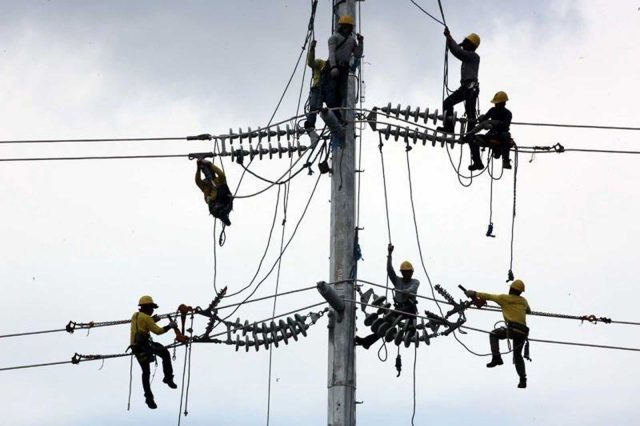
A HOUSE of Representatives committee has approved the consolidation of measures that will, among others, increase the insurance coverage and benefits of power line workers.

In a hearing Tuesday, the House Committee on Energy approved the committee report on the draft substitute bill for House Bill (HB) 471, also known as A Bill Establishing the Lineman Training Academy of the Philippines; HB 472 or the proposed National Lineman Appreciation Day Act; and HB 3247 or the Lineworker Appreciation and Benefits Act, subject to amendments.

“We have passed this which will now be on the floor… let’s just make sure the amendments… are taken up on the floor,” according to the Committee’s Chairman, Representative Juan Miguel M. Arroyo.

HB 471 called for free training at the proposed Lineman Training Academy of the Philippines, allowing more workers to practice the trade. The bill’s authors, who represent the power sector, said line work is considered a “hard to fill” occupation.

Representative and HB 471 and 472 author Presley C. De Jesus said at the same hearing that the bills “are assurances that (line workers) are not left behind. Considering they are the backbone of the electric power industry and also considered frontliners.”

The Department of Energy’s (DoE) Electric Power Industry Management Bureau (EPIMB) Director Mario C. Marasigan said at the hearing that the DoE “has no objections and we support (the measures).”

The measures also received support from the National Electrification Administration, the National Grid Corp. of the Philippines, and the Association of Mindanao Rural Electric Cooperatives. — Gillian M. Cortez

Duterte to send warships if China drills for oil

By Kyle Aristophere T. Atienza and Vann Marlo M. Villegas, Reporters

PHILIPPINE President R. Rodrigo Duterte on Monday said he would only deploy warships to the South China Sea if Beijing starts drilling for oil and taking other key resources.

“I’m not so much interested now in fishing,” he said in a televised speech on Monday night. “I don’t think there’s enough fish really to quarrel about.”

¨But when we start to mine, when we start to get whatever it is in the bowels of the China Sea, then by that time, I will send my ships there. I will send my gray ships there to state a claim,” he added.

Mr. Duterte noted that once oil or nickel is taken from the sea, “that is the time that we should act on it.”

He said drilling oil from areas within the Philippines’ exclusive economic zone is not part of the country’s agreement with China.

“If it is not part of our agreement, I’m going to also excavate — to drill my oil there,” Mr. Duterte said. “If you own it, I own it. I do not want a quarrel but that is how it is.”

“The constructive occupation of the West Philippine Sea was completed by the singular act of China not retreating,” he said, referring to areas in the South China Sea within the country’s exclusive economic zone.

He blamed the government of his predecessor Benigno S.C. Aquino III for failing to maintain Philippine presence in the area.

Mr. Duterte said the Philippines would not be able to gain control of its territories in the disputed waterway “without bloodshed.”

The Philippines has fired off another diplomatic protest against China after authorities spotted a swarm of Chinese vessels, including six war ships within its waters in the South China Sea.

Two Houbei class missile warships were spotted at Mischief Reef, one Corvette class warship at the Fiery Cross Reef and one navy tugboat at Subi Reef, according to a Philippine task force on border security.

Two Chinese coast guard vessels were also spotted at Thitu Island, which the Philippines calls Kalayaan, according to a report based on patrols by Philippine authorities on April 11.

The Philippine task force said more than 200 Chinese ships were scattered in waters within its exclusive economic zone. About 15 vessels either manned by Chinese militia, People’s Liberation Army Navy or the Chinese Coast Guard had also been spotted at the Scarborough Shoal.

Meanwhile, about 240 Chinese vessels that China claims are ordinary fishing vessels have spread out to a wider area in the South China Sea, the agency said. The ships allegedly manned by Chinese maritime forces were scattered across the Spratlys, about 175 nautical miles west of Palawan province, it added.

It said 136 vessels were seen at Gaven Reef and more than 60 vessels were at McKennan Reef.

The rest of the ships were scattered in other parts of the disputed territory — 11 at the Second Thomas Shoal, nine at Whitsun Reef, six at Mischief Reef, five at Loaita Island, four at Thitu Island, three at Subi Reef and one at West York Island. The ships were about 60 meters long.

The Philippines has summoned China’s ambassador to convey its “utmost displeasure” over the continued presence of Chinese militia vessels at Whitsun Reef.

Mr. Duterte has said provoking Beijing into war over the disputed waterway would only lead to the massacre of government troops.

His spokesperson Herminio “Harry” L. Roque, Jr. earlier said the government would try to resolve the conflict peacefully, adding that the President would rather deal with Beijing privately.

NO SURRENDER
Also on Tuesday, Senator Panfilo M. Lacson said Mr. Duterte should not imply surrendering the country’s territory in the South China Sea to China.

The commander-in-chief of the Armed Forces “can think of anything and speak about anything except surrender.¨

“We have an arbitral ruling in our favor and it’s permanent although it’s unenforceable,” he told CNN Philippines. “There are so many things to think about except surrender. We cannot wave the white flag, so to speak.”

“I am not saying the President is actually raising the white flag but that’s the implication,” Mr. Lacson said. “If the officers and men of the AFP would take it that way, it could be disastrous to Philippine sovereignty.” Mr. Lacson also said that the Philippines can build stronger allies with other countries such as Japan and the United States.

The Philippines can also conduct joint military exercises with other countries like the US and Australia.

Senator Grace Poe-Llamanzares said the country should assert its sovereignty in the South China Sea.

The country should also seek the aid of neighboring countries and allies, while bringing the issue to international attention, she said in a statement.

Senator Risa N. Hontiveros-Baraquel said Mr. Duterte had surrendered Philippine sovereignty.

“The President may see no other option other than letting China take control of our waters, but the Filipino people are not ready to give up,” she said in a statement.

Meanwhile, Mr. Duterte said he felt “downhearted” when he learned that members of the military had planned to withdraw their support for him for his alleged inaction on the China issue.

Mr. Roque earlier said Mr. Duterte was not bothered by rumors of military discontent.

“If we cannot work together, maybe we cannot work together on bigger things. So what’s the point?” Mr. Duterte said in his speech.

Mr. Duterte said Defense Secretary Delfin N. Lorenzana had given him a document that was “full of arrogance.” A general whom he did not name was involved, he added.

Mr. Duterte said he would step down and go home to Davao City if the military wanted him out.

“If I cannot have the cooperation of the Armed Forces, then there is no point in working for this government.”

Still, the President said he would rather appoint retired military officers rather than civilians to the government. “If I rely on civilians, we’re dead. So if I want things, it’s really the military.”


Philippines approves J&J, Bharat vaccines for emergency use

THE LOCAL Food and Drug Administration (FDA) on Tuesday said it had approved the emergency use of coronavirus vaccines made by Johnson & Johnson, Inc. and India’s Bharat Biotech.

The benefits of the vaccines outweigh the risks, FDA Director-General Enrique D. Domingo told a televised news briefing. Both vaccines can be used for adults, he said in a mobile phone message.

Meanwhile, the Philippines would take delivery of about 20,000 doses of the coronavirus vaccine made by Moderna, Inc. this quarter, Ambassador to the US Jose Manuel Romualdez told a televised news briefing.

The first batch of Moderna vaccines would arrive by mid-June,

“It will start increasing in succeeding months,” he said of the orders. “They will complete the 20 million before the end of the year.”

Mr. Romualdez said 117,000 doses of the Pfizer vaccine would probably arrive in May.

The country was set to take delivery of its first batch of Pfizer doses by mid-February, but the shipment was delayed after the government failed to sign a document freeing the drug maker from potential lawsuits.

Mr. Romualdez said they expect to finalize the indemnity deal by next month.

The Department of Health (DoH) reported 7,379 coronavirus infections on Tuesday, bringing the total to 953,106. The death toll rose by 93 to 16,141, while recoveries Increased by 21,664 to 809,959, it said in a bulletin.

There were 127,006 active cases, 96.9% of which were mild, 1.3% did not show symptoms, 0.6% were critical, 0.7% were severe and 0.48% were moderate.

DoH traced the lower tally to the fact that 19 laboratories did not conduct tests on Sunday.

The Health department on April 2 reported the highest daily tally of 15,310 cases since the pandemic started last year.

The agency said 18 duplicates had been removed from the tally and 20 recovered cases were reclassified as deaths. Eight laboratories failed to submit data on April 19.

About 10.5 million Filipinos have been tested for the coronavirus as of April 18, according to DoH’s tracker website.

The coronavirus has sickened about 142.7 million and killed three million people worldwide, according to the Worldometers website, citing various sources including data from the World Health Organization.

About 121.3 million people have recovered, it said. — Kyle Aristophere T. Atienza and Vann Marlo M. Villegas

Philippines further slips in World Press Freedom Index

PHILSTAR

THE PHILIPPINES dropped by two places to 138th in the World Press Freedom Index this year, according to Reporters Without Borders (RSF), which cited “extremely draconian laws or decrees” that allegedly criminalized state criticism.

This marked the fourth straight year that the country slipped in the ranking that covers 180 economies. The Philippines was 133rd in 2018 and 134th in 2019, scored 45.64 out of a worst possible score of 100.

The Philippines placed 21st among 32 economies in the Asia-Pacific region, ahead of Myanmar (140th overall), India (142nd), Cambodia (144th), Pakistan (145th), Bangladesh (152nd), Brunei (154th), Singapore (160th), Laos (172nd), Vietnam (175th), China (177th) and North Korea (179th).

The fall in the country’s press freedom ranking is alarming, said Dennis C. Coronacion, who heads the University of Santo Tomas (UST) Department of Political Science.

“The press and news media contribute greatly in shaping citizens’ informed political opinions and decisions,” he said in an e-mail. “If this trend continues, it will take its toll on Philippine democracy.”

Mr. Coronacion said attacks on press freedom is nothing new in the Philippines, but the scale of attacks under the government of President Rodrigo R. Duterte is “unprecedented in our history, with the exception of the martial law period.”

Reporters Without Borders cited the use of the coronavirus pandemic among authoritarian regimes in the region to “perfect their methods of totalitarian control of information.”

“Dictatorial democracies” have also used the health crisis as a pretext to impose “repressive legislation.”

It cited the government’s “grotesque judicial harassment campaign” against online news website Rappler, Inc., Congress’ rejection of ABS-CBN Corp.’s franchise, red-tagging of and the persistent online harassment carried out by pro-government “troll armies.”

The country’s ranking would “surely continue to slide unless the government ceased from its impunity that aggravates free speech and media practice,” Marlon M. Villarin, a political science professor from UST, said in a text message. — I.B. Celis

Philippines slips further in World Press Freedom Index

Privacy commission, senators castigate police for profiling community pantry organizer

PHILIPPINE STAR/ MICHAEL VARCAS

THE POLICE drew widespread flak after the organizer of the first community pantry, a food aid initiative that has been replicated across the country, reported being questioned by cops. The National Privacy Commission (NPC), in a statement on Tuesday, warned the police against such profiling activities that may violate privacy laws. “We would like to emphasize that collecting personal data must be done fairly and lawfully with respect to the rights of a data subject, including the rights to be informed and object,” NPC Commissioner Raymund E. Liboro said. The NPC said that some individuals have allegedly been asked by the police to provide personal data like email addresses and social media accounts. Mr. Liboro said that the Philippine National Police’s (PNP) data protection arm should look into reports of profiling. Anna Patricia Non, who started the Maginhawa Community Pantry in Quezon City, said in a post on her Facebook page that she feared for her safety after being tagged by government representatives as a member of the communist movement. She temporarily halted the pantry operations on Tuesday, citing safety concerns for the volunteers assisting in the project. “Lalo na po at nagkaproblema kanina ang ibang Community Pantry sa mga kapulisan (Especially since other community pantries were also having problems with the police),” she said. In an online press conference later on Tuesday, she categorically said that she has no communist links but decried that her political views should be an issue. Speaking mostly in Filipino, she said it is irrelevant who she is or what she stands for, and what is important is her clear intention to simply help people in need amid a coronavirus pandemic.

NO ORDER
Police chief Debold M. Sinas, in a statement, said there was no order “to conduct any form of profiling of organizers of community pantries.” “It is beyond the interest of the PNP to delve into purely voluntary personal activities of private citizens… we have no intention to interfere but to serve the best interest of law and order and public safety in such public activities.” Senators slammed the police and expressed support for Ms. Non and the growing grassroots effort. “When common people band together to help those who are in need; when volunteers offer a selfless act of serving the people; and when ordinary Filipinos put up community pantries as a pure form of generosity — I don’t see them as enemies of the state, but as champions who have genuine compassion for our people,” Senator Maria Lourdes Nancy S. Binay said. Senator Panfilo M. Lacson, in an interview over CNN Philippines, said, “I think it is ill-advised even, you know, deplorable that police officers suspect these people of engaging in destabilization.” Senate President Pro Tempore Ralph G. Recto said community pantries “need more food bags, not red tags, nor red tape” after an interior department official said organizers should get a permit. “Community pantries require no state franchise, nor government permit, nor police clearance. The business of helping your neighbor, as God commanded, requires no business permit from man,” Mr. Recto said in a statement. Senators Binay, Recto, Leila M. de Lima, Franklin M. Drilon, Sherwin T. Gatchalian, Risa N. Hontiveros-Baraquel, Grace Poe-Llamanzares also jointly condemned the social media post of the national task force to end communist movement.  “The profiling of organizers must stop. It puts people’s lives in danger, knowing how notorious some police, military officers, and personnel are in red-tagging progressives and now civic-minded citizens who only want to do good for their fellow men and women,” they said in a statement. — Jenina P. Ibañez and Vann Marlo M. Villegas

ADVERTISEMENT
ADVERTISEMENT