Home Blog Page 7656

Philippine beach volleyball team in training

PNVF

THE national teams for beach volleyball for men and women train on three courts set up on the beach off Villa Del Mar Resort in Pagudpud, Ilocos Norte, during a visit by Philippine National Volleyball Federation (PNVF) President Ramon Suzara on Saturday. PNVF Beach Volleyball Commission head Charo Soriano is supervising the training camp with head coaches Paul Jan Doloiras (men) and Rhovyl Verayo (women) and in cooperation with Ilocos Norte Governor Matthew Joseph Marcos Manotoc and Pagudpud Mayor Rafael Ralph Benemerito II. The teams are preparing for the Asian Volleyball Confederation Continental Cup — a qualifier for the Tokyo Olympics — in Nakhon Pathom, Thailand, starting on June 18.

Ready and willing

Norman Powell didn’t exactly end the regular season on a high note. Career highs for the Raptors made him the subject of trade rumors, and, true enough, he found himself changing addresses by the deadline on player movements. He started in the Blazers’ last 27 games, and while he saw his minutes rise, his productivity dipped enough for pundits to wonder if he was truly worth acquiring vice rotation regulars Gary Trent, Jr. and Rodney Hood. The jury was out, and he figured he needed to show his worth sooner rather than later.

Yesterday, Powell proved the Blazers did not make a mistake targeting him. In what could very well turn out to be the pivotal match in their first-round series against the favored Nuggets, he put up 29 points on 15 shots to make up for leading scorer Damian Lillard’s off-night. In fact, he did much more than just pick up the slack; he was likewise active at the other end of the court, coming up with a steal and two blocks — a reflection of the unique mix of speed and power he possesses at 6’3”, but with a 215-pound frame and a 6’11” wingspan.

So effective was Powell yesterday that Nuggets head coach Michael Malone saw fit to note, “If you told me going in that Damian Lillard was going to be one of 10 from the field and we’re going to get blown out, I probably would have had a hard time believing that.” He castigated his starters, saying they “were awful… I thought we had some guys that were tentative, that looked a little scared, who played soft.” Indeed, no member of the starting lineup had a better net rating than minus 17, with presumptive Most Valuable Player awardee the worst at negative 32 in 27 minutes on the court.

To be sure, all the Blazers did was knot the count in the best-of-seven affair to two wins apiece. Next up is the challenge of claiming yet another contest on the road, no mean feat in high-altitude Ball Arena, with victory securing for them homecourt advantage in the series. Meanwhile, they can claim confidence in the shellacking they dealt yesterday. If nothing else, it proves that they’re not just ready and willing, but also able — especially if Powell continues to live up to potential.


Anthony L. Cuaycong has been writing Courtside since BusinessWorld introduced a Sports section in 1994. He is a consultant on strategic planning, operations and Human Resources management, corporate communications, and business development.

Brazilians stage nationwide protests against President Bolsonaro’s COVID response

RIO DE JANEIRO/BRASILIA – Brazilians staged protests against President Jair Bolsonaro’s handling of the COVID-19 pandemic in at least 16 cities across the country on Saturday, carrying signs such as “Out with Bolsonaro” and “Impeachment now.”

Bolsonaro’s popularity has plummeted during the coronavirus crisis, which has killed more than 460,000 Brazilians as the far-right leader played down its severity, dismissed mask wearing and cast doubt on the importance of vaccines.

Organized by leftist political parties, unions and student associations, Saturday’s protests in the capital Brasilia and in Rio de Janeiro were peaceful, but in the northeastern city of Recife, police threw tear gas and shot rubber bullets.

In Sao Paulo, Brazil’s largest city, thousands of mask-wearing people blocked one the largest city’s avenues. One large balloon depicted Bolsonaro as a vampire.

Some protests, like the one in Rio, included images of former leftist president Luis Inacio Lula da Silva wearing the presidential sash.

Earlier in May, Lula met centrist Fernando Henrique Cardoso, also a two-term former president, for lunch in a public show of their common purpose to block Bolsonaro from gaining a second term in next year’s presidential election.

UK’s Sunak says deal to be done on tax at G7, but tech must pay fair share

LONDON – British finance minister Rishi Sunak said there was a deal to be done with the United States on tax but big tech firms would have to pay their fair share in return for British backing for Washington’s corporation tax proposals.

The United States has proposed a global minimum corporation tax rate of 15%, well below G7 levels, but above those in some countries such as Ireland. But Britain remains concerned the plans do not go far enough on taxation of tech giants such as Amazon, Google and Facebook.

“We need them to understand why fair taxation of tech companies is important to us. There’s a deal to be had, so I’m urging the U.S. – and all of the G7 – to come to the table next week and get it done,” Mr. Sunak told the Mail on Sunday newspaper ahead of a meeting of G7 finance ministers on June 4-5.

“Negotiations are going well … But it has to be the right deal for Britain and that’s what this week’s negotiations will be about.”

Mr. Sunak said that firms like Facebook themselves also wanted resolution on the issue that would give them certainty and stability.

He also said that he wanted to “level the playing field for British high streets”, with Britain looking at a separate online sales tax.

“Fundamentally, the global tax system isn’t working … Large multinational companies, particularly digital companies, are able by the nature of their businesses not to pay the right tax in the right places. And that’s not fair,” he said.

“That’s what we’re fighting hard to fix in these negotiations. If everyone works hard over the next few days and weeks, I’m confident that we can find a good place.” – Reuters

Vietnam detects hybrid of Indian and UK COVID-19 variants

COMPUTER-GENERATED representation of COVID-19 virions via Felipe Esquivel Reed / CC BY-SA

HANOI – Authorities in Vietnam have detected a new coronavirus variant that is a combination of the Indian and UK COVID-19 variants and spreads quickly by air, the health minister said on Saturday.

After successfully containing the virus for most of last year, Vietnam is grappling with a rise in infections since late April that accounts for more than half of the total 6,856 registered cases. So far, there have been 47 deaths.

“Vietnam has uncovered a new COVID-19 variant combining characteristics of the two existing variants first found in India and the UK,” Health Minister Nguyen Thanh Long said, describing it as a hybrid of the two known variants.

“That the new one is an Indian variant with mutations that originally belong to the UK variant is very dangerous,” he told a government meeting, a recording of which was obtained by Reuters.

The Southeast Asian country had previously detected seven virus variants: B.1.222, B.1.619, D614G, B.1.1.7 – known as the UK variant, B.1.351, A.23.1 and B.1.617.2 – the “Indian variant”.

Long said Vietnam would soon publish genome data of the newly identified variant, which he said was more transmissible than the previously known types.

The World Health Organization (WHO) has identified four variants of SARS-CoV-2 of global concern. These include variants that emerged first in India, Britain, South Africa and Brazil.

“At the present time, we have not yet made an assessment of the virus variant reported in Vietnam,” Maria Van Kerkhove, WHO Technical Lead for COVID-19, said in an emailed statement. “Our country office is working with the Ministry of Health in Vietnam and we expect more information soon.”

From the WHO’s current understanding, the variant detected in Vietnam was the B.1.617.2 variant, more commonly known as the Indian variant, possibly with an additional mutation, she said.

“However we will provide more information as soon as we receive it,” Van Kerkhove added.

Long said laboratory cultures of the new variant showed the virus replicated itself very quickly, possibly explaining why so many new cases had appeared in different parts of the country in a short period of time.

The health ministry told the meeting the government was working to secure 10 million vaccine doses under the COVAX cost-sharing scheme, as well as a further 20 million doses of Pfizer’s vaccine and 40 million of Russia’s Sputnik V.

The country of about 98 million people has so far received 2.9 million doses and aims to secure 150 million this year. – Reuters

British retail faces “tsunami of closures” without rent help

A closeup shot of a sign that says "Sorry We're Closed" hanging on a glass door Wood photo created by wirestock - www.freepik.com

LONDON – Britain’s retail sector will endure a “tsunami of closures” if the government does not extend a moratorium on aggressive debt enforcement, industry lobby group the British Retail Consortium (BRC), said on Sunday.

Citing survey data it said two thirds of British retailers have been told by landlords they will be subject to legal measures to recover unpaid rent from July 1 when the moratorium ends.

Many UK retailers deemed “non essential” had to close their stores during multiple COVID-19 lockdowns over the last 15 months, accruing total rent debt of 2.9 billion pounds ($4.1 billion), the BRC said.

The pandemic has hammered the sector and industry data shows one in seven shops already lie empty.

The BRC’s survey found 80% of tenants said some landlords have given them less than a year to pay back rent arrears.

Without action, the end of the moratorium could see thousands of shops close, said BRC chief executive Helen Dickinson.

She called on the UK government to allow the rent arrears built up during the pandemic to be ringfenced and the moratorium on repayment of these debts to be extended to the end of the year.

“With this in place, all parties can work on a sustainable long-term solution, one that shares the pain wrought by the pandemic more equally between landlords and tenants,” she said.

“Without action, it will be our city centres, our high streets and our shopping centres that suffer the consequences, holding back the wider economic recovery.” – Reuters

Qatar charges migrant activist with taking payment to spread disinformation

DUBAI – Qatar’s public prosecution has charged a Kenyan man who has written about migrant rights in the Gulf Arab state with receiving payment to spread disinformation, the government’s communication office (GCO) said on Saturday.

Malcolm Bidali, who had been writing under a pseudonym, was arrested on May 5 for violating Qatar’s security laws, according to a Qatari official. Rights groups have voiced concern that his detention may be in reprisal for human rights work.

“Mr. Bidali has been formally charged with offences related to payments received by a foreign agent for the creation and distribution of disinformation within the State of Qatar,” the GCO said in a statement, without elaborating.

It said his case was transferred to the Public Prosecution after a thorough investigation and that Mr. Bidali was “receiving legal advice and representation ahead of the court date, which has not yet been set”.

Rights groups including Amnesty International said in a statement on Friday that Bidali, a security guard and blogger, told his mother in a May 20 phone call that he was being held in solitary confinement and had no access to a lawyer.

The GCO did not immediately respond to a request for comment.

Mr. Bidali had a week before his arrest given a presentation to a large group of civil society organisations and trade unions about his experience working in Qatar, according to an earlier statement by Amnesty, Migrant-Rights.org, Human Rights Watch, FairSquare and the Business & Human Rights Resource Centre.

Qatar’s human rights record has been in the spotlight as it prepares to host the 2022 soccer World Cup, especially over migrants’ living and working conditions.

Doha has introduced labour reforms that aimed to address some concerns. – Reuters

Monde Nissin IPO has top funds ditching blue chip stocks

Food giant Monde Nissin Corp.’s record-breaking entry into the Philippine stock market is driving a shakeup that’s impacting everything from the nation’s consumer sector to holdings of some of the biggest money managers.

Investors say the P48.6 billion ($1 billion) initial share offering — the biggest ever debut in the Southeast Asian country — is pushing them to reallocate funds from existing consumer-staples holdings and even sell blue-chip stocks from other sectors to pay for a slice of the iconic snack brand that debuts June 1. Average volume on the benchmark stock index is up nearly one-third since the March 4 IPO filing compared with the start of the year.

Overseas heavyweights including Singapore state investment fund GIC Pte and Hong Kong insurer AIA Group Ltd. have also taken stakes in the Quorn maker, which has won favor for its prospects in the fast-growing global market for alternatives to meat. The company’s dominant position in the Philippines for basic foods like noodles has added to its allure because of the strong revenue stream it provides during economic downturns.

The blockbuster share sale is providing a rare bright spot for a market that until last week was the most unloved in the world. Monde is attracting foreign investors even as they exit the broader market as the Philippines struggles with one of Asia’s largest COVID-19 outbreaks.

“The switch started as early as when the IPO was approved and it’s partly driving the market weakness and foreign fund withdrawals,” said Gerard Abad, chief investment officer at AB Capital & Investment Corp. in Manila. Abad said Monde will be his largest investment in the consumer sector.

The Philippine Stock Exchange Index is down 6.5% this year, having pared much of its losses recently on expectations that pandemic-linked restrictions will ease.

‘TRIM AND SHIFT’

“It makes sense too for investors to trim and shift money to Monde,” said Fritz Ocampo, chief investment officer at BDO Unibank Inc. “Monde has strong brands, market leadership and growth.”

Ocampo, who helps manage about P1 trillion of investments, said there was selling in Monde competitors such as Universal Robina Corp. and San Miguel Food and Beverage Inc., as well as large stocks that are part of the Ayala, SM Investments and Gokongwei groups.

He also noted that a reduction in MSCI Inc.’s weighting for the Philippines market to 0.4% from 0.65% had played a big part in recent declines, which Monde exacerbated.

At its P13.50 per share IPO price, Monde is valued at P242.6 billion. This would make it the 14th biggest company by this measure on the 30-member Philippine Stock Exchange Index. Given its market capitalization, potential trading liquidity and dominant presence in the nation’s consumer sector, the stock is a candidate for inclusion in the benchmark, analysts say.

The company’s Quorn meat-alternatives operations accounted for 22% of Monde’s 2020 revenue. It gets more than 94% of its non-meat alternative sales from the Philippines, where its Lucky Me! noodles have 68% market share.

While the company’s return-on-equity is attractive, some investors are balking at the company’s estimated price-to-earnings ratios.

Monde’s ROE stood at 31.3% last year, compared with Universal Robina’s 11.8% and San Miguel Food’s 13.9%.

At its IPO price and estimated 2021 earnings, AP Securities Inc. analyst Andrei Soriano pegs Monde’s P/E at 27.1 times, versus 25.6 times at Universal Robina. He recommends buying the stock below P13.20 a share.

“Monde is in non-discretionary consumption that itself makes it an interesting play,” said Robert Ramos, who helps manage 130 billion pesos as head of trust and investments group at Rizal Commercial Banking Corp. “I like the sector. I like the name. But I would look to buy at a more attractive price.” – Bloomberg


Philippines lifts ban on workers deploying to Saudi Arabia

STOCK PHOTO

MANILA – The Philippines on Saturday said the country’s workers could again go to work in Saudi Arabia, reversing a brief deployment ban after the kingdom said they would not be charged for COVID-19 tests and quarantine upon arrival.

“Our Saudi-bound workers will no longer be disadvantaged,” said Labor Secretary Silvestre Bello.

Flag carrier Philippine Airlines said it will accept Filipino workers on flights to Dammam and Riyadh, waiving rebooking fees for passengers who had been unable to board because of the deployment ban.

Bello apologized for the “inconvenience and momentary anguish” caused by his Thursday ban, saying, “I understand that the suspension order drew confusion and irritation among our affected departing overseas Filipino workers.

More than a million Filipinos work in Saudi Arabia, the most preferred destination of overseas Filipino workers in 2019, government data show. Many Filipinos are hired as construction workers, domestic helpers or nurses.

In 2020, Filipinos in Saudi Arabia sent home $1.8 billion in remittances, a key support for the consumption-led economy.

With more than 1.2 million cases and 20,722 deaths, the Philippines has the second-highest COVID-19 infections and casualties in Southeast Asia, behind Indonesia. – Reuters

Hot money flees Philippines for third straight month

KSTUDIO-FREEPIK

Short-term portfolio investments left the Philippines for a third straight month in April amid cautious investor sentiment due to the stricter lockdown measures to curb a spike in coronavirus infections.  

Hot money – dubbed as such due to the ease by which these funds enter or leave an economy – posted a net outflow of $373.95 million in April, based on data released by the Bangko Sentral ng Pilipinas (BSP) on Thursday evening. 

This was lower by 43% than the $660.38 million net outflow a year earlier, and by 31% than the $540.97 million net outflow in March. 

“Developments during the month included investor reaction to easing inflation, contraction of the country’s gross domestic product in 2020, extension of local quarantine measures, progress of the government’s vaccination program and the continued rise of infections in the country,” the central bank said in a statement. 

The Philippine Statistics Authority said the economy shrank by 9.6% in 2020, a tad steeper than the 9.5% drop earlier reported. 

The hot money net outflow in March reflects the “continued adverse market effects caused by the record high local infection cases logged in March and April, said Rizal Commercial Banking Corp. Chief Economist Michael L. Ricafort. 

The number of new coronavirus disease 2019 (COVID-19) patients rose by an average of 10,000 from late March to early April, which prompted the government to tighten quarantine restrictions in Metro Manila and nearby provinces.  

Central bank data showed inflows in April rose 3.8% to $651.16 million from $627.02 million a year ago, but declined by 21%  from the $824.23 million in February. 

Meanwhile, outflows fell 20.4% to $1.025 billion from April 2020’s $1.287 billion. It was also smaller by 24% than the $1.365 billion outflow a month ago. 

The top five investors during the month were United Kingdom, United States, Luxembourg, Singapore and Norway, the BSP said.  

More than half (68.9%) of the investments went to securities listed in the Philippine Stock Exchange, mainly property companies, banks, holding firms, food, beverage and tobacco companies and transportation services firms. 

Meanwhile, nearly a third (31%) of hot money flows went to government securities. 

Hot money posted a net outflow of $857.44 million, lower by 58.5% than the $2.067 billion of net outflow seen in the same period of 2020. 

The central bank expects foreign portfolio investments to post a net inflow of $5.7 billion this year.  — Luz Wendy T. Noble 

Electronics exporters seek copper standard review

The electronics industry is asking the Environment department for an analysis of its wastewater guidelines that set parameters on copper produced by the industry. 

Semiconductor and Electronics Industries in the Philippines Inc. (SEIPI) President Danilo C. Lachica said  the group has submitted a position paper requesting for a cost-benefit analysis from the Department of Environment and Natural Resources (DENR). 

“The biggest concern for our industry is the tightened copper standard from one PPM or milligram per liter of total copper to 0.04 PPM of dissolved copper,” he said at the group’s general membership meeting on Friday. 

“This overly tight standard is only comparable to Thailand’s drinking water and not treated industrial effluence.” 

The DENR’s general effluent standards, or standards related to liquid waste discharged into rivers or seas, sets parameters for the concentrations of copper released into water.  

The standards were issued to preserve the country’s fresh, brackish, and marine waters by preventing water pollution. 

According to Mr. Lachica’s presentation, revised effluence guidelines are awaiting signature from the Environment Secretary Roy A. Cimatu. He said that the industry continues to await the department’s response on the matter. 

The cost-benefit analysis, Mr. Lachica said in a Viber message, would help establish the viability of the standard set in 2016. 

Trade Secretary Ramon M. Lopez said at the same meeting that he is in talks with the DENR on the issue. 

“We are just waiting for their response. We are helping you on that one,” he said. 

DENR through its Laguna Lake Development Authority unit recently issued cease and desist orders to several departments for releasing wastewater into Manila Bay. 

The Department of Public Works and Highways (DPWH), the Cultural Center of the Philippines (CCP) and the Philippine Navy were all found to have failed to meet the effluent standards after water inspections at the bay. 

The electronics exports industry is retaining its 7% growth target for 2021, SEIPI Chairman Glenn Everett said. 

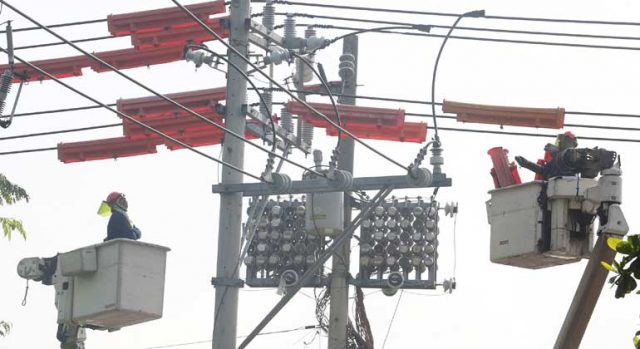
Meralco rates seen to increase in June

PHILIPPINE STAR/MICHAEL VARCAS

Manila Electric Co. (Meralco) customers are likely to see a rise in their electric power bills in June, following a surge in spot market prices, an official from the firm said on Friday. 

 “Based on early, initial projections, there may be an upward pressure on the generation charge for the month of June 2021 due to observed increase in WESM (wholesale electricity spot market) prices,” Meralco Vice President and Head of Corporate Communications Joe R. Zaldarriaga said in a statement shared on Viber on Friday. 

He was referring to the spike in power prices in the WESM this month. The market operator previously reported that average spot market price more than doubled in May, reaching P7.72 per kilowatt hour (kWh) from P3.85 in April due to a surge in demand and supply disruptions. 

“WESM prices were persistently high for extended periods triggering the secondary price cap on May 4-7 and 20-22,” Mr. Zaldarriaga said. 

A secondary price cap is price-mitigating mechanism which limits high market prices. 

The Meralco executive also noted the rise in temperatures and economic activity, explaining that the Luzon grid hit a new peak of over 11,500 MW this month.  

“Average capacity on outage remained at the 3,000 MW level and the grid was placed on Yellow Alert on May 5, due to insufficient operating reserves,” he said.  

A yellow alert is issued when reserves fall below ideal levels. This is downgraded to a red alert, which brings the possibility of power interruptions, when the supply situation worsens. 

Meralco’s controlling shareholder, Beacon Electric Asset Holdings, Inc., is partly owned by PLDT, Inc. Hastings Holdings, Inc., a unit of PLDT Beneficial Trust Fund subsidiary MediaQuest Holdings, Inc., has an interest in BusinessWorld through the Philippine Star Group, which it controls.