Home Blog Page 7595

Customer complaints surge during pandemic, Globe says

GLOBE Telecom, Inc. has seen a spike in complaints amid the surge in demand for internet services during the coronavirus pandemic, a company official said.

“Definitely, compared to pre-pandemic, there was a surge in complaints because there were heightened expectations from customers,” Globe Vice-President and Head of Broadband Business Darius Jose Delgado said at an online briefing on Tuesday.

“They cannot live without the Internet a single moment, a single second, or a single day. That’s expected, and I think it happened across the industry. But now we are better in managing them because we have reinforced our channels,” he added.

The company has “reinforced” its Globe at Home app to take care of the complaints. “We have also improved our technician resourcing, so we have increased like 80%,” Mr. Delgado noted.

During the pandemic, home internet became the lifeblood of every household, according to Globe.

Globe’s home WiFi prepaid product registered 3.6x growth in total data traffic as of end-March versus the previous year from 58 petabytes to 211 petabytes.

“We heavily distributed and made available our home prepaid WiFi [product] across all of our channels. It’s a do-it-yourself… product, and we made sure we had enough stocks to address the surge in demand,” Mr. Delgado said.

“At only P999, a household belonging to the lower socioeconomic class can now have an internet access,” he added. — Arjay L. Balinbin

Apex Mining income hits P279M on better metal prices

APEX MINING Co. Inc. saw a 133.3% increase in its attributable net income to P278.81 million for the first quarter on the back of better revenues and metal prices.

The listed mining company said in a regulatory filing on Tuesday that its consolidated revenues for the January-to-March period rose 30.3% to P1.55 billion from P1.19 billion last year.

Gold revenues increased 29.5% to P1.45 billion after the sale of 17,051 ounces of gold during the period.

Silver revenues also climbed 56.7% to P103.02 million, with 85,681 ounces of silver sold for the quarter.   

According to Apex Mining, the milling throughput of its Maco Mine in Davao De Oro for the quarter fell 0.8% to 157,552 tons against 158,834 tons last year.

“While tonnage milled was slightly lower this quarter, a higher recovery rate was achieved at 87.06% from 86.84% a year ago,” the company said in the regulatory filing.

It added that the average ore grade in Maco Mine during the quarter reached 3.14 grams of gold per ton, a 3.3% improvement from the 3.04 grams per ton last year.

The company’s gold sales reached 15,878 ounces, a 14.1% increase, against 13,916 ounces sold in 2020.   

Meanwhile, Apex Mining’s Sangilo mine in Itogon, Benguet posted a milling throughput of 11,898 tons with a gold recovery rate of 90.74%. The mine’s gold sales reached 1,173 ounces during the period.

“Partly cushioning the negative effect in revenue of the lower metal outputs were the stronger metal prices which averaged $1,752 per ounce for gold and $25 per ounce for silver, as compared to $1,585 and $17, respectively, in 2020,” the company said.

Apex Mining’s cost of production during the quarter increased 21.8% to P1.06 billion from P871.68 million last year.

“There are no know trends, events or uncertainties that would have any material impact on liquidity and revenues of the company except for the coronavirus disease 2019 (COVID-19) pandemic,” the company said.

On Tuesday, shares of Apex Mining at the stock exchange dropped 1.16% or two centavos to finish at P1.70 per share. — Revin Mikhael D. Ochave

Arts & Culture (06/02/21)

WWW.DISCOVERHONGKONG.COM

Arts in Hong Kong

THE HONG Kong Tourism Board (HKTB) has rolled out the Arts in Hong Kong campaign to promote a series of major events, in both physical and digital format, organized by fair organizers and cultural institutions around town. It ensures that audiences can reconnect with art and the vitality of Hong Kong, whether in person or abroad. The HKTB created a dedicated campaign website, (www.discoverhongkong.com/Arts), which is a one-stop platform providing essential information about Arts in Hong Kong and introducing online showcases, art itineraries, an event calendar, artsy offers, interviews with art insiders, and more. In the online showcases, curated virtual experiences, provided by both international fairs and local events, are at the fingertips of viewers regardless of where they are located. It also features an interactive microfilm presented by two local celebrities — multidisciplinary artist Ivana Wong and director Kearen Pang — at some of the city’s attractions, including Tai Kwun, The Mills, and the West Kowloon Cultural District. There is the annual French May (May 1 to June 30), a multicultural feast of more than 100 mostly in-person events spanning art, design, opera, classical, pop concerts, dance, and movies (www.frenchmay.com/en/home/). Meanwhile, the Yim Tin Tsai Arts Festival 2021 is an opportunity to get a glimpse into this unique village with its Roman Catholic and Hakka background. The third edition (which runs until July 16) features 31 art pieces, including 14 new works, available on-site and online (www.yimtintsaiartsfestival.hk/index.php?lang=en). The Hong Kong Arts Festival’s PLUS program is embracing the digital format this year to connect with audiences both on and offstage. Available throughout June is a hybrid line-up of online and in-venue programs, in addition to an interactive online exhibition, and series of online documentaries and cinema screenings (https://www.hk.artsfestival.org/en/programmes/index-plus.html#All).

CCP façade lights up with Philippine flag colors   

THE CULTURAL Center of the Philippines (CCP) lights up its Main Building façade in honor of the Philippine flag until June 13. The façade lighting is a collaborative effort between Danilo Villanueva and Luis Alcoran, with Gobo makers Mark Macapulay and Shantie De Roca, working with theater crew members Kevin Orag, Richard Galvero, Jomar Lauta, Junelyn Maureal, Allan Jay Fami, Donato Alforja, Lucio Tapiru, Norman Aguirre, and Timothy John Calma. In accordance with R.A. 8491 (Section 26), May 28 to June 12 marks the official celebration of Flag Day, culminating in the celebration of Independence Day. The façade is lit  from 7 to 10 p.m. daily, except Mondays.

Cinemalaya Institute conducts filmmaking workshop

AFTER a year-long hiatus brought by the pandemic, the Cinemalaya Institute, returns this year to pursue its commitment to provide education, training, and accreditation of film practitioners in key aspects of film production. Established in 2015, the Institute has trained new and upcoming Filipino filmmakers to ensure the growth and sustainability of Cinemalaya as the leading independent film festival in Asia. The training arm of the Cinemalaya Foundation, Inc. (CFI), the Institute plans to open selected courses following the limiting protocols imposed by the national government. The online training programs are Scriptwriting for Film by veteran playwright Ricky Lee (June 9 to Aug. 4); Master Workshop on Continuing Narratives for Broadcast and Web-based Platforms by Jose Javier Reyes (Aug. 14 to Oct. 29); Production Management by John Paul Su (July 15 to Aug. 13); and an Assistant Director’s Workshop for Film and Television by Jay Abello (Sept. 1 to 29). Interested individuals may submit their application at cinemalayainstitute@gmail.com. Download the application form/s through these links: http://bit.ly/CinemalayaProdManagement and http://bit.ly/CinemalayaAssistantDirector.

Instituto Cervantes celebrates filmmaker García Berlanga 

TO CELEBRATE the birth centenary of Spanish filmmaker Luis García Berlanga (1921-2010), Instituto Cervantes this June presents the online film series “Berlanga Turns 100.” The films will be shown through the Instituto Cervantes channel on the Vimeo platform (vimeo.com/institutocervantes) and will be freely accessible for 48 hours from their start date and time. The series kicks off June 5, with the screening of the comedy Esa pareja feliz (1951) about a young couple fighting to improve their economic and social status. It will be available anytime for 48 hours on Saturday and Sunday, for free through https://vimeo.com/548754354.  It is in Spanish with English subtitles.

#DamaKoLahiKo campaign kicks off

THIS June 12 marks the 123rd Independence Day of the Philippines. The Dama Ko, Lahi Ko campaign is a private sector-initiated campaign by the Filipino Culture Collective, a group of creative professionals and social entrepreneurs which aims to celebrate Filipino culture through supporting local products. The collective has prepared a website (damakolahiko.com) for free downloads of Dama Ko, Lahi Ko logos, patterns, and graphics. All these are free to use and remix. A sticker set is also available for download on Viber, Telegram, and GIPHY (search “dama ko lahi ko”). Share photos, videos, music, anything that showcases Filipino culture through the five senses. Tag @damakolahiko and #damakolahiko across Facebook, Instagram, Twitter, and Tiktok.

Learn about Korean culture

WHILE the pandemic has changed the times and the way students learn and take their classes, the Korean Cultural Center (KCC) in the Philippines has education-themed activities for the month of June. Kicking off KCC’s June events is ChikaHansik: Kimchi Edition, a digital talk and cooking series featuring Korea’s kimchi. It will come out on all Fridays of June at 5 p.m. via KCC’s YouTube channel. In this month’s episode of Along with K-Culture: Meet the K-Stans in the Philippines, there will be a discussion on the growing popularity of the Korean language, on June 10 on KCC’s YouTube Channel. There will be a one-day webinar on K-Drama scriptwriting on June 30 on KCC’s YouTube Channel. KCC will be launching KCC Throwback Photo & Essay Contest as a prelude to KCC’s 10th birthday this July. Prizes including P5,000 cash, a KCC gift bag, and a feature on KCC’s SNS pages await the 10 winners. For more information on these and other programs, follow Korean Cultural Center in the Philippines on Facebook https://www.facebook.com/KoreanCulturalCenterPH/ and @kccphil on Instagram and Twitter.

Fr. Tito Caluag releases prayer guide

FATHER Tito Caluag has launched his latest book, Only Your Grace, a personal guide to having a more intimate relationship with the Lord through prayers, reflection, action, and rhythm. The first a planned three-set volume on prayers and reflection exercises, Only Your Grace was inspired by The Spiritual Exercises (SPEX) of St. Ignatius of Loyola. Its 26-week prayer, reflection, and journaling activities aim to guide readers in discovering their own “style of prayer.”  Fr. Caluag’s previous book was the prayer and devotional book Give Thanks and Praise, which received a special citation at the 42nd Catholic Mass Media Awards’ Best Special Feature category. The book can still be purchased via Lazada and Shopee for  P225, while its e-book version can be availed in Amazon, Kobo, Scribd, Barnes & Noble, and Smashwords. Copies of Only Your Grace can be ordered via myprayerchannel@gmail.com,  via Viber (0945-352-8731), and on Shoppee and Lazada starting June 2. The Only Your Grace Kindle e-book version is also now available on Amazon.

Hagonoy Art Group Artists at Robinsons Galleria

NINETEEN Filipino artists from the Hagonoy Art Group gathered together this June for an art exhibition at ARTablado, located at the 3rd floor of Robinsons Galleria. The exhibit entitled Hango features pieces that unites the work of Hagonoy, Bulacan’s culturally diverse contemporary artists. Over 30 art pieces will be sold until June 15. The group is composed of Kevin Atienza, Nilo Badajos, Osie Bautista, Jade Alfonso Cabauatan, Carlos Noriel Colonel, Fil Delacruz, Janos Delacruz, Jojo Dela Cruz, Len-Len, CJ Lopez, Pilo Medina, Roxan Musni, Mario Nolasco, Al Perez, Mar Perez, Gody Reyes, Marc Salamat, Jun Sta. Cruz, and Gliff Victor. For more updates, visit ARTablado on Facebook and @artablado on Instagram.

CCP holds National Rondalla workshop

THE ARTIST Training Division of the Cultural Center of the Philippines (CCP) is holding the sixth National Rondalla Workshop 2021 on July 27 to 31. This year’s National Rondalla Workshop will be held online for the first time via Zoom. The Workshop is open to rondalla groups nationwide who have been in existence for at least two years and are non-beginners. Rondalla Ensembles who have all the rondalla instruments including the banduria, octavina/laud, guitar, and bass may apply for the workshop. The workshop trainers will be led by Prof. Elaine Juliet Espejo of the Celso Espejo Rondalla and the UP Rondalla, and faculty member of the UP College of Music. The workshop will culminate in an online recorded performance that will be streamed via the CCP Facebook page on Aug. 21. The workshop fee is P2,000 per participant (inclusive of online materials and newly arranged rondalla pieces). Due to limited slots available, a maximum of 16 participant slots (15 students and one conductor) per group can be accommodated. Interested applicants must submit the following: an accomplished application form (http://bit.ly/CCPRondalla2021App); and an audio/video recording of a recent performance of at least two pieces by the group. Applications must be sent via e-mail to artist.training@culturalcenter.gov.ph on or before June 15. Acceptance to the workshop will be based on the merit of the application. Upon notice of acceptance, each rondalla group must pay a reservation fee of P5,000 that will be deducted from the full amount of the registration fee. The full amount must be paid on or before July 16. For more information, contact the CCP Artist Training Division by e-mail at artist.training@culturalcenter.gov.ph.


Advancing COVID-19 vaccine equity

PHILIPPINE STAR/ MICHAEL VARCAS

The massive effort to develop and manufacture coronavirus disease 2019 (COVID-19) vaccines is succeeding. A number of vaccines have been given Emergency Use Approval by the World Health Organization (WHO) and more are undergoing clinical trials.

Following more than 200 clinical trials and nearly 300 partnerships and collaborations among manufacturers worldwide, COVID-19 vaccine production has increased in just a few months from zero to 2.2 billion doses in May. By the end of the year, the estimate is that 11 billion vaccine doses would be produced to protect people from the pandemic.

As of this time, however, COVID-19 vaccines are not equally reaching all priority populations worldwide. With this, collaborations among manufacturers, governments. and non-government organizations must center on addressing this inequity to help protect vulnerable populations including frontliners and the elderly, among others.

The International Federation of Pharmaceutical Manufacturers and Associations (IFPMA), which represents research-based pharmaceutical companies and associations across the globe, is among the stakeholders that are taking steps to urgently advance COVID-19 vaccine equity. The Pharmaceutical and Healthcare Association of the Philippines (PHAP) is a member of the IFPMA which recently put forward “Five steps to urgently advance COVID-19 vaccine equity.” Critical among these steps are responsible dose sharing and maximizing production without compromising quality or safety.

First, vaccine manufacturers and biotech companies must commit to immediately work with governments that have significant domestic supplies of COVID-19 vaccine doses to share a meaningful proportion of their doses with low- and lower-middle-income countries. The dose sharing must be both responsible and timely through COVAX or other efficient established mechanisms.

COVAX, a global pooled procurement mechanism for COVID-19 vaccines, is co-led by the Global Vaccine Alliance (GAVI), the Coalition for Epidemic Preparedness Innovations (CEPI), and the WHO. The goal of COVAX is to accelerate the development and manufacture of COVID-19 vaccines, and to guarantee fair and equitable access of the vaccine doses. It commits to providing doses for at least 20% of countries’ populations, manage a portfolio of vaccines, and deliver them as soon as possible.

As of May 27, COVAX has delivered about 70 million doses of vaccines to 126 countries. It is, on the other hand, projecting a shortfall of 190 million doses in June due to the surge of cases in India and its impact on COVAX supply.

In a joint statement by WHO, GAVI, CEPI and UNICEF, proponents are calling for further funding and sharing of doses immediately. They said that at least one billion doses could be shared by wealthy countries in 2021.

“COVAX’s need for doses is greatest right now. Countries with higher coverage rates, which are due to receive doses soon should swap their places in supply queues with COVAX so that doses can be equitably distributed as quickly as possible,” the statement said.

The second urgent action to equity is to continue optimizing production. Vaccine manufacturers must commit to work with governments and individual suppliers of raw materials and components to determine how to quickly and safely facilitate scale up needed for COVID-19 vaccine manufacturing.

The third action is to call for the immediate elimination of trade barriers. The IFPMA said that there is a need to eliminate all trade and regulatory barriers to export and to adopt policies that facilitate and expedite the cross-border supply of key raw materials, essential manufacturing materials, vaccines along with the prioritized movement of skilled workforce needed for COVID-19 vaccine manufacturing.

Fourth, vaccine manufacturers and biotech companies must support country readiness and help governments deploy available COVID-19 vaccine doses within their shelf life — this, while mitigating the risks to the production and deployment of other vaccines.

Lastly, vaccine manufacturers and biotech companies have to drive further innovation and prioritize the development of new COVID-19 vaccines, including vaccines effective against variants of concern.

The US Centers for Disease Control and Prevention (CDC) has three SARS-CoV-2 variant classifications, namely, variant of interest, variant of concern, and variant of high consequence.

A variant of interest has “specific genetic markers that have been associated with changes to receptor binding, reduced neutralization by antibodies generated against previous infection or vaccination, reduced efficacy of treatments,” and may have increase in transmissibility or disease severity.

A variant of concern, according to the CDC, is one “which there is evidence of an increase in transmissibility, more severe disease, significant reduction in neutralization by antibodies generated during previous infection or vaccination, reduced effectiveness of treatments or vaccines, or diagnostic detection failures.”

A variant of high consequence, finally, has “clear evidence that prevention measures or medical countermeasures have significantly reduced effectiveness relative to previously circulating variants.”

PHAP fully supports the five steps to urgently advance COVID-19 vaccine equity. Only through the equitable distribution of COVID-19 vaccines to priority populations can we reach worldwide herd immunity and curb the rise of variants as quickly as possible. Indeed, “no one is safe until everyone is safe.”


Teodoro B. Padilla is the executive director of the Pharmaceutical and Healthcare Association of the Philippines (PHAP). PHAP represents the biopharmaceutical medicines and vaccines industry in the country. Its Members are in the forefront of research and development efforts for COVID-19 and other diseases that affect Filipinos.   

Treasury monitoring market appetite for possible debt swap

BW FILE PHOTO

THE Bureau of the Treasury (BTr) is monitoring market demand for new issuances as it finalizes its borrowing plan for the second half of the year, National Treasurer Rosalia V. de Leon said on Tuesday.

“[We] will continue watching market appetite. Depends on real rates,” Ms. de Leon told reporters via Viber when asked if the BTr is considering a debt exchange program in the second semester for liability management.

The official said the market’s appetite will determine if a debt switch offer will be launched and if this would be offered as a standalone program.

The government does liability management exercises to improve its debt profile. These may include debt switch offers to swap issuances nearing maturity for cheaper or longer tenors.

Its most recent bond swap program was in March, which it held along with a retail Treasury bond (RTB) offering. It raised P411.6 in fresh funds via the three-year RTBs and P51.5 billion from the switch offer.

“A debt exchange or a debt swap is usually meant to replace those illiquid bonds in the interest of an opportunity for investors to hold more liquid bonds — which will eventually lead them to trade efficiently in the secondary market. It’s a win-win for both investors and the government,” a bond trader said in a Viber message on Tuesday.

“Such a program will also improve credibility of the government securities yield curve as it should increase the amount of the existing liquid bonds in the market,” the trader added.

The government is looking to raise P3 trillion this year from domestic and external lenders to help fund its budget deficit seen to hit 9.4% of gross domestic product. — BML

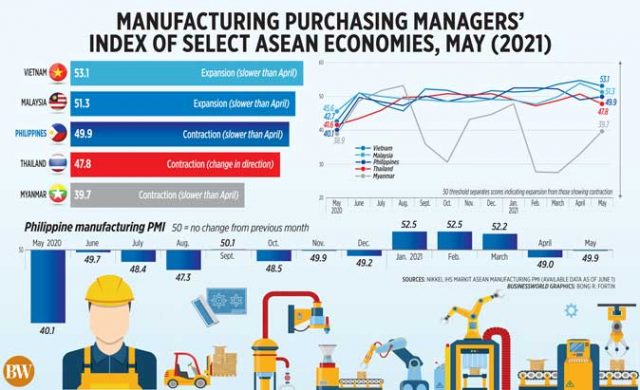
Manufacturing Purchasing Managers’ Index of Select ASEAN Economies, May (2021)

MANUFACTURING ACTIVITY in the Philippines declined at a softer pace in May, as new orders and production improved amid the easing of lockdown restrictions in the Philippine capital and nearby provinces, a survey by IHS Markit showed on Tuesday. Read the full story.

Manufacturing Purchasing Managers’ Index of Select ASEAN Economies, May (2021)

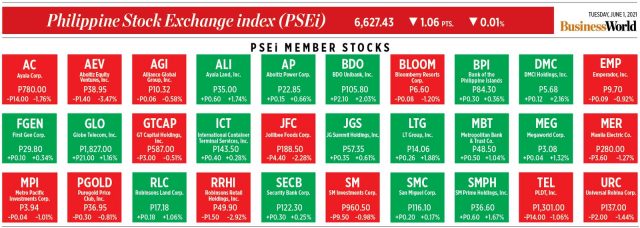
How PSEi member stocks performed — June 1, 2021

Here’s a quick glance at how PSEi stocks fared on Tuesday, June 1, 2021.


Peso weakens vs dollar as factory activity improves

BW FILE PHOTO

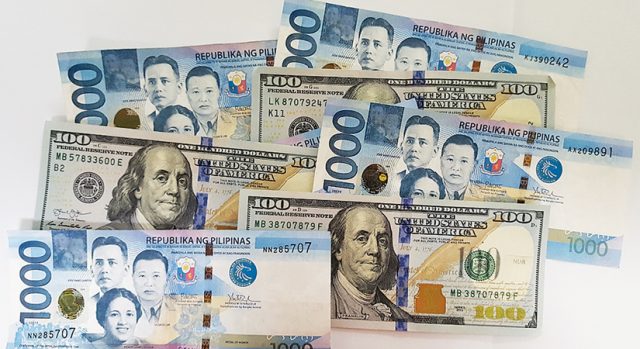
THE PESO weakened against the dollar on Tuesday as the government kept Metro Manila and nearby provinces under lockdown and due to data showing that manufacturing activity improved in May, which may mean higher imports.

The local unit closed at P47.76 versus the dollar on Tuesday, weakening by 6.5 centavos from Monday’s finish of P47.695, data from the Bankers Association of the Philippines’ website showed.

The peso opened Tuesday’s session stronger at P47.65 against the dollar. It climbed to as high as P47.61, but succumbed to the greenback’s strength as it closed nearer to its intraday low of P47.77.

Dollars traded went up $1.124 billion on Tuesday from the $878.5 million seen on Monday.

Rizal Commercial Banking Corp. (RCBC) Chief Economist Michael L. Ricafort said the peso dropped versus the dollar following the release of data showing improved factory activity in the country, “which could lead to some pick up in imports.”

Manufacturing activity in the country posted a softer contraction in May as new orders and production improved amid eased quarantine conditions, a survey by IHS Markit showed.

The Philippine Manufacturing Purchasing Managers’ Index (PMI) picked up to 49.9 in May from 49 in April, a tad below the 50 neutral mark that separates expansion from contraction, IHS Markit said in a press release on Tuesday.

This signaled a “softer downturn across the Philippines manufacturing sector, as operating conditions inched towards to stabilization,” it said.

Mr. Ricafort added that the government’s decision to keep Metro Manila and its nearby provinces under general community quarantine with “heightened restrictions” this month also affected the local currency.

Meanwhile, a trader said the peso dropped versus the dollar on the back of progress in the US government’s infrastructure spending plan.

Negotiations with US President Joe Biden over a potentially massive infrastructure investment package are inching forward even though disagreements remain over the size and scope of such legislation, Republican Senator Shelley Moore Capito said on Sunday, according to a Reuters report.

The Republican senators have proposed $928 billion to improve roads, bridges and other traditional infrastructure projects. Much of the funding would come from money already enacted into law for other purposes that they argue is unused.

The Biden administration’s latest offer in negotiations is for $1.7 trillion and would include federal spending on projects that go beyond traditional infrastructure, such as home care for the elderly.

For Wednesday, the trader expects the peso to move between P47.65 and P47.85 versus the dollar, while RCBC’s Mr. Ricafort gave a forecast range of P47.70 to P47.85. — with Reuters

PSEi slips as gov’t keeps NCR Plus under lockdown

COURTESY OF PHILIPPINE STOCK EXCHANGE, INC.

THE benchmark index slipped on Tuesday as investors digested the government’s decision to keep Metro Manila and nearby provinces under a lockdown with heightened restrictions for two more weeks.

The Philippine Stock Exchange index (PSEi) inched down by 1.06 points or 0.01% to close at 6,627.43 on Tuesday. Meanwhile, the broader all shares index went up by 0.47 point or 0.01% to end at 4,023.30.

“The market ended on a slight loss as investors assess the government’s decision to keep NCR (National Capital Region) Plus under GCQ (general community quarantine),” Timson Securities, Inc. Trader Darren Blaine T. Pangan said in a Viber message.

“Moreover, participants may have chosen to stay on the sidelines ahead of the inflation announcement for the month of May,” he added.

President Rodrigo R. Duterte kept Metro Manila and nearby provinces of Bulacan, Rizal, Laguna, and Cavite under general community quarantine “with heightened restrictions” until June 15.

Meanwhile, the Philippine Statistics Authority will report May inflation data on Friday, June 4.

“MONDE (Monde Nissin Corp.) was the big story for the day as it debuted as the largest IPO (initial public offering) in the PSE’s history,” Christopher John Mangun, research head at AAA Southeast Equities, Inc., said in an e-mail.

Monde Nissin debuted at the stock market on Tuesday following its P55.9-billion IPO, said to be the largest in Philippine history and the biggest food and beverage public offering to date in Southeast Asia.

Most sectoral indices declined on Tuesday except for property, which improved by 50.73 points or 1.57% to 3,276.15; and financials, which gained 15.73 points or 1.1% to close at 1,434.40.

Meanwhile, mining and oil dropped by 165.56 points or 1.75% to end at 9,245.26; holding firms shed 59.70 points or 0.89% to 6,648.80; industrials lost 74.91 points or 0.83% to close at 8,862.68; and services went down by 7.09 points or 0.47% to 1,486.54.

Value turnover soared to P14.78 billion on Tuesday with 4.08 billion issues traded, from the P5.39 billion logged on Monday with 1.39 billion shares switching hands.

Advancers narrowly beat decliners, 107 versus 101, while 41 names closed unchanged. Net foreign buying ballooned to P341.37 million on Tuesday from the P56.14 million logged on Monday.

Timson Securities’ Mr. Pangan expects the index to trade between the 6,600 to 6,680 range, while AAA Southeast Equities’ Mr. Mangun sees the PSEi testing its support level of 6,500 within the week.

“We believe that this cautiously optimistic sentiment, which is translating to a slower rally, will ultimately be more sustainable,” Mr. Mangun said.

“Having these pullbacks will keep the price from becoming too volatile and it will also allow investors to come in at more desirable prices,” he added. “The rally may not move as quick as what we saw last year, but it will keep it from seeing rapid declines.” — Keren Concepcion G. Valmonte

NGCP expects more red alerts on Luzon grid until next week

PHILSTAR

THE National Grid Corp. of the Philippines (NGCP) said it expects the Luzon grid to experience four more red alerts until next week, following an unplanned outage at a power plant in Mariveles, Bataan.

“We foresee a sustained grid alert status for the next few days until Monday, June 7, because of thinning power supply. We see red alerts coming in tomorrow (June 2), Thursday (June 3), until Friday (June 4). We will have a short break in the weekend because demand is low but we see another red alert status on Monday (June 7),” NGCP Spokesperson Cynthia P. Alabanza said at a virtual briefing Tuesday.

Ms. Alabanza added that the Luzon grid may be put on yellow alert on June 5, 6 and 8.

When reserves fall below ideal levels, the grid operator issues a yellow alert. This moves to a red alert should the supply-demand balance worsen. The Department of Energy (DoE) has clarified that yellow alerts do not warrant power interruptions, while red alerts trigger rotating brownouts.

On Tuesday, the NGCP declared a red alert over the Luzon grid between 10 a.m. and 5 p.m., and then 6 p.m. to 10 p.m. The grid was on yellow alert between 9 and 10 a.m., 5 and 6 p.m. and 10 p.m. and 12 midnight.

In a separate statement, the Department of Energy (DoE) said it met with the NGCP and GNPower Mariveles Energy Center (GMEC) to discuss the unplanned outage of Unit 2 of the GMEC coal-fired plant on Tuesday morning.

“This resulted in the Luzon Grid going on red alert… and yellow alert,” the DoE said. On Monday, the same plant was unavailable due to a suspected boiler tube leak. The plant is scheduled to go online by June 8.

As of Tuesday, total planned outages were equivalent to 435 megawatts (MW), with outages at Units 1, 2 and 3 of the San Roque Power Corp.’s hydroelectric plant. Meanwhile, forced outages amounted to 1,579 MW, including the 647-MW Sual Unit 2 coal-fired plant; Units 1 and 2 of the GMEC coal-fired plant at 345-MW each; and Unit 2 of the Calaca coal-fired plant.

The DoE estimates that some 484 MW has been rendered unavailable from the 1,200-MW KEPCO Ilijan Corp. gas plant due to disrupted supply from the Malampaya gas field.

“The DoE continues to monitor the power situation and will submit the additional pieces of information for the consumers and the enforcement agencies, including the Energy Regulatory Commission, the Philippine Competition Commission and the Department of Justice, considering its long-term strategy of addressing the power supply and demand situation during the summer season,” the department said in a statement.

The DoE also reminded distribution utilities and the system operator of their duty to address the required capacity increases on the grid.

Manila Electric Co. separately announced Tuesday that it may implement manual load dropping or rotational power outages in portions of Cavite, Batangas, Laguna, Metro Manila and Rizal until 3 p.m.

The distribution utility added that 85% of the total participants in the DoE’s interruptible load program (ILP) have committed to participate, as of 11:30 a.m. ILP participants have their own means of generating power and voluntarily reduce their take from the grid during peak hours. — Angelica Y. Yang

PCCI commissions study on digital industry

REUTERS

THE Philippine Chamber of Commerce and Industry (PCCI) has commissioned a study to be conducted with a university in Singapore to map the development of the Philippine digital economy.

The country’s largest business group is working on an action plan for the digital economy, covering the roll out of 5G, artificial intelligence, and the cloud, PCCI Intellectual Property Committee Chairman Antonio L. Sayo said at an event Monday.

The development of the plan will start with a white paper prepared by public policy researchers at the National University of Singapore.

“(It’s) essentially a benchmarking exercise,” Mr. Sayo said.

“The idea is to have an indication as to where we are as regards to digital transformation, and to be presented and discussed at the PCCI board.”

The PCCI will present initial findings in panel discussions with its partners, including the Department of Trade and Industry. The final paper will be presented to government, business groups, and universities.

The PCCI in January launched a center for technology education and entrepreneurship in partnership with Huawei Technologies Co. Ltd., with the intent of exploring artificial intelligence, robotics, coding, big data analysis, the Internet of Things, satellite internet connectivity, and blockchain. — Jenina P. Ibañez

Business group joins call to expedite amendments to bank secrecy law

REUTERS

EASING THE BANK secrecy law should be an immediate priority to demonstrate a commitment to transparency and toughening regulation of money laundering, corruption, and tax evasion, according to the Philippine Chamber of Commerce and Industry (PCCI).

“The PCCI believes the government needs stronger monitoring and enforcement tools to fight tax evasion and other financial crimes. And this could only happen if the country’s stringent bank secrecy law is amended,” the country’s largest business organization said in a statement Tuesday.

House Bill 8991 amends Republic Act No. 1405 or the Secrecy of Bank Deposits Law. The measure will expand the supervisory powers of the Bangko Sentral ng Pilipinas (BSP) by allowing it to look into the deposit accounts of bank shareholders, owners, directors, officers or employees in the course of investigating closed banks, given reasonable grounds to suspect fraud, serious irregularity or unlawful activity.

The loosening of bank secrecy conditions will be applied to deposits as defined by the Philippine Deposit Insurance Corp., as well as foreign currency deposits of banks operating in the Philippines and offshore branches of Philippine lenders.

“Greater transparency could bolster the country’s reputation as compliant and well-regulated. A transparent financial banking system cultivates trust and represents a commitment to restricting money laundering, corruption, tax evasion and other fraudulent banking schemes,” the PCCI said.

The group, however, cited the need for safeguards to avoid abuse and maintain trust. They said this will be possible when banks “embrace accountability not only in sharing information over bank activities where there are suspicions or evidence of criminal activity, but also in restricting access to banking that potential criminals might have before they are able to place and manage illicit funds in offshore accounts.”

“On the other hand, banks and honest depositors must also be protected from the use of the law for harassment or other illicit motives,” it added.

Other industry groups earlier expressed support for the amendments, including the Financial Executives Institute of the Philippines, Bankers Association of the Philippines, Chamber of Thrift Banks, and the Makati Business Club.

BSP Governor Benjamin E. Diokno has said the bank will ask President Rodrigo R. Duterte to certify the bill as urgent.

He said the International Monetary Fund (IMF) and the World Bank have singled out the Philippines and Lebanon for having strict bank secrecy laws that hamper anti-money laundering efforts. He noted, however, that Lebanon eased its bank secrecy law in May 2020, leaving only the Philippines with such strict protections.

In April, the IMF flagged the possibility of the Philippines being included in the list of jurisdictions that the Financial Action Task Force deems to have serious anti-money laundering and counter-terrorism deficiencies if no major reforms are implemented by June 2021. The IMF said easing the bank secrecy law will strengthen the BSP’s supervision powers, boost guards against “dirty money” and terrorist financing, and improve ties with foreign authorities. — Luz Wendy T. Noble