Home Blog Page 7577

Asia’s factories sustain expansion, supply chain woes cloud outlook

REUTERS

TOKYO – Asia’s factory activity continued to expand in May thanks to an ongoing recovery in global demand, surveys showed on Tuesday, though rising raw material costs and supply chain constraints clouded the outlook.

A spike in COVID-19 infections in countries like Taiwan and Vietnam could disrupt semiconductor output and supply chains, posing a headache for manufacturers and weighing on Asia’s export-driven recovery, analysts say.

Japan and South Korea saw an expansion in factory activity moderate in May, purchasing managers’ indexes (PMI) showed on Tuesday, underscoring the fragile nature of their recoveries.

“A spread of new variants is already having a negative impact on supply chains. If this situation persists, it would hit Asian manufacturers that had been scrambling to diversify supply chains out of China,” said Toru Nishihama, chief economist at Dai-ichi Life Research Institute.

“Asia’s recovery has been driven more by external than domestic demand. If companies have trouble exporting enough goods, that bodes ill for the region’s economies,” he said.

China’s factory activity expanded at the fastest pace this year in May on solid demand at home and overseas, though sharp rises in input prices and strains in supply chains crimped some firms’ production, a survey showed on Tuesday.

The Caixin/Markit Manufacturing PMI, which focuses on smaller firms, rose to 52.0 last month, the highest since December and inching up from April’s 51.9.

The survey followed China’s official PMI on Monday, which showed factory activity in the world’s second-largest economy slowed slightly in May on surging raw material costs.

Factories in Taiwan and Vietnam were so far holding up despite rising infections. Taiwan’s PMI stood at 62.0 in May, slowing from April but remaining well above the 50-mark that separates growth from contraction.

Vietnam’s PMI also stayed above 50 at 53.1 in May, though slowing from 54.7 in April.

The final au Jibun Bank Japan Manufacturing PMI dropped to a seasonally adjusted 53.0 in May from 53.6 in the previous month, but higher than a 52.5 flash reading.

A global chip shortage and supply chain disruptions have hit car production, causing Japan’s output growth to miss expectations in April.

Japanese auto giants Toyota Motor and Honda Motor have suspended output in Malaysia due to lockdown measures imposed to combat the pandemic, Kyodo news agency reported on Tuesday.

Separate data released on Tuesday showed Japanese companies cut spending on plant and equipment for the fourth consecutive quarter in January-March, as the economy struggles to shake off the drag from the coronavirus pandemic.

South Korea’s PMI stood at 53.7 in May, slowing from April but extending growth into an eighth straight month.

In a sign South Korean firms were facing rising cost burdens, however, the survey also showed a gauge of input prices surging to its highest level in over 13 years.

DITO Telecommunity now covers 29 million Filipinos as it promises stronger connectivity

DITO Telecommunity Corp., the country’s third major player in the telecommunications industry, after a little more than two months from its commercial launch last March 8, 2021, has finally reached 16 cities and one municipality in Metro Manila. As of today, DITO is already present in 100 cities and municipalities and available in more than 3,000 stores nationwide, covering 29 million Filipinos.

DITO na Kami: The DITO Journey since the commercial launch

Tracing back the milestones that DITO has achieved in the past two months, DITO Chairman and Chief Executive Officer Dennis A. Uy attested to the company’s fulfillment of its promise of bringing stronger connectivity to our countrymen, “Our commercial activities began with 15 cities na sinimulan natin doon sa Cebu at sa Davao with our ongoing CSR program of providing free service to our frontliners in ten cities as one of the pillars of our launch. Last April 16, we added 21 more cities. In just another two weeks, 18 cities were added, reaching as far north as Nueva Ecija in Central Luzon for a total of 54 cities.”

Prior to DITO’s NCR launch, DITO had already opened close to 2,000 stores in various areas nationwide, including four DITO Stores in Cebu and Davao as well as online via Shopee and Lazada.

“Network optimization has been happening at full speed. Tower and infrastructure rollout have continued unabated despite the pandemic to ensure that our subscribers numbering close to half-a-million Filipinos continue to enjoy top notch experience — speed and service we truly deserve,” Mr. Uy further mentioned.

The announcement was greeted by Department of Information and Communications Technology Secretary Gregorio Honasan II and National Telecommunications Commission Commissioner Gamaliel Cordoba with much satisfaction as they spoke of the hard work and partnership with DITO to make the dream of a third telco possible.

Empowering you to move at the speed of life

Fully recognizing the clamor of Filipinos for better internet services for the longest time, DITO remains committed to empower Filipinos by providing them affordable, reliable, and fast data services that allow each and every one to move at the speed of life.

DITO Chief Administrative Officer Atty. Adel Tamano said that for its initial entry in NCR, DITO from May 17 to June 30, 2021 offers 25GB of high-speed data for 30 days along with free unlimited texts to all networks, unlimited DITO-to-DITO calls, and free 300 minutes of calls to other mobile networks for only P199.

DITO’s welcome offer will be available in various channels, both offline and online, such as DITO Stores, device retail partners, DITO online store, Shopee and Lazada.

“More products and offers are on their way as this is only the beginning of our long-term commitment to elevate the industry through digital transformation and connectivity,” ended Mr. Tamano.

Jasper Evangelista, DITO Brand and Marketing director, echoed what Mr. Tamano said, “At DITO, we hear you and we are here for you. We are constantly developing our products, offers, and services, bearing in mind challenges that Filipinos encounter every day. Rest assured, we intend to continually improve our network by listening to you, our customers.”

Mr. Evangelista ended with what has been DITO’s stand since the beginning, “At DITO, we put Filipinos at the forefront. You will be our co-builders in this goal of weaving together telecommunities through stronger connectivity.”

For more information on where to buy DITO SIMs, the attractive welcome offer, and other details, please visit the official Facebook page of DITO at www.facebook.com/DITOphofficial or the website at www.dito.ph.

Loophole allows China firms to misuse green financing – research

SHANGHAI – Loopholes in China’s green financing rules could allow big state-owned firms to use proceeds from “carbon-neutral bonds” to fund day-to-day operations including coal-fired power plants, according to research published on Tuesday.

The Institute for Energy Economics and Financial Analysis (IEEFA) examined the first batch of yuan-denominated carbon-neutral bonds issued this year by giant state-owned energy corporations such as China Energy Investment Corporation (CEIC) and the China Huaneng Group.

It said 30% of proceeds from the bonds were to be allocated to the working capital of the issuers.

“The promise of green bonds is that they can help channel capital to energy transition investments,” IEEFA researcher Christina Ng said.

“But potentially the proceeds raised by the SOEs from these bond deals could be spent on maintaining a steady or growing coal business, particularly as they have new coal assets in the pipeline.”

Neither CEIC nor Huaneng responded immediately to a request for comment.

Green financing has become one of China’s top priorities as it tries to pay for the clean energy infrastructure required to bring emissions to a peak by 2030 and to net zero by 2060.

China central bank advisor Ma Jun said in January that China would require at least 100 trillion yuan ($15.7 trillion) to meet its 2060 carbon neutrality pledge.

China overtook the United States when it came to issuing green bonds in the first quarter of this year, raising $15.7 billion, but analysts said more policy support was needed.

Companies were previously allowed to apply for green finance to fund “clean coal” projects, even though they still produced large amounts of carbon dioxide.

The central bank has since excluded “clean coal” from the list of projects eligible for green bonds, but up to 50% of green bond proceeds can still be allocated to working capital and used to finance coal, Ng said.

“One hundred percent of green bond proceeds should be going to green projects,” she said. – Reuters

China reports first human case of H10N3 bird flu

BW FILE PHOTO

BEIJING – A 41-year-old man in China’s eastern province of Jiangsu has been confirmed as the first human case of infection with the H10N3 strain of bird flu, China’s National Health Commission (NHC) said on Tuesday.

The man, a resident of the city of Zhenjiang, was hospitalized on April 28 after developing a fever and other symptoms, the NHC said in a statement.

He was diagnosed as having the H10N3 avian influenza virus on May 28, it said, but did not give details on how the man had been infected with the virus.

H10N3 is a low pathogenic, or relatively less severe, strain of the virus in poultry and the risk of it spreading on a large scale was very low, the NHC added.

The man was stable and ready to be discharged from hospital. Medical observation of his close contacts had not found any other cases.

Many different strains of avian influenza are present in China and some sporadically infect people, usually those working with poultry. There have been no significant numbers of human infections with bird flu since the H7N9 strain killed around 300 people during 2016-2017.

No other cases of human infection with H10N3 have previously been reported globally, the NHC said. — Reuters

Meralco expands its San Pablo II Substation

Seen in the photos are Manila Electric Co. (Meralco) personnel during the commissioning of the new 83 MVA transformer bank no. 2 located at its San Pablo II 115 kV-34.5kV Substation in Cosico Avenue, San Pablo City, Laguna, resolving the critical loading of the existing 83 MVA transformer bank. The project also ensures the continuous power supply of the customers served by the said substation even during contingencies. It prevents possible power outages to many of its customers in the areas of San Pablo and Alaminos in Laguna, as well as in Dolores, Tiaong, Candelaria, and San Antonio in the Quezon Province. Despite the continued implementation of community quarantine measures throughout the country due to the COVID-19 pandemic, Meralco and its subsidiaries are continuously working hard to improve its distribution system in order to provide safe, adequate, and reliable electric service to its customers.

Monde Nissin bets Americans will dig Quorn’s alternative chicken

Monde Nissin Corp. will use some of its $1 billion initial public offering proceeds to expand its Quorn Foods Ltd. fake meat business in the U.S., the world’s biggest market by far for plant-based alternative food.

The Philippines-based company, which also sells staple foods and is the owner of Lucky Me! instant noodles, will use Quorn’s substitute chicken product to take on heavyweights like Beyond Meat Inc. and Impossible Foods Inc. in a sector dominated by faux beef, executives said in an interview.

“Our ambition is to become the king of alternative chicken globally,” Quorn Chief Executive Officer Marco Bertacca told Bloomberg before Monde’s IPO, the largest ever for a Southeast Asian food company. Monde debuted in the Philippines on Tuesday, trading little changed at P13.50 as of 10:52 a.m..

Monde plans to increase Quorn’s production capacity and ship to more fast-food chains in the U.S., spending nearly P16 billion ($335 million) to expand its presence in the country. It is also building two fermenters and packaging facilities in the U.K., where Quorn is based and has a 28% market share. Barclays Plc estimates the global alternative-meat market will grow tenfold to more than $140 billion by 2029, or 10% of the meat industry as a whole.

“The alternative meat category is going to explode, and we want to get our capacity ready as soon as possible,” Monde Chief Executive Officer Henry Soesanto said. “We need big money for that.”

There’s some ground to catch up on. Since its 550 million pound ($780 million) acquisition by Monde in 2015, Quorn has suffered construction delays and chiller failures at its facilities, which depleted inventory and forced it to cut back on orders. The compound annual growth rate of Monde’s alternative-meat sales ticked along at only 5% from 2017-2020 despite the boom in the market. Beyond Meat’s sales had a CAGR of more than 130% in that period.

In two years, Monde could bring its plant-based business to Asia, with an eye on the Chinese market as the government aims to reduce meat consumption. Quorn distributes limited amounts in Singapore and the Philippines.

“Europe and the U.S. are at the forefront of alternative protein. Asia is coming up a bit late, but it is catching up in the next two to three years,” Soesanto said in an interview with Bloomberg Television.

Rather than faux ground beef, Quorn will focus on chicken — the most-consumed protein in the U.S. — and try to get fast-food chains to include it on their menus. A planned monthlong promotion with Kentucky Fried Chicken in the U.K. saw Quorn chicken burgers “flying off the shelves,” said Bertacca. The “Imposter Burger,” featuring a Quorn “chicken” fillet made with KFC batter and topped with vegan mayo and lettuce, sold out in four days, he said.

In the Philippines, Monde’s portfolio of food staples including bread, noodles and sauces should continue to drive business after profit last year surged 26% to 7.34 billion pesos, Soesanto said. Monde will pay out 60% of net income as dividends, potentially rising to 90% after capital expenditure in the long-term.

The snack maker plans to increase its Lucky Me! noodle sales by making them healthier and offering more flavors, while also cutting palm-oil content by as much as 70%, Soesanto said. Instant noodles accounted for half of Monde’s 68 billion pesos in sales in 2020. The average Filipino consumes only 36 packs of noodles a year, well below places like Indonesia, Vietnam and South Korea, where the number is over 60, he said.

Chief Strategy Officer David Nicol said Monde is on the lookout for ventures where it can provide food technology and partners can oversee local supply chains.

“Given its dominant position in the Philippines, Quorn will be its major growth source going forward,” said Gerard Abad, chief investment officer at AB Capital & Investment Corp. in Manila. The IPO should put Monde in a good position to capture a significant share of the expanding meatless market, he said.

AIA Investment Management Pte, Eastspring Investments (Singapore) Ltd. and Singapore state investment fund GIC Pte are among cornerstone investors, according to Monde’s IPO prospectus. Soesanto said in a statement last week there’d been “overwhelming interest” from international and domestic investors.

Los Angeles-based Beyond Meat surged more than 800% in the three months after its sizzling May 2019 listing in New York, and it remains almost 500% higher than its IPO price. Impossible Foods is preparing a public listing, Reuters reported in April.
Monde’s goal is for Quorn to at least match the pace of growth in the global alternative-meat industry, even as new players like Nestle SA and Unilever join the fray.

“If we get even 5% of that huge market, we will be very happy,” Soesanto said of the U.S. “We don’t want to be left by the bus.” – Bloomberg

Bring yourself closer with the new vivo V21 selfie phone

Never miss a beautiful moment

  • vivo V21 is the brand’s latest and trendiest selfie smartphone yet.
  • A boon for millennials and Gen Zs, the vivo V21 creates clear and colorful selfies for every picture-perfect moment.
  • vivo’s newest smartphone series turns the Internet into frenzy with its fashion-forward style.

Bringing you closer to you. The vivo V21 5G in Sunset Dazzle features a beautiful design that is as handy as it is fine-looking.

With the situation people are all in, many have found different ways to cope. Some have turned to cooking, some found solace in working out, while others had a heightened appreciation for simple, yet fun things — like taking selfies!

Selfies, after all, is a form of self-presentation and expression. This is why many young people place their confidence in smartphones that deliver superb photography features.

vivo, a top global brand in innovative smartphones, is set to release a new line of products that can give the best selfie results. The vivo V21 series fuses fun photography, trendy features, and smooth performance, all in one ultra-sleek design.

With this latest series from vivo, the selfie-generation can find a friendly companion in a device that captures and complements their best looks. With every selfie taken on this consumer-oriented phone, millennials and Gen Zs can be closer to their real selves as they express their uniqueness through creative, high-quality selfies.

Don’t miss out on all the fun that the vivo V21 series has to offer! Watch out for the latest news on vivo’s official website, Facebook, and Instagram pages.

Intellicare partners with UnionBank to open fully digital ePaycard accounts for affiliated doctors

Intellicare and UnionBank partnership virtual signing ceremony: Top Row (L-R) Joyce Gonzalez - EVP and head, Retail Banking Center (UnionBank); JP Casas - AVP, Retail Banking Center (UnionBank); Audrey Gallardo, EVP (Intellicare); and Cris Namoco - SAVP, Treasury, Investment, Billing and Collection (Intellicare); 2nd Row (L-R) Pearlie Lontoc, SVP and Sales director, Makati CBD (UnionBank); Gerard Darvin - FVP, Cash Management Solutions (UnionBank), Jinky Recto - senior manager, Corporate Communications (Intellicare); and Dr. Gerry Jiao - Group Medical director, Intellicare; 3rd Row (L-R) Dr. Louie Agregado - AVP, Medical Group (Intellicare); and Misha Agcaoili - manager, Branding (Intellicare)

Asalus Corp. (operating under the trade name “Intellicare”), one of the country’s leading health maintenance organization (HMO), recently partnered with Union Bank of the Philippines (UnionBank), renowned as the “best digital bank” in the country, for the ePaycard Digital Account Opening (eDAO) of its affiliated doctors to help speed up the disbursement of their professional fees, benefits, and other reimbursements. A virtual signing ceremony was held last May 14, 2021 to formalize the partnership agreement.

UnionBank offers an account opening facility that is efficient, paperless, and with a fully digital disbursement solution for the convenience of Intellicare-affiliated doctors. To facilitate the opening of their accounts, the doctors will receive an SMS with a unique reference code which will be used to continue the application via the UnionBank Online App. Account opening will be a fully digital process which can be made at the doctor’s own time and convenience. Upon Intellicare’s approval, the ePaycard accounts will be opened real time.

The doctors’ ePaycard accounts will automatically be enrolled in UnionBank Online and will be able to do digital transactions like Fund Transfer, Bills Payment, Save up for Goals, Split Bills, Buy Load, and many more.

UnionBank and Intellicare will be providing communication materials and hosting online onboarding sessions and webinars to educate the doctors on the features and benefits of eDAO and how to secure their online bank accounts.

Mary Joyce S. Gonzales, executive vice-president and Retail Banking Center head of UnionBank, stated: “The COVID-19 pandemic has pushed all of us to innovate. With restrictions on movement and the need for contactless payment to reduce exposure to the virus, the bank has made it its goal to aid companies and its employees in making the disbursement process more efficient, convenient, and safe for all those involved in the transaction.”

Audrey Meldy B. Gallardo, executive vice-president of Intellicare, remarked: “It is Intellicare’s desire to always consider the best for our partner doctors and medical facilities to ensure the efficient flow in the supply chain. This payment facility of UnionBank is an enabler for us to meet our commitments to them in the best way possible amid the challenges of less physical contact in managing the pandemic.”

Duterte extends metro lockdown, India travel ban

PCOO.GOV.PH

Philippine President Rodrigo R. Duterte on Monday night extended the general lockdown in Manila, the capital and nearby cities and provinces for two more weeks until June 15, with thousands of Filipinos still getting infected with the coronavirus daily.

The general community quarantine with heightened restrictions will also apply to the provinces of Bulacan, Rizal, Laguna and Cavite, the President said in a late-night televised speech.

Mr. Duterte also extended the travel ban on India, Pakistan, Sri Lanka, Bangladesh, Nepal, Oman and the United Arab Emirates until June 15, his spokesman Herminio L. Roque, Jr. said in a separate statement.

Baguio City and the provinces of Kalinga, Mountain Province and Abra in the Cordillera Administrative Region (CAR) will remain under a general lockdown. So will the provinces Isabela, Nueva Vizcaya and Quirino in the Cagayan Valley region in northern Philippines.

Also under a general lockdown are the provinces of Batangas and Quezon in Southern Tagalog and Iligan City, Davao City, Lanao Del Sur and Cotabato City in southern Philippines.

Meanwhile, Santiago City and the provinces of Cagayan, Apayao, Benguet, and Ifugao in the north will be placed under a stricter modified enhanced community quarantine from June 1 to 15.

Also placed under the second strictest lockdown are Puerto Princesa City, Iloilo City, Butuan City, Cagayan de Oro City, Zamboanga City, Zamboanga Sibugay, Zamboanga Del Sur and Zamboanga del Norte.

Coronavirus infections in Metro Manila were “plateauing,” Health Secretary Francisco T. Duque III said at the same briefing. The infection rate in Mindanao, on the other hand, was rising, he said.

The Health department reported 6,684 coronavirus infections on Monday, bringing the total to 1.23 million. The death toll rose by 107 to 20,966, while recoveries increased by 6,098 to 1.16 million, it said in a bulletin.

A Brown Company sets virtual stockholder’s meeting

BSP chief says policy adjustments by mid-2022

PHILIPPINE STAR/ GEREMY PINTOLO

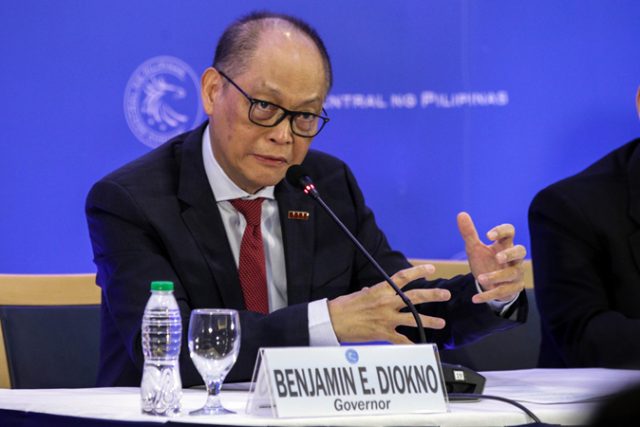
THE Philippine central bank will remain accommodative until economic recovery is sustained, with further monetary policy adjustments likely by the second half of 2022, Governor Benjamin E. Diokno said.

“We will continue this loose monetary policy until such time that we are sure that the government is on its way to recovery, a sustainable recovery. And that I see will happen maybe second half of next year so that’s when we’ll probably look at further adjustments in our monetary policy,” he said in an interview with the ABS-CBN News Channel on Monday.

The Bangko Sentral ng Pilipinas (BSP) chief vowed to have “a very carefully crafted, managed disengagement strategy” in unwinding policies implemented during the pandemic.

The Monetary Board kept the overnight reverse repurchase at a record low of 2% at its May policy review.

Mr. Diokno said this would provide continued support for the economy’s recovery from the crisis.

The economy remained in a recession in the first quarter, when it shrank by 4.2%. The country’s gross domestic product contracted by a record 9.6% last year.

The government earlier in May has slashed its growth target for 2021 to 6-7% from 6.5-7.5%.

“I think that its [targets are] optimistic but that’s the fighting target of the government authorities so let’s give them a chance,” Mr. Diokno said.

The pace of the mass vaccination campaign will be crucial in restoring consumer confidence and driving economic activity.

“I think really the focus of the government right now is still the vaccination. That’s the best way to perk up the economy. Because with the vaccination, you gain confidence. The [confidence of] consumers will of course lead to more economic activity,” he said.

The government is targeting to inoculate 50 million Filipinos by end-November, concentrated mostly in the high-risk areas of Metro Manila, Cavite, Laguna, Rizal and Bulacan. By the first quarter of 2022, the government hopes to have 70 million Filipinos vaccinated.

Based on Johns Hopkins University’s vaccine tracker, the Philippines has fully vaccinated 1.029 million Filipinos, equivalent to 0.95% of the population. This ratio is lower than other ASEAN economies that have fully vaccinated a bigger part of their population including Singapore (28.34%), Indonesia (3.78%), Thailand (1.57%), and Malaysia (3.42%).

Apart from the vaccination drive, the government’s continued infrastructure push would also support recovery, Mr. Diokno said.

Meanwhile, the BSP governor discounted the possibility of another “taper tantrum,” similar to what happened in 2013.

“I don’t think that [an interest rate hike] is in the cards at the moment because there’s a midterm election next year and I don’t think that the [US] Treasury or the Fed will engineer an increase in interest rates because that will cut down the economy at its band. I will assign it a very low probability that there will be a taper tantrum,” Mr. Diokno said.

For the Philippines, the more relevant concern is inflation, which Mr. Diokno said would be “manageable this year.”

The central bank in May lowered its inflation forecast for the year to 3.9%, already within its 2-4% target from the 4.2% it previously penciled.

Mr. Diokno’s latest guidance on the policy decision would help calm market participants, said Security Bank Corp. Chief Economist Robert Dan J. Roces.

“Markets will welcome a carefully crafted messaging of the central bank’s strategy as it manages volatility and lessen speculation, and more importantly it should help restore business and consumer confidence,” he said in a Viber message.

Mr. Roces said the governor’s assessment that a more sustainable recovery is more likely by the second half of 2022 is possible due to the impact of the lingering pandemic.

“We share the view that recovery will take some time, what with the deep economic scarring, uncertainties, and cautiousness the pandemic has brought. Restoring business and consumer confidence will be important and indeed, the primary challenge to the economy, and the key ingredient to a sustainable recovery,” he said.

The Monetary Board’s next policy-setting meeting is scheduled on June 24. — L.W.T.Noble

Good Samaritans give help amid Philippine coronavirus hardships, fill state void

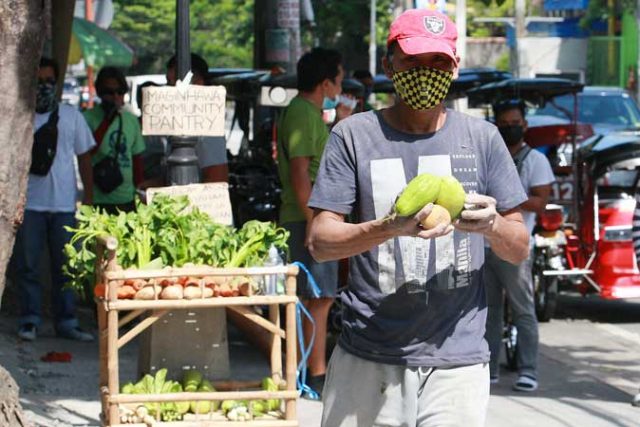
Entrepreneur Ana Patricia Non set up a small cart of donated food and vegetables along Maginhawa Street in Quezon City in mid-April. Over the next few weeks, hundreds of people flocked to the community pantry. — PHILIPPINE STAR/ MICHAEL VARCAS

By Kyle Aristophere T. Atienza,  Reporter

AGNES C. HONRADA, 54, used to line up for free food at a so-called community pantry near the Philippine capital after she lost her job as an acting extra amid a coronavirus pandemic.

“I couldn’t pay my rent so I was forced to go back to the streets as a scavenger,” she said by telephone in Filipino.

Ms. Honrada, a single mom, said she received a few kilos of rice from the local government in Quezon City, but never got cash aid from the government despite several tries.

When a civic leader sought the help of street dwellers and local residents to set up a give-and-take hub offering free canned goods, fruits, vegetables and rice to the poor, she didn’t hesitate to volunteer.

“I never had second thoughts because I wanted to help even if I’m poor,” she said. “I barely have an education but I know that you don’t need to be rich to be able to help others.”

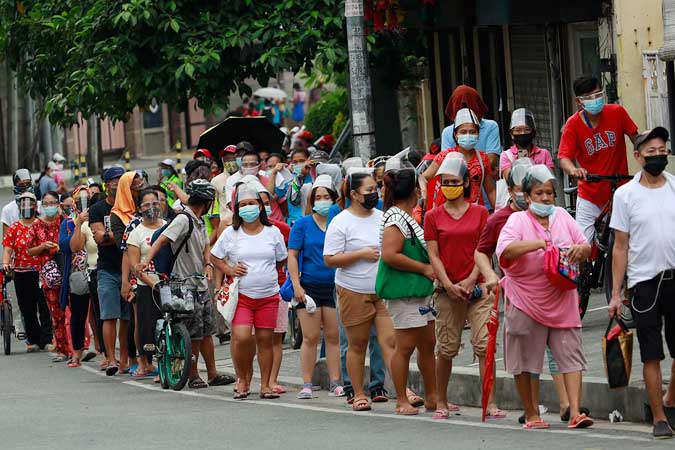
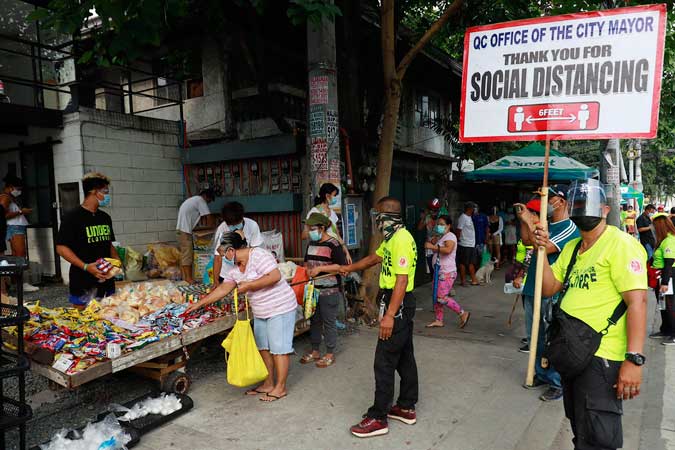
Thousands of carts carrying donated food have sprouted across the Philippines, which critics of President Rodrigo R. Duterte point to as evidence of government failure to help the poor amid one of the world’s strictest and longest coronavirus lockdowns.

His supporters, on the other hand, have accused the opposition and activists of politicizing purely charitable acts of kindness to paint his government in a bad light.

Millennial entrepreneur Ana Patricia Non started the idea of putting up a humble cart of donated food along Maginhawa Street in Quezon City in mid-April, when the capital region and nearby provinces were placed under a strict lockdown amid a fresh surge in coronavirus infections.

Her community pantry bore a sign: “Give what you can, take what you need.”

The kindness cart was set up to help people affected by prolonged lockdowns and inadequate government support, Ms. Non said by telephone.

“The pantries were set up to help the poor, but these are also a manifestation of government inadequacy,” she said by telephone.

A government task force has labeled Ms. Non and other food pantry organizers communists. Ms. Non was forced to suspend her pantry operations after being interrogated by police. She reopened after the city mayor assured her safety.

From having less than a dozen organizers in April, another community pantry along Matatag Street in Quezon City now has 26 volunteers, most of whom used to be beneficiaries of the grassroot initiative.

“These volunteers martial the lines, repack food and think of guidelines to make the pantry run better,” Hannah Nario-Lopez, one of the organizers, said by telephone.

“A community pantry is a good start for civic engagement,” she said. “That’s very important, especially during the pandemic.”

Ms. Lopez said all their volunteers barely finished school but are very capable in finding sustainable and equitable solutions for everybody.

“People should really be included when dealing with social problems,” she said in Filipino. “This is a stark contrast from the government approach of telling people not to be hard-headed and just follow directions. “If that’s the strategy, people will feel belittled and nothing will happen.”

Ed Billiones, who organized a community pantry in another village in Quezon City, said the setup has given people, including the poor, a sense of purpose.

“Before, they used to think that they could not contribute anything, that they were useless,” he said by telephone in Filipino. “Now, they realize that they can give something after being given a chance to serve others.”

‘INACTION’
Community pantries wouldn’t have spread so quickly if there weren’t “so many desperately hungry Filipinos, and so many citizens realizing that they can do something to make up for the government’s inadequacies,” Ibon Foundation Executive Director Sonny A. Africa said in a Facebook Messenger chat.

“This is also why the authorities are so threatened,” he said. Whether they admit it or not, their irresponsibility is showing and they are being made accountable for their inaction.”

The government’s economic team earlier said about 252,000 Filipinos could have lost their jobs due to the two-week strict lockdown in Metro Manila that ended in mid-April. The quarantine has since been eased.

The Philippine unemployment rate eased to 7.1% in March from 8.8% a month earlier, according to the local statistics agency. About 3.44 million Filipinos were out of work in March, down from 4.2 million in February.

But Mr. Africa noted that the labor force also grew by 3.8 million, meaning there still was not enough work for everyone.

Economic managers were “overstating employment gains to cover up the harsh impact of their refusal to give more cash aid and meaningfully stimulate the economy,” he said.

“The pantries clearly fill in a huge gap in government relief for tens of millions of distressed Filipinos,” Mr. Africa said. “The administration’s refusal to give any more aid has clearly become intolerable and people have decided to take matters into their own hands.”

The Presidential Palace remained lukewarm to calls for another round of cash aid for the poor. Presidential Spokesperson Herminio “Harry” L. Roque, Jr. has said the government should allow previous economic packages to run their course first before considering another, especially since funds are limited.

The House of Representatives has approved on second reading a third stimulus package that allots more than P400 billion to spur economic recovery.

Marikina Rep. Stella Luz A. Quimbo, one of the bill’s authors, said the measure could be funded by savings from the 2020 and 2021 national budgets as well as dividends from government-owned and -controlled corporations. She also urged the government to enforce austerity measures.

“Community pantries emerged because of the slow pace of the government’s social amelioration program,” John Paulo R. Rivera, an economist from the Asian Institute of Management, said in a Viber message.

He said the cash aid program has been plagued by issues of “exclusion, redundancy, slowness and inconsistencies.”

‘PRESSURE POINT’
The Department of Interior and Local Government (DILG) said that as of May 15, 91% of Metro Manila beneficiaries have gotten the P1,000 aid that Mr. Duterte approved more than a month ago.

“People’s stomachs can’t wait for the government to take concrete action,” Mr. Rivera said. “This is the main point being addressed by community pantries.”

“This gesture is a testament to Filipinos knowing that the government isn’t doing enough,” Noreen Sapalo, a college lecturer on culture and politics at the University of the Philippines said in a Messenger chat. “It should serve as a wake up call for our public officials.”

DILG puts the number of community pantries across the Philippines at 6,715 as of May 5.

If 100 poor families take food worth a dollar from a kindness stall daily, these pantries could be giving away a billion pesos worth of food every month, said Terry L. Ridon, former chairman of the Presidential Commission on the Urban Poor.

The number of families who benefit from these pantries daily is almost three times the number of families that benefited from the government’s modified conditional cash transfer program, the former lawmaker said in a Messenger chat.

The National Economic and Development Authority (NEDA) in 2018 estimated that a family of five spent about P127 daily on food.

Ms. Lopez said this estimate is “not dignified” and consists mostly of canned goods, not nutritious food.

“What we distribute is not just canned goods but also vegetables and meat that local governments are unable to provide,” she added.

Mr. Rivera said the rise of community pantries shows the benefits of participatory governance. “Consult, involve those who are mostly affected, those who are mostly in touch with reality,” he said.

“This is what community pantries are teaching us: We may be physically distant but we are socially integrated.”

“The community pantries are now the single-biggest pressure point on the administration to rectify its long-running insensitivity and weak COVID-19 response,” Mr. Africa said.