Home Blog Page 7537

Peso strengthens on lower daily coronavirus cases

BW FILE PHOTO

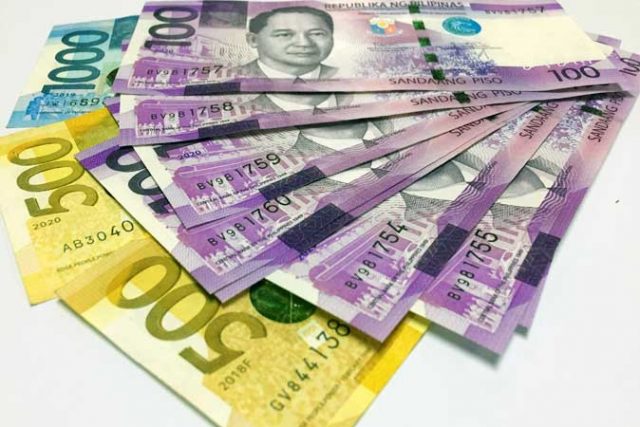
THE PESO rebounded against the greenback on Tuesday on the back of the decline in new cases of the coronavirus disease 2019 (COVID-19).

The local unit closed at P47.805 per dollar, gaining five centavos from its P47.855 finish on Monday, based on data from the Bankers Association of the Philippines.

The peso opened the session at P47.88 versus the dollar. Its weakest showing was at P47.90, while its intraday best was at its close of P47.805 against the greenback.

Dollars exchanged surged to $925.2 million from $567.19 million on Monday.

The peso was backed by improving investor sentiment as new coronavirus disease 2019 (COVID-19) cases continue to subside, Rizal Commercial Banking Corp. Chief Economist Michael L. Ricafort said.

Cases rose by 4,487 on Tuesday, with the country’s total cases at 1.154 million, based on data from the Department of Health.

Meanwhile, a trader attributed the peso’s strength to dovish signals from the US central bank.

“The peso appreciated after US Federal Reserve officials dismissed any premature tapering of the Fed’s asset purchases,” he said in an email.

Atlanta Fed President Raphael Bostic told CNBC it not yet time to change the central bank’s “strong accommodative stance.” He added the “healthy level of inflation” is an indication of economic growth.

For today, Mr. Ricafort gave a forecast range of P47.76 to P47.81 per dollar, while the trader expects the local unit to move within the P47.75 to P47.95 levels. — LWTN with Reuters

Duterte issues gag order on his Cabinet over China sea dispute

PCOO.GOV.PH

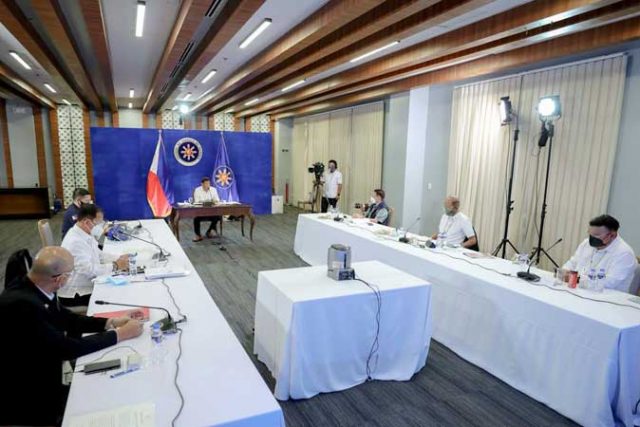
PHILIPPINE President Rodrigo R. Duterte on Monday night barred his Cabinet from talking in public about the country’s sea dispute with China, which some of his ministers had rebuked for its actions in the disputed waterway.

“If we have to talk, we talk among ourselves,” he said in a televised speech. Only his spokesman can talk about the issue publicly, he added.

Foreign Affairs Secretary Teodoro Locsin, Jr. this month minced no words in telling the Chinese to get out of Philippine waters in the South China Sea, cussing at its neighbor for failing to reciprocate its goodwill.

The presidential palace later distanced itself from Mr. Locsin. Presidential spokesman Herminio L. Roque, Jr. said Mr. Duterte is against the use of profanities in the field of diplomacy.

Mr. Locsin later apologized to his Chinese counterpart, Foreign Minister Wang Yi, after his expletive-laden tweet.

Defense Secretary Delfin N. Lorenzana had also told Chinese ships in the disputed sea to leave.

“Only the secretary of Foreign Affairs and myself can speak on the issue now,” Mr. Roque told a televised news briefing on Tuesday.

He said a Philippine task force on border patrols had also been barred from commenting on the issue.

The task force earlier said 287 Chinese ships were still in Philippine waters, many of them spotted near artificial islands built by China, while some were near islands occupied by Manila, based on patrols made on May 9.

Two Houbei class missile warships were also near Mischief Reef, while two Vietnamese logistics ships and a VN Coast Guard vessel were at Grierson Reef, it said.

Thirty-four Chinese ships also remained at Whitsun Reef, which the Philippines also claims.

The government would continue to defend its sovereign rights and jurisdiction over the “West Philippine Sea,” the task force said, referring to areas of the waterway within the country’s exclusive economic zone.

“Reports of the National Task Force are forwarded to the Department of Foreign Affairs and they would determine if they will file a diplomatic protest,” Mr. Roque said.

He said the Philippines would continue to “patrol relevant areas to assert what is ours.” “Our principled position and stand on the West Philippine Sea remains. Our vessels will continue.”

Meanwhile, Senate President Vicente C. Sotto III urged Malacañang to consider an “alternative response” by looking at the feasibility of starting oil exploration studies within the country’s exclusive economic zone to assert its jurisdiction in the area. 

“The public discourse over the West Philippine Sea boils down to one thing: While the United Nations ruled in our favor, the ruling cannot be put in force because of the absence of an international body that would enforce it,” he said in a statement. “But we can use this arbitral victory to our advantage.”

He said the Department of Energy could propose to conduct exploration activities in the contested areas and open initiatives to private investors and even other countries under a 60-40 joint agreement.

China cannot stop the Philippines from exploring natural and mineral resources within its exclusive economic zone, Mr. Sotto said. If China is interested, it can be a joint partner, he added.

A United Nations arbitration panel in 2016 favored the Philippines and rejected China’s claim to more than 80% of the disputed waterway based on a 1940s map.

The Philippines under President Benigno S.C. Aquino III filed the lawsuit that critics said Mr. Duterte had failed to pursue.

Aside from the Philippines and China, Brunei, Malaysia, Vietnam and Taiwan also claim parts of the waterway.

Meanwhile, Senator Panfilo M. Lacson agreed with former Senate President Juan F. Ponce-Enrile that the government should continue diplomatic talks with China.

“But neither should we disregard other options available, not only to finally resolve the West Philippine Sea issue but to provide the balance of power in the Indo-Pacific region,” he said in a statement.

Mr. Lacson said the Philippines should build stronger alliances with powerful countries.

Mr. Enrile advised Mr. Duterte during a taped meeting on Monday to continue its friendly approach with China.

Senator Ralph G. Recto said the Philippines should work with its allies including the United States and others “who share similar interests and values of a rule-based order.”

“It is in the interest of most nations to uphold our UNCLOS victory,” he said, referring to the United Nations Convention on the Law of the Sea. “We can maintain trade relations with China at the same time.” — Kyle Aristophere T. Atienza and Vann Marlo M. Villegas

500,000 more doses of CoronaVac arriving this week — Palace

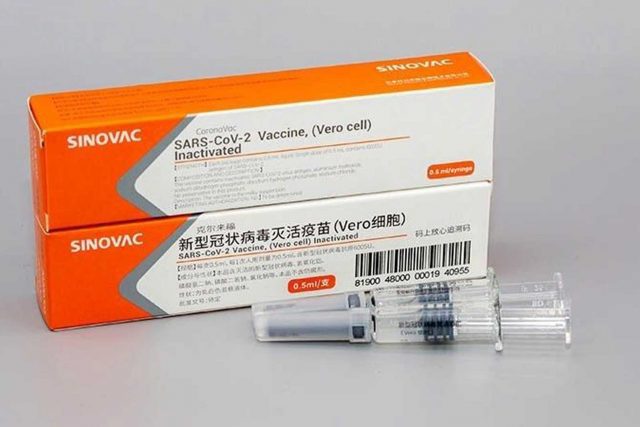
THE PHILIPPINES will take delivery this week of about 500,000 more doses of CoronaVac made by China’s Sinovac Biotech Ltd., according to the country’s vaccine czar.

The shipment that was paid for by the Philippine government would  arrive on Thursday, vaccine czar Carlito G. Galvez, Jr. told a televised news briefing on Tuesday.

The country would also receive about 4.5. million doses of CoronaVac next month and 10 million doses next quarter, he said.

Mr. Galvez said President Rodrigo R.Duterte had approved a recommendation by an inter-agency task force to open up the vaccination program to economic frontliners and the indigent population.

He said about 12.8 million people have been classified as economic frontliners and about 16 million people as poor.

Mr. Galvez said economic frontliners would be vaccinated using drugs bought by the government. Indigent people will receive shots from a global initiative for equal access.

More than 3.1 million doses of coronavirus vaccines have been given out as of May 17, he said.

Mr. Galvez also said the country would take delivery this month of about 2.2 million more doses of the vaccine made by Pfizer, Inc. under a global initiative for equal access.

He said about two million doses of the vaccine developed by AstraZeneca, Plc would arrive in June. About 250,000 doses of the shot made by Moderna, Inc. will also arrive soon.

He added that about two million doses of Sputnik V made by Russia’s Gamaleya Research Institute of Epidemiology and Microbiology would

The Department of Health (DoH) reported 4,487 coronavirus infections on Tuesday, bringing the total to 1.15 million.

The death toll rose by 110 to 19,372, while recoveries increased by 6,383 to 1.08 million, it said in a bulletin.

There were 52,291 active cases, 1.4% of which were critical, 93.3% were mild, 2% did not show symptoms, 2% were severe and 1.25% were moderate. 

It said 24 duplicates had been removed from the tally, 22 of which were tagged as recoveries and one as death. Sixty-four recoveries were reclassified as deaths. Eight laboratories failed to submit data on May 16.  

About 11.9 million Filipinos have been tested for the coronavirus as of May 16, according to DoH’s tracker website.

The coronavirus has sickened about 164.3 million and killed 3.4 million people worldwide, according to the Worldometers website, citing various sources including data from the World Health Organization.

About 143.1 million people have recovered, it said.

Meanwhile, the Health department said cases in Metro Manila and nearby provinces have gone down, but flagged an increase in the Visayas and Mindanao.

“There is a need for a thorough monitoring of the Visayas and Mindanao areas where we are seeing an increase,” Health Officer-in-Charge Director Alethea de Guzman told an online briefing in Filipino on Tuesday.

Average daily reported cases nationwide in the seven days to May 17 hit 5,886, lower than the peak of 10,406 from April 6 to 12, she said.

In Metro Manila, average daily reported cases in the past seven days reached 1,417, also lower than the peak of 5,325 from March 30 to April 5.

In the provinces of Bulacan, Laguna, Rizal and Cavite, cases in the past week hit 1,070, lower than the peak of 2,203 cases from April 6 to 12.

Ms. de Guzman said 10 regions reported an increase in the average daily attack rate — the ratio of new cases to the population — in the past two weeks.

These were Zamboanga, Western Visayas, Mimaropa, Caraga, Northern Mindanao, Soccsksargen, Bicol, Davao, Eastern Visayas and the Bangsamoro Autonomous Region in Muslim Mindanao.

Ms. de Guzman said they were monitoring the Zamboanga region, where the average daily attack rate was at 6.1, nearing seven which is considered high risk.

She also cited an increase in infections in the Visayas and Mindanao, particularly in highly urbanized areas where lockdowns were more relaxed. — Kyle Aristophere T. Atienza and Vann Marlo M. Villegas


Anti-red tape body probing villages that charge entrance fees

THE ANTI-RED Tape Authority (ARTA) is investigating local governments that continue to charge fees on transported goods despite a circular banning the practice. 

In a statement on Tuesday, ARTA Director General Jeremiah B. Belgica said they found that a number of villages were violating the order issued in April.

Those that charge banned pass-through fees may be investigated under guidelines issued by ARTA, the Department of Finance and Department of Interior and Local Government (DILG).

The circular covers any taxes and fees on transported goods, including wharfage charges and fees for stickers, toll, discharge, delivery, entry and mayor’s permits.

The DILG in 2018 passed a circular barring local governments from collecting illegal fees, but the agency continued to receive complaints.

The new joint circular could be used to file cases against violators with the Office of the Ombudsman, Interior Secretary Eduardo M. Año said.

ARTA is also working on developing a “unified logistics pass” QR code that will replace all stickers needed to transport goods across villages, port authorities, economic zones and checkpoints. — Jenina P. Ibañez

Lawyers get confirmation of being under next priority group for COVID-19 vaccination; prisoners still under consideration

PHILIPPINE STAR/ JOVEN CAGANDE

THE INTEGRATED Bar of the Philippines, the official organization of all Philippine lawyers, has received confirmation from the government that legal professionals are included in the next priority group for vaccination against coronavirus disease 2019 (COVID-19).

The next sector in line for inoculation are those under group A4, which covers economic and government frontliners.

The vaccination program is currently covering the A1 to A3 groups, which include medical workers, senior citizens, and persons with comorbidities.

Meanwhile, Justice Secretary Menardo I. Guevarra said prisoners are not yet included in the A5 group, which covers the indigent population.

He told reporters on Tuesday that as of last week, inmates are still “under consideration for (priority group) A5.”

Kapatid, a support group for families and friends of political prisoners, have been appealing to the Department of Health to include inmates in congested jails across the country to be prioritized for COVID-19 vaccination.

“Prisoners should enjoy the same standards of health care that are available in the community, and should have access to necessary health-care services free of charge without discrimination on the grounds of their legal status,” the group said in a March 2 letter to Health Secretary Francisco T. Duque III. — Bianca Angelica D. Añago

Solons call for inclusion of dentists, med-techs in vaccination teams

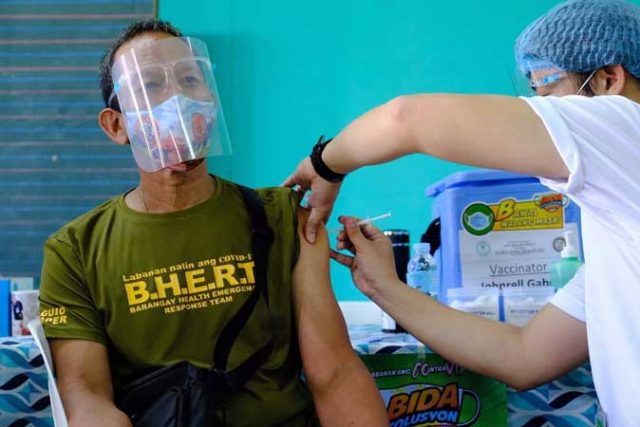
A health emergency response team member in Davao City gets inoculated against the coronavirus in this April 2021 photo. — DAVAO CIO

A BILL was filed Tuesday for the inclusion of dentists and medical technologists as vaccinators to speed up the government’s inoculation program against coronavirus disease 2019 (COVID-19).

“With the arrival of more vaccines in the country, the swift roll out of the vaccine is needed for the efficient administration and prevention of possible expiration of the doses,” reads part of House Bill No. 9354, which will amend the recently enacted Republic Act No. 11525 or the COVID-19 Vaccination Program Act.

Under the existing law, those permitted to administer COVID-19 vaccines are duly trained doctors, nurses, pharmacists and midwives.

The government targets to vaccinate around 70% of the 108 million population to develop herd immunity. Around 2.2 million Filipinos have been vaccinated as of Monday since the start of the vaccination drive in March.

The proposal was jointly filed by Representatives Angelina DL Tan, Jose Christopher Y. Belmonte, and Stella Luz A. Quimbo. Gillian M. Cortez

Rep Quimbo calls on PhilHealth to settle hospital claims, seeks probe

PHILSTAR FILE PHOTO

A LAWMAKER filed a resolution calling on the Philippine Health Insurance Corp. (PhilHealth) to immediately settle its unpaid claims, and is seeking a probe on the agency’s fund management.

Marikina Rep. Stella Luz A. Quimbo filed House Resolutions 1769 and 1770 on Monday. The first urges PhilHealth to settle its balance to hospitals, while the second asks the House Committee on Good Government and Public Accountability to launch an investigation on the agency’s expenditures.

“There is an urgent need to settle payments due to hospitals so as not to further hinder our health system’s capacity to respond to the ongoing pandemic,” Ms. Quimbo said in HR 1769.

The investigation in aid of legislation will focus on the unpaid benefit claims of healthcare facilities and look into the efficiency of PhilHealth’s mechanisms in addressing unsettled claims.

Ms. Quimbo, in a privilege speech on Monday, said the measures are urgent as these unpaid claims have reportedly forced private hospitals to cut costs by retrenching personnel and downsizing facilities despite the continued high demand amid the coronavirus crisis. — Gillian M. Cortez

Human rights groups, family of slain activists list recommendations to Supreme Court on people’s protection 

EIGHT human rights groups and four family members of slain activists have submitted recommendations to the Supreme Court on increasing people’s protection against red-tagging or being labeled as a communist armed rebel, “search warrant factories,” and extrajudicial killings.

The recommendations, contained in a May 18 letter, relate to the High Court’s recent condemnation on the attacks on lawyers and judges, and its assurance that it will “act decisively when it is clear that injustices are done.”   

The groups called for the following: a review on the rules on writs meant to protect one’s right; create new rules to ensure the timely receipt of subpoenas and criminal complaints; make a repository of criminal charges; amend rules on the issuance of search warrants; and to investigate the so-called search warrant factories, referring to lower courts that have been issuing multiple search warrants and are allegedly “weaponized” by government forces to silence activists and critics.   

The rights groups said these concerns stem from the “unchecked powers of the Executive (branch of government),” and “require an immediate response from the Honorable Court as the protector of constitutional rights.”

They also said the “attacks against human rights lawyers violate the basic principle that lawyers shall not be identified with their clients or their clients’ causes as a result of discharging their functions.”

Further, they said “that it is equally important for the Honorable Court to look into the attacks suffered by the clients (of the human rights lawyers) and to understand the overarching government policies that cause them.” — Bianca Angelica D. Añago

NEA adds guidelines on writing-off lost, destroyed power bills

PHILSTAR FILE PHOTO

THE NATIONAL Electrification Administration (NEA) has issued additional guidelines on writing-off uncollected power bills that have been lost or destroyed due to natural calamities and man-made disasters.

In a memorandum posted on its website on Tuesday, NEA said the new regulations were added after an electric cooperative in Lanao del Sur requested to write-off electric bills whose records were deemed lost due to the armed conflict which took place in Marawi City in 2017.

The guidelines will be added to NEA’s earlier memo on the “Revised Guidelines for Writing-Off Worthless Consumer Accounts Receivables as Amended,” which was issued on Oct. 27, 2020.

Accounts qualified for write-off now include those whose physical or electronic copies are lost or damaged due to typhoons, earthquakes, floods, war, robbery and acts of terrorism, among others, the agency said.

Requests for canceling certain accounts must be approved by the cooperative’s board, which will issue a resolution stating the amount that will be waived and the circumstances of the loss or damage.

“The amount to be written-off, as proven by the required evidence presented, shall be limited and shall be applicable only to power bills that were lost on the date of declaration of the state of calamity or occurrence of the… unforeseen or fortuitous events and other circumstances,” NEA said.

The addendum will take effect 15 days after it is filed with the University of the Philippines Law Center.

The Oct. 27 revised guidelines were issued for electric cooperatives with receivables from consumers that have “unrealistically accumulated over the years.” — Angelica Y. Yang

Lawmaker asks Budget dep’t to immediately release funds for PGH repairs

MANILA DRRM OFFICE

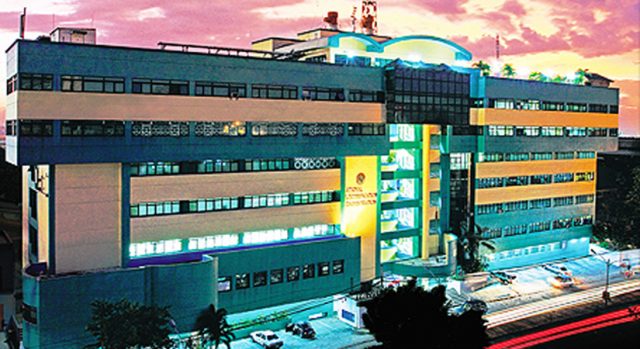
A LAWMAKER is calling on the Budget department to immediately release funds to repair and re-equip the University of the Philippines-Public General Hospital (UP-PGH), the biggest coronavirus disease referral hospital in the capital, which was partly damaged by fire last Sunday.

The cost of damage was estimated at P300,000, according to the Bureau of Fire Protection.

In House Resolution 1768 filed by Quezon City Rep. Jose Christopher Y. Belmonte on Tuesday, the solon urged the Budget department and other pertinent agencies “to immediately release funds for the rehabilitation” of the state-run UP-PGH.

Mr. Belmonte also said the inter-agency task force handling the coronavirus response should establish “stop-gap” measures to help UP-PGH continue providing crucial medical services.

There were no casualties in the fire that broke out in the early hours of May 16 due to faulty electrical wiring.

Medical workers on duty promptly evacuated patients, including several newborns. — Gillian M. Cortez

Claimant of P3.1-M party drugs shipped from Malaysia arrested

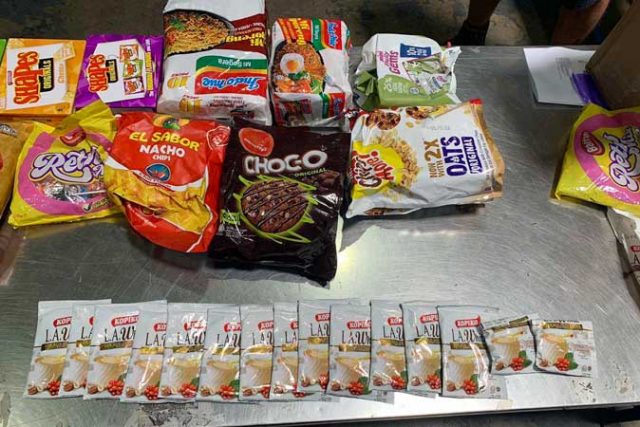
A PACKAGE from Malaysia declared as “snacks” was discovered to contain 622 grams of Ketamine, also known as the party drug Special K. — BOC

AUTHORITIES arrested the claimant of a package from Malaysia containing P3.11 million worth of party drugs concealed in instant coffee sachets. A joint team from the Bureau of Customs (BoC), Philippine Drug Enforcement Agency, and NAIA Inter-agency Drug Interdiction Task Group nabbed Kristopher Segumban during a “controled delivery operations” in Caloocan City on May 17, the BoC reported on Tuesday. The suspect was the authorized representative of the package’s consignee, Nick Dimagiba. The package declared as “snacks” was discovered to contain the substance Ketamine, also known as the party drug Special K, after going through x-ray scanning at the Ninoy Aquino International Airport and K-9 sweeping. BoC said Ketamine was originally developed as anesthetics but commonly abused as party drugs for its tranquilizing effects. It was listed in the Philippines as a dangerous drug in 2005.

Senate bodies OK new anti-child porn law

PHILSTAR

THREE Senate committees on Tuesday approved a measure seeking to strengthen protection against the sexual abuse of children online.

Senator Risa N. Hontiveros-Baraquel, who heads the committee on women, endorsed to the plenary Senate Bill 2209, which will repeal the Anti-Child Pornography Act of 2009 and amend the Anti-Photo and Video Voyeurism Act of 2009.

The committees on science and technology and finance also approved the bill.

Ms. Baraquel said the bill penalizes the use of digital or analog communications to abuse and exploit children sexually.

Cases of online child sexual abuse almost quadrupled in the Philippines at the height of a coronavirus pandemic from March to May 2020, according to data from the Department of Justice.

The Philippines was also among the top 10 countries that produced child porn in 2016, Ms. Baraquel said in her sponsorship speech, citing a report by the United Nations International Children’s Emergency Fund (UNICEF). — Vann Marlo M. Villegass