Home Blog Page 7470

NK markets in turmoil as borders stay closed

REUTERS

SEOUL — Currency exchange rates and commodity prices appear to be wildly fluctuating in North Korea (NK) as a resumption in major trade with China hasn’t materialized, media reports and analysts say, increasing the hardship for residents facing food shortages.

After steadily rebounding in the first few months of the year, China’s exports to North Korea in May fell to $2.71 million from $28.75 million in April, quashing hopes among traders along the border that more than a year of anti-coronavirus closures could soon ease.

North Korea is highly insular and it is difficult to pinpoint the situation within the country. But reports this week that China, its biggest ally, plans to keep pandemic border restrictions in place for at least another year have cast doubt on North Korea’s prospects.

In some areas, that appears to be among the factors that sparked significant volatility in foreign exchange rates and the prices of some key goods.

“The fuel and forex price swings are likely caused by the foreign trade situation,” said Peter Ward, an expert on North Korea’s economy.

Daily NK, a Seoul-based website that has tracked such indicators in North Korea for years, reported on Tuesday that North Korea’s won had surged 15-20% against the US dollar and China’s renminbi in the space of around a week.

The swings seem driven in part by North Korean organizations and individuals selling off their dollars and yuan because the expected restart of China-North Korea trade did not materialize, the website reported, citing sources in the country.

“After years of relative stability, the wild swings in prices and internal exchange rates in recent days threaten to raise the level of popular desperation and may make reopening trade with China more difficult,” a report from the US-based 38 North program, which tracks North Korea, said this week.

Last week, North Korean leader Kim Jong Un said the country’s economy improved this year but called for measures to tackle the “tense” food situation caused by the coronavirus pandemic and last year’s typhoons.

State media reported that the government would produce and distribute more grain to the people.

Daily NK reported that corn and rice prices in some of the country’s major cities, including Pyongyang, have fallen after local residents received government rations. But some other areas have seen prices soar for basic supplies, the website said.

Earlier this year, some imported luxuries reappeared on store shelves in Pyongyang as border restrictions appeared to ease, but prices have shot back up again, one Western source with contacts in the city told Reuters.

Some shampoo has been selling for $200 per bottle and a kilogram of bananas for $45, NK News, which monitors North Korea, reported last week.

“From what we can learn through Asia Press and Daily NK, the food situation outside a few major cities is very bad,” Ward said. “If these trends continue, we will have to start to worry about hunger and even starvation amongst North Korea’s poorest.” — Reuters

As banking sector consolidates, 9,000 physical branches to disappear across SEA by 2030 — report

FREEPIK

By Patricia B. Mirasol 

Traditional banks that do not adjust to meet evolving customer habits risk being overtaken by hungrier digital startups, according to big data firm ADVANCE.AI. 

“Traditional banks and financial institutions (FIs) have the customer base and brand equity, while fintechs are nimbler and more innovative, and so can tailor customized solutions for the bigger banks,” said Aradhna Sharma, Southeast Asia digital and data solutions director of ADVANCE.AI, in an e-mail interview with BusinessWorld. “Many such banks and FIs are looking to either enhance their digital capabilities by building their own technology or setting up digital subsidiaries, or else through partnering with tech startups like ourselves to accelerate their digital transformation journey.” 

Most Southeast Asia countries will significantly reduce their bank branch footprints, and only a few less mature markets are expected to slightly increase their physical networks, according to an April 2021 report by global consulting firm Roland Berger. A net reduction of more than 9,000 bank branches across Southeast Asia is expected by 2030, with the biggest consolidations driven by Indonesia, Thailand, the Philippines, and Malaysia. 

The coronavirus pandemic has compelled banks to reimagine basic hygiene services such as account deposits and bill payments. The report stated that future bank branches in Southeast Asia will likely move away from offering simple transactions and focus on higher value-added services. With key drivers such as an increased access to technology and government digital economy policies influencing the future of retail banking branch networks, traditional banks need to reimagine how they offer services that meet evolving customer needs. 

With the focus on higher value-added services, traditional bank employees must be retrained from repetitive roles, such as bank telling, to ones that require more human decisioning and skills such as creativity, problem solving, and design thinking. 

The Bangko Sentral ng Pilipinas approved on November 2020 the recognition of digital bank as a new bank category that is separate and distinct from existing bank classifications. A digital bank is defined as a bank that offers financial products and services that are processed end-to-end through a digital platform and/or electronic channels with no physical branches. 

BENEFITING THE UNBANKED
The benefits of virtual banks also redound to the unbanked and underbanked, as they enable these segments  many of whom come from rural areas  quicker access to loans and financial services, Ms. Sharma said. 

“With virtual banking, customers can be onboarded and have access to banking services solely through their mobile phone, anywhere and anytime, without having to step into a bank branch,” she added. 

More than 70% of the population of Malaysia, Vietnam, and the Philippines have access to the internet (above the global average of 54%), the Roland Berger report said. 

“AI can be deployed in a variety of ways to facilitate customer onboarding via your smartphone,” said Ms. Sharma. “A simple video call with a customer service agent could also cut the need for a trip to the physical bank.” 

Examples of customer onboarding include digital identity verification and authentication by taking selfies or submitting photos of national identity documents such one’s Taxpayer Identification Number (TIN). With the use of AI software and optical character recognition (OCR) technology, meanwhile, an agent can verify and match the authenticity of the caller with the documents shown on the video call. Ms. Sharma added that these verification techniques will gradually phase out the reliance on cash on delivery (COD).  

Ms. Sharma told BusinessWorld that physical banks remain an important touchpoint to help consumers in the transition towards online banking. 

“You also have certain times (e.g., setting up a business, buying property, mortgage/wealth management, retirement planning) when complex discussions or high-value transactions are better done face-to-face to build trust, understanding, and relationships,” she said. “Physical banks are still instrumental in providing a human touch, but the question is, how many do you need?” 

Meralco Improves substation in Cabuyao, Laguna

Meralco recently commissioned a new 83 MVA transformer bank no. 2 in its Light Industry and Science Park (LISP) 115 kV – 34.5 kV Substation located along South Street, Cabuyao, Laguna. This additional transformer bank will provide the additional capacity needed to serve the new load requirements of locators inside the LISP, as well as the increasing power demand in the City of Cabuyao in Laguna.  This project is also expected to reduce system losses, improve system reliability and voltage regulation, and provide adequate supply of electricity to the Meralco customers in the area.  Despite the continued implementation of community quarantine measures throughout the country due to the COVID-19 pandemic, Meralco personnel and its subsidiaries are continuously working round the clock to execute major capital projects to “Keep the Lights On”, “Save Lives” and “Keep the Hopes Alive” for its customers.

China condemns latest US warship transit of Taiwan Strait

NAVY.MIL

BEIJING/TAIPEI  China condemned the United States on Wednesday as the region’s greatest security “risk creator” after a US warship again sailed through the sensitive waterway that separates Taiwan from China. 

The US Navy’s 7th Fleet said the Arleigh Burke-class guided missile destroyer USS Curtis Wilbur conducted a “routine Taiwan Strait transit” on Tuesday in accordance with international law. 

“The ship’s transit through the Taiwan Strait demonstrates the US commitment to a free and open Indo-Pacific.” 

The People’s Liberation Army’s Eastern Theater Command said their forces monitored the vessel throughout its passage and warned it. 

“The US side is intentionally playing the same old tricks and creating trouble and disrupting things in the Taiwan Strait,” it said. 

This “fully shows that the United States is the greatest creator of risks for regional security, and we are resolutely opposed to this.” 

Taiwan’s Defense Ministry said the ship had sailed in a northerly direction through the strait and the “situation was as normal.” 

The same ship transited the strait a month ago, prompting China to accuse the United States of threatening peace and stability. 

The latest mission comes around a week after Taiwan said 28 Chinese air force aircraft, including fighters and nuclear-capable bombers, entered Taiwan’s air defense identification zone (ADIZ), the largest reported incursion to date. 

That incident followed the Group of Seven leaders issuing a joint statement scolding China for a series of issues and underscoring the importance of peace and stability across the Taiwan Strait, comments China condemned as “slander.” 

The US Navy has been conducting such operations in the Taiwan Strait every month or so. 

The United States, like most countries, has no formal diplomatic ties with democratic Taiwan but is its most important international backer and a major seller of arms. 

Military tension between Taiwan and Beijing have spiked over the past year, with Taipei complaining of China repeatedly sending its air force into Taiwan’s air defense zone. — Reuters

Trial of first person charged under Hong Kong’s national security law begins

Image via Comma Papana BS200/CC BY-SA 4.0/Wikimedia Commons

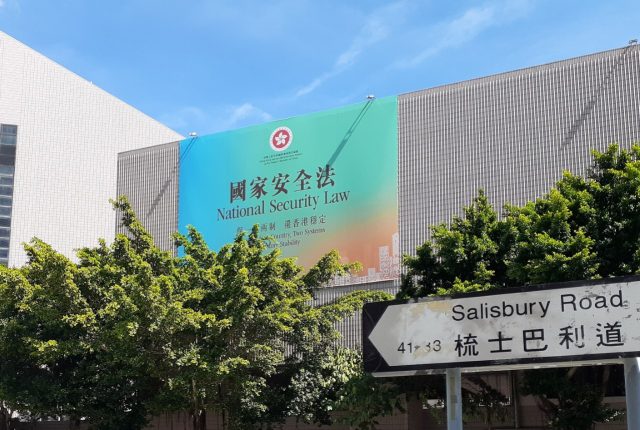
HONG KONG  The trial of the first person charged under the national security law in Hong Kong begins on Wednesday, almost a year after he was charged with driving his motorbike into officers during a rally while carrying a flag with a protest slogan. 

The case of Tong Ying-kit is seen as a departure from Hong Kong’s common law traditions, as he was denied bail and a jury, and a test of the government’s claim that the slogan “Liberate Hong Kong! Revolution of our times” is secessionist. 

Mr. Tong, 24, was arrested on July 1, 2020, hours after the enactment of the national security law, which punishes what China deems as subversion, secessionism, terrorism and collusion with foreign forces with up to life in prison. 

Mr. Tong faces charges of terrorism and inciting secession, as well as an alternative charge of dangerous driving causing grievous bodily harm, which can lead to up to seven years in prison. 

Mr. Tong has been denied bail. Hong Kong’s common law has traditionally allowed defendants to seek release unless prosecutors can show lawful grounds for their detention. Under the new law, the burden is now placed on the defendant to prove they will not break the law if released on bail. 

On Tuesday, the Court of Appeal upheld a decision to deny Mr. Tong a trial by jury, citing a threat to the personal safety of jurors and their family members. 

His trial will be held by a panel of three judges instead: Esther Toh, Anthea Pang and Wilson Chan. 

Hong Kong’s Judiciary describes trial by jury as one of the most important features of the city’s legal system, a common law tradition designed to offer defendants additional protection against the possibility of authorities overreaching their power. 

Article 46 of the security law  drafted by Beijing, where courts are controlled by the Communist Party and conviction rates are close to 100% – states three instances in which juries can be scrapped: protecting state secrets, cases involving foreign forces and protecting jurors’ safety.  Sara Cheng/Reuters 

US blocks websites linked to Iranian disinformation

Screenshot via www.almasirah.com

DUBAI — The US Justice Department said on Tuesday it seized 36 Iranian-linked websites, many of them associated with either disinformation activities or violent organizations, taking them offline for violating US sanctions.

Several of the sites were back online within hours with new domain addresses. 

“Today, pursuant to court orders, the United States seized 33 websites used by the Iranian Islamic Radio and Television Union (IRTVU) and three websites operated by Kata’ib Hizballah (KH), in violation of US sanctions,” the department said in a statement. 

Also spelled Kataib Hezbollah, KH is one of the main Iran-aligned Iraqi militia groups and has been designated a Foreign Terrorist Organization by the United States. 

The sites seized included Press TV, the Iranian government’s main English-language satellite television channel, and Al Alam, its Arabic-language equivalent. Both came back online using Iranian domain addresses Alalam.ir and Presstv.ir. 

The Justice Department said the 33 domains used by IRTVU are owned by a United States company and that IRTVU did not obtain a license from Treasury’s Office of Foreign Assets Control prior to utilizing the domain names. 

KH also did not obtain a license. 

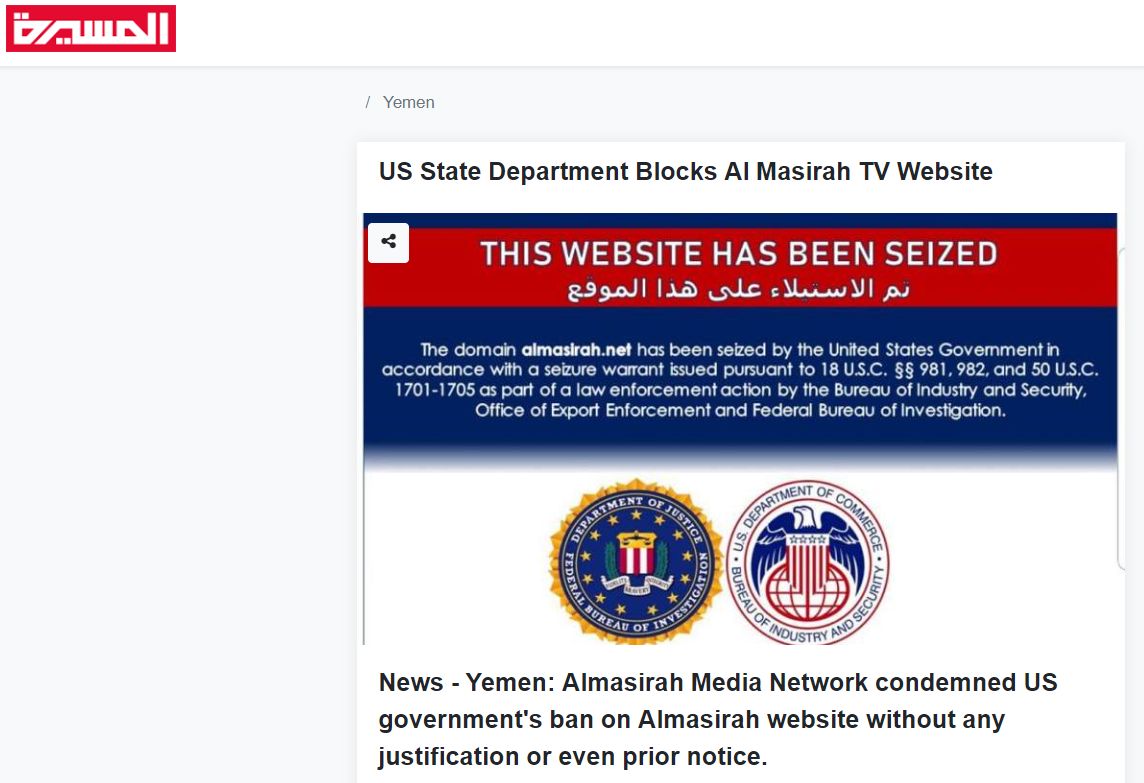
Notices appeared earlier on Tuesday on a number of Iran-affiliated websites saying they had been seized by the United States government as part of law enforcement action. 

Iranian news agencies said the US government had seized several Iranian media websites and sites belonging to groups affiliated with Iran such as Yemen’s Houthi movement. 

The notices appeared days after a prominent hardliner and fierce critic of the West, Ebrahim Raisi, was elected as Iran’s new president and after envoys for Iran and six world powers, including Washington, adjourned high-stakes talks on reviving their tattered 2015 nuclear accord and returned to capitals for consultations. 

The website of the Arabic-language Masirah TV, which is run by the Houthis, read: 

“The domain almasirah.net has been seized by the United States Government in accordance with a seizure warrant … as part of a law enforcement action by the Bureau of Industry and Security, Office of Export Enforcement and Federal Bureau of Investigation.” 

The site quickly opened up a new, working website at www.almasirah.com. 

Iran’s Arabic language Alalam TV said on its Telegram channel: “US authorities shut down Al-Alam TV’s website.” 

Notices also appeared on the website of Lualua TV, an Arabic-language Bahraini independent channel that broadcasts from Britain. 

US prosecutors in October seized a network of web domains they said were used in a campaign by Iran’s Revolutionary Guard Corps (IRGC) to spread political disinformation around the world. 

The Justice Department said then it had taken control of 92 domains used by the IRGC to pose as independent media outlets targeting audiences in the United States, Europe, Middle East and Southeast Asia. 

The semi-official Iranian news agency YJC agency said on Tuesday the US move “demonstrates that calls for freedom of speech are lies.” — Reuters 

Pag-IBIG Fund members save record-high P10.7B in MP2 Savings in Jan-May 2021, up 109%

Pag-IBIG Fund members collectively saved P10.67 billion under the agency’s voluntary Modified Pag-IBIG 2 Savings program in the first five months of the year, setting another record-high despite the ongoing health crisis, top officials of the agency said on Monday (June 21).

“We are happy to report that despite the impact of the pandemic to our economy, the amount saved by our members in the MP2 Savings from January to May of this year has reached P10.67 billion. This amount is a record-high for any January to May period in our history and hence, speaks highly of the trust that our members have in Pag-IBIG Fund. We would like to assure our members that we will continue to safeguard their savings and do our best to gain the best possible return for every hard-earned peso they save with us. This will also go a long way in helping us serve more members by providing funds for their cash loans and home loans, all in line with President Rodrigo Roa Duterte’s directive to help uplift the lives of more Filipinos especially during these difficult times,” said Secretary Eduardo D. del Rosario of the Department of Human Settlements and Urban Development and Chairperson of the 11-member Pag-IBIG Fund Board of Trustees.

The MP2 Savings is Pag-IBIG Fund’s voluntary savings program that has a 5-year maturity period and a minimum savings requirement of only P500. Made available to members in 2010, the MP2 Savings has seen phenomenal growth over the last 5 years due to the program’s consistently high dividends. In 2020, amid the pandemic-induced economic slowdown, the program still posted a 6.12% annual dividend rate.

Pag-IBIG Fund Chief Executive Officer Acmad Rizaldy P. Moti cited the MP2 Savings’ remarkable growth, noting that even in midst of the pandemic, more members continue to save in the program.

“It was only in 2017 when collections from our MP2 Savings surpassed the P1 billion-mark, which was then a historic feat. By the end of 2020, in a span of just three years, MP2 Savings reached a record-high P13.28 billion, surpassing the previous high of P12.01 billion saved by our members in 2019 – an 11% growth. This year, despite the ongoing health crisis, MP2 Savings continue to increase as collections in January to May are up by 109% compared to the same period last year. In fact, the amount of MP2 Savings collected in the first five months of 2021 is already equivalent to 80% of the P13.3 billion saved in MP2 for the entire year of 2020. We thank our members for their continued support and enduring trust that despite the challenging times, they opt to save voluntarily in our MP2 Savings Program,” said Moti.

World Bank vows to keep board apprised of climate action progress

PIXABAY

WASHINGTON  The World Bank on Tuesday agreed to boost its spending on climate change to 35% from 28% and to provide annual progress reports to its board after its draft climate change action plan came under fire for lacking a clear implementation strategy. 

The bank, the largest source of climate finance for developing countries, said it would also publicly release a roadmap to show how it will help those nations meet their Paris climate accord targets. 

Bank officials pledged to provide the board with regular updates, with details to be included in an addendum to the plan, Genevieve Connors, who oversees tracking and reporting of climate finance for the World Bank, told Reuters. 

“This is really transformational in the way we do business,” she said. “One of the central differences of this (climate change action plan) is that we as the World Bank Group have now elevated climate to be central to everything that we do.” 

The World Bank released some details of its five-year plan in April, saying it would help developing countries reduce greenhouse gas emissions by aiding the transition out of coal. But it drew fire for stopping short of halting all funding of fossil fuel projects. 

The bank’s plan calls for increase the amount it dedicates to climate finance, which has totaled $83 billion over the past five years, peaking at $21.4 billion in 2020. 

Environmental campaigners took aim at the new plan on Tuesday, saying its failure to completely end fossil fuel investments undermined the broader goals. 

“The World Bank Group’s selective approach to phasing out fossil fuels is about as effective as throwing both water and gasoline at a house fire,” said Luisa Galvao, a campaigner with the US arm of Friends of the Earth. 

Ms. Connors said the bank would assess gas investments on a case-by-case basis and that gas projects would face high thresholds to win funding. 

In some cases, it makes sense to proceed with gas projects, Ms. Connors said, adding that there was no firm deadline for halting all such investments. 

“It’s a moving target,” she said. “We see it as a journey towards decarbonization … but our countries are all on different pathways and there always may be extenuating circumstances in which a particular natural gas project may make sense. But the hurdles are high, and proof needs to be shown.”  Andrea Shalal/Reuters 

As seas rise, coastal communities face hard choices over ‘managed retreat’

ANDRZEJ KRYSZPINIUK-UNSPLASH

LONDON  With climate change expected to drive a meter or more of sea level rise this century, planning now for “managed retreat” from places facing inundation could help at-risk communities preserve what they value most, researchers and city officials said Tuesday. 

Whether families opt for floating homes or new ones inland, coming moves also present opportunities to address historical inequities and ensure that protecting communities  rather than just cutting economic losses  is a top priority, they said. 

“Too often adaptation is trying to keep the world the way it is when we should be trying to make it better,” argued A.R. Siders, a University of Delaware assistant professor and managed retreat specialist. 

With people everywhere reluctant to leave their homes and communities, even raising the prospect of managed retreat “is incredibly difficult,” Ms. Siders told an online event organized by The Earth Institute and Columbia Climate School. 

But if it is not talked about now and prepared for, “then we will limit the futures we can build,” she said. 

Rising seas, driven by melting of the world’s glaciers and polar ice and by the expansion of warming oceans, threaten low-lying communities from the Pacific islands to US cities like New York and Miami. 

Efforts to protect them have long relied on building engineering defenses, such as seawalls, or reinforcing natural barriers, from replanting mangroves to widening beaches. 

But seawalls, for instance, can cut off communities from the ocean access and views they value or rely on for an income  and as sea levels rise they may fail or prove too costly and impractical to continue expanding, analysts say. 

Instead, many communities will need to move to safer places  or rethink how they stay in place, such as by adopting floating homes or turning flooded roads into canals and relying on boats for travel, Ms. Siders, a lawyer and social scientist, noted in an article in the journal Science this month. 

‘NOT A WELCOME WORD’ 

But few communities are ready to talk seriously about the threats yet, noted Nichole Hefty, deputy resilience officer for Miami-Dade County in flood-threatened southern Florida. 

“The word ‘retreat’ is not a welcome word,” she said. In her county, “we’re not thinking of retreat in terms of leaving but really more in making changes in how we live,” she added. 

That means, for instance, figuring out how to help the more than 100,000 homeowners in the area whose septic tanks  which process waste  are likely to fail by 2040 as groundwater levels rise, she said. 

The county is also experimenting with buying out at-risk property owners, though a pioneering program covers only 10 properties, she said. 

In New York City, about 400,000 people live in flood hazard areas, a problem “we’re going to need every tool in the toolbox” to solve, said Eric Wilson, deputy director for land use and buildings in the Mayor’s Office of Climate Resiliency. 

Globally, some early efforts at managed retreat are underway. 

The Pacific island nation of Fiji has identified more than 40 coastal communities threatened by worsening cyclones and storm surges that need to be moved inland, and about six have been relocated so far. 

An indigenous community living on southern Louisiana’s disappearing Isle de Jean Charles also has used a pioneering $48 million grant from the US government to buy land and begin relocating all of its members. 

That move is “not a lotto, it is not a celebration. It is a response to the changes to the environment,” Chris Brunet, a member of the community, told the online event. 

ECONOMIES OR PEOPLE? 

Jacqueline Patterson, senior director of the NAACP environmental and climate justice program, urged people who may need to move to ask hard questions, including who pays, who benefits and who gets to make key decisions. 

She pointed to an Army Corps of Engineers formula used to prioritise levy improvements in Louisiana, based on the potential economic impact not on how it will affect families. 

“That prioritization of dollars is literally at the sacrifice of people who need protection most,” she said, noting “these are the kind of dynamics we have all too often around how decisions are made.” 

But Mr. Wilson, of New York City, said some signs of change are emerging. 

He said the US Federal Emergency Management Agency (FEMA) had requested information from his city on whether compensating families for lost homes based on their “fair market value” was perpetuating inequities by giving the rich more help. 

Ms. Siders said communities being asked to consider leaving their homes should be able to make key decisions about not just whether to go but what they want to protect or even improve if they do, from access to affordable housing to community culture. 

“It’s about choice  choosing what we preserve, choosing what we let change and (choosing) what we actively change,” she said. 

She warned the decisions would be tough, and governments and other organizations trying to help communities may struggle to provide good advice. 

“How do we help people make decisions when every single decision has harms and benefits?” she asked.  Laurie Goering and Elijah Clarke/Thomson Reuters Foundation 

Golden MV Holdings, Inc. announces schedule of stockholders’ meeting

Loxon Philippines appoints new president

Jon Esmerio, Loxon Philippines president

Loxon Philippines, Inc. (LPI), one of the country’s leading specialty engineering contractors of fully integrated building management systems for the protection of life and property, would like to announce the appointment of Jonathan A. Esmerio as its new President. He assumed the top post following the retirement of Company Founder, Ed C Esmerio. Ed will remain to be the Chairman of the Loxon Group of Companies, Loxon Limited (Hong Kong), and Loxon Philippines, Inc. He is also the Chairman and CEO of Loxon Wandset, Incorporated which anchors its business in architectural aluminium and glass to create modern, eco-friendly, and safe building envelop systems.

“I am confident to leave LPI under the very capable hands of Jon with the guidance of our competent and very hard-working members of the board of directors. Jon brings with him a wealth of experience having served in a variety of roles within the Company. His proven track record, deep expertise, and accomplishments in the construction industry will enable him to steer LPI into even greater heights,” said Ed C. Esmerio.

Jon has been with the Company since 2001 and served as its Chief Executive Officer prior to his appointment. Described as a transformational leader, he takes an active role in ensuring LPI consistently delivers operational and service excellence. He has undergone extensive training overseas in the modern discipline of building protection and risk management and keeps himself abreast with the latest technologies and innovations advancing the industry. Jon graduated with a degree in BS Industrial Engineering from De La Salle University and completed the Corporate Finance Diploma Course in Ateneo de Manila Graduate School. He is scheduled to take the Eliminate Obstacles to Growth by Recognizing and Overcoming Challenges Course of Harvard Business School in the first quarter of 2022. He is concurrently President of ECE Prime Holdings, Inc., which has interests in the property sector.

As an advocate for sustainable development, he is excited to promote the latest technology in fire suppression systems, the Nohmi NN100, which employs clean agent nitrogen gas resulting in zero ozone depletion potential (ODP) and zero global warming potential (GWP). With most companies moving towards digitalization, the Nohmi NN100 offers maximum protection to an organization’s data center in an eco-friendly manner.

Loxon Philippines, Inc. was established in 1983 and was the first in the industry to achieve ISO 9002:1994 certification.  The Company continues to be driven by its unwavering commitment to quality and professionalism and today operates a Risk-Based Quality Management System under ISO 9001:2015.

LPI enjoys long-standing relationships with its overseas partners in Japan, United States, Spain, Canada, Singapore and Australia who continuously provide marketing support and technical assistance. To date, it is responsible for the installation of different types of systems in over one thousand major establishments across the Philippines such as commercial and residential buildings, hotels, malls, airports, schools, manufacturing facilities, telecommunications facilities, and power plants.


Half of PHL students consider putting off school amid pandemic

PHILIPPINE STAR/ MIGUEL DE GUZMAN

MORE than half of students in the Philippines consider temporarily dropping out of school until the coronavirus pandemic ends mainly due to difficulties in technology access for remote learning, according to a survey by a private company.

The survey conducted by global software firm Desire 2 Learn (D2L) showed 51% of the respondents want to postpone their schooling until face-to-face classes are allowed again.

A total of 202 students, aged 16 to 23, from universities, vocational schools, and K-12 institutions in the Philippines participated in the survey.

The students’ main concerns with remote learning were: internet connectivity (78%), difficulty in focusing and lack of motivation to learn (66%), finding a quiet and comfortable place to study (58%), balancing learning with other responsibilities (47%), and issues with mental health and wellbeing (43%).

A total of 802 students from the Philippines, Australia, India, and Singapore were surveyed to find out the concerns and situations of students amid the sudden shift to remote learning prompted by the global pandemic.

Among the four countries, the Philippines showed the highest percentage of students who want to postpone their schooling, with only 33% in Australia, 47% in India, and 21% in Singapore.

With the results, D2L recommended that to improve remote learning, teachers must be trained on how to more effectively conduct online classes, including adjusting the delivery of lessons based on the medium, maximizing available digital tools, and determining appropriate student workload, among others. — Bianca Angelica D. Añago