Home Blog Page 7280

Novavax seeks emergency use approval its COVID-19 vaccine in PHL

https://novavax.reportablenews.com/

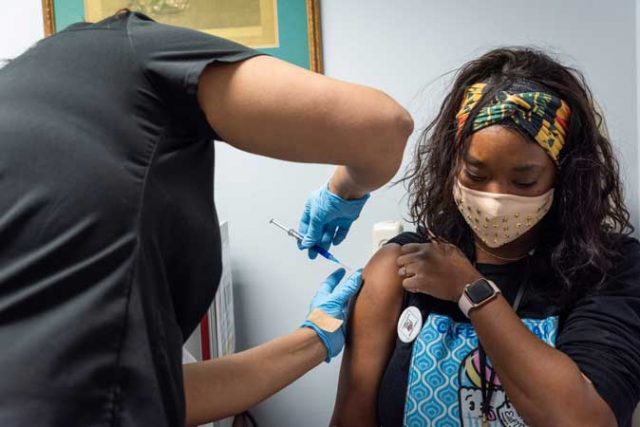
US-based pharmaceutical firm Novavax, Inc. has applied for emergency use authorization (EUA) for its two-dose coronavirus vaccine in the Philippines, according to the Food and Drug Administration (FDA).  

Novavax has “applied for an EUA but their requirements are not yet complete,” FDA Director General Rolando Enrique D. Domingo told BusinessWorld in a Viber message on Friday.  

The country’s drug regulator has already approved eight vaccine brands for emergency use. 

Philippine vaccine czar Carlito G. Galvez, Jr. earlier said that the country had signed a supply deal with Novavax for about 30 million doses of its protein-based vaccine, also known as Covovax. 

In a study that involved 29,960 participants across 119 sites in the US and Mexico, Covovax demonstrated 100% protection against moderate and severe cases, Novavax said in a press release dated June 14. It added that the vaccine was 91% effective in high-risk populations and was 93% effective against “predominantly circulating Variants of Concern and Variants of Interest,” such as Alpha, Beta, and Gamma.   

The Serum Institute of India, the largest vaccine manufacturer in the world, produces the Novavax vaccines.  

The Indian biotechnology firm started the production of the first batch of Covovax vaccines in June. — Kyle Aristophere Atienza 

OCTA Research group welcomes possible House probe

THE OCTA Research group late on Thursday said it welcomed a possible probe by the House of Representatives into their projections and affiliations as cases of the coronavirus disease 2019 (COVID-19) Delta variant continue to surge.  

“OCTA Research welcomes public inquiries and fora that serve as opportunities for us to engage the public and disseminate our research work as well as to elaborate on the importance of scientific and evidence-based policymaking,” the group said in a formal statement.   

Filed on Tuesday by five lawmakers, House Resolution 2075 asks the House Committee on Good Government to probe the “qualifications, research methodologies, partnerships, and composition” of the OCTA Research group.  

“There is a public health and public policy need to ensure the safety and security of the population during this pandemic, and that information being distributed is correct and are not irresponsibly and erroneously published,” said the resolution.  

This comes after Edsel T. Salvaña, director of the Institute of Molecular Biology and Biotechnology at the National Institutes of Health-University of the Philippines Manila refuted OCTA’s projections of a surge in the National Capital Region, saying that it was based on “incomplete” and “erroneous” data.  

The resolution also seeks to investigate the researchers’ ties with the state-funded University of the Philippines. However, the think tank said that it is an “independent and interdisciplinary” organization. 

“The group is composed of alumni and professionals from the University of the Philippines and the University of Santo Tomas. The findings and recommendations of our research do not reflect the official position of the institutions aforementioned,” the group said in its statement.  

OCTA also said that it is “one with government, the private sector, and the entire nation” in tackling the COVID-19 pandemic.   

However, OCTA research fellow Fredegusto Guido P. David questioned in a DZMM Teleradyo interview on Friday whether the House is the “proper venue” for the inquiry into the group since “they might not be the expert” on the matter. 

Meanwhile, Cagayan de Oro City Rep. Rufus B. Rodriguez opposed the filing of the House Resolution, noting that the group helped him and city officials to act promptly over an increase of cases along with local infections of the COVID-19 Delta variant in the city.  

“This group should be supported, encouraged and requested to continue with their good work and the big help it is giving to our country in fighting this crippling health crisis,” he said. — Russell Louis C. Ku 

DILG withdraws show cause order vs Manila mayor

The Interior and Local Government department has withdrawn a show cause order issued to Francisco M. Domagoso, mayor of Manila, over the Philippine capital’s supposed failure to fully implement a 2018 memorandum in relation to President Rodrigo R. Duterte’s war on drugs. 

Mr. Moreno was elected mayor of the city in 2019.

The show cause against Mr. Moreno was an “inadvertent re-issuance,” Department of Interior and Local Government (DILG) Undersecretary Ricojudge Janvier Echiverri said in a memorandum issued Friday. 

“By virtue of this error and the guidance of policies and procedures of the Department, we are hereby withdrawing the document in issue,” the memorandum read.  

The show cause order, which was based on a 2018 performance audit, asked Mr. Moreno to explain within 10 days why he should not be held liable for the supposed failure of the Manila City government to effectively run its anti-drug abuse councils.  

“It was an honest mistake on his part and on the part of his staff,” DILG Undersecretary Jonathan E. Makaya told CNN Philippines when asked to clarify the order made by his colleague. 

In 2019, Mr. Moreno had responded to a similar order claiming that Manila performed badly in an anti-drug abuse audit under the term of his predecessor, Joseph E. Estrada.  

HIGHER OFFICE? 

Speculation is rife that Mr. Moreno may run for president in next year’s elections, although he is yet to announce that he is running. He placed second in the latest presidential poll by Pulse Asia Research Inc. that was released in July. The chief of the Philippine capital came in second to presidential daughter and Davao City Mayor Sara Duterte-Carpio, who is open about running for the country’s top post.  

On Thursday, Mr. Moreno resigned as vice-chairman for political affairs of the National Unity Party (NUP), which was formed by former party mates of ex-President Gloria M. Arroyo. He also withdrew his membership in the party. 

“I am very thankful to the party for giving me the chance to serve it the best way possible,” Mr. Moreno said in his resignation letter addressed to party officials.   

The NUP has already thrown its weight behind the potential presidential bid of Ms. Duterte-Carpio in the 2022 polls.  

A PDP Laban faction led by a Cabinet official recently endorsed Senator Christopher Lawrence T. Go as president and President Rodrigo R. Duterte as vice-president at next year’s elections. — Kyle Aristophere Atienza 

Stranded HK OFWs need PH gov’t support — Migrante

PHILIPPINE STAR/EDD GUMBAN

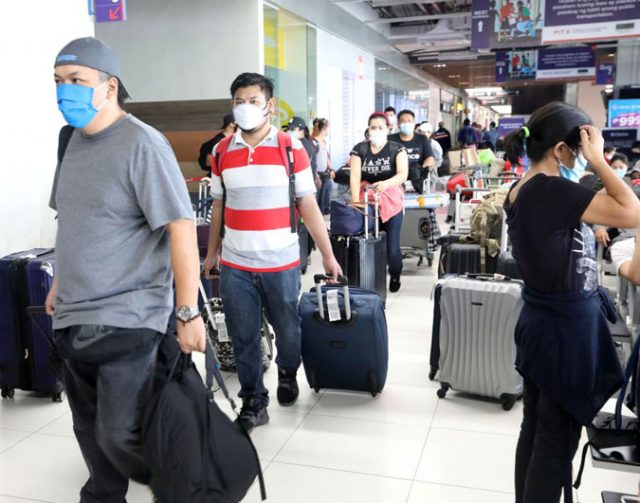
OVERSEAS Filipino Workers (OFWs) feel abandoned by the Philippine government as they receive no support while they wait in Manila for the day they can go to their jobs in Hong Kong, said a labor group. 

Speaking at press conference on Friday via Zoom, Migrante International Chairperson Joanna Concepcion said that the government should prioritize stranded OFWs as recipients of cash relief; ensure that OFWs with approved visas be given priority for free vaccines; provide temporary accommodation in lieu of financial assistance for renting boarding house; and should assist the OFWs when recruitment agencies try to collect excessive fees and require multiple mandatory medical examinations.  

“Why do OFWs suffer because of the Duterte government’s ineptitude in handling the virus? Instead of lockdowns, financial relief and government temporary shelters should have been immediately provided to the stranded OFWs who come from far-flung provinces without relatives to rely on in Metro Manila,” a Migrante press statement said. 

Numerous OFWs, stranded in Manila, shared similar stories in the press conference. They apply for work in Hong Kong, have their flight cancelled several times, worry about the expiration of their visa, incur debt while waiting, then are forced back to their provinces to survive.  

“The longer they stay in the Philippines, the longer their miseries are,” said the United Filipinos in Hong Kong Chairperson and Secretary-General of Migrante International Dolores Balladares. 

Ms. Concepcion explained that although HK opened its doors to workers bound for Hong Kong on Monday, the stringent requirements the Hong Kong government requires made workers feel uncertain. 

“The entry ban is only one form of the discriminatory policy of the Hong Kong government that our migrant workers are fighting against. Filipino migrant workers are among those who are severely suffering because of the Philippine government’s ineptitude in handling its overall COVID-19 pandemic response,” said Ms. Concepcion. — Alyssa Nicole O. Tan 

Indictment of US diplomat highlights need for stricter laws vs. sexual abuse — Brosas

A HOUSE lawmaker who advocates for the protection of women said on Friday that the indictment of US diplomat Dean Cheves by a federal grand jury in the Eastern District of Virginia highlights the need for stronger support for victims of sexual abuse.  

“Young girls from the poorest and most neglected parts of the country are falling prey as many foreign sex offenders are invading the Philippines to exploit the dire state of families under this economic crisis,” said Gabriela Party-list Rep. Arlene D. Brosas  

The US Department of Justice said on Tuesday that Mr. Cheves, who had served at the US Embassy in Manila from September 2020 to February 2021, was indicted for engaging in sexual activity with a Filipina minor.   

“Court documents further detail that Cheves allegedly engaged in sexual activity with the minor on two occasions, knowing the minor’s age, and produced cell phone videos of himself engaging in the sex acts each time. The videos were found on Cheves’s devices seized from his embassy residence while in the Philippines,” they said.   

If found guilty, Mr. Cheves could face up to 30 years in prison for “engaging in illicit sexual conduct in a foreign place” and up to 10 years for possessing child pornography.  

Ms. Brosas said that while she welcomes the decision by the US justice department, she added that the Philippine government should provide support to the victim should cases be filed in local courts.  

She also urged the House to immediately pass the Online Sexual Abuse and Exploitation of Children Law which was passed by the Senate on third and final reading on May 31. A counterpart measure filed by Tarlac Rep. Victor A. Yap is currently pending in the House Committee on Revision of Laws.  

Ms. Brosas also urged the passing of amendments to the Anti-Rape Law that seeks to raise the legal age of sexual consent from 12 years old to 16 years old. This was already passed at the House through House Bill 7836, while Senate Bill 2332 is still pending for second reading.  

“Women and other victims of rape who would want to seek justice through the judicial system must be given ample remedies under the law,” she said. — Russell Louis C. Ku 

Off-site passport renewal center to open in LA

An alternative, off-site passport renewal center, operated by Visa Facilitation Services (VFS) Global, will open soon in Los Angeles. This is in order to address the increased demand for ePassport renewal applications, the Department of Foreign Affairs said in a press release. 

VFS Global is described as a private third-party outsourcing service provider. It will process the renewal of passports that “have non-complex, non-sensitive and non-discretionary elements.” VFS Global will be charging an additional fee for its services. 

“The DFA reached the agreement with VFS Global in line with President Duterte’s directive for Philippine agencies to streamline procedures and to make ePassport renewal services faster and more convenient, especially for Overseas Filipinos,” Consul General Edgar B. Badajos was quoted as saying in the press release. 

There are already VFS Global Philippine Passport Renewal Centers (PaRC) in Riyadh and Jeddah, Saudi Arabia; and Abu Dhabi and Dubai in the United Arab Emirates (UAE). 

Opening the renewal center in Los Angeles was necessary because demand for the service has already surpassed the Consulate’s operating capacity “by a wide margin.” 

“Passport renewal through the VFS Global PARC is not compulsory. It is up to the applicant to decide whether to apply through VFS Global or through the DFA-Global Online Appointment System (GOAS),” the Consul General said.  —  Alyssa Nicole O. Tan 

Moody’s affirms LANDBANK’s rating, places UCPB under review for upgrade

BW FILE PHOTO

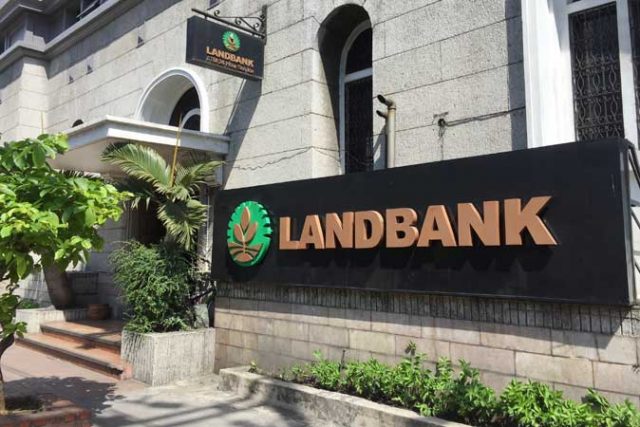
MOODY’S Investors Service maintained the “Baa2” rating of the Land Bank of the Philippines (LANDBANK), saying its capital is expected to remain stable even after its impending merger with the United Coconut Planters Bank (UCPB). 

LANDBANK’s outlook was also retained at “stable”, which means its credit rating will likely be steady in the next 12 to 18 months. 

“The outlook on LANDBANK’s ratings, where applicable, is stable because LANDBANK’s healthy capital and a very high level of government support offset downside risks from asset quality,” Moody’s said in a note on Friday. 

Moody’s expects LANDBANK’s common equity Tier 1 ratio to stay higher than 12%, which is within its comparable historical levels, even after the merger with UCPB. 

It said the government’s P27.5-billion capital infusion as provided by the Bayanihan II will offset the expected capital erosion resulting from its acquisition of UCPB, which Moody’s estimates “will have negative net worth at the time of the merger”. 

Meanwhile, LANDBANK’s asset quality is expected to remain weak due to the coronavirus crisis, although Moody’s noted that its large volume of corporate loans will help offset the impact of the pandemic. It noted that the bank’s bad loan ratio of 2.9% at end-2020, which climbed from 2.1% the prior year, was similar to those recorded by its other rated Philippine banks. 

Moody’s added that LANDBANK’s profit could be similar to the 2020 level as credit costs are expected to remain high. 

Despite the continued risks from the pandemic, Moody’s believes LANDBANK will continue to have strong funding and liquidity, supported by its role as the payments bank of the government.  

A rating downgrade is possible if there is a further weakening in the lender’s asset quality due to the crisis or a downgrade in the Philippines’ sovereign rating. 

On the other hand, an improvement in the timeliness and transparency of the bank’s financial reporting, or significantly lower credit risk concentration in its exposure to individual borrowers and industry groups could become grounds for a rating upgrade, Moody’s said. 

UCPB RATING UNDER REVIEW 

Meanwhile, the debt watcher is reviewing whether to upgrade UCPB’s “Ba3” rating depending on the impact of its merger with LANDBANK. This means a downgrade is unlikely in the meantime, Moody’s said. 

“UCPB’s long-term ratings could be upgraded to align with that of LANDBANK upon completion of the merger with LBP, a larger and more-systemically  important state-owned bank in the Philippines,” it said. 

President Rodrigo R. Duterte in June signed Executive Order 142, which approved the merger between the lenders, with LANDBANK as the surviving entity.  

Based on central bank data, as of end-March, LANDBANK was the country’s second biggest bank in terms of assets with P2.405 trillion, while UCPB placed 13th with P322.906 billion. — LWTN 

BSP makes full award of 28-day bills

BW FILE PHOTO

THE BANGKO SENTRAL ng Pilipinas (BSP) fully awarded its offer of short-term securities on Friday as yields went down amid hints of a possible reduction in reserve requirements and lower oil prices. 

The central bank awarded P100 billion in 28-day bills as planned as bids for the offer amounted to P165.88 billion, beating the P117.75 billion logged last week. 

Accepted rates for the papers ranged from 1.7475% to 1.78%, a narrower band compared to the 1.735% to 1.9279% margin in the previous auction. With this, the average rate of the one-month securities inched down by 1.5 basis points (bp) to 1.7619% from 1.7769% last week. 

The BSP bills and the term deposit facility are used by the central bank to gather excess liquidity in the financial system and guide market rates. 

Rizal Commercial Banking Corp. Chief Economist Michael L. Ricafort said rates of the BSP bills inched down after the central bank said it is open to another cut in banks’ reserve requirement ratios (RRR), which would infuse additional liquidity into the financial system. 

The BSP said lowering the RRR remains “on the table”, Bloomberg reported on Wednesday. 

The reserve requirement for big banks is currently at 12%, still one of the highest in the region. The central bank last cut big banks’ RRR in April 2020 with a 200-bp reduction. 

In July 2020, it likewise slashed the reserve requirements of thrift and rural banks by 100 bps to three percent and two percent, respectively.  

The central bank’s easing measures have infused about P2.2 trillion in fresh liquidity into the financial system, equivalent to about 12.1% of gross domestic product. 

The Monetary Board will have its next policy-setting meeting on Aug. 12. However, it has adjusted its RRR outside these meetings in the past. 

The decline in global oil prices also caused the yields on the BSP securities to drop, Mr. Ricafort added. 

Reuters reported that while US crude oil futures picked up on Friday, prices remained on track for their biggest weekly decline since late October due to worries on how restrictions caused by the spread of the Delta variant could affect demand. 

US West Texas Intermediate crude futures declined 6.4% this week, the biggest weekly loss since the end of October. Meanwhile, Brent crude oil futures shed 6.5% this week, the most since March. — L.W.T. Noble with Reuters 

PBB net income down 10% in Q2

BW FILE PHOTO

PHILIPPINE Business Bank (PBB) recorded a lower net profit in the second quarter, it said on Friday. 

The bank’s net earnings declined by 10% to P363.8 million from P400.4 million in the same period a year ago as net interest income stood at P1.374 billion, down 1.29% from P1.392 billion. 

This brought its first semester net income to P524 million, 34% lower than the P794.87 million seen last year. 

However, its core income in the period increased by 1.82% to P1.397 billion from P1.372 billion, which PBB attributed to the 53.9% decrease in its interest expense to P431.4 million. 

“In the next two quarters, the bank will continue to strengthen its core business while managing its risk assets and servicing the needs of its key clientele — the small and medium enterprises,” PBB President and CEO Roland R. Avante was quoted as saying. 

The bank’s loans and receivables rose 4.2% to P87.9 billion as of June from P84.346 billion a year earlier. 

On the funding side, PBB’s deposit liabilities stood at P102.9 billion, also up by 8.25% against the P95.053 billion seen at end-June 2020. Current account, savings account (CASA) deposits rose 41%, while time deposits reached P45.3 billion, PBB said. Its portfolio’s mix improved to 56:44 in favor of CASA deposits from 43:57 a year ago.  

Meanwhile, the bank’s assets reached P122.7 billion as of June, rising by 6.8% from P114.848 billion a year earlier. 

Its capital adequacy ratio stood at 14.41% at end-June, well above the regulatory requirement. 

PBB’s shares closed at P10.32 apiece on Friday, down by two centavos or by 0.19% from its previous finish. — LWTN 

DBP books lower earnings in Q1

COURTESY OF DBP FACEBOOK PAGE

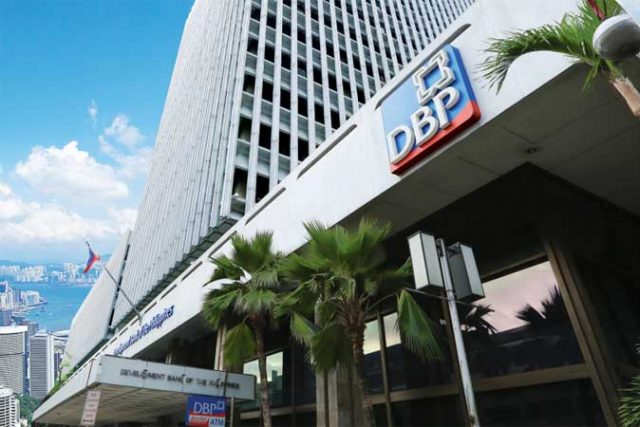
DEVELOPMENT Bank of the Philippines (DBP) saw its net profit decline by 62% in the first quarter due to higher expenses. 

The bank’s net income in the January to March period was at to P547.83 million, down from the P1.455 billion booked in the same quarter a year earlier, based on DBP’s financial report published on its website. 

Net interest income after provisions for losses inched up 0.25% to P3.94 billion. This was due to higher interest expenses, which offset the improvement in its interest income. 

Meanwhile, non-interest income increased 16% to P812.509 million in the January to March period from P699.426 million a year earlier. 

Operating expenses climbed by nearly a third (32%) to P3.684 billion from P2.79 billion in the first quarter last year.  

The bank set aside provisions for impairment losses worth P403.642 million, down by 23.5% against the P527.865 billion in the same period last year. 

On the other hand, its provisions for income tax rose 37% to P520.479 billion from P378.893 billion a year ago.  

The state-owned lender’s loan portfolio rose 12% to P414.72 billion in the first three months of 2021 from P371.01 billion a year ago, DBP President and Chief Executive Officer Emmanuel G. Herbosa said in a statement. 

“The increase in loans to priority sectors reflects the bank’s firm commitment to ensure the steady and gradual recovery of the national economy, despite the looming uncertainties of the current public health emergency,” Mr. Herbosa said. 

More than half or 53% of the loans, equivalent to P218.65 billion, went to infrastructure and logistics projects. Other sectors such as social services and community development initiatives (P82.56 billion); environmental projects (P44.72 billion); and micro, small and medium enterprises (P32.79 billion) also received loans from DBP. 

Meanwhile, deposits with the bank climbed 57% to P879.83 billion in the first quarter from P559.68 billion a year earlier. Mr. Herbosa said this was “driven by renewed public confidence in the stability of DBP as a strong and stable government financial institution”. 

DBP’s total equity rose 26% to P76.64 billion in the January to March period from P61.1 billion the previous year. This was mainly backed by the P12.5-billion capital infusion for the bank granted under the Republic Act 11494 or the Bayanihan to Recover as One Act.  

Through the capital infusion, DBP’s Rehabilitation Support Program on Severe Events (RESPONSE) was able to provide P6.4 billion in credit assistance to 29 borrowers. The bank was also able to restructure loans of 41 borrowers with loans worth P5.7 billion through RESPONSE. 

Meanwhile, the program also provided assistance to 13 small business borrowers with total loan approvals of P2.3 billion. 

“We shall continue to leverage on our recent financial gains such as being a trillion-peso bank and utilize our expanded asset base to create a myriad of viable and sustainable set of opportunities for our clients and for our fellow Filipinos,” Mr. Herbosa said.  

Based on central bank data, DBP, the country’s designated infrastructure bank, was the sixth largest lender with assets worth P1.102 trillion at end-March. — LWTN 

Peso weakens as external trade improves

THE PESO weakened versus the greenback on Friday as imports continued to increase, reflecting a likely increase in dollar demand as external trade improves. 

The local unit closed at P50.40 per dollar on Friday, shedding 16.5 centavos from its P50.235 finish on Thursday, data from the Bankers Association of the Philippines showed. 

Week-on-week, the peso also depreciated by 43 centavos from its finish of P49.97 on Aug. 30. 

The peso opened Friday’s session at P50.30 per dollar. Its weakest showing was at P50.47, while its intraday best was at P50.20 against the greenback. 

Dollars exchanged declined to $1.28 billion on Friday from $1.47 billion on Thursday. 

The peso declined following the release of June trade deficit data, which showed imports continued to rise, Rizal Commercial Banking Corp. Chief Economist Michael L. Ricafort. 

Data released by the Philippine Statistics Authority on Friday showed the trade deficit widened to $2.83 billion in June against the $1.42-billion gap a year earlier. Last month’s trade deficit, however, narrowed compared to the $3.17-billion shortfall in May. 

Imports climbed 34.2% to $9.33 billion in June from a year earlier while exports increased 17.6% to $6.51 billion from last year. 

Year to date, the trade balance widened to a $17.44-billion deficit from the $11.37-billion gap in the first semester of 2020. 

Meanwhile, a trader attributed the peso’s weakness to preference for the greenback amid positive market sentiment due to positive US jobless claims data. 

Data from the US Labor Department showed initial claims for state unemployment benefits dropped 14,000 to a seasonally adjusted 385,000 for the week ended July 31, Reuters reported. This was its lowest level since the pandemic started in March 2020. — L.W.T. Noble with Reuters 

GCash waives Padala fees this ECQ, from Aug. 6 to 20

Leading mobile wallet and digital payment solutions provider GCash is extending a new service called GCash Padala.

GCash Padala is a more affordable, faster and easier way for Filipinos without an e-wallet account to send and receive money instantly, and free of charge, anywhere in the Philippines via the GCash app. In an effort to reduce our travels, and keep our activities to only the essentials, GCash Padala allows senders to save time and effort from physically going to remittance centers, giving them the option to do all this through their mobile phones.

While GCash Padala boasts one of the lowest remittance rates, charging up to as low as a 1% remittance fee with a minimum send of P500, in an effort to extend much needed help and alleviate today’s Filipino of worrying to go out of their homes this ECQ, GCash is waiving all Padala fees from August 6 to 20, 2021.

“We hope our new service brings more Filipinos the ease and convenience of sending money during this ECQ,” said Winsley Bangit, GCash Chief Customer Officer. “GCash Padala aims to make everything Pinabilis, Pinamura, at Pinadali for users and recipients alike. Hopefully, this also encourages those who are still reluctant to use financial technology to download the GCash app and experience the convenience and ease it continues to bring many Filipinos here and around the world.”

To claim the transaction, recipients just need to present 1 valid ID through any of the 2,000 GCash Padala partners located nationwide like Posible, Go VIP Center, Tambunting, Panalo Express, and local authorized “pera outlet” sari-sari stores too. The claiming process is made easier and more convenient to also prevent recipients from spending too much time outdoors.

To access the service, the sender logs into the GCash app, selects “Send Money,” and taps the “GCash Padala” option. A user interface pops up next where the sender will key in the intended recipient’s full name, mobile number, and the amount of money to be sent. Afterwards, the sender has to confirm the transaction and pay for it using existing funds from his GCash account to send the money successfully. A notification with reference number of the transaction, and other detailed information, will be sent via text message to both the sender and the recipient in real-time as soon as the process has been completed.

GCash Link: https://go.gcash.com/padala

GCash Website: https://www.gcash.com/services/padala

GCash List of Partners: https://www.gcash.com/partners/padala


Join us on Viber to get more updates from BusinessWorld: https://bit.ly/3hv6bLA