Home Blog Page 7234

Philippines to get more Sputnik, Pfizer vaccines

The Philippines was set to take delivery on Friday of about 2.8 million doses of the Sputnik V vaccine from Russia, according to the presidential palace. 

The government bought the latest batch of Sputnik V two-dose vaccines, acting palace spokesman Karlo Alexei B. Nograles told a televised news briefing. 

He said about 5,000 more doses of Russia’s single-dose coronavirus vaccine were also set to arrive on Nov. 19. He added that 609,570 doses of the vaccine made by Pfizer, Inc were likewise expected to arrive on Friday night. 

The Philippines has given out 73.92 million doses of coronavirus vaccines. More than 32.99 million or 42.77% of adult Filipinos had been fully vaccinated against the coronavirus as of Nov. 18, Mr. Nograles said. 

The Department of Health (DoH) reported 1,485 coronavirus infections on Friday, bringing the total to 2.82 million. 

The death toll rose to 46,698 after 277 more patients died, while recoveries increased by 1,393 to 2.75 million, it said in a bulletin. 

There were 23,200 active cases, 59.6% of which were mild, 3.8% did not show symptoms, 12% were severe, 19.56% were moderate and 5.1% were critical. 

The agency said 28 duplicates had been removed from the tally, 24 of which were tagged as recoveries, while one was relisted as a death. It said 230 cases that were tagged as recoveries were reclassified as deaths. 

One laboratory failed to submit data on Nov. 17. 

DoH said 33% of intensive care units in the Philippines were occupied, while the rate for Metro Manila was 32%. 

Meanwhile, DOH said about 2,500 booster shots had been given out to health workers nationwide. 

Only 2% of 2,488 workers had an adverse reaction, Health Undersecretary Maria Rosario S. Vergeire told an online news briefing. 

The agency said it needed 160,000 volunteers to ensure the success of its vaccination drive next month. 

Ms. Vergeire also said more than 800,000 adolescents had been vaccinated against the coronavirus as of Nov. 17. — Kyle Aristophere T. Atienza and Alyssa Nicole O. Tan 

No extradition request yet for Duterte adviser

The Philippine Justice department on Friday said it had not received a request from the United States to extradite a Filipino televangelist who is facing sexual trafficking charges there. 

Apollo C. Quiboloy, President Rodrigo R. Duterte’s personal adviser who founded a Philippine-based church was indicted along with two US-based church administrators by a federal grand jury for allegedly coercing women as young as 12 to have sex with the religious leader. 

Justice secretary Menardo I. Guevara said no sex trafficking charges had been filed or are pending in the Philippines against Mr. Quiboloy “involving the same factual circumstances as those in the recent US indictment.” 

“The Department of Justice has not received any request for extradition from the US DOJ nor from the US State Department thru the Department of Foreign Affairs,” he told reporters in a Viber message  

A complaint for rape was filed against Mr. Quiboloy last year in Davao City but the case was dismissed, Mr. Guevara said. “That dismissal is now on appeal with the DoJ.” 

The Philippine presidential palace said Mr. Quiboloy, as a private individual, is capable of getting proper legal advice. 

Acting presidential spokesman Karlo Alexei B. Nograles said the Philippines would cooperate if the US requests the religious leader’s extradition. 

The US DoJ on its website said Mr. Quiboloy and his officials had been “charged in count one of the superseding indictments, which alleges the sex trafficking conspiracy” and each “charged in at least three of five substantive counts of sex trafficking by force, fraud and coercion.” 

Citing an indictment, the US DoJ said the victims prepared Mr. Quiboloy’s meals, cleaned his houses, gave him massages and were required to have sex with him in what they called “night duty.” Three of the five victims in the sex trafficking, which started before 2002 and continued until 2018, were minors. 

The victims who were obedient were rewarded with food, luxurious hotel rooms, trips to tourist spots, and yearly cash payments that were based on performance, all paid for with money solicited by Mr. Quiboloy’s church workers in the US, US prosecutors said. 

Victims who managed to escape suffered retaliation in the form of threats, harassment and allegations of criminal misconduct, according to a copy of the indictment.  

Meanwhile, the Philippine Consulate General in Los Angeles is closely monitoring the case against Mr. Quiboloy. 

“The Consulate General is aware of the federal grand jury indictments that were unsealed today and the ongoing investigation by US law enforcement agencies, including the FBI,” it said via Viber message. 

It promised to provide support to the US by seeking avenues to extend consular assistance to both the accused and victims. — Kyle Aristophere T. Atienza and Alyssa Nicole O. Tan 

Peso weakens as central bank flags inflation risks

BW FILE PHOTO

The peso weakened against the dollar Friday after the central bank warned of inflation risks next year.

The peso closed at P50.41 Friday against its P50.23 finish Thursday, according to the Bankers Association of the Philippines.

The peso opened at P50.27, with the high at P50.21 and the low at P50.43.

Dollar volume rose to $1.188 billion on Friday from $1.1274 billion a day earlier.

A trader said in an email that the peso weakened after the Bangko Sentral ng Pilipinas (BSP) noted potential upside inflation risks for 2022 from transport fare hikes and a strong recovery in domestic demand.

Monetary officials said Thursday that risks to inflation next year include typhoons and fare increases.

Headline inflation last month eased to 4.6% from 4.9% in September following a slower increase in food prices.

This was the third straight month inflation exceeded the 2-4% target band of the central bank. Inflation has topped the BSP target every month this year except in July.

Rizal Commercial Banking Corp. Chief Economist Michael L. Ricafort said the peso was also influenced by election-related leads that could have triggered profit-taking in other financial markets. The markets, he said, have yet to gain clarity on the policies being proposed by the leading Presidential candidates.

“(The) peso (was) also weaker as global market sentiment (was) partly weighed by the spike in new COVID-19 cases for some countries, especially in Europe,” he said.

Lingering inflation concerns could slow down the global economic recovery, he added. – Jenina P. Ibañez

PEZA given authority to grant 2-year work visas to foreign investors, key employees

The Philippine Economic Zone Authority (PEZA) said it now has the authority to issue two-year working visas to foreign investors, key employees, and their dependents.

The PEZA said it signed a memorandum of agreement and agreed to the implementing rules and regulations (IRR) for the visa-issuing process with the Bureau of Immigration (BI) on Thursday. The agreement allows PEZA to issue working visas to foreign investors, non-resident foreign employees of PEZA-registered ecozone enterprises, and their respective qualified dependents starting Dec. 1.

The processing of visa facilitation and approval was also reduced to 10 days from one month under the memorandum.

In a statement Friday, PEZA said the agreement complies with Republic Act 11032, or the Ease of Doing Business and Efficient Government Service Delivery Act of 2018, which authorizes measures to “reduce the cost of doing business and improve the country’s investment growth.”

BI Commissioner Jaime H. Morente said the signing of the agreement and IRR with PEZA “is a major step forward as we expand our services through collaborations with like-minded institutions such as PEZA.”

Enterprises registered with PEZA may submit the visa application of their foreign employees with complete requirements to the PEZA Zone Administrator or Manager in the area where the enterprise is located.

Meanwhile, ecozone companies in Metro Manila involved in information technology-business process outsourcing, tourism, and medical tourism may submit their visa applications at the head office of PEZA in Taguig City.

Requirements for a PEZA visa for foreign nationals include “a notarized application form, notarized company’s letter request addressed to the PEZA Director General, checklist of application for (visa) extension or change of admission, certified true copy of PEZA Certificate of Registration, and photocopy of the foreign applicant’s passport.”

For dependents of foreign employees, the requirements include a notarized application form, photocopy of passport, and a notarized Affidavit of Support/Guarantee executed by the PEZA-registered company’s president or vice president.

Once the new visa is approved and issued, it “will no longer be called the 47 (a)2 visa, but…the PEZA-Visa with two years validity for qualified international employees and their dependents,” PEZA Director General Charito B. Plaza said. – Bianca Angelica D. Anago

NGO coalition urges gov’t to go slow on approving Pasig River toll road 

PASIG RIVER REHABILITATION COMMISSION

Non-government organizations said the government needs to hold off giving the green light to the proposed Pasig River Expressway (PAREX) until the appropriate environmental impact and cost-benefit studies are performed.

The Move as One Coalition in a letter Thursday noted that the toll road’s design is also still subject to change, complicating the Toll Regulatory Board’s (TRB) job of evaluating its actual impact.

The coalition of 140 civil society organizations also cited the need for consultation, as guaranteed by the Constitution.

“Any assessment of social, environmental, and economic impacts, benefits, and costs can only be made once all project details are disclosed by the Project Proponent,” the coalition said in a letter to President Rodrigo R. Duterte.

PAREX, proposed by San Miguel Corp., will be built on one bank of the Pasig River, connecting the City of Manila to Rizal province. Its stated objective is to decongest roads in the capital.

“Any assessment of social, environmental, and economic impacts, benefits, and costs can only be made once all project details are disclosed by the Project Proponent,” it said in the letter to the Palace.

Premature approval, it added, may give off the impression that the project should proceed regardless of any negative impacts.

The TRB, it said, has yet to conduct an analysis on the economic, environmental, and social costs and benefits of the project.

“Accordingly, the government has no assurance that the benefits of the project outweigh its costs. Given the many concerns about the project that have surfaced in recent months, there is a strong possibility that the project’s negative impacts could far exceed its expected benefits,” it said.

PAREX will entail at least P164 billion in economic, health, and social costs– P97 billion in economic costs due to reduced property prices, and P67 billion from reduced life expectancy due to noise, air, and river pollution, it said.

Attached to the letter were its claims detailing the potential harm caused by PAREX, including increased congestion, degraded ecology, and worsening air pollution.

The group noted that with densely-populated neighborhoods on both sides of the river, many people may suffer from negative health outcomes.

The benefits will accrue mainly to private motor vehicle users who represent a small minority, it added, noting that in the capital region, only about 12% of households own a private car. “The travel time and vehicle operating cost savings of private cars using PAREX are likely to be offset by the costs of more traffic due to induced demand and added congestion in downtown areas.”

“The net gains from vehicle time and cost savings will therefore not be substantial,” it said. — Alyssa Nicole O. Tan

ADB approves $600 million loan for Philippine UHC program

The Asian Development Bank (ADB) has approved a $600 million loan to support the Philippines’ universal health care (UHC) reform program.

The bank’s Build Universal Health Care Program will help finance government delivery of health services and monitor the performance of health service providers, the ADB said in a statement Friday.

The ADB said the program will expand the use of digital tools in and support the Department of Health (DoH) and the Philippine Health Insurance Corp. (PhilHealth) as they implement universal healthcare.

The program will also support local government access to health care workers and facilities, especially in underserved areas.

“The COVID-19 pandemic has highlighted existing constraints in the country’s health care service delivery, which the government sought to address in its pandemic health response,” ADB Director of Human and Social Development for Southeast Asia Ayako Inagaki said.

“This program seeks to boost the government’s ability to achieve its UHC goals and provide timely and equitable health care services, especially for the poor and marginalized across the country.”

The bulk of government funding for UHC comes from the general appropriations act and tax collections from “sin” products such as tobacco and vaping products.

Excise tax collections from cigarettes rose 31% to P83 billion in the first seven months due to higher tax rates and growing sales after a pandemic-induced slump last year.

“This new ADB program will help the government boost financing for UHC, expand the supply of health facilities and workers, enable the integration of health care providers, and enhance health system efficiency,” ADB Principal Health Specialist for Southeast Asia Eduardo Banzon said.

Meanwhile, the ADB said it will also extend a $2 million technical assistance grant from the Japan Fund for Poverty Reduction to support health policy reforms in local government units.

“The ADB will provide technical advice as the government prepares to implement the next set of UHC-related reforms by 2023,” the bank said.

Fitch Solutions Country Risk and Industry Research has said the more contagious Delta variant worsened the effects of the pandemic in the Philippines. It said the slow vaccine rollout and pandemic containment setbacks will delay the goal of achieving universal healthcare because of the diversion of healthcare funds to deal with the emergency.

But the Finance department said it does not expect problems with the rollout of UHC even with funding pressures caused by the pandemic, noting the reserves held by the government health insurer. — Jenina P. Ibañez

LGU competitiveness awards to be handed out next month

PHILSTAR

The Department of Trade and Industry (DTI) said it will hand out awards to local government units (LGUs) and provinces it deems the most competitive at the ninth Regional Competitiveness Summit on Dec. 7.

In a statement Friday, DTI Competitiveness Bureau Director Lilian G. Salonga said the city of Manila ranked as the most competitive Highly Urbanized City, according to the department’s Cities and Municipalities Competitiveness Index (CMCI) rankings for 2020.

Manila posted an overall score of 65.98 points, followed by Davao City with 60.04 and Pasay City with 58.65.

In the statement, Ms. Salonga also clarified that the City of Manila’s recent social media post on its selection refers to last year’s ranking. The DTI has yet to compile its list of awardees for this year.

The 2021 Regional Competitiveness Summit next month will be streamed on the DTI’s Facebook page.

Other awards to be handed out are the Hall of Fame selection, Most Competitive Province, Most Competitive Component City, and Most Competitive First to Second, Third to Fourth, and Fifth to Sixth Class Municipalities.

“We hope that as we move forward, more LGUs, national government agencies, private sector and academic communities will continue to support and help us build a brighter future,” Ms. Salonga said. – Bianca Angelica D. Anago

BoI approves Sinoma Energy as new operator of 4.5-MW waste-heat recovery plant in Cebu province

The Board of Investments (BoI) has cleared Sinoma Energy Conservation (Cebu) Waste Heat Recovery Co. Inc. to serve as the operator of a 4.5-megawatt (MW) power generating plant in the city of Naga in Cebu province.

Sinoma Energy is a unit of China National Building Material Group Co., Ltd.

The P531.2-million power plant is set to commence operations in the first quarter of 2022 with about 17 employees, mostly from Naga and nearby areas, the BoI said in a statement Friday.

Under a Power Supply Agreement, the plant will provide energy support to an unidentified cement company in the city of Naga by capturing and using heat from the gases emitted by the cement plant.

With the cement company drawing less power from the grid, power supply available for other consumers is expected to increase.

Apo Cement Corp. a unit of CEMEX Holdings Philippines, operates a plant in Naga, Cebu.

The BoI said a report on the Philippines’ Technology Needs Assessment for Climate Change Mitigation in 2018 indicates that the cement industry has three waste heat recovery power plants with a total capacity of 17.5 MW.

One of the three power plants is a 6-MW power plant in the Cemex Antipolo facility, a 4.5-MW plant at Lafarge Holdings (Philippines) Inc.’s Teresa, Rizal facility, and a 7-MW power plant run by Eagle Cement Corp. at an unspecified location. On its website, Eagle describes its San Ildefonso, Bulacan plant as its primary production facility.

The report estimated that the waste heat recovery process reduced carbon dioxide emissions at Lafarge Teresa by 11,800 tons per year. – Bianca Angelica D. Anago

Local shares slip as BSP keeps key rates

Philippine Stock Exchange index

Philippine shares dropped for the third straight day on Friday as investors digested the decision of the Bangko Sentral ng Pilipinas (BSP) to keep rates unchanged to accommodate economic growth.

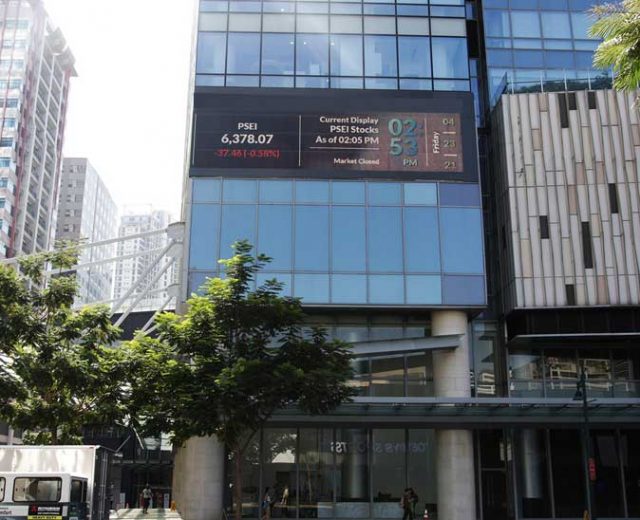
The Philippine Stock Exchange index (PSEi) lost 18.77 points or 0.25% on Friday to close at 7,280.57, while the broader all shares index shed 55.59 points or 1.41% to end at 3,878.11.

Darren Blaine T. Pangan, a trader at Timson Securities, Inc., said in a Viber message that stocks finished lower as “investors may be digesting the recently announced interest rate decision by the local central bank.”

After the market’s close on Thursday, BSP Governor Benjamin E. Diokno said in a virtual briefing that the Monetary Board decided to keep benchmark interest rates unchanged at 2% in line with market expectations.

The central bank also revised its average inflation forecast for the year to 4.3% from 4.4%, and set the expected inflation rates for 2022 and 2023 at 3.3% and 3.2%, respectively.

Mr. Pangan said the PSEi’s decline was also “consistent with most markets in Asia” amid investors’ concerns over the unexpected 11.1% drop in Chinese e-commerce giant Alibaba’s earnings for the third quarter of 2021.

Globally, stock markets also declined as inflation remains investors’ main concern, said Regina Capital Development Corp. Head of Sales Luis A. Limlingan in a Viber message.

He cited New York Federal Reserve Bank President John C. Williams comments that “inflation is becoming more broad-based and that expectations for future price increases are rising.”

Rizal Commercial Banking Corp. Chief Economist Michael L. Ricafort said that “some election-related leads could have also triggered the recent healthy profit-taking in the local stock market.”

He said these leads were the “latest survey results, [and] recent tirades, directly or indirectly.”

Investors have yet to see the details of presidential candidates’ proposed policies, reforms, and platforms, Mr. Ricafort said, thus “a source of uncertainty for the 2022 presidential elections.”

On the last trading day of the week, sectoral indices mostly closed in the red except for property, which went up by 11.76 points or 0.35% to finish at 3,334.36; and services, which gained 1.53 points or 0.07% to 1,980.45.

Meanwhile, mining and oil dropped 272.04 points or 2.84% to 9,308.22; holding firms went down by 46.47 points or 0.65% to 7,011.98; financials lost 10.42 points or 0.65% to finish at 1,578.25; and industrials declined by 3.57 points or 0.03% to 10,707.

Value turnover increased to P22.07 billion with 2.11 billion issues traded on Friday, from P7.82 billion with 882.46 million shares in the previous day.

Decliners beat advancers, 127 against 66, while 49 names closed unchanged.

Net foreign selling rose to P1.82 billion on Friday from the P589.91 million recorded on Thursday.

Timson Securities’ Mr. Pangan said the next support level may be pegged at 7,060, “while immediate resistance may be placed at 7,454.50.” — Bianca Angelica D. Añago

Nature-pact goal to protect 30% of land and ocean hangs in balance

Apo Myna – Neon Rosell

KUALA LUMPUR — The central pledge of a planned new global nature pact — to protect 30% of the planet’s land and seas — is in doubt, with some biodiversity-rich nations refusing to commit because of jitters over funding and implementation, officials have warned.  

A coalition of about 70 countries — including G7 wealthy governments — have already promised to conserve at least 30% of their land and oceans by 2030, a pledge known as 30×30, to help curb climate change and the loss of plant and animal species.  

The 30×30 goal is part of a draft global treaty to safeguard plants, animals and ecosystems, due to be finalized next May at the COP15 nature summit in the Chinese city of Kunming, according to the UN Convention on Biological Diversity (CBD).  

“Many countries are supporting it — but also many countries are not supporting it,” said Elizabeth Maruma Mrema, the CBD’s executive secretary.  

“It is still very much for debate,” she told the Thomson Reuters Foundation, adding that effective management of a 30×30 goal would be key.  

Improving protection of natural areas, such as parks, oceans, forests and wildernesses, is seen as vital to maintaining the ecosystems on which humans depend, and to limiting global warming to internationally agreed targets.  

Dozens of nations pledged to do more to conserve nature and make farming greener at the COP26 UN climate talks this month.  

Brian O’Donnell, director of the US-based Campaign for Nature, which is urging leaders to back the 30×30 pledge, said it was “perhaps the most supported target in the negotiations.”  

There is broad scientific consensus that protecting or conserving at least 30% of land and oceans is the minimum needed to curb biodiversity loss and to reach climate goals, he added.  

But the inclusion of the pledge in the final COP15 accord is far from certain, with improvements needed, said green groups.  

“Like it or not, 30×30 will be one of the defining issues for COP15,” said Li Shuo, a policy advisor at Greenpeace China.  

“The Kunming biodiversity summit will not be a success only with this target — but it will certainly not be seen as a triumph if without [it],” he added.  

WAIT AND SEE  

Southeast Asia covers just 3% of the Earth’s surface but is home to three of the world’s 17 “mega-diverse” countries — Indonesia, Malaysia, and the Philippines.  

It is also the only region where a significant number of countries have yet to back the 30×30 goal, with only Cambodia signing up so far, said Mr. O’Donnell.  

South Africa, meanwhile, has called for a much lower target of 20%, he added, while others like Argentina have questioned the science behind the flagship pledge.  

On a more positive note, India is the latest country to commit to 30×30.  

And at the first part of the COP15 talks, held online last month, host nation China announced a new national parks project that would bring 230,000 square km (88,800 square miles) of land under stronger state protection.  

While China has yet to endorse the 30×30 pledge, the signs are that it may be getting ready to do so at the Kunming summit, said Linda Krueger, director of biodiversity at The Nature Conservancy.  

Opposition to the 30×30 goal is largely linked to the challenges of putting it into practice, such as financing for developing nations, high population density, low levels of biodiversity and lack of domestic laws, environmentalists said.  

But Ms. Krueger said she had only heard Brazil speak out against it clearly. “Many countries seem to be on the fence, and the support of others is conditioned on adequate financing being made available,” she added.  

Some political leaders have yet to grasp the economic benefits of conservation, with many still relying on exploitation of natural resources to lift people out of poverty, green groups said.  

Others are home to a large proportion of the planet’s biodiversity and want a protection target higher than 30%.  

Despite these hurdles, there is significant momentum to land the 30×30 goal in the deal, said Susan Lieberman, vice president of international policy at the Wildlife Conservation Society.  

Some countries are still studying how it would play out in their own contexts, she added.  

“Many governments do not realize this is a global target and each country will contribute to achievement of the targets in different ways,” Ms. Lieberman said.  

“Governments need to look not only at area-based conservation within their own territories, but at what their ‘footprint’ is globally,” she said, pointing to procurement of commodities like timber and fish.  

NO PANACEA  

There are also concerns the 30×30 target will threaten the rights of indigenous and local communities — and that new protected areas could dispossess those groups, said Guido Broekhoven, head of policy research and development at WWF International.  

These are the very people who for generations have done the most to sustain, defend and restore biodiversity, he said.  

The 30×30 pledge will be far more effective in halting and reversing biodiversity loss if protected areas are sited in the most important parts of the planet for biodiversity and ecosystem services, he noted.  

That means achieving the target should be “a collective, global effort,” he added, calling for more financing.  

Countries with relatively few suitable areas should contribute as far as they can to conservation efforts in other biodiversity-rich nations, Mr. Broekhoven said.  

But 30×30 is not “a panacea,” he emphasized, adding that the goal will need to be complemented by reforms to ecologically harmful investment, agriculture and consumption.  

“On its own, it will be insufficient to reverse the loss of nature,” he said. — Michael Taylor/Thomson Reuters Foundation 

  

Only 1.2% of world’s top firms make substantial climate disclosures — Arabesque

REUTERS

LONDON — Little more than one percent of 5,000 big companies globally are making substantial disclosures of their climate risks, while more than half are not reporting them at all, according to data from ESG research and investment manager Arabesque.  

Only 1.2% of the companies analyzed by Arabesque — most of them large listed firms — reported on all 11 recommendations of the Task Force on Climate-Related Financial Disclosures (TCFD) in 2019.  

Fifty-four percent of the top firms made no disclosures, it added.  

The TCFD was set up by the Financial Stability Board, which groups regulators, central banks and treasury officials from G20 countries, and set out recommendations in 2017 on how companies could voluntarily disclose the risks and opportunities from climate change.  

Investors are increasingly focusing on companies’ exposure to climate change, as UN climate talks ended on Saturday with a deal that for the first time targeted fossil fuels as the key driver of global warming.  

“We need to put action to the promises,” said Arabesque president Daniel Klier.  

“TCFD is the framework everyone is looking at … the quality of disclosure has to improve quite significantly.”  

Health and technology services companies were the worst offenders, with more than 70% making no disclosures, Arabesque’s analysis showed, while energy companies were among those giving the most information.  

“Industries facing most investor scrutiny are industries that are trying to do a better job,” Mr. Klier said.  

Regulators in markets such as Britain, the European Union, Brazil, Hong Kong, Japan, New Zealand, Singapore, and Switzerland have begun using the TCFD recommendations as a basis for mandatory disclosures.  

The TCFD also said last month only about half of companies disclosed climate-related risks and opportunities in some form, on average covering around a third of the 11 recommended disclosures.  

The TCFD’s 2021 review covered more than 1,600 companies around the world.  

A lack of analytical tools to quantify the exposure of assets to physical climate risks is contributing to “chronic underinvestment” in climate resilience by the private sector, according to a report this week by the Coalition for Climate Resilient Investment group of institutional investors and governments with over $20 trillion in assets. — Reuters 

Live long and prosper

https://www.imdb.com/

MOVIE REVIEW
The Eternals
Directed by Chloe Zhao

I saw The Eternals and lemme put it this way: it is the best MCU movie in recent years, and the worst Chloe Zhao film to date.

Which, as I like to put, it is not saying much but is saying something.

“Has he finally gone nuts?” you might say; sometimes I wonder.

I enjoyed the movie. Don’t mean that sarcastically; I had a fine time.

Didn’t think I would; the picture opens with a long title crawl explaining context and history that I kept wishing would crawl faster (I blame George Lucas) and we dive straight into battle, with the heroic Eternals fighting the evil Deviants (you want to ask: Deviants? Puritanical much? But the comic is the creation of Jack Kirby, hardly known for subtlety or tact — you appreciate Kirby for the dynamic dramatic art and grand worldbuilding more than the writing).

Zhao shoots in a series of swirling shots, the camera weaving in and out of the battle between handsome actors striking power poses and CGI monsters being ripped limb from limb (bloodlessly of course, to keep the PG 13 rating) and you realize: she doesn’t know how to direct fight sequences. Or rather, she does (there’s a brief boxing match in Songs My Brothers Taught Me that’s bruisingly shot and edited) but can’t do the house MCU style of heavily CGI’d fighting, not in the way fanboys would approve. Not much pain involved (the Eternals hardly even flinch) and what brutality is on show is rendered toothless by the fact that the Deviants look and move like the kind of expensive oversized toys kids like to walk up to and knock down.

That’s arguably quite an achievement and not in a good way: frenetically staged and shot long-take action sequences where you don’t quite know — or much care — what’s going on. I remember seeing them, possibly for the first time, in Sam Raimi’s Spiderman movies, only Raimi’s had this marked difference: the fights often tossed out the occasional visual gag, and you realize there is structure to his fights, they build up and pay off as propulsive comedy routines a la Jackie Chan or Buster Keaton.

Arguably there’s a rationale for opening with this unmemorable display of superpower: we get to see the Eternals at their mightiest, later at their most vulnerable. Zhao in effect doesn’t shy away from setting herself up, adopt the more challenging narrative route.

Or perhaps Zhao doesn’t really give a shit and wants to move on to what really interests her.

The next hour or so seems interminable; the picture skipping pebble-in-a-pond forward and backward in time, showing us the various Eternals as sent by the Celestial Arishem (voiced by David Kaye) to Earth to live through and react to various periods of human development (some 7,000 years, a mere eyeblink in human evolution and barely a blip in geological history) and we get to know them a little along the way: we learn that Ikari (Richard Madden) and Sersi (Gemma Chan) used to have a thing, a spark between them that flares up every time they come in close proximity; that Druig (Barry Keoghan) can control minds and is itching to control the destiny of these fool mortals; that Don Lee’s Gilgamesh has taken on the task of caring for Angelina Jolie’s increasingly senile Thena (well, not quite senility but that’s a whole other footnote) and cooking Martin Picard-sized savory pies and table-length feasts for 11 on the side; that Kingo (Kumail Nanjiani) is now a charmingly self-centered Bollywood star complete with video-recording acolyte (Harish Patel); that Phastos (Brian Tyree Henry) leads a quiet life with his lovely loving family.

I’m reminded of Alfred Bester’s The Computer Connection, about a group of formerly famous immortals living out their lives in relative anonymity (they even have a deadly disease they fear, in Bester’s case lepcer (a combination of leprosy and cancer) where in Thena’s case it’s the crushing weight of memories from past lives) — not Bester’s best work though it sparked along nicely thanks to his wit and Joycean wordplay.

“But,” fanboys cry, “what does any of this have to do with the story? The Expanded Universe?” Nothing, and I like that about the film; it’s stubbornly perverse about its priorities. Maybe my biggest problem with the picture is that Zhao doesn’t go far enough, do something that’ll really make me sit my rear up in my seat — like 150 minutes of story without action or digital effects; or Phastos enjoying lyrical sex with husband Ben (Haaz Sleiman); or Sersi leaping on the back of a Deviant and riding it to a standstill; or the entire cast bursting into a rousing rendition of “I Say a Little Prayer” with a horde of Deviants as backup chorus and pause the number for Arishem’s guitar solo.

Not as if Zhao has never struck out for unknown territory before: she was born in Beijing, studied in the United Kingdom and the United States, shot her first film — Songs My Brothers Taught Me — in a Lakota reservation in South Dakota, arguably the last place in the world one would expect a Chinese-American filmmaker to land. Critics compare her to Terence Malick in terms of natural landscapes and largely improvised performances (also traces of early Chen Kaige, particularly Yellow Earth) but there’s an edge to this and her second feature The Rider that I miss in Malick: the disaffected Lakota youths smolder and fume and chafe against the invisible barriers erected between them and the rest of American society. That edge largely vanished by the time of Nomadland (2020), replaced by an elegiac despair (Amazon’s treatment of its seasonal workers goes by unremarked) but even without, Zhao’s film had its moments of piercing sadness and transcendent serenity.

None of which belong in the loud and thundering expanded universe of Marvel, but the fact that Zhao shoehorns attempts here and there to the utter joy of practically nobody makes this a unique — if uniquely ungainly — Marvel movie.

And that ending (skip the rest of this paragraph if you plan to see the picture)! Most folks will hoot and holler and stamp their feet; I quietly applauded. Thought Gemma Chan intriguingly beautiful if rather hollow in Crazy Rich Asians; thought Madden yet another pretty face, though his thick brows helped give him a faint brooding Brando vibe; when they finally confront each other in the film’s unlikely finale they do with the past hundred plus minutes of patiently building their performances with detail here detail there, with Chan playing with children or braiding a young girl’s hair, and Madden looking admiringly from the side (presumably thinking she’d look good playing with or braiding their children’s hair). Shamelessly sentimental? Can’t believe Zhao dared? Madden, to his credit, looks persuasive being carried away by Chan’s quiet presence — again those darkly pronounced brows help — but Zhao does dare and I mostly bought it. Faces, music, a montage of moments throughout the film; visual storytelling at its most basic, and I think it works.

With this picture put out the question that interests me now is: quo vadis, Chloe? You have taken on a multi-million-dollar production from the mightiest. most mendaciously malevolent (posing as a source of family entertainment when it’s really churning out mediocre pap) studio in the world — your most intimidating bronco to date, whispering it down from a tempestuous gallop to a recognizably distinct if awkward canter. Most filmmakers get hooked once they have a taste; can you let go, strike out in yet another direction? One holds one’s breath in anticipation.

ADVERTISEMENT
ADVERTISEMENT