Home Blog Page 7230

Understanding epilepsy 

PIXABAY

Even in the 21st century, epilepsy remains shrouded in myth. Centuries-old misconceptions persist, fueling fear, misunderstanding, discrimination, and social stigma. As the country celebrates National Epilepsy Awareness Week, it’s time to shine the spotlight on the scientific facts about epilepsy and ways to better manage it. 

Epilepsy is a chronic noncommunicable disease (NCD) of the brain characterized by recurrent seizures caused by excessive electrical discharges in a group of brain cells, according to the WHO. Seizures are brief episodes of involuntary movement that may involve a part of the body (partial) or the entire body (generalized) and are sometimes accompanied by loss of consciousness and control of bowel or bladder function. 

The World Health Organization (WHO) estimates that around 50 million people worldwide have epilepsy, making it one of the most common neurological diseases globally. A local study “Treatment gaps and challenges in epilepsy care in the Philippines” published early this year in the international journal Epilepsy & Behavior estimates a 0.9% prevalence of epilepsy in the country, representing nearly a million Filipinos. 

Epilepsy is not contagious. It is also not true that people with epilepsy are mentally ill or emotionally unstable, or are less smart. Epilepsy is a functional, physical problem — not a mental one. It can develop at any age. Having a seizure doesn’t automatically make a person epileptic; other factors can provoke a seizure, such as binge drinking, sleep deprivation, or a new medication.  

A person is diagnosed with epilepsy when he or she has two or more unprovoked (“out of the blue”) seizures that occur more than 24 hours apart, according to the Cleveland Clinic’s “13 Common Epilepsy Myths, Debunked.” 

Contrary to what we sometimes see in movies, one should never put anything into a person’s mouth or force it open if they are having a seizure. “This could actually injure them,” the Cleveland Clinic explained. “Roll the person on one side, keep him or her a safe distance from any nearby objects, and let the seizure run its course. If you see any signs of distress or if the seizure persists for more than a couple of minutes, call [emergency medical services].” 

Although many underlying disease mechanisms can lead to epilepsy, the cause of the disease is still unknown in about 50% of cases globally, the WHO added.  

Identified causes of epilepsy include brain damage from a loss of oxygen or trauma during birth and low birth weight; congenital abnormalities or genetic conditions with associated brain malformations; severe head injury; stroke; an infection of the brain, certain genetic syndromes; and brain tumor. 

The Centers for Disease Control and Prevention (CDC) emphasize that most people with epilepsy live a full life. People with epilepsy must adhere to best possible seizure controls and live safely to reduce the risk of early death, the CDC added. This means avoiding risk factors such as having more serious health problems (i.e., stroke or tumor) that may also cause seizures, falls, or injuries; and seizures that last more than five minutes which happens when one suddenly stops taking the appropriate medicines. 

Regular exercise is rarely the cause of seizures. According to the CDC, safely engaging in exercise and sports, in fact, improves overall health.  

There are, on the other hand, real seizure triggers that vary from person to person. These include missing medications, being sick with another illness, flashing lights, menstrual cycles or other hormonal changes, and alcohol or drug use, according to the Epilepsy Foundation.  

Remember that epilepsy can be managed. The WHO states that up to 70% of people living with epilepsy can become seizure-free with the appropriate use of anti-seizure medicines, including recently introduced ones with safer long-term profiles. Lastly, surgery to prevent future seizures is also an option. 

A person who has a seizure for the first time must speak with a healthcare professional. Once diagnosed, learning how to recognize seizure triggers, getting enough sleep and lowering stress levels will also help in managing epilepsy. 


Teodoro B. Padilla is the executive director of Pharmaceutical and Healthcare Association of the Philippines (PHAP), which represents the biopharmaceutical medicines and vaccines industry in the country. Its members are at the forefront of research and development efforts for COVID-19 and other diseases that affect Filipinos. 

Apollo Global completes P988-M follow-on offering

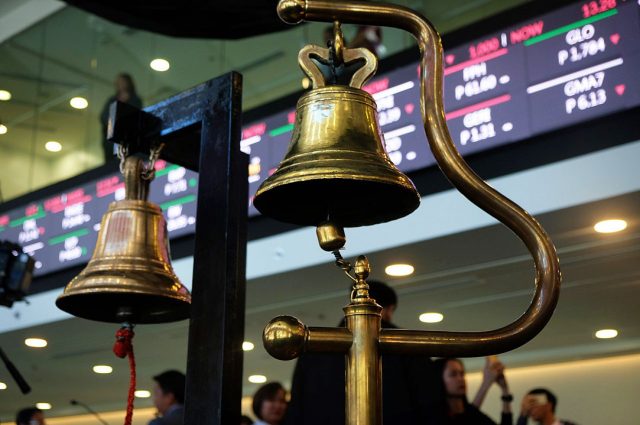
APOLLO Global Capital, Inc. completed its follow-on offering (FOO) on Tuesday, raising P988 million from the sale of 12.35 billion shares for eight centavos each.

It listed follow-on shares at the Philippine Stock Exchange (PSE).

“Now that this FOO has jumpstarted the company’s quest to commence operations, I hope that all other factors will fall into place because the company’s investors have long-awaited and deserve positive developments on this front,” PSE President and Chief Executive Officer Ramon S. Monzon said during the listing ceremony.

According to its prospectus dated Aug. 13, the company will be using the majority of the proceeds from the follow-on offer to acquire a 49% stake in Poet Blue Ocean Pte Ltd. Proceeds will also be used to buy environmental and ecological mitigating measures, equipment and insurance as well as for its general corporate purposes.

Singapore-based Poet Blue Ocean owns the MB Siphon Vessel 1, which will be used for the offshore mining activities of Apollo Global subsidiary JDVC Resources Corp.

The MB Siphon Vessel 1 is estimated to start its operations on or before the end of April next year, subject to weather conditions and once all the necessary environmental protection equipment and ecologically balanced offshore mining protective gears have been procured.

“The procurement of the required equipment will normally take four to five months which will be sourced from China and Japan,” the company said in its prospectus.

On Tuesday, shares of Apollo Global at the stock market declined by 4.39% or P0.005 to close at P0.109 each. — Keren Concepcion G. Valmonte

Financial behaviors shift amid coronavirus crisis

FILIPINOS are now more focused on spending for necessities and investing as the coronavirus pandemic has shown the importance of having enough savings for emergency situations.

In a BusinessWorld Insights session on Tuesday titled “Saving, Spending, Investing: Achieving Financial Goals even amid a Crisis,” experts said more Filipinos became aware of the need for financial security due to the crisis.

Manulife Asset Management and Trust Corp. (MAMTC) President and Chief Executive Officer Aira Gaspar said younger Filipinos who belong in Generations Y and Z or those aged 40 years old and below said they are setting aside a budget for their necessities and starting to invest due to the pandemic.

Ms. Gaspar cited a study they conducted, which showed 81% of Filipino respondents belonging to this age group are now actively working towards a financially secure future.

“This change actually came with the recognition that they relatively have lower income, their limited funds should be focused on necessities. They also acknowledge that job opportunities in the current environment is limited,” she said.

Meanwhile, AIA Philippines Chief Executive Officer Kelvin Ang said savings and protection have become a more crucial financial concerns for Filipinos given the uncertainties during the pandemic.

He said a survey they have conducted in AIA’s markets in Asia earlier this year showed 71% of Filipino respondents said their income was negatively affected by the crisis. Half of the survey respondents also said their savings were reduced in 2020.

“Many of them placed their savings with the bank and they are not happy with the interest given the low interest rates now, so they are in a lot of stress looking at their bank savings depleting in value because of inflation,” Mr. Ang said.

Clients have also become interested in buying products to protect their health and long-term savings, he added.

The pandemic served as an “eye opener” for many Filipinos regarding financial goals, said Edser Trinidad, first vice-president and head of Investments and Research at First Metro Asset Management, Inc. (FAMI).

“In the past, a part of their financial goals is to set aside some for a goal to travel, to purchase material things, but because of the uncertainties, the goal has changed. They’re now putting emphasis on putting financial buffers for the family, setting aside more…for securing health and well-being,” he said.

Filipinos’ investment appetite also changed, he said, with most becoming more conservative last year and choosing products like time deposits and money market funds.

However, this year, risk appetite has improved due to prospects of global reopening and higher vaccination rates in more developed markets, he said. With this, more individuals have started to look for investment opportunities offshore.

There was also a change in the financial behavior of affluents amid the crisis, said Lorraine Saguinsin, relationship manager at the private banking group of UnionBank of the Philippines, Inc. She said their joint study with Swiss private bank Lombard Odier showed ultra-wealthy individuals are focusing on technology, investments, sustainability, and family services during the economic downturn.

Ms. Saguinsin said families need to discuss the transfer of assets and possible transition of roles in their managed businesses amid this time of uncertainty and the threat of death due to the coronavirus.

“With this pandemic, you never know what can happen tomorrow, you might lose a source of income or your business might be disrupted,” she said.

As the virus continues to affect the economy and individuals, Mr. Trinidad said Filipinos should focus on their financial goals.

“There is no perfect time to invest or save. You have to do something now to craft your future,” he said. — LWTN

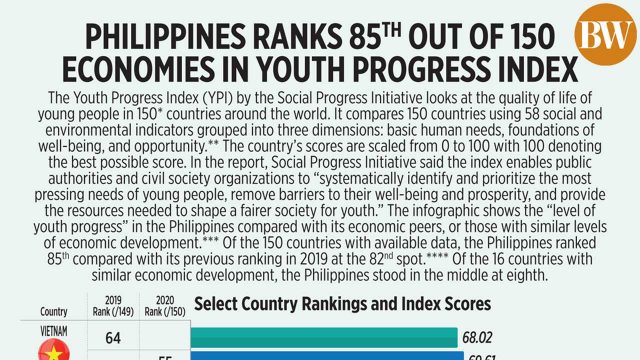
Philippines ranks 85th out of 150 economies in youth progress index

Philippines ranks 85<sup>th</sup> out of 150 economies in youth progress index

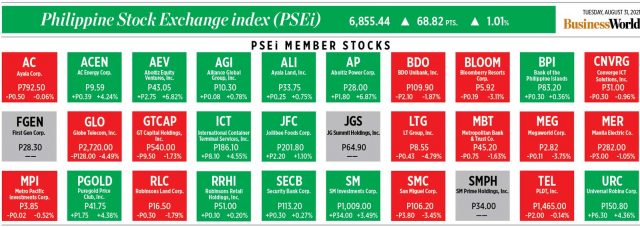
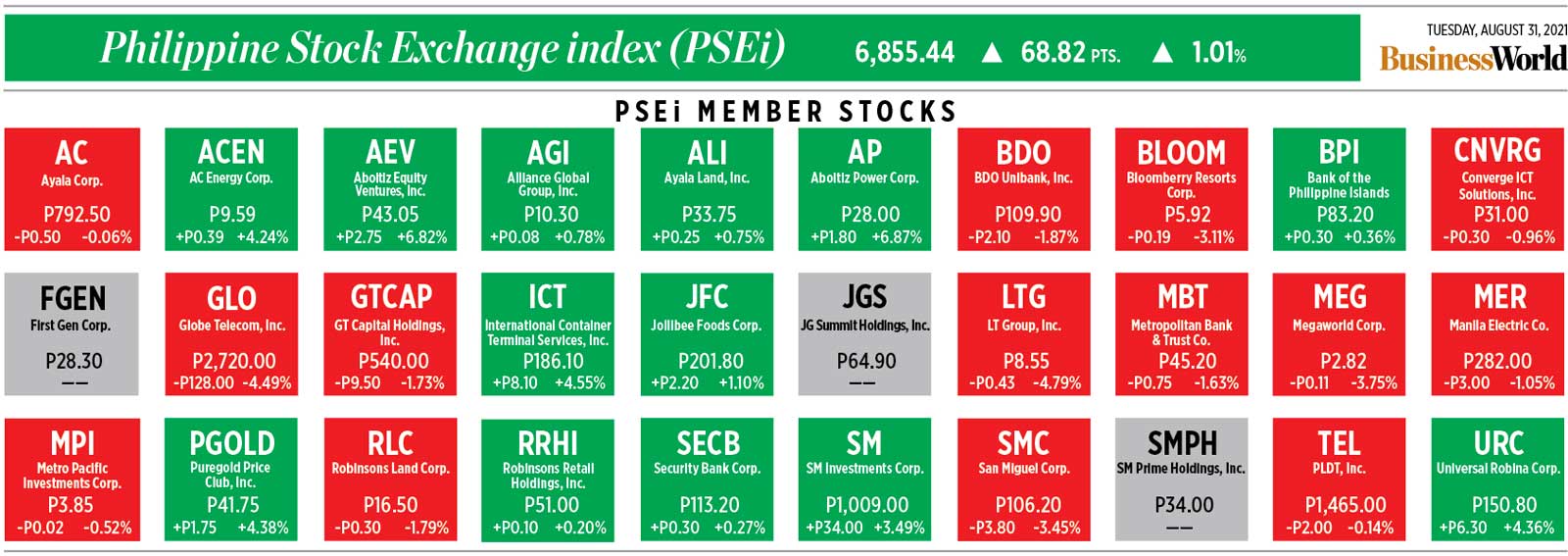
How PSEi member stocks performed — August 31, 2021

Here’s a quick glance at how PSEi stocks fared on Tuesday, August 31, 2021.


Business, unions lobby for bigger role in job task force

PHILSTAR

BUSINESS GROUPS and trade unions said they need to be able to participate at the working-group level in preparing the National Government’s employment recovery plan.

The organizations said in a statement Tuesday that the National Employment Recovery Strategy (NERS) task force should have dialogue with employers and workers groups.

“The engagement of the task force with the genuine representatives of employers and workers groups will bring a more coordinated and cohesive collaboration among the public and private sectors in the recovery strategy of the economy,” the groups said.

“Substantively (involve) employers and workers groups by ensuring their genuine representation in the various technical working groups of the task force.”

The statement was released by the Leaders Forum, which is composed of the Employers Confederation of the Philippines, Federation of Free Workers, Philippine Chamber of Commerce and Industry, Sentro ng mga Nagkakaisa at Progresibong Manggagawa, Philippine Exporters Confederation, Inc., and the Trade Union Congress of the Philippines.

President Rodrigo R. Duterte in June signed an executive order creating the NERS task force to work on the government’s plan to restore employment until 2022.

Noting that the NERS implementation is on a 2021-2022 timeframe, the groups said social dialogue is needed to improve policy reforms that will shape the rebound from the economic crisis caused by the pandemic.

“The Leaders Forum appreciates that a whole-of-government approach is necessary to curb the ill effects of the pandemic and ultimately address the employment crisis with speed and urgency,” they said.

Private-sector groups in June said they planned to organize job caravan events, identify vacancies and make recommendations to the NERS task force, while the task force planned to provide profiles for job vacancy referrals and promote alternative work arrangements.

The recovery strategy is expected to involve the drafting of legislation, the upskilling of workers, the creation of employability programs, the provision of loan assistance to enterprises, the suspension of fees, and outlays for social protection to vulnerable groups.

NERS is budgeted for P1.14 trillion.

In late June, the Labor department estimated that NERS is “expected to generate at least 220,000 jobs and assist over 1.4 million Filipinos struggling with unemployment and income losses.”

The Department of Trade and Industry chairs the task force, with the Department of Labor and Employment and the Technical Education and Skills Development Authority as co-chairs. — Jenina P. Ibañez and Bianca Angelica D. Añago

July government debt hits record P11.6T as state taps local and dollar bond markets

BW FILE PHOTO

THE NATIONAL Government’s outstanding debt grew further to P11.61 trillion as of the end of July following a dollar bond issue and further tapping of domestic lenders, the Bureau of the Treasury (BTr) reported Tuesday.

Preliminary data from the BTr indicate that overall debt rose 4% month on month compared with the level booked at the end of June. It was 26.7% higher than the year-earlier total.

The debt stock has risen 21.3% from the end-2020 level of P9.8 trillion.

The government endeavors to maintain a balance of 70% domestic debt and 30% foreign to minimize exposure from external shocks like currency movements.

Outstanding domestic debt rose 2.3% from a month-earlier level to P8.12 trillion at the end of July following the issuance by the BTr of more government securities. Domestic borrowing rose 29.8% year on year and 21% compared with the ending debt balance in 2020.

The portfolio of government securities rose 2.4% from a month earlier to P7.6 trillion.

The government borrows from domestic and foreign sources to plug the budget deficit, which started to widen last year due to spending requirements imposed by the pandemic.

Outstanding external obligations rose 8.2% from a month earlier to P3.5 trillion at the end of July following a dual-tranche dollar bond issue and fluctuations in the value of the peso.

“The impact of both local- and third-currency exchange fluctuations against the US Dollar added P100.66 billion and P3.39 billion, respectively,” it said.

Overall foreign debt rose 20.1% from a year earlier. It has increased 12.6% since the end of 2020.

Foreign loans obtained by the government rose 4% month on month to P1.47 trillion, while the total for global bonds rose 11.4% to P2.02 trillion.

The government issued $3 billion (P149 billion) worth of securities on July 6 — $2.25 billion in 25-year instruments and $750 million worth of 10.5-year bonds. This raised the stock of dollar-denominated securities by 14.3% to P1.53 trillion at the end of July.

Euro-denominated bonds also rose 3.2% to P241 billion largely due to currency fluctuations, while samurai bonds rose 4.5% to P138 billion, and panda bonds were up 3% to P19.43 billion. Outstanding peso global bonds remained unchanged at P85.57 billion.

Debt guaranteed by the National Government rose 1.3% from a month earlier to P444.31 billion at the end of July after it guaranteed more foreign debt.

Guaranteed domestic obligations fell to P242.65 billion from P244.1 billion at the end of June, reflecting the retirement of some debt.

Guaranteed foreign debt rose 3.7% month on month to P201.65 billion.

“The higher level of guaranteed debt was due to the impact of local- and third-currency exchange rate fluctuations against the US dollar amounting to P6.07 billion and P1.25 billion, respectively, it said.

Budget planners have set a P3-trillion borrowing cap for this year.

The government’s outstanding debt is expected to hit P11.73 trillion by year’s end from P9.795 trillion at the end of 2020.

This is expected to rise further to P13.418 trillion at the end of 2022.

Economic managers project the debt stock to be equivalent to 59.1% of economic output by the end of this year, peaking at 60.8% in 2022. — Beatrice M. Laforga

DoF launching online platform for reporting on GOCC obligations

THE DEPARTMENT of Finance (DoF) is set to launch an upgraded online platform for the reporting of debt taken on by government-owned and -controlled corporations (GOCCs).

It said in a statement Tuesday that the GOCCs’ Liabilities Reporting and Processing Tool (GLRPT) aims to help the DoF analyze the debt incurred by state-run firms and their impact on the financial exposure of the National Government.

Finance Secretary Carlos G. Dominguez III said the DoF will ask the Governance Commission for GOCCs (GCG) to include in its performance evaluations compliance in reporting their debt via the GLRPT.

DoF Corporate Affairs Group Director Joanna P. Castillo said the group will train participants in the use of the platform, while the GCG committed to transfer its web-based debt reporting system for integration with the GLRPT.

“The Central Management Information Office (CMIO) of the DoF further developed the system by expanding the GOCC coverage, enhancing the data field and creating a report template,” she said.

Mr. Dominguez, an ex-officio member of the GCG, said the commission should also consider including the findings of other regulators in assessing and rating GOCCs.

The GCG said last month that it will improve its online monitoring system and review its process for assessing GOCCs after the DoF in mid-June criticized it for weak oversight.

Mr. Dominguez had noted that some assessments made by the commission “contrast sharply” with the conclusions reached by other regulators, while several GOCCs were given high ratings even if they did not comply with accounting and reporting standards.

He said the results of the Insurance Commission’s review on state-run firms was not in line with the assessment of the GCG.

He said wide variances in evaluation could cause confusion among GOCCs and lead to errors in policymaking.

GOCCs have remitted P51.7 billion in dividends to the national treasury as of Aug. 13. — Beatrice M. Laforga

Peso climbs versus dollar

BW FILE PHOTO

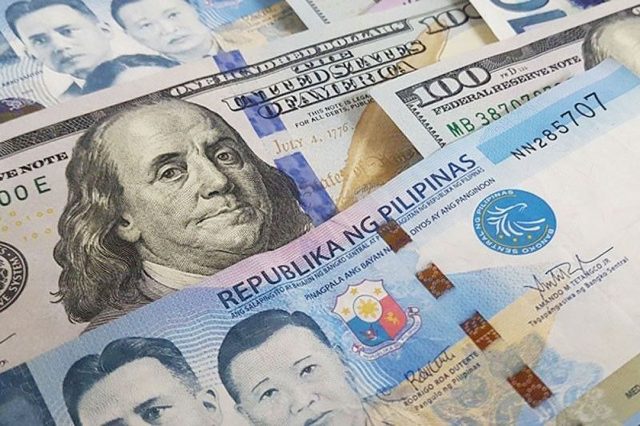
THE PESO strengthened versus the greenback on Tuesday on the back of an expected slowdown in economic activity following the extension of strict restriction measures in Metro Manila and the dovish tone of the US Federal Reserve during last week’s Jackson Hole symposium.

The local unit closed at P49.76 per dollar, gaining 19.5 centavos from its P49.955 finish on Friday, based on data from the Bankers Association of the Philippines.

The market was closed on Monday in observance of National Heroes’ Day.

The peso opened Tuesday’s session at P49.83 per dollar. Its weakest showing was at P49.87, while its intraday best was at P49.65 versus the greenback.

Dollars traded dropped to $848.73 million on Tuesday from the $922.6 million seen on Friday.

The peso appreciated as Metro Manila remained under the modified enhanced community quarantine (MECQ), Rizal Commercial Banking Corp. Chief Economist Michael L. Ricafort said.

“This could still slow down economic activities, including imports,” Mr. Ricafort said in a text message.

The Palace last week said Metro Manila, Bataan, and Laguna will remain under MECQ until Sept. 7 to prevent the spread of the virus amid a new wave of cases.

Infections rose by 13,827 on Tuesday, bringing the total active cases to 145,562, based on data from the Department of Health. The country registered its highest daily tally of 22,366 on Monday.

Meanwhile, a trader attributed the peso’s strength to risk-off sentiment after Fed Chairman Jerome H. Powell failed to give a specific timeline for the central bank’s plan to taper their asset purchases at the Fed’s Jackson Hole symposium on Friday.

Mr. Powell said there has been clear progress toward maximum employment and that he was of the view that if the US economy evolved broadly as anticipated, “it could be appropriate to start reducing the pace of asset purchases this year,” Reuters reported.

For Wednesday, Mr. Ricafort expects the local unit to move from P49.65 to P49.85 per dollar, while the trader gave a forecast range of P49.60 to P49.85. — LWTN with Reuters

Shares rise after last-minute bargain hunting

BW FILE PHOTO

PHILIPPINE shares closed higher on Tuesday on last-minute bargain hunting after trading in negative territory for most of the session as the country logged record coronavirus disease 2019 (COVID-19) infections on Monday.

The Philippine Stock Exchange index (PSEi) gained 68.82 points or 1.01% on Tuesday to close at 6,855.44, while the all shares index climbed 21.47 points or 0.51% to 4,225.58.

“Philippine shares climbed on the combination of window dressing and the latest MSCI rebalancing to bargain hunt at closing. In addition, sentiment got a boost as overseas equities edged higher on Monday led by tech stocks,” Regina Capital Development Corp. Head of Sales Luis A. Limlingan said in a Viber message.

“Last-minute buying sent the local market higher,” Philstocks Financial, Inc. Senior Research Analyst Japhet Louis O. Tantiangco said in a separate Viber message. “For most of the day, however, the market was in the negative territory, plunging as low as 6,651.01. This came as investors priced in the wider economic losses brought by the extension of the strict quarantine measures in the National Capital Region and in other areas of the country. COVID-19 worries also weighed on sentiment amid the continuous surge in our daily new cases…”

Metro Manila and other areas will remain under modified enhanced community quarantine until Sept. 7, the Palace announced last week.

The Health department reported a record 22,366 infections on Monday, bringing the country’s tally to 1,976,202. Active cases stood at 148,594.

The World Health Organization on Tuesday said the more transmissible Delta variant of COVID-19 is now the dominant variant in the Philippines.

Most sectoral indices posted gains on Tuesday except for financials, which shed 9.61 points or 0.66% to finish at 1,427.71.

Meanwhile, industrials rose 202.17 points or 2.05% to 10,049.93; holding firms climbed 114.92 points or 1.70% to 6,875.80; mining and oil went up by 99.54 points or 1.09% to close at 9,224.98; services gained 16.15 points or 0.91% to end at 1,773.61; and property inched up by 1.06 points or 0.03% to 3,094.98.

Value turnover surged to P14.85 billion on Tuesday with P2.92 billion issues switching hands from the P6.86 billion with 1.62 billion issues traded on Friday.

Decliners overwhelmed advancers, 120 against 65, while 55 names closed unchanged. Net foreign buying dropped to P306.96 million on Tuesday from P631.26 million on Friday.

“The attention of local players [will be] directed to the release of Markit PH PMI (Purchasing Managers’ Index) manufacturing [on Wednesday],” Regina Capital’s Mr. Limlingan said.

The country’s PMI stood at 50.4 in July, slipping from the 50.8 reading in June but still above the 50 neutral mark that separates contraction from expansion. — K.C.G. Valmonte

AmCham confident Creative Industries bill will get approved

TOPDRAWANIMATION.COM

THE AMERICAN Chamber of Commerce of the Philippines (AmCham) said it is encouraged by the progress made in Congress to pass a bill on the development of the creative industry, which it said would raise the industry’s competitiveness in Southeast Asia.

“With inclusion of the bill in the House’s list of priorities, we are optimistic that the bill will be reported out to plenary and approved soon,” AmCham Philippines Executive Director Ebb Hinchliffe said.

The chamber said a Creative Industries Act would support the growth of the sector and its contribution to the Philippine economy.

“Passage of the legislation creating strong institutional bodies, plans, and incentives at the national and local level is crucial to achieving the Philippine goal of becoming the top creative economy in the ASEAN region in terms of size and value by 2030.”

Speaker Lord Allan Jay Q. Velasco at the opening of the third regular session pushed for institutions to prop up the creative economy. The bill has been approved by the House Special Committee on the Creative Industry and Performing Arts and the appropriations committee, while Senate deliberations have started. 

“Business groups anticipate filing of the committee report on the measure, with the Trade Committee Chairman’s (Senator Aquilino Martin L. Pimentel III) commitment to shepherd the bill to passage,” AmCham said.

The chamber recently formed its first creative industries committee, which will discuss the bill and the industry’s largest subsectors, including advertising, animation, design, film, and software.

AmCham and several industry groups released a creative industry policy brief in November 2018, which recommended the passage of the bill. — Jenina P. Ibañez

DoF to support shift to low-carbon energy production

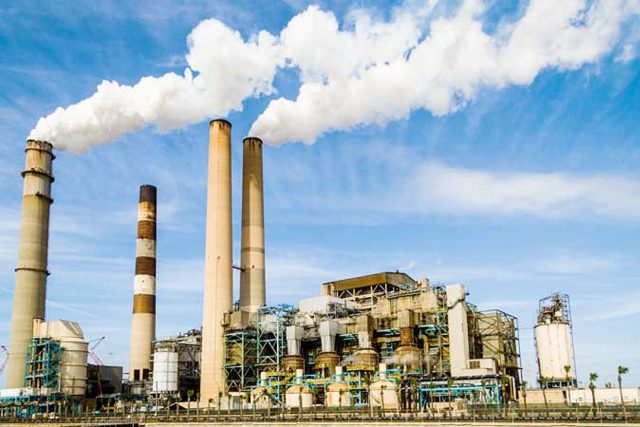
THE DEPARTMENT of Finance (DoF) said it will seek financing sources and develop programs that will attract investment for the shift away from carbon-intensive energy.

“The DoF is fully intent on mobilizing financing for climate change mitigation. We are establishing a sustainable financing ecosystem to synergize investments from both the public and private sectors, and we look forward to building, very soon, green social projects that will have a lasting and permanent impact on the environment,” Finance Assistant Secretary Paola Sherina A. Alvarez said in a forum Tuesday.

She said the DoF is exploring all possible instruments with the potential to shift investment in favor of renewables during the transition away from coal.

“What we don’t want to have is a scenario where you set a moratorium on coal but don’t provide foundational policies that will help the environment be more conducive to investment,” she said.

Ms. Alvarez said the government is working with the Asian Development Bank on a Coal Replacement Fund that will support the acquisition of coal-fired power plants in Mindanao and eventually elsewhere in the Philippines to provide momentum to the shift to renewables.

The initial goal is to set up a fund to acquire all power plants in the region and eventually shut them down while the generating capacity of the Agus-Pulangi hydropower plant is upgraded.

“The shift to renewable clean energy sources and green technologies and the adoption of modern, and low-carbon approaches to help mitigate this climate crisis, will make our economy more resilient, and our growth more sustainable,” she said.

Aside from financing, Ms. Alvarez said the government will also collaborate more with international partners and the private sector to achieve the country’s climate change mitigate goals.

She said $121 billion worth of total investment is needed between 2020 and 2040.

“Investments, technology and capacity building are needed to scale up, and speed up energy transition,” she added.

The Energy department has imposed a moratorium on new coal-fired power plant projects and allowed foreign investors to fully own geothermal plants.

The Philippines aims to reduce its greenhouse gas emission by 75% by 2030 according to its Nationally Determined Contribution under the Paris Agreement on Climate Change.

The Philippines is one of the world’s most disaster-prone countries, hit by typhoons, earthquakes and volcanic eruptions, which cause P177 billion worth of losses in public and private assets annually. — Beatrice M. Laforga