Home Blog Page 7228

Give the gift of holiday hygiene

Even though we’re two years well into the pandemic, you can’t deny that coronavirus essentials STILL make for no-brainer holiday presents.

So if you’re a practical gift-giver, here are our top BENCH/ Everyday Essentials for gifting:

BENCH/ Alcogel Ultimate Clean Air + Surface Disinfectant Spray

A room spray and a disinfectant in one, BENCH/’s Air + Surface Disinfectant Spray is definitely on the top of our nice-to-gift list! It comes in Powder Power, Lavender Dreams, and Ring Around a Rosey scents that have a fresh aroma that lingers, but never overpowers. Plus points because it’s also available in travel-sized 60ml bottles, so you can disinfect on-the-go!

BENCH/ Alcogel Antibacterial Hand and Body Wash

The perfect gift for the skindulgent friend who loves to give their skin a treat! This antibacterial hand and body wash from BENCH/ is infused with Argan Oil and Vitamin E for that smooth and moisturized feeling.

BENCH/ Alcogel Skin Antiseptic Solution

This BENCH/ Alcogel skin sanitizer kills 99.9% of bacteria to keep skin clean and germ free. The non-sticky formulation and long term effectiveness makes this product an essential for friends and family who are always out and about their daily activities.

BENCH/ Alcogel Clean Kitchen

Christmas is among the celebrations where the kitchen is essential. Good thing this all-natural brew BENCH/ Clean Kitchen Sanitizer does an impressive job keeping kitchens, utensils, surfaces, and even fresh produce spick-and-span clean and germ free!

BENCH/ Organics Lavender Castile Soap

This essential soap is perfect for the essential oil lover — or anyone for that matter! Why? With seven different uses (face, body, hair, shaving, dishes, surfaces, and washing fresh produce!), your giftee is sure to find this all-in-one lather useful.

Find these practical holiday gifts in BENCH/ stores nationwide, or at their official online store at https://shop.bench.com.ph/.


Spotlight is BusinessWorld’s sponsored section that allows advertisers to amplify their brand and connect with BusinessWorld’s audience by enabling them to publish their stories directly on the BusinessWorld Web site. For more information, send an email to online@bworldonline.com.

Join us on Viber to get more updates from BusinessWorld: https://bit.ly/3hv6bLA.


Finance chief bucks tax on super-rich

A PLAN TO TAX the super-rich could lead to aggressive tax avoidance schemes and drive investment out of the country, according to the Department of Finance (DoF).

In a letter to House Speaker Lord Allan Jay Q. Velasco, Finance Secretary Carlos G. Dominguez III said the proposal is unlikely to boost government revenue.

“While this wealth tax could initially lead to gains in tax collections, it could, at the same time, discourage growth and investments in the long haul,” the agency said in a separate statement at the weekend.

House Bill 10253 or the proposed Super-Rich Tax Act of 2021 will impose a tax of 1-3% on rich people.

Under the bill filed by a minority bloc at the House of Representatives, the tax would be used to fund for medical assistance, education, employment, social protection and housing for the poor.

The DoF estimated the bill would generate P57.6 billion in revenue each year, while some congressmen said the government could collect P236.7 billion from just 50 of the country’s richest.

But the agency said lost investments caused by the tax would cut the country’s revenue in the long run and reduce new jobs.

“There is a risk of capital flight if the wealth tax is passed in the Philippines,” Mr. Dominguez said.

Only four countries continue to implement the wealth tax — Belgium, Norway, Spain and Switzerland, he said.

“Many countries that had wealth taxes before ended up repealing the said measures particularly because of the increased capital mobility and access to tax havens in other countries,” he added.

Think tank IBON Foundation said the measure would generate P467.1 billion from 2,919 people who have taxable assets exceeding P1 billion. These super-rich account for 0.003% of the population and control 16% of the country’s wealth, it said.

This estimated revenue could fund P10,000 in emergency aid to 18.6 million poor households, subsidies for micro, small and medium enterprises to support a daily wage increase of P100 for three months and hiring additional health workers.

Nongovernment organization Freedom from Debt Coalition has been pushing for a wealth tax to finance the country’s COVID-19 pandemic response. It said candidates for the national elections should pledge that social development will take up a bigger portion of the country’s budget than debt payments.

Meanwhile, Mr. Dominguez said the proposed tax would discourage businesses from taking on riskier ventures that could benefit the public.

They will be subject to tax liabilities on the high capital value of their assets while they generate low profits at the start of operations, he said.

“Wealth taxes fail to significantly promote economic equality or create additional fiscal space,” the Finance chief said. “Moreover, net wealth taxes often failed to meet their redistributive goals as a result of their narrow tax bases, tax avoidance and tax evasion.”

He also expressed concerns about enforcement, citing the need to relax the Bank Secrecy Law and develop exchange of information agreements with other countries to assess wealth in the absence of a reliable database identifying the country’s richest. — Jenina P. Ibañez

Election spending not a concern for prices — BSP

BW FILE PHOTO

By Luz Wendy T. Noble, Reporter

PHILIPPINE ELECTIONS next year are unlikely to cause consumer prices to spiral out of control because the economy remains below its full capacity, according to the central bank.

“It will not be significant enough to affect the path of inflation, which we see going back to within the target range in 2022,” Bangko Sentral ng Pilipinas (BSP) Deputy Governor Francisco G. Dakila, Jr. told a news briefing on Boracay Island in central Philippines on Thursday.

“Demand conditions continue to be muted so any additional spending will come at a time when we are still operating below full capacity,” he added.

The Monetary Board on Thursday cut its inflation forecast for this year to 4.3% from 4.4%, though this is still above the BSP’s 2-4% target. Estimates for 2022 and 2023 were kept at 3.3% and 3.2%.

At the same meeting, the Monetary Board kept the key policy rates untouched at their record lows. Central bank Governor Benjamin E. Diokno said they need to keep supporting an economic recovery that has gained traction.

Election spending helps boost growth because it fuels consumption, but could cause faster inflation, Asian Institute of Management economist John Paulo R. Rivera said.

“While election spending accelerates the multiplier effects of consumption on economic growth, it also reinforces the pressure on inflation given the combined effects of holiday spending and premature campaigning,” he said in a Viber message.

Election-related spending contributed about 1% to economic output in past presidential elections, said Michael L. Ricafort, chief economist at Rizal Commercial Banking Corp.

But the 2022 elections might be different amid restrictions related to a global coronavirus pandemic, he said in a Viber message.

“Election-related spending for 2022 could be reduced compared to previous elections amid greater focus on social media and some restrictions on person-to-person campaigning,” he said. “Campaign contributions from donors could also be reduced amid cost-cutting during the pandemic.”

Mr. Dakila said political developments are not a “significant consideration” in formulating monetary policy. “We have always been emphasizing that the decision of the board is guided by the inflation outlook.”

Inflation continued to exceed the target at 4.6% in October, though slower than 4.9% in September mainly due to a slower increase in food prices. Inflation averaged 4.5% for the 10 to October.

Mr. Dakila had said inflation might return to levels within the BSP target as early as this month. The central bank is set to review policy rates on Dec. 16.

Political dynasties dominate 2022 PHL elections

By Kyle Aristophere T. Atienza, Reporter

ELBERT JOHN HONORICA, 25, says he knows better than to vote for a presidential candidate who comes from a political dynasty, a main feature of Philippine politics.

“An alliance like that of the Marcoses, Dutertes and Arroyos is not unprecedented,” the millennial activist said in a Facebook Messenger chat. “The triple-threat alliance is simply shameless and shows their obvious thirst for power.

“In the Philippines, multiple parties compete in a political climate focused on personalities and dominated by powerful dynasties. President Rodrigo R. Duterte’s predecessor, the late Benigno S.C. Aquino III, was the son of former President Corazon C. Aquino, whose People Power Revolution ended the dictator’s more than 20-year rule.

More than 70,000 people were jailed, about 34,000 were tortured and more than 3,000 people died under the dictator’s martial rule, according to Amnesty International. The government has recovered P174 billion of the family’s ill-gotten assets, the Presidential Commission on Good Government has said.

The Dutertes also have their own brand of dynastic politics, having ruled Davao City in southern Philippines for decades. Mr. Duterte was a former mayor, while his daughter Sara Duterte-Carpio is the city’s chief now. Both her brothers are also into local politics.

Ms. Duterte-Carpio registered her candidacy for vice-president this month under the political party of ex-President Gloria Macapagal-Arroyo, a known powerbroker in Philippine politics.

The presidential daughter will run in tandem with the late dictator’s son Ferdinand “Bongbong” R. Marcos, Jr., who filed his candidacy for president in October.

“A Marcos-Duterte-Arroyo alliance will irreparably entrench dynastic rule in the country,” said Temmario C. Rivera, chairman of the Center for People Empowerment in Governance.

“While seething with its own internal rivalries and distrust of each other, even their temporary, opportunistic alliances will make it very difficult to mount political challenges against them,” he said in a Messenger chat.

Julio C. Teehankee, a political science professor at De La Salle University, said the alliance of powerful families would mark the peak of dynastic politics in the country, which seems to be aimed at protecting them from lawsuits and political persecution.

“Arroyo has been brokering the Marcos-Sara alliance,” he said in a Messenger chat. “The former queen has become the kingmaker. Even the best laid plan of mice and men can be countered by an equally crafty politician in the person of President Duterte.”

“That will serve as each family’s political protection — a dynastic consolidation for political survival,” he added.

The International Criminal Court (ICC) has ordered an investigation of Mr. Duterte’s crackdown on illegal drugs that has killed thousands, saying crimes against humanity might have been committed.

An infrastructure think tank warned that allowing dynasty members to hold national elective posts would worsen corruption in infrastructure projects.

“We can be more than certain that one of the major vehicles for dynastic plunder will be multibillion infrastructure projects due to the sheer magnitude of project costs and the prospect of massive but illicit value capture in a single project,” InfraWatch convenor Terry L. Ridon said in a Facebook Messenger chat.

He said corruption in public infrastructure would be worse under a dynastic regime because the whole family would benefit from it, not just a single politician.

Human rights activists and victims of Marcos martial rule have asked the Supreme Court to affirm a decision by the country’s anti-graft court charging former First Lady Imelda R. Marcos with seven counts of graft for illegally funneling at least $352 million to Swiss foundations in the 1970s when she was governor of Metropolitan Manila.

Civic leaders have also asked the Commission on Elections to block the presidential run of Marcos, Jr., saying he’s ineligible to run for office after a trial court convicted him in 1995 for failing to pay income taxes.

FAMILY INTERESTS
“This move shows that the Dutertes are also traditional politicians seeking to protect their interests, possibly hoping that if they win, the father can be saved from prosecution,” said Maria Ela L. Atienza, a political science professor from the University of the Philippines.

“The question here is which political family is allowing themselves to be used by the others,” she said in a Viber message. “As alliances of traditional politicians and political families go, there could be a time for them to eventually fight for dominance and the alliance will break up.”

Senator Christopher Lawrence T. Go, Mr. Duterte’s former aide, dropped out of the vice-presidential race and will run for president instead. This shows that some people in the Duterte camp distrust the Marcoses, who could not guarantee the ruling camp of greater political support, said Antonio Gabriel La Viña, a professor of law and politics at the Ateneo de Manila University.

“In the end, what matters to them is their personal or family interests, not of the people,” he said by telephone. They haven’t focused on the pandemic response and have failed to focus on their platforms.”

Jean Encinas-Franco, who also teaches political science at UP, said the failure of post-People Power administrations to reform the country’s political system is partly to blame for the mockery of the electoral process.

“They have abused the electoral process because they know that they can get away with it without accountability,” she said by telephone. “They downplay the intellect of the electorate.”

Mr. Rivera said personality-driven politics has been present in the country even before Mr. Marcos became president.

“Far more acrimonious is the relationship between Marcos and Arroyo going back all the way to the deep rivalry between the family patriarchs, former Presidents Diosdado Macapagal and Ferdinand, Sr.,” he said.

The two were bitter rivals in the Liberal Party, the political group of Vice-President Maria Leonor G. Robredo.

“They were bitter rivals in the Liberal Party and the latter switched party and joined the Nacionalista Party to run against the incumbent Macapagal for the presidency in 1965,” he said.

Mr. Macapagal and his daughter Gloria helped the anti-dictatorship movement that soon became her political enemy, he said. “The Gloria Arroyo who became president is another story.”

Ms. Franco said the significance of votes from religious blocks could not be ignored in a tight presidential race.

An important religious group is the Iglesia ni Cristo (INC), which is known to vote as a block. Its more than a million voters could be enough to swing the results, she said, noting that the bloc had historically backed the Marcoses.

The INC, which backed Mr. Duterte and the younger Mr. Marcos’s failed vice-presidential bid in 2016, is expected to support administration bets.

Political observers have said the next Philippine president would again fail to get the support of majority of voters.

A clan winner threatens the fight for political reforms, Ms. Atienza said. “The Marcos-Duterte team will be a threat to the fight against the dominance of political dynasties and personality-oriented politics.”

Chezka Decena, a 38-year-old Bongbong Marcos volunteer, begs to disagreee.

“My elders only had praises for the late Marcos,” she said by telephone. “There was no rape and crime during his time. I know when he declared martial law — there was anarchy.”

More than 70,000 people were jailed, about 34,000 were tortured and more than 3,000 people died under the dictator’s martial rule, according to Amnesty International.


Crop exports at risk from fading Chinese rebound

By Jenina P. Ibañez, Senior Reporter

EXPORTERS expect agricultural orders from China to slow as the country’s economic rebound fades, an industry group’s top official said.

“We expect that there might be some effects especially on agricultural products,” Philippine Exporters Confederation, Inc. (Philexport) President Sergio R. Ortiz-Luis, Jr. said by telephone. Mining exports won’t be affected, he added.

There have not been a significant cancellation in orders despite the expected slowdown, he said.

China’s economy grew by 4.9% in the third quarter, slower than expected and below the 7.9% growth in the second quarter after power shortages and supply chain constraints dampened recovery.

This poses risks to global recovery fueled by China’s raw material orders after the country quickly reopened during the initial stages of the pandemic, according to Bloomberg News.

China was the Philippines’ second-biggest export destination after the United States in the nine months through September, government data showed.

Exports to China worth $8.72 billion accounted for 15.7% of Philippine exports during the period, growing by 23% from a year earlier.

In September alone, Philippine exports to China declined by 14.7% year on year to $1.05 billion.

Despite China’s recovery slowdown, Mr. Ortiz-Luis said shipping containers that transport goods to China are available amid a global container shortage.

The global shipping industry has been facing a shortage of vessel space after demand bounced back in some countries, pushing freight rates higher and causing delays in the shipments of goods.

“There are boats that go to China even though there is a shortage,” Mr. Ortiz-Luis said in Filipino.

The economic slowdown in China poses a big challenge to global recovery, National Economic and Development Authority (NEDA) Undersecretary Rosemarie G. Edillon said.

“From a global supply perspective, the Chinese economic slowdown could increase the cost of trade because of supply chain gaps,” she said in a Viber message.

Emerging markets and exporters could experience slower demand from China, she added. “For the Philippines, our strong macroeconomic fundamentals are expected to provide resiliency against external shocks, including a China slowdown.”

Trade and investment opportunities from China remain despite its slower economic growth, Trade Secretary Ramon M. Lopez said.

“There is still optimism but it can be viewed with caution given their slowdown, so we need to watch this development closely,” he said in a Viber message.

Mr. Lopez said the country should continue to develop manufacturing capacity for higher value-added products, diversify goods and services and expand market destinations.

The government should continue to pursue economic reforms such as opening up the country to more foreign investment, build on the infrastructure program and boost the country’s foreign trade agreements, he added.

Megaworld plans P6-billion business district in Bulacan

THE 16-hectare Northwin Main Street will offer prime commercial and shophouse lots surrounded by parks and gardens for businesses, multinational companies.

MEGAWORLD Corp. is planning a central business district called the Northwin Main Street, which will be located within its 85-hectare Northwin Global City township in Bulacan.

In an e-mailed statement on Saturday, Megaworld said the 16-hectare commercial district will offer 145 shophouse and commercial lots due for turnover in 2026. The company’s sales from the project are estimated to reach P6 billion.

“Since the township is just conveniently located along the North Luzon Expressway (NLEX), and just 20 kilometers away from Metro Manila, this will be the nearest business district outside of the capital where companies and businesses can build their shops and officers,” Megaworld Executive Vice-President for Sales and Marketing Noli D. Hernandez said.

“We also encourage entrepreneurs to become part of this global business district, which will soon be just 20 minutes away from the much-anticipated New Manila International Airport in Bulacan,” he added.

The commercial district will complement Megaworld’s P98-billion Northwin Global City township, which will also feature residential condominiums, hotels, malls, mixed-use commercial buildings, educational institutions, and office towers.

Megaworld said Northwin Main Street is designed to mimic Fifth Avenue in New York City, emphasizing its walkability. It will feature promenades and walking parks, with 44% of the district allocated for green and open spaces.

Its shophouse lots will be offered from 250 square meters (sq.m.) to 550 sq.m. Shophouses, which will be designed with a French-inspired architecture, may be built up to three-storeys high to accommodate retail, food, and beverage retailers.

Megaworld said the topmost floor of shophouses may also be used for residential or office purposes.

Meanwhile, its commercial lots span from 450 sq.m. to 750 sq.m. and may go up to five-storeys high and may be used for office or boutique hotels.

Shophouses and commercial lots will be lined up in pedestrian-friendly streets and it will also feature gardens and parks.

Megaworld shares on Friday closed lower by 0.60% or two centavos, finishing at P3.30 apiece. Megaworld shares on Friday closed lower by 0.60% or two centavos, finishing at P3.30 apiece. — Keren Concepcion G. Valmonte

SEC drafts registration rules for online lenders

THE Securities and Exchange Commission (SEC) has made public its drafted guidelines for the registration and operation of online lending platforms (OLPs).

In an e-mailed statement on Friday, the SEC said the draft rules for existing and newly registered financing and lending companies seek to stop “abusive and predatory practices.”

“The proposed guidelines will apply to both existing and newly registered financing and lending companies who have yet to own, operate, or utilize OLPs and other modes of financial technology (fintech), as well as those who are already engaged in fintech who look to provide their credit products and related services,” the SEC said.

Once the memorandum circular is deemed effective, companies with existing OLPs are required to comply with the new guidelines within 180 days.

They must apply for a new OLP license under the new set of requirements, which include an amended Articles of Incorporation. Otherwise, they will not be allowed to operate their OLPs.

“The SEC may, at its discretion, set a limit on the total number of OLPs that may be established. The commission shall take into consideration the total number of applications received, OLPs already existing, and its effects on the industry and the general public,” the commission said.

Under the new guidelines, financing and lending companies will not be allowed to operate or use OLPs or have fintech services that are not registered or approved by the SEC.

“The company’s ability to engage in fintech must also be included in its purpose as stated in its Articles of Incorporation,” the commission said.

OLPs will also be required to register as business or trade names of the financing or lending company as stated under the SEC Memorandum Circular No. 13, series of 2019.

Those applying for an OLP license should have at least five directors and at least two independent directors. The SEC said at least 20% of its board of directors should be comprised of independent directors, or whichever is higher.

Applicants are required to provide a detailed business and operational plan, which comply with Republic Act No. 3765 or the Truth in Lending Act (TILA) and the SEC Memorandum Circular No. 19, series of 2019, detailing the disclosure requirements of financing and lending companies and reporting of ALPs.

A panel from the SEC will discuss with the applicant its business plans, as well as its marketing strategy, target market, interest rates, loan products, and services.

The SEC said the financing or lending company applying for a license must also provide a walkthrough of its user interface, discuss how it will handle complaints, and how it will be handling the data it collects through the OLP.

Applicants must also comply with the SEC’s memorandum on prohibiting unfair debt collection practices or the credit information system act. It must also provide official e-mail addresses and cellphone numbers for its transactions with the commission.

“The SEC Corporate Governance and Finance Department (CGFD) will then evaluate the documents submitted by the applicant company,” the commission said.

A recommendation on the granting or denial of an entity’s OLP application will be submitted to the Commission en banc for their final decision. The SEC said those who have been rejected may reapply after a year, with tweaks showing “the reason for rejection no longer exists.”

“Under the draft guidelines, the OLP license shall have an initial validity of one year from the issuance date, subject to periodical examination and renewal by the SEC,” the commission said.

The OLP license’s validity will also depend on the company’s compliance with reportorial requirements, among others. Meanwhile, those with additional OLPs are required to undergo another application process for the prospective OLP.

Financing and lending companies with OLP licenses are required to report changes or termination of their OLP within 10 days before its implementation.

The draft memorandum circular also includes penalties for those who fail to comply with the conditions of the OLP license. Financing companies may be subjected to penalties worth P100,000 and P200,000 for the first and second offense, respectively, while lending companies may face a P50,000 and a P100,000 fine.

“For the third offense, the SEC may impose a fine of not less than twice the basic penalty but not more than P1 million; suspension of the OLP license for 60 days; or revocation of the OLP license, as appropriate for each circumstance,” the SEC said.

“The Commission may also impose a daily penalty of P400 and P200 for financing and lending companies, respectively, on top of the basic penalties,” it added.

The regulator said financing and lending companies that operate an OLP without complying with the guidelines set forth by the SEC will have their certificate of authority or primary licenses suspended or revoked, depending on the circumstances and gravity of the offense.

The commission is now calling on interested parties to comment on the draft memorandum circular until Dec. 3. — Keren Concepcion G. Valmonte

Property infusion into REITs seen to attract more investors

Filinvest Cyberzone Cebu — FILINVESTREIT.COM/

By Keren Concepcion G. Valmonte, Reporter

NEWLY listed real estate investment trust (REIT) firms have announced plans to expand initial portfolios, which are seen to further generate interest among investors.

In separate statements last week, Megaworld Corp.’s MREIT, Inc. and Filinvest Land, Inc.’s (FLI) Filinvest REIT, Corp. (FILREIT) said they are planning to inject new properties into their REIT portfolios. MREIT is eyeing to infuse four assets, while FILREIT is aiming to add three more properties to its portfolio.

“We expect continued positive reception for the REIT market following these portfolio expansions, especially for industrial assets as the sector has been one of the bright spots under the pandemic,” JLL Philippines Research Head Janlo C. de los Reyes said in an e-mail on Saturday.

Meanwhile, Timson Securities, Inc. Trader Darren Blaine T. Pangan said current investors also stand to benefit from the infusion of new properties into REIT portfolios.

“The asset injections may result in the firms having a more enhanced and attractive asset portfolio,” Mr. Pangan said in a Viber message on Friday.

In a statement on Nov. 16, MREIT said its planned acquisition will increase its portfolio’s gross leasable area (GLA) to 280,131 square meters (sq.m.) from 224,431 sq.m. The acquisition is expected to be finalized by December this year so the properties may contribute to its revenues by January next year.

These properties include three assets in Iloilo Business Park, which are Two Techno Place, Three Techno Place, and One Global Center, and World Finance Plaza in McKinley Hill in Fort Bonifacio in Taguig. MREIT said the properties have an average occupancy rate of 99%, thanks to business process outsourcing (BPO) locators.

Meanwhile, in a statement on Nov. 18, FILREIT said the acquisitions will increase its GLA to 403,000 sq.m. from over 300,000 sq.m. It plans to infuse Filinvest Cebu Cyberzone Tower 2 in Cebu City, Filinvest Axis Tower Two, and PBCom Tower in Makati City within one to 1.5 years.

RL Commercial REIT, Inc. (RCR), the REIT firm sponsored by Robinsons Land Corp. (RLC), is also planning to infuse 40,000 to 100,000 sq.m. within the next 18 months. RLC previously said its potential pipeline for infusion into RCR spans 422,000 sq.m. from its office business portfolio alone.

Pioneering Ayala-led AREIT, Inc. has already recognized income from the properties that were part of its property-for-share swap transaction earlier this year, which also grew its GLA to 549,000 sq.m.

“We saw stable performance of REITs despite headwinds, and we anticipate this to be the case [until] end of the year,” JLL Philippines’ Mr. De los Reyes said.

“The initial REIT portfolios have been generally resilient on the back of diverse locations, solid occupancy levels, and balanced tenant mix, which have helped manage risk brought by the pandemic,” he added.

Timson Securities’ Mr. Pangan said REITs “seem to remain attractive to investors, especially that they continue to provide a good avenue for portfolio diversification.”

“Majority of the REIT issues have appreciated since their listing dates, and the market may be looking forward to upcoming REITs with unique exposures to various industries in the country,” Mr. Pangan said.

After an eruption, a pandemic, and other issues: Ikea finally opens locally

PHOTO COURTESY OF JOSEPH L. GARCIA

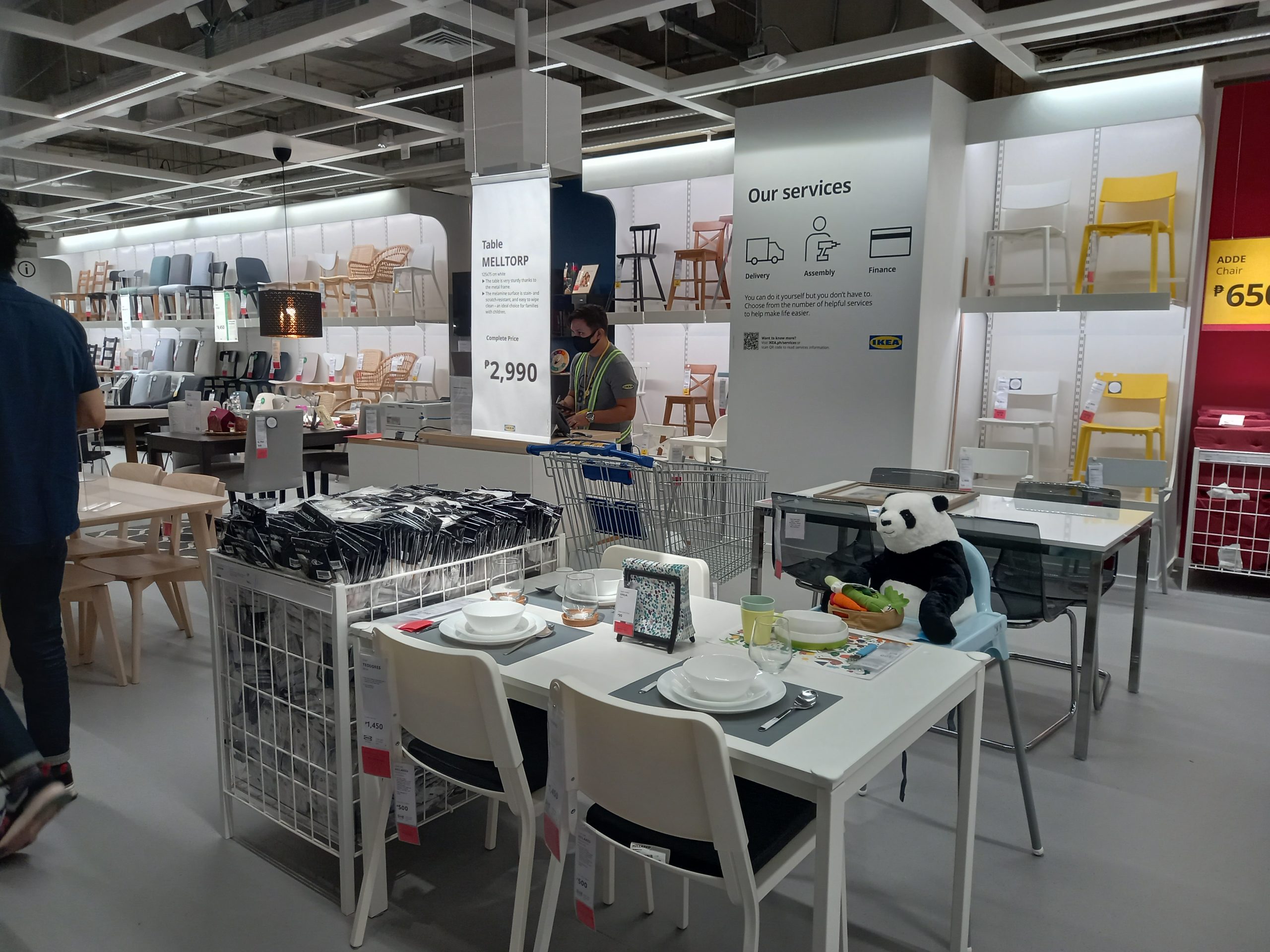
THE FIRST Ikea store in the Philippines is finally open, after rumors of its arrival in 2016, an announcement in 2018, and the events of 2020 and 2021 getting in its way.

Georg Platzer, Country Manager for Ikea in the Philippines, spoke about the delays during a group interview on the sidelines of a store tour last on Nov. 19. “Many reasons. Certainly, the pandemic is one of the reasons, because the supply chain of construction materials was impacted. We simply couldn’t get things from other countries imported to the Philippines,” said Mr. Platzer. These included the escalators and elevators that would help people go around the enormous store, the biggest Ikea so far in the world with about 68,000 sqm. This includes a showroom and market hall with a combined floor space of 15,000 sqm. Lockdowns imposed last year and this year also hampered construction, with about 3,000 workers stationed there then sent home due to lockdown work restrictions.

“We were also, I think, very optimistic in the beginning, because we did not have experience how it is to build something like this in a market like the Philippines. It was new to us, and we were super optimistic in the beginning. Now we know better. Some things in a country like the Philippines, being an archipelago, just take more time,” he said.

Adding to the delays were natural disasters, with Mr. Platzer counting among them the Taal volcano eruption in 2020. “What else? We got everything here. You don’t have these things in other countries in the world.”

Mr. Platzer also explained the size of the first Ikea store in the Philippines. Aside from the aforementioned 15,000 sqm. of space in the shopping floors, it also boasts 16,000 sqm. of space in the warehouse.

“It is so big, because it was driven by our logistics needs. Ikea has a promise we give to the customers, and it’s called instant gratification. Everybody who comes [who] sees something should be able to pick it and take it home on the same day,” he said. As such, the company has about seven- or eight-weeks’ worth of stock in their warehouse, determined by the seven-week lead time for something to be shipped from the central distribution warehouse in Shanghai. “For this reason, we needed a big warehouse which is like 16,000 sqm. on top here, and that’s basically one of the reasons why the building is so big.”

Some items, however, do come from the Philippines. There’s the restaurant (home of the famous Swedish meatballs), which has about 25 local suppliers for fish, dairy, meat, vegetables, and fruits. They also have a local supplier for live plants in Laguna. “We do not have any supplier yet for any furniture products,” he said, since a large percentage of their products are still made in Poland. China is also a lead manufacturer, with about 35% of their stock coming from that country, but they also source items from about 55 other countries.

Ikea also keeps its prices low. Mr. Platzer says, “We really try to be as low-priced as possible. That is mandatory by concept.

“We also have challenges with the Philippine import taxes, and some other costs which just comes along if you do business in the Philippines,” he said, counting electricity bills, for one. “In other countries, it’s something else.”

Of the 8,200 items in the store, the most expensive one BusinessWorld spotted was a desk that moved up and down, at about P30,000.

BusinessWorld took three hours to walk around two shopping floors, without stopping to buy anything, during the Nov. 19 preview tour. The first floor is dedicated to furniture showrooms, with several booths depicting possible rooms for a customer, each with a story (newlywed family, or a family with kids, for example). The kitchen section (one of more than 20 sections on the floor) boasted a working kitchen for customers to test (and for future demos to be held).

A second shopping floor, the Market Hall, carries accessories like rugs, glasses, and even toys.

In the interest of safety since the pandemic is ongoing, shopping is by appointment through www.ikea.com/ph/en/, with first slots available for the official opening day, Nov. 25 (some people have already booked their appointments). According to Mr. Platzer, they can accommodate, at full capacity, 8,000 people in the building, but due to concerns about the pandemic, they can only fill the building with up to 4,000 people (staff included: Mr. Platzer counts about 525 in-store employees).

“If anybody asks somebody a year from now if they know Ikea, I would like first that they say ‘yes,’ and that what they like about Ikea would be the low price and the quality.” — Joseph L. Garcia

T-bill rates may inch up as funds shift to RTBs

RATES of Treasury bills (T-bills) could inch higher this week as funds are expected to shift to the government’s ongoing retail bond offer.

The Bureau of the Treasury (BTr) will auction off P15 billion in T-bills on Monday, broken down into P5 billion each in 91-, 182- and 364-day debt papers.

A trader said the rates of the short-term securities could move sideways or end 5 basis points (bps) higher as investors will likely choose to park their excess funds in the government’s retail Treasury bond (RTB) offer, which offers a higher yield.

“While the Bangko Sentral ng Pilipinas held rates steady in their recent meeting, the Fed may consider faster tapering due to surging inflation and good economic data,” the trader said in a Viber message.

Rizal Commercial Banking Corp. Chief Economist Michael L. Ricafort said T-bill yields could be slightly higher in line with a weekly increase in most short-term yields in the secondary market.

Short-term secondary market yields went up by 0.01 bp week on week, he said, “amid the ongoing RTB offering that could siphon off some of the excess liquidity in the financial system.”

The Treasury on Tuesday raised an initial P113.545 billion at its price-setting auction for its offer of 5.5-year RTBs. This was oversubscribed by more than five times versus the initial P30-billion offer. The RTBs had fetched a coupon rate of 4.625%.

National Treasurer Rosalia V. de Leon said the proceeds of the offering will fund the government budget. The RTB public offer will run until Nov. 26, unless closed earlier, and the bonds will be issued on Dec. 2.

Meanwhile, the Bangko Sentral ng Pilipinas (BSP) on Thursday kept benchmark rates unchanged, as expected by all 20 economists in a BusinessWorld poll held the previous week, saying an accommodative stance is key to economic growth that has gained solid traction.

The BSP left the key rate steady at 2%. It also kept the overnight deposit and lending rates at historic lows of 1.5% and 2.5%.

On the other hand, the US Federal Reserve recently announced the start of the reduction of its $120-billion monthly asset purchases at $15 billion per month. New York Federal Reserve Bank President John Williams on Thursday said inflation in the United States is becoming more broad-based and expectations for future price hikes are rising, a trend policy makers will be watching closely, Reuters reported.

At the secondary market on Friday, the 91- 182- and 364-day T-bills were quoted at 1.2171%, 1.4525% and 1.641%, respectively, based on the PHL Bloomberg Valuation Reference Rates published on the Philippine Dealing System’s website.

The BTr raised P15 billion as planned via the T-bills it auctioned off last week as total tenders reached P37.99 billion, or more than double the initial offer but lower than the P42.52 billion in bids logged in the previous auction.

Broken down, the BTr raised P5 billion as planned via the 91-day debt papers from P11.34 billion in bids. The three-month T-bills fetched an average rate of 1.15%, up by 0.7 bp from the 1.143% seen at the previous week’s offering.

The BTr also borrowed the programmed P5 billion from the 182-day securities as bids reached P113.07 billion. The average rate of the six-month T-bills went up 1.2 bp to 1.413% from 1.401% a week earlier.

Lastly, the government made a full P5-billion award of the 364-day T-bills as the tenor attracted tenders worth P13.58 billion. The average yield on the one-year instruments stood at 1.621%, up by 0.5 bp from the 1.616% fetched the previous week.

The government previously planned to raise P200 billion from the domestic market in November: P60 billion via weekly T-bill auctions and P140 billion from weekly offers of Treasury bonds (T-bonds). However, the BTr canceled the auctions of P35 billion each in five-year and seven-year T-bonds on Nov. 16 and 23 to give way to its RTB offering.

The government wants to borrow P3 trillion from local and external sources this year to help fund a budget deficit seen to hit 9.3% of the country’s gross domestic product. — Jenina P. Ibañez with Reuters

PAL eyes more flights from Middle East, US for holidays

An airplane is seen on the runway at the Ninoy Aquino International Airport (NAIA) in Manila, March 14, 2016. — REUTERS/ROMEO RANOCO/FILE PHOTO

FLAG carrier Philippine Airlines, Inc. (PAL) said it is ready to add more flights from the Middle East, the United States, Australia and various Asian countries as more overseas Filipinos are expected to fly home next month.

But alternative gateways in the country need to be opened due to the Manila arrival limits. Rerouted passengers can fly onward to their final destinations at no extra cost.

“With the help of enlightened government intervention to open up alternative airports and liberalize health and quarantine protocols, we will do our best to adjust our network so that we can fly more people home and support the revival of our local economy,” PAL said in an e-mailed statement over the weekend.

The Air Carriers Association of the Philippines (ACAP) said in a statement on Saturday that the airline industry is experiencing “high demand” for flights based on forward bookings and passenger inquiries.

PAL said it recently brought in more than 10,000 overseas Filipinos by using alternate gateways such as Cebu, Bohol, Subic and Davao to prevent the cancelation of their flights.

“These include our recent rerouting of flights from Bangkok to Panglao; Dubai to Subic, Davao or Cebu; Los Angeles and San Francisco to Cebu; Kuala Lumpur to Laoag; Doha to Subic; and other routes,” the flag carrier noted.

“In the meantime, we are working with government authorities to open up alternative gateway airports in the Philippines,” it added.

ACAP said the government should simplify further the requirements for travelers “to meet the resurging travel demand during the holidays.”

The association wants the local government units to accept vaccine cards, with or without QR (Quick Response) codes.

“ACAP is also appealing to the government to increase the prevailing cap of four thousand to ten thousand passengers daily on international arrivals for inbound passengers carried by all international airlines into the country.”

At the same time, the airlines are calling for “a reduction of quarantine days for fully-vaccinated passengers from ‘yellow list’ (moderate-risk) countries, from the current five days to just two days.”

In a statement last week, the Tourism department said the task force had approved in principle the entry of fully vaccinated tourists from “green list” (low-risk) countries.

Fully vaccinated foreigners from these countries only need a negative RT-PCR test within 72 hours before departure.

No facility-based quarantine and additional testing will be required, but tourists should self-monitor for any symptoms until the 14th day after their arrival in the country. — Arjay L. Balinbin

L’Oreal offers vouchers to end spat with China’s ‘lipstick brother’

REUTERS

BEIJING/PARIS —  French cosmetics giant L’Oreal is offering shopping vouchers to some Chinese customers to settle a dispute over discounts that drew the ire of the country’s top two livestreaming sales stars, the pair said.

Li Jiaqi, known as “lipstick brother,” and fellow top influencer Viya gave details of the compensation scheme to followers during a livestreaming event late on Thursday. L’Oreal Paris confirmed the details on its Weibo account in China.

The duo said last week that they had cut ties with L’Oreal after some followers said facial products the pair had promoted as carrying the biggest discounts of the year during Alibaba Group’s 9988.HK Singles Day shopping promotion could be bought for less days later on L’Oreal’s own platform.

The spat has thrown the spotlight on the sway of popular culture personalities in China and how retail companies are relying on them to market products.

Mr. Li, 29, who counts 47 million followers on his Taobao livestream room and Viya, 36, who counts 92 million, have risen to become two of the country’s most influential shopping hosts.

Mr. Li started his career as a cosmetics counter sales person. He has built his popularity with entertaining and at times, critical commentary on cosmetics, famously trying on hundreds of lipsticks in one sitting.

Ms. Viya, who won a popular singing contest in China early on in her career, shot to fame selling products ranging from fashion apparel to houses.

She has grown her fan base with a laid-back, intimate conversation style, and has hosted Singles Day livestream shopping sessions featuring US stars including Kim Kardashian, patching in from abroad.

News that Ms. Viya and Mr. Li had suspended their collaboration with L’Oreal, giving the company 24 hours to come up with a plan to compensate customers who felt misled about shopping discounts, became one of the most viewed topics on China’s Twitter-like Weibo social media network on Thursday, with 450 million hits.

According to the pair, L’Oreal is to offer a coupon of 200 yuan ($31) to consumers who spent more than 999 yuan over the last 11 days in October on facial masks at the center of the dispute, redeemable for any L’Oreal products.

Those who purchased the facial masks but did not spend 999 yuan, are eligible for two coupons, worth 100 yuan each, that can be used when the buyer spends at least 499 yuan.

L’Oreal, which apologized to customers for a “too complicated promotion mechanism,” said earlier it had found a constructive and satisfactory solution to address the complaints.

According to Chinese media, Mr. Li and Ms. Viya pre-sold a combined 18.9 billion yuan ($2.96 billion) worth of goods on Oct. 20 in pre-Singles Day promotions. China is the biggest sales growth engine for luxury goods and cosmetics groups. —  Reuters