Home Blog Page 6988

Peso may climb versus dollar on remittance data

PHILIPPINE STAR/KRIZ JOHN ROSALES

THE PESO may appreciate versus the dollar this week on expectations of strong remittance data and amid cautious sentiment due to the surge in coronavirus infections.

The local unit closed at P49.865 per dollar on Friday, appreciating by 5.5 centavos from its P49.92 finish on Thursday, based on data from the Bankers Association of the Philippines. However, it shed 2.5 centavos from its P49.84-per-dollar close on Sept. 3.

The peso strengthened from its Thursday finish following the release of data showing higher foreign direct investments (FDIs) in June, Rizal Commercial Banking Corp. Chief Economist Michael L. Ricafort said.

Data released by the central bank on Friday showed FDI net inflows climbed 60.4% to $833 million in June from $519 million a year ago. This brought FDI inflows in the first semester to $4.298 billion, higher by 40.7% from the $3.055 billion logged in the same period of 2020.

Inflation data also affected peso-dollar trading last week, UnionBank of the Philippines, Inc. Chief Economist Ruben Carlo O. Asuncion said.

The consumer price index rose 4.9% in August from the 4% in July, the Philippine Statistics Authority reported on Tuesday.

Last month’s inflation print was quicker than the 4.4% median in a BusinessWorld poll and was the fastest in more than two years or since the 5.1% print in December 2018. It also breached the central bank’s 2-4% target.

For this week, Mr. Ricafort said remittance data scheduled to be released by the Bangko Sentral ng Pilipinas (BSP) on Wednesday could affect peso-dollar trading this week.

Cash remittances increased 7% year on year to $2.638 billion in June from $2.465 billion, latest BSP data showed. This was the biggest inflow since the $2.89 billion in December.

For the first semester, remittance inflows rose 6.4% to $14.918 billion from $14.019 billion in the same period of 2020. The BSP expects remittances to grow by 4% this year.

Meanwhile, Mr. Asuncion said negative sentiment due to the surge in coronavirus infections could also affect the peso.

Data from the Department of Health showed infections rose by a new record high of 26,303 on Saturday, bringing the total active cases to 185,706.

For this week, Mr. Ricafort gave a forecast range of P49.65 to P50.10 per dollar, while Mr. Asuncion expects the local unit to move within P49.70 to P50.20. — L.W.T. Noble

Michelin will transform yogurt cups and PET bottles into tires

The Michelin Man gathers recyclables in Germany.

AT THE 2021 IAA Mobility Event in Munich, Germany, global tire maker Michelin highlighted its plans to make sustainable tires. Six Michelin teams of German Michelin employees roamed through downtown Munich during the event, encouraging people to recycle plastic waste.

They were joined by the familiar Michelin Man to raise awareness “that today’s discarded container will become a valuable resource for tomorrow’s tires.”

Michelin is looking to roll out tires made from recycled yogurt cups and PET bottles as early as 2024, “with the potential for around four billion PET bottles to be recycled every year as raw material for tires,” the Clermont-Ferrand, France-headquartered brand said in a release. The aforementioned teams at the IAA hoped to collect enough plastic for the first 100 tires.

Shared Michelin Europe North CEO Anish K. Taneja, “In one tire, we can process up to 143 yogurt cups and around 12.5 PET bottles with the high-tech recycling processes. We want to address society’s plastic problem and offer solutions.”

At the Michelin booth in Munich’s Königsplatz, visitors found out about the rest of the recycling journey through the Michelin REGEN’Lab, which explained the recycling processes and demonstrated how raw materials for new tires are obtained from wood, PET plastic or packaging waste.

Michelin is aiming to manufacture its premium tires using 40% sustainable materials by 2030 – up to 100% by 2050. These materials may be natural rubber or sunflower oil.

In Munich, the brand also exhibited its vision of the future for recycled tires through its Michelin Vision Concept. This is made of 100% recyclable sustainable material, 3D-printed and puncture-resistant. An electric vehicle running on prototype Michelin Uptis tires (set for production in 2024) also made an appearance at the IAA.

Female farmers held back by land titling system, unequal pay 

PHILSTAR

By Revin Mikhael D. Ochave, Reporter

FEMALE FARMERS are hindered by land titling issues and unequal pay, which must be addressed if production is to improve, agribusiness executives said.

Cherrie D. Atilano, AGREA Philippines chief executive officer, said in an interview with BusinessWorld that land distributed under the agrarian reform program is usually titled in the name of the husband in the farming family.

“It should not be the case. The land title should be in the name of both the husband and the wife,” Ms. Atilano said.

“If your name is not on the title, then you are not the owner. The title is not just about the property. This is also about the idea of since they own the land, they exercise ownership to make it productive,” she added.

Elizabeth C. Hernandez, Corteva Agriscience Asia Pacific head of External Affairs and Sustainability, also told BusinessWorld that the land titling issue limits the potential of female farmers.

“The land ownership is a source of collateral. What that means is that you do not have access to finance, which is a critical part to be able to invest and modernize the farms,” Ms. Hernandez said.  

Ms. Atilano said another issue that should be resolved is the disparity in terms of compensation among female farmers compared to male farmers.

In 2019, male farm workers had an average nominal wage rate of P335 per day, against the P304.60 daily wage of female farm workers, the Philippine Statistics Authority estimated.

“For example, in corporate farming — those that are operated by big corporations — you have farmers who are not landowners but are tenants. They are given a daily wage. Most of the time, the woman’s salary is lower compared to the male counterparts even if the women do the same amount of work,” Ms. Atilano said.  

“Addressing the gender pay gap and land titling and ownership… would make it easier for women,” she added.

Ms. Hernandez said more women can be encouraged to venture into agriculture if their view of the industry is changed.

“The more that we put the spotlight on women farmers and recognize their contribution, more will be engaged. I think when the pride is there in the farming profession, the more that we can encourage women and youth to pursue careers in agribusiness,” Ms. Hernandez said.  

Ms. Atilano said women can also take part in other aspects of agriculture.

“Agriculture is not just farming or planting. You can do agribusiness. You can be in your kitchen but doing food processing. It is still part of agribusiness. You can be a vendor and run a business from your home through online tools,” Ms. Atilano said.

Growth prospects drive interest in AC Energy

AYALA-LED AC Energy Corp. was among the actively traded stocks last week amid sustained positive investor sentiments.

Data from the Philippine Stock Exchange (PSE) showed 190.41 million AC Energy shares worth P1.91 billion exchanged hands from Sept. 6 to 11, making it the most actively traded stock during the week.

Shares in the Ayala energy unit closed higher by 1.8% to P10.16 per share from its P9.98 finish on Sept. 3. So far this year, the stock has gone up by 11.4%.

“Overall, investors and traders are well informed about the activities in AC Energy. It is a growth stock which we think that at this level there is still room for upward movement. There are still a lot of projects which the company has that are still in the development phase,” said Mercantile Securities Corp. Analyst Jeff Radley C. See in a Viber message.

In an e-mail, I.B. Gimenez Securities, Inc. Research Head Joylin F. Telagen said the stock’s consolidation over the previous days last week and hitting a new all-time high last Friday at P10.22 per share was “an overextended sentiment” over its recent disclosure.

In a disclosure last Thursday, AC Energy said its wholly owned subsidiary ACEN Finance Ltd., has completed the issuance of $400-million worth of senior guaranteed green bonds, making up portion of its parent firm’s fresh capital which has hit nearly $1 billion in 2021 alone. The undated green bonds were issued at an aggregate amount of $400 million, with a fixed coupon of 4% for life, with no step-up and no resent, priced at par.

The bonds were issued by ACEN Finance under its $1.5-billion medium-term note program and are guaranteed by AC Energy. The bonds are listed on the Singapore Exchange.

The Securities and Exchange Commission earlier confirmed the bonds complied with the ASEAN Green Bonds Circular, making their net proceeds eligible for the funding or refinancing of new and existing green projects.

AC Energy said that earnings from this issuance may fund solar power facilities, offshore wind projects and geothermal undertakings with direct emissions of less than 100 grams of carbon dioxide per kilowatt-hour.

Late last month, the firm announced that its management gave the green light for the firm to embark on a joint venture with an affiliate of German solar firm ib vogt GmbH to develop local solar projects with an initial 300 megawatts of direct current.

It added its executive committee also cleared the respective capital expenditure (capex) amounts of the AC Energy’s planned solar project of about 288 megawatts (MW) in Buguey and Lal-lo, Cagayan; and its proposed 275-MW expansion of its Gigasol Palauig solar project in Zambales.

The listed energy platform of the Ayala group, AC Energy has about 2,600 MW of attributable capacity in Philippines, Vietnam, Indonesia, India and Australia. The firm said that its renewable share of capacity stood at 80%, among the highest in the region.

AC Energy looks to be the largest listed renewables platform in Southeast Asia, aiming to achieve 5,000 MW in attributable renewable energy capacity by 2025.

The company reported an attributable net income of P1.42 billion in the second quarter, lower by 28% from P1.97 billion in the same period last year. This was despite a 43% increase in its electricity sales to P7.63 billion from last year’s P5.36 billion. Cost and expenses involved in AC Energy’s sale of electricity reached P5.95 billion in the same period, twice the amount registered in last year’s comparable three months.

Still, its attributable net income of P2.69 billion in the first half was 4.5% higher compared with P2.57 billion in the same six months last year.

“AC Energy is a good long-term buy and HODL (hold on for dear life) as the future seems bright for renewables and with consistent expansion…,” I.B. Gimenez Securities’ Ms. Telagen said.

Ms. Telagen pegged the stock’s support at P9 per share with breakdown to P8.50. Meanwhile, resistance is placed at P10.16, which was last Friday’s closing price.

“[I]f it breaks, it might hit a new all-time high at P12 [per share],” she said.

Mercantile Securities’ Mr. See said: “Support levels are P10.00 and P9.50, while resistance levels are P11.30, P12.00 and P12.80.”

“Current earnings are good, but for sure this will be increase moving forward,” he said. — Abigail Marie P. Yraola

Being a good son, and a great architect

JUDGING from the way Japanese homes and cities work, it’s almost as if Japanese architects see spaces — and the very idea of what spaces are, or do — differently than most people do.

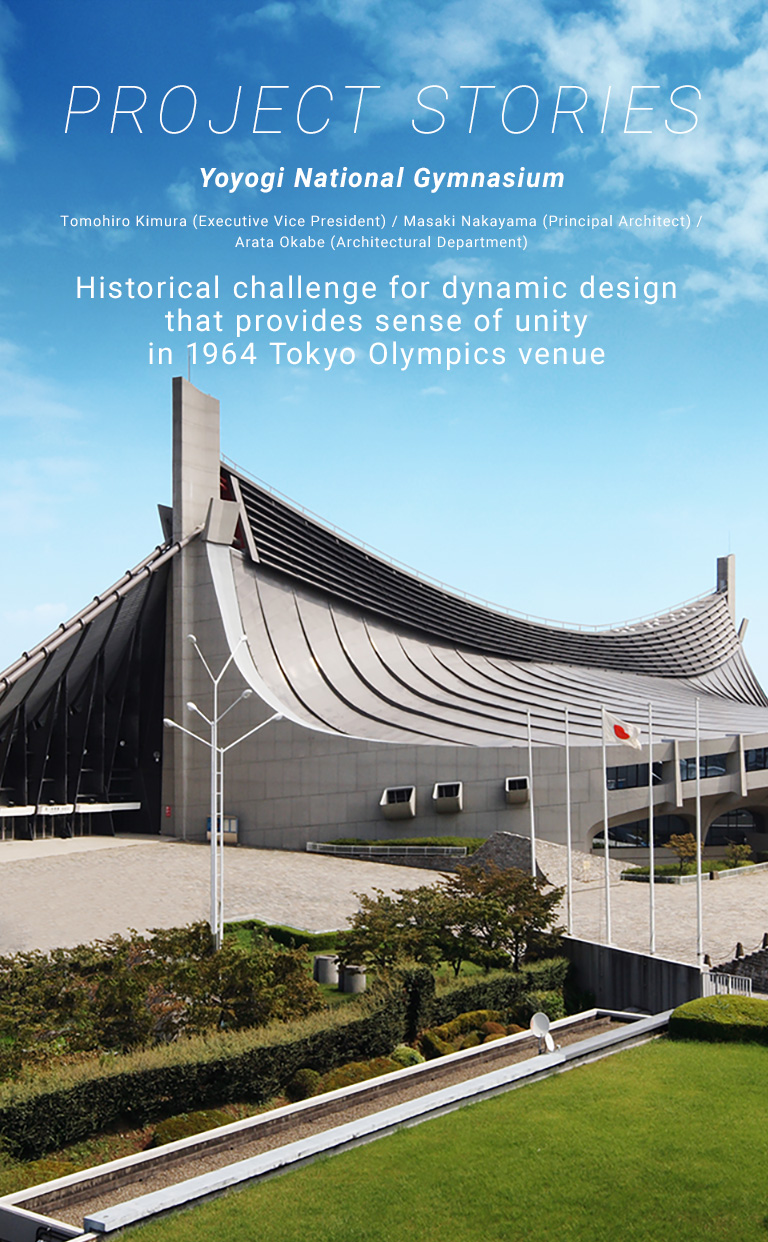
Paul Noritake Tange has a very distinguished pedigree. His education alone deserves some mention: he has a master’s degree in Architecture from the Harvard University Graduate School of Design. But then, it might all be a matter of genetics: his father was Kenzo Tange, the designer of the Hiroshima Peace Memorial, winner of the Pritzker Prize for Architecture, and designer of Japan’s Yoyogi National Gymnasium. His son Paul, who delivered a presentation for Philippine audiences on Sept. 7, meanwhile, designed the Tokyo Aquatics Center for the 2020 Tokyo Olympics — two Olympic structures then stand in the same city, from different generations of the same family.

Mr. Tange appeared in a Zoom meeting to introduce his project, the Grand Midori Ortigas, a two-tower condominium with over 908 housing units build by Federal Land Inc. in a forum titled “Japanese Architecture: The Synergy of Culture and Design.” Mr. Tange recalled meeting Federal Land Chair Alfred Ty as a young man. “We carry on the legacy of important fathers,” said Mr. Tange, speaking about the late Metrobank founder George Ty, Alfred’s father.

The story of fathers and legacy ran deep in the forum. Mr. Tange recalled his joy on being approached to design the 2020 Tokyo Aquatics Center. “I personally was very happy, because we have tried, before getting to 2020 — we tried for the Olympic village for the Beijing Olympics (2008).” His father, who died in 2005, was still alive during the planning stages. “I thought it would be nice to report to my father — he was already sick in bed at that time — to let him know that we are good enough to design another Olympic venue. Unfortunately, that did not happen.”

Since being approached by the 2020 Aquatics Center Commission, as well as seeing the building finished and put to use, Mr. Tange said, “I have visited my father’s resting place and reported to him. ‘Here we are. This is a building that we have designed’.”

The Grand Midori in Ortigas follows a motif of a series of weaves and screens, typical of Japanese architecture. Screens are a leitmotif of Mr. Tange’s work, appearing as well at the Tokyo Aquatics Cener. “These are the very fine Japanese details: sensitive and very fine. Even though the building is very large, you don’t feel it is very large,” he said, speaking about the Aquatics Center, which also takes its cues from images of Japanese bamboo forests.

“We try to interpret Japanese culture in modern style. We cannot use typical temple architecture in modern architecture. What we do is we try to understand, interpret Japanese culture into architecture to create something modern and new. This is what we consider our mission,” he said.

Take into account his father’s 1964 Olympics venue, the Yoyogi National Gymnasium. He took inspiration from big Japanese roofs. Inside, the senior Tange used suspension structures usually used for bridges to create a venue seemingly without columns, so audiences on both sides can see and “feel” each other. “The whole idea was to share the energy of people underneath.”

For the 2020 Aquatics Center, he maintained the same seamless relationship between athlete and spectator by, again, eliminating columns that would impede the view of the audience. “Everybody shared one space — united space.”

In designing the swimming pool, he interviewed Olympic swimmers “to find out what is considered a good swimming pool.” Apparently, domed ceilings are out of the question. “It’s important to have a straight line,” he said. “Dome-like space is no good. People will get confused, and you will lose time.” While he designed the ceiling of the Aquatics Center to have origami-like motifs, he thought it important for straight lines to be present, in order to serve as a guide to swimmers. “We’re talking one-hundredths of a second; one-thousandths of a second.”

On his own Olympic venue, he said, “It’s a different interpretation, but I’m a good son. I learned from my father and I continue. I think that’s a good thing about Asian culture. We learn from the generation before and we carry on.” — Joseph L. Garcia

MrSpeedy is now Borzo

PHOTO FROM BORZO

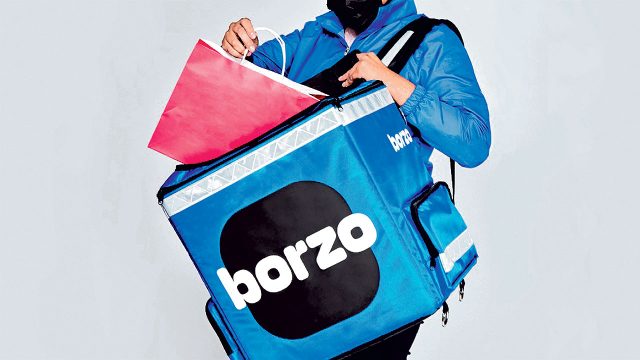
SAME-DAY DELIVERY service MrSpeedy recently changed its name to Borzo — patterned after the global brand that has already been proven effective in its fast and cost-efficient delivery services.

As the demand for fast and hassle-free delivery continues to grow in the country, MrSpeedy Philippines has rebranded into Borzo — a marque that is already in 10 countries. Now, Borzo also continues to build on the reputation that MrSpeedy has established over several years.

Borzo can be accessed through
borzodelivery.com/ph. The company assures “fast and flexible intra-city delivery with any route, with any transport, and with any weight or size.” Customers can also easily access the 10 countries or wherever Borzo is present, with just a single app to download.

Said Borzo Philippines Marketing Manager Beatrice Puyot, “MrSpeedy is a trusted name in the Philippines. With the global direction to unify its name into Borzo, it intends to bring a world-class caliber to the local courier delivery business. Because of the ongoing pandemic, people heavily rely in transporting their products through dependable and trusted services, and we aim to fulfill their needs and expectations.”

Guided by the company’s tagline “Borzo, pabor sa ‘yo,” Borzo aims to address the pressing needs of its fast-growing range of clients in more areas in the Philippines. “It’s not just a change in our brand name, but also a way to show customers and delivery partners that we are offering improved services and connections through our platforms,” Ms. Puyot added. “Though Borzo Philippines is part of the growing Borzo global brand, we also commit to sustaining services adapted and tailor-fit to Filipinos in Luzon, Visayas, or Mindanao.”

Founded in 2012, Borzo is an international same-day delivery service brand that is also in Brazil, India, Indonesia, Korea, Malaysia, Mexico, Russia, Turkey, and Vietnam. In all the countries Borzo is in, customers may easily request a delivery service on the Borzo website or on its easy-to-use app. Borzo has a rapidly expanding customer base of two million users now, with 75% comprised of small- and medium-sized businesses. With more than 2.5 million couriers, the same-day delivery company has up to three million orders filled every month.

“We at Borzo always believed that on-demand delivery will become a new normal as it is beneficial for all parties involved and access to service via single app or API, we’re glad it’s happening,” said its founder and CEO Mike Alexandrovski. Customers may book their deliveries and download the app at borzodelivery.com/ph.

Thailand legalizing opioid-like herb spurs rush of online sales

REUTERS

ENTREPRENEUR Sittichai Komam didn’t waste time once Thailand in late August decriminalized kratom, a coffee-like plant native to Southeast Asia that can give users a mild high. Within hours, Sittichai was on Facebook selling freshly picked kratom leaves, sourced from his neighborhood in southern Thailand, to local consumers.

Popular in the US, where advocates say it’s an opioid alternative but critics say it’s a dangerous drug, kratom is the latest herb the Thai government has legalized for production. Though producers can only sell domestically for now, Thailand has plans to allow exports, potentially enabling local dealers to become suppliers to the US, the world’s most lucrative market.

“A lot of the older villagers kept kratom trees to harvest and eat its leaves,” Sittichai, 31, said. “After it became legal, I started collecting and buying the leaves to help them earn extra income.”

Already, the domestic response has been overwhelming: One week after Sittichai launched, he stopped advertising because Thai orders were coming in faster than villagers could harvest the crop.

Still, Thai consumers have many options on social media platforms like Facebook or e-commerce outlets like Sea Ltd.-backed Shopee, where hundreds of new posts offer stacks of fresh leaves for roughly 100 baht ($3.09) per 100 grams.

Thailand removed kratom from the narcotics list on Aug. 24 and on Sept. 8 lawmakers passed a draft law to allow kratom imports and exports. The moves followed easing of rules against cannabis and hemp.

BEHIND INDONESIA
Thailand lags Indonesia as a producer of the coffee-like shrub, which has leaves that, advocates say, can kill pain, boost energy and treat depression and high blood pressure. Thailand had banned its cultivation, consumption or sale, and people convicted of possessing any part of the plant faced hefty fines and lengthy prison sentences.

Thailand’s local kratom market could be worth 600 million baht by next year, based on assumptions that the sector will be smaller than the hemp industry, according to Chaiwat Sowcharoensuk, an analyst at Krungsri Research. Once Thailand announces rules to regulate trade and large-scale companies join the green rush, though, the export market could be significantly larger, he said.

“Decriminalization will not only benefit farmers but will create a whole new supply chain from upstream to downstream and will likely attract operators looking to turn it into beverages, health supplements and cosmetics,” Chaiwat said.

US MARKET
The biggest potential export market is the US, where online dealers now sell Indonesian-sourced kratom powder and other products to consumers looking for alternatives to opioids. The US market is estimated to be valued at more than $1 billion annually, with 11 million to 15 million users, according to the American Kratom Association, which based its valuation on imports from Indonesia.

“We expect that the legalization of kratom in Thailand will lead to more acceptance of this botanical, and, in turn, reasonable regulations for growing and processing in the countries where kratom is cultivated,” said Jenn Lauder, director of marketing and advocacy at Kraken Kratom, an Oregon-based vendor that sells products from strains local to Indonesia and Thailand.

“This means that companies in the US could have greater control over their supply chains, including seed-to-sale tracking and quality assurance standards that start at the source, and more consistent raw plant materials,” she added.

The timing of liberalization is awkward. The World Health Organization’s Expert Committee on Drug Dependence, which evaluates the potential harm of psychoactive substances, next month will begin what it calls a pre-review of kratom, the first step in a process that could lead to tighter controls.

In the US, the Food and Drug Administration has warned consumers about kratom. “There is substantial concern regarding the safety of kratom, the risk it may pose to public health and its potential for abuse,” Judy McMeekin, the FDA’s Associate Commissioner for Regulatory Affairs, said in a May statement.

Advocates say criticism is unfair. “Kratom may be much more beneficial than harmful to society and if properly regulated can help with certain addictions, help those struggling with acute and chronic pain, and offer those who are trapped in the opioid addiction cycle a safe path away from that,” said Mac Haddow, senior fellow on public policy at the American Kratom Association.

In Thailand, decriminalization is getting good reviews from people like Phatcharaphon Thupaphong, a 47-year-old caddie who chews kratom to get an energy boost while working under the tropical sun.

“Before it became legal, I’d have to hide the leaves under my car seat and they’d shrivel from the heat by the time I got home,” she said. “Now I don’t have to worry.” — Bloomberg


Yields on government debt end flat

YIELDS on government securities (GS) moved sideways last week on faster-than-expected August inflation data and after the government deferred its implementation of targeted lockdowns.

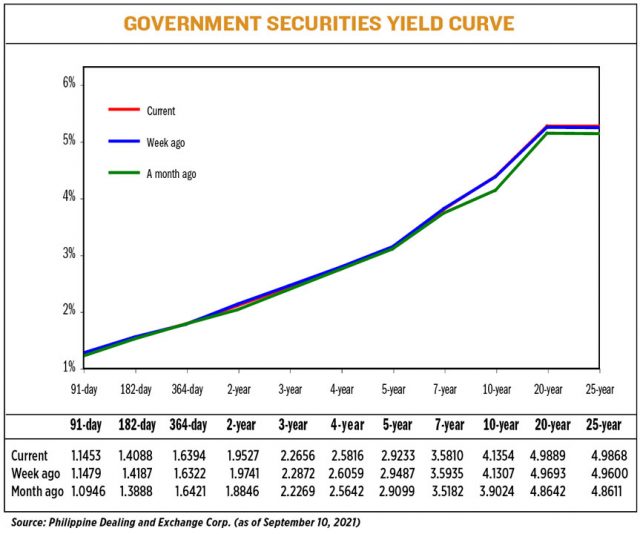
GS yields in the secondary market inched down by 0.54 basis point (bp) on average week on week, based on the PHP Bloomberg Valuation (BVAL) Service Reference Rates as of Sept. 10 as published on the Philippine Dealing System’s website.

Yields on Treasury bills (T-bill) ended mixed last Friday. The rates of the 91- and 182-day papers fell by 0.26 bp and 0.99 bp to fetch 1.1453% and 1.4088%, respectively. On the other hand, the yield on the 364-day T-bill inched up by 0.72 bp to 1.6394%.

Meanwhile, the belly of the curve edged lower as yields on the two-, three-, four-, five-, and seven-year Treasury bonds (T-bonds) fell by 2.14 bps (to 1.9527%), 2.16 bps (2.2656%), 2.43 bps (2.5816%), 2.54 bps (2.9233%) and 1.25 bps (3.581%), respectively.

Rates on the high end of the curve inched higher. The 10-year debt saw its yield rise by 0.47 bp to 4.1354%, while the 20-year paper climbed 1.96 bps to 4.9889%. The 25-year T-bond also added 2.68 bps to yield 4.9868%.

Security Bank Corp. Chief Investment Officer for Trust and Asset Management Group Noel S. Reyes said last week’s average yield movement was “small” as changes in rates were minimal due to data showing faster-than-expected inflation in August and as the government delayed its plan to implement granular lockdowns instead of region-wide quarantine measures to gradually reopen the economy.

A bond trader said last week’s yields ended firmer than the previous week even as the August inflation print was at higher end of the expected range.

“Market seemed to focus more on BSP’s (Bangko Sentral ng Pilipinas) post CPI (consumer price index) statements, where they mentioned that the policy stance will remain as long as economy remains fragile,” the bond trader said in a Viber message.

Rising food and utilities prices pushed August inflation to 4.9%, the fastest pace seen in more than two years. This was higher than the BusinessWorld median estimate of 4.4% and was at the upper end of the central bank’s 4.1-4.9% estimate for the month.

Inflation averaged at 4.4% in the first eight months, beyond the BSP’s 2-4% target band and 4.1% forecast for this year.

The central bank last week said it will maintain its accommodative monetary stance “for as long as necessary” to support the economy as long as inflation stays within expectations.

Meanwhile, government officials on Sept. 7 said National Capital Region (NCR) will remain under modified enhanced community quarantine until Sept. 15, backtracking from an earlier decision to put NCR under general community quarantine to be accompanied by an alert level system.

For this week, the bond trader sees local yields moving sideways with a downward bias, especially for tenors of seven years and below, “while market will likely be cautious ahead of the 10-year auction.”

The Bureau of the Treasury will offer P35 billion in reissued 10-year papers with remaining life of nine years and 10 months on Tuesday.

Meanwhile, Mr. Reyes said yields will be range-bound this week as liquidity and movement could remain the same due to the lack of catalysts. — A.O.A. Tirona

Style (09/13/21)

Rustan’s holds lingerie sale

FOR the whole month of September, Rustan’s offers up to 20% off on selected items from Hanes, Maidenform, Luna, Permanent Weekend, Spanx, Triumph, and Wacoal. Luna offers sleepwear choices that provide comfort for lounging or sleeping, with vibrant designs that help level up one’s style. For something more plain but still comfy, Permanent Weekend has a wide range of choices. There are the Pointelle Knit Scoop Tank and Tap Pants for a chill weekend, while the slip dress can elevate one’s mood. Maidenform shapewear offers a luxurious and superior fit. Triumph Fit Smart and Zero Feel selections are must-haves for pro-active individuals. Meanwhile, the Spanx Bra-llelujah offers added support without compromising comfort. For craftsmanship and superior fit, check out the sets at Wacoal, with styles in new hues sold in packs or by pair. To shop at Rustan’s, one may opt to use the personal shopper service by calling the Personal Shopper On-Call hotline, 0917-111-1952, from 10 a.m. to 6 p.m. Fulfilled orders can be collected via curbside pick-up or items can be delivered for free, for a minimum purchase requirement of P5,000.

New fragrances from Avon

IN CELEBRATION of its 43rd anniversary in the Philippines, Avon is unveiling the newest addition to Imari — its original line of sensual fragrances — with Imari Rouge, “its most daring fragrance to date,” according to a company release. “Each spray is designed to elevate one’s sensuality and pushes you to go after what you want with an unquestionable attitude and drive.” This Chypre-Oriental fragrance greets with top notes made from rich mandarin, dainty pink peppercorn, and upcycled apple oil. The scent later reveals a soulful mix of rose, iris, and peach accord. Finally, the base notes are made from Indonesian patchouli, benzoin, and warm notes of vanilla. Check out the whole Imari collection and more at avonshop.ph.

Rustan’s Beauty Addict sale is on

RUSTAN’S annual Beauty Addict event is a bit more restrained this year, and has a different trajectory, considering the times. In line with the theme “Transcend,” Rustan’s The Beauty Source is placing a focus on “Looking Good, Thinking Good, Feeling Good, and Doing Good.” What was once a month of scoring beauty deals is now a series of talks throughout the month (the beauty deals are still there). The next talk will be on Sept. 15, with Tatler Homes editor-in-chief Stephanie Zubiri preparing a healthy recipe and beauty tips (from inside out), via her Instagram account (@stephanizezubiri) to promote Rustan’s Feel & Do Good campaign. As for the scoring deals on beauty products, exclusive offers await Beauty Addict members for the rest of the month (and beyond). From Sept. 1 to Nov. 30, get a Viajecito Splashkit Sport Set for a minimum purchase of P20,000, and enjoy up to five times more points on all purchases in all Rustan’s Stores and through the Personal Shopper on Call program from Sept. 11-30. Be a member (and thus, an official Beauty Addict), for any purchase — no minimum amount — and get +50 points when you download the Beauty Addict mobile app. Meanwhile, The Beauty Addict Raffle promo will run from Sept. 3 to Oct. 31. For every purchase of P2,500, the customer is entitled to one electronic raffle entry for a chance to win either Rustan’s Sporty Street Clothing vouchers worth P15,000 from The North Face, Columbia, and Champion and a Rustan’s The Beauty Source Gift Box.; Rustan’s Casual Chic Clothing; Miyuki Side Tie Overlap Dress from Lady Rustan and a limited-edition Twilly d’Hermès Gift Set, or the grand prize: a Rustan’s The Beauty Source shopping spree worth P50,000. Join Rustan’s Viber Community and get the latest updates on beauty essentials, events, special offers and more (bit.ly/RTBSonViber).

Bally appoints Johnny Huang as Chinese Brand Ambassador

BALLY has officially appointed Chinese actor Johnny Huang as its new Brand Ambassador. “Huang’s role will reinterpret the Swiss luxury brand’s pioneering spirit and reverence for art, and nature, while espousing his confidence and strong personal style with understated elegance and edge,” the brand said in a release. Bally, which entered the Chinese market in 1986,  says the actor “will engage China’s younger generation, captured through his large following of 20 million on Weibo, building upon Bally’s robust retail network and digital ecosystem, with a presence in the Chinese mainland of 60 stores and e-commerce through its Bally.cn and WeChat Mini-Program as well as Tmall and JD.” Mr. Huang will be the face of Bally’s Autumn/Winter 2021 and Spring/Summer 2022 seasonal campaigns, and join regional festivity campaigns such as Chinese Valentine’s Day. The Autumn/Winter 2021 campaign is presented together with Mr. Huang alongside supermodel Zhao Jiali, and introduces Bally’s Legacy Continua collection.

Investors to monitor lockdown implementation

BW FILE PHOTO

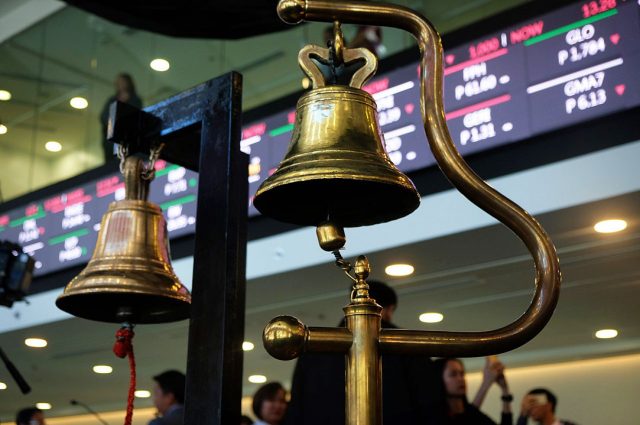
STOCKS may move sideways this week as investors monitor the government’s implementation of targeted lockdowns, which are meant to curb rising coronavirus disease 2019 (COVID-19) infections while boosting economic activity.

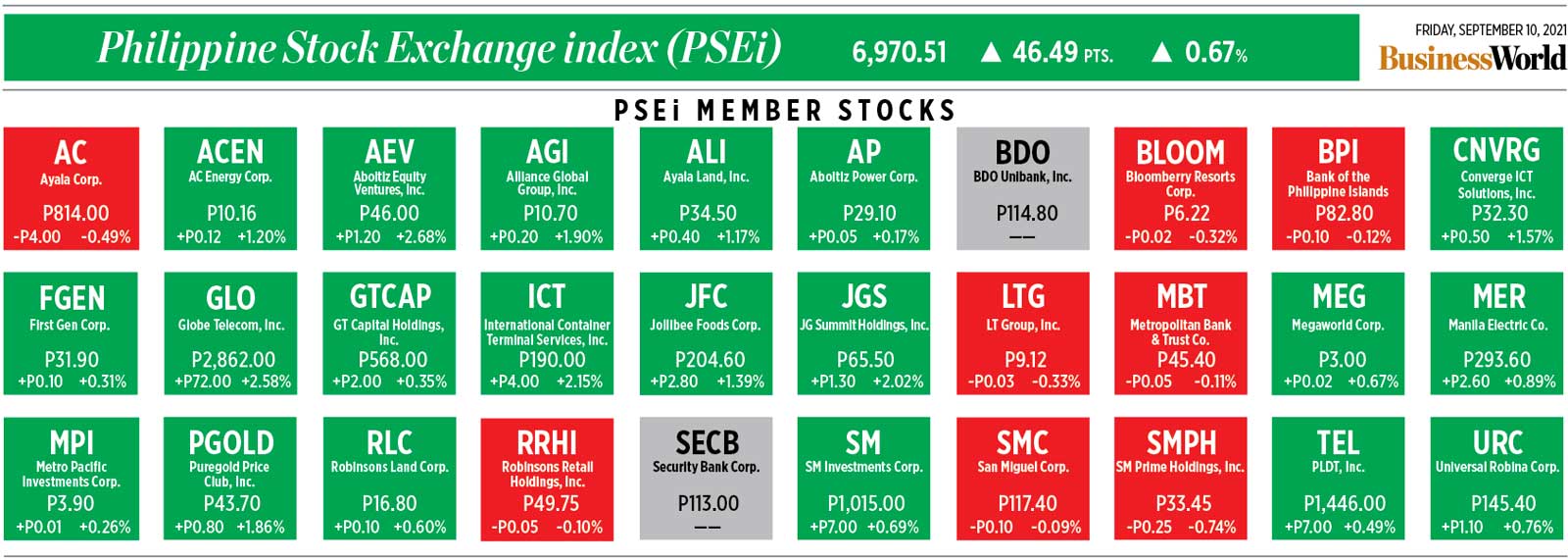
The bellwether Philippine Stock Exchange index (PSEi) climbed 46.49 points or 0.67% to close at 6,970.51 on Friday, while the all shares index went up by 22 points or 0.51% to 4,302.79.

Week on week, the benchmark index gained 73.38 points from its 6,897.13 finish on Sept. 3.

“The market started the week on a good note as investors cheered over the positive jobless report for the month of July, shrugging off worries over the acceleration seen in our inflation rate for the month of August,” Timson Securities, Inc. Trader Darren Blaine T. Pangan said in a Viber message on Saturday.

Preliminary results of the Philippine Statistics Authority’s (PSA) monthly Labor Force Survey released on Wednesday showed the number of unemployed Filipinos decreased to 3.073 million or 6.9% in July from the previous month’s 3.764 million or 7.7% jobless Filipinos. This is also less than the 4.569 million or 10% jobless Filipinos recorded in July last year.

Meanwhile, inflation rose 4.9% in August from the 4% in July, the PSA reported on Tuesday.

“The PSEi also gained after [the] IATF-EID (Inter-Agency Task Force for the Management of Emerging Infectious Diseases) provisionally approved the guidelines on the pilot implementation of Alert Level System on COVID-19 response in the transition towards more localized or granular lockdown in [the] NCR (National Capital Region) initially with target implementation on September 16,” Rizal Commercial Banking Corp. Chief Economist Michael L. Ricafort said in an e-mail on Friday.

Metro Manila is under modified enhanced community quarantine until Sept. 15. After this, it will transition to granular lockdowns, which will be implemented until the end of the month. These targeted lockdowns are meant to curb infections without sacrificing economic activity.

“Potential catalysts that may affect the market’s performance [this] week include how the government goes about with the implementation of the granular lockdowns in the capital region,” Timson Securities’ Mr. Pangan said. “7,000 seems to be the nearest resistance area, with 6,780 being the closest support area.”

“Investors may also be staying tuned to how RCR (RL Commercial REIT, Inc.) will perform upon listing date,” Mr. Pangan added.

RCR is the real estate investment trust (REIT) unit sponsored by Robinsons Land Corp., which is set to list at the stock exchange on Tuesday, Sept. 14. It is offering 3,342,864,000 common shares for P6.45 apiece, with an overallotment option of up to 305,103,000 shares.

RCR is expected to raise up to P23.53 billion in proceeds. Upon listing, it will be the third REIT to make its debut this year and RCR will be the fourth REIT listed on the Philippine Stock Exchange. — K.C.G. Valmonte

Which regions received the most investment commitments in the first half?

Which regions received the most investment commitments in the first half?

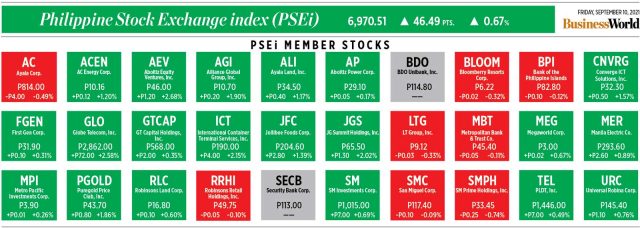
How PSEi member stocks performed — September 10, 2021

Here’s a quick glance at how PSEi stocks fared on Friday, September 10, 2021.