Home Blog Page 6970

Evergrande wooed retail investors with Gucci bags, Dyson appliances

SHANGHAI – Lured by the promise of yields approaching 12%, gifts such as Dyson air purifiers and Gucci bags, and the guarantee of China’s top-selling developer, tens of thousands of investors bought wealth management products through China Evergrande Group.

Now, many fear they may never get their investments back after the cash-strapped property developer recently stopped repaying some investors and set off global alarm bells over its massive debt.

Some have been protesting at Evergrande offices, refusing to accept the company’s plan to provide payment with discounted apartments, offices, stores and parking units, which it began to implement on Saturday.

“I bought from the property managers after seeing the ad in the elevator, as I trusted Evergrande for being a Fortune Global 500 company,” said the owner of an Evergrande property in the conglomerate’s home province of Guangdong surnamed Du.

“It’s immoral of Evergrande not to pay my hard-earned money back,” said the investor, who had put 650,000 yuan ($100,533) into Evergrande wealth management products (WMPs) last year at an interest rate of more than 7%.

More than 80,000 people – including employees, their families and friends as well as owners of Evergrande properties – bought WMPs that raised more than 100 billion yuan in the past five years, said a sales manager of Evergrande Wealth, launched in 2016 as a peer-to-peer (P2) online lending platform that originally was used to fund its property projects.

Some 40 billion yuan of the investments are outstanding, said the person, declining to be named as they were not authorized to speak with the media.

China Evergrande did not respond to a request for comment on Tuesday, which was a public holiday in China.

With more than $300 billion in debt, Evergrande’s liquidity crisis rattled global markets this week. The company has vowed to repay WMP investors.

CHRISTMAS PROMOTION

China’s years-long effort to deleverage its economy has pushed companies to resort to off-balance sheet investments in search of funding.

After Beijing further capped debt levels of property developers last year, the most indebted players like Evergrande felt even more pressure to find new sources of capital to ease mounting liquidity stress, turning to employees, suppliers and clients for cash through commercial paper, trust and wealth management products.

Evergrande Wealth started to sell WMPs to individuals in 2019 after a regulatory crackdown led to a collapse of the P2P lending sector, said the sales manager and another Evergrande employee who bought the WMPs.

To attract investors, the sales manager offered gifts such as Dyson air purifiers and Gucci handbags to each person who bought more than 3 million yuan of WMPs during a Christmas promotion last year.

A product leaflet provided by the sales manager seen by Reuters showed the WMPs are categorised as fixed-income products suitable for “conservative investors seeking steady returns”.

‘DE-FACTO EVERGRANDE PRODUCT’

In two products sold last November, a construction company in Qingdao was looking to raise up to 10 million yuan with annualised yield of 7% in one and 20 million yuan with yields ranging from 7.8% to 9.5%, depending on the investment size, in another. Minimum investments were 100,000 yuan and 300,000 yuan, respectively.

Evergrande also usually offers additional yield up to 1.8% to certain investors, which can push returns to above 11% for a 12-month investment, said the sales manager.

Proceeds were to be used for Qingdao Lvye International Construction Co’s working capital, the documents showed. The firm could not be reached for comment during a public holiday.

Repayment would either come from the issuer’s income or from Evergrande Internet Information Service (Shenzhen) Co, a subsidiary that runs Evergrande Wealth and promises to cover the principal and interest if an issuer fails to repay, the prospectus said.

The sales manager said the Qingdao company was working on Evergrande projects and would use the payment from Evergrande upon completion to repay investors.

“It’s a de-facto Evergrande product,” the person said.

Other highly leveraged Chinese conglomerates including HNA Group, which declared bankruptcy early this year, and China Baoneng have used similar products.

In a petition to various government bodies, a group of WMP investors in Guangdong accused Evergrande of inappropriately using money that should have gone to the issuers to fund its own projects, and not sufficiently disclosing the risks.

They also complained that they were misled by the stature of its chairman, Hui Ka-yan, noting that he was seated prominently during a 2019 celebration of the 70th anniversary of the founding of the People’s Republic of China.

“The investors trusted Evergrande and bought Evergrande’s WMPs out of our love for and faith in the Party and government,” they wrote. — Reuters

McDonald’s Happy Meal toys to go green globally by 2025

McDonald’s Corp said on Tuesday it will drastically cut the use of plastic in the more than 1 billion children’s toys it sells globally each year by the end of 2025.

The change involves swapping out a plastic figurine of Batman, for example, for one made with a dozen cardboard pieces that kids can put together themselves.

More toys will also be made from recycled or plant-based plastics, McDonald’s said. The changes will allow the Chicago-based company to cut its use of virgin fossil fuel-based plastic for Happy Meals by 90% compared with 2018.

McDonald’s is one of many restaurant chains aiming to reduce environmental harm from packaging and other products.

Burger King, a unit of Restaurant Brands International Inc , said in 2019 that it would stop giving out free plastic toys and that customers could return existing ones to be melted down and used as trays and other items.

Stephanie Feldstein, population and sustainability director at the Center for Biological Diversity, said in a statement that if McDonald’s really wanted to be more sustainable it should reduce the amount of beef it serves and “stop nibbling around the edges of sustainability.”

McDonald’s, which started selling Happy Meals in 1979, shifted to more sustainable toys in the UK, Ireland and France in 2018.

Some similar toys will soon make their way to the more than 100 other countries where Happy Meals are sold.

In the United States, McDonald’s is already using some sustainable toys, including books and Pokemon collectible cards.

More such toys will hit the U.S. market in January, said Amy Murray, vice president of global marketing enablement. The revamped Happy Meals will not cost franchisees more money, she said. — Reuters

Celebrity mayor eyes Philippine presidency, challenging Duterte

Manila Mayor Francisco "Isko" Moreno Domagoso / Photo by Edd Gumban, Philippine Star

The movie star turned mayor of Manila declared his candidacy for the Philippine presidency in next year’s elections, posing the biggest challenge to President Rodrigo Duterte’s plans to extend his hold on power.

Manila Mayor Francisco “Isko” Moreno Domagoso, 46, said on Wednesday he will soon unveil his platform, but pledged to expand his pandemic response and projects for the poor in the capital on a national level. He also said he will appoint officials outside his circle and encourage millennials to join a “government of national reconciliation.”

“The road to recovery will be hard, the journey long, the challenges complex,” Moreno said in a speech declaring his presidential bid. “There is no magic wand that will make our problems go away, only hard work will.”

Moreno has picked cardiologist Willie Ong as a running mate, his political strategist Lito Banayo said in an earlier interview with ABS-CBN News Channel.

The Manila mayor’s entrance heats up a crowded presidential race as he is the nearest rival to Duterte’s daughter, Sara, in a presidential preference survey carried out in June. While Duterte’s daughter has since said she will no longer seek the presidency in next year’s elections, her father accepted his party’s vice-presidential nomination with his aide-turned-senator Christopher “Bong” Go as a potential presidential candidate.

Moreno was a garbage collector before becoming a movie teen star in the 1990s. He later entered Manila politics as a city councilor and eventually became its vice-mayor. Rivals have often tried to use Moreno’s sexy photos from his showbiz career to cast doubt on his character, but Moreno has been candid about his past and often talks about how his impoverished childhood in Manila gives him perspective in governing the city.

In a sign of increasing rivalry, Duterte in August mocked a mayor who has “bikini” photos, without naming Moreno. Duterte himself appointed the former movie star as the social welfare undersecretary in 2018 before Moreno resigned a year later to seek the top post in Manila, which he won.

Moreno is now the third politician to confirm joining next year’s presidential race. Aside from him, boxer-turned-senator Manny Pacquiao, who is from the same ruling party as Duterte, launched his bid over the weekend, while Senator Panfilo Lacson declared his run earlier this month.

The son of late dictator Ferdinand Marcos has said he’s eyeing a national post in the 2022 elections. — Bloomberg

US to donate an additional 500 million COVID-19 vaccines

Handout

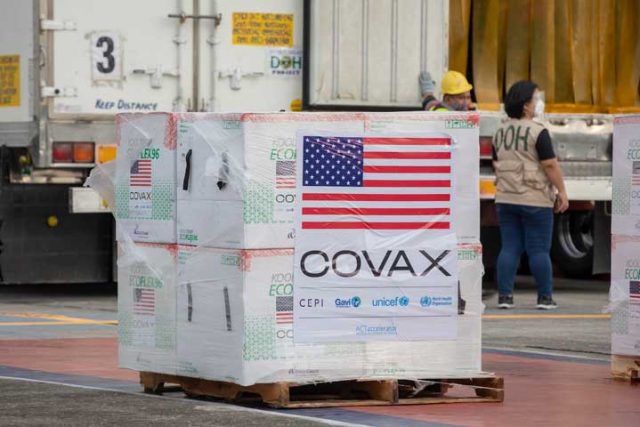
WASHINGTON – The United States plans to donate an additional 500 million COVID-19 vaccines made by Pfizer Inc and BioNTech SE to nations around the world, lifting the total the country is sharing to more than 1 billion doses, according to a source familiar with the plans.

President Joe Biden is hosting a virtual summit on COVID-19 on Wednesday and is likely to announce the new pledge then.

Earlier on Tuesday, Biden told the United Nations General Assembly that the United States had put more than $15 billion toward the global response to COVID-19 in order to fund more than 160 million COVID-19 vaccines in other countries.

The U.S. has already purchased 500 million doses of the Pfizer/BioNTech vaccine and donated them through the global vaccine-sharing platform COVAX.

Vaccines have already landed in 100 countries, Biden said, adding he would announce additional commitments on Wednesday at the U.S.-hosted global COVID-19 summit.

The United States is pushing global leaders to endorse its targets for ending the COVID-19 pandemic, including ensuring 70% of the world’s population is vaccinated by this time in 2022, according to a draft U.S. document viewed by Reuters.

Chinese leader Xi Jinping reiterated on Tuesday in a speech to the UNGA that China aims to provide 2 billion COVID-19 vaccine doses to the world by the end of the year.

Philippine President Rodrigo Duterte and Indonesian Foreign Minister Retno Marsudi were critical of plans by rich countries to provide booster shots when so many people in the developing world are unvaccinated.

“Rich countries hoard life-saving vaccines, while poor nations wait for a trickle,” Duterte said in his address to the General Assembly. “They now talk of booster shots, while developing countries consider half-doses just to get by.

“This is shocking beyond belief,” he said, stressing the pandemic will not end unless the virus is defeated everywhere.

Speaking to the Asia Society think tank, Marsudi emphasized restrictions on the export of materials to make vaccines must end, saying “access to safe and affordable vaccines is critical.”

U.S. regulators could authorize a booster shot of the Pfizer/BioNTech vaccine for older and some high-risk Americans this week, in time for the government to roll them out by Friday.

The U.S. Food and Drug Administration is expected to give the nod to the third shots for at least this group before advisers to the U.S. Centers for Disease Control and Prevention are due to meet on Wednesday.

As the gap widens between vaccinations in wealthy and poor countries, the World Health Organization has repeatedly implored the United States and other wealthy countries to hold off on plans to offer boosters and to use those doses to help inoculate the many people worldwide who have yet to receive their first shots. — Reuters

Duterte vows accountability for anyone who went ‘beyond bounds’ in drug war

REUTERS

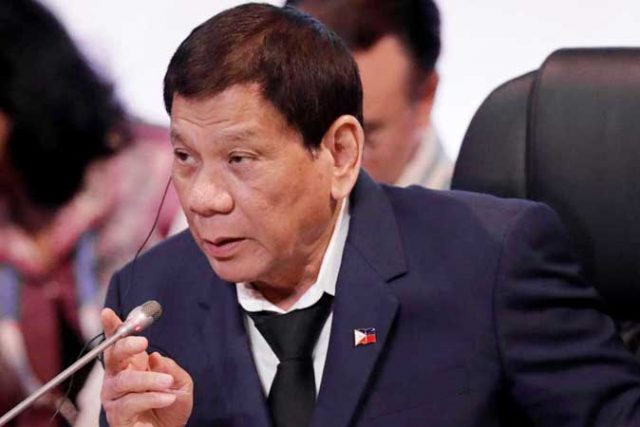
UNITED NATIONS – Philippines President Rodrigo Duterte said on Tuesday that anyone found to have “acted beyond bounds” in his campaign against illegal drugs would be held accountable under national laws, while appearing to reject an International Criminal Court probe.

Duterte told the United Nations General Assembly he had instructed the Philippines Justice Department and police to review the conduct of the campaign, in which more than 6,100 suspected drug dealers and users have been killed since he took office in June 2016.

“Those found to have acted beyond bounds during operations shall be made accountable before our laws,” Duterte said in a video address to the annual gathering.

Duterte made no mention of a formal investigation into possible crimes against humanity, which was approved by judges from the International Criminal Court last week, although he appeared to reject outside interference in human rights issues.

“We have recently finalized with the United Nations our Joint Program on Human Rights. This is a model for constructive engagement between a sovereign Member State and the United Nations,” he said.

“Meaningful change, to be enduring, must come from within. The imposition of one’s will over another – no matter how noble the intent – has never worked in the past. And it never will in the future.”

Duterte’s government said last week it will not cooperate with the ICC or allow any investigators into the Philippines. Duterte and his police chiefs have said the killings were in self-defense and his government has insisted the ICC has no right to meddle in the country’s affairs.

Rights groups say Duterte personally incited deadly violence in the drug war and accuse police of murdering unarmed suspects on a massive scale. Rights group say the police summarily executed suspects, which the policy deny.

In February, the Philippine police said they were looking into a government review of the killings after the justice minister made an unprecedented admission to the United Nations of widespread police failures. — Reuters

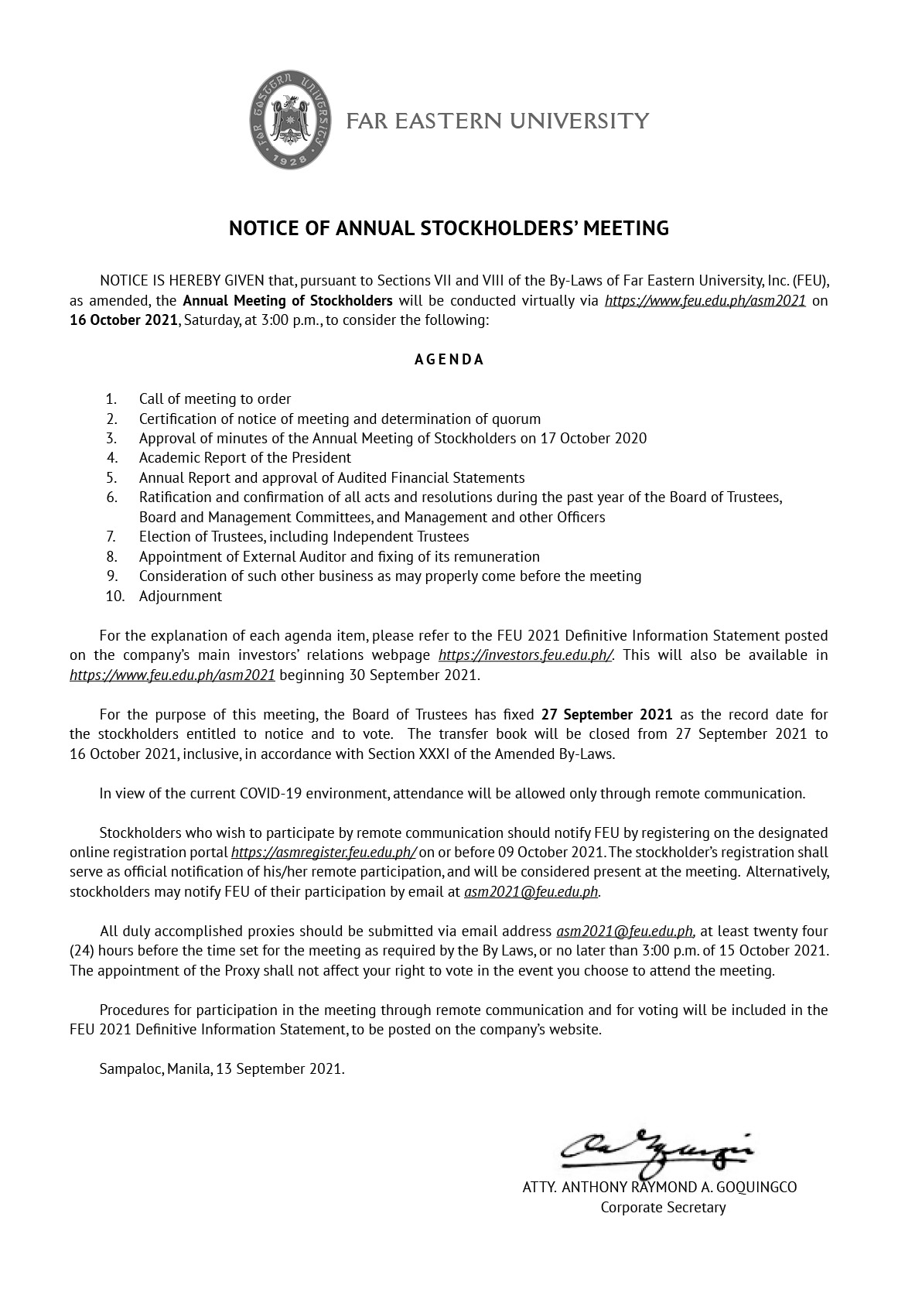
FEU to conduct virtual stockholders’ meet on October 16

The 2021 Annual Stockholders’ Meeting of Far Eastern University, Inc. (FEU) will be conducted virtually on October 16, 2021, at 3 p.m.

COVID’s economic cost to hit P41T

PHILIPPINE STAR/ MICHAEL VARCAS
Economists have warned of the possible “long-term economic scarring” for the Philippines if the pandemic drags on. — PHILIPPINE STAR/ MICHAEL VARCAS

THE TOTAL ECONOMIC cost of the coronavirus pandemic and lockdowns may reach P41 trillion over the next four decades, the National Economic and Development Authority (NEDA) said.

The economy is now expected to return to the pre-pandemic growth trend after 10 years, as consumption and investments will likely remain sluggish, according to the NEDA presentation obtained by BusinessWorld.

Socioeconomic Planning Secretary Karl Kendrick T. Chua said the cost of the pandemic and quarantines on society is estimated to have reached P4.321 trillion in 2020. This is measured through the net present value (NPV) terms, or the difference between the present value of inflows against the value of outflows for a certain period of time.

The economic cost of the pandemic is estimated to rise by another P37.044 trillion over the next 10 to 40 years in NPV terms, mainly due to the projected heavy losses in private investments and human capital gains.

In a Viber message on Tuesday, Mr. Chua said the 40-year period is equivalent to the average working life of a Filipino from age 22 to 62. He said NEDA conducted the study for six months starting January.

Mr. Chua in his presentation said the size of the Philippine economy may have grown by 9.5% to P21.4 trillion in 2020 had the COVID-19 pandemic not occurred. However, due to the pandemic, the size of the economy shrank by 8.1% to P17.9 trillion last year from P19.5 trillion in 2019.

“Consumption and investment will be lower in the next 10 years due to lower demand in sectors that require social distancing (e.g., amusement, tourism, restaurants, public transportation). Consequently, tax revenues will be lower,” Mr. Chua said in the presentation.

“After the 10th year, the economy is expected to converge to the pre-pandemic growth path,” he added.

Losses in private investments would have the biggest impact on present and future generations, followed by unrealized human capital investment gains and weak consumption, according to NEDA estimates.

“Foregone consumption and investments in 2020 will result in lower capital accumulation in the future… (This) will result in lower financial returns and lower economic benefits for the people,” NEDA said.

It attributed the decline in consumption and investments to social distancing rules, lackluster business and consumer confidence and rules that prevent children from going out.

The economy may miss out on P25.8 trillion in consumption, investments and returns over the next four decades, after already losing P3.92 trillion in 2020 due to the strict lockdowns. Foregone investments and returns alone would reach P21.33 trillion in 40 years.

“It may take 10 years to reach pre-COVID-19 trajectory,” Mr. Chua said.

Foregone tax revenues for the government could hit P1.206 trillion in a decade as it collects less income taxes from pandemic-hit companies and individuals and less sales taxes. In 2020 alone, foregone tax revenues reached P782 billion.

The Philippine economy also stands to lose heavily due to the severe impact of COVID-19 pandemic on human capital investments, particularly on education and the health sector.

NEDA estimated foregone income from human capital investment and returns could reach P15.528 trillion in NPV terms over the long run.

Two-thirds of the projected losses are mainly from the impact on the education sector. The Philippines has not allowed in-person classes since March 2020, although the government has approved a pilot test for face-to-face classes in low-risk areas.

“The estimated cost of face-to-face school closure is P11 trillion in lost wages over a 40-year period,” Mr. Chua said.

NEDA noted the estimated cost of COVID-19 and non-COVID-19 diseases will reach P4.5 trillion over a 40-year period. This includes foregone wages from premature deaths, lost productivity due to illnesses and additional medical expenses.

“Life expectancy in the Philippines before COVID-19 ranged from 71 years for males and 77 for females. This could be 1-4 years shorter based on international estimates… This results in forgone wages due to early deaths,” Mr. Chua said.

He said the health crisis may lead to lower productivity for the population as many people who recovered from COVID-19 still experience related health complications such as brain fog, weakness and respiratory damage, while some cannot still return to work in their full capacity due to the lack of treatment from other diseases.

The Philippines saw its steepest economic downturn in 2020, with gross domestic product contracting by 9.6%.

The economic team earlier slashed its growth target for 2021 to 4-5% from 6-7% amid strict lockdowns to curb a Delta-driven surge in COVID-19 cases.

Economists have warned of the possible “long-term economic scarring” for the Philippines if the crisis drags on. — Beatrice M. Laforga

PHL slips in global innovation report

REUTERS

THE PHILIPPINES slipped one spot to 51st place out of 132 economies on an annual list that measures innovation performance after the country’s information technology (IT) infrastructure scores sank.

The country’s performance in the Global Innovation Index (GII) 2021 had previously been improving drastically.

The index, which is prepared by Cornell University, INSEAD, and the World Intellectual Property Organization (WIPO), showed the Philippines reached its highest rank so far last year after it broke into the top 50. In 2019, the Philippines jumped 19 spots to 54th.

Philippines places 51<sup>st<sup> out of 132 economies in global innovation ranking

The index measures seven innovation pillars, in which the Philippines dropped 23 spots to 86 in the infrastructure category this year, after losing points in information and communications technology access and use, along with government online service and e-participation.

The Philippines improved its institutions ranking by one spot at 90th and improved under human capital and research (80th) along with knowledge and technology outputs (24th). The country retained its market sophistication rank at 86th.

However, its business sophistication (33rd) and creative outputs (65th) rankings also slipped this year.

Among the sub-pillars, the Philippines was strong in trade, diversification and market scale as well as both knowledge diffusion and absorption, which are measured in high-tech and ICT services exports and imports. The country’s lowest sub-pillar rankings include regulatory environment, general infrastructure, credit, and investment.

Science and Technology Secretary Fortunato T. de la Peña at a briefing on Tuesday said that he is hoping for the passage of the Science for Change Program (S4CP) bill, which backs research and development, to help improve the country’s ranking.

“We need to have policies to strengthen the pillars that we are weak in, namely investments. No matter how efficient we are in transforming our limited resources to Knowledge and Technology Outputs, there are limits if we still need more inputs,” he said.

According to the report, the Philippines is one of several middle-income economies that are “changing the innovation landscape,” naming the country an innovation achiever for the third straight year.

“Although it’s one position back, the high-level news we sent regards to the Philippines is extremely positive. Let’s make sure it’s not minus 5 or 10 slots next year,” WIPO Economics and Statistics Head Sacha Wunsch-Vincent said.

The Intellectual Property Office of the Philippines (IPOPHL) in a statement said a multi-sectoral task force should address the country’s innovation weak spots.

“We might not only reverse our GII ranking but also push the country further into an innovation frontier,” IPOPHL Director-General Rowel S. Barba said. — Jenina P. Ibañez with inputs from Brontë H. Lacsamana

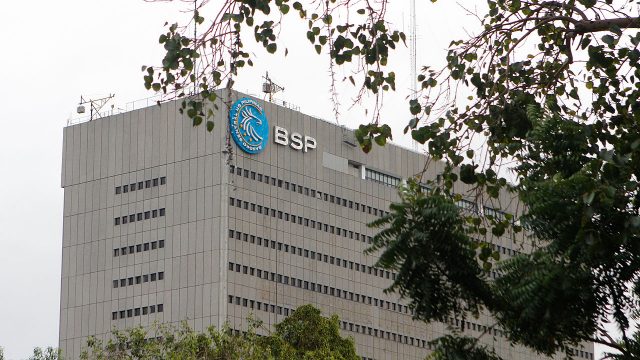
BSP regulations to support post-pandemic economy, Diokno says

THE BANGKO SENTRAL ng Pilipinas (BSP) said it will continue supporting the post-pandemic economy through enabling regulations that will encourage investments and infrastructure projects.

“On the part of the BSP, we support investment promotion through a regulatory environment that is welcoming to foreign investors and technological innovation,” BSP Governor Benjamin E. Diokno said in a speech for an event organized by London-based think tank Official Monetary and Financial Institutions Forum.

Central bank officials have said their sandbox approach to regulating digital financial firms allows them to be more flexible and open, rather than stifling potential players.

This is reflected in the BSP’s approval of three digital bank licenses to foreign entities — including Tonik Digital Bank, Inc. (Philippines) and UNObank which both have Singapore-headquartered parent units, and GoTyme which jointly is owned by the Gokongwei Group and Singapore fintech firm Tyme.

Mr. Diokno said government policies that will further liberalize the economy will also be key to making the Philippines “more investor-friendly” in a post-pandemic world.

These include the country’s participation in the Regional Comprehensive Economic Partnership (RCEP) among select Asia-Pacific economies and tax reforms like the Corporate Recovery and Tax Incentives for Enterprises (CREATE) law.

The Philippines signed the RCEP in November together with 14 other economies in the Asia-Pacific. The deal builds on existing bilateral and multilateral agreements in the region and also simplifies the rules related to identifying products that are “made” in a particular country.

Meanwhile, Republic Act 11534 or the CREATE law took effect this year. It streamlines tax incentives for businesses and immediately slashed the corporate income tax to 25% from 30%.

Mr. Diokno said the BSP will also back the infrastructure push that is seen to help the post-pandemic economy.

“The BSP is contributing to infrastructure development through regulatory measures such as by increasing the single borrower’s limit (SBL) as well as deepening of the capital market that makes it easier for infrastructure companies to finance projects,” he said.

In December last year, the BSP said it will waive sanctions for foreign bank branches that will breach the SBL until end-2021. This was done in a move to diversify credit exposures specifically for funding big-ticket projects.

The Monetary Board in 2018 also approved a separate SBL for special purpose entities that take part in implementing major infrastructure projects of the government.

The central bank chief said regulations and programs that provide accessible credit for small businesses are also expected to support recovery. This is complemented by financial literacy programs done related to savings and investments, he added.

The BSP is developing a credit risk database together with the Japan International Cooperation Agency that is aimed to help financial institutions for their lending decisions to micro-, small-, and medium-sized enterprises.

“Looking ahead, we do not aim to simply regain the economic losses from the pandemic. We aspire for a ‘post-COVID-19 Philippine economy’ that is stronger and more resilient, more technologically advanced, and more inclusive than ever before,” Mr. Diokno said. — L.W.T.Noble

Job creation program delayed by lockdowns —ECoP

PHILIPPINE STAR/ MICHAEL VARCAS
People line up for cash aid during the strict lockdown. — PHILIPPINE STAR/ MICHAEL VARCAS

By Jenina P. Ibañez, Reporter

THE PRIVATE SECTOR’S job creation program will likely be delayed due to the reimposition of strict lockdowns, although the year-end target has been retained.

Private sector groups such as the Employers Confederation of the Philippines (ECoP) in partnership with the government in June pledged to create a million jobs by the end of 2021.

The businesses said they would help identify job vacancies for unemployed Filipinos and make recommendations to the government’s employment recovery task force.

ECoP President Sergio R. Ortiz-Luis, Jr. said in a mobile message on Saturday that the recent lockdowns in Metro Manila delayed the project implementation by a month, although the one million full-year goal will stay.

“We are doubling efforts to make up for (the delay),” he said.

Unemployment soared last year as lockdown restrictions were put in place to contain the coronavirus disease 2019 (COVID-19) outbreak, with the jobless rate hitting a record 17.6% in April 2020.

The unemployment rate has since eased to 6.9%, translating to three million jobless Filipinos, in July this year.

The government’s National Employment Recovery Strategy (NERS) task force said it would assist private sector efforts by providing worker profiles for job vacancy referrals, promote alternative work arrangements, train workers, and help facilitate vaccination for qualified workers.

President Rodrigo R. Duterte in June signed the executive order creating the task force to implement the government’s employment recovery plans until 2022.

Business groups and trade unions last month said they need to be able to participate at the working-group level in the job recovery plan, asking the task force to have more dialogue with them.

PAL seeks local recognition of Chapter 11 rulings

REUTERS

By Arjay L. Balinbin, Senior Reporter

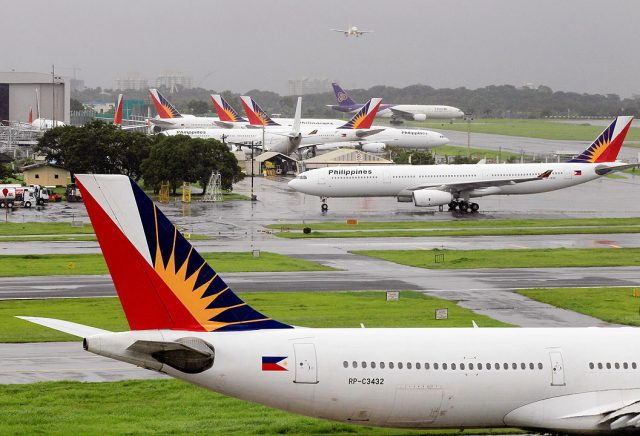
PHILIPPINE Airlines, Inc. (PAL) said on Tuesday that it has filed a petition before a Pasay City court seeking recognition of the proceedings and decisions of a United States bankruptcy court hearing its Chapter 11 case.

“The recognition petition filed by PAL before a local court is a petition which aims to ensure that the Philippine legal system recognizes all proceedings and decisions rendered by the foreign court handling the Chapter 11 case,” PAL Spokesperson Cielo C. Villaluna said in a statement sent to BusinessWorld.

“This was filed before a Pasay City court yesterday, Sept. 20,” she added.

PAL filed a voluntary petition for relief under Chapter 11 of the US Bankruptcy Code in the US Bankruptcy Court for the Southern District of New York on Sept. 3.

The proceedings are supervised by Judge Shelley C. Chapman under Case No. 21-11569.

PAL has said that the bankruptcy protection filing will allow it to “successfully restructure and reorganize its finances to navigate the COVID-19 (coronavirus disease 2019) crisis and emerge as a leaner and better-capitalized airline.”

The “first day motions” hearing took place on Sept. 9. PAL won the court’s approval to access the first $20 million of its debtor-in-possession financing totaling $505 million.

The court also authorized the airline to pay “ongoing suppliers and trade creditors in the ordinary course for goods and services delivered throughout the Chapter 11 process,” PAL said.

It likewise received authorization to “continue to pay all employee wages, compensation and benefit obligations, subject to the continuation of any temporary work arrangements as necessary and maintain employee benefit programs in the ordinary course of business throughout the Chapter 11 process.”

The second hearing has been set for Sept. 30. Eight motions pertaining to its customer programs, insurance, taxes, derivative contracts, employee wages, cash management, critical and foreign vendors, and financing will be heard “on a final basis.”

PAL’s restructuring support agreements motions will also be heard on Sept. 30.

PAL Chief Financial Officer Nilo Thaddeus P. Rodriguez has said that the airline expects to exit its recovery phase by 2022, with operating activities seen to “generate more consistent positive monthly cash flow.”

PAL expects an operating income of $220 million next year and $364 million in 2023.

The airline plans to exit unprofitable markets and selectively increase regional capacity in targeted growth markets.

It intends to consolidate capacity in the West Coast gateways and cancel certain ultra-long-haul flights.

Globe, Smart top global 5G gaming ‘uplift’

FREEPIK

GLOBE Telecom, Inc. and Smart Communications, Inc. have seen a significant boost in global scores for their fifth-generation (5G) games and video experience scores when compared to their scores on the fourth-generation (4G) network, latest data from mobile analytics company Opensignal showed.

In Opensignal’s global survey of top 30 mobile operators, Globe and Smart, the wireless arm of PLDT, Inc., came in first and second for overall 5G gaming experience improvement over 4G, with scores of 65.2% and 42.2%, respectively. TrueMove H of Thailand received a score of 37.1%, coming in third place.

Released on Monday, Opensignal’s “5G Global Impact” report recognized the top 30 operators with the “greatest uplift” on four measures of mobile network experience: download speed experience, upload speed experience, video experience, and games experience.

Globe and Smart had 5G video experience scores of 32.8% and 23.4%, respectively, placing them second and third, respectively, over their 4G video experience scores. The AIS of Thailand scored 36.6% and took first place.

“This highlights the impressive improvements in their mobile experience that Filipino users see when upgrading to the latest generation of mobile technology,” Opensignal said.

In terms of the 5G video experience that uses a combination of real-world measurements of video streams from smartphone users over an operator’s 5G network — including picture quality, stall rate and loading time — to reflect users’ perceived video experience using an International Telecommunication Union (ITU) derived approach, Smart is a “global leader” with its score of 81.6 points out of 100.

“Both Globe and Smart… [were] in the top 30 for all four measures of 5G Global Impact — the percentage improvement in the download speeds, upload speeds, games experience and video experience observed by Opensignal’s users on an operator’s 5G network compared to that seen on its 4G network,” the mobile analytics company noted.

Hastings Holdings, Inc., a unit of PLDT Beneficial Trust Fund subsidiary MediaQuest Holdings, Inc., has a majority stake in BusinessWorld through the Philippine Star Group, which it controls. — Arjay L. Balinbin