Home Blog Page 6886

Jim Furyk takes one-shot lead into final round at Charles Schwab Cup

JIM Furyk is 18 holes away from adding a Champions Tour points title to his impressive resume.

Furyk fired a 65 on Saturday in the third round of the Charles Schwab Cup Championship, holding on to a one-stroke lead heading into Sunday’s final round. Furyk sits at 16-under 197.

If Furyk holds on for the victory in Phoenix, he claims the season points title.

However, Bernhard Langer rebounded from back pain and a poor round Friday to card a 63, vaulting 22 spots back up the leaderboard to sit tied for ninth at 10 under. Though winning the tourney is likely out of the question, Langer put himself in position to claim a sixth Charles Schwab Cup if Furyk can’t bring home the victory.

Furyk turned in a clean card Saturday and has just three bogeys through 54 holes.

Langer put together four birdies and two eagles on a bogey-free day and was effusive about his round after shooting 72 on Friday.

Kirk Triplett, solo leader after 36 holes, shot 69 to sit alone in second at 15 under, one shot behind Furyk. Canada’s Stephen Ames (65) and New Zealand’s Steven Alker (68) are tied for third two shots back.

Phil Mickelson posted a 68 and is at 13 under, three shots back. Scott Parel (66) is four shots back alone in sixth. — Reuters

Badosa beats Sakkari to move into WTA Finals semis; Sabalenka survives Świątek test

SPAIN’S Paula Badosa ground out a 7-6(4), 6-4 victory over Maria Sakkari at the Women’s Tennis Association (WTA) Finals in Guadalajara, Mexico on Saturday and advanced to the semi-finals with two wins from two matches in Group Chichen Itza after Aryna Sabalenka beat Iga Świątek.

Facing one of the WTA Tour’s great battlers, the seventh-seeded Badosa showed she can also play with grit during a two-hour, four-minute slugfest in the Mexican heat, stretching her winning streak to eight matches.

Badosa blasted 10 aces past her Greek opponent and kept her under pressure, converting three of 12 break points. Sakkari could not consistently find the mark, committing 49 unforced errors compared to just 22 from Badosa.

“I suffered but I knew I was going to suffer against a player like Maria, she is an amazing fighter,” said Badosa, who will celebrate her 24th birthday on Monday.

“I think the key was to fight as well, I’m the same as her I am a competitor, I like to compete.

“I had to stay very aggressive but here it is tough because of the altitude. I stayed aggressive and focused and fighting a lot and I think that was the game plan.”

Sakkari underlined her warrior reputation, clawing her way back from 5-2 down in the first set to force it to a tie-break.

But the fourth seed quickly lost the momentum when Badosa roared in front 4-0 on her way to claiming the breaker 7-4.

Badosa kept up the pressure in the second, securing the early break to jump in front 2-1.

A reeling Sakkari had to dig deep to keep from falling into an even bigger hole, fighting off six break points before holding serve at 3-2.

Sakkari finally got the break she needed to level at 4-4 but Badosa immediately broke back, then served out the match, clinching the victory on her third match point with a backhand winner.

SABALENKA PUSHED BY Świątek
Badosa’s victory did not guarantee a semifinal spot but she advanced as the group winner after top seed Sabalenka fought back from a set down to beat Świątek (2-6, 6-2, 7-5) later on Saturday.

Świątek, the 2020 French Open champion, started well and broke twice in the opening set as the Belarusian struggled with her first serve.

But Sabalenka stormed back into the contest in the second set and was spurred on by a raucous crowd as she found her range on serve and won five straight games, saving three break points in the final game to take it to a decider.

The two were locked at 5-5 in the third when Sabalenka broke Świątek and then served out to eliminate the Polish 20-year-old.

“Guys, you’re just amazing, I have never felt that good on court, I’ve never felt this support from the crowd,” Sabalenka said in a post-match interview as the crowd cheered her on.

“I honestly think that this win is because of you. You gave me this energy, the motivation to keep fighting and I love you guys.”

The final group match between Sabalenka and Sakkari on Monday will decide the second semifinalist from the group. — Reuters

Unpredictable scenario

Although just four weeks in, the 2021-22 season of the National Basketball Association has already played host to twists even the most astute oddsmakers proved unable to predict prior to kickoff. Not that they didn’t try. Certainly, fans would have laughed them off had they argued that the Wizards and Warriors would be Conference leaders, or that the Bulls and Cavaliers would have better records than the Sixers, or that the Clippers would have a superior slate vis-a-vis the Lakers.

To be sure, little can be gleaned from a small sample size. As heady as the efforts of those crowding the top of league standings may be to date, they need to retain their consistency in order to produce the same results for the remaining 85% of their campaigns. After all, an equally unforeseen turn — say, an injury to a vital cog — can spoil even the best-laid plans. Meanwhile, the surfeit of talent enjoyed by preseason favorites figure to improve over time; progression to the mean is expected both in view of historical data and in consideration of the intrinsic strength of the supposed under-performers.

That said, not a few developments stand as reflections of the truth even this early. For instance, there can be no denying that the Wizards got the better of the Lakers in claiming three starters vice overbearing Russell Westbrook. How lopsided has the trade been in their favor? Consider that they’re smoking the opposition even though leading scorer and lone All-Star Bradley Beal is in the midst of a shooting slump. Meanwhile, the purple and gold have been hard-pressed to stay afloat amid a home-heavy and supposedly soft schedule.

Course correction and momentum building are said to be made as familiarity sets in. In any case, the current NBA snapshot shows a buildup to a more unpredictable scenario. How will the Ben Simmons saga play out? Does LeBron James still have enough in the tank to keep his title hopes alive? Should Giannis Antetokounmpo prepare for the worst? Can Kevin Durant keep churning otherworldly performances? The answers to these, and more, will be known soon enough. In the meantime, everybody’s enjoying the ride.


Anthony L. Cuaycong has been writing Courtside since BusinessWorld introduced a Sports section in 1994. He is a consultant on strategic planning, operations and Human Resources management, corporate communications, and business development.

Gov’t benefits for contractuals seen as alternative to ‘endo’ ban

PHILSTAR FILE PHOTO

PRESIDENTIAL CANDIDATES for next year’s national elections need to consider extending government benefits to contractual workers instead of abolishing labor contractualization, analysts said.

Ateneo de Manila University Economics Professor Leonardo A. Lanzona said that government cannot expect the private sector to provide support to contractual workers and consider the “significant” social gains from enacting policies such as a Universal Basic Income.

He added that while contractualization will remain a key election issue, politicians will have to consider the economic state of the country after the pandemic.

“The pandemic has been made contractualization even more viable as firms are able to cut losses, making workers carry much of the risk as standard work utilizes more telecommunications and virtual communication. Setting up an anti-endo law is like moving against the market tide,” he said in an e-mail to BusinessWorld.

Labor contractualization, also known as “end-of-contract” or endo, denies workers a pathway to permanent employment via five-month contracts. Workers by law are required to be granted permanent status after six months.

Permanent workers are entitled to 13th month pay, health insurance, and annual leave once regularized.

Foundation for Economic Freedom President Calixto V. Chikiamco said high unemployment rates tend to give employers more leverage. Unemployment jumped to 8.9% in September, equivalent to 4.25 million jobless.

“Unless these factors are eliminated, the problem of contractualization will not end, law or no law,” he said in a Viber message.

Mr. Chikiamco instead proposed the amendment to the Labor Code lengthening the probationary period but allowing workers to port their accumulated benefits after they leave a company.

“In an age where whole industries like banks and cars are being disrupted by technology, we should encourage labor mobility, rather than force companies to hire them for life,” he added.

Manila Mayor Francisco M. Domagoso, the Presidential candidate of the Aksyon Demokratiko party, said last month that the issue is “the least of (his) problems,” instead focusing on immediate job recovery from the coronavirus pandemic, if elected.

Meanwhile, Vice-President Maria Leonor “Leni” G. Robredo and Senator Emmanuel “Manny” D. Pacquiao said that they would support moves to end endo in a bid to support workers’ rights to job security.

Abolishing endo was one of the promises of President Rodrigo R. Duterte when he campaigned for President in 2016.

However, he vetoed the Security of Tenure Bill in July 2019 which would have banned outsourcing workers via manpower agencies and granted benefits enjoyed by regular workers to project and seasonal employees.

Trade Union Congress of the Philippines (TUCP) spokesman Alan A. Tanjusay said that the lack of action since Mr. Duterte’s veto has left contractual workers vulnerable to treatment as “disposable commodities.”

“Contractual workers are the most vulnerable during pandemic because they have no unions, they are unorganized and (have) no collective bargaining agreement with principal business owners. Endo workers are easily dismissed without due process and separation pay and benefits,” he said in a Viber message.

Ecumenical Institute for Labor Education and Research Director Rochelle Porras said that the next president should provide “greater representation” to workers in negotiations of labor laws.

“To balance the interests of workers and employers, our government officials sometimes forget that the majority of the workers are already exploited to begin with, given the low minimum wages, rampant contractualization, and violations of trade union rights,” she said in an e-mail. Russell Louis C. Ku

Dominguez presses multilateral banks to help vet climate projects

PHILSTAR

THE FINANCE department is asking multilateral banks to come up with guidelines for vetting climate adaptation projects in developing countries, in order to firm up the projects’ attractiveness to private investors.

Finance Secretary Carlos G. Dominguez III in a letter to the presidents of the World Bank Group (WBG), Asian Development Bank (ADB), and Asian Infrastructure Investment Bank (AIIB) proposed what he called a “seal of good housekeeping” to attract private-sector financing to climate adaptation and mitigation projects.

Multilateral banks could set transparency and monitoring standards to assure investors that their funds will be used well, Mr. Dominguez said in a statement released by the Finance department Saturday.

“With the public and private sectors resting their trust and confidence in (multilateral development banks), I propose that the WBG, ADB and AIIB collaborate in setting up a harmonized set of guidelines to determine the viability and sustainability of climate projects,” he said.

He made the proposal after noting that discussions at the 26th United Nations Climate Change Conference in Glasgow were largely focused “on consensus regarding certain principles and parameters on climate change without a clear understanding of how global finance can play a significant part in moving the climate agenda along.”

Mr. Dominguez also said the three banks should collaborate with other development banks to adopt such guidelines.

The Finance Secretary has been pushing for more climate financing from wealthy economies that he contends have not offered enough to help developing nations reduce their carbon footprints.

Such countries bear the most responsibility for their historic emissions, he said in the lead-up to the conference.

The Philippines has committed to reduce greenhouse gas emissions by 75% from 2020 to 2030. Of the 75% target, just 2.71% can be achieved with internal resources, while the remaining 72.29% rests on international assistance. — Jenina P. Ibañez

PHL credit rating supported by economy’s long-term track record

THE Philippine sovereign rating will remain supported by the country’s long-term track record of economic growth, which will be weighed against the damage caused by the pandemic, S&P Global Ratings said.

It said however that the coronavirus continues to pose risks to the economy’s potential.

“The Philippine economy remains among the fastest-growing in the world on a 10-year weighted-average per capita basis. We continue to view this as a credit strength that underpins the sovereign rating,” Yee Farn Phua, director at S&P Global Ratings said in an e-mail.

In the years prior to the crisis, the Philippine economy was growing by about 6% annually on average. However, the economy contracted by a record 9.6% in 2020 as a result of the effective shutdown of the economy.

S&P last affirmed the Philippines’ investment-grade BBB+ rating in May, with a stable outlook. Such an outlook means the rating could be maintained over the next 12 to 18 months.

In its assessment, S&P said it assumed a “healthy” economic recovery which will help improve the country’s fiscal standing, which has weakened because of the coronavirus crisis.

S&P in August said it expects the economy to grow 4.3% this year, downgrading the 6% projection it issued in June as it factored in the impact of the new lockdown as a result of the Delta variant of the virus. It also warned that gross domestic product (GDP) will likely be 12% below where it would have been without the pandemic.

S&P has said it expects 7.7% growth in 2022.

The third quarter growth rate of 7.1% was a welcome development and could allow the economy to recover to pre-pandemic levels by mid to late 2022, according to Vincent Conti, senior economist at S&P Global Ratings. However, he also warned that the virus could remain a threat to this rebound.

Last week, the Philippine Statistics Authority reported that GDP rose 7.1% in the three months to September, turning around from the 11.6% decline a year earlier. The final result was lower than the 12% annual expansion in the second quarter due to the August lockdown.

The economy grew 3.8% from a quarter earlier.

“With a low vaccination rate and easing restrictions over the upcoming holidays, there remains the potential for further spikes in cases to once again at least put a dampener on the recovery,” Mr. Conti said in an e-mail.

Johns Hopkins University estimates that 34.14% or 36.907 million of the population have been fully vaccinated against the virus. The government is hoping that 70 million Filipinos will get their jabs by the end of the year.

Fitch Ratings in July revised its outlook for the Philippines’ BBB credit rating to “negative” from “stable,” citing the impact of the prolonged pandemic. A negative outlook means the rating could be downgraded in the next 12 to 18 months. — Luz Wendy T. Noble

September debt service bill falls by 26% to P54.45 billion

BW FILE PHOTO

THE NATIONAL Government in September made debt service payments of P54.45 billion, falling 26.48% year on year following a decline in amortization payments, the Bureau of the Treasury (BTr) reported, citing preliminary data.

Around 87.9% of the debt service bill consisted of interest payments, which were up 10.36% at P47.86 billion in September.

Interest paid on domestic debt rose 12% year on year to P40.11 billion. This consisted of P26 billion in interest payments for fixed-rate Treasury bonds, P12.79 billion for retail Treasury bonds and P1.29 billion for Treasury bills.

Interest paid on foreign debt rose 2.47% year on year to P7.752 billion.

Meanwhile, amortization payments fell 78.52% to P6.59 billion in September.

All principal payments went to foreign creditors that month. The BTr did not settle any of outstanding principal with domestic lenders.

Despite the drop in September, the nine-month debt service bill rose 15.47% to P963.86 billion.

A total of 64.79% went to amortization payment, while the rest went to interest.

Amortization payments from the first nine months stood at P624.51 billion, rising 19.698% year on year. This consisted of P405.4 billion for domestic debt and P219.11 billion for external obligations.

Interest payments also rose 8.43% to P339.348 billion during the period. This included P257.62 billion to settle interest on domestic debt and P81.73 billion for interest on foreign debt.

The government borrows from foreign and local sources to plug its budget deficit as it spends more than it makes to support programs that will stimulate economic growth.

The National Government’s gross borrowings hit P2.6 trillion at the end of September as it continued to raise funds to respond to the coronavirus crisis, according to separate data from the BTr.

Gross borrowing in the first nine months rose 15.143% from a year earlier. — Jenina P. Ibañez

Property in civil forfeiture valued at nearly P900 million — Diokno

REAL PROPERTY seized from criminals and subject to civil forfeiture as part of money-laundering prosecutions has been valued at nearly P900 million, Bangko Sentral ng Pilipinas Governor and Anti-Money Laundering Council (AMLC) Chairman Benjamin E. Diokno said.

Mr. Diokno reminded the real estate industry of its responsibility to guard against money laundering risks.

“As of 2020, real estate with an estimated value of almost P900 million accounted for 22% of the total assets subject to civil forfeiture proceedings in the Philippines,” Mr. Diokno said in a speech delivered to the Real Estate Brokers Association of the Philippines (REBAP) Friday.

He added that the AMLC has confiscated outright nearly P30 million worth of real estate that was “used as a means to hide the proceeds of crime including terrorism financing.

Mr. Diokno said the dirty-money regulator recently filed a petition for civil forfeiture on assets, including a property in Cebu, connected to the illegal drug trade.

Real estate assets that are subject to freeze orders were also found to have links to terrorism financing, he added.

These cases demonstrate how illicit funds are parked in the formal economy, Mr. Diokno said.

“When used for business activities, the purchased real property, such as a hotel or restaurant, may also provide what appears to be a legitimate source of income,” he said.

Mr. Diokno noted how condominiums and other real property have been identified as assets of criminals in a majority of fraud, corruption, and illegal drug cases.

He told the REBAP to practice customer due diligence and to retain Know Your Customer records for property transactions for at least five years.

Following the recommendation of the Financial Action Task Force (FATF), Republic Act 11521 passed in January included real estate developers and brokers as covered persons for the purpose of enforcing anti-money laundering laws. It also covered single-property cash transactions of over P7.5 million.

The Philippines is currently on the FATF gray list of jurisdictions that are obliged to prove their progress in implementing stricter anti-money laundering and counter-terrorism financing laws. Mr. Diokno is hopeful of exiting the list by January 2023. — Luz Wendy T. Noble

Asian Terminals reports 24% decline in nine-month profit

ASIAN TERMINALS, Inc. (ATI) said net profit in the first nine months fell 24% year on year to P1.5 billion following disruptions in global supply chains, rising fuel prices, pandemic-related measures, and unfavorable foreign exchange rates.

“Cargo flow during the third quarter was tempered by operational disruptions in major Asian transshipment hubs caused by spikes in COVID-19 (coronavirus disease 2019) incidents, with governments pre-emptively locking down port facilities to curb infection rates,” the listed port operator said in a statement Friday.

The company added that disruptions in the major regional ports caused ship rerouting, anchorage queuing, terminal gridlocks, and delays in container and logistics cycles.

But ATI Executive Vice-President William Khoury said the company expects cargo to increase for the rest of the year due to increased consumer confidence and the easing of community quarantine rules.

“As of October, we have reached 100% vaccination rate for our employees. This further boosts ATI’s capacity and capability to handle more container volumes safely and efficiently as we keep in step with market recovery and fulfill our vital role in keeping cargoes flowing in the supply chain,” Mr. Khoury said.

ATI’s international gateway ports in Manila and Batangas handled more than 810,000 TEUs (twenty-foot equivalent units) and almost 200,000 TEUs in the first nine months, respectively.

The company said the volumes indicate “resilient growth since the novel health emergency disrupted global and local supply chains last year.”

“This represents a consolidated volume growth of 8% compared to end-September 2020,” it noted.

For the first nine months, revenue totaled P8.22 billion, up 3.2% from a year earlier. — Arjay L. Balinbin

How to win Asia-Pacific consumers in the new era

First of two parts

Before the COVID-19 pandemic unleashed its unprecedented impact on economies and societies, consumer behaviors were already shifting. Digitalization was reimagining how consumers live, work, play and consume, evidenced by the rapid rise of e-commerce in the Asia-Pacific region.

In a survey conducted by VISA (VISA Consumer Payments Attitude Study) mid-year, about 93% of Filipinos increased their shopping activity on websites and mobile apps. In fact, up to one in two Filipinos shopped online during stricter lockdown protocols. Businesses and consumers alike anticipate monthly promotions of online retail platforms and explore shopping via social media platforms such as Facebook and Instagram.

The pandemic accelerated some of these changes that were underway, leading consumers to reprioritize what they value. Arguably, it is no longer just about what they buy but also how they want to live their lives. That means consumer companies need to understand what is driving consumer lifestyles and ultimately, use these insights to make bolder plans to get ahead of change.

To be fair, many consumer companies did pivot to cater to shifting consumer demand during the last 18 months of the pandemic. However, the consumers that companies adapted to serve during the pandemic may not be the same consumers who will make them profitable in the future. That said, certain pandemic-induced traits may persist. For example, companies that offered the supply and price stability needed by consumers early in the pandemic are more likely to be rewarded with consumer stickiness than those that chose to pass on the higher costs to consumers.

Many consumers, particularly in the Asia-Pacific region, appear to be turning into COVID-19 anxiety “long haulers,” as indicated by real-time global consumer sentiment tracked by the EY Future Consumer Index which surveyed more than 5,500 respondents across six Asia-Pacific countries — China, India, Indonesia, Japan, Australia and New Zealand — from among 20 countries in total. Of the Asia-Pacific consumers surveyed in the May 2021 edition, 85% express concerns over health. With regard to pandemic-related caution in their spending behavior, 44% say they are purchasing only essentials and about two-thirds say they are thinking more carefully about how they spend money. This is consistent with the results of the study published by Kantar (Kantar Purchase Confidence Study in July 2020) where roughly 79% of consumers expressed worry about their financial situation and the importance of health and immunity benefits of fast-moving consumer goods (FMCG) products.

FIVE DOMINANT BEHAVIORAL SHIFTS
While individual consumer behaviors are likely to be volatile in the foreseeable future, companies can proactively accommodate their needs in five key areas: value, health, sustainability, experiences and omnichannel.

VALUE
Consumers, being concerned about finances, are invariably increasingly price-sensitive. Of the respondents in the consumer index report, 56% of consumers see price as a more important purchasing criteria than before, while 44% are purchasing only essentials. Less than half at 42% will buy more store-brand household staples moving forward.

Consumer companies need to review their overall portfolios and value chains to consider if they can offer consumers quality, low-cost alternatives, as well as compete effectively with store brands and private labels. At the same time, retailers need to reassess their private label strategy. Short-term brand conversion during the pandemic could likely lead to longer-term brand loyalty — but only if private labels continue to drive product range and innovation, marketing outreach and quality.

HEALTH
The pandemic has re-emphasized the importance of health, fitness and wellness. Understandably, as much as 85% of consumers are concerned about their family’s health. Meanwhile, 48% are spending more on healthy or “good for me” products, and 36% are willing to pay a premium for products promoting health and wellness.

Asia-Pacific consumers are concerned with protecting their health and that of their family. Consumers are actively shopping for health products that will make them safer and healthier at home. Catering to this “in-home” hygiene market, including cleaning, nutrition, fitness and even beauty products may require more ingenuity in exploring healthier formulations, reshaping product portfolios and R&D investments.

SUSTAINABILITY
It is not enough to just offer a product at the right price point: the behavior of a company is as important as what it sells. An overwhelming 82% of Asia-Pacific consumers say that companies must be transparent about their environmental impact and 28% are willing to pay a premium for more sustainable goods and services. Almost half at 48% also say that local sourcing has become more important.

If consumer companies can proactively demonstrate accountability and transparency over their environmental impact, they will be able to gain consumer trust and encourage higher spending. To do so, companies should look into re-engineering their production, logistics and supply chains as well as recognizing the third-party risks that can erode credibility.

EXPERIENCES
Pent-up demand for unique experiences, especially among younger consumers, will create opportunities for consumer companies to provide new offerings that fit a range of budgets. The EY Future Consumer Index revealed that 64% of Asia-Pacific consumers are willing to share personal data for a tailored online experience. Meanwhile, 45% will be less inclined to take part in experiences outside their homes, and 43% will actually spend more on experiences. The question is whether companies can switch flexibly between on-trade (or on-site) and off-trade (or bring home) as pandemic restrictions vary.

Forward-thinking companies are offering consumers a mix of both digital and physical experiences: digital experiences that can be accessed safely at home, paired with unique in-store experiences that are worth exploring. Adapting to this new trend may require an operating model reset for some Asia-Pacific companies, strategically reallocating resources and restructuring the organization for greater agility.

OMNICHANNEL
Many consumers who moved online out of necessity will largely sustain their online behaviors, although the extent of digital engagement may shift. The interaction between online and offline will be more important than before. For instance, 54% of consumers in the Asia-Pacific region are doing their grocery shopping both online and in person, while 47% even say that the availability of delivery is a more important priority when shopping. On the other hand, 41% are visiting stores less frequently.

Consumers want digital engagement to be just as reliable as going to the store. An integrated channel strategy, supported by agile supply chains and logistics, is needed to deliver a consistent and enjoyable experience across online and offline channels. With the right data strategy, the data captured from online interaction and consumption will also yield valuable insights for business planning and delivering superior, bespoke experiences.

In the second part of this article, we discuss the three key actions that leaders of consumer companies should consider in order to address these aforementioned shifting consumer expectations.

This article is for general information only and is not a substitute for professional advice where the facts and circumstances warrant. The views and opinions expressed above are those of the authors and do not necessarily represent the views of SGV & Co.


Olivier Gergele is the EY ASEAN Consumer Products & Retail leader, Maria Kathrina S. Macaisa-Peña is a business consulting partner and the Consumer Products and Retail Sector leader of SGV & Co., and Fabrice Imparato and Shaurya Ahuja are EY-Parthenon partners.


Duterte daughter tries to justify VP ambition

DAVAO CIO

PRESIDENT Rodrigo R. Duterte’s daughter on Sunday said running for vice-president next year was an opportunity to meet halfway her supporters, who wanted her to run for president.

“I have thousands of supporters who cried last Oct. 8 and I cannot find it in my heart to make them cry again on Nov. 15,” Davao City Mayor Sara Duterte-Carpio said in a video message posted on her Facebook page.

Ms. Carpio, 43, earlier rejected calls for her to run for a national post. She had opted to run for reelection as mayor before the Oct. 8 filing deadline. Substitution of candidates is allowed until Nov. 15.

“After the deadline, the offer to run for vice-president became an opportunity to meet you halfway,” Ms. Carpio said. “It’s a path that would allow me to heed your call to serve our country.”

The Davao mayor on Saturday agreed to run for vice-president in tandem with former Senator Ferdinand “Bongbong” R. Marcos, Jr. who filed his candidacy for President last month.

The Partido Federal ng Pilipinas, Mr. Marcos’s party, adopted Ms. Carpio as its vice-presidential bet for the May elections, according to a copy of a resolution passed by the party at the weekend.

The presidential daughter registered her candidacy for vice-president under the Lakas-Christian Muslim Democrats (Lakas-CMD) through a representative.

She substituted for a party member who is a relative unknown.

She took her oath last week as a member of Lakas-CMD, which is led by former President Gloria Macapagal Arroyo — a known powerbroker in Philippine politics.

Political analysts have said Mr. Duterte could not afford to lose support from the Marcoses because their supporters backed his presidential bid in 2016.

Civic groups earlier asked the Commission on Elections to disqualify the younger Mr. Marcos from the presidential race after a trial court convicted him for tax evasion in the 1990s.

More than 70,000 people were jailed, about 34,000 were tortured and more than 3,000 people died under his father’s martial rule, according to Amnesty International.

The dictator ended martial law in Jan. 1981, but it wasn’t until five years later that he was toppled by a popular street uprising that sent him and his family into exile in the United States.

The younger Mr. Marcos was among the first to return to the Philippines from exile in 1991.

Ms. Carpio als tried to distance herself from the ruling PDP-Laban.

“The problems of PDP are their own,” she said. “Let them resolve the issues within their party. This is all politics and this will not matter in five years, or even now when what we need to focus on is our country’s recovery and the people’s welfare.”

Senators Ronald M. Dela Rosa and Christopher Lawrence T. Go withdrew their presidential and vice-presidential bids on Saturday under PDP-Laban.

Mr. Go, Duterte’s former aide, filed his candidacy for president under another party via substitution.

Mr. Duterte, who earlier claimed he was retiring from politics next year, might also run for vice-president, Communications Secretary Martin M. Andanar said on Saturday.

The tough-talking leader is barred by law from running for reelection.

Analysts earlier said the ruling camp might be doing everything to remain in power to protect Mr. Duterte from potential lawsuits.

The International Criminal Court (ICC) has ordered an investigation of Mr. Duterte’s crackdown on illegal drugs that has killed thousands, saying crimes against humanity might have been committed.

The other vice presidential candidates include Senate President Vicente C. Sotto III, Senator Francis N. Pangilinan, Party-list Rep. Jose L. Atienza, Jr. Willie Ong and Walden F. Bello.

Also running for president  next year aside from Mr. Marcos are Vice-President Maria Leonor “Leni” G. Robredo, Manila Mayor Francisco M. Domagoso, Senator  Panfilo M. Lacson and boxing champion and Senator Emmanuel “Manny” D. Pacquiao. — Norman P. Aquino

Gov’t adviser seeks further lockdown easing in capital

PHILIPPINE STAR/ MICHAEL VARCAS
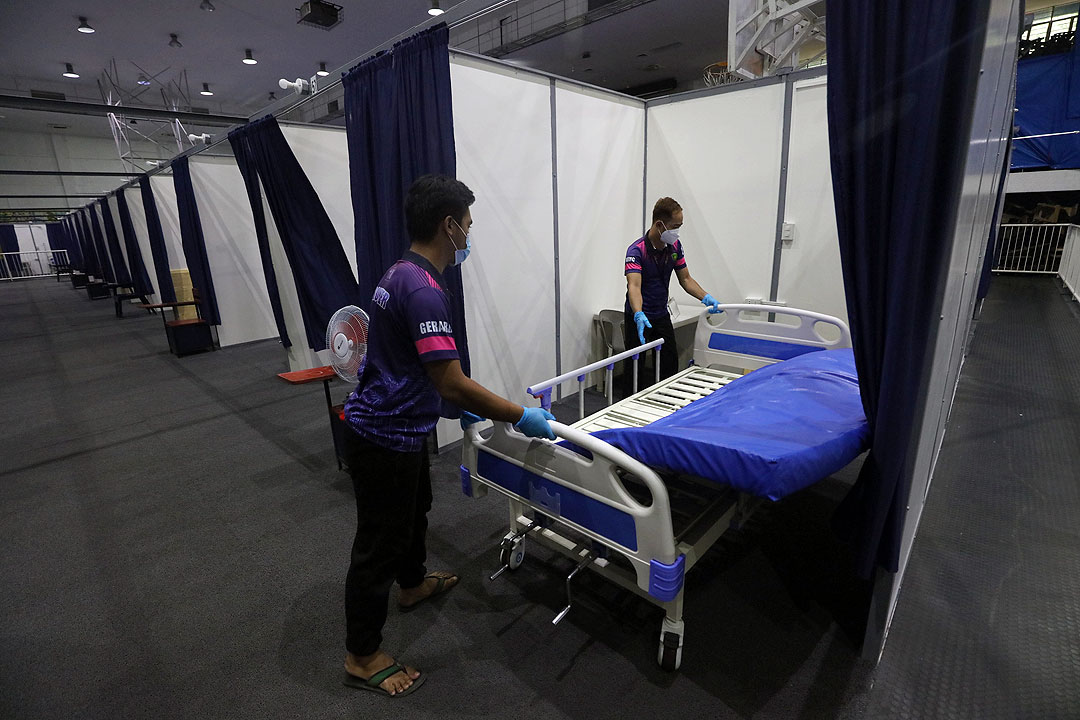
MAINTENANCE workers from the Pasig local government disinfected an isolation booth of a quarantine facility at the Caruncho stadium before it got dismantled on Nov. 11. — PHILIPPINE STAR/ MICHAEL VARCAS

THE LOCKDOWN level in Metro Manila could be eased further to Alert Level 1 next month, as long as its more than 13 million residents remain cautious to prevent another surge in coronavirus infections, according to the country’s entrepreneurship adviser.

“We can do it,” presidential adviser for entrepreneurship Jose Maria A. Concepcion III told ABS-CBN’s TeleRadyo in Filipino on Sunday. “While we continue to go down in cases, and we’re recommending Alert Level 1, vigilance is important.”

An area may be put under the first alert level if virus transmission is low, cases are decreasing, and hospital bed and intensive care unit use is low, according to an inter-agency task force.

Under this quarantine level, movement is allowed regardless of age and illness. All types of businesses may operate and venues may be used at full capacity subject to minimum public health standards.

“I think the relaxed policies this fourth quarter will continue until 2022,” Mr. Concepcion said. “We already found the solution — local governments vaccinating at least 80% of their constituents.”

The Department of Health (DoH) reported 1,926 coronavirus infections on Sunday, bringing the total to 2.82 million.

The death toll rose to 45,581 after 309 more patients died, while recoveries increased by 3,140 to 2.74 million, it said in a bulletin.

There were 28,102 active cases, 62.3% of which were mild, 5.8% were asymptomatic, 10.5% were severe, 16.94% were moderate and 4.5% were critical.

The agency said 26 duplicates had been removed from the tally, 24 of which were tagged as recoveries, while 245 recoveries were relisted as deaths. Two laboratories failed to submit data on Nov. 12.

DoH said 34% of intensive care units in the Philippines were occupied, while the rate for Metro Manila was 31%.

The government aims to vaccinate at least 50% of its adult population by yearend.

Metro Manila is now under Alert Level 2. Mr. Concepcion cited the need for people to get vaccinated against the coronavirus and always wear masks.

“We all need to get vaccinated,” he said. “This is for the national interest and common good. Our economy depends on it.”

Mr. Concepcion said there is now enough vaccine supply, and local governments should counter fake news against vaccination.

The Philippines has received almost 122 million COVID-19 vaccine doses, 67.7 million of which had been given out.

About 30.8 million Filipinos had been fully vaccinated against the coronavirus as of Nov. 11. Almost 37 million more have received their first dose.

President Rodrigo R. Duterte has approved a plan to use for the entire country a coronavirus alert level system first tested in the Philippine capital and nearby cities.

The nationwide enforcement of the quarantine strategy will be in four phases, according to Executive Order 151 released on Thursday.

The government on Sept. 16 started enforcing granular lockdowns with five alert levels in Metro Manila, weeks after the government struggled to contain a fresh surge coronavirus infections triggered by a more contagious Delta variant.

Coronavirus cases in the capital region might soon plateau as the infection rate dropped to 3%, the OCTA Research Group from the University of the Philippines said last week. — K.A.T. Atienza