Home Blog Page 6838

‘No to the IMF’: thousands protest in Argentina against debt deal

BUENOS AIRES – Thousands of Argentines marched through the streets of Buenos Aires on Tuesday to protest against a likely deal with the International Monetary Fund (IMF) to revamp more than $40 billion of debt the country cannot pay back.

The protesters paraded through the capital with banners saying “no to paying the IMF” and “no to an IMF deal“, a sign of rising tension in the South American nation over the tentative agreement struck late last month.

Argentina and the IMF announced a breakthrough in talks in late January to revamp a failed 2018 loan, which would see debt payments pushed back but involve pledges to meet certain economic targets agreed with the lender.

That agreement still needs details ironed out and approval from both Argentina‘s Congress and the IMF board.

“No to the government’s deal with the IMF,” said Celeste Fierro, a protest leader, wearing a T-shirt reading “scams are not paid”.

“They want us to pay with more (fiscal) adjustments, with more precariousness and taking more out of us, that is why we cannot allow the submission of our people to the designs of the IMF.”

IMF chief Kristalina Georgieva said last week that while an agreement had been reached in principle with Argentina on a new standby loan, “hard work” still lay ahead.

In Argentina, splits have appeared in the ruling Peronist coalition over the deal, with one prominent lawmaker stepping down from his position in Congress in opposition to it.

Juan Carlos Giordano, a representative for a leftist group in the march, said that the debt deal was akin to making working class people foot the bill and that the funds should be used to pull people out of poverty.

“The aim is to defend wages, defend work so that the money goes to combat social ills,” he said, blaming the previous government of conservative Mauricio Macri for taking on the IMF debt.

“We are marking a path. The path of no submission, no to resignation, and no to the IMF.” – Reuters

Meta, Chime file lawsuit against alleged phishing scam on Facebook, Instagram

BYCGZR-FREEPIK AND RAWPIXEL.COM-FREEPIK

Facebook parent Meta Platforms said on Tuesday it had filed a joint lawsuit with digital banking company Chime against two Nigeria-based individuals who engaged in phishing attacks to deceive people and gain access to their online financial accounts.

The lawsuit, which is the first joint complaint between Meta and a financial services company, alleged that the defendants used Facebook and Instagram accounts to impersonate Chime and lure people to fake branded phishing websites with the aim of obtaining their Chime account login information and withdrawing funds.

In the suit, which was filed in the U.S. District Court for the Northern District of California, Meta said the defendants used a network of computers to control more than 800 impersonating Instagram accounts and five Facebook accounts, in order to conceal their activity and evade technical enforcement measures.

Reuters could not immediately reach the defendants for comment.

“Impersonation scams are a serious challenge, and this action represents a major step forward in cross-industry collaboration against this abuse,” Meta‘s director of platform enforcement and litigation Jessica Romero said in a blog post.

Fintech company Chime was launched by former Visa Inc executive Chris Britt and Comcast Corp alumnus Ryan King in 2012. Reuters exclusively reported last month that Chime had asked Goldman Sachs to help it with IPO preparations.

Meta said it had taken several previous actions against the defendants since June 2020 for violating its terms, including disabling their accounts, blocking impersonating domains on its platforms and sending cease and desist letters. – Reuters

U.S. December trade data reveals massive shortfall in China’s ‘Phase 1’ purchases

STOCK PHOTO | Image by Ally Thomas from Pixabay

WASHINGTON – U.S. goods exports to China fell in December, cementing a massive shortfall in Beijing’s two-year purchase commitments under the “Phase 1” trade deal negotiated by former President Donald Trump’s administration.

The U.S. Census Bureau said on Tuesday that the United States’ 2021 goods trade deficit with China rose by $45 billion, or 14.5%, to $355.3 billion, the largest since a 2018 record of $418.2 billion.

The 2020 gap was $310.3 billion, a 10-year low driven by coronavirus pandemic lockdowns.

The global U.S. trade deficit in 2021 surged 27% to a record $859.1 billion as businesses restocked inventories to meet robust demand.


NO EXTRA PURCHASES

The data showed China by far missed its commitments to purchase an additional $200 billion worth of U.S. farm and manufactured goods, energy and services above 2017 levels – the year before a bitter trade war embroiled the world’s two largest economies.

The purchase commitments were the centerpiece of Trump’s Phase 1 trade deal with China, which launched in mid-February 2020 and halted a threatened escalation of tariffs.

The deal also called for China to grant increased U.S. market access to its agricultural biotechnology and financial services sectors and mandated some intellectual property protection improvements.

An analysis of final 2021 Census trade data compiled by economist Chad Bown of the Peterson Institute for International Economics showed China met just 57% of its full two-year goods and services targets.

Beijing’s purchases of the goods, energy and services targeted in the Phase 1 agreement were not even enough to return to China’s baseline 2017 level of purchases of U.S. imports after retaliatory tariffs had eroded them in 2018 and 2019, he said.

“Put differently, China bought none of the additional $200 billion of exports Trump’s deal had promised,” Bown said in his analysis.


China exceeded the 2017 baseline in agricultural purchases, but only reached 83% of the $73.9 billion two-year farm goods target, Bown’s analysis showed.

Services exports to China, which had been a bright spot for U.S. trade, fell sharply as the pandemic slashed Chinese tourism and business travel to the United States and cut the flow of Chinese students to U.S. universities, reaching only 52% of the target.

“We have engaged the PRC (People’s Republic of China) on its shortfalls for months, but have not seen real signs towards making good on the purchase commitments and our patience is wearing thin,” Adam Hodge, a spokesperson for the U.S. Trade Representative’s office, said in an e-mailed statement.

“Regardless of how these negotiations conclude, the fact remains that the Phase One Agreement did not address the core problems with the PRC’s state-led economy,” Hodge said, adding that the Biden administration would “shape the environment around China” by building U.S. competitiveness, diversifying markets and limiting the impact of China’s “harmful practices.”

Liu Pengyu, a spokesperson for China’s embassy in Washington, said China has been working on implementation of the agreement “despite the impact of COVID-19, global economic recession and supply chain disruptions.”

“The Phase 1 deal benefits China and the U.S. and the whole world,” Liu added.

Beijing has sought the removal of tariffs on hundreds of billions of dollars of goods that were left in place by the Phase 1 deal.

The agreement contains a clause that the two parties “project that the trajectory of increases” in China’s purchases “will continue in calendar years 2022 through 2025” without specific targets.

Former USTR chief of staff Jamieson Greer, who helped negotiate the Phase 1 deal, said that clause could be used to pursue “retrospective enforcement for what’s been missed.”

“It’s in the interest of the administration to pursue enforcement,” said Greer, a trade lawyer with King and Spalding.

“With a few kind of narrow exceptions, we haven’t really seen that much enforcement” on trade matters from the Biden administration, he added. – Reuters

Global COVID response program ‘running on fumes’ amid budget shortfall

A global initiative to get COVID-19 tests, treatments and vaccines to poorer nations has only received 5% of the donations sought to deliver on its aims this year, according to the World Health Organization (WHO) and other aid groups.

The Access to COVID-19 Tools (ACT) Accelerator budgeted $23.4 billion for its efforts from October 2021 to September 2022, of which it hoped $16.8 billion would come in the form of grants from richer countries.

However, so far it has had just $814 million pledged, leaders of the initiative told a media briefing on Tuesday. In addition to the WHO, the project is backed by organizations including the Coalition for Epidemic Preparedness Innovations, The Global Fund, and the Bill & Melinda Gates Foundation.

“That’s just a minuscule 5% of what we require. It is time to awaken the conscience of the world,” said the WHO’s global ambassador for health financing, Gordon Brown, a former British prime minister.

On Wednesday, a number of world leaders are set to support publicly the push for more funding, calling for the investment to end the emergency phase of the COVID-19 pandemic this year.

The ACT-Accelerator hub encompasses the COVAX initiative, which has focused on equitable access to vaccines. It also involves providing tests and treatments to low and middle-income countries, as well as personal protective equipment (PPE) for healthcare workers.

Bruce Aylward, a senior WHO official who acts as coordinator for the initiative, said it was stuttering due to a lack of funds.

“The global response is running on fumes,” he said.

The lack of funding has been apparent since the start of the pandemic. The gap for the project’s previous budget was $14.5 billion. Partners said the majority of funding so far had gone into COVID-19 vaccines, leaving the other goals – tests, treatments, and PPE – short.

Even so, the initiative has fallen well short of its goal to deliver 2 billion COVID vaccines in 2021, with only 10% of people in low-income countries having received at least one dose of a vaccine, compared to almost 68% in richer countries, according to WHO data.

Brown called for countries to fund the initiative under a “fair share” model based on the size of their own economies, which he said resembled how nations commit to funding United Nations peacekeeping forces. – Reuters

Marcos Jr.’s path to Philippine presidency muddied by lawsuits

FACEBOOK.COM/BONGBONGMARCOS

Ferdinand “Bongbong” Marcos Jr. may have a decisive lead in the Philippine presidential race, but his path to obtain the country’s highest office remains uncertain three months before the election.

The Commission on Elections, whose four remaining members were appointed by President Rodrigo Duterte, has yet to decide on four disqualification petitions against the late dictator’s son which all cite his conviction nearly three decades ago for failing to file tax returns.

The petitioners, some of whom were arrested and tortured during Ferdinand Marcos’s military rule in the 1970s and 1980s, argue that the tax conviction permanently bars his son from public office. Marcos’s camp says he’s qualified to run, describing the cases as “pathetic stunts” that interfere with the right of Filipinos to freely choose leaders. His Chief of Staff Vic Rodriguez said Marcos’s focus is now on nation-building and unifying the country.

Still, Marcos said last week that he’s concerned about the possibility of being disqualified even if he wins the presidential elections. “I take everything seriously, I worry about everything, but I don’t let it distract me from the campaign,” he said in a television interview.

No matter what happens with the Marcos disqualification petitions, the losing party can appeal before the Supreme Court, which could take months to decide. Here’s how the scenarios could play out:1) Marcos cleared before electionsThis would clear any doubts about Marcos’s bid for the presidency. He is well ahead of all his competitors, with a December opinion survey showing Vice President Leni Robredo — the opposition leader who defeated Marcos in 2016 — trailing by 33 points in second place.One petition, similar to the remaining four, has already been thrown out by a division of the Election Commission. It disagreed with the petitioners’ argument that Marcos made false representations in his certificate of candidacy showing he’s eligible to run despite a 1995 tax conviction. They are planning to appeal this ruling before the entire poll body, and the case could go all the way to the Supreme Court.In the 2016 race, Senator Grace Poe, who was a presidential front-runner, was initially disqualified by the poll body for not being a natural-born citizen and failing to meet a residency requirement. The Supreme Court overturned this decision two months before the elections, but Poe eventually lost to Duterte.2) Marcos disqualified before election

This scenario would open up the race to a range of candidates currently well behind Marcos. While another candidate with the same surname and from the same party can legally take his place — possibly his sister, Imee Marcos — it’s unclear if his supporters would stick around.Many of them may shift over to Manila Mayor Isko Moreno, who recently praised President Duterte, or former police chief Senator Panfilo Lacson, according to Jean Franco, a professor from the University of the Philippines.Those two men have emphasized discipline and strong leadership in their campaigns, which Marcos supporters have tended to associate with the late dictator’s rule. Duterte, who maintains high popularity, has yet to endorse any presidential candidate.Still, a large block of voters could remain loyal to the Marcoses even if he’s disqualified. “Marcos has been successful in saying that this is just political persecution, that people are doing this because they’re afraid of him winning the elections,” Franco said.3) Marcos wins election, then gets disqualified

A protracted legal battle over Marcos’s disqualification cases could eventually benefit the president’s daughter, Sara Duterte, who’s leading the vice-presidential race. Election Commission spokesman James Jimenez said in a briefing in January that the vice-president would have to take over if an elected president gets disqualifed.Sara Duterte’s camp has declined to comment on the issue although she said in a statement tweeted by state TV that the speculation of her possibly replacing Marcos as president was “exceptionally unpleasant.” “In reality, both of us are yet to win the elections. It is putting the cart before the horse,” she added.Some analysts see this scenario as unlikely, as she had a good chance of succeeding her father if she ran for president against Marcos. Still, it could set Sara Duterte up for a lengthy run as president: She could finish out Marcos’s remaining time in office and then run again in the next election, potentially ruling for longer than a single six-year term normally allows.4) Marcos wins election, cases later dismissed

Much depends on the extent to which current President Rodrigo Duterte would want leverage over Marcos. Past Philippine presidents have faced trials after leaving office, with former president Gloria Arroyo pardoning her predecessor Joseph Estrada in 2007 after he was convicted of plunder.The president has faced allegations of illegal activity particularly over his drugs war, with an International Criminal Court prosecutor last year pausing a probe into the policy. In the past, he has repeatedly denied wrongdoing on the drugs war, and recently said that the accusation before the international court about the killings was “incredible.”Either way, Duterte will play a key role: He currently can appoint three new election commissioners, and he’s already picked 11 out of 14  judges who would hear any case that makes its way to the Supreme Court. Duterte’s spokesman didn’t immediately respond to a request for comment.“As soon as he’s out of the door, he needs to cover himself,” said Sol Iglesias, assistant professor of political science at the University of the Philippines.If Marcos solidifies his hold on power, however, the poll body and the top court could dismiss the cases on the back of a landslide at the polls, said Victor Manhit, a managing director at strategic advisory firm BowerGroupAsia and former deputy secretary in the Philippine Senate.“When he is the head of government these commissioners and courts will simply say: it’s the voice of the people,” Manhit said. “They’ll hide behind that.” — Bloomberg

Manufacturing growth eases in Dec.

REUTERS

By Bernadette Therese M. Gadon, Researcher

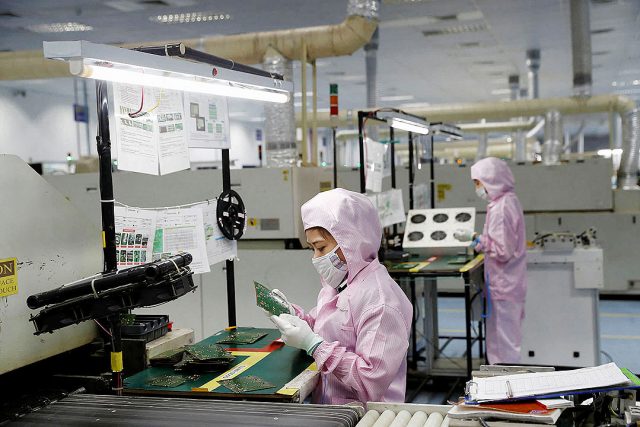
FACTORY PRODUCTION grew at a slower pace in December but remained in the positive territory for the ninth straight month despite the supply chain disruption in the aftermath of Typhoon Odette.   

Preliminary results of the Philippine Statistics Authority’s Monthly Integrated Survey of Selected Industries (MISSI) showed factory output, as measured by the volume of production index (VoPI), went up by 17.9% year on year in December.

This was slower than November’s revised 25.8% growth and a turnaround from the 14.8% contraction recorded in December 2020.

Philippine factory output growth eases in December

December was the ninth consecutive month that the VoPI remained in the positive territory or since April’s 152.1% surge.

This brought average factory output growth last year to 50.3%, reversing the 40.5% decline in 2020.

The PSA attributed December’s growth to year-on-year increases in half of the 22 industry divisions, led by manufacture of wood, bamboo, cane, rattan articles, and related products which jumped by 122.6%.

Other industries that showed growth included machinery and equipment except electrical (to 50% from 40.7%), electrical equipment (49.6% from 44.9%), and coke and refined petroleum products (47.6% from 84.8%).

Meanwhile, the following industries registered declines in December: basic pharmaceutical products and pharmaceutical preparations (-30.2% from -10.5% in November), beverages (-14.6% from -0.8%), and tobacco products (-14.5% from -20.4%).

In comparison, IHS Markit’s Philippines Manufacturing Purchasing Managers’ Index (PMI) slightly increased to a nine-month high of 51.8 in December from 51.7 in November. A reading above 50 marks an improvement for the manufacturing sector while anything below indicates deterioration.

The capacity utilization of these factories averaged 67.3% in December, slightly down from 67.8% in November. Of the 22 sectors, 20 averaged a capacity utilization rate of at least 50%.

Analysts said December’s growth was due to base effects after factory production nearly grounded to a halt in 2020 amid the strict lockdown restrictions imposed to contain the spread of the coronavirus disease 2019 (COVID-19).

“Base effects appear to still play a part in the recent report with the recovery magnified from the sharp fall in the previous year. In the coming months, we do expect these growth rates to moderate further but remain in expansion as the economy reopens gradually,” ING Bank N.V. Manila Senior Economist Nicholas Antonio T. Mapa said in an e-mail.

Security Bank Corp. Chief Economist and Assistant Vice-President Robert Dan J. Roces said in a separate e-mail interview that December saw most economic sectors perform strongly, thanks to the further relaxation of mobility curbs in Metro Manila and other parts of the country.

“December was a strong month for most of the economy with mild community quarantines and above pre-pandemic mobility, and the slower output may be attributed to some effects coming from Typhoon Odette but also due to a slight seasonal pullback,” he said.

In a Viber phone interview, Philippine Chamber of Commerce and Industry (PCCI) President George T. Barcelon said that the easing manufacturing growth seen in December is “normal.”

“People don’t want to carry too much inventory moving into the new year,” Mr. Barcelon said. He added that the supply chain has not yet stabilized, noting that incoming shipments of raw materials were disrupted.

In mid-December, Typhoon Odette (international name: Rai) swept through parts of the Visayas and Mindanao, leaving damage to agriculture and infrastructure worth P13.3 billion and P17.19 billion, respectively.

For January, analysts are looking at a modest output, due to the reimposition of tighter restrictions amid the surge of the Omicron variant in the country. However, they expect manufacturing to pick up again by February.

Metro Manila and other areas were placed under Alert Level 3 in January, but are currently under a looser Alert Level 2.

“The Omicron surge in January may have only a modest impact on manufacturing activity and we expect a quick recovery by February as mobility restriction have been relaxed somewhat,” Mr. Mapa said.

“For January, it was reported that the manufacturing sector’s output and new orders contracted given the resurgence of Omicron as well as the lingering impact of Odette, on top of remaining raw material shortages that led manufacturers to raise selling prices thus the MISSI in January may show that underperformance,” Mr. Roces said.

Manufacturing PMI reading in January hit the 50 mark that denotes no change from previous month. IHS Markit traced this to Typhoon Odette’s aftermath as well as the fresh surge in COVID-19 cases.

“For February, we expect manufacturing to revert to an uptrend on the back of a pickup in manufacturing activity as mobility improves given the easing of quarantine restrictions in the capital region and as the sector’s capacity utilization expands amid a deceleration in coronavirus new infections,” Mr. Roces added.

Mr. Barcelon said he views this year with “guarded optimism,” hoping new COVID-19 cases will continue to drop.

The Department of Health reported 3,574 new cases on Feb. 8, bringing the total coronavirus cases in the country to 3.62 million. Active cases, meanwhile, were tallied at 105,550.

Sa ngayon, pababa ng pababa ’yung infection eh so that’s a good thing. Pero kailangan ma maintain natin hanggang umabot ng middle or end of February and if that is sustained at a lower rate, that is good (At present, new infections have trended lower so that’s a good thing. But we still need to maintain this until mid- or end-February and if that is sustained at a lower rate, that is good),” Mr. Barcelon said.


BSP weighs impact of soaring oil prices on inflation outlook

REUTERS

By Luz Wendy T. Noble, Reporter

THE PHILIPPINE central bank is closely monitoring the impact of the recent rally in global oil prices on domestic inflation, Bangko Sentral ng Pilipinas (BSP) Governor Benjamin E. Diokno said.

“We continue to monitor global crude oil prices to the extent that they affect inflation and growth prospects. Recent surge in oil prices could affect inflation forecasts adversely only if it is persistently high,” Mr. Diokno said in a text message.

Crude oil prices have continued to climb this year, amid resurgent demand and supply disruptions. Brent crude hit a seven-year high of $94 a barrel during Monday’s session, but closed lower at $92.69.

In January, Mr. Diokno said the BSP’s inflation forecast for 2022 and 2023 would hold unless world crude prices settle above $95 a barrel during the period.

The BSP expects inflation to be within target for 2022 and 2023 at 3.4% and 3.2%, respectively.

Mr. Diokno said present oil prices are due to “short supply, higher demand, partly due to global economic rebound as well as severely harsh winter.”

“It’s hard to predict how oil prices would look like this spring or summer. As policy makers, we monitor, assess risks and act accordingly. We continue to gather data and assess various scenarios,” he said.

Mr. Diokno said geopolitical uncertainty arising from the Russia-Ukraine crisis may also affect oil supply and oil price movements.

“First, it could incentivize some countries — for example, US and Saudi Arabia — to increase oil outputs. Second, higher oil prices accompanied by higher interest rates and currency depreciation could result to world recession; in turn, these could result in lower demand for oil,” he said.

In the Philippines, prices of gasoline, diesel, and kerosene have increased by P5.70, P7.95, and P7.20 per liter as of Feb. 1 year to date.

“Oil prices is only one of the variables that affect inflation. Food prices, housing, other utilities contribute more to the consumer price index (CPI) than oil prices,” Mr. Diokno said.

Headline inflation reached 4.5% in 2021, surpassing the 2-4% target range of the central bank and much quicker than the 2.6% in 2020.

In a letter addressed to President Rodrigo R. Duterte explaining why the target was breached, Mr. Diokno said beyond target inflation in 2021 was mainly due to low supply of staple food items and the spike in oil prices.

“The rise of global oil prices will affect supply of goods and services and it will come from the cost of inputs for the production of these said goods and services,” UnionBank of the Philippines, Inc. Chief Economist Ruben Carlo O. Asuncion said in a Viber message.

“The broader reopening of most advanced and emerging economies may even increase the demand for energy to produce and cope up with an also rising demand,” he added.

Mr. Asuncion said inflation is projected to average 3.5% this year, based on preliminary data and in the absence of more details used for the CPI with a 2018 base by the Philippine Statistics Authority. A 4% reading is also “not unthinkable” by the second half of the year if recovery gains traction, he added.

Asian Institute of Management economist John Paolo R. Rivera said some industries, such as transportation and manufacturing, will bear the brunt of higher oil prices.

“Oil prices are huge explanatory factor for inflation as most industries are dependent on oil. Increase in oil prices increase their production cost, which they will pass to consumers,” Mr. Rivera said in a Viber message.

Headline inflation in January slowed to 3% from 3.6% in December. It was the first month that a 2018 base year was used for the CPI.

The Monetary Board will have its first policy review on Feb. 17.

Despite elevated inflation in 2021, the central bank has kept rates untouched for more than a year as it focused on keeping its support for the economy.

The BSP on Tuesday said its quarterly inflation report will be turned into a monetary policy report which will be released a day after the policy reviews in February, May, August, and November.

“The shift to the monetary policy report further strengthens the BSP’s commitment towards greater transparency under the Inflation Targeting framework. The increased disclosure and communication by the BSP of its policy decisions should further help to anchor inflation expectations going forward,” the BSP said.

Meralco customers to see lower power bills in February

TYPICAL HOUSEHOLDS in Metro Manila will see a reduction of around P24 in their electricity bills this month due to lower generation charges, distribution utility Manila Electric Co. (Meralco) said on Tuesday.

Meralco in a statement said the overall rate fell by P0.1185 per kilowatt-hour (kWh) to P9.5842 per kWh in February, from the P9.7027 per kWh in January.

A typical household is defined as one that consumes 200 kWh. Households consuming 300 kWh, 400 kWh and 500 kWh can expect to see their February bills reduced by P35, P46, and P56, respectively.

“The generation charge for February decreased by P0.2305 per kWh to P5.1957 per kWh from P5.4262 last month, due to lower charges from Independent Power Producers (IPPs) and the Wholesale Electricity Spot Market (WESM), which more than offset an increase in the rate from Power Supply Agreements (PSAs),” Meralco said.

Meralco noted charges from IPPs fell by P0.3395 per kWh, after Quezon Power resumed operations in January and First GasSta. Rita increased its output after a maintenance outage in December.

“The IPP charges also reflected a reimbursement from SPEx (Shell Philippines Exploration B.V.) to First Gas covering a portion of incremental fuel cost incurred in relation to the use of liquid fuel during unplanned Malampaya gas supply restrictions. These were able to more than offset the increase in Malampaya natural gas prices resulting from its quarterly repricing, and an increase in coal prices,” it added.

SPEx is the operator of the Malampaya gas-to-power project.

WESM charges dropped by P13.1277 per kWh after Meralco significantly reduced purchases from the spot market, tempering the impact of higher spot market prices in January.

Meralco said the tight supply condition led to the continued high WESM prices, which triggered the imposition of the secondary price cap 28.37% of the time.

“[Had we purchased more from the spot market], it would’ve put pressure upwards,” Meralco Vice-President and Head of Corporate Communications Agapito Joe D. Zaldarriaga said at a media briefing on Tuesday.

Meanwhile, PSA rates went up by P0.1631 per kWh, due to the lower demand that led to a drop in excess energy deliveries from AC Energy, San Miguel Energy Corp., and South Premiere Power Corp. and the decline in the average PSA dispatch.

IPPs accounted for 52.2% of Meralco’s energy requirement, followed by PSAs and the WESM with 47.4% and 0.4%, respectively.

Transmission charge for residential customers jumped by P0.0454 per kWh due to higher ancillary service and power delivery service charges. Taxes and other charges went up by P0.0666 per kWh, with the resumption of local franchise tax and higher effective value-added tax (VAT) rates.

The collection of the universal charge-environmental charge worth P0.0025 per kWh is still suspended.

Meralco’s distribution, supply, and metering charges have remained unchanged for 79 months now.

The company said the ongoing refund of distribution charges, which was ordered by the Energy Regulatory Commission (ERC), tempered the rate hike for February.

Asked if rates will likely go up next month, Mr. Zaldarriaga said historical data showed a rise in consumption patterns of customers ahead of the summer season.

“At least the past two months, we have had, in some way, a reprieve from electricity costs despite the surge in fuel prices,” he added.

Meralco’s controlling stakeholder, Beacon Electric Asset Holdings, Inc., is partly owned by PLDT, Inc. Hastings Holdings, Inc., a unit of PLDT Beneficial Trust Fund subsidiary MediaQuest Holdings, Inc., has interest in BusinessWorld through the Philippine Star Group, which it controls. — M.C.Lucenio

Power supply shortfall seen during elections — report

PHILIPPINE STAR/ MICHAEL VARCAS

THE INSTITUTE for Climate and Sustainable Cities (ICSC) is projecting a shortfall in electricity supply in the second quarter, raising concerns if there will be enough power ahead of and during the elections in May.

The ICSC’s Luzon Power Outlook report, which was released on Tuesday, challenged the grid operators’ outlook there will be sufficient electricity supply during the April to June period.

“Given historical trends and current power reserve issues, [we] anticipate a 1,335-megawatt (MW) deficit in the country’s electricity supply during peak demand, leading to a red alert status and possible blackouts over the Luzon grid in the second quarter of 2022,” ICSC said in a statement.

“This is supported by the Department of Energy (DoE), who foresees red and yellow alerts raised across the Luzon grid after the elections on May 9.”

The climate and energy policy group said the National Grid Corp. of the Philippines’ (NGCP) projection that operating reserves will likely be thinner two weeks before (April 18-May 1) and after (May 16-29) the elections is the “most optimistic” scenario. However, it noted this forecast does not take into consideration possible unplanned outages of coal power plants.

“Unreliable electricity supply would undermine the credibility of the elections. We need our electrical power system to provide reliable supply especially during election day and while transmitting data; otherwise our political power system might fail if the results are not accepted by our people,” Pedro Maniego, Jr., ICSC senior policy advisor, was quoted as saying in the statement.

Filipinos head to the polls on May 9 to elect national and local officials. The campaign period began on Tuesday.

ICSC also said complications may arise from two coal power plants that have had recent unplanned shutdowns.

“If there is no definite schedule as to when these coal plants can provide reliable power supply again, the DoE should take them out of what they consider dependable capacity. Keeping these plants in the scheduled total dependable capacity will only mask the power supply deficiency problem, like what is happening today,” ICSC chief data scientist and report co-author Jephraim Manansala said. — MCL

PNOC-EC, Shell say Malampaya stake sale still on

PNOC Exploration Corp. (PNOC-EC) continues to be in discussion with executives of Shell Petroleum N.V., an official of the state-led company said on Tuesday, amid talk that other entities are keen on the foreign group’s stake in the offshore Malampaya gas-to-power project.

“The PNOC-EC and Shell Petroleum N.V. bosses are talking about the decision that was made last December, and PNOC-EC is not in talks with anybody else, but Shell,” said Joseph W. Buduan, who leads the oil and gas exploration firm’s media relations office.

He was responding to a request for confirmation after an executive from the Shell group said that Shell Petroleum’s door is closed to any offer from other companies as it is still in talks with PNOC-EC to gain the latter’s consent to the sale of Shell Philippines Exploration B.V.’s (SPEx) 45% stake in the project to a subsidiary of Udenna Corp.

Mr. Buduan did not elaborate on details of the discussion between the two parties. PNOC-EC holds a 10% stake in the Malampaya project.

In an earlier text message on Tuesday, a SPEx executive who asked not to be named said: “Shell is still focused on the sale transaction with Malampaya Energy XP Pte. Ltd. as the transaction signed in May 2021 is still active.”

“Since the sale transaction to MEXP (Malampaya Energy XP) is still active, Shell will continue the dialogues with PNOC-EC,” the executive added.

Shell Petroleum is the signatory to the sale and purchase agreement with Udenna’s Malampaya Energy XP for the operating interest of SPEx in Service Contract (SC) 38, which covers the Malampaya gas field.

Shell Petroleum previously said the base consideration for the sale is $380 million, with additional payments of up to $80 million between 2022 and 2024 “contingent on asset performance and commodity prices.”

The deal came after Udenna unit UC Malampaya Philippines Pte. Ltd. signed on Oct. 25, 2019 a sale and purchase agreement to acquire the entire stake of Chevron Malampaya LLC, which holds 45% of the deep-water project.

On Dec. 16, the top official of PNOC-EC, the exploration company of state-led energy company Philippine National Oil Co. (PNOC), announced that he had withheld consent to the SPEx sale to Malampaya Energy XP.

Rozzano D. Briguez, PNOC-EC president and chief executive, made the disclosure during a Senate hearing, but did not elaborate on the reason for the withheld consent.

Manuel V. Pangilinan, chairman and president of Metro Pacific Investments Corp.,  said during a media round table discussion on Feb. 3 that he was waiting to see how the Malampaya stake sale would unfold, noting that it would be good to develop the natural gas field.

He did not confirm if his company was still interested in buying SPEx’s interest in the Malampaya consortium.

Malampaya is the country’s lone natural gas field that provides 20% of the country’s energy requirements. — Marielle C. Lucenio

SEC orders 5 online lending firms to stop operating

THE Securities and Exchange Commission (SEC) has issued cease-and-desist orders against five online lending firms for conducting lending activities without securing the proper authorization from the commission.

In an order issued Feb. 3, the Commission En Banc ordered Tacoloan, VCash, 365 Cash, SwipeCash, and BootCash to stop their lending operations until they have incorporated and secured Certificates of Authority (CA) to Operate as a Lending or Financing Company from the SEC.

“The SEC issued the order after finding that none of the groups are registered as a corporation, nor have they secured CAs from the Commission,” the regulator said in a statement on Tuesday.

The Lending Company Regulation Act of 2007 (LCRA) or Republic Act No. 9474 requires individuals or entities that operate as lending firms to register and to secure a CA from the commission to operate.

“[T]he Commission finds and so holds that the issuance of a CDO (cease-and-desist order) is warranted in the instant case not only to stop the illegal act, but also to prevent the continued fraud on the public who are led by the Online Lending Operators to the belief that they are a legitimate business,” the Commission En Banc said.

Aside from the entities, those involved in the offering of the illegal lending services such as agents, representatives, and promoters were ordered to stop offering and advertising their lending operations online and were told to remove online advertising materials.

The regulator said it also received complaints about the unfair debt collection policies of the illegal online lending operators. — Keren Concepcion G. Valmonte

A gray tsunami is brewing and the Philippines has to prepare for it

EDUARDO BARRIOS-UNSPLASH

By Patricia B. Mirasol, Reporter 

A GRAY tsunami is brewing in the Philippines, as its population ages. Staff resignations, a lack of funding, and the pandemic, however, are slowing gerontology initiatives to prepare for this demographic shift.  

“If you ask me, we are not yet ready for this tsunami,” said Lydia T. Manahan, a registered nurse, professorial lecturer at the University of the Philippines (UP) Manila’s College of Nursing, and founder of the Gerontology Nurses Association of the Philippines (GNAP).  

The Philippines is expected to have an ageing population by 2032 — with the proportion of individuals aged 65 and above projected to exceed 7%, according to the United Nations (UN) Department of Economic and Social Affairs. In 2020, it was at 5.5%, according to data from the World Bank. 

Per another UN report, 1 in 6 people in the world will be over the age of 65 by 2050.  

RESPECT AND DIGNITY
Gerontology is a multidisciplinary approach that includes doctors, nurses, social workers, and interest groups that look into the different facets of aging — whether physical, mental, emotional, or spiritual. The term is sometimes interchanged with geriatrics, which refers to medical care for individuals over 65 years.  

Despite being similar in age, adults in this age bracket are “very heterogeneous,” said Ms. Manahan in a Feb. 5 Facebook discussion on gerontology nursing.  

“A nurse has to be creative to come up with a care program that fits not only a person’s age, but also his/her functional capacity,” she added. “The number one thing I tell my students and co-nurses is that there should be respect and dignity afforded to older adults. They are persons and they are our patients.”  

The Department of Health (DoH) is aware of the need to prepare our nurses on the how-to’s of elderly care, she added. The department, together with GNAP, started offering a three-month Gerontology Nursing Training Program in July 2016. For three successive years, staff from various DoH hospitals were trained in core competencies related to the health maintenance and well-being of older adults.  

“We were cooking up plans on how to further the program, but then COVID-19 [coronavirus disease 2019] came in,” Ms. Manahan said.  

TRAINING GAP
Personnel have resigned in both private and public hospitals because of COVID-19, said Dr. Eva Aranas-Angel, a Davao City-based geriatric specialist.  

“If you extrapolate this with the entire archipelago, we do have understaffing,” she said. “Even contractual [staff] and those in the plantilla resign.”  

Ms. Manahan acknowledged that funding is an issue for the training gap.  

“It all goes back to who will fund it. Even hospitals can’t afford to send their personnel to training programs,” she said. At a recent gerontology training session sponsored by GNAP, the UP College of Nursing, and the World Health Organization, she added, some of the trainees had to excuse themselves because they were being called to vaccinate patients.  

Two silver linings exist, Ms. Manahan pointed out. One is the Masters of Arts in Nursing degree being offered at the UP Open University with a specialization in gerontology. The other is the National Commission of Senior Citizens. Signed into law by President Rodrigo R. Duterte on July 25, 2019, the commission is intended to function as the sole body attending to senior citizens’ needs.  

“The pandemic is not going to stop people from getting older,” said Dr. Angel. “The general consensus is that older adults deserve TLC [tender loving care] plus add-ons.”