Home Blog Page 6616

COVID-19 curbs China’s power in Indo-Pacific, risks of war ‘significant’ — report

REUTERS

MELBOURNE — The coronavirus pandemic has weakened China’s power in the Indo-Pacific, and the region’s deepening security uncertainties present a “significant” risk of war, the Lowy Institute said in a report on Sunday.  

US allies in the region and key balancing powers such as India have never been more dependent on American capacity and willingness to sustain a military and strategic counterweight in response to China’s rise, said the Sydney-based foreign policy think tank.  

At the same time, Beijing has sought to dissuade Southeast Asian countries from joining the US coalition, while upgrading its military exchanges with Russia and Pakistan as well as North Korea and creating as such a formidable trio of China-aligned nuclear-armed powers in the region.  

“Whether the emerging balance of military power contributes to deterrence and strategic stability in the Indo-Pacific is an open question,” the report said.  

“The depth of hostilities, the breadth of US–China competition and the presence of multiple potential flashpoints means the risk of war is significant.”  

The impact from the pandemic has undermined the overall region’s prosperity, weakening China’s comprehensive power.  

“Beijing is now less likely to pull ahead of its peer competitor in comprehensive power by the end of the decade — this suggests that there is nothing inevitable about China’s rise in the world,” the report said. “It appears very unlikely China will ever be as dominant as the United States once was.”  

The think tank said Australia, whose relations with China have deteriorated significantly in recent years, has weathered China’s growing power better than most US partners — but is growing more reliant on Washington.  

In 2018, Australia banned Chinese tech giant Huawei Technologies Co from its 5G telecommunications network. Relations worsened last year when Canberra called for an independent investigation into the origins of the coronavirus, prompting a series of trade reprisals from China. — Reuters

SM Supermalls makes getting vaccinated more rewarding with #VacForGood promos

Because getting a ‘jab’ well done definitely calls for a celebration

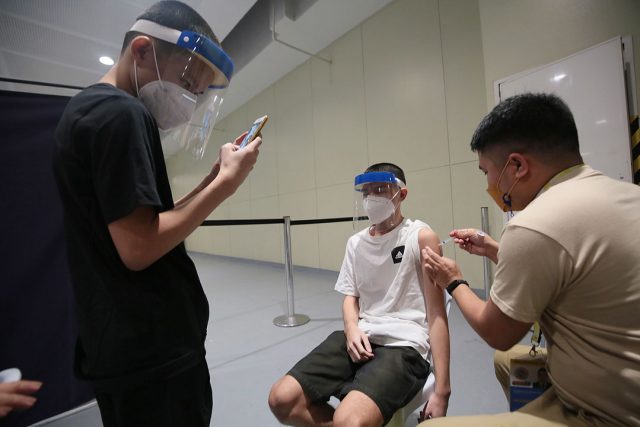
Weekends with the family will be more fun to celebrate at SM Supermalls as its Vax, Shop, and Dine will be taking your bakuna benefits up a notch!

Vaccinated SM Supermalls shoppers will be treated to exclusive promos, deals, and freebies starting this Friday, December 3, until December 5 during the #VacForGood weekend. Over 2,000 stores and restaurants under the ongoing Vax, Shop, and Dine will be participating in this three-day all-out rewards program. What’s more, is that exciting deals are prepared for 12- to 18-year-old shoppers who have been fully vaccinated as well.

Celebrate a ‘jab’ well done and get a free meal or special combo deals or product bundles when you present your vaccination cards and valid ID in any participating restaurant like Blackbeard Seafood Island, Buffet 101, Vikings, Ramen Nagi, Marugame Udon, Max’s Restaurant, and Tim Ho Wan.

Enjoy an upsize or upgrade of your favorite drinks at Coffee Bean and Tea Leaf, Koomi, Buku Buku Kafe, and Macao Imperial Tea. You can also get 40% off when you shop at your favorite retail brands like Keds and Old Navy.

Apart from that, vaccinated shoppers can also get free premium items or big discounts from George Optical, Great Image, LOOK, Ideal Vision, and National Book Store.

“Now that Christmas is just around the corner, the best gift that our shoppers can give themselves and their families is the gift of protection from COVID-19. We highly encourage everyone to get vaccinated and reap its multitude of benefits and rewards, including our #VacForGood deals and promos made especially for them. We look forward to more families, friends, and loved ones coming in here and spending more time together,” said Steven Tan, SM Supermalls President

So, after getting your COVID-19 shot at SM, check out and enjoy your exclusive rewards and special treats at SM Supermalls! Or if you haven’t been vaccinated yet, register for a vaccine slot as soon as possible and don’t miss out on SM Supermalls’ exciting Vax, Dine, and Shop promos just for you!

For the full list of promos at SM, check out the SM Supermalls website. And for more updates, visit www.smsupermalls.com and follow @smsupermalls on social media.


Spotlight is BusinessWorld’s sponsored section that allows advertisers to amplify their brand and connect with BusinessWorld’s audience by enabling them to publish their stories directly on the BusinessWorld Web site. For more information, send an email to online@bworldonline.com.

Join us on Viber to get more updates from BusinessWorld: https://bit.ly/3hv6bLA.

[B-SIDE Podcast] Money Talks: Graduating to investing from saving

Follow us on Spotify BusinessWorld B-Side

Money Talks is a series on personal finance sponsored by Metropolitan Bank & Trust Co. (Metrobank). 

Money is on the mind of many people, particularly amid the COVID-19 pandemic. A recent study titled “State of Banking and Financial Wellness” by US-headquartered research firm Forrester, commissioned by fintech company Backbase, found that more than half (58%) of Filipinos identified building savings (58%) and planning for retirement (52%) among their concerns in personal finance. Debt is a top concern, with 70% of Filipinos citing it as a challenge in financial management.

In this B-Side episode, Chorie Chan, first vice-president and head of the Financial Markets – Investment Distribution Division for Countryside at Metrobank, talks money with BusinessWorld, and how the pandemic has changed how we view and think about it.

TAKEAWAYS 

What has changed, and what hasn’t

“I have been in banking for over 27 years now and what the pandemic taught me is this: the basic tenets of saving, budgeting and investing are still there. Am I saving enough? Am I spending too much? How should I budget my finances?” Ms. Chan said.

“No matter how you think about it, no matter if you compute for unforeseen expenses, if you still have an extra amount that you couldn’t possibly need, then we talk about investing. That’s still a universal truth that has not changed over the years, pandemic or not. A universal truth that has probably evolved over the years and more so in the pandemic, would be the need to have better returns, and the need for diversity in what you can possibly invest in.”  

We must be able to assess our own financial wellness

People need to reassess how they view money in an environment of uncertainty.

“Before we seemed to have that confidence in stability. Stability of where we are if we have businesses, if we are employed. We kind of were able to project that ‘I’m still going to have this income stream in the next couple of years.’ But lo and behold, the pandemic happened, and none of us are as certain as before that this could persist in the years or months to come,” Ms. Chan said.

“This has become too pressing for all of us that we might want to consider expanding or deepening that amount of savings that we might need anytime soon to beyond the six-month requirement for expenses.”

Saving is not investing

“I don’t equate saving with investing. A lot of us get confused that when we have extra from our inflows minus the outflow, we automatically consider that as an investable fund,” Ms. Chan said.

“Liquidity. The ability for anyone to convert savings into cash. Liquidity means that you are able to access your money in whatever form it is in and be able to use it for an unforeseen expense. So if there is any doubt in your mind that if say, a family member would need help or your car need maintenance in a few months, then there is an amount that you should always keep liquid, so you can spend for that unforeseen need.”

Explore various ways to manage portfolio

At the end of the day, what you need to do about saving and investing will have to depend on what you need and what you hope to accomplish. “There’s a whole wide world of ways… to discuss how and why and in what manner you can construct your portfolio. At the end of it all, it will have to be about your investment objectives, your tolerance for risk, and your requirement for liquidity,” Ms. Chan said.

“The critical point that an investor has to be mindful about is the access to these financial investments, securities, or assets is so free that you can actually approach any financial institution that you’re comfortable dealing with and be led to talk to specialists within that institution. Ask them, feel free to explore, talk to people who are in touch with financial markets so they can sit down with you. Advice is free, I’m sure. And they can profile your suitability and your preferences and match these with your needs and objectives.”  


Recorded remotely Nov. 4. Interview by Santiago J. ArnaizBusinessWorld contributor and chief operating officer of health startup Day3 Innovations. Research by Bjorn Biel “JB” M. Beltran. Produced by Paolo L. Lopez and Sam L. Marcelo.

Follow us on Spotify BusinessWorld B-Side

Cebu Landmasters solidifies leadership in VisMin property market

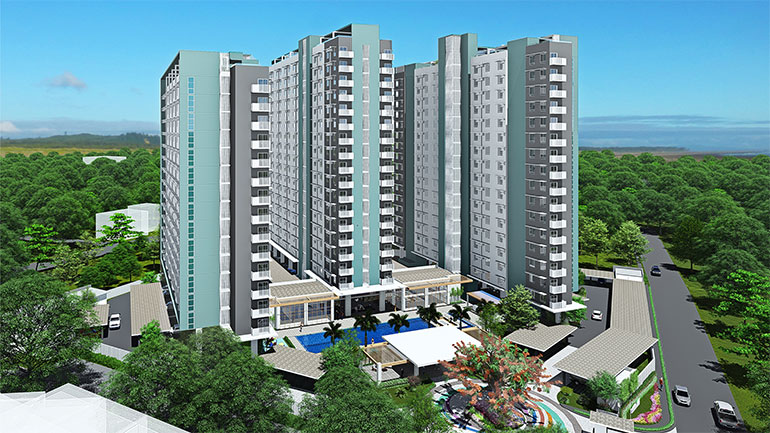
Davao Global Township (DGT) is envisioned to transform the 22-hectare Davao Golf Club into a central business district of Davao City. Phase 1 of the development is set to be completed in 2023. It includes The DGT City Center, a retail component whose design was recalibrated to address the needs of the new normal. It has rich landscape features with open walkable spaces.

Widely recognized in 2021 Philippines Property Awards, Cebu Landmasters surpasses full-year 2020 performance in nine months

Despite the industry-spanning effects of the COVID-19 pandemic across all regions, leading developer in Visayas and Mindanao Cebu Landmasters, Inc. (CLI) is outperforming in the Philippine real estate sector as it grows its year-on-year revenues by more than a third compared to last year.

CLI attributed the impressive growth to robust sales and construction progress due to 100% operating capacities at its sites. Revenues were recorded growing 34% from P5.7 billion to P7.7 billion. Meanwhile, nine-month net income grew strongly by 23% year on year to P1.854 billion from 2020’s P1.5 billion.

CLI announced that it has recorded a net income of P1.854 billion in the first nine months of 2021, surpassing its full-year 2020 figure of P1.845 billion.

The bulk or 44% of third quarter revenue was contributed by CLI’s popular economic housing brand Casa Mira, with the fast-selling mid-market Garden Series accounting for 30%, and the high-end Premier Masters contributing 24%.

As much as 59% of the revenues were from Cebu, the biggest metropolis in the Visayas-Mindanao (VisMin) region, while strong and growing sales in other key cities contributed the rest. Namely, Cagayan de Oro took credit for 10%; Bacolod, 10%; Iloilo, 10%; and all others, 11%.

“The pandemic has emphasized to our buyers the importance of and impact to family stability of owning a home in a safe and secure community. We will continue to meet this need and to earn the trust of VisMin homeowners moving forward,” CLI chairman and Chief Executive Officer Jose Soberano III said in a statement.

The company’s growth momentum in 2021 was sped up by seven projects collectively worth P12 billion, or significantly more than the P5.5 billion value of launches recorded in 9M 2020. As of end-September, 77% of 2021 launches were already sold out.

CLI has already sold out 90% of its inventory across all projects in different stages of development allowing the firm to record unrecognized revenue of P24.2 billion, up 19% from P20.6 billion as of the end of 2020.

CLI’s quarterly performance further cements the company’s three-year lead in the residential development sector in the VisMin region according to a 2021 market study by Santos Knight Frank (SKF). The listed company has held the largest market share among the region’s real estate firms providing condominium and subdivision projects. CLI has close to 100 projects in different stages of development in 15 key cities all over Visayas and Mindanao.

The firm was even recently recognized as the Best Developer for Visayas and Mindanao by PropertyGuru Philippines during the eponymous PropertyGuru Philippines Property Awards 2021.

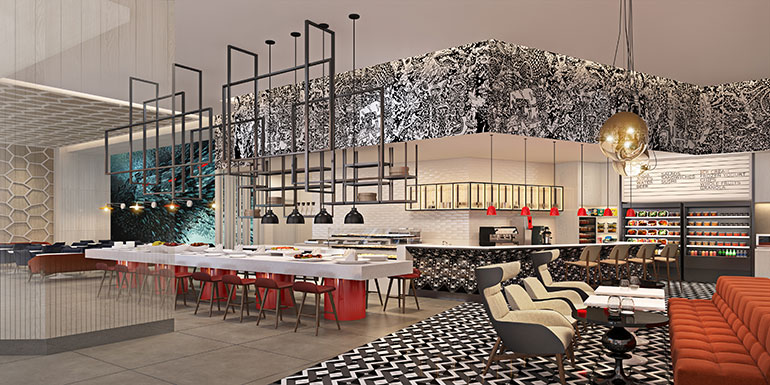
The Best Developer awards were alongside nine other significant recognitions, including Best Township for Davao Global Township; Best Mega Mixed-Use Development for Patria de Cebu; Best Condo Development (Visayas) for MesaVirre Garden Residences; Best Affordable Condo Development (Metro Cebu) for Casa Mira Towers Mandaue; Best Condo Development (Metro Davao) for One Paragon Place; Best Housing Development (Mindanao) for Velmiro Uptown CDO; and Best Hotel Interior for Radisson RED.

CLI also won Special Recognition in ESG and Special Recognition in Sustainable Design and Construction by the same award-giving body.

For CLI, these accolades, together with the listed company’s financial performance, cement its leadership in the region.


Spotlight is BusinessWorld’s sponsored section that allows advertisers to amplify their brand and connect with BusinessWorld’s audience by enabling them to publish their stories directly on the BusinessWorld Web site. For more information, send an email to online@bworldonline.com.

Join us on Viber to get more updates from BusinessWorld: https://bit.ly/3hv6bLA.

Inflation likely eased in Nov. — poll

PHILIPPINE STAR/ MICHAEL VARCAS
Fuel retailers slashed pump prices for four weeks in a row in November. — PHILIPPINE STAR/ MICHAEL VARCAS

HEADLINE INFLATION likely eased in November amid a slower rise in food prices and a drop in pump prices, analysts said.

A BusinessWorld poll of 18 analysts yielded a median estimate of 4% for the November inflation, which is near the upper end of the 3.3% to 4.1% estimate given by the Bangko Sentral ng Pilipinas (BSP).

If realized, last month’s consumer price index (CPI) will be within the 2-4% target range by the BSP and slower than the 4.6% in October but quicker than the 3.7% logged a year earlier.

Analysts’ November 2021 inflation rate estimates

The Philippine Statistics Authority will release the November inflation report on Tuesday (Dec. 7).

The reduction in global oil prices likely helped soften the rise in the CPI in November, analysts said.

“Prices could slow down due to the decline in oil prices but prices of other basic commodities remain high. Hopefully, the opening up of the global economy will increase supply,” Mitzie Irene P. Conchada, an economist from the De La Salle University, said.

Dubai crude prices fell by $4.9 per barrel in November, based on data from the Department of Energy. There are concerns the fresh spike in coronavirus disease 2019 (COVID-19) cases, as well as the emergence of new variants such as Omicron, could hurt global economic recovery.

Local oil companies on Nov. 30 cut pump prices for gasoline by P1.10-P1.20 per liter, diesel by P0.60-P0.70 per liter, and kerosene by P0.50 per liter. Year to date, pump price adjustments are still at a net increase of P18.10/liter for gasoline, P15.70/liter for diesel, and P13.19/liter for kerosene.

“The impact of the emergence of the Omicron variant on inflation is highly uncertain. In the short term we may see global oil and commodity prices soften in anticipation of lower global demand,” said Makoto Tsuchiya, an economist from Oxford economics.

Meanwhile, Dabalika Sarkar, an economist from ANZ Research, said “some mild moderation in food prices” likely helped to slow inflation in November.

Rizal Commercial Banking Corp. Chief Economist Michael L. Ricafort agreed, citing better weather conditions during the month.

Despite possible faster month-on-month rise in prices ahead of the holidays, November inflation will benefit from favorable base effect, Security Bank Corp. Chief Economist Robert Dan J. Roces said.

The CPI rose by 4.5% in the first 10 months of 2021. Inflation was beyond the BSP’s target so far this year, except July, as low meat supply caused prices to spike.

The central bank expects inflation to average by 4.3% this year, before easing to 3.3% and 3.2% by 2022 and 2023.

Analysts expect the BSP will maintain an accommodative policy to support economic recovery.

“The discussion abroad of whether inflation is transitory or not looks less relevant for us, since I’m seeing a continued easing of inflation rates until the first quarter of 2022, and only slight upward movements thereafter but staying within BSP target,” Victor A. Abola, an economist from the University of Asia and the Pacific, said.

US Federal Reserve officials in recent weeks have become more hawkish, with Fed Chairman Jerome H. Powell saying it was time to stop talking about “transitory” inflation. He added that officials should discuss a quicker winding down of the bond-purchase program.

The BSP will likely instead focus on gross domestic product (GDP) growth rather than the November inflation outturn, said Alvin Joseph A. Arogo, vice-president and head of equity research division at Philippine National Bank.

“The BSP will be comfortable to start the hike cycle when the economy is nearer its fourth-quarter 2019 level, which we estimate will occur in the fourth quarter of 2022,” Mr. Arogo said.

The Philippine GDP expanded by 7.1% year on year in the third quarter, bringing year-to-date growth to 4.9%. The government set a 4-5% GDP growth target this year, a turnaround from the record 9.6% contraction in 2020.

BSP Governor Benjamin E. Diokno has said there is a need to keep an accommodative policy to support economic growth that is gaining traction.

In its Nov. 18 policy review, the Monetary Board kept interest rates at record low, even as it cautioned on upside risks to inflation next year.

The central bank’s last policy review meeting for the year is on Dec. 16. Mr. Diokno has earlier said he does not see the need for rate adjustments until the end of 2021. — Luz Wendy T. Noble

Big PHL banks post fastest asset growth since onset of pandemic

BW FILE PHOTO

THE THIRD QUARTER saw the country’s biggest banks post the fastest asset growth since the start of the coronavirus pandemic, while aggregate loans rose for the first time in a year.

The latest edition of BusinessWorld’s quarterly banking report (see S4) showed the combined assets of 44 universal and commercial banks (U/KBs) expanded by 8.97% to P19.822 trillion in the July-September period, from P18.190 trillion in the same three months of 2020.

The third-quarter asset growth performance marked the fastest in eight quarters, or since the year-on-year expansion of 9.89% recorded in the third quarter of 2019.

Big banks’ asset growth picks up pace as loans recover

Meanwhile, aggregate loans in the third quarter grew by 3.24% to P9.739 trillion, a reversal of the year-on-year declines of 5.6% and 0.74% in the second quarter of 2021 and the third quarter of 2020, respectively.

The loan growth in the three months to September snapped four straight quarters of decline.

The median return on equity (RoE), which is an indicator of profitability, improved to 3.36% in the third quarter from 2.77% in the preceding quarter. However, this was still lower than the 4.13% RoE in the third quarter of last year.

Bad loans, also known as nonperforming loans (NPL), rose by 2.8% to P400.08 billion from P389.16 billion in the second quarter of 2021. Compared with the third quarter of 2020, NPLs went up by 39.5%.

This brought the NPL ratio, or the portion of bad loans to the total loan portfolio to 4.49% in the third quarter, slightly less than the 4.67% in the second quarter of 2021 but still higher compared with last year’s 3.57%.

Loans are considered to be nonperforming once they are left unpaid at least 30 days beyond the due date. They pose a risk to the lenders’ asset quality as borrowers are likely to default on these debts.

Likewise, the U/KBs’ nonperforming asset (NPA) ratio — or the NPLs and foreclosed properties in proportion to total assets — was 1.43%, lower than the previous quarter’s 1.46%, but higher than last year’s 1.24%.

Relative to total assets, foreclosed real and other properties stood at 0.26%, roughly the same from the second quarter. This was, however, a tad lower compared with the 0.29% posted in the third quarter of 2020.

Total loan loss reserves reached P353.525 billion during the period, bigger than the preceding quarter’s P338.535 billion and last year’s P294.805 billion.

The big banks’ median capital adequacy ratio — or the ability to absorb losses from risk-weighted assets — stood at 20.80%. This was lower than the 22.34% in the second quarter of 2021 and 21.02% in the third quarter of 2020 but remained above the required minimum of 10% set by the Bangko Sentral ng Pilipinas and the international standard of 8% set under the Basel III framework.

BDO Unibank, Inc. remained the biggest bank in terms of assets with P3.487 trillion, followed by Land Bank of the Philippines (LANDBANK) with P2.902 trillion and Metropolitan Bank & Trust Co. (Metrobank) with P2.438 trillion.

The three banks also had the most deposits with P2.736 trillion for BDO, P2.557 trillion for LANDBANK, and P1.852 trillion for Metrobank.

BDO issued the most loans with P2.233 trillion, while Bank of the Philippine Islands and Metrobank came in at second and third with P1.382 trillion and P1.147 trillion, respectively.

Among U/KBs with assets of at least P100 billion, LANDBANK posted the fastest year-on-year asset growth with 28.41%, followed by the Bank of Commerce (25.13%) and Rizal Commercial Banking Corp. (19.71%).

LANDBANK also saw the quickest growth in loans during the period with 19.53%, along with the Development Bank of the Philippines’ 16.55% and Robinsons Bank Corp.’s 15.46%.

BusinessWorld Research has been tracking the financial performance of the country’s big banks on a quarterly basis since the late 1980s using banks’ published statements.

The statements of conditions of two U/KBs were not available as of Nov. 26 when the compilation of the financial data was concluded. The two banks are Bank of China Ltd. and Mega International Commercial Bank.

The full version of BusinessWorld’s quarterly banking report will soon be available for download at www.bworldonline.com. — Bernadette Therese M. Gadon

Philippines faces another infection wave as Omicron looms

PHILIPPINE STAR/ MICHAEL VARCAS

By Kyle Aristophere T. Atienza, Reporter
and Norman P. Aquino, Special Reports Editor

PAULINE F. CONVOCAR, a Filipino emergency physician, had to turn down patients upon patients when a coronavirus surge spurred by a more contagious Delta variant nearly exhausted the country’s health system in the past quarter.

Now, she’s worried of another wave of infections from the Omicron variant — scientists on Friday said this one appeared to spread more than twice as quickly as Delta — just as the Philippines relaxed lockdowns amid decreasing cases.

“This new variant gives us that feeling of uncertainty again because we do not yet fully know how it behaves,” Ms. Convocar, who heads the Philippine College of Emergency Medicine’s advocacy section, said by telephone. “It poses another uncertainty.”

Scientists around the world are racing to understand how widespread Omicron is and how severe a threat it may pose. For one, it’s still unclear whether or to what extent the virus first detected in South Africa may resist existing vaccines.

In the United States, a hunt for the variant started last week when South African researchers announced Omicron’s array of worrisome mutations. The search has intensified in recent days, with at least 12 states identifying cases, the New York Times reported on Sunday.

At the Philippine Genome Center (PGC), medical experts are racing to screen samples from international travelers to see if Omicron has arrived.

They have yet to detect the virus after screening 18,000 samples, PGC Executive Director Cynthia P. Saloma told a televised news briefing at the weekend, but “it is possible that it has entered our borders. We are on the lookout for that.”

Philippine shares slightly gained on Friday as investors turned a bit optimistic after Wall Street’s rally, but trading remained sluggish amid lingering concerns over the pandemic.

Wall Street’s major indexes closed lower on Friday as investors grappled with uncertainty around the Omicron coronavirus variant.

As part of easing quarantine rules, the Philippine government last month started allowing children in Manila, the capital and nearby cities in malls after they were holed up in their houses for the past 20 months.

Now, all parts of the country are under Alert Level 2, the second most relaxed lockdown level.

As the Omicron variant came to light, the government said it would allow fully vaccinated foreigners to enter the country starting Dec. 1, even as it banned flights from several African countries where the variant was present. It scrapped the plan days later.

A group of private hospitals is preparing for a potential spike in Omicron coronavirus infections. Jose Rene de Grano, president of the Private Hospitals Association of the Philippines, Inc., told ABS-CBN Teleradyo last week they are ready in case of another infection wave.

He said they have ample supply of oxygen and vacant beds amid decreasing cases in recent weeks.

The new “variant of concern” gives the world a glimpse of where the pandemic might be headed. It should also prompt the government to focus on evidence-based policies and listen to the calls of the health sector, said Joshua L. San Pedro, a medical doctor who started the Coalition for People’s Right to Health.

“Evidence-based policies should be the standard by now, almost two years into the pandemic,” he said in a Facebook Messenger chat. “Learning from other countries’ experience as well as ours, there is some semblance of what is effective and how it ought to be implemented.”

PANDEMIC GAPS
Mr. San Pedro said the government has done very little to boost health facilities and increase health staff. It has to see the gaps in its pandemic response and do something about it.

“As we saw with previous surges, every new one seems to be worse than the one before it.”

The government also can’t rest on its vaccination laurels when there are still provinces without testing laboratories, its contact tracing system remained weak and there’s growing public complacency, Mr. San Pedro said.

Many countries with much higher vaccination rates have experienced some of the worst coronavirus spikes, he added.

There’s also the problem of understaffed hospitals, said Maristela Presto-Abenojar, president of Filipino Nurses United.

The chronic nursing shortage in one of the world’s top sources of health workers has existed even before the coronavirus pandemic, she pointed out.

Local governments only have 5,656 public nurses, while the National Government has 18,994, Ms. Abenojar said, citing government data. Ideally, there should be at least one nurse in each of the country’s 42,046 villages, she added.

“In addition, there are only 30,396 nurses in 202 public hospitals working three shifts a day and/or two shifts a day for a 12-hour duty,” she said.

In 1,170 state-licensed private hospitals, there are only 34,840 nurses working three shifts a day, she added.

“For the last two years, nurses, doctors and other health workers were referred to as heroes on the frontline taking care of more than 2 million COVID-19 patients nationwide,” Ms. Abenojar said. “But they have become sacrificial lambs in this pandemic battle.”

At the heart of a major breakdown of the country’s healthcare system earlier this year, overworked and underpaid nurses and caregivers protested and threatened to quit their jobs.

“We have not heard any ambitious proposals yet to address health workforce shortage and burnout,” said Renzo R. Guinto, a doctor and associate professor of global public health at the St. Luke’s Medical Center College of Medicine. “We are still relying on health workers’ sense of volunteerism.”

He noted that as 2022 beckons with potentially more coronavirus variants emerging, the country is still largely “using the 2020 playbook for pandemic response with a largely pre-pandemic healthcare infrastructure.”

“After almost two years since the pandemic began, we are still resorting to reactive rather than anticipatory approaches,” he said in a Facebook Messenger chat.

The Philippines needs a “Marshall plan” to revitalize its public health system, Mr. Guinto said, adding that the government should invest in research and surveillance activities that will detect disease-causing pathogens “to make sure we do not become the ground zero for the next pandemic.”

“COVID-19 already revealed to us the myriad defects of our health system, and unfortunately we are not using the pandemic period to fix many of these problems,” he said.

Joey Francis Hernandez, a doctor and treasurer of the Philippine Society of Public Health Physicians, said the country needs a community-based approach instead of a heavy-handed militarist one that tries to silence critics.

People from communities must be part of public health conversations, he said in a Messenger chat. Contact tracing is also useless “if we’re not going to do anything about the data we collected.”

“With our numbers improving, contact tracing and accessible testing should be emphasized again to keep our numbers low and even lower,” he said. “However, that has to be through a stronger national push with solid, coordinated efforts from the local governments.”

Mr. Hernandez said authorities should ditch policies that are not enforceable.

In jeepneys, for example, it’s better to ensure that everyone wears a mask and hand sanitizers are provided instead of limiting their capacity by setting up plastic barriers, he pointed out.

Policy makers should heed the advice of scientists and public health experts before anyone else. “COVID response should be led by scientists and public health experts, and not generals and politicians.”

“Even if we’re tired, we’d rather take a rest and soon get back to work and try to really hold the line,” said Ms. Convocar, the emergency physician. “We are the first to stand and the last to fall. We have to be brave for the others.”

Anti-dumping duties slapped on cement exporters from Vietnam

THE DEPARTMENT of Trade and Industry (DTI) has slapped provisional anti-dumping duties as high as 32% on specific Portland cement brands from Vietnam, as these were found to be causing “serious injury” to local cement manufacturers.

In a statement on Sunday, DTI said a preliminary determination showed that nine out of 16 Vietnamese exporters of Type 1 cement and four out of 12 exporters of Type 1P cement have been dumping cement in the Philippines.

The provisional anti-dumping duties on Type 1 cement starts at $1.02 per metric ton (/MT) or 2.69% of the price, to $10.53/MT or 31.87% of the price.

“The nine exporters account for 82% of total imports of Type 1 cement. These provisional duties are estimated to add P2.01 to P25.08 to the import cost of a 40-kilogram bag of cement,” DTI said. 

Meanwhile, Type 1P cement exported from Vietnam will be slapped with provisional duties ranging from $1.16/MT or 3.8% of the price, to $12.79/MT or 29.20% of the price.

“These provisional duties are estimated to add P2.01 to P25.08 to the import cost of a 40 kg (kilogram) bag of cement, but this is not expected to be passed on to the users due to strong competition from local and other imported brands,” the Trade department said.

The imposition of anti-dumping duties stemmed from the petition filed by Republic Cement & Building Materials, Inc., CEMEX – Solid Cement Corp. and Apo Cement Corp., and Holcim Philippines, Inc. 

The DTI found that dumped cement exports from Vietnam accounted for 55% of total Philippine imports from July 2019 to December 2020.

Dumping occurs when exporters sell their products to an importing country at a lower price compared with its normal value when used in the home market.   

Based on the World Trade Organization (WTO) anti-dumping agreement, member countries are allowed to impose anti-dumping duties to mitigate any injury to the local industry.

Trade Secretary Ramon M. Lopez said the provisional anti-dumping duties is not expected to cause a spike in the retail price of cement.   

“We do not anticipate that these duties will result in an increase in the retail price of cement because its effect on landed cost is minimal. Any price increases in imported cement will be discouraged by competition from domestic cement producers,” he said in the same statement.

Mr. Lopez said the duties will only be imposed on specific Vietnamese exporters discovered to be dumping cement to the Philippines.   

“Vietnamese exporters who are not dumping can continue to export cement without having to post the provisional anti-dumping cash bond,” he said.

Meanwhile, the case will be forwarded to the Tariff Commission that will conduct a formal investigation and check if the anti-dumping duty will be made permanent. — Revin Mikhael D. Ochave

Banks told to adapt as gov’t starts to unwind support from pandemic

By Lourdes O. Pilar, Researcher

WITH ECONOMIC RECOVERY expected to be underway, banks will have to tailor their relief measures accordingly as authorities begin unwinding its support to the financial sector.

This sentiment was reflected by Bangko Sentral ng Pilipinas’ (BSP) Governor Benjamin E. Diokno at a virtual convention of the Chamber of Thrift Banks on Oct. 12. In that event, Mr. Diokno encouraged banks to grant financial relief that considers the borrowers’ payment and risk-bearing capacity as lenders are not similarly affected by the coronavirus disease 2019 (COVID-19) pandemic.

Mr. Diokno added the BSP believes financial institutions have already been given enough time to assess their loan portfolio and that the central bank is “constrained from extending regulatory relief measures provided” as they will affect the banks’ viability and their capacity to continue lending.

Some of the relief measures provided by the BSP have already lapsed. For instance, the central bank’s recognition of allowances for loan losses on a staggered basis for all types of credit for retail and business borrowers affected by COVID-19 has ended on March 8.

Meanwhile, others are scheduled to lapse by the end of this year such as the reduction of the credit risk weight of loans to micro-, small-, and medium-sized enterprises (MSMEs) to 50%, the lower minimum liquidity ratio (MLR) of 16% for thrift banks from 20% previously, and the higher single borrowers’ limit (SBL) of 30% for banks from 25%.

The BSP has also permitted lenders to count their lending to MSMEs and pandemic hit large enterprises as part of banks’ alternate reserve compliance until the end of next year or will be reviewed once the limits of P300 billion for MSMEs and P425 billion for large firms would be reached.

To recall, the central bank in late April last year reduced the reserve requirement ratio (RRR) for thrift banks to 3% from 2% to provide a liquidity boost amid the ongoing pandemic. It was later extended to pandemic-hit large enterprises but are only applicable to those with asset sizes of more than P100 million but are not part of a conglomerate. 

The BSP in December last year capped credit to MSME and large enterprises that banks could utilize as alternate reserve compliance at P300 billion and P425 billion, respectively.

In an e-mail to BusinessWorld, the BSP said the unwinding of the temporary relief measures “will be done in a gradual, prudent, and informed manner.”

“The time-bound nature of the BSP’s support measures allows for an orderly transition based on a holistic analysis of the impact of the COVID-19 not only on the financial system but also on other critical sectors of the economy. In particular, the BSP will consider the pace of liquidity and credit growth; improvements in market confidence and financial market activity, including the bond markets; recovery in consumer spending and private sector investment; and stability of the financial system,” the BSP said.

The BSP has emphasized the need for timely communication of policies and decisions in setting expectations as the government strikes a delicate balance between providing debt support to struggling households and firms affected by the COVID-19 pandemic and, at the same time, guard against the buildup of inflationary pressures and risks within the banking system.

As of this writing, the BSP is still assessing the duration of some of the policy relief measures it has implemented during the pandemic.

What is clear is that the central bank is retaining some of these measures at least until next year.

“The relief measures that incentivize lending to sectors such as underserved market segments, MSMEs and critically impacted large enterprises will be retained for as long as necessary to support their recovery,” the BSP said.

They also cited the recently issued two regulations that will further give banks an incentive to grant new loans or restructure the loan accounts of their borrowers.

“The first measure clarifies the prudential treatment of modifications to loan terms, including restructuring arrangements, and will be in effect until [Dec. 31, 2022]. The second measure allows banks to add back to their capital, the increase in provisioning requirements applicable to new and restructured loans starting [Jan. 1, 2022 until Dec. 31, 2023],” the BSP said, explaining these measures look to temper the impact of provisioning requirements on new and restructured loans on capital which will provide banks with room to further tailor loan terms to their clients’ requirements. 

TAILORED APPROACH
On top of these measures, the BSP has allowed banks to provide financial relief to their borrowers through loan payment terms that considers their paying capacity and cash flows.

“This tailored approach will allow banks and their clients to arrive at mutually agreeable loan payment terms that consider the bank’s financial capability and the client’s requirements. This also increases likelihood of loan collection rather than loan default,” the BSP said.

With this flexibility, banks are expected to look into the borrowers’ reputation, as well as the purpose of credit, and sources of repayment and capacity to repay based on cash flow projections, the BSP said. In the case of commercial credits, the BSP said banks should consider the firm’s business expertise, its credit relationships including its shareholders and directors, and the status of the borrower’s economic sector, among others.

“It is also important for the bank to distinguish between borrowers that are facing serious or temporary financial difficulties and employ the appropriate risk management and remedial or workout measures on their exposures to these borrowers,” the BSP noted.

In an e-mail, Development Bank of the Philippines (DBP) President and Chief Executive Officer Emmanuel G. Herbosa noted that in addition to payment moratoriums, waiver of penalties and other fees and additional low-interest facilities, the bank has also “proactively implemented loans restructuring… to recalibrate and adjust the payment schedules and terms of outstanding loans of enterprises given the new realities of their operations.”

“Conditions that are now the ‘new normal’ of their business transactions are considered in either extending loan tenors, repricing loans, extending grace periods, and other payment schemes that allow the bank to capture cash flow for repayment without impairing the businesses’ capacity to operate sustainably,” Mr. Herbosa said.

For its part, BDO Unibank, Inc. said it has proactively engaged with its borrower clients to help them weather the challenges brought by the health and economic crisis.

“We ensured continued access to credit facilities for clients with resilient and sustainable business models amid the pandemic, as well as granted loan moratoria to qualified customers in compliance with Bayanihan Acts I and II,” BDO said.

BDO added it offered loan restructuring packages for its clients in the hard-hit travel, tourism, retail, and transportation sectors to tailor fit cash flow capabilities that are specific to their needs.

Thrift bank Bank of Makati, Inc. (BMI) also provided loan restructuring, as well as payment arrangements and the waiving of penalties among their qualified clients.

BMI said it would be favorable for bank if the BSP retains some of its relief measures such as the use of qualified MSME loans for compliance with reserve requirements, the lower risk weight for qualified MSME loans for the purposes of CAR (capital adequacy ratio) computation.

DBP’s Mr. Herbosa shared a similar assessment, noting that the measures that reduced credit risk weights of loans to MSMEs, the staggered booking of allowance for credit losses, and the counting of MSME loans as compliance to the RRR “greatly enhanced” DBP’s ability to continue lending to those that were most adversely affected by COVID-19.

“Without such relief measures, the bank’s capital ratios would not have been able to carry the additional risks of continuous on-lending to distressed industries,” Mr. Herbosa said.

Nevertheless, Mr. Herbosa said the prevailing economic conditions has compressed the state lender’s margins this year.

“The low interest rate environment resulting in a lack of high-yielding investment instruments, as well as the bank’s mandate to lend to distressed sectors at below market rates, have limited its capacity to generate profits. Additionally, due to a number of loans falling past due this year, the provisioning requirements for non-performing loans have further reduced its bottom line. Its thinning margins has caused the Bank to prioritize and carefully consider its interventions and assistance, recognizing its own institutional challenges,” Mr. Herbosa said. 

“[A]s a licensed universal bank, DBP also maintains the same minimum capital and other regulatory ratios expected from private commercial banks, therefore increased pressure on these ratios brought about by lending to risky sectors within a volatile economic environment further limits its capacity to extend more generous assistance. Unlike private commercial banks that can easily raise capital from the market, DBP’s options as a wholly government-owned development bank is limited and it can only increase its capital through income and direct capital infusion,” he noted further.

Likewise, ING Bank N.V. Manila Senior Economist Nicholas Antonio T. Mapa said the decision to allow lending to firms as alternative compliance for RRR “is a good relief measure given that the overall directive is to lower the RRR.” 

“This way, banks can free up more funds for lending activities,” he said.

Mr. Mapa added these relief measures should remain in place to further help bolster bank lending.

“Despite aggressive rate cuts by the BSP, banks have not passed on lower borrowing costs to consumers just yet. This is likely the reason why the lagged impact of policy rate cuts has taken eight months.  With the economy still not fully healed, perhaps BSP should still encourage banks to lend and keep these measures until capital formation rebounds in a convincing manner,” Mr. Mapa said.

Latest data by the BSP showed outstanding loans by universal and commercial banks (U/KBs) increased 2.7% in September, following an annual 1.3% growth in August. Prior to that, it had declined for eight straight months.

OUTLOOK
As of the third quarter of 2021, the country’s gross domestic product (GDP) expanded by 4.9%, within the government’s revised 4-5% target range for the entire year.

The BSP said the country’s banks “remain cautiously optimistic, projecting positive business outlook in the next two years.”

“Results of the First Semester 2021 Banking Sector Outlook Survey show that banks will remain stable with prospects of double-digit growth (between 10% and 15%) in assets, loans, investments, deposits, and net income,” the BSP said.

“Meanwhile, results of the latest consumer and business confidence survey likewise indicate a more optimistic/encouraging outlook in the succeeding quarters. This is expected to prop up credit and lending activities in the coming months,” it added.

BDO noted that their clients can expect a further rollout in its new digital capabilities as investments in their digital capabilities bear fruit.

We launched early this year our mobile wallet, BDO Pay, and re-engineered our operations to allow paperless in-branch transactions, card-less ATM transactions using biometrics and QR codes, and fully digital account opening while continuing to ensure compliance with KYC (know-your-client) requirements,” BDO said.

DBP’s Mr. Herbosa was similarly upbeat: “Barring another surge in COVID-19 cases, the country may face a better economic environment in 2022 and moving forward. With recovery plans updated and readily in place, the bank in particular, is better prepared for a possible similar disruption in the future,” he said.

“The bank’s umbrella program for COVID-19, the DBP RESPONSE (Rehabilitation Support Program on Severe Events), will remain as its primary flagship credit assistance facility post-pandemic. Under the program, credit packages that are tailor-fit to the needs of affected industries and those that effectively support business transformation and resiliency will remain accessible to enterprises. This is in addition to grants from the National Government that may be tapped through DBP, such as the P1-billion interest subsidy fund for local government units for their pandemic recovery projects,” he explained further.

In line with market expectations, the BMI expects the economy to return to pre-pandemic levels by the second quarter of this year profits. BMI expects its MSME clients to start recovering from the effects of the pandemic.

“This market improvement would enable the Bank to focus on its strategies of creating a better customer experience for its clients. Aligned to its tagline of being a Malalapitan, Maaasahang Kaibigan (A Reliable Friend), the bank will be introducing new products and services that would cater to the changing needs of the market and empower existing and potential clients’ to recover and grow their businesses,” the thrift bank said.

ING Bank’s Mr. Mapa noted that while lenders have remained resilient throughout the pandemic, they have “largely remained on the sidelines in terms of contributing to the recovery story.”

“Lending rates have even increased after BSP rate cuts, which may have made it more difficult for consumers and firms to access much needed financing,” Mr. Mapa said.

“With the economy on surer footing this year, perhaps banks can join in and jump headlong to help contribute to the recovery by performing its primary function of delivering credit to real sector activities that in turn will fuel capital formation and drive GDP growth into higher gear,” he added.

Expanding MSME reach: A Q&A with Small Business Corp.

By Ana Olivia A. Tirona, Researcher

THE PAST TWO years have been rough on micro-, small-, and medium-sized enterprises (MSMEs). According to the Philippine Statistics Authority’s (PSA) List of Establishments data, the number of the country’s MSMEs fell by 4.3% to 952,969 in 2020 from 995,745 the year before. The closure of around 43,000 of these firms led to approximately 130,000 jobs lost.

While analysts and the country’s economic managers expect economic output to return to pre-pandemic levels as early as the second quarter of 2022, they recognize that the economy is still “not quite out of the woods yet.” For MSMEs, there still needs for state support as they continue to stave off financial collapse.

Small Business Corp. (SB Corp.), the financing arm of the Department of Trade and Industry (DTI), hopes to continue providing that support.

The funding institution originated in 1991 as the Small Business Guarantee and Finance Corp. (SBGFC) with the role to invest in MSMEs in manufacturing, processing, agribusiness and services (with the exception of crop level production and trading). Through an executive order, SBGFC was merged with Guarantee Fund for Small and Medium Enterprises (GFSME) in 2001 to what would become SB Corp.

Since then, SB Corp. has been pushing to innovate its financing services and strengthen its institutional partnerships to enhance the access of MSMEs to low-cost credit. By 2025, SB Corp. looks to be the “leader in building financing alternatives” for the country’s MSMEs that would put them at the “forefront of inclusive growth.”

In particular, SB Corp. actively targets seven MSME segments: micro and small agri and aqua enterprises, micro retailers, small island economies, MSMEs requiring rehabilitation arising from disaster, Islamic MSMEs, indigenous people (IP)-owned enterprises, and first-time small businesses.

To know more about the financing institution, BusinessWorld reached out to the management of SB Corp. regarding its current and future offerings for the aspiring Filipino business owner.

What changes did SB Corp. have to make as a result of to the pandemic? Were there operational challenges, and if so, how were these being dealt with?

The pandemic has challenged the way we do business. We shifted last year to online application and processing of loans to reduce or eliminate face-to-face interactions, and to also fast-track evaluation and approval. We also streamlined our requirements to reduce processing time and become more responsive to the needs of affected businesses.

We have developed products to cater to specific segments that were heavily affected, such as the tourism, overseas Filipino workers (OFW), and retail sectors, aside from vulnerable MSMEs in the manufacturing, trade, and service sectors.

In May 2020, we launched the CARES Program or the COVID-19 Assistance to Restart Enterprises Program, which provided interest-free, non-collateral loans with grace periods of up to one year and up to four years to pay.

The initial funding allocation for CARES came from the Pondo sa Pagbabago at Pag-asenso (P3) Fund, as approved by the Governing Board and DTI Secretary Ramon M. Lopez.

With the enactment of Bayanihan II, our loan funds for the CARES Program increased. Congress allocated P10 billion for the CARES Program as equity to SB Corp. under Bayanihan II. However, the Department of Budget and Management (DBM) only [earned] P8.08 billion in November 2020.

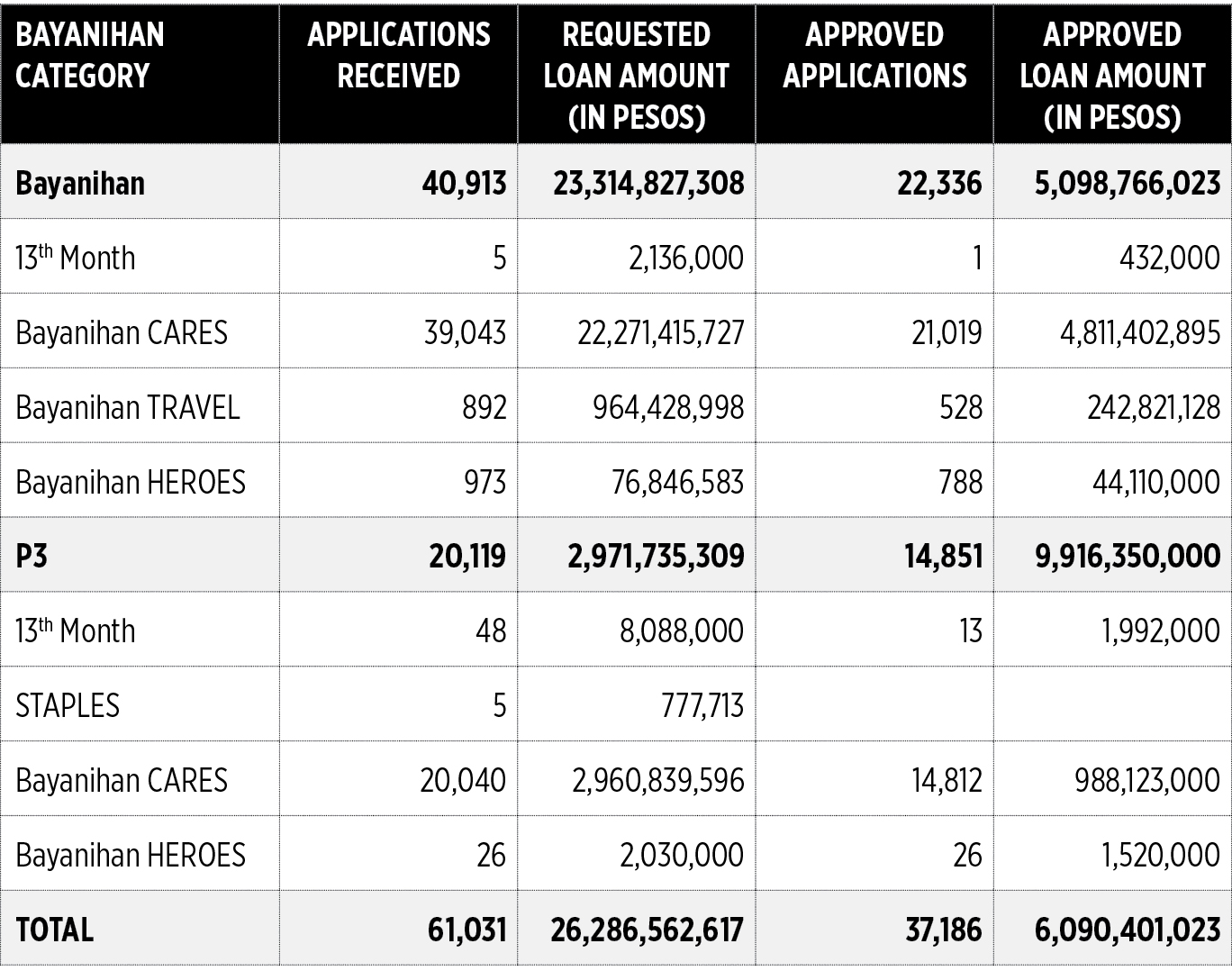
We re-launched CARES in Oct. 2021 and renamed it Bayanihan CARES. The loan products under the Bayanihan CARES program include Helping the Economy Recover Thru OFW Enterprise Start-ups (HEROES) for OFWs, CARES for Tourism Rehabilitation and Vitalization of Enterprises and Livelihood (CARES for TRAVEL), Sustaining Trade Access to Primary Food and Link to Enterprises (STAPLES) for sari-sari stores, mini groceries, and other micro and small businesses in the retail chain, and Bayanihan CARES, the product itself. Just last November, we launched a new product for a limited period, called the 13th Month Loan Facility to help micro and small businesses fund their mandatory 13th month pay for employees and workers.

The products we developed in response to the pandemic are on top of the loan products we have for the P3 Program and for our regular corporate lending. The pandemic has made us very busy in responding to the financing needs of the MSME sector, especially as we were mandated by the government to provide credit for early recovery and provided with additional funds for the purpose.

There were a lot of internal challenges to us, especially the reconfiguration of our information technology (IT) systems for us to migrate to online lending, and the maintenance of a high level of quality and efficiency in our work despite work from home arrangements. The government’s response to the pandemic has increased our workload significantly, and we have responded to the challenge given the limitations.

Your firm looks to be the leader in the building financing alternatives for Philippine MSMEs by 2025 as per your vision statement. In what ways did current conditions affect the realization of said vision?

The current conditions have afforded us opportunities to pursue our mandate as we cater to MSMEs that are so called “unfinanceable,” or those that pose higher risks which the private sector is unwilling or unable to finance. These include those affected by calamities and hazards, small island economies, agri-aqua MSMEs, micro and small retailers, indigenous peoples, and the like. We provide financing and other forms of assistance to help them grow so that they can eventually engage the formal banking and quasi banking sectors. We provide the bridges for them to become stable, viable and sustainable so that they can become “financeable” by the mainstream finance sector.

In the future, we will pursue more purposeful and strategic interventions into these vulnerable and marginalized sectors so that we can catalyze the countryside and aide in urban development through affordable financing products and terms.

How would you characterize the demand among MSMEs on the programs offered by SB Corp.? Would you say this demand has been met?

There has been a large demand for our products, especially as our flagship program, Bayanihan CARES which provide very soft terms. These terms are needed because of the current pandemic situation. They were designed so that they could really help and not become an added burden in the future. That is why there was a grace period of up to one year and up to four years to pay, on top of the zero interest and zero collateral required.

We could say that we have met the demand to the extent of the availability of the funds provided us by the National Government. An exception is the loan uptake for the CARES for TRAVEL Program which has been slow to take off because of the restrictions in traveling.

Which among your programs were most sought by MSMEs? Can you provide us figures illustrating this increase in demand?

SB Corp. has since been offering regular retail, wholesale, and microfinance wholesale lending programs to MSMEs and partner financial institutions. These are regular products which are offered based on the current market rates. When the COVID-19 pandemic happened, SB Corp. came up with the CARES Program in May 2020. This recovery financing assistance program has become the most sought-after program to date. With the initial P1.5 billion using SB Corp.’s P3 program fund, it expanded with the additional capitalization of P8.08 billion that was provided to SB Corp. upon the enactment of the Bayanihan 2 law in September 2021. The expanded CARES program is re-launched in October 2020 as “Bayanihan CARES.”

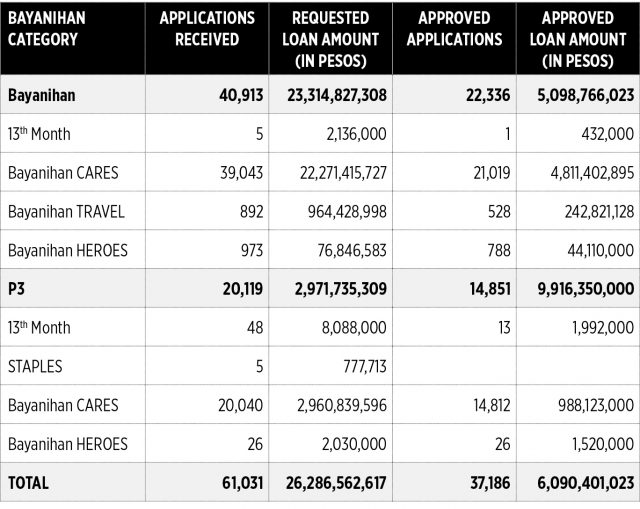
We received a total of 61,031 applications of which 37,186 have been approved as of Nov. 10, 2021. The total approved loan is P6.09 billion.

Among your Company’s target MSME segments, which one required the most assistance? What kind of assistance were provided to said segments?

Our existing financing programs and guidelines were designed to respond to the financing needs and realities of the different segments we serve. As such the segments can effectively access our products and services.

However, due to the very small sizes of their micro businesses, it is difficult to cater to clients of the P3 program on a retail basis. To improve access, we partnered with different private financing institutions who can identify them and visit them on a more regular and frequent basis. We provide soft, wholesale loans to these institutions, which they can relend, also at low rates to end borrowers. These institutions include rural banks, microfinance institutions, cooperative rural banks, and mother cooperatives.

What were the company’s target outcomes for this year? Would you say these targets have been met?

We have set out to provide more than P12-billion worth of loans to MSMEs all over the country for 2021. This is a 70% increase over our target in 2020. This is a tall order, but we are doing our best to achieve it so that we could help alleviate the condition of more MSMEs, as instructed by the National Government. We are hopeful we can achieve this target by the end of the year.

What are some of your concerns that need to be addressed as we go into 2022?

One of our foremost concerns is the extent of recovery experienced by our client borrowers, due to the series of lockdowns and restrictions that were imposed in 2021. We are looking at their situation pro-actively so that we could be prepared to help when they encounter problems in repayment, such as helping them to re-structure their loans to make their payment terms even more affordable. We foresee this to be a major concern as we move towards 2022.

Is there something, in terms of regulation or public policy, which you would want to be passed or enforced to help MSMEs cope with the persisting effects of COVID-19? If so, what are these?

We would like to lobby for an increase in capitalization so we could serve the MSMEs more, especially the priority sectors that have not been fully integrated into the economic mainstream, or are still very vulnerable to external shocks, such as climatic, physical and health hazards like this ongoing pandemic. The backbone of a healthy economy are resilient and sustainable MSMEs, and the more we help the unfinanceable sectors, the more we provide opportunities for broad-based development across the country. We are currently studying the nature and magnitude of the financing needs of these sectors, along with their potential impact on economic growth and poverty reduction, especially in the poorest municipalities all over the country. From these studies that we are conducting, we hope to convince Congress to provide for more loan funds and increase our capitalization.

What can we expect for SB Corp. coming into next year? Will there be new offerings? Modifications in current ones?

There will be new product offerings as we continue to adjust and tailor fit our products to the needs of the MSME sectors that we serve. We constantly innovate and study how we can be most responsive within our mandate, while adhering to government laws, policies, and regulations.

Any advice you can give to small- and medium-sized business owners coming in to 2022 and the years ahead?

We think they should all adjust to the so called new normal. This includes accessing financing assistance online, doing marketing online, availing of training and product development assistance online, and so on. Technology will be a key component and driver of success, even for MSMEs. We would advise our MSMEs to embrace this direction and prepare for it. Obviously, many are still technologically handicapped or have some aversion to using the internet for business and government transactions, or even just to obtain important information. As more and more people embrace mobile phone technology and online payment solutions, the MSMEs should also level up with the market, no matter how small they are. Information technology is a great equalizer.

We would also advise them to be on the lookout for government programs that try to assist them and be open to be accountable and responsible partners of the government in the growth of their businesses, and in the development of our country.

Anything else you would like to share with us?

Visit our website, www.sbcorp.gov.ph and our Facebook page, Small Business Corp. (facebook.com), to learn more about us.

PHL recovery hopes to support financial markets

ANALYSTS expect the country’s financial markets to recover along with the economy next year, but cautioned risks remain with the threat of the coronavirus disease 2019 (COVID-19), as shown by the mixed performance in the third quarter.

“In [the third quarter], financial markets showed mixed trends with investor sentiment influenced by various developments both domestically and externally,” the Bangko Sentral ng Pilipinas (BSP) told BusinessWorld in an e-mail.

The BSP said domestic financial markets were weighed by developments at home and abroad such as the renewed lockdowns to curb the spread of the more-infectious Delta variant and news on the US Federal Reserve’s plans to wind down its massive bond-buying program.

To recall, the government in August cut its economic growth target to 4-5% from 6-7% previously to reflect the effect of stricter mobility restrictions declared to curb the Delta-driven surge in COVID-19 cases in Metro Manila.

Furthermore, the account of the July 27-28 meeting showed Fed officials largely expecting to reduce the US central bank’s emergency monthly purchases of $120 billion of Treasury bonds and mortgage-backed securities.

The BSP also noted the forecast and outlook downgrades by the International Monetary Fund, the World Bank, ASEAN+3 Macroeconomic Research Office (AMRO), Oxford Economics, S&P Global Ratings, Moody’s Investors Service and Fitch Rating as among key factors in driving investor sentiment during the quarter.

On the other hand, the central bank also noted favorable macroeconomic data that lifted sentiment such as the faster-than-expected gross domestic product (GDP) growth in the second quarter and the sustained recovery in other metrics such as factory activity, corporate earnings, remittances from overseas Filipinos, foreign direct investments, unemployment, and domestic inflation.

These mixed developments reflect the results in the country’s financial markets.

In the third quarter, the Philippine Stock Exchange index (PSEi) averaged 6,751.98, up by 2.76% from the 6,570.78 in the second quarter, data from the local bourse showed. On an end-period basis, the PSEi was 0.74% higher in the third quarter at 6,952.88 versus the preceding quarter.

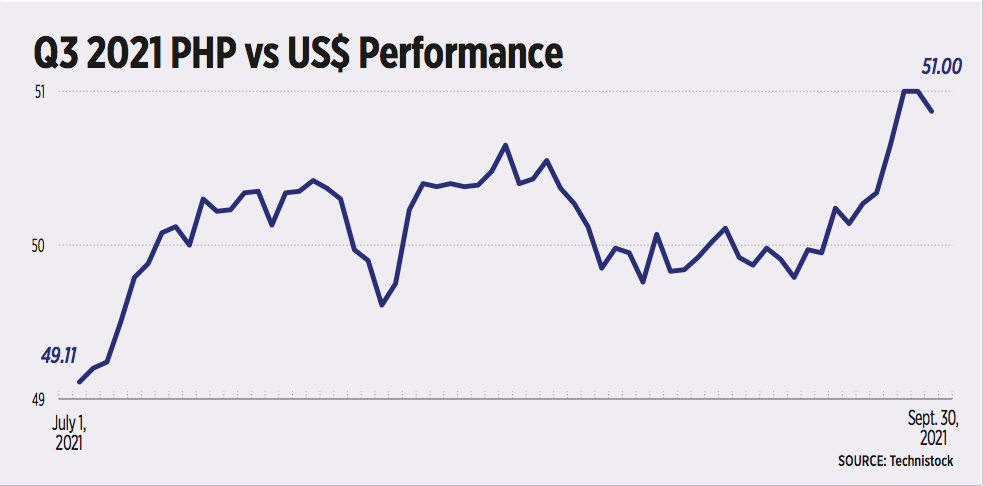
Meanwhile, BSP data showed the peso averaging P50.11 against the dollar in the July-September period, depreciating 4.01% from the previous three-month period’s average of P48.17:$1.

Demand for government bonds remained strong during the period. Treasury bill (T-bill) auctions conducted in the third quarter saw total subscription for the quarter amounting to around P701.68 billion, which is around 3.6 times the P197-billion aggregate offered amount. This oversubscription amount of P504.68 billion, however, was lower than the P705.52 billion in the previous quarter.

Demand for Treasury bonds (T-bonds) were likewise robust with a total subscription amount of P868.26 billion, almost twice more than the offered amount of P455 billion.

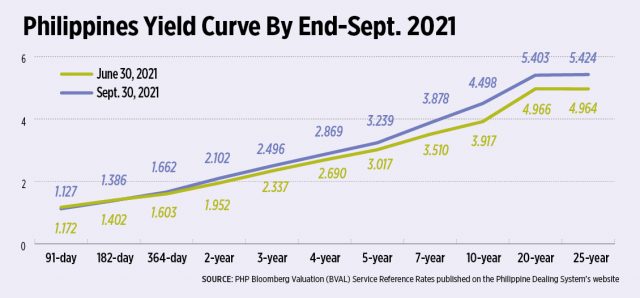
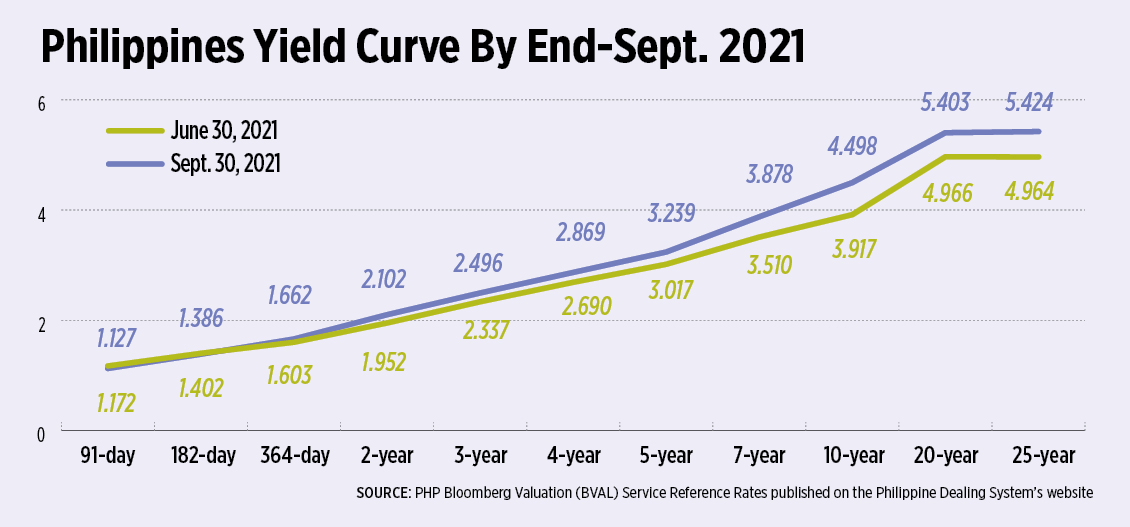
In the secondary bond market, domestic yields as of end-September were higher by a range of 5.89 basis points (bps) for the 364-day T-bonds to 58.13 bps for the 10-year bonds compared with end-June levels. On the other hand, rates for the 91- and 182-day T-bills were lower by 4.51 bps and 1.67 bps, respectively.

On average, yields were higher by 23.21 bps on a quarter-on-quarter basis, according to the PHP Bloomberg Valuation Service Rates published on the Philippine Dealing System’s website.

WHAT INDICATORS TO WATCH OUT FOR
“Financial market participants are anticipated to closely monitor developments in the country’s GDP, corporate earnings, inflation, remittances, and trade balance, to name a few,” the BSP said.

The central bank added that market players are also expected “to be mindful of the downside risks” to economic growth such as the potential spike of new COVID-19 cases that could trigger a reimposition of lockdown restrictions.

“External developments such as global inflation concerns following the movement in global oil and commodity prices, as well as potential changes in the monetary policy stance of major central banks will likewise be in the radar of investors,” the BSP added.

UnionBank of the Philippines, Inc. Chief Economist Ruben Carlo O. Asuncion cites the Purchasing Managers’ Index (PMI) as “an insightful indicator” in gauging how businesses will perform in the future, as well as looking at trends in the manufacturing and service sectors.

ING Bank N.V. Manila Senior Economist Nicholas Antonio T. Mapa said market players should keep an eye on developments in China.

“Inflation is heating up in large part due to the multispeed recovery with the US the main driving force behind this acceleration. However, China has limped along after a strong start to the year and a possible slowdown of the world’s second largest economy may be the issue that throws a monkey wrench into next year’s recovery narrative,” Mr. Mapa said.

“Included also on this list should be the normalization of monetary policy by the Fed and others, but I believe China’s growth fortunes plays a major part in this space as well,” he added.

Analysts also cited pandemic-related developments to continue influencing markets, albeit at a lesser degree compared with the previous quarters.

“[B]usinesses that were previously restricted are now allowed to operate again and with higher capacity…,” said Rizal Commercial Banking Corp. (RCBC) Chief Economist Michael L. Ricafort.

For Asian Institute of Management (AIM) economist John Paolo R. Rivera, the impact of the pandemic “has been slowly integrated into the system” as people learn to coexist with the virus.

“Investor confidence is not dependent on whether the current situation can be improved further to avoid any return to strict restrictions,” he said.

ECONOMIC RECOVERY PROSPECTS
Barring a resurgence of COVID-19 cases, the economy is expected to have performed better in the last three months of 2021, analysts said.

“There are signs of a continued recovery in [the fourth quarter 2021] as mobility data are already reflecting a strong rebound in domestic activity; data for retail and recreation, grocery and pharmacy mobility signaling the highest level of activity since the onset of the pandemic. These should be positive for market sentiment as well,” said Security Bank Corp. Chief Economist Robert Dan J. Roces.

The BSP expects the economy to settle within the revised 4-5% growth target this year.

“With the acceleration in vaccine deployment and the recalibration of quarantine protocols, the government is optimistic that the country will be able to recover further in 2022 with a growth of 7.0-9.0%, and over the medium term with growth rates of 6.0-7.0% in 2023 and 2024,” the BSP said.

“After five consecutive quarters of contraction, the positive performance in [the second and third quarter]… suggests that the economy could be on its way to recovery,” the central bank added.

The country’s GDP expanded by an annual 12% and 7.1% in the second and third quarter, respectively, following a 3.9% decline in the first three months of the year. This brought year-to-date growth at 4.9%.

The economy would have to grow by 1.7% in the fourth quarter to meet the lower end of the government’s 4-5% target band, while it would need to expand by 5.3% to reach the higher end of the goal.

“The Philippine economy is in a better position in 2021 compared to 2020 due to the effects of vaccination. It could have been better if vaccination had been much faster but nonetheless, the vaccination process has saved a lot of lives and jobs. Hopefully, this would continue as we achieve herd immunity and co-exist with the virus until its eventual eradication,” AIM’s Mr. Rivera said.

ING Bank’s Mr. Mapa was less upbeat, citing the recovery is the result of base effects after GDP plunged to 2017 levels.

“Relatively outsized [year-on-year] growth prints were to be expected and scarring effects from the protracted recession will begin to show in the coming quarters,” he said.

With these in mind, below are the BSP’s and analysts’ outlook for each of the key markets. — Bernadette Therese M. Gadon

*****

EQUITIES MARKET
BSP: “In the near term, the local bourse may be expected to further rally and trade over the 7,400 and 7,500 levels amid the continued improvement in the pace of the country’s vaccine rollout, decline in COVID-19 infections, and the continued reopening of the Philippine economy. Moreover, the sustained government spending on infrastructure and the implementation of the third stimulus package under the “Bayanihan to Arise as One Act,” complemented by decisive monetary policy support by the BSP, could further boost investors’ buying momentum.”

Mr. Mapa: “A disappointing GDP performance in the coming quarters will sober market expectations after base effects wear off, capping equity market rallies.”

Mr. Roces: “Better, with improved business optimism and investor sentiment.”

Mr. Asuncion: “As lockdowns continue to ease down during the fourth quarter, consumer spending is expected to increase and strengthen manufacturing supply and demand. The forecasted value of PMI is expected to be at a number above the expansion 50.0 plus range.”

Mr. Ricafort: “The PSEi could still gain towards well into the pre-pandemic levels, should there a breach above 7,500 and eventually 8,000 levels, partly supported by liquidity-driven gains amid greater normalization of the economy (though may be in a gradually manner) amid increased vaccinations and further significant reduction in new COVID-19 cases.

“Further measures to re-open the economy would increase capacity for many businesses, especially the previously restricted ones, thereby leading to higher sales, earnings, employment, more business activities, and higher investment valuations for many positively affected listed companies.

“New record high US stock markets amid liquidity-driven gains and improved US/global economic recovery would help support global market risk appetite/risk-on mode.”

Mr. Rivera: “It is hard to say, but assuming the situation continues to improve faster than the Philippines’ counterparts, we would be in a relatively better position to attract investors to put in their money. This would also have repercussions on our PHP (Philippine Peso) being stronger than other currencies. Financial markets behave depending on the state of economic and public health.”


FIXED-INCOME MARKET
BSP: “The domestic bond market is expected to remain liquid amid the BSP’s continued liquidity support to ensure the proper functioning of financial markets. In the corporate bond market, firms are expected to continue to tap the bond market as alternative source to finance existing debt, business operations, and investments, as the economy enters the recovery phase.

“Meanwhile, the BSP expects some narrowing trend in debt spreads due to improved investor sentiment as business activities start to reopen. However, negative developments such as the possible resurgence of COVID-19 cases could pose significant downside risk to growth and affect debt spreads. Eventual monetary policy normalization in the US could also exert upward pressure on both sovereign and corporate debt yields.”

Mr. Mapa: “[R]ates are moving higher and much higher as BSP will likely need to adjust rates against a backdrop of elevated inflation. A ratings downgrade may also force the bond space into some correction.”

Mr. Roces: “In the short-to-medium term, we see yields trading on an upward trajectory given upward risks from local inflation; upward risks remain as well with rising global inflation and with expectations of a Fed rate hike next year. But with the view of lower local inflation expected next year, end-2022 GS10 yield may be lower than end-2021.”

Mr. Asuncion: “Supply constraints coupled with wage increases is expected to increase inflation as demand picks up near the holiday season. Alongside inflationary pressures, Fed bond purchases have begun tapering on November. Despite this, the national treasury holds an optimistic view that government bonds would remain attractive amidst the speculations for inflation. This was manifested by the debt paper rates increasing, both local and international, given that inflation rates remain elevated. Moreover, the GDP data for the fourth quarter [is] expected to be at 5.5%, however, this will change because of the better-than-expected outlook.”

Mr. Ricafort: “Any increase in Fed rates in the latter part of 2022, by about 0.25% and by another 0.25% in 2023, consistent with the hawkish Fed signals since June 16, 2021, could lead to higher key policy rates for some countries around the world, from unusually low levels, including the Philippines, especially if the economy recovers further with increased vaccinations versus COVID-19.”

Mr. Rivera: “It is hard to say but assuming the situation continues to improve faster than the Philippines’ counterparts, we would be in a relatively better position to attract investors to put in their money. This would also have repercussions on our PHP being stronger than other currencies. Financial markets behave depending on the state of economic and public health.”
FOREIGN EXCHANGE (FX) MARKET
BSP: “Consistent with the country’s floating exchange rate arrangement, the peso will remain market-driven and would continue to reflect emerging demand and supply conditions in the FX market. Over the near term, the peso will continue to be supported by structural FX flows through recovery in exports, remittances, and business process outsourcing (BPO) receipts. FX inflows related to FDIs are seen to continue to grow as the global economy recovers and National Government (NG) infrastructure spending continues. The latest outlook on the external sector for 2021-2022 likewise suggests improvements in these sources of FX amid expected recovery in major trading partners as well as the gradual reopening of the domestic economy as the share of vaccinated population in most economies continue to increase. The ample international reserves could also buttress the Philippine peso.

“Nonetheless, (i) uncertainties over the potential resurgence of COVID-19 cases amid new virus variants, which could negatively impact on the deployment of [remittances] and tourist arrivals as well as dampen investor sentiment, among others; (ii) the rise in global yields (in particular, US interest rates) which could result in investors’ portfolio reallocation; and (iii) the possible continued rise in deglobalization (or protectionism) which could weaken the demand for exports and foreign investments, could pose risks to the peso. At the same time, weak market sentiment may persist if the availability and deployment of safe and effective vaccine in the Philippines is delayed.

“Given these risks, the BSP will rely on measures that will cushion the impact of possible sharp currency movements such as maintaining a healthy level of FX reserves as a buffer alongside reviewing and adjusting existing macro-prudential measures.”

Mr. Mapa: “A strong USD (US Dollar) environment should translate to a gradual depreciation trend for the PHP.”

Mr. Roces: “PHP to depreciate with wider trade deficit and stronger USD as the US economy continues to rebound.”

Mr. Asuncion: “The peso-dollar exchange rate has demonstrated strong depreciation beginning Q2 2021. The peso has remained sensitive to COVID-19 outbreaks given the poor vaccination rates and difficulty in managing the effect of the pandemic. As remittances has experienced sustained growth over the months and the expected headline inflation to come, the PHP is expected to continue to depreciate for 2022.”

Mr. Ricafort: “The seasonal increase in remittances and conversion to pesos in the fourth quarter, culminating in the Christmas holiday season, would help provide some support on the local currency vs. the US dollar.

“Continued growth in remittances, BPO revenues, foreign investments, as well as some possible pick up in BPO revenues and tourism receipts eventually would help finance the country’s trade deficit, in view of the expected pickup in economic activities including importation as the economy re-opens further.

“The country’s gross international reserves, near record highs recently and equivalent to more than 10 months of imports, or way above the minimum acceptable standard of three to four months, would continue to provide structural buffer for the peso exchange rate, especially greater protection versus any speculative attacks, going forward.”

Mr. Rivera: “It is hard to say but assuming the situation continues to improve faster than the Philippines’ counterparts, we would be in a relatively better position to attract investors to put in their money. This would also have repercussions on our PHP being stronger than other currencies. Financial markets behave depending on the state of economic and public health.”

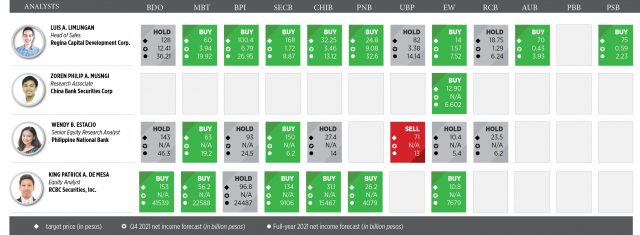
Analysts give rosy outlook on stocks

WITH THE ECONOMY showing signs of recovery, investors may consider bank stocks for next year as lenders are seen to be in a better position to bounce back compared with the previous quarters.

The Philippine Stock Exchange index (PSEi) averaged 6,751.98 in the third quarter, up 2.76% from 6,570.78 in the preceding quarter.

In comparison, the financials sub-index, which included the banks, grew at a slower pace with 1.1% to average 1,438.17 in the three months to September from 1,423.19 in the three months to June.

The third quarter saw 11 of the 14 listed banks whose share prices have fallen on a quarter-on-quarter basis. These were Rizal Commercial Banking Corp. (RCB, -18.1%), Philippine Business Bank (PBB, -15.1%), East West Banking Corp. (EW, -14.2%), Philippine National Bank (PNB, -10.6%), Metropolitan Bank & Trust Co. (MBT, -10.3%), Security Bank Corp. (SECB, -10.2%), Philippine Bank of Communications (PBCOM, -8.4%), Bank of the Philippine Islands (BPI, -8.2%), China Banking Corp. (CHIB, -5.3%), Asia United Bank (AUB, -2.4%), BDO Unibank, Inc. (BDO, -2.3%),

On the other hand, UnionBank of the Philippines (UBP) led gainers with 10.6%, followed by Philippine Trust Co. (PTC, 8%) and Philippine Savings Bank (PSB, 0.8%).

“What mainly affected bank stock performance in [the third quarter and early fourth quarter] were pandemic-related developments, particularly the rise in COVID-19 (coronavirus disease 2019) cases due to the Delta variant, subsequent tightening of restrictions, and eventual easing of quarantine classifications as daily virus case counts retreated,” said China Bank Securities Corp. Research Associate, Zoren Philip A. Musngi.

Mr. Musngi, however, noted a recovery in loan growth in August and September due to better lending activity “all of which are encouraging indicators that point to sustained economic recovery.”

Latest data by the Bangko Sentral ng Pilipinas (BSP) showed outstanding loans by universal and commercial banks (U/KBs) increased 2.7% in September, following an annual 1.3% growth in August. Prior to that, it had declined for eight straight months.

In a separate BSP release, U/KBs showed net interest margin — or the ratio that measure banks’ efficiency in investing their funds by dividing annualized net interest income to average earning assets — slightly declined to 3.33% as of September from 3.39% in end-June and 3.49% in end-March.

RCBC Securities, Inc. Equity Analyst King Patrick A. de Mesa noted most banks were able to substantially lower loan loss provisions, as well as see a recovery in fee-based income following the increase in transaction volumes due to the relaxation of quarantine restrictions.

“Aside from the respective banks’ earnings results, I think the recent economic reopening as well as the good GDP (gross domestic product) growth in [the third quarter] influenced bank stocks for the period,” Mr. De Mesa said.

PNB Senior Equity Research Analyst Wendy B. Estacio attributed the third-quarter result to the market’s anticipation in a decline in banks’ net interest income “as earning asset yield were repriced lower.”

“In addition, limited trading income was also priced in by the market as interest rates started to go up. As a reference, the 10-year BVAL (Bloomberg Valuation) rate increased by 58 basis points during the same period,” Ms. Estacio said, referring to the 10-year government bonds.

OUTLOOK
Analysts pinned their hopes on the economic recovery to be sustained into next year.

The second and third quarter saw GDP growing by 12% and 7.1%, respectively, following the economic recession that started in the first quarter of 2020 up until the same quarter of this year. Year to date, GDP expanded by 4.9%.

The country’s economic managers expect the economy to recover by 4%-5% for the entire 2021 following the record 9.5% plunge in 2020.

Metro Manila is currently under a more relaxed Alert Level 2, with businesses allowed operate at higher capacity. Economic managers expect the Alert Level to be further lowered to 1 by January 2022 as COVID-19 cases drop and the vaccination rate improves.

The government also expects nominal GDP to recover to pre-pandemic levels by early 2022.

“I expect listed banks to perform on a positive note for the rest of 2021 and for next year given attractive valuations and favorable economic outlook on the back of continuously improving virus situation in the country,” RCBC Securities’ Mr. De Mesa said.

“More mobility would mean more business activity, which could translate to higher loans, and subsequently, higher income for banks,” Mr. De Mesa added.

PNB’s Ms. Estacio noted that while the loan growth seen since August is still below its peak, investors should factor in a recovery in banks’ loan portfolios due to a rebound in household spending.

“Along with this, investors should remain on guard of the possible rise in banks’ nonperforming loans (NPL),” Ms. Estacio said.

Regina Capital Development Corp. Head of Sales Luis A. Limlingan shared a similar assessment.

“Determining whether or not a bank’s NPL coverage ratio is sufficient and if they’re at least meeting the required BSP capital requirements are also going to help gauge the future prospect of the banks,” he said.

Mr. Limlingan also cited the normalized loan loss provisioning, but noted it is difficult to determine whether the improvement will be substantial given uncertainties posed by the pandemic.

“Nonetheless, the rebound would likely be carried over into next year, assuming more business activity will be generated by then, following the increased vaccinated population, which will lead to the further easing of quarantine restrictions,” he noted.

NPLs held by big banks went up to P400.65 billion as of end-September compared with the P397.18 billion in end-June.

Their NPL ratio dipped to 3.99% in September from 4.03% in June. However, this remained higher than the 2.95% in September last year.

Meanwhile, the U/KBs’ NPL coverage ratio — which shows the allowance for potential losses due to bad loans — improved to 89.44% in September from June’s 87.63%. Still, it was below last year’s 102.9%.

China Bank Securities’ Mr. Musngi was also upbeat, advising investors to mainly focus on macroeconomic events such as the pandemic situation, pace of vaccinations, and changes in quarantine restrictions, as well as the industry’s indicators such as NPL coverage, interest rate outlook, and loan growth “as these will likely be the drivers for performance going forward.”

“In particular, investors should focus on banks with strong NPL coverage (over 100%) and improving NPL ratios, as these institutions would be in a better position to navigate future adverse surprises such as the emergence of another virus variant or re-imposition of restrictions,” he said.

He noted investors are particularly bullish in the sector given the improving outlook for loan growth as economic activity continues to pick up.

“This optimism holds despite expectations of higher interest rates in the coming year, since banks have already positioned themselves to benefit from higher rates. In addition, banks have been investing in more technological solutions such as digital banking, e-commerce, e-payments, which are growth areas that investors are focusing on as future value drivers,” he explained further.

First Metro Investment Corp. Head of Research Cristina S. Ulang expects “good share price performance” next year “in light of credit cycle pickup in sync with economic reopening.”