Home Blog Page 6592

Fighting Putin comes before climate change

RUSSIAN PRESIDENT VLADIMIR PUTIN — KREMLIN.RU/

ON THE DAY Russia launched its all-out attack on Ukraine, Svitlana Krakovska was holed up in her home city of Kyiv, working feverishly to finish a report. As leader of the Ukrainian delegation to the Intergovernmental Panel on Climate Change (IPCC), she and scientists around the world were dotting the i’s and crossing the t’s of their sixth assessment of global warming and its threats to humanity.

But then Russian artillery started exploding all around her, and Krakovska and her team members had to scurry to the nearest bomb shelters.

The IPCC report was released a few days later nonetheless. In normal times, these tomes make headlines all over the world. This one would have set records, because it’s the most dismal read yet in a genre that was plenty dire already. Humanity, it suggests, will probably miss its goals of limiting the rise in global temperatures and enter an age of calamities. But, of course, these aren’t normal times, and the message was muffled in a news cycle dominated by shooting and dying.

Add this to the list of atrocities committed by Russian President Vladimir Putin. He’s not only violated a free country, killed and terrorized innocent people, and broken all norms of civilization. He’s also distracted the world from what should be a common quest to save our climate. Politicians who previously talked about little besides Green Deals are now focused entirely on resisting Putin’s onslaught.

There’s another connection between his war and global warming. It’s one that Krakovska, a mother of four who’s chosen to stay in Kyiv, has emphasized in her sporadic Zoom calls with the outside world. Putin rules over a petrostate that hawks the very fossil fuels causing climate change. By paying for his oil, coal, and gas, the world has in effect been funding his war machine and aggression.

That’s why energy has also become a military and strategic weapon for both sides. Putin could cut off the oil, coal, and gas fueling the economies of Europe. The West, for its part, is trying to wean itself from Putin’s hydrocarbons to make him go bankrupt as soon as possible.

The most visible effect of this clash is the soaring cost of all fossil fuels. Rising heating bills and pump prices will hit the poor hardest. In the worst case, this could lead to mass protests — like the yellow-vest riots of 2018 in France, but bigger, and in more places. Many countries must fear for their social peace.

So there’s really no alternative to temporarily pausing Green Deals and other projects meant to save us in the longer term. The need for physical security currently trumps everything else. To survive now and get through the next winter or two — however long Putin stays at large — we must replace one kind of fossil fuel — his — with all the others.

For Europe, which gets about 40% of its natural gas from Russia, that means frantically buying more liquefied natural gas (LNG) from places like the US or Qatar, while simultaneously building the ports and terminals that can welcome the ships. Where possible, it’ll also mean extending the life of nuclear power plants due to be phased out — as Belgium is considering, but Germany stubbornly isn’t yet.

But even as we manage the acute emergency, we must also prepare to exit from it. Yes, we can talk now about temporary rebates for gasoline or heating oil to the poor. But our goal must be to return as soon as possible to letting carbon become gradually more expensive over time — via cap-and-trade systems and such — so that people get used to consuming less of it.

And we must bid farewell to some dearly held assumptions. One, especially in Germany, is that natural gas can be a “bridge” from even dirtier coal-fired electricity to the cleaner, greener solar and wind sort. Owing to geopolitics, that gas bridge has in effect collapsed.

The new reality is that we have to go all the way to universal electrification even faster, powered by 100% renewable energy with green hydrogen filling the gaps. Countries that have so far dabbled in building out photovoltaics, wind farms, smart grids and other parts of the puzzle must double down as though life depended on it. It probably does.

The only glimmer of hope is that Putin may have inadvertently simplified the politics of such a global quest. Convincing voters requires communicating the need for sacrifice — from sleeping colder in the winters to flying less and paying more when you do. But now politicians can make that case in two ways — as necessary to fight both Russian aggression and climate change. Those on the front lines of both struggles, like Svitlana Krakovska, remind us that they’re equally urgent.

BLOOMBERG OPINION
Biden says he is not calling for regime change in Russia

REUTERS

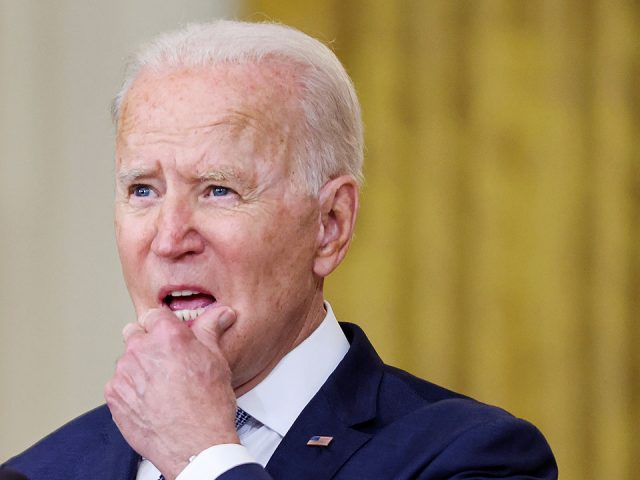
WASHINGTON — US President Joseph R. Biden clarified on Sunday that the United States does not have a policy of regime change in Russia, after his declaration that Russian President Vladimir Putin “cannot remain in power.”

Mr. Biden’s comments in Poland on Saturday also included calling Mr. Putin a “butcher” and appeared to be a sharp escalation of the US approach to Moscow over its invasion of Ukraine.

Top American diplomats on Sunday had played down his declaration, and Mr. Biden, asked by a reporter as he departed a church service in Washington if he was calling for regime change in Russia, gave a one-word reply: “No.”

Julianne Smith, the US ambassador to NATO, earlier sought to contextualize Mr. Biden’s remarks, saying they followed a day of speaking with Ukrainian refugees in Warsaw. Russia’s month-old invasion has driven a quarter of Ukraine’s population of 44 million from their homes.

“In the moment, I think that was a principled human reaction to the stories that he had heard that day,” Ms. Smith told CNN’s “State of the Union” program before adding: “The US does not have a policy of regime change in Russia. Full stop.”

US Secretary of State Antony Blinken told a news conference in Jerusalem that Mr. Biden was making the point that Mr. Putin couldn’t be empowered to wage war. But Mr. Blinken said any decision on Russia’s future leadership would be “up to the Russian people.”

Republicans flatly said Mr. Biden’s remarks amounted to an unfortunate blunder.

Senator James Risch, the top Republican on the US Senate Foreign Relations Committee, called Mr. Biden’s remarks a “horrendous gaffe” and said he wished the president would have stayed on script.

“Most people who don’t deal in the lane of foreign relations don’t realize those nine words that he uttered would cause the kind of eruption that they did,” he told CNN.

“It’s going to cause a huge problem,” he said, referring to Mr. Biden’s statement in Warsaw: “For God’s sake, this man cannot remain in power.”

Senator Rob Portman, who is also on the committee, lamented the public misstep in wartime.

“It plays into the hands of the Russian propagandists and plays into the hands of Vladimir Putin. So it was a mistake,” Mr. Portman told NBC’s Meet the Press program.

UKRAINIAN RESISTANCE
The United States has sought to strike a balance during the conflict in Ukraine to avoid a direct military confrontation with Russia, speeding weapons deliveries to Kyiv to help its military fight but ruling out sending troops into the country or imposing a no-fly zone.

That support has bolstered fiercer-than-expected Ukrainian resistance, and Russia has failed to seize any major Ukrainian city after more than four weeks of fighting.

Ukrainian President Volodymyr Zelensky urged the West to give Ukraine tanks, planes and missiles to help fend off Russian forces.

The conflict has killed thousands of people, sent nearly 3.8 million abroad and driven more than half of Ukraine’s children from their homes, according to the United Nations.

Moscow says the goals for what Mr. Putin calls a “special military operation” include demilitarizing and “denazifying” its neighbor. Ukraine and its Western allies call this a pretext for an unprovoked invasion. — Reuters

China’s economy faces fresh blow from COVID lockdown in Shanghai

REUTERS
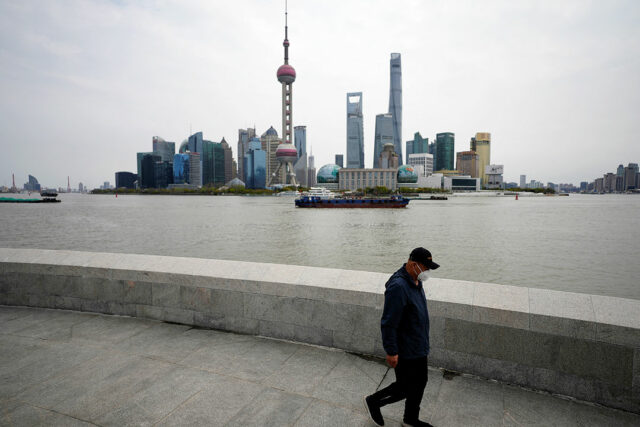
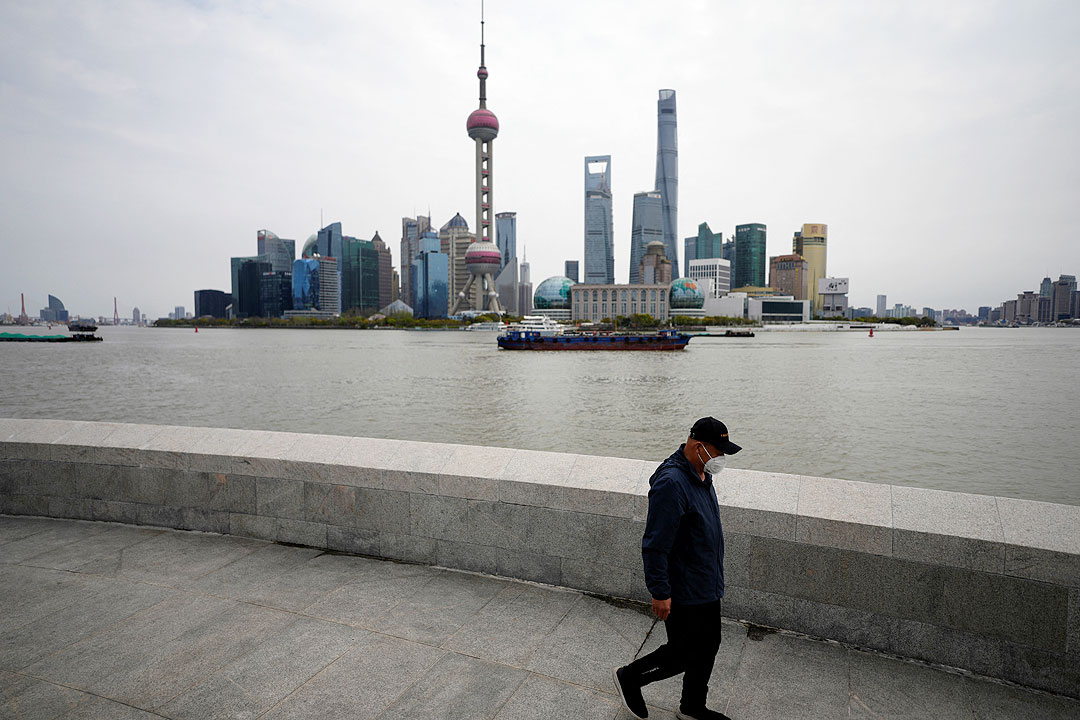
A MAN walks past Lujiazui financial district, seen across the Huangpu river, amid the lockdown in Pudong area to contain the spread of the coronavirus disease 2019 (COVID-19) in Shanghai, China on March 28. — REUTERS

SHANGHAI’s sweeping, two-phase lockdown will likely deal a heavy blow to businesses reliant on consumer spending, though economists say the city’s industrial sector can largely withstand the disruption, mitigating threats to the global supply chain.

The staggered eight-day lockdown in Shanghai — a city of 25 million people — and lingering effects from the measure may shave up to 0.4 percentage point from China’s economic growth in the first and second quarter, compared to a year ago, according to estimates by Liu Peiqian, China economist at NatWest Group Plc.

The restrictions targeting half of the city at a time will bar the city’s residents from leaving home, an attempt to curb China’s worst COVID outbreak since Wuhan in early 2020. That will likely hurt employment in the services industry and weigh on small businesses the most. 

“COVID suppresses people’s confidence and expectations for spending,” said Bruce Pang, head of macro and strategy research at China Renaissance Securities Hong Kong. He also pointed to impacts on industries that rely on in-person and social gatherings, especially catering.

Liu, whose forecast for gross domestic product (GDP) growth in the first quarter is 4.7%, said the “gradual recovery” of the services and consumption sectors could take eight weeks. As a major financial and trade hub, Shanghai contributes 3.8% to the country’s GDP. It’s also the second-richest city, trailing only Beijing, according to the latest available figures from the National Bureau of Statistics.

The impact on the supply chain will likely be temporary as long as the lockdown doesn’t last longer than three weeks, according to Raymond Yeung, chief economist for Greater China at Australia & New Zealand Banking Group Ltd.

He said a so-called closed loop system tested in Shenzhen — where factory workers are living in dorms, working in a bubble separate from the general public — has lessened the impact on the economy. The southern technology hub of Shenzhen resumed normal operations Sunday, about two weeks after the government placed its 17.5 million residents under lockdown.

“Similar to Shenzhen, Shanghai is the economic powerhouse of the country,” Mr. Yeung said. “The scale is obviously larger but the action is swift, hoping to minimize the economic impact as soon as possible.”

The Shanghai port, the world’s largest, is still operating around the clock, according to local media reports. Chinese chipmaker Semiconductor Manufacturing International Corp is maintaining normal production at its facility in the city, and is complying with Covid prevention measures.

Tesla, Inc., meanwhile, suspended production Monday, Bloomberg News reported. The American carmaker hasn’t yet informed employees whether that halt will be extended.

Larry Hu, an economist at Macquarie Capital Ltd., said policy makers will have “no choice but to step up stimulus in the coming months” in order to meet a GDP growth target of about 5.5% this year.

“We maintain our annual GDP forecast of 5%, as more policy easing would come through,” he said, predicting a benchmark interest rate cut in April, as well as more support for infrastructure and property sectors. — Bloomberg

Apple to cut iPhone, AirPods output – Nikkei

REUTERS

APPLE, INC. is planning to cut the output of its iPhone and AirPods devices as the Ukraine crisis and looming inflation start to weigh on demand for consumer electronics, the Nikkei reported on Monday, citing sources.

The company plans to make about 20% fewer iPhone SEs next quarter, or lower production orders by about 2 million to 3 million units than originally planned, due to weaker-than-expected demand, Nikkei said.

The US tech giant also reduced orders for its AirPods wireless headphones by more than 10 million units for all of 2022, as it scales back the level of inventories due to lukewarm demand, the newspaper said.

Earlier this month, Apple unveiled 5G connectivity to its iPhone SE, its low-cost model aimed mostly at buyers in emerging markets.

Counterpoint Research said the earlier 4G iPhone SE accounted for 12% of total iPhone sales from its launch in the second quarter of 2020 until the end of 2021, with Japan being the biggest market after the United States.

The company also asked suppliers to make a couple of million fewer units of the entire iPhone 13 range than previously planned, but said this adjustment was based on seasonal demand, according to the report.

Apple did not immediately respond to a Reuters request for comment. — Reuters

NK to keep developing ‘formidable’ striking capabilities

KCNA VIA REUTERS

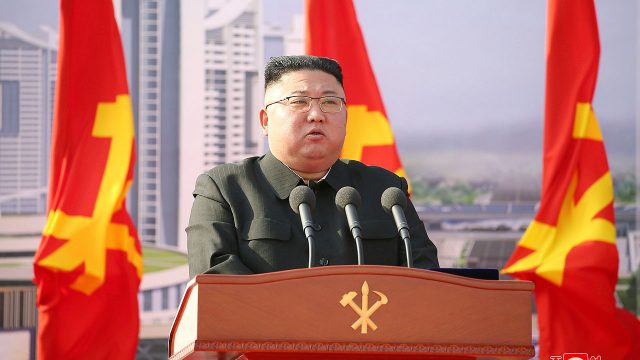
SEOUL — North Korea (NK) will continue to develop “formidable striking capabilities” that cannot be bartered or sold for anything, leader Kim Jong Un said, according to state media on Monday, as he visited workers involved with the country’s biggest missile test.

Mr. Kim was meeting with officials, scientists, technicians and workers who contributed to a missile launch on Thursday, which North Korea said was its largest intercontinental ballistic missile (ICBM), state news agency KCNA reported.

“Only when one is equipped with the formidable striking capabilities, overwhelming military power that cannot be stopped by anyone, one can prevent a war, guarantee the security of the country and contain and put under control all threats and blackmails by the imperialists,” Mr. Kim said, according to the report.

While personally overseeing the test on Thursday, Mr. Kim said the new ICBM was to help deter any military moves by the United States, which remains technically at war with the North after the 1950-1953 Korean War ended in an armistice rather than a peace agreement.

Washington has sought to pressure Pyongyang into surrendering or reducing its arsenal of nuclear weapons and ICBMs, which may be able to strike targets in the United States.

But Mr. Kim said his self-defense force “cannot be bartered nor be bought with anything” and will be held firm without the slightest vacillation despite harsh trials and difficulties.

North Korea will continue to build a “more perfect and stronger strategic force,” Mr. Kim said, referring to the country’s nuclear force.

The United States said on Friday it will push United Nations sanctions on North Korea to be strengthened over “increasingly dangerous provocations,” but China and Russia signaled opposition and instead argued for such measures to be eased.

North Korea said Thursday’s missile was the Hwasong-17, and Japan and South Korea confirmed that flight data showed the launch flew higher and longer than any previous North Korean test.

But analysts said that state media coverage appeared to be trying to pass off footage from a previous launch, and South Korea’s Yonhap news agency reported on Sunday that intelligence officials in Seoul and Washington believe the North actually tested an older and slightly smaller Hwasong-15 ICBM. — Reuters

Ukraine insists on territorial integrity as talks loom

REUTERS

LVIV, Ukraine — With peace talks between Russia and Ukraine set to take place in Turkey this week, Ukrainian President Volodymyr Zelenskyy has insisted on the territorial integrity of his country after earlier suggesting he was ready for a compromise. 

Mr. Zelenskyy said in a video address to the Ukrainian people late on Sunday that in talks due to take place in Istanbul his government would prioritize the “territorial integrity” of Ukraine. 

But in comments made to Russian journalists earlier in the day, Mr. Zelenskyy adopted a different tone, saying Ukraine was willing to assume neutral status and compromise over the status of the eastern Donbas region as part of a peace deal. 

In the video call that the Kremlin preemptively warned Russian media not to report, Mr. Zelenskyy said any agreement must be guaranteed by third parties and put to a referendum. 

“Security guarantees and neutrality, non-nuclear status of our state. We are ready to go for it,” he added, speaking in Russian. 

Even with talks looming, Ukraine’s head of military intelligence, Kyrylo Budanov, said Russian President Vladimir Putin was aiming to seize the eastern part of Ukraine. 

“In fact, it is an attempt to create North and South Korea in Ukraine,” he said, referring to the division of Korea after World War Two. 

Mr. Zelenskyy has urged the West to give Ukraine tanks, planes, and missiles to help fend off Russian forces. 

In a call with Mr. Putin on Sunday, Turkish President Tayyip Erdogan agreed to host the talks and called for a ceasefire and better humanitarian conditions, his office said. Ukrainian and Russian negotiators confirmed that in-person talks would take place. 

Top American officials sought on Sunday to clarify that the United States does not have a policy of regime change in Russia, after President Joseph R. Biden, Jr., said at the end of a speech in Poland on Saturday that Putin “cannot remain in power.” 

US Secretary of State Antony Blinken said Biden had simply meant Mr. Putin could not be “empowered to wage war” against Ukraine or anywhere else. 

After more than four weeks of conflict, Russia has failed to seize any major Ukrainian city and signaled on Friday it was scaling back its ambitions to focus on securing the Donbas region, where Russian-backed separatists have been fighting the Ukrainian army for the past eight years. 

REFERENDUM IDEA DISMISSED
A local leader in the self-proclaimed Luhansk People’s Republic said on Sunday the region could soon hold a referendum on joining Russia, just as happened in Crimea after Russia seized the Ukrainian peninsula in 2014. 

Crimeans voted overwhelmingly to break with Ukraine and join Russia — a vote that much of the world refused to recognize. 

Mr. Budanov predicted Ukraine’s army would repel Russian forces by launching a guerrilla warfare offensive. 

“Then there will be one relevant scenario left for the Russians, how to survive,” he said. 

Ukraine’s foreign ministry spokesperson also dismissed talk of any referendum in eastern Ukraine. 

“All fake referendums in the temporarily occupied territories are null and void and will have no legal validity,” Oleg Nikolenko told Reuters. 

Moscow says the goals for what Putin calls a “special military operation” include demilitarizing and “denazifying” its neighbor. Ukraine and its Western allies call this a pretext for unprovoked invasion. 

Ukraine has described previous negotiations, some of which have taken place in Russian ally Belarus, as “very difficult.” 

The invasion has devastated several Ukrainian cities, caused a major humanitarian crisis and displaced an estimated 10 million people, nearly a quarter of Ukraine’s population. 

In his Sunday blessing, Pope Francis called for an end to the “cruel and senseless” conflict. 

HUMANITARIAN CORRIDORS
Russia has continued to move additional military units to the Ukraine border and is launching missile and air strikes on Ukrainian forces and military infrastructure, including in the city of Kharkiv, the Ukrainian military said on Sunday night. 

Ukraine’s General Staff said on Monday Kyiv defense forces were holding back Russian troops trying to break through from the northeast and northwest and take over key roads and settlements. In the south of the country, Ukrainian forces were focused on defending Krivy Rih, Zaporizhzhia, and Mykolayiv. 

It said that Ukraine had downed four Russian aircraft, one helicopter, two drones and two cruise missiles over the past 24 hours. 

Ukraine raised concerns about the safety of the Russian-occupied defunct nuclear power plant at Chernobyl, the site of the world’s worst civil nuclear accident in 1986. 

Russian forces have created a risk of damaging the containment vessel constructed around the station’s wrecked fourth reactor, said Ukrainian Deputy Prime Minister Iryna Vereshchuk. She urged the United Nations to dispatch a mission to assess the risks. 

The mayor of Slavutych, the town created and built to house the plant’s staff in the aftermath of the 1986 accident, said early on Monday that Russian forces that took over the town at the weekend had now left. 

Yuri Fomichev said in an online video post that the troops “completed the work they had set out to do” and were gone. He originally said three people had been killed in clashes. 

The United Nations has confirmed 1,119 civilian deaths and 1,790 injuries across Ukraine but says the real toll is likely to be higher. Ukraine said on Sunday 139 children had been killed and more than 205 wounded so far in the conflict. — Reuters

[B-SIDE Podcast] Ready for the rain?

Each year, the Philippines is hit by an average of 20 typhoons, which are growing progressively more destructive.  

A report released by Fitch Ratings in November 2021 said that the country is one of the most exposed to climate change physical risks, particularly floods and storms.  

In addition, the Department of Finance reported that climate-related hazards have cost the country $10 billion in losses and damage over the past decade. 

In this B-Side episode, Rick Holland, Grundfos senior regional sales director for Asia Pacific, talks to BusinessWorld reporter Alyssa Nicole O. Tan about key solutions in mitigating flooding caused by extreme weather events amid worsening climate change. Headquartered in Denmark, Grundfos manufactures pumps for flood control, irrigation, and sewage, among others. 

“You cannot just take one approach to everything,” said Mr. Holland, noting that a community’s geography, economic status, and density should be considered when thinking of long-term solutions.  

TAKEAWAYS

To prevent flooding, fix the trash problem. 

“We end up with quite a lot of trash in the waterways from various causes and… it tends to clog up the canals and block up the pump stations sometimes, so that does have an impact on how to handle current flood waters,” said Mr. Holland. 

The combination of rising sea levels, climate change events, and land subsidence already makes Manila particularly flood-prone — mountains of trash exacerbate the problem. 

“I think development planning and infrastructure planning will form a key part of the strategy,” he added. 

Flood solutions are unique to each community.

Mr. Holland noted that the real challenge with floods in Manila is that each community and micro-area is unique.  

Low-lying areas close to Manila Bay will need solutions that can handle seawater applications and still run reliably. 

Meanwhile, areas with informal settlements need technology partners who can provide materials that can remove high volumes of trash efficiently. 

“All of these things require a degree of consideration to tailor the solution for the best outcome in a particular community,” he said. 

New flood mitigation solutions must work well with other existing flood prevention strategies. 

While the systems built by Grundfos within the flood station infrastructure are designed to operate independently, its success in a community is tied to many things operating in tandem.

“The development that happens in that community will either assist run-off and flood mitigation or make it worse,” Mr. Holland said.

Flood water drained into the pumping stations have to be clean and free-flowing to enable the pump station to operate.

“One of the big challenges for flood infrastructure projects is [that] there are always factors that will determine the success of a project, and they really all need to work in tandem to be successful,” he said. 

Big picture: climate change has to be addressed. 

“Climate change is bringing more extreme rainfall and rising sea levels, and these directly impact on the severity and the frequency of flooding, and also inundation from the sea for low-level communities,” Mr. Holland said.

“If we don’t take action to reduce the degree that climate change is going to happen then it may well end up in a situation where it’s not possible to be resilient, or not possible to mitigate the impacts as they become more severe,” he added. 

Recorded remotely in February 2022. Produced by Earl R. Lagundino, Jino D. Nicolas, and Sam L. Marcelo.

Impermanence nation: Canada’s growing reliance on temporary residents to meet labor needs

PRAVEEN KUMAR NANDAGIRI-UNSPLASH

TORONTO — Canada is increasingly relying on temporary residents to meet its labor force needs, according to a Reuters analysis of official data, but this phenomenon makes workers vulnerable and fails to provide wage growth or stability to businesses, warn workers, advocates, economists and industry groups. 

Temporary residents come to Canada on time-limited visas, some of them tied to specific employers, after which they are expected to return to their countries of origin. While there are ways to become permanent residents, and many come intending to do so, there are often significant hurdles to achieving this. 

Offering temporary visas is seen as an easy fix for tight job markets and may allow politicians to avoid the potential political fallout of large numbers of new permanent residents, analysts say. 

But this trend can depress labor standards, which employers might otherwise boost to entice hires. People with permanent resident status are better positioned to demand better working conditions, economists say. 

Wage suppression can reduce the overall population’s spending power and hurt economic growth, said economist Armine Yalnizyan, Atkinson Fellow on the Future of Workers. 

University of Waterloo economist Mikal Skuterud argues that to promote economic equality it may make more sense to prioritize the immigration of higher-skilled people, who will exert downward pressure on the highest salaries while employers of lower-paid workers raise wages to woo employees. 

Temporary residents — who often come from Asia, Latin America and the Caribbean — say their precarious immigration status leaves them open to exploitation. 

The programs are an “essential tool” for Canada’s economy, its immigration minister told Reuters, but he sees room for broader pathways to permanency. 

The number of people living and working in Canada on a temporary basis has grown faster than the annual number of new permanent residents in the past decade, according to Reuters analysis of federal immigration data. 

In 2020 temporary residents were more than triple the number of new permanent residents; last year, when Canada set a permanent resident record, it had more than twice as many temporary ones. 

This growth has been fueled in part by international students, whose ranks more than doubled in a decade. The number of people in Canada on post-graduate work permits, meanwhile, almost quintupled between 2012 and 2021. 

Many international students can work, subject to different limitations, but Canada’s immigration department said it doesn’t know how many do. 

PATH TO PERMANENT RESIDENCY
Kathleen Sullivan, chief executive officer of Food and Beverage Canada, said some of her members, strapped for labor, are racing to bring in temporary foreign workers for the first time. 

But they would prefer stability, she said. 

“If I have a permanent job, I want a permanent employee — I’m investing in training, I’m investing in them,” she said. 

Canada’s immigration system prioritizes high-skilled jobs but its labor market needs people doing lower-skilled work, too. Canada’s job vacancy rate in the fourth quarter of 2021 was 5.3%, and was highest in accommodation and food services, at 10.8%. That sector also had the lowest average hourly wages, according to Statistics Canada, at C$15.50 ($12.37) late last year. 

Temporary foreign workers saved Louis Bontorin’s family bakery, he said. But his goal is to make them permanent. Of the 60 temporary workers they brought over in five years, he figures all but five are in Canada to stay. 

It would make a big difference for people to have permanent residency on arrival, he said. “It really changes the dynamic of how they sort of plan with their family,” he said. 

Last year, Canada announced a limited plan to make 90,000 temporary residents permanent. So far, it has given 23,880 permanent residency; the immigration department said more applications are being processed. 

Canada’s Immigration, Refugees and Citizenship Minister Sean Fraser said in a January interview it may be time to establish a path to permanent residency. 

“Certain temporary programs can develop into a tool to solve permanent and persistent gaps in the labor force. I think there is a better answer.” — Anna Mehler Paperny/Reuters

India’s largest multiplex operators to merge, creating cinema giant

Image via pvrcinemas.com

NEW DELHI — India’s two largest multiplex firms said on Sunday they would merge to create a giant cinema operator with more than 1,500 screens across 109 cities as the entertainment industry recovers from the coronavirus disease 2019 (COVID-19) pandemic. 

PVR and INOX Leisure said the merger, which is subject to regulatory approvals, would help both companies improve efficiency, reach newer markets, and optimize cost. 

“The film exhibition sector has been one of the worst impacted sectors on account of the pandemic and creating scale to achieve efficiencies is critical for the long-term survival of the business and fight the onslaught of digital OTT platforms,” PVR Chairman Ajay Bijli said in a press release. 

Over-the-top, or OTT, platforms such Netflix, Amazon’s Prime Video, and Disney have made deep inroads in India, where the pandemic ravaged a film industry known for song-and-dance spectacles watched by millions. 

PVR is India’s largest multiplex chain with more than 850 screens, followed by INOX Leisure with about 650 screens. 

The merger follows a two-year period when most theaters were shut due to COVID-19 restrictions. — Reuters

Hong Kong to halve COVID flight-ban penalty to 7 days

Hong Kong International Airport. Image via hongkongairport.com

HONG KONG — Hong Kong said on Sunday it is shortening the ban on airlines that are found to have carried three or more passengers who test positive for coronavirus disease 2019 (COVID-19) upon arrival, as the number of local cases continues to ease from its peak. 

Starting on Friday, the ban on individual airline routes will be halved to seven days as part of an ongoing “flight suspension mechanism,” the government said in a statement. 

The change comes after the government said last week a ban on flights from nine countries — Canada, India, Pakistan, Nepal, Britain, the United States, France, Australia, and the Philippines — would be lifted on April 1. 

If there is at least one positive test and at least one case of non-compliance with pre-departure testing on any single flight, the airline will also be suspended from flying the route for seven days. 

Hong Kong reported 8,037 new COVID-19 infections on Sunday and 151 deaths, the second day in a row below 10,000 cases, as its latest wave of infections continues to ease. 

The financial hub will relax the social distancing measures in phases starting April 21, allowing restaurant dining after 6 p.m. with tables of four people, up from two currently. 

Hong Kong’s economy is set to contract in the first quarter, breaking four quarters of recovery streak, as retail sales fell for the first time in 12 months in February and export growth slowed, Financial Secretary Paul Chan said on his blog. 

Businesses and the city’s economy are reeling from widespread closures, as the government has imposed stringent social distancing rules since January amid a dramatic spike in the Omicron variant. 

While the former British colony has officially stuck to a “dynamic zero” coronavirus policy similar to that of mainland China, which seeks to curb all outbreaks, it has been shifting to mitigation strategies as deaths skyrocketed. — Reuters

How to save the Amazon? Brazil company says NFTs are the answer

Andre Deak/CC BY 2.0/Wikimedia Commons

BRASILIA — A Brazilian company that owns 410 square kilometers (158 square miles) of Amazon rainforest is offering a new way to fund conservation: selling non-fungible tokens (NFTs) that allow buyers to sponsor the preservation of specific areas of jungle. 

NFTs are a kind of crypto asset that exploded in popularity last year, with a unique digital signature guaranteeing they are one of a kind. Other efforts to fund conservation via NFTs include plans for a South African wildlife reserve. 

In Brazil, a company called Nemus on Friday began selling NFTs granting buyers unique sponsorship of different sized tracts of forest, with the proceeds going to preserve the trees, regenerate clear-cut areas and foster sustainable development. 

Token holders will not own the land itself, but will have access to key information about its preservation, from satellite imagery to licensing and other documentation, said Nemus founder Flavio de Meira Penna. 

He said Nemus had sold 10% of an initial offer of tokens for 8,000 hectares on the first day. 

“My guess is this will accelerate rapidly in coming weeks,” Mr. Penna told Reuters, adding that blockchain technology would ensure transparency in the use of the funds. 

Plots vary in size from a quarter of a hectare to 81 hectares (0.6 to 200 acres), which buyers will be able to locate with online maps. 

NFTs for the smallest plots sell for $150 and the largest fetch $51,000, said Mr. Penna, who is hoping to raise $4 million to $5 million to buy an additional 2 million hectares of land already under negotiations in the municipality of Pauini in Amazonas state. 

Along with preserving the forest, Penna said the funds would support sustainable development efforts such as harvesting acai berries and Brazil nuts by local communities in Pauini, which is the size of Belgium. 

Each token comes with artwork of an Amazon plant or animal and is processed by San Francisco-based Concept Art House, a content developer and publisher for NFTs. 

Critics have questioned the value of NFTs for environmental causes because tokens using the blockchain technology require intense computing power, driving up demand for electricity generation that releases climate-warming greenhouse gasses. 

Mr. Penna dismissed that view, saying preservation of threatened areas of the Amazon far outweighs the environmental cost of NFT transactions. — Anthony Boadle/Reuters

Filipino MSMEs turn to friends and family amid business funding roadblocks

Three in four Filipino MSMEs unable to secure adequate funding

Micro, small and medium-sized enterprises (MSMEs) make up more than 99% of businesses in the Philippines and employ around 62% of the workforce, however these essential businesses experience significant barriers to growth when it comes to accessing business funding.

A new report from cloud banking platform Mambu, titled the ‘Small businesses, big growth’ report, surveyed over 1,000 MSME owners globally, including Filipino SME owners, who set up their company and applied for a business loan in the last five years.

The survey found that three in four (77%) of micro, small and medium-sized enterprises surveyed have been unable to secure sufficient, or any, funding on at least one or more occasion over the last five years. Of these businesses unable to secure sufficient funding, 48% went on to experience cash flow issues, 48% were unable to launch new products or services and 35% struggled to pay back creditors.

While Filipino banks and financial institutions were previously required to set aside a minimum of 8% of their loanable funds for micro and small enterprises (Republic Act No. 9501), this law lapsed in 2018, and the most recent estimates show that current bank loan funds allocated to MSMEs is well under this threshold at around 5.4%[1].

To overcome these barriers to growth, MSMEs are turning to challenger banks and tech-enabled alternative lenders for funding, embracing the benefits that technology can bring to the lending process, such as faster applications and loan processing. With 93% of Filipino MSMEs indicating they would consider changing lenders for a better experience, there is a clear opportunity for new entrants.

Technology enabling superior customer experiences in lending

Tech-enabled lenders leverage technology like artificial intelligence, machine learning, data analytics and cloud to offer faster loan applications and processing, with much less arduous application requirements. In fact, some digital lenders offer applications that can be completed in just five minutes, with loans approved and funds processed within 24 hours. This is a vast improvement on the traditional lending journey for MSMEs.

In order for the Filipino economy to recover from the impact of the pandemic, it is vital that banks and lenders embrace these new technologies that can dramatically improve the lending experience for MSMEs. Mambu’s survey also identified that the length of time it takes to apply for a loan is a major influence on businesses when choosing a lender, so there is also a clear business case for financial service providers to transition to a more digital approach.

What’s next?

The message from our research is clear: SMEs want better support and they’re not afraid to change lenders to find it. 93% of Filipino businesses say they are open to changing lenders for a better offer. If this demand goes unaddressed, it is a huge missed opportunity for the economy and SME banks and lenders.

Download Mambu’s ‘Small businesses, big growth’ report to learn about the pain points being experienced by SMEs when it comes to lending.

[1] Business World: The SME finance gap during the pandemic, Sept 17, 20221


Spotlight is BusinessWorld’s sponsored section that allows advertisers to amplify their brand and connect with BusinessWorld’s audience by enabling them to publish their stories directly on the BusinessWorld Web site. For more information, send an email to online@bworldonline.com.

Join us on Viber to get more updates from BusinessWorld: https://bit.ly/3hv6bLA.