
How PSEi member stocks performed — April 11, 2022
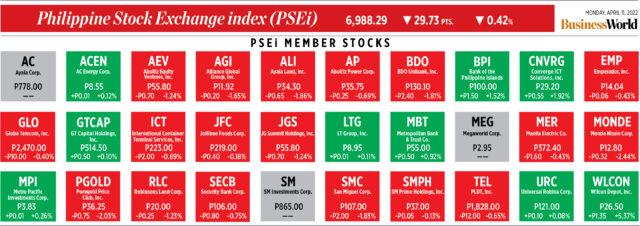
Here’s a quick glance at how PSEi stocks fared on Monday, April 11, 2022.


Here’s a quick glance at how PSEi stocks fared on Monday, April 11, 2022.

THE PESO sharply retreated to return to the P52 level versus the greenback on Monday amid hawkish signals from the US Federal Reserve and expectations of a prolonged war between Russia and Ukraine.
The local unit closed at P52.05 per dollar on Monday, shedding 46 centavos from its P51.59 finish on Friday, based on Bankers Association of the Philippines data.
This is the peso’s weakest close in almost two weeks or since it ended trading at P52.075 per dollar on March 29, Rizal Commercial Banking Corp. Chief Economist Michael L. Ricafort said in a Viber message.
The peso opened at P51.70 against the dollar. Its weakest showing was at P52.08, while its intraday best was at P51.69 versus the greenback.
Dollars exchanged increased to $1.635 billion on Monday from $1.056 billion on Friday.
The peso weakened after a Fed official said inflation could remain elevated until 2023, giving it a reason to tighten its policy stance more aggressively, a trader said.
Reuters reported that Cleveland Fed President Loretta Mester in a TV interview said the Fed’s policy tightening will help to reduce excess demand and in turn bring price pressures down.
“It is very important that we get inflation under control. That is the biggest challenge right now,” she said.
Meanwhile, Mr. Ricafort said the market also reacted to US officials warning that the war in Ukraine could take weeks or years.
World Bank in a report released on Sunday said Ukraine’s economic output will likely shrink by 45.1% this year amid the Russian invasion that has shuttered businesses.
For Tuesday, Mr. Ricafort gave a forecast range of P51.95 to P52.15 per dollar, while a trader said the peso could move within P52 to P52.25. — Luz Wendy T. Noble with Reuters
SHARES declined on Monday amid a shortened trading week and ahead of the release of US inflation data, which are expected to have reached a fresh high in March.
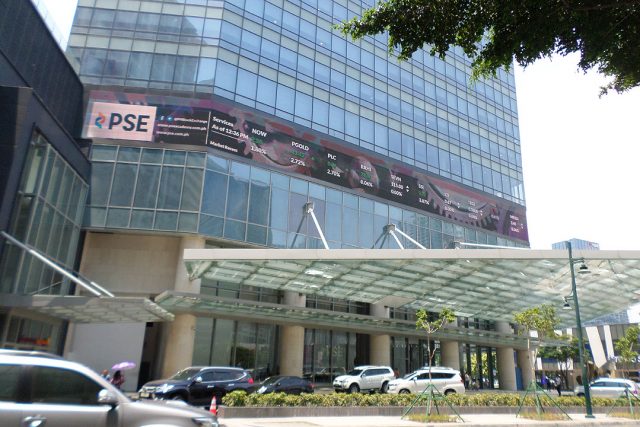
The benchmark Philippine Stock Exchange index (PSEi) fell by 29.73 points or 0.42% to close at 6,988.29 on Monday, while the broader all shares gave up 11.24 points or 0.30% to end at 3,728.21.
“Share prices opened the week in a negative tone. Market participants traded with caution ahead of a long Lenten holiday break as apprehensions over the US inflation continue to spook investors,” Papa Securities Corp. Equities Strategist Manny P. Cruz said in a text message.
“Monday’s sideways trading ended in a last-minute sell-off which brought the local market down. The decline and the lethargic trading are attributed to worries over the Philippines’ inflation, the Federal Reserve’s hawkish policy outlook, and the Russia-Ukraine war and its global economic implications,” Philstocks Financial, Inc. Senior Research Analyst Japhet Louis O. Tantiangco said in a Viber message.
“Philippine shares were quietly sold down as the market lacked major catalysts during the shortened trading week. Sentiment also didn’t get much of a boost as US equities notched losses for the week but ended mixed on Friday as investors braced for tighter monetary policy from the Fed,” Regina Capital Development Corp. Head of Sales Luis A. Limlingan added in a Viber message.
Markets have raced to price in the risk of ever-larger rate hikes from the Federal Reserve with futures implying rises of 50 basis points (bps) at both the May and June meetings, Reuters reported.
The Fed in March raised its benchmark rate by 25 bps for the first time since 2018 to fight inflation, which hit a 40-year high in February.
The March US consumer price report will be released on Tuesday and the median forecast is for a stratospheric rise of 1.2%, taking annual inflation to an eye-watering 8.5%.
Asian shares slipped on Monday ahead of a week packed with central bank meetings and US inflation data.
At home, all sectoral indices ended in the red on Monday. Property declined by 24.17 points or 0.74% to 3,243.84; mining and oil lost 80.32 points or 0.64% to 12,349.86; industrials dropped by 45.34 points or 0.46% to 9,621.75; holding firms fell by 25.42 points or 0.38% to 6,543.22; financials gave up 1.87 points or 0.11% to 1,667.81; and services went down by 1.46 points or 0.07% to 1,930.86.
Meanwhile, the MidCap index advanced by 0.04 point or 0.52% to close at 1,191.22 and the Dividend Yield index retreated by 4.60 points or 0.27% to 1,692.61.
Value turnover decreased to P3.36 billion with 882.34 million shares changing hands from the P4.02 billion with 659.97 million issues seen on Friday.
Decliners outnumbered advancers, 102 versus 75, while 55 names were unchanged.
Net foreign selling of P208.85 million was seen on Monday versus the P458.19 million in net buying seen the previous trading day. — L.M.J.C. Jocson with Reuters
FINANCE Secretary Carlos G. Dominguez III said he prefers a wealth tax centered on reforming the real property valuation system because taxes on other forms of wealth are more easily evaded.
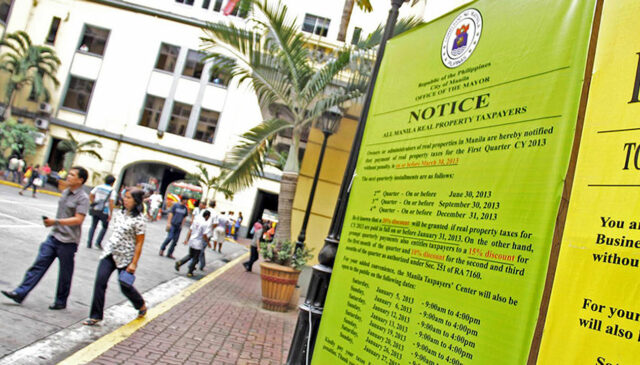
He said in a statement issued by the Department of Finance (DoF) on Monday that should the government end up targeting the super-rich, he would prefer a method that involves regularly updating the schedule of market values (SMV) on real property.
The SMV is the basis for appraising property values for taxation.
Taxes on movable assets lead to tax avoidance, while taxes on property have a higher probability of collection as “land cannot be hidden nor spirited away,” Mr. Dominguez said in the statement.
“That kind of wealth cannot escape to offshore accounts or anywhere. That is wealth here. The other kind of wealth they want to tax can disappear,” he added.
He said current land valuations are outdated relative to their market value.
“The market value of prime commercial areas in Ayala Avenue within the vicinity of San Lorenzo in Makati City, is only about P40,000 per square meter (sq.m.), based on the City’s SMV, when in fact, the real market value ranges from P400,000 to P900,000 per sq.m.,” Mr. Dominguez said. “So we are losing tens of billions of pesos because that kind of wealth is not being taxed correctly.”
The DoF found that the real property tax (RPT), based on the current SMV for Barangays San Lorenzo and Bel-Air in Makati, is P40,000 per sq.m., as opposed to the P940,000 per sq.m. benchmark used by the Bureau of Internal Revenue (BIR) to “compute estate, donor’s and capital gains taxes.”
The DoF estimated the SMV-based valuation of commercial land in Barangay San Lorenzo, which covers 52,640 sq.m., at P842.24 million, yielding RPT of P25.27 million. Bel-Air’s 52,080 sq.m. area is worth P833.28 million, implying an expected RPT of P25 million.
However, if market values are used, commercial land in Barangays San Lorenzo and Bel-Air would be worth P19.79 billion and P19.58 billion respectively, yielding RPT of P593.78 million and P587.46 million, respectively, or P1.18 billion combined.
Mr. Dominguez said that the DoF has been pushing for the passage of the Real Property Valuation and Assessment Reform Act, a component of the Comprehensive Tax Reform Program.
The Real Property Valuation and Assessment Reform Act is currently pending in the House Committees on Ways and Means, Local Government, and Finance.
Only 62% of Revenue District Offices under the BIR have updated zonal values, while only 40% of local government units have updated SMVs, according to the DoF’s tax reform website.
“This proposed tax reform aims to promote the development of a just, equitable, and efficient real property valuation system and broaden the tax base used for property-related taxes imposed by the national and local governments,” the DoF said.
Mr. Dominguez last year warned legislators that imposing a “super-rich” tax “would only encourage aggressive tax avoidance schemes,” adding that it would drive away investment, resulting in fewer jobs and dampened business growth.
“There is a risk of capital flight if the wealth tax is passed in the Philippines,” he said in a letter to House Speaker Lord Allan Jay Q. Velasco. “Currently, only four countries continue to implement the wealth tax — Belgium, Norway, Spain, and Switzerland.”
He also cited a German study that found that wealth taxes on the extremely rich adversely affect the economy, as these taxes take away accumulated wealth and savings, discouraging investment on the part of taxpayers.
The Tax Reform for Acceleration and Inclusion (TRAIN) law, and the proposed Valuation Reform Act and Passive Income Financial Intermediary Taxation Act (PIFITA) adequately address inequalities in the system, he added.
He said a wealth tax would also necessarily involve additional administrative and enforcement efforts and relaxing the Bank Secrecy Law, which prohibits the disclosure of individual bank details, except in extreme cases or with the permission of the account holder.
The BIR’s list of largest taxpayers is not based on wealth, but on income. — Tobias Jared Tomas
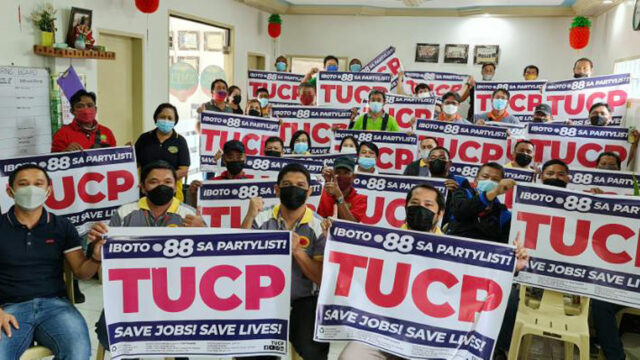
THE Trade Union Congress of the Philippines (TUCP) on Monday filed a petition seeking to increase the daily minimum wage in the Soccsksargen region in the southern Philippines to P724 from P336, in line with petitions filed with other regional wage boards.
The TUCP cited the rising cost of living, which has far surpassed the ability of workers on minimum wage to afford most expenses.
The TUCP, the largest Philippine labor federation, said in its petition filed before the Soccsksargen wage board that the P25 minimum wage increase granted in 2019 “has long dissipated.”
It said the February inflation level in the region implies that the purchasing power of the P336.00 gross daily minimum wage “is only P295.00.”
On a net basis, “the take-home pay of a minimum wage earner is a measly P309.48/day after the government-mandated deductions, with a purchasing power of 271.71/day.”
It cited the 2021 government estimate of a P13,298.00/month poverty threshold for Region XII, compared with the current minimum wage of only P8,736.00, equivalent to an inflation-adjusted P7,699.89.
It also said that deducting the P5,340.80 food threshold from the current take home pay of P7,647.20 per month implies an “estimated budget for a meal/person for a family of five is around P12.32.”
“Clearly, the amount cannot provide for the recommended nutritional requirements for a family of five, not by any stretch of the imagination,” it said.
The TUCP said the current P12.31 allocated for the daily food expenses of every family of five in the region is much lower than the P917.50/meal/family estimated by the Ateneo Policy Center using a state-designed food model.
“The current minimum daily wage of P365.00 can only accord workers and their families nutritionally deficient survival meals.”
TUCP last week refiled its petition for a P470 increase in the daily wage for Metro Manila, after the capital region’s wage board dismissed an earlier petition due to jurisdiction issues.
The TUCP on Sunday called the labor bureaucracy’s response to wage hike petitions “business as usual, time-consuming, (and) technically tedious.”
Soccsksargen, formerly known as Central Mindanao, covers South Cotabato, Cotabato, Sultan Kudarat, Sarangani including General Santos City, Cotabato, Koronadal, Tacurong and Kidapawan.
The TUCP has already filed similar petitions in the Central Visayas and the Davao region. — Kyle Aristophere T. Atienza

THE Sugar Regulatory Administration (SRA) said the draft order authorizing 350,000 metric tons (MT) of sugar is intended to backstop domestic supply following shortfalls in local production.
Administrator Hermenegildo R. Serafica said in a statement on Monday: “What the detractors of imports have failed to consider is the issue of food security, in particular, the availability of supply and the issue of affordability of sugar.”
“As such and coupled with the increase in demand for sugar due to the opening up of the economy, the SRA has determined that there won’t be enough local production of sugar to meet our domestic consumption in the coming months, particularly June to August,” he added.
The SRA recently put forward Sugar Order No. 4, which calls for the import of 250,000 MT of refined sugar, of which 150,000 MT is to be premium grade or bottlers’ grade refined sugar. The remaining 100,000 MT will consist of raw sugar.
Mr. Serafica said natural calamities and disrupted planting schedules were behind weak domestic production, pushing sugar prices higher.
Apart from Typhoon Odette (international name: Rai) in December, he said other weather disturbances affecting the sugar crop were excessive rain and reduced sunlight due to the La Niña weather phenomenon.
“Another effect of the rise in sugar prices is the rush of farmers to mill their cane while prices are up even though the cane is not yet fully mature; thus (yielding) less tonnage and sugar content. As a result, aside from lower sugar production when compared to last crop year, milling will also be ending earlier than expected,” he added.
Mr. Serafica said opposition to imports is being put forward by “self-interested” parties, adding: “The issue of sugar importation has become very political. There are no midnight or sweetheart deals. I will always do what I believe is right for the greater good. As the government agency regulating sugar supply, SRA has a mandate to ensure food security.”
The import program is being contested in the Regional Trial Courts of Negros Occidental by sugar planters, who obtained preliminary injunctions against earlier import orders. — Luisa Maria Jacinta C. Jocson

THE GOVERNMENT has invited bidders to participate in an auction for the contract to supply buses to the P73.93-billion Davao City bus system project.
The Transportation department said the government is seeking suppliers of diesel and electric buses for the Asian Development Bank (ADB)-funded project.
The auction is “open to bidders from eligible source countries of ADB,” the department said in its bid invitation.
“Bidders may bid for a single contract only or for both contracts (diesel and electric buses),” it added.
Bids should be delivered to the Transportation department’s procuring agent, the Procurement Service of the Department of Budget and Management in Manila on or before May 12.
A pre-bid conference is scheduled for April 8.
The department noted that bidders seeking both diesel and electric contracts must submit separate bids rather than a single combined bid.
According to the department, it will evaluate and compare bids on the basis of each contract separately or multiple contracts combined in order to arrive at the least-cost combinations.
It said the discounts offered by bidders for the award of multiple contracts will be taken into account.
“Any discounts offered by bidders submitting bids for multiple contracts and the methodology for the application of any discount shall be stated in the Letter of Bid included in its bids for each contract.”
The department recently sought bidders for the project’s three contract packages that cover the construction of Buhangin Depot, Calinan Depot, and Calinan Driving School.
The second contract is for the Toril Depot and Terminal, Bunawan Terminal, and Calinan Terminal, while the third contract covers the civil works along bus routes, including bus stops, bus lanes, and other pedestrian improvement works.
The bus system will have 29 routes with a total route network of 672 kilometers, operating over 580 kilometers of road traversing the entirety of Davao City.
The project is expected to commence operations in August 2023.
Former Transportation Assistant Secretary Goddes Hope O. Libiran told BusinessWorld in December that the civil works component will cost P19.71 billion, while the bus fleet, both diesel and electric, will cost P21.17 billion. — Arjay L. Balinbin

THE full potential of trade deals available to micro, small, and medium enterprise (MSME) exporters remains largely untapped, pointing to a need for the government to talk up the advantages of such preferential arrangements, the Department of Trade and Industry (DTI) said.
“The government must empower MSMEs, particularly those that are export-oriented by encouraging them to utilize preferential trade arrangements to expand their market reach and level the playing field,” Trade Assistant Secretary Allan B. Gepty said during a recent workshop organized by the ARISE Plus Philippines project.
“Based on Philippine Statistics Authority’s (PSA) 2020 data, MSMEs have generated more than 5 million jobs comprising 62.66% of the country’s total employment,” Mr. Gepty added.
Among the trade agreements the Philippines is party to, Mr. Gepty said the Regional Comprehensive Economic Partnership (RCEP) was particularly crucial for MSMEs to tap because of its harmonized and improved trade facilitation mechanisms for member economies.
RCEP includes Australia, China, Japan, South Korea, New Zealand and the 10 members of the Association of Southeast Asian Nations (ASEAN).
“For example, the RCEP’s Rules of Origin have a single set of requirements for ASEAN and its key trading partners to enter each other’s markets under, mostly, duty free treatment,” Mr. Gepty said.
“It would be much easier for Philippine exporters to comply with certifications and forms and avail of preferential arrangements as they need only review and meet RCEP requirements instead of having to study and hurdle the requirements of various free trade agreements depending on the country they intend to export to,” he added.
The Philippines has yet to sign on to RCEP after the Senate was unable to give its concurrence before it took a break on Feb. 3 for the May elections. President Rodrigo R. Duterte signed the RCEP agreement on Sept. 2.
The ARISE Plus Philippines project, a four-year project funded by the European Union, seeks to develop the Philippines’ trade performance and competitiveness with an eye towards bringing about inclusive economic growth and reducing poverty. — Revin Mikhael D. Ochave
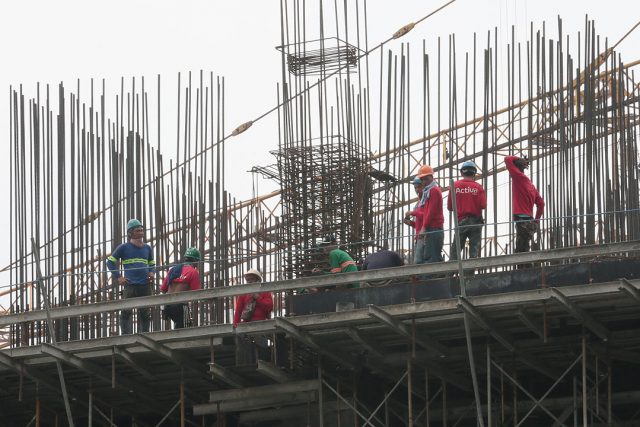
WHOLESALE PRICE growth of construction materials in Metro Manila eased to a four-month low in February, according to preliminary data from the Philippine Statistics Authority (PSA) released on Monday.
The construction materials wholesale price index in the National Capital Region (NCR) rose 5.2% year on year in February, slowing from 5.3% in January but higher than the 2% logged in February 2021.
The February reading was equal to the growth rate posted in December. Both months represent the lowest rate since the 4.7% reported in October 2021.
In the year to date, the growth in bulk construction materials prices was 5.3%, against the year-earlier rate of 1.6%.
The PSA said the slower growth was led by the prices of concrete products and cement, growth in which decelerated to 3.3% in February from 3.5% in January. Also posting slower growth were hardware (3.2% from 3.5%); glass and glass products (1.4% from 14.4%); and doors, jambs, and steel casements (2.2% from 2.9%).
Price growth accelerated for sand and gravel (2.2% from 2.1%); plywood (4.1% from 3.1%); reinforcing and structural steel (7.2% from 7.0%); electrical works (9.2% from 8.5%); plumbing fixtures and accessories/waterworks (6.6% from 5.4%); painting works (4.5% from 4.2%); PVC pipes (5.3% from 4.2%); and fuels and lubricants (31.87% from 26.6%).
February’s easing was “due to existing and adequate supply of materials purchased earlier making supply steady despite supply chain constraints due to pandemic and war in Eastern Europe,” Asian Institute of Management Economist John Paolo R. Rivera said in a text message.
JAN. RETAIL PRICE GROWTH
Separately, retail price growth of building materials in the NCR rose to its highest level in three-and-a-half-years in January, the PSA said, also on Monday.
The NCR construction materials retail price index rose 3% in January from 2.7% in December and 1.2% in January 2021, the PSA said.
This was the largest rise in the index in 42 months, or since the 3.3% reading posted in July 2018.
Price growth accelerated for most commodity groups in January. Miscellaneous construction materials price growth was 4.4% in January from 3.6% in December. Price growth was also higher for tinsmithry materials (4.2% from 3.8%); plumbing materials (3.8% from 3%); electrical materials (2.8% from 2.5%); and masonry materials (2% from 1.6%).
Mr. Rivera said this jump in January was due to continuous construction by both the private and public sectors.
“Due to limited supply and supply constraints in the world now, there is pressure for prices to go up as construction activities intensify,” he added.
The wholesale price index indicates large purchases by major construction companies and property developers and serves as a leading indicator for future activity by those industries.
Meanwhile, retail construction prices reflect demand from small-scale building projects, such as small contractors. — Mariedel Irish U. Catilogo

Last month, the Philippines adopted the 10-Point Policy Agenda on Economic Recovery to accelerate and sustain economic recovery from the COVID-19 pandemic through Executive Order (EO) No. 166. Among the principles laid down by EO No. 166 is the resumption of economic and social activity, removal of age-based restrictions on mobility, and the further expansion of public transport capacity.
Consistent with the objective of further reopening the economy, the Fiscal Incentives Review Board (FIRB), through Memorandum Circular 2022-018, denied a request by the Philippine Economic Zone Authority (PEZA) to extend the government’s authorization of remote work for Information Technology-Business Process Management (IT-BPM) companies.
It must be noted that FIRB Resolution No. 19-21, dated Aug. 2, 2021, allowed registered business enterprises (RBEs) in the IT-BPM sector to continue implementing work-from-home (WFH) arrangements without adversely affecting their fiscal incentives under the Corporate Recovery and Tax Incentives for Enterprises (CREATE) Law until March 31, 2022. Further, on Oct. 15, 2021, the FIRB issued Resolution No. 23-21, denying the request of PEZA and its enterprises to be exempted from the WFH arrangement under Resolution No. 19-21 which required that the number of employees working remotely must not exceed 90% of the total workforce.
With the denial of an extension, IT-BPM employees were required to return to work in the registered sites starting April 1, 2022. While RBEs are not barred from continuing to implement WFH arrangements past that date, they must however give up the tax incentives they are currently enjoying. The dilemma now for RBEs is which side to take — employee convenience, productivity, and morale, or revocation of tax incentives such as an income tax holiday or a 5% special corporate income tax in lieu of all taxes, such as the value-added tax (VAT), income tax, and local business tax.
Section 309 of the CREATE Law provides the condition precedent to avail of the tax incentives. It states that a qualified registered project or activity under an Investment Promotion Authority administering an economic zone or freeport must be exclusively conducted or operated within the geographical boundaries of such a zone or freeport. An RBE may also conduct or operate more than one qualified registered project or activity within the same zone or freeport under the same IPA. Any project or activity conducted or performed outside the geographical boundaries of the zone or freeport is not be entitled to the tax incentives unless such a project or activity is conducted or operated under another IPA.
Noncompliance with the conditions prescribed under FIRB Resolution Nos. 19-21 and 23-21 will result in the suspension of the income tax incentives on the revenue corresponding to the months of noncompliance. Recently, the Bureau of Internal Revenue (BIR) issued Revenue Memorandum Circular (RMC) No. 39-2022 prescribing the manner of payment of penalties relative to violations incurred by RBEs under the IT-BPM Sector on the conditions prescribed regarding WFH arrangement. The RMC requires RBEs to compute the penalty in the manner illustrated in the circular, and pay the penalty within 30 days after the due date prescribed for the payment of income tax. If the deadline is missed, administrative penalties will be imposed as if the RBE were paying the regular corporate income tax rate of 20% or 25%.
While PEZA may grant applications for hybrid work setups until Sept. 12, 2022, this measure, being temporary, does not really address the problems of the IT-BPM sector. It must be noted that based on current studies, employees prefer WFH to working on-site, so it has become more difficult for the sector to comply with the work on-site directive.
To allow employees to continue with the WFH arrangements, the IT-BPM sector is considering various options. These include (1) deregistration from PEZA, (2) downsizing of PEZA operations, (3) transfer of registration with another IPA, and (4) retaining registration to continue to avail of other incentives.
DEREGISTRATION FROM PEZA
This option is available to IT-BPM companies that see the WFH set-up as a long-term arrangement.
IT-BPM RBEs that opt to deregister with PEZA will lose their tax incentives and will be subject to the regular corporate income tax (RCIT) of 25%, VAT, and local taxes. Other factors to be considered are the need to relocate business operations to non-PEZA locations, payment of import duties and taxes on imports, payment of VAT on local purchases, and registration updates with various government agencies.
The lost tax incentives may be compensated for by reduced lease payments, utilities, and administrative expenses.
Deregistering from PEZA means that the RBE will be considered a regular corporation and will no longer be subject to mandatory administrative, compliance, and reportorial requirements under the PEZA Law.
DOWNSIZING OF PEZA OPERATIONS
Some IT-BPM companies have various PEZA-registered sites. To meet the on-site percentage requirement, some RBEs are planning to downsize their PEZA sites by delisting some of their registered activities. RBEs may also consider retaining their PEZA sites where their employees can comply with the work on-site requirement and creating a new entity that will conduct the business operations of the delisted activities.
The remaining PEZA-registered sites will continue enjoying the tax incentives while the new entity will be subjected to regular tax rates.
TRANSFER OF REGISTRATION WITH ANOTHER IPA
The implementing rules and regulations (IRR) of the CREATE Law provides that qualified expansions, entirely new projects, or existing registered projects or activities prior to the effectivity of the CREATE Law, may register and avail of incentives subject to the criteria and conditions set forth in the Strategic Investment Priorities Plan (SIPP) in effect at the time of application, and performance review by the FIRB. The IRR provides that the application for a qualified expansion project or activity must be approved by the FIRB or concerned IPA, based on the level of capital invested.
Some IT-BPM companies are looking at the possibility of transferring and registering their activities from PEZA to another IPA which does not require work to be performed at specific registered sites. With the rationalization of incentives under CREATE, RBEs are now entitled to the same set of incentives. However, IPAs that do not administer ecozones or freeport zones do not require that their registered RBEs operate within a specific site. Thus, the option to transfer of registration to another IPA is available.
RETAINING REGISTRATION TO CONTINUE TO AVAIL OF OTHER INCENTIVES
The penalty for noncompliance with the on-site requirements is equivalent to paying the regular corporate income tax of 20% or 25%.
Although they stand to lose the incentives for income tax, some RBEs are considering retaining their PEZA registration to continue availing of other tax incentives such as VAT zero-rating on their local purchases of goods and services which are directly and exclusively used in the registered activity and importations and exemption from local business tax. Thus, some RBEs are considering retaining their PEZA registration and paying the penalty while availing of the VAT zero-rating incentives.
In summary, IT-BPM companies should consider the various factors involved in choosing which path to take, balancing both recovery from the economic impact of the pandemic and maintaining the welfare of their employees.
Let’s Talk Tax is a weekly newspaper column of P&A Grant Thornton that aims to keep the public informed of various developments in taxation. This article is not intended to be a substitute for competent professional advice.
Neptali G. Maroto is a manager from the Tax Advisory & Compliance division of P&A Grant Thornton, the Philippine member firm of Grant Thornton International Ltd.

By Kyle Aristophere T. Atienza, Reporter
A PARTY-list group on Monday asked the Finance department to seize the bank accounts of the administrators and beneficiaries of the estate of the late dictator Ferdinand E. Marcos for failing to pay billions of pesos in taxes in the past two decades.
In a letter to Finance Secretary Carlos G. Dominguez III and Internal Revenue Commissioner Caesar R. Dulay, the Akbayan Party-list, founded by victims of the late strongman’s martial rule, said seizing the bank accounts of the Marcoses would help the government collect their unpaid estate taxes, which have ballooned to P204 billion due to interest and other penalties.
“By garnishing the bank accounts, the Republic of the Philippines can immediately get the P204-billion unpaid estate tax debt of the Marcoses, which could go a long way during this pandemic,” it said.
Akbayan said demand letters issued by the Bureau of Internal Revenue in the past showed that the tax assessments had become final and executory.
“Clearly, the above persons are delinquent taxpayers, and it is incumbent upon the government to collect immediately the total amount due,” it said, referring to the late dictator’s immediate family members — his wife Imelda, son Ferdinand “Bongbong” and daughters Imelda “Imee” and Irene — and the estate administrators.
“We appeal to the Department of Finance and BIR to send notices of garnishment to all banks in the Philippines and proceed from there in recovering the funds due the Filipino people,” it added.
Marcos, Jr.’s lawyer Victor D. Rodriguez did not immediately reply to a Viber message seeking comment.
Akbayan said the law does not stop the tax agency from seizing the bank accounts of the Marcos family. “We are also aware that no temporary restraining order or injunction may be issued against the BIR.”
“Upon receipt of the warrant of garnishment, the bank shall turn over to the BIR commissioner so much of the bank accounts as may be sufficient to satisfy the claim of the government,” Akbayan said, citing the country’s tax law.
Michael Henry Ll. Yusingo, a lawyer and a research fellow at the Ateneo de Manila University Policy Center, said the BIR must explain to Congress why it has failed to collect the taxes.
“The erring officials must be penalized,” he said in a Facebook Messenger chat, noting that this sets a bad precedent and emboldens tax evaders.
Political analysts and historians have decried an alleged effort to revise the country’s history about the late dictator by putting him in a good light.
Marcos, Jr. is leading in presidential opinion polls. His sister Imee is a senator, while their mother Imelda had been a congresswoman who represented their hometown in Ilocos Norte for most of the time since she came back to the Philippines three decades ago.
His son Sandro is seeking to represent Ilocos Norte in Congress, a position that his grandmother held for more than 20 years.
“Civil society must not relent in making sure the Marcos estate tax is collected and that the proper history of the Marcos dictatorship, including the Martial law period, is written in our textbooks, regardless of whoever is in the administration after the elections,” Mr. Yusingco said. “We cannot just rely on our political class to attain this objective for us.”
Legal experts including former Supreme Court Justice Antonio T. Carpio worry that the government would never recover the dictator’s ill-gotten wealth if his son becomes president.
Former Presidential Commission on Good Government (PCGG) Commissioner Ruben Carranza earlier said President Rodrigo R. Duterte should do more than ask the country’s tax agency why the taxes have remained unpaid for decades.
Mr. Carranza, who now works as a senior expert at the International Center for Transitional Justice, was involved in a Supreme Court case where $678-million in Swiss deposits of the Marcos couple were found to have been illegally obtained.
He earlier said the late strongman’s son is aware of his family’s stolen wealth because he has been a key administrator of the Marcos estate since his father died in exile in the US in 1989.
He said Mr. Marcos was already 40 years old when the PCGG — created in the 1980s to recover ill-gotten assets of his father and his cronies — discovered in 1998 the $2 million worth of assets deposited by his late father with Merrill Lynch Securities in New York in 1972 under the Panamanian corporation Arelma S.A.
Mr. Carranza said it was the son who answered questions about the content of the Swiss bank accounts during court proceedings.
The dictator stole as much as $10 billion (P522 billion) from the Filipino people, according to government estimates, earning him a Guinness World Record for the “greatest robbery of a government.”

By John Victor D. Ordoñez
THE COMMISSION on Elections (Comelec) has allowed senior government officials and their bodyguards to carry firearms during the election period, exempting them from the election gun ban, according to its chairman.
“I don’t want a senior government official to get injured or lose his life from an armed assailant simply because he cannot defend himself with his own fireman due to the gun ban,” Comelec Chairman Saidamen B. Pangarungan told a news briefing on Monday.
Among those exempted were the vice-president, lawmakers, magistrates, bureaucrats and election officers who have a license to own a gun. The president is already exempted from the gun ban, he added.
Mr. Pangarungan said Comelec changed the gun ban rules promulgated last year due to the large volume of requests for exemptions.
Under an order issued on Nov. 10 last year, only policemen, soldiers and other law enforcers deputized by Comelec may carry guns during the election period.
Election Commissioner George Erwin M. Garcia earlier said the election body would decentralize the filing and processing of applications for exemption to its regional offices.
The amendment also allows the Comelec chief to place election areas of concern under the agency’s control.
Meanwhile, exit polls on the first day of overseas voting on Sunday have gone viral on social media.
“If the exit poll will undermine the integrity of the election process, that will be the subject of investigation,” Mr. Garcia told the same briefing. He said people should focus on the official results after the May 9 elections.
One post on Twitter claimed former Senator Ferdinand “Bongbong” R. Marcos, Jr. dominated the first day of overseas voting in Hong Kong.
“It will be difficult If we believe all of these, which trend online and maybe a way to influence [voting],” he said in Filipino. “What is important is our citizens vote based on their conscience and free from influence.”
A Facebook post of a Filipino voter based in Singapore claiming she had received a pre-shaded ballot also went viral. “We haven’t received any report on this post even from our officials based in Singapore, and therefore it is fake news,” Mr. Garcia said.
In a Facebook post, the Philippine Embassy in Singapore said it was aware of an incident where one “spoiled ballot” was inadvertently given to a voter during Monday’s election, which it called an “isolated incident.”
Election Commissioner Marlon S. Casquejo said Comelec plans to double the five vote counting machines in Hong Kong due to the influx of voters during the first overseas voting on Sunday.
He said three of 92 overseas posts failed to start the election on Sunday due to coronavirus lockdowns and transportation issues.
“The opening of polls was generally peaceful and successful, except for some issues that were unavoidable due to coronavirus situations,” he told the briefing.
Also on Monday, the National Citizen’s Movement for Free Elections (Namfrel) called on Filipinos to monitor all phases of the election process to ensure transparent, free and fair elections.
In a statement, Namfrel said citizens need not join political parties or election watchdogs to become election observers. “Any Filipino can be a citizen election observer.”
“Active vigilance, critical engagement, and assistance to the Comelec as it prepares for the polls, and citizens’ observation of the process are assurances that will help dispel fears of cheating during the vote count and manipulation in the coming elections,” it said.
