Home Blog Page 6480

Booster

BANGSAMORO.GOV.PH

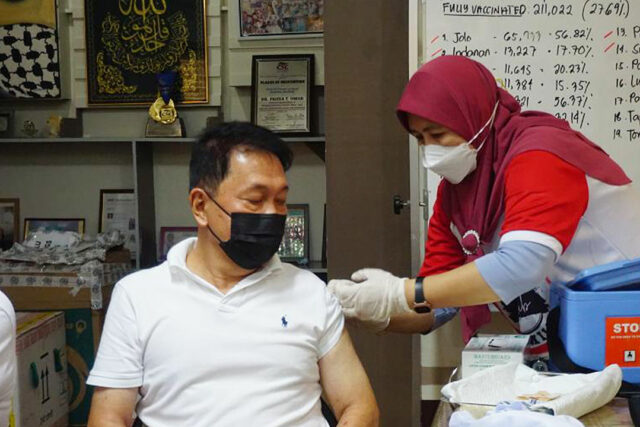
SULU Governor Abdusakur M. Tan receives his second booster shot against COVID-19 as the Bangsamoro regional government launches special vaccination days starting this week to increase jab the region’s low immunization coverage. “I received my second Pfizer booster to show that this vaccine is safe and effective, with fatwa (Islamic ruling) from our Grand Mufti that it is halal, and moreover it is free,” said Governor Tan, the reelectionist governor.

Bucks erase fourth-quarter deficit, stun Celtics

BOBBY Portis turned a missed Giannis Antetokounmpo free throw into a go-ahead hoop, Jrue Holiday made two critical defensive plays in the final 8.1 seconds and the visiting Milwaukee Bucks rallied past the Boston Celtics 110-107 on Wednesday night for a 3-2 lead in their Eastern Conference semifinal playoff series.

Antetokounmpo finished with a game-high 40 points, including a 3-pointer during Milwaukee’s late comeback, to put the Bucks one win away from their third trip to the Eastern Conference finals in the past four seasons.

Game 6 of the best-of-seven series is scheduled for Friday night at Milwaukee.

Portis’ game-winning basket came after Antetokounmpo got Milwaukee within 107-106 by making the first of two free throws with 14.2 seconds left, then missed the second.

Two Celtics fought over the rebound in a crowd, and when the ball deflected to Portis under the hoop, he converted a layup that gave the Bucks the lead for good.

Marcus Smart attempted to counter immediately for the Celtics, but Holiday blocked his driving attempt with 8.1 seconds left and threw the ball off Smart and out of bounds, giving the Bucks possession with 6.6 seconds to go.

The Celtics were then forced to foul Pat Connaughton, and his two free throws with 5.9 seconds left completed the scoring.

Without a time out available, the Celtics had to try to rush the ball up the court for a potential game-tying 3-pointer, but Holiday stripped Smart near midcourt and ran out the clock on Milwaukee’s second win at Boston in the series.

Boston’s Jaylen Brown scored 16 of his 26 points in the third quarter, when the Celtics appeared to take control of the game. The hosts were up by nine points after three periods and by as many as 14 early in the fourth.

The Bucks chipped away, eventually drawing even at 105-all with 42.4 seconds remaining after Antetokounmpo and Holiday buried 3-pointers.

Jayson Tatum capped a team-high, 34-point game by sinking two free throws with 31.1 seconds left to put Boston back up by two, setting up the wild finishing sequence.

Antetokounmpo completed a double-double with 11 rebounds, while Portis led all rebounders with 15 off the bench and contributed 14 points.

Holiday finished with 24 points, eight rebounds and a game-high eight assists, and Connaughton had 13 points for the Bucks, who outscored the Celtics 39-30 on 3-point attempts. Holiday had four of Milwaukee’s 13 treys.

Smart (15 points) and Daniel Theis (11) backed Tatum and Brown for the Celtics. — Reuters

Balanced-scoring Grizzlies demolish Warriors to stay alive

DESMOND Bane, Jaren Jackson, Jr. and Tyus Jones each scored 21 points and sank four 3-pointers as the host Memphis Grizzlies steamrolled the Golden State Warriors 134-95 in Wednesday night’s Game 5 of the Western Conference semifinals.

The Grizzlies had little trouble cutting Golden State’s series lead to 3-2 despite playing without star point guard Ja Morant for the second straight game. Morant has a bone bruise in his right knee and is doubtful to play again this postseason.

Steven Adams collected 13 rebounds, Jones compiled nine assists and Jackson grabbed eight boards for second-seeded Memphis, which led by as many as 55 points. The 39-point margin of victory is the Grizzlies’ largest in postseason play, topping a 124-96 win over the Minnesota Timberwolves earlier this postseason.

Klay Thompson scored 19 points, Jonathan Kuminga had 17 and Stephen Curry added 14 for the third-seeded Warriors. No Golden State player saw more than 26 minutes of action.

Golden State committed 22 turnovers while the Grizzlies had 10. Memphis made a franchise playoff record 18 3-pointers (out of 41 attempts).

The Grizzlies shot 47.5% overall. Dillon Brooks contributed 12 points.

Game 6 is Friday night in San Francisco.

Memphis led 77-50 at half time and then poured it on by outscoring Golden State 42-17 in the third quarter.

Jones and Jackson connected on back-to-back 3-pointers to cap a 14-0 burst and make it 103-56.

The lead went over 50 when Ziaire Williams drilled a 3-pointer to push the gap to 113-61 with 3:20 remaining in the third.

A four-point play by Williams increased the lead to 55 with 40 seconds left in the third period. The Grizzlies held a 119-67 lead entering the final stanza, and both teams played reserves over the final 12 minutes.

Warriors forward Otto Porter, Jr. missed the second half due to right foot soreness. Golden State shot 45% from the field and made 14 of 39 from 3-point range.

Golden State trailed 29-28 after Thompson’s trey with 1:21 left in the first quarter before the Memphis onslaught kicked into high gear.

The Grizzlies scored the next 11 points to lead by 12 after Kyle Anderson’s basket 37 seconds into the second quarter. Memphis used a 9-0 run to increase its lead to 53-36 and later tallied 14 straight to raise the margin to 25 with 1:49 left.

Jones’ basket made it 77-50 entering the break.

The 77 points were the most the Warriors allowed in the first half of a postseason game since the Cleveland Cavaliers scored 86 in Game 4 of the 2017 NBA Finals. Cleveland won that game, 137-116. — Reuters

Osaka breaks from IMG to start own sports agency

FOUR-TIMES major winner Naomi Osaka is breaking away from IMG to launch her own sports agency with longtime agent Stuart Duguid.

Duguid and Osaka began discussing the venture at the Tokyo Olympics last year, Duguid told Reuters via e-mail, adding that the firm, called Evolve, will operate as a “small boutique and bespoke agency.”

“We were discussing the business models of some of her mentors like Kobe (Bryant) and Lebron (James). We thought — why has no transcendent female athlete done that yet,” he said.

“It’s athlete-driven and focused on big picture brand building rather than quick checks with a commission attached.”

Duguid said he could not share much about the identities of the initial clients but added, “it would be only athletes who transcend their sports; or those with the potential to do so.”

Former number one Osaka, the first player for Japan to win a Grand Slam, has emerged as a leading advocate for athlete mental health and well-being since she pulled out of the French Open a year ago and disclosed she had been suffering from depression for years.

On Wednesday, she tweeted a compilation of clips from her earlier playing days in which she discussed her career aspirations with the caption “Hey kid, you’ve come a long way and even though there’s been some bumps on the road I hope you know you’re doing amazing.”

In one of the clips, she prophetically discussed what she might be doing were she not a tennis player.

“I just like sports, so maybe (I would be) like an agent in the end,” she said. — Reuters

Messi tops Forbes’ highest-paid athletes list

LIONEL Messi was the world’s highest-paid athlete over the last year, according to the annual Forbes list released on Wednesday that had the Paris Saint-Germain forward ahead of the NBA’s LeBron James and Manchester United’s Cristiano Ronaldo.

Messi earned $130 million, a figure which includes $55 million of endorsements, during the 12-month period ended May 1, 2022, to sit atop the list of the 10 highest-paid athletes a year after finishing second to Irish MMA fighter Conor McGregor.

Los Angeles Lakers forward James was next on the list after bringing home a combined $121 million, shattering the $96.5-million record for an National Basketball Association (NBA) player that he set last year, while Portugal captain Ronaldo earned $115 million to sit third.

Brazilian soccer player Neymar ($95 million) and three-time NBA champion Stephen Curry ($92.8 million) of the Golden State Warriors rounded out the top five.

NBA player Kevin Durant ($92 million) was sixth while Swiss tennis great Roger Federer, who played five tournaments in 2021 before a knee operation curtailed his season, was third with total earnings of $90.7 million.

The final three spots on the list went to Mexican boxer Canelo Alvarez ($90 million), seven-time Super Bowl champion Tom Brady ($83.9 million) and reigning NBA Finals Most Valuable Player Giannis Antetokounmpo ($80.9 million).

Forbes said its on-the-field earnings figures include all prize money, salaries and bonuses earned during the 12-month period while off-field earnings are an estimate of sponsorship deals, appearance fees and licensing income. — Reuters

SEAG council meeting

PSC

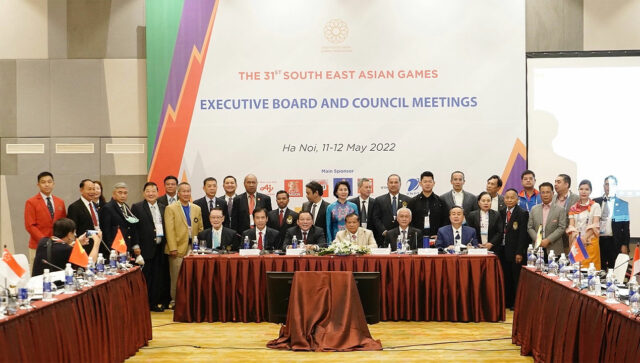
PHILIPPINE Olympic Committee President Rep. Abraham “Bambol” Tolentino (seated, right) and his counterparts strike a pose with Vietnamese Sports Ministry officials during Thursday’s Southeast Asian Games (SEAG) Council Meeting at the Hyatt Regency West Hanoi. Mr. Tolentino says the council has approved the order of hosting for the succeeding SEA Games — Cambodia 2023, Thailand 2025, Malaysia 2027 and Singapore 2029. Mr. Tolentino also appeals during the meeting the nine-member Philippine bodybuilding team’s doping compliance issues.

Ball movement

Luka Dončić remained confident in the aftermath of the Mavericks’ disappointing loss the other day. In his post-mortem, he spoke about the way fans at the American Airlines Center seem to buoy them to meet their potential. Considering how they were shellacked by the Suns, his words better ring true. Coming off a 30-point beatdown, they need to be at their best if they aim to go deep in the postseason.

Perhaps Dončić has reason to be optimistic. After all, the Mavericks did perform much better while hosting Games Three and Four. The problem, of course, is why their output the other day was at the opposite extreme. They should be ashamed that they failed to hit double digits in assists, as clear an indication as any that the ball rarely moved; against the dynamic defense of the Suns, the development sealed their fate. And, yes, they need look no further than the three-time All-Star; their principal playmaker wound up with a career-low two dimes, often keeping the offense to himself by dribbling the seconds down and then taking a shot in tight coverage.

As Mavericks head coach Jason Kidd and Dončić himself rightly noted, isolation plays aren’t detrimental in and of themselves. When they lead to excursions in the lane, they become catalysts for quick ball movement and open stabs at the basket. It’s when they devolve into single possessions for players mimicking black holes and ultimately settling for stepback prayers with hands in their faces that they spell doom. And that’s exactly what happened early and often in Game Five.

Today is do or die for the Mavericks, and the premise is simple. If Dončić can summon his usual flirtation with a triple-double, they have a chance. If not, they would do well to prepare themselves for a long offseason in which they have cause to both celebrate their first foray beyond the first round of the playoffs and rue their inability to get closer to the Larry O-Brien Trophy.


Anthony L. Cuaycong has been writing Courtside since BusinessWorld introduced a Sports section in 1994. He is a consultant on strategic planning, operations and Human Resources management, corporate communications, and business development.

Presidential vote ratio ‘statistically sound’ but election itself marred by disinformation — forum

PHILIPPINE STAR/MIGUEL DE GUZMAN
PHILIPPINE STAR/ MIGUEL DE GUZMAN

The transmitted vote count for the 2022 presidential election is statistically sound but the period leading up to the May 9 poll was marred by a “multiverse” of disinformation, according to a May 11 forum organized by communication scholars and practitioners. 

“There’s nothing statistically that we can say is unusual, but there is still a possibility that something happened in the course of transmission. The only way to verify that is to cross-check the manual count,” said Erniel B. Barrios, a statistics professor at the University of the Philippines (UP), in a webinar titled “Anyare? Post-Election Analysis” hosted by the Philippines Communication Society.  

Statistics can explain “68:32 magic,” a term coined by netizens to refer to the consistent gap in votes between leading presidential candidate Ferdinand “Bongbong” R. Marcos, Jr., and runner-up Maria Leonor “Leni” G. Robredo.  

“For each number of votes accumulated, that’s a cumulative count. In statistics, that’s possible; that’s statistically sound. It’s not irregular that while the votes we’re counting increase, we get closer to the real proportion,” Mr. Barrios said, as he explained the central limit theorem in the vernacular.  

All eyes turn to the Parish Pastoral Council for Responsible Voting (PPCRV), which will complete its cross-check of manually counted votes by this weekend.   

The main takeaway from the elections, said the panelists, is the power of disinformation, strategic branding, and social media algorithms to shape Philippine public perception.  

“You can get trapped in an algorithm where all you see are the fake news — and the real news or the facts don’t penetrate into your algorithm … That’s why disinformation becomes easier,” said Rachel E. Khan, associate dean of the UP College of Mass Communication and coordinator of Tsek.ph, a collaborative fact-checking platform.   

“Especially if your networks are very narrow, you only have people of the same mindset. Our worldview becomes unreal. We are just in a multiverse,” she said.  

The panelists criticized the use of incomplete polls like Pulse Asia and Google Trends to assume outcomes. “These are based on perception. That can easily change,” said Mr. Barrios. — Brontë H. Lacsamana

Church and politics

FREEPIK
FREEPIK

About 84% of Filipinos are at least nominally Catholic, which makes the Roman Catholic Church in the Philippines potentially the most powerful force in politics and governance. But it is the minority sects, among them and especially the 2.6 million-strong Iglesia Ni Cristo (INC), that have most used their numbers in their perennial focus on electing into public office those whom they think will best serve their temporal interests. The INC on May 3 chose, and told its members to vote for, Ferdinand Marcos, Jr. and Sara Duterte for President and Vice-President, respectively.

The media habitually describes the INC as “influential” due to its widely assumed capacity to command its membership to vote according to the preferences of its leadership. If that assumption is correct, the INC numbers can make the difference between a candidate’s defeat or victory.

Politicians of various stripes have thus sought its support in every election. The INC has always obliged by announcing before Election Day whom it is endorsing for the country’s most important elective posts including those for senators and congressmen.

Rarely has the Catholic Church openly endorsed anyone, although some of its cardinals and bishops, without necessarily speaking for the Church as an institution, have in the past named whom they would prefer not to be President. The late Jaime Cardinal Sin, for example, in 1992 implied in his public utterances that he would prefer someone else other than Fidel Ramos, a Protestant, to be President. In 1998 he described as “catastrophic” a Joseph Estrada Presidency. But his saying whom he did not want to President did not prevent Ramos’ and Estrada’s election, although the “catastrophic” Estrada Presidency was eventually removed from office by direct people’s action in 2001.

In seeming departure from its usual practice, on May 4 some 1,200 Catholic priests and bishops who were apparently speaking for the institutional Church went beyond advising the faithful to elect, without naming names, only those candidates who are honest, incorruptible, competent, etc. They instead announced their endorsement of Vice-President Maria Leonor “Leni” Robredo for the Presidency of the Republic and of Senator Francisco “Kiko” Pangilinan for the Vice-Presidency. Church reservations over endorsing specific candidates in such mundane but crucial concerns as elections seems to have given way to the urgency of addressing the ongoing and worsening political, economic, social, and moral crisis in this, the only (supposedly) Christian country in Asia.

The priests and bishops indeed urged — they did not command — the laity to make the “moral choice” of voting for VP Robredo and Senator Pangilinan on May 9 for the sake of this country and its people. But it was hardly surprising, the alternatives being, for the Catholic Church, no alternative at all.

The Church was a leading participant in overthrowing the Marcos dictatorship in 1986, and it stands to reason that it could not support his son, who, in denying any wrongdoing by his father’s martial law regime, is in effect saying that Church people were wrong in joining the millions who removed Marcos Senior from power and forced his family into exile. It could not have supported Sara Duterte either. But it was only partly due to her father’s antipathy to the Church and his calling the Christian God names. Neither could the Church have endorsed Duterte enablers “Isko” Moreno Domagoso and Panfilo Lacson, or the boxer, death penalty advocate, and former Duterte ally Emmanuel “Manny” Pacquiao.

The involvement of religious groups in politics and governance issues has provoked complaints that it is contrary to the Constitutional mandate for the separation of Church and State. It has also invited comparisons with the Spanish colonial period when the friar orders were among the country’s rulers. As valuable a principle as that separation is, however, its implementation, say Church partisans, should not include the suppression of their sentiments on who they think can best serve and lead the faithful because it would be a denial of its priesthood’s and the laity’ Constitutional rights as citizens to free expression and free choice.

Most Constitutional experts have argued that only the adoption of a State religion would be in violation of the separation of Church and State principle. But that argument ignores the problematic issue of whether, by endorsing this or that candidate, the leaderships of religious groups in effect make their members’ choices for them.

The phrase “command votes” that has been used to describe the INC’s supposed control over its members’ votes aptly defines its seeming usurpation of every citizen’s right to free choice. In addition, the election of public officials with the help of a particular church does put those officials in its debt, to repay which they could use their office in its behalf.

Although generally perceived to be less political than the INC — it persuades rather than commands — Catholic Church influence in governance has nevertheless been fairly evident in the absence of a divorce law and the suspension of the death penalty, among others. Church influence has also prevented the public exhibition of motion pictures it considers inappropriate and immoral, even as its more ardent believers in government support and introduce bills whose purposes are consistent with its teachings.

It is almost impossible to stop or even limit the influence of religious organizations in politics and government. Catholic Church influence has at times been positive, as it was at EDSA in 1986, when nuns and priests risked their lives in confrontations with heavily armed troops, tanks, and helicopter gunships in behalf of the faithful. And there is as well its pivotal role in the suspension of the death penalty during the Macapagal-Arroyo regime.

The Philippine Church may not have been as vocal in the defense of human rights and in the advocacy of political, economic and social change as its counterparts in Latin America, which opposed the most brutal dictatorships there at the cost of the lives of its nuns and priests. Beatified in 2018, Saint Oscar Romero, a Catholic bishop, was among the latter. He was killed in 1980 while celebrating mass by a military death squad for his denunciation of the then ruling junta of El Salvador.

No such sterling example of martyrdom, it seems, has so far arisen in Catholic Philippines. But although historically part of the power elite, the Catholic Church in these isles has at least been equal to meeting some of the most urgent challenges of the times, despite much of the laity’s Sunday Catholicism and weekday atheism. (The churches are crammed to the rafters every Sunday by worshippers who lie, cheat, steal or murder from Monday to Saturday.) One can only hope that despite this and other constraints, it will do more, given the urgent need for solutions to the worsening problems that have haunted the people for decades.

The English novelist Graham Greene, who was a Catholic, admitted that the Church has committed “great crimes” during its long 2,000-year history. He was thinking of the Inquisition’s persecution of “heretics” and its burning “witches” at the stake in the Middle Ages, and Church collusion with the European powers in the conquest, enslavement, and exploitation of colonized peoples. But he declared in his 1966 novel The Comedians that the Catholic Church has never been guilty of the indifference to human suffering that decades later Pope Francis was to condemn as the worst sin of all.

May 4’s endorsement of specific candidates was in affirmation of Greene’s observation. But it should not, and hopefully will not be, the last.


Luis V. Teodoro is on Facebook and Twitter (@luisteodoro).

www.luisteodoro.com

Delivering on campaign promises

BW FILE PHOTO

In all of the four-month campaign period, people witnessed Vice-President Leni Robredo inspiring an amazing resurgence of people power, 36 years after EDSA. Of all the colors, people embraced pink as the symbol of radical love for the Filipino people and the Philippines, quintessential music and poetry composed around it, while T-shirts and tarpaulins could not be mistaken for those of other candidates. A new sense of people power seemed to have been birthed. Post-election, some wise guys would say the movement failed to convert the groundswell into votes because the rest of humanity was turned off. The movement was not Pharisaic, but there was rather unmistakable realization that this country is worth fighting for. That was the spirit of EDSA.

EDSA has not failed. It remains a work in progress. Remember incrementalism, that Rome was not built in a day? Good reforms have accumulated from where we were before 1986.

It is in fact impertinent to blame whatever shortcoming we have incurred along the way to any one family or any political color because it is precisely a people’s movement that is subject to the country’s election laws, appointments and decisions of Commission on Elections (Comelec) officials, the composition of the Supreme Court that resolves election cases, corporate money that funds political campaigns, and most important today, social media.

It is by no means easy to pursue the vision for a progressive and more inclusive Philippines, one where rule of law is supreme, with a globally competitive economy, where the marginalized could hope to break through intergenerational cycle of illiteracy and poverty. It is not all about politics and economics. It is also about values, moral compass if you will. It’s a leading indicator of how leaders would manage the risks and travails of governance, how they would handle stress in Malacañang and the temptations while on the throne. In like manner, character and capability are good metrics of how an electorate could discern the best candidates and provide support to public policy.

Some of us would have to give it to Marcos Jr. for adhering closely to his handlers’ script that to one commentator (with the following hashtags #TheFilipinoRightWing, #Eleksyon2022, and #MarcosDuterte) said was nothing but brilliantly executed according to Sun Tzu’s Art of War. We summarize his analysis:

The script called for pretension: “feign disorder and crush him.” President Duterte pretended to be anti-Marcos Jr. by accusing him of being a cocaine addict. Marcos Jr. tested negative and solidified his base; their candidate was clean. The non-administration candidates wasted time attacking on that front.

The script called for confusion: “The whole secret lies in confusing the enemy, so that he cannot fathom our real intent.” President Duterte announced he would run for vice-president with Senators De la Rosa and Go declaring their presidential candidacies. The non-administration’s ammunition would have to be focused but with multiple targets, confusion ensued.

The script called for non-confrontation: “The supreme art of war is to subdue the enemy without fighting.” Marcos Jr. soldiered on his campaigns by skipping public debates. The non-administration candidates attacked him because he refused to give the electorate a glimpse of his platform. Such assaults on Marcos Jr.’s character further strengthened his base for being the underdog, turning off some pink supporters. Many thought the pink movement was hostile and cultic.

The script called for some irritation: “If your opponent is temperamental, seek to irritate him.” Marcos Jr. irritated all the other candidates by not showing up in most of the public debates. This must have led the other candidates to some “stupid stuff that will inevitably hurt their candidate of choice.” The pink camp imploded.

This commentator, however, failed to explain the role of troll farms and influencers in blogs and Twitter and TikTok in mind conditioning. Remember, Sun Tzu also stressed that “all warfare is based on deception.” Cambridge Analytica’s contribution to rebrand the Marcos name for political mainstreaming cannot be ignored. A whole generation of youngsters, and even the seniors among us, could not have known better because the true narrative is sorely missing from history.

If following the Art of War was all that mattered, there was no need for excessive liquidity to fund crowd transport and attendance, take-homes, and actual support. While anecdotes and sporadic texts and videos may not build into a strong case, we have a lot of these that could probably show a pattern of election irregularities. Is this also part of Sun Tzu’s principle that “according as circumstances are favorable, one should modify one’s plans?”

What then do we expect from a Marcos Jr. presidency?

Barring any electoral protest or adverse Supreme Court decision arising from his disqualification cases, Marcos Jr. will be sworn in as the 17th president of the Philippines on 30 June 2022. Based on the 1987 Constitution, he will take the following oath:

“I do solemnly swear that I will faithfully and conscientiously fulfill my duties as President of the Philippines, preserve and defend its Constitution, execute its laws, do justice to every man, and consecrate myself to the service of the Nation. So help me God.”

First things first. Preserving and defending our Constitution require Marcos Jr., as future chief architect of foreign policy, to ensure our sovereignty in West Philippine Sea is respected, that the peace process should be resumed provided the other parties will renounce the use of arms. Executing the laws of the land requires the presumptive president to implement the law recognizing what really happened during martial law in terms of plunder and violation of human rights, prescribing the tax-free indemnification of the victims, and establishing a martial law museum to perpetuate the memory of that dark moment in Philippine history. Another law is the tax code on which basis the Marcos estate was assessed to be liable for payment of P203 billion including interest and penalty.

Doing justice to every man means those in detention without charges, or those whose prosecution witnesses have already withdrawn, should be released in accordance with due process. It also means imprisoning those charged with crimes against public welfare including corruption and plunder. Consecrating himself to the service of the nation means, among other things, he will work to honor his campaign promises to establish unity, reduce the price of rice to P20 per kilo, making more jobs available to our people, and expanding investment in agriculture and infrastructure.

If the presumptive president could deliver on these expectations, he would disprove his critics and inspire market confidence.

However, as Pantheon Macroeconomics recently declared: “It’s almost impossible to say at this stage what a Marcos presidency would do for the Philippine economy, partly because his campaign is devoid of concrete proposals.”

Now that he seems destined for Malacañang, Marcos Jr. will have to buckle down to work to deliver on things he avoided during the campaign. He will now be in command of state efforts to manage the pandemic and the roadmap to economic recovery. As such, he is expected to be more careful in public finance because the national debt level as it is relative to national output is already elevated. A better version of public-private partnership will have to be explored to minimize the use of state finances without sacrificing the delivery of social services and infrastructure. The presumptive president will have to rethink his vintage view on regulatory agencies like the National Food Authority and public subsidy like the oil price stabilization fund which was abolished ages ago. He will be responsible for what happens to school children’s academic performance unless appropriate intervention is done. We need to go digital.

But Marcos Jr. looks serious in disproving all these reservations against his victory. In his post-election interviews with media, he disclosed that he intended “to hit the ground running.” It is good he stressed that one of his priorities is to form his economic team as soon as possible because that would help ease market jitters given his paternal provenance. “As you can imagine, the economic managers are going to be critical for the next several years because of the pandemic and economic crisis, something that we are looking at very carefully.”

While the US and China heads of state have already reached out to Marcos Jr. to congratulate him and pledged to work with him closely, it is likely only now that the heavy burden of leading more than 110 million people is beginning to sink in.

After the election, we really need to shift from the script to vision casting and serious business of governance. The nation awaits the list of deliverables.


Diwa C. Guinigundo is the former deputy governor for the Monetary and Economics Sector, the Bangko Sentral ng Pilipinas (BSP). He served the BSP for 41 years. In 2001-2003, he was alternate executive director at the International Monetary Fund in Washington, DC. He is the senior pastor of the Fullness of Christ International Ministries in Mandaluyong.


Why one little goof drove Wordle fans nuts

JOSHUA HOEHNE-UNSPLASH

FANS of the daily hidden word game Wordle woke up Monday to a social media uproar. The New York Times, which owns and operates the game, had made a last-minute change to eliminate the word “fetus,” presumably in deference to sensitivities swirling around a leaked Supreme Court opinion on abortion.

Whatever the motive, the execution was botched and a diversion so popular for its simplicity and innocence lost a little bit of its joy.

Wordle players try to identify a five-letter word within six guesses. Green squares indicate which letters in each guess exactly match letters in the answer word, and yellow indicates correct letters in incorrect positions.

The beauty of the game is that it’s easy and social. Players share their solving patterns and statistics on social media, trying to beat their friends.

The botched answer swap spoiled the fun. Software quirks gave some players the original answer word, “fetus,” instead of the substitute, “shine.” And if different people face different answer words, the social competition collapses.

I often start my daily Wordle with the word “spine.” That gave me bragging rights on Monday because it yielded four green squares on my first guess.

If, instead, I had faced the original answer word, “fetus,” my starting word would have been close to a whiff, and it would have taken me many more guesses to solve the puzzle.

But since some people faced one answer word and others faced another, the joy of boasting (and schadenfreude) from social sharing was greatly diminished.

Then there’s the politics. It’s not exactly obvious that a game about word structure and letter patterns would exclude words based on whatever’s in the news, especially since Wordle has famously avoided linking answer words to current events in other ways. (The answer on New Year’s Day was “rebus” and the answer on Valentine’s Day was “cynic.”)

It’s reasonable to avoid inserting potentially traumatic or triggering elements to an otherwise guileless word game. But is “fetus” so troubling that it shouldn’t be considered appropriate, say, for Scrabble?

Once Wordle starts going in this direction, where would its sponsors draw the line? What if the word “trump” makes some people think of a polarizing politician and others of nothing more emotional than a pack of cards? Should we be concerned about accidental product placement? (Tuesday’s fiendishly difficult word was the mascot of a well-known car insurance company.)

The game would take a lot more effort — and would be a lot less fun — if for each guess players had to think about which words the editors might have suppressed.

People play Wordle in loose collectives and like to draw inferences off of other people’s tactics. When I see that people have guessed the answer word quickly, I expect an easier word, with more common letter patterns. By contrast, when I see that lots of people are striking out, I skew my guesses towards words like “quirk” and “vivid” that are bristling with unusual letters. Social clues make it possible to crack a particularly difficult word faster than friends and family.*

But if players can’t be sure that everyone is seeing the same word, then there’s little reason to look at other people’s solutions. Changing the Monday word led to mass confusion as people tried to figure out why their patterns looked nothing like their friends’. (The same thing happened a couple months ago when the Times mysteriously edited out the answer word “agora.”)

If Wordle is to exist in its own world, then editing out words because they have social resonance chips away at expectations players have built up around the game. That harms the social cohesion that gives it its charm.

It’s definitely not a way for Wordle to “shine.”

* This columnist is especially pleased whenever he solves the day’s Wordle in fewer guesses than his mom — except that pretty much never happens.

BLOOMBERG OPINION

Elections and good governance should not involve destroying our institutions

Remember back in 2010 when Noynoy Aquino won the presidency and those who campaigned or voted for the other side got so drained and depressed? So much so that they started severing ties from family and friends, particularly those celebrating Aquino’s victory by lecturing them about their “ignorance” and “corruption,” about how they were obstructing “good governance”? Remember when that losing side went to the streets demanding revolution, gleefully looking forward to the country’s situation deteriorating, perhaps even demise? Remember that?

No? Well because it never happened. After the initial disappointment and after it became clear that Aquino won, most of the opposing voters just shrugged and went back to work. They treated their family and friends as before, regardless of their political stance. And most of all, they hoped for the best for the country.

Compare that with today, what with supposed calls for walking out of schools, the repetitive droning calls to the streets, the invitation to cut ties with family and friends whose only sin was to back the candidacy of Ferdinand Marcos, Jr. And compare that with today’s attitude from many of the losing Leni Robredo side, declaring total withdrawal of support for their fellow citizens and even of the country.

Incredibly, the winning side isn’t even allowed to celebrate: any amount of gleeful sentiment was taken as gloating by the Kakampinks, of laughing at the “pain suffered by those so invested in their campaign,” about the victory they supposedly deserved because, after all, they went house to house. But that’s how elections campaigns are: all get invested in it yet inevitably some will win and some will lose.

And setting aside the childishly self-entitled “trophy for every participant” attitude, what is seemingly sought to be forgotten are the months and months of repeated insults and condescension heaped upon by the Kakampink’s, to the point that merely wearing red or the BBM/Sara facemask in public will make one suffer the indignity of snide remarks, glares, or even deranged haranguing lectures, including accounts of vague victimhood suffered through the “1986 revolution,” whatever that is.

More disconcerting is the attitude of wanting to win at all costs, the willingness to do away with our country’s institutions just to be able to impose one’s will over another.

Our universities, supposedly bastions of free thought and free exchange of ideas have suddenly become unabashed hives of homogeneous political thought. And it is no good to pretend that merely this school official or that school organization endorsed a specific presidential candidate. The fact that such happened with no official declaration made about the university maintaining neutrality speaks volumes. And how a student who happens to back a different candidate or — even worse — backed a candidate which the university explicitly or implicitly opposes will be welcomed inside the classroom has never been explained. So much for safe spaces.

The same with the local Catholic clergy. Never mind the other religions, that is their concern. But for a church that prides itself in being “catholic,” to suddenly do away with centuries and centuries of tradition exercised in every country where the Catholic Church is found, to suddenly back a specific candidate — after it refused to even endorse anyone back in the 2013 elections amidst the heat of the then RH Bill national debate — reeks of politicized egotism. And this never mind the fact that the candidate they backed, Mrs. Robredo, happened to author the RH Law, advocated for the SOGI bills, as well as pushed for civil unions (which, in the form currently discussed, is practically the same as same sex “marriage”). This within the further context that the local clergy meekly remained silent for the past two years, when the churches were closed and many of the Catholic faithful were unable to have access to the sacraments.

But most disgusting, worthy of contempt, is the attitude towards the family, where insulting and cutting off one’s parents, siblings, relatives, and even friends are lauded when such was done for partisan reasons. The sheer arrogance of this, the utter selfishness, to think that one has a monopoly on facts and reason, resulting in individualistically being the sole exclusive determinant of right and wrong, is horribly breathtaking. And sad.

Politicians come and go but the care and safety of one’s personal relationships are precisely why we engage in politics. To believe that politics is the end all and be all is downright massively ignorant and self-centered.

To sum, lawyer and legal scholar Trixie Legaspi-Francisco’s words are worth heeding: “Democracy is governed by its most popularly understood principle: majority rule. The majority vote (or plurality when there are more than two choices) decides the election or the issue. And so, when the People have spoken, the People’s will should be respected — whether you agree with it or not. Democracy is not a weapon you can wield only if it suits you.”


Jemy Gatdula is a senior fellow of the Philippine Council for Foreign Relations and a Philippine Judicial Academy law lecturer for constitutional philosophy and jurisprudence

https://www.facebook.com/jigatdula/

Twitter@jemygatdula