Home Blog Page 6380

Women’s football team visits PSC

THE women’s football athletes joined the Philippine Sports Commission (PSC) employees on Monday when they visited for a courtesy call to PSC Chairman William “Butch” Ramirez, who was joined by PSC Commissioners Celia Kiram and Arnold Agustin.

“We recognize the outstanding performance of our women’s football team and their historic accomplishment,” said the sports chief, lauding the ladies who graced the agency’s first physical flag-raising ceremony at Rizal Memorial Sports Complex on Monday.

Lady footballers Chandler and Olivia McDaniel, Camille Rodriguez, Anicka and Sara Castañeda, Hali Long, and Inna Palacios were present on the flag-raising together with Philippine Football Federation (PFF) President Mariano “Nonong” Araneta, Jr.

“This is one of the pinnacles of our experience. We couldn’t have done it without the PSC’s support and all of you behind the scenes. You are all part of this achievement,” said Ms. Long, who served as the team’s co-captain in the tournament.

Mr. Ramirez also commended the leadership of the PFF, its officials, and Australian coach Alen Stajcic, for ensuring that each of our athletes are bringing their best performance on the world stage. Mr. Araneta responded that, “the PSC has been very supportive of all our elite athletes and the campaign of the women’s football team.”

You can now book the ‘Marvelous Mrs. Maisel’ suite at the Plaza Hotel

THE Marvelous Maisel Suite at the Plaza Hotel — COURTESY OF THE PLAZA WEBSITE

CITY DWELLERS may be craving a return to 2019-like normalcy, but for visitors to Manhattan it will soon be possible to rewind the clock much further: to the early 1960s. That’s courtesy of the storied Plaza Hotel and Amazon Prime Video, which are teaming up to recreate aspects of the hit show The Marvelous Mrs. Maisel. The Emmy award-winning comedy will begin streaming its fourth season debut on Feb. 18.

Although the hotel itself is not prominently featured in the show, a suite on its 12th floor has been converted into a replica of main character Midge Maisel’s Upper West Side apartment.

The room at the historic Plaza on Fifth Avenue is filled with midcentury art, antiques, and furniture similar to those sourced by the show’s designers; the dark wooden, carved headboard is an exact replica of the one on set. Perhaps most enticing will be the closet, loaded with such Midge-inspired outfits as her signature wide-lapel wool coats and pearl jewelry, which guests can wear and purchase on site. Overnights, available until April 10, will start at $1,675, reflecting nearly a 50% premium over the Plaza’s one-bedroom suites. The rates include a themed afternoon tea menu and Midge-inspired blowout from the hotel salon.

For the Plaza, the partnership comes at a good time. The 115-year-old hotel has struggled to regain footing after being acquired by Qatari sovereign wealth fund Katara Hospitality for $600 million in June 2018 and subsequently closing for a year amid the pandemic. And themed suites have historically represented good business for the property: According to Crystal Laurence, the hotel’s director of sales and marketing, its 10-year-old Eloise suite has seen such consistent, year-round demand that it’s become one of the hotel’s signatures.   

Amazon and the Plaza are hoping to generate buzz beyond the suite with additional offerings that can bring in a local crowd. Some of the show’s actual costumes and props, including one of Midge’s gold handbags and a pair of her long, green, leather gloves, are on display in glass showcases throughout the hotel lobby. And a special riff on the Plaza’s signature Afternoon Tea called the Midge Menu, from $99 per person, includes black-and-white cookie-inspired macarons, Nutella babka cheesecake, and gussied-up pastrami finger sandwiches served on three-tiered trays, all paying homage to Midge’s ’60s Jewish New York.

Laurence expects the appeal to be even broader than the show’s sizable fan base. “The quintessential New York items on the menu will resonate, even if someone’s never seen the show,” she says. — Bloomberg

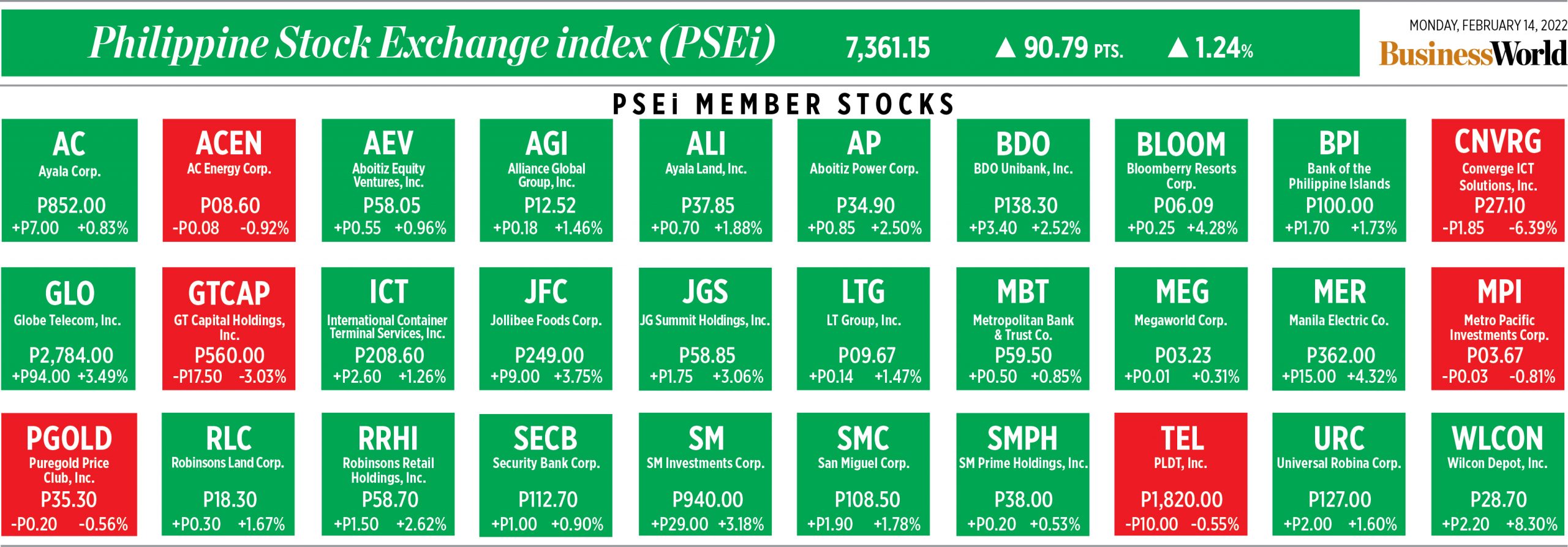
How PSEi member stocks performed — February 14, 2022

Here’s a quick glance at how PSEi stocks fared on Monday, February 14, 2022.


Metro Manila 18th worst traffic-congested city in 2021

TRAFFIC CONGESTION in the Philippine capital further eased last year, pushing Metro Manila out of the top five most congested cities in the world. Read the full story.

Metro Manila 18<sup>th</sup> worst traffic-congested city in 2021

Shares rebound as investors pick up bargains

REUTERS

SHARES bounced back on Monday on bargain hunting and the impact of the index rebalancing ahead of the central bank’s upcoming policy review.

The 30-member Philippine Stock Exchange index (PSEi) advanced 90.79 points or 1.24% to end at 7,361.15, while the broader all shares index went up 20.81 points or 0.53% to close at 3,892.94.

COL Financial Group First Vice-President April L. Tan said the PSEi staged a recovery rally following its sharp fall on Friday. The index sank by 162.26 points or 2.18% to end at 7,270.36 on Friday, while the broader all shares index fell 52.61 points or 1.34% to finish at 3,872.13.

Unicapital Securities, Inc. Equity Trader Christopher Adrian T. San Pedro said bargain hunters caused the PSEi to move sideways between the 7,156 support and 7,500 resistance zones amid hopes of a continued accommodative stance by the Bangko Sentral ng Pilipinas (BSP).

The BSP’s policy-setting Monetary Board will meet on Thursday. All 16 analysts in a BusinessWorld poll last week said the central bank will likely keep benchmark interest rates steady to help the economy recover.

“The latest iteration of the benchmark PSE index came into effect today, and was the main driver of market activity despite weekend developments in the Ukraine,” AAA Southeast Equities, Inc. President William M. Cabangon said in a Viber message on Monday.

“Smart money that speculated on their inclusion to the index used the rebalancing flows as an opportunity to take profits on their positions, while passive funds begin to accumulate,” Mr. Cabangon added.

Monde Nissin Corp. and Emperador, Inc. became PSEi members on Monday after the regulator’s review of the index and sectoral indices’ performance from the first to last trading days of 2021. Monde Nissin’s shares ended 6.39% lower and Emperador dropped by 10.44%.

Back home, most sectoral indices advanced on Monday, except for mining and oil, which dropped 27.76 points or 0.25% to 10,923.64, and industrials, which lost 35 points or 0.33% to end at 10,550.54.

On the other hand, holding firms climbed 129.67 points or 1.89% to 6,973.98; financials went up 26.28 points or 1.53% to 1,741.83; property advanced 29.98 points or 0.88% to 3,427.05; and services increased 13.07 points or 0.68% to 1,921.25.

Value turnover dropped P14.19 billion with 1.19 billion issues traded on Monday from the P22.83 billion with 1.93 billion shares that switched hands on Friday.

Decliners beat advancers, 113 versus 85, while 48 names closed unchanged after Monday’s trading session.

Foreigners turned sellers with P2.42 billion in net outflows logged on Monday versus the P4.47 billion in net purchases seen on Friday. — M.C. Lucenio

Peso weakens versus the dollar due to Russia-Ukraine tensions

BW FILE PHOTO

THE PESO retreated versus the greenback on Monday amid cautious sentiment caused by the ongoing rift between Russia and Ukraine.

The local unit closed at P51.37 per dollar on Monday, depreciating by three centavos from its P51.34 finish on Friday, data from the Bankers Association of the Philippines showed.

The peso opened Monday’s session weaker at P51.38 versus the dollar. Its weakest showing was at P51.405, while its intraday best was at P51.32 against the greenback.

Dollars exchanged dropped to $627 million on Monday from $913.88 million on Friday.

“The peso weakened amid growing geopolitical concerns between Russia and Ukraine over the weekend,” a trader said in an e-mail.

The United States and Europe have warned their citizens to exit Ukraine amid a brewing possibility of Russian invasion which may include an air assault, Reuters reported.

US officials have said Moscow may invade Ukraine before the end of the Winter Olympics on Feb. 20 and may target Kyiv and other cities.

Ukraine on Sunday told airlines to avoid the open waters of the Black Sea from Monday to Saturday while Russian forces conduct their naval exercises.

The dollar and safe-haven currencies held firm and riskier ones struggled for traction on Monday, with traders on edge about the prospect of war in Europe and unsettled by soaring inflation.

The risk of war in Ukraine pushed the euro down on Friday and it was nursing losses at $1.1346 on Monday, well below last week’s top of $1.1495.

The Australian and New Zealand dollars were also pinned below last week’s levels and the Russian rouble was struggling after the spectre of sanctions sparked its sharpest fall in nearly two years on Friday.

The safe-haven yen has climbed to 115.53 yen from a five-week low of 116.34 last week.

The Russia-Ukraine flashpoint adds to stress already evident in markets’ volatile response to hotter-than-expected US inflation data last week, which unleashed bets on the Federal Reserve lifting rates more than 160 basis points before the end of the year.

The dollar index crept up to 96.059 in the Asia session. Analysts see the euro, which dropped 1.2% on the yen on Friday, and oil importers’ currencies as most at risk from conflict in Ukraine. Oil prices have surged.

Meanwhile, Rizal Commercial Banking Corp. Chief Economist Michael L. Ricafort in a Viber message said the peso only moved sideways as the market was waiting for remittance data.

Based on the central bank’s advance release calendar, December and full-year 2021 cash remittances data will be out this Tuesday.

Remittance inflows in November rose by 5.1% year on year to $2.502 billion. This caused inflows in the 11 months to November to increase by 5.2% to $28.43 billion.

The Bangko Sentral ng Pilipinas had forecast cash remittances to have grown by 6% in 2021. It expects a 4% rise this year.

For Tuesday, Mr. Ricafort gave a forecast range of P51.30 to P51.45, while the trader expects the local unit to move within P51.25 to P51.50. — LWTN with Reuters


Over 7,000 visitor arrivals logged since Feb. 10 border reopening

REUTERS

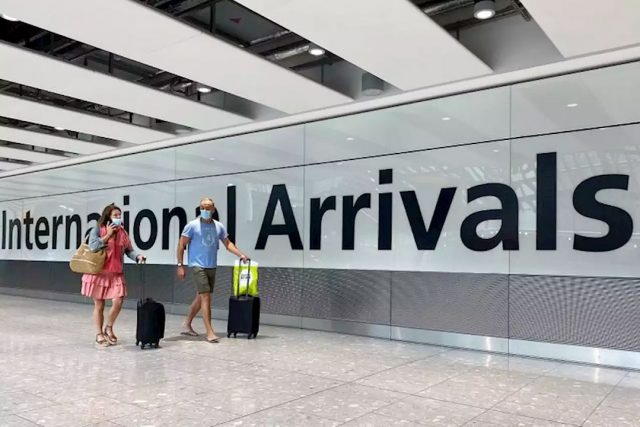
MORE THAN 7,000 international visitors landed in the Philippines since the borders reopened on Feb. 10 to fully vaccinated nationals who are not required to obtain visas to enter the Philippines, the Department of Tourism said.

Tourism Secretary Bernadette Romulo-Puyat said many of the visitors are balikbayans (returning Filipinos holding foreign nationality), though many other foreigners are here on business or are reuniting with their Filipino spouses and families after a long separation due to the pandemic.   

“I was quite surprised when we reopened Feb. 10. I thought that only a few would come. But then… a lot came. In fact, if you count the four days from Thursday to Sunday, we’ve already had about 7,051 tourist arrivals. But of course, 45% are balikbayans (who are) considered tourists because they have foreign passports,” Ms. Puyat said in a television interview on Monday.  

According to Ms. Puyat, the foreign nationals are American, Canadian, Australian, British, Japanese, and Korean.

Ms. Puyat said feedback from tour operators indicates that foreign visitors place a high value on ease of entry requirements.

“Some just really want to travel. That’s it. What they are looking at are travel restrictions. If it’s complicated to visit the country, they won’t. That’s it,” Ms. Puyat said.

On Feb. 10, the Inter-Agency Task Force for the Management of Emerging Infectious Diseases (IATF-EID) allowed quarantine-free entry of fully vaccinated foreign nationals who do not require a visa to enter the Philippines.  

Other requirements include a negative reverse transcription polymerase chain reaction (RT-PCR) test taken 48 hours before departure from the country of origin, a passport valid for at least six months, an outbound ticket, and travel insurance that includes coronavirus coverage with a minimum payout of $35,000. 

The Philippines has also been admitting returning Filipinos quarantine-free since Feb. 1. — Revin Mikhael D. Ochave

Repeal movement gathers steam as review period nears for tariffication law

PHILIPPINE STAR/ MICHAEL VARCAS

FARMER organizations said the Rice Tariffication Law, or Republic Act No. 11203, has failed to make farmers more prosperous three years after it was enacted, and called on the government to repeal it and focus on supporting rice cultivators.

“We call on the government to understand that these last three years are enough to judge the effectivity of this program. First off, it did not improve the lives of farmers. Let’s not add to this during the review, let’s just accept that it failed so we can move on and can enhance agriculture,” National Spokesperson of the Pambansang Katipunan ng Makabayang Magbubukid (PKMM) Jhun P. Pascua said at a virtual press conference.

On March 5, the law is subject to automatic review, a process which the farmers said they hope to participate in.

“Three years of the law is three years of deepening structural hunger — three years of setting up the stage for yet again faux corporate-led solution such as Golden Rice. It will never address food insecurity in the country; rather it will further advance the problems (with) our country’s already fragile biodiversity by yet again implementing lopsided trade agreements and letting in corporate solutions in the form of policies and environment-contaminating creations,” Magsasaka at Siyentipiko para sa Pag-unlad ng Agrikultura (MASIPAG) said in a statement.

Golden Rice is an enriched variety intended to address Vitamin A Deficiency, co-developed by the International Rice Research Institute.

“The government (insists on) retaining a law that virtually obliterated the local rice market, buried rice farmers neck deep into debt, and basically intensified the food security problem both in the peasant and consumer sector,” it added.

They said the law, which liberalized rice imports but required importers to pay a 35% tariff on Southeast Asian grain, has discouraged young people from going into agriculture.

“We know that the liberalization of agriculture has had a big effect on the youth… We have many universities that teach about agriculture but our education system is all about agribusiness and liberalization. They should change the orientation and direction of our education towards developing local products. We need subsidies and the fixing of farm to market roads and (lower the) cost of production in farming,” PKMM Spokesperson Sara D. Espiritu said.

“In its third year, we urge the government to finally repeal the law on rice tariffication and stop the entry of GM Yellow Rice and focus instead on the genuine development of the rice industry. MASIPAG farmers’ experience shows that food security can be achieved using sustainable and appropriate technologies and techniques which can be further upscaled with genuine pro-farmer policies. Furthermore, we likewise call for an immediate resolution to the land struggles suffered by small-scale farmers over the country — only when farmers have access and control over this resource can we truly attain food security,” MASIPAG said.

“Achieving food security will start from junking the law that removed the quantitative restrictions and allows for rice tariffication. Addressing food insecurity and malnutrition will start with shifting from chemical-based agriculture to sustainable organic agriculture that puts emphasis on a diversified and integrated farming system ultimately championing a diversified, accessible, and nutritious diet for the masses,” it added. — Luisa Maria Jacinta C. Jocson

Sugar industry says import plan depressed prices

REUTERS

SUGAR FARMERS urged the government to drop plans to import 200,000 metric tons (MT) of sugar after the domestic price for raw sugar dropped by nearly 10% in some markets.

On Feb. 4, the Sugar Regulatory Administration (SRA) issued Sugar Order No. 3, which authorized the import of those quantities, citing the need to maintain a buffer stock between milling seasons.

“Two days (after the order), week-ending sugar bids closed (lower),” planters said in a statement, noting that mill prices per 50-kilogram bag (Lkg) ranged from P99.12 to P230.”

 “(It) is evident that the ill-timed announcement of SRA to import led to a price drop,” former SRA Board Member Emilio Bernardino L. Yulo said.

He said that the 10% drop will impact the livelihoods of small sugar farmers, which account for more than 80% of sugar producers.

“These small farmers are barely surviving due to the high cost of farm inputs, particularly fertilizer and fuel, (whose prices are) increasing steadily each week and will now suffer more because of this drop in sugar prices,” he added.

Mr. Yulo attributed the drop to “the premature announcement” of SRA Administrator Hermenigildo R. Serafica.

“He knew that this will have an immediate effect on sugar pricing,” he added.

Asociacion de Agricultores de la Carlota y Pontevedra, Inc., an organization of producers in those two Negros Occidental towns, reiterated their appeal for a price freeze on farm inputs to reduce the burden on farmers.

“Since last year, we have appealed to the SRA, the Department of Agriculture (DA) and the Department of Trade and Industry (DTI) yet there has been no action. Instead, SRA released Sugar Order No. 3 knowing that we are in the peak of the milling season and this led to the drop of prices,” the group said. — Luisa Maria Jacinta C. Jocson

Fuel marking program revenue tops P367B; volume 36B liters

PHILSTAR

TAXES collected from marked fuel products amounted to P367.26 billion as of last week, dating back to 2019 when the program started, according to the Department of Finance.

The volume of marked fuel topped 36 billion liters since Sept. 4, 2019, according to data sent by Finance Secretary Carlos G. Dominguez III to reporters on Viber Monday.

As of Feb. 11, revenue collected included P337.44 billion in Customs duties, along with P29.81 billion in excise tax.

Almost three-quarters of the fuel was marked in Luzon, with more than a fifth in Mindanao and 5% in the Visayas.

Diesel accounted for more than 60%, while gasoline had a 39% share, and kerosene the remainder.

The program seeks to deter fuel smuggling by injecting a special dye into the products to signify tax compliance. The absence of the dye is an indication the fuel was smuggled.

In 2021, the Bureau of Customs (BoC) collected nearly P166 billion in duties from the fuel marking program.

The BoC last year marked over 17 billion liters of gasoline, diesel, and kerosene.

It also intercepted nearly 87,000 liters of smuggled diesel and kerosene worth P5.16 million last year, along with two tanker trucks containing unmarked fuel valued at P7.4 million.

Customs collections in 2021 hit P645.77 billion, or 20% higher than the previous year and 4.7% above the bureau’s target as international trade rebounded after the pandemic-driven economic downturn. — Jenina P. Ibañez

Caraga mining output up 8.9% by value on higher metals prices

BW FILE PHOTO

THE Mines and Geosciences Bureau (MGB) said the Caraga mining industry, which extracts much of the country’s nickel, posted growth of 8.93% by value in 2021 due to higher metal prices.

Gross sales of Caraga shipments of mining products increased to P78.86 billion in 2021 from P72.39 billion a year earlier, the MGB said in a statement.

“The increase of the mineral sales for 2021 was mainly due to the increase of metal prices in the world market. The nickel producing mines in the region have been consistent in gaining considerable earnings even in the previous years,” the MGB said.

“The Caraga mining industry has significantly contributed to the country’s economic development as well as the foreign-exchange earnings through mineral exports,” it added.

The value of the region’s gross sales rose 21.19% to P52.75 billion in 2021.

The mining season for the majority of nickel and iron mines in the region ends in the fourth quarter every year.

Caraga in northeastern Mindanao, also supplies gold, copper, chrome, nickel, iron and limestone. — Luisa Maria Jacinta C. Jocson

PHL support for four-day work week among strongest in region

STOCK PHOTO | Image by Yibei Geng from Unsplash

SURVEY respondents from the Philippines were among the most receptive in Southeast Asia to a four-day work week, according to a survey conducted by consumer data and analytics firm Milieu Insight.

Milieu Insight said on Monday that on a survey in which participants ranked propositions on a scale ranging from zero to 10 (where a response of 10 indicates greatest receptivity), 74% of the 1,000 respondents from the Philippines were in the 8 to 10 range, while 21% selected 5 to 7 range and 6% answered between zero and 4 range.

The survey defined a four-day work week as having the same number of hours compared to a five-day schedule.

“In this arrangement, an employee is expected to still work 40 hours/week (10 hours/day), and will have three days off instead of the usual two every week,” Milieu Insight said.

Other countries with responses in the 8 to 10 range were Vietnam (78%), Singapore (76%), and Thailand (75%). Indonesia came in at 69% and Malaysia 48%.

“Receptiveness towards compressed four-day work week is rather positive, with at least 7 in 10 in Southeast Asia indicating at least an 8 from a 0 to 10 scale when asked how much they would like this arrangement to be implemented at their workplaces,” Milieu Insight said.

The survey also found that 39% of respondents from the Philippines were not willing to take a pay reduction to go on a four-day week. Some 19% expressed openness to a 20% pay cut to work four days, 17% were willing to take a 10% pay cut, 13% said they will accept a 15% pay cut, and another 13% indicated that they are willing to take a 5% pay cut.

Milieu Insight found that 67% of respondents in Southeast Asia said a compressed work week will allow for improved work-life balance; 64% said they will be able to spend more time with their loved ones; 48% said they will have more time to be creative and generate ideas; while 45% expect increased productivity.

The survey was conducted in December and involved 500 senior employees and 500 junior employees each in Singapore, Thailand, Malaysia, Indonesia, the Philippines, and Vietnam. — Revin Mikhael D. Ochave