





Home Blog Page 6159

Style (07/18/22)

Teddy Santis’ 1st seasonal collection for New Balance out

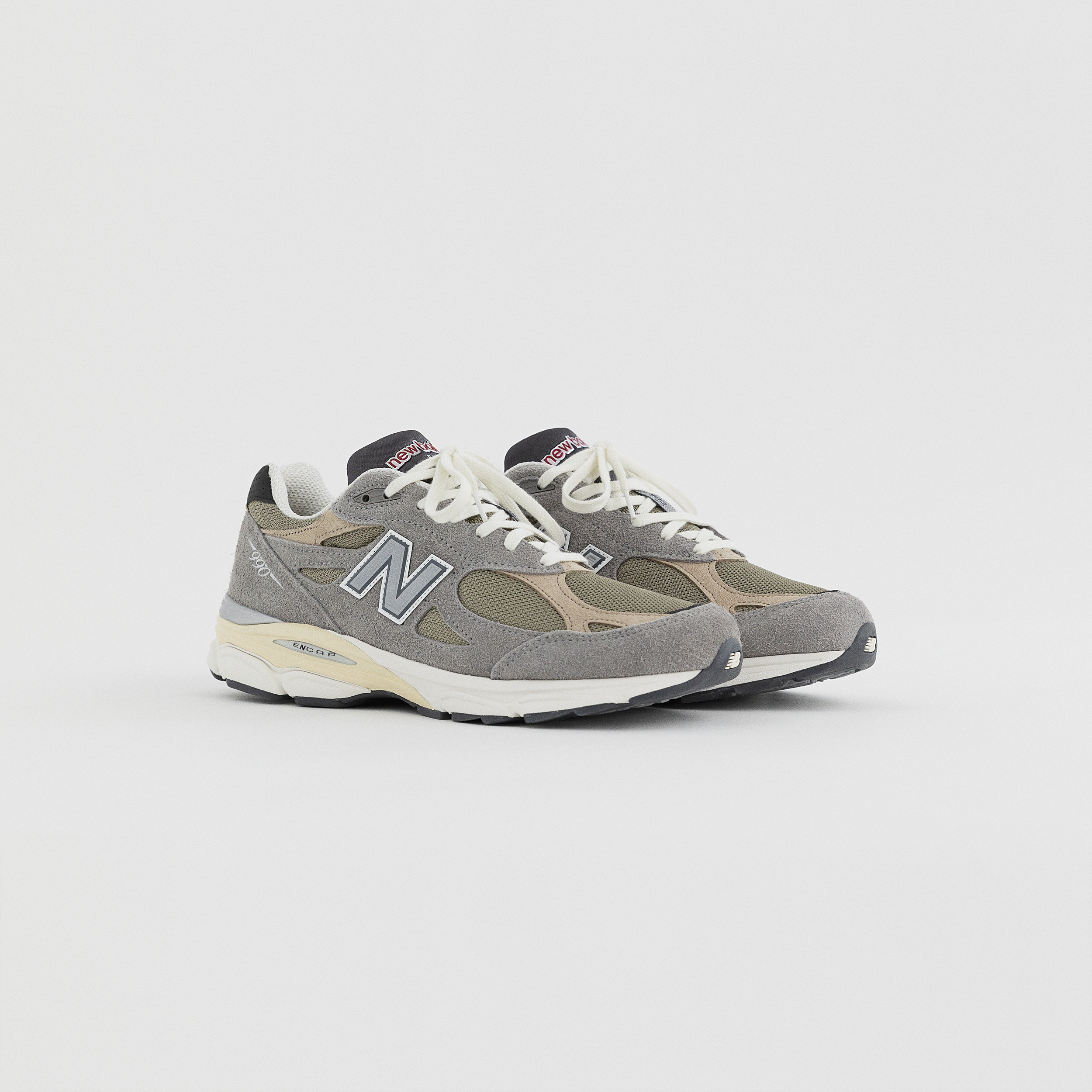
TEDDY Santis, founder and creative director of NYC apparel and lifestyle brand Aimeì Leon Dore (ALD), recently released his first seasonal collection as Creative Director for New Balance MADE in USA. As part of the “MADE in USA” collection and to mark the 40th anniversary of the iconic 990 silhouette, Santis designed seasonal, limited-edition models of the 990v1, 990v2 and 990v3 which were released in the US in April, with new introductions each month. The collection also includes classic American sportswear apparel, including sweatshirts, sweatpants, shorts, long sleeved T-shirts and short sleeved T-shirts. The next drop is set to be released locally this month in select New Balance stores and in Commonwealth stores. To learn more about the collection, follow New Balance Philippines on its official Facebook page https://www.facebook.com/NewBalancePhilippines.

Fendi reveals Flavus diamond collection

DESIGNED by Fendi Artistic Director of Jewelry Delfina Delettrez Fendi, Fendi released the debut High Jewelry designs from the House during the Fendi Couture Autumn/Winter 2022 collection in Paris, France. Consisting of a necklace, earrings, and cocktail ring, the Fendi Flavus parure uses a mix of white and yellow diamonds. Rooted in Roman mythology, the Fendi Flavus parure melds the mechanical and the organic with a dose of sculptural, mid-century glamor from the Cinecittà.

Bambi Harper donates Farrales gowns to exhibit

INSPIRED after visiting the ongoing FARRALES@BENILDE, a physical exhibition of choice ensembles by Ben Farrales, known as the Philippine Dean of Fashion, at the Main Gallery of the Benilde’s Design and Arts Campus, once-upon-a-time Manila’s toast of a model, Bambi Harper, has donated select Farrales ternos, evening gowns, and fabric drapes from her own personal wardrobe, in order for future students to likewise learn from the fashion giant. The ongoing show features Farrales’ Filipiniana creations, traditional ternos, and Muslim-inspired pieces, works that led to his being honored with The Outstanding Filipino award by the Junior Chamber International Philippines and Gawad CCP Para sa Sining by the Cultural Center of the Philippines. Ms. Harper’s pieces will be incorporated in the ongoing exhibit, which runs until Sept. 10. The entire collection will then be transferred to a permanent site in the DLS-CSB campus. FARRALES@BENILDE is on view at the 12F Main Gallery of the Design and Arts Campus, De La Salle-College of Saint Benilde, 950 Pablo Ocampo St., Malate, Manila. Those who wish to share their Farrales gowns for exhibit and safekeeping, contact Gerry Torres and the CCA at campus.art@benilde.edu.ph.

SSI holds End-Of-Season Sale

THE SSI Group is holding its End of Season sale until Aug. 31, with discounts of up to 70% on select items from the SSI Group’s premium and luxury brands: Anne Klein, Armani Exchange, Bally, Banana Republic, Bershka, Coach, Cortefiel, DKNY, Furla, Gap, Kate Spade New York, Lacoste, Marc Jacobs, Marks & Spencer, Massimo Dutti, Nine West, Old Navy, Pazzion, Polo Ralph Lauren, Pottery Barn, Springfield, Stradivarius, Steve Madden, Superga, Tommy Hilfiger, Women’s Secret, and Zara. Shoppers can also fit, try, and buy when shopping in-store, or order online through Trunc.ph, bananarepublic.com.ph, gap.com.ph, lacoste.com.ph, marksandspencer.com.ph, massimodutti.com/ph, oldnavy.com.ph, superga.ph, and zara.com/ph. Shoppers can also opt to order through The Specialist, The SSI Group’s At-Home concierge service: e-mail customerservice@ssigroup.com.ph, call 8-830-5000, reach out via Viber at 0917-552-9359, or send a message to www.facebook.com/SSILifePH. Customers can also join a social media challenge for a chance to win SSI Purple Cards, which can be used as a gift card when purchasing in the physical stores of participating brands. To qualify, the customer must shoot an unboxing video describing items bought from any SSI brand or Trunc.ph and post this on their Instagram, Facebook, or TikTok account on or before Aug. 15. Tag @SSILife and use the hashtags #SSILifeUnboxed #SSILifeEndofSeasonSale.

Filipino jewelry brand opens branch at Shangri-La Plaza

FILIPINO jewelry brand V!, known for its chic and playful collection, recently opened its new store at Shangri-La Plaza. Offering every day and statement jewelry, V! has a variety of rings, necklaces, earrings, and bracelets in youthful designs mainly using ethically sourced Palawan South Sea pearls as their centerpiece. V! is located at Level 2, Main Wing of Shangri-La Plaza. Visit V! @vjewelryoffcial on Instagram and Facebook to learn more about the brand.

adidas Ph unveils adiClub x Maker Lab Artist Series by V.O.N.

FOLLOWING last month’s launch of its new membership program adiClub, adidas Philippines announces the first-ever member-exclusive release through the adiClub x Maker Lab Artist Series by V.O.N. Starting July 22, a collection of patches and stickers designed by feature artist V.O.N. will be available at the Maker Lab of adidas Brand Center in Glorietta, Makati. Von “V.O.N.” (Very Own Name) Alcantara is a self-taught multimedia artist whose portfolio includes a variety of design projects for global brands such as SEGA, Capcom, Sony, and Illest. He is no stranger to adidas, with the collaboration first starting in 2021 when he helped the brand bring to life the adidas Brand Center through designing the store’s different moment areas. In this collection of patches and stickers, adidas releases designs that put creative spins to the “adiClub” logo — from the classic adiClub logo in earth tone colors to the Philippine-, Kawaii-, and even KPOP-inspired designs. Sticker designs will be given to adiClub members for free with every purchase at the Brand Center, and heat press patches will be available at the Maker Lab for P250 for members who want to customize their apparel or bags.

Peso may rebound vs dollar as BSP turns hawkish

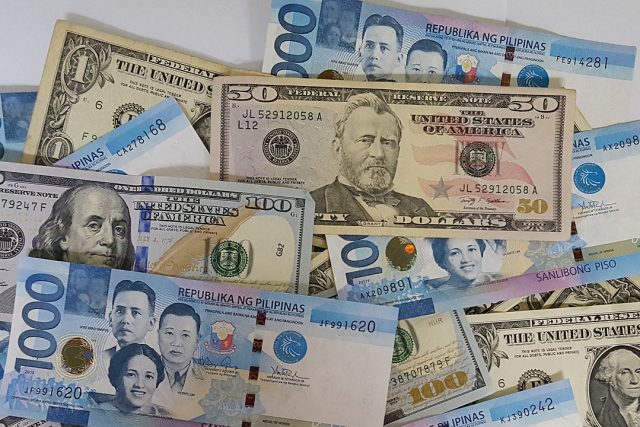
BW FILE PHOTO

THE PESO may rebound versus the dollar this week on hawkish remarks from the Bangko Sentral ng Pilipinas (BSP) chief following the surprise rate increase on Thursday.

The local unit closed at P56.36 per dollar on Friday, depreciating 21 centavos from its P56.15 finish on Thursday, based on Bankers Association of the Philippines data.

The peso also declined by 44 centavos from its P55.92-a-dollar finish a week earlier.

Year to date, it has weakened by 10.5% or by P5.36 from its close of P51 versus the dollar on Dec. 31, 2021.

The local currency opened Friday’s session at P56.35 against the dollar. Its weakest showing was at P56.44, while its intraday best was at P56.315 versus the greenback.

Dollars exchanged declined to $678.3 million on Friday from $1.65 billion on Thursday.

The peso weakened versus the dollar on Friday following hawkish signals from the US Federal Reserve after US inflation hit a fresh 40-year high, Rizal Commercial Banking Corp. (RCBC) Chief Economist Michael L. Ricafort said in a Viber message.

US consumer prices jumped by 9.1% annually in June, the fastest in more than 40 years, data released on Wednesday showed. This fueled bets of an even bigger hike by the Fed at its July 27-28 review following the 75-basis-point (bp) increase made in June.

For this week, UnionBank of the Philippines, Inc. Chief Economist Ruben Carlo O. Asuncion said the peso may be supported by the BSP’s hawkish turn.

RCBC’s Mr. Ricafort likewise said the BSP’s move “is meant to support or at least stabilize the peso exchange rate, as part of the toolkit related to the exchange rate vis-a-vis the inflation-targeting framework since 2001 and the price stability mandate.”

The BSP raised its benchmark interest rates by an all-time high 75 bps in an off-cycle move on Thursday and left the door open for further tightening amid growing risks to inflation.

BSP Governor Felipe M. Medalla said the Monetary Board’s “significant” hike was due to signs of “sustained and broadening price pressures” as well as spillover effects from aggressive tightening in other countries, such as the United States, amid global inflation concerns.

The move came ahead of the Monetary Board’s Aug. 18 review and follows the back-to-back 25-bp hikes done in May and June, bringing total increases for the year to 125 bps.

On Friday, Mr. Medalla said in an interview with Bloomberg Television that he would not rule out another interest rate increase in the August review, although the need for a 50-bp hike at that meeting is “much less now” following the 75-bp increase on Thursday.

Headline inflation rose by 6.1% year on year in June, the fastest in nearly four years and exceeding the central bank’s 2-4% target band for a third straight month. The average inflation rate in the first six months is 4.4%, still below the BSP’s full-year forecast of 5%.

For this week, Mr. Ricafort gave a forecast range of P56 to P56.45, while Mr. Asuncion expects the local unit to move within P55.80 to P56.50 per dollar. — Keisha B. Ta-asan

Emperador shares jump after Singapore debut

By Bernadette Therese M. Gadon, Researcher

INVESTORS snatched up Emperador, Inc. after it debuted on the Singapore stock exchange last week.

Data from the Philippine Stock Exchange showed a total of 32.24 million shares worth P562.55 million were traded from July 11 to 15.

Shares in Emperador jumped by 6.5% week on week, finishing at P18.40 apiece on Friday from its P17.28 closing on July 8. Since the start of the year, the stock has fallen by 9.4%.

Analysts said Emperador’s secondary listing in Singapore helped draw market players to the company last week.

“The run-up of the stock starting April 13 was due to positive reactive moves following disclosures in relation to its secondary listing on SGX,” China Bank Securities Corp. Research Associate Lance Gabriel U. Soledad said in a separate e-mail.

He said trading in more than one stock exchange helps a company shore up its liquidity and diversify its capital-raising options.

“It will be important to watch out for how Emperador will capitalize on such benefits moving forward,” Mr. Soledad added.

“EMI’s international base is one of its strongest suits, so expanding this segment would greatly benefit the company in the long run,” Regina Capital Development Corp. Equity Analyst Anna Corenne M. Agravio said in an e-mail, referring to the ticker symbol of Emperador for both bourses.

“Building on its already existing customer base for its scotch whiskey segment, for example, would definitely be value-accretive in the longer scheme of things,” she added.

Mr. Soledad said that Emperador’s performance in Singapore will depend on both its fundamentals and the growth trajectory of the alcoholic beverages sector.

Boosting its presence in the international markets, the Andrew L. Tan-led manufacturer of brandy and other alcoholic beverages made its debut in the Singapore Exchange Securities Trading Ltd. (SGX-ST) last Thursday.

Emperador opened the trading at S$0.435 apiece and finished at S$0.450 (about P18.06 per share). On Friday, it ended at S$0.455.

Emperador is the first Philippine-listed company that conducted a secondary listing in the Singapore stock exchange.

Its product portfolio is composed of domestic and foreign brands which include Emperador and Fundador brandies as well as Andy Player whisky, Smirnoff Mule, The Bar, The Dalmore and Jura single malt whiskies.

Emperador’s attributable net income in the first quarter amounted to P2.10 billion, a bit higher than P2.08 billion in the same period last year.

Ms. Agravio expects Emperador’s second-quarter income to reach P2 billion to P2.5 billion, and its full-year bottom line to hit P11 billion to P13 billion.

She placed the company’s support and resistance levels at P17.00 and P19.00, “as long as Emperador’s buying momentum continues to pick up” this week.

“Over the near term, we think EMI will consolidate within the P17.30-P20 range,” Mr. Soledad said.

BSBios to build Brazil’s first big wheat ethanol plant as crop expands

REUTERS

SAO PAULO — Brazil’s largest biofuel producer BSBios will build the country’s first big facility that uses wheat to make ethanol, which will increase, not diminish, food supplies, its chief executive said, amid a global discussion on prioritizing food over fuel production.

Whereas wheat-based ethanol plants are common in Europe and Canada, most of Brazil’s production comes from sugarcane and more recently from corn. CEO Erasmo Battistella told Reuters in an interview late Wednesday BSBios’ project underscores his confidence that farmers will expand wheat area and output, reducing dependence on imports and creating an even bigger domestic market for the cereal.

Brazil is forecast to produce a record 9 million-ton crop this year, with growers sowing the largest area in 32 years. BSBios’ facility should go on-stream in the second half of 2024 in Rio Grande do Sul, Brazil’s southernmost state and the country’s biggest wheat producer. It will produce 111 million liters (29.3 million gallons) of ethanol in the project’s first phase.

Mr. Battistella noted his factory will increase food supplies as it will also sell dried distillers grains, a by-product of ethanol production used as livestock feed. “I don’t want any person to look at our company and say: you are taking our daily bread off the table!” he said. “I want them to say: you are helping to increase the supply of meat, milk and eggs and making food cheaper through this project.” 

The government is also relying on research to boost “tropical wheat” in Brazil’s Cerrado biome, considered a new wheat farming frontier. The Cerrado’s hotter and drier weather requires plants to be adapted, and planting wheat there is seen as key for the South American country to become wheat self-sufficient in 10 years, a government goal.

Brazil’s wheat yields jumped fivefold to about 3,000 kilos a hectare since the 1970’s, according to agriculture research agency Embrapa. Also, Brazil recently began testing a variety of drought resistant, genetically modified wheat in the Cerrado in partnership with Argentina. — Reuters

Arellano ousts José Rizal to face Benilde in Finals

ARELLANO University sets a Final showdown with College of St. Benilde. — SYNERGY/GMA NETWORK, INC.

ARELLANO University (AU) put an end to José Rizal University’s (JRU) fairy tale run while bolstering its chances of snaring a four-peat feat with a 19-25, 25-20, 27-25, 25-17 victory on Sunday in the 97th NCAA volleyball tournament at the Filoil EcoOil Centre.

Unheralded Pauline de Guzman came out of nowhere and unleashed a match-best 19 points including 15 on kills and three service aces to carry the Lady Chiefs to their fourth straight finals appearance and a chance for an amazing four-peat feat.

There, AU will clash with the league titan in College of St. Benilde (CSB), which swept its way straight to the best-of-three finals on a magnificent nine-win elimination round record.

The series starts on Wednesday while Game Two on Friday.

A deciding Game Three, if necessary, is Sunday.

It looked like though that AU won’t make it that far after starting the game a little nervous and sluggish and dropped the opening set to the gritty JRU team that was seeking a first finals trip in its history in the first and oldest collegiate league in the land.

But the Lady Chiefs managed to shake off the rust and showed nerves of steel from there to take the final three sets and the match.

“We got a little lucky there,” said AU Obet Javier.

But luck was far from the reason the reigning three-peat champions made it through.

It was actually Mr. Javier’s brilliance of pulling Ms. De Guzman, who was never even in the top 50 in the league’s top scorers, out of his hat of magic tricks that spelled the biggest difference.

“I asked her (Ms. De Guzman) if she wants play and she answered with a firm yes,” said Mr. Javier.

That magic stroke sent the Lady Bombers packing and in tears as they missed the chance of having a date with destiny.

It was AU who will try to test fate instead as it faces an unflappable CSB in a finale that the latter is heavily favored to win.

“It’s like playing a wall, a tower. But we’ll take the challenge,” said Mr. Javier. — Joey Villar

Stocks may drop on bets of aggressive Fed hike

BW FILE PHOTO

PHILIPPINE SHARES may decline further this week on expectations of another aggressive rate hike from the US Federal Reserve due to soaring inflation in the world’s largest economy.

The benchmark Philippine Stock Exchange index (PSEi) went down by 52.87 points or 0.84% to close at 6,195.26 on Friday, while the broader all shares index declined by 21.27 points or 0.63% to 3,345.73.

Week on week, the PSEi sank by 166.56 points or 2.62% from its close of 6,361.82 on July 8.

China Bank Securities Corp. Research Director Rastine Mackie D. Mercado said selling pressure remained strong last week amid US data and developments at home.

“Market weakness prevailed starting Wednesday as investors likely lightened their positions ahead of the US inflation data report. The June US inflation surprised to the downside at 9.1% and the BSP (Bangko Sentral ng Pilipinas) subsequently delivered a 75-basis-point (bp) off-cycle rate hike — its biggest rate hike on record — which resulted in the marked increase in selling pressure,” Mr. Mercado said in an e-mail.

Rizal Commercial Banking Corp. (RCBC) Chief Economist Michael L. Ricafort said Philippine shares went down as the BSP’s surprise move could lead to higher financing costs for businesses and could cause a slowdown in economic activity.

“The PSEi [was] also lower, moving in line with the US stock markets that hovered among one-week lows recently amid lingering market concerns over a possible US economic slowdown or even recession amid aggressive Fed rate hikes to bring down elevated US inflation, as well as the continued hawkish signals by Fed officials,” Mr. Ricafort added.

US stocks closed sharply higher on Friday. The Dow Jones Industrial Average rose 658.09 points or 2.15% to 31,288.26; the S&P 500 gained 72.78 points or 1.92% to close at 3,863.16; and the Nasdaq Composite added 201.24 points or 1.79% to end at 11,452.42.

US consumer prices jumped 9.1% annually in June, the fastest in more than 40 years, data released on Wednesday showed. This fueled bets of an even bigger hike by the Fed at its July 27-28 review following the 75-bp increase made in June.

For this week, AP Securities, Inc. Equity Research Analyst Carlos Angelo O. Temporal said via Viber: “For the early part of [this] week, the local bourse may take a breather before continuing on its downtrend, taking cue from US market’s rebound last Friday which reflected abating expectations for a 100-bp Fed rate hike after policy makers remained firm on a possible 75-bp move this July.”

Mr. Ricafort said aside from the Fed, leads include local budget balance and external position data, as well as reports on US jobless claims and home sales. He placed the PSEi’s immediate support at psychological 6,000 mark and resistance at 6,300-6,500.

“The market was unable to adhere to the 6,300-6,500 range for [last] week, even breaching the 6,200-support level. This opens up the possibility of revisiting the 6,000 level as the index struggles to establish a strong support base,” Mr. Mercado added. — JIDT

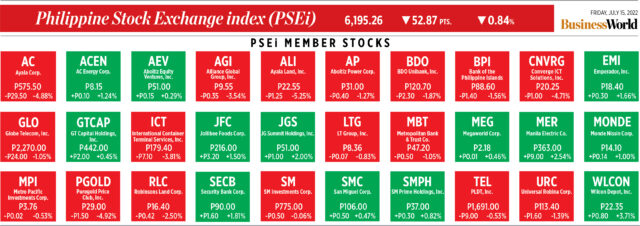
How PSEi member stocks performed — July 15, 2022

Here’s a quick glance at how PSEi stocks fared on Friday, July 15, 2022.


EV production to hinge on vehicle takeup levels

REUTERS

THE possibility of domestic electric vehicle (EV) production will depend on the market reaching critical mass in both adoption and the number of charging stations, according to the Department of Trade and Industry (DTI). 

“We will come to a stage where we will assemble the vehicles here (in the country). But we’re not yet there because there’s so many preconditions to bringing in EVs here. You need a critical number so you can have charging stations along the way. Otherwise, there will be no buyers if users cannot bring their EVs out of Metro Manila,” Trade Secretary Alfredo E. Pascual said on the sidelines of the Management Association of the Philippines general membership meeting in Taguig City last week.

He did not provide an estimate for which levels of adoption might make investors believe critical mass has been achieved.

Mr. Pascual said that the DTI is aiming to build a parts ecosystem for EVs from among medium-sized Philippine suppliers.

“I want Philippine manufacturers, particularly, medium-sized companies, to become suppliers of parts and components, to be part of the global value chain,” Mr. Pascual said.

In April, former Trade Secretary Ramon M. Lopez proposed the issuance of an executive order that would grant the remaining slot for local manufacturing under the Comprehensive Automotive Resurgence Strategy (CARS) program to a domestic EV producer.  

Asked to comment, Mr. Pascual said that he is pushing for the CARS program, but maintained that some issues should be dealt with before EVs can be included in the initiative.

“We need to address the fundamental issues. It will take time to set up charging stations and the price of electricity in the country is high,” Mr. Pascual said.

The CARS program offers fiscal support to participating car manufacturers domestically producing at least 200,000 units within six years.

The program was supposed to have three car manufacturers, but only two companies enrolled — Toyota Motor Philippines Corp. (TMPC) and Mitsubishi Motors Philippines Corp. (MMPC).

TMPC manufactures its Vios small sedan while MMPC produces the Mirage under the program. The deadline for MMPC to achieve the Mirage production quota is 2023 while TMPC has until 2024 to manufacture the required number of Vioses.

The DTI has also proposed a zero-tariff policy for EV imports to reduce purchase prices and encourage broader adoption.

The Philippines recently passed Republic Act No. 11697 or the Electric Vehicle Industry Development Act. Under the law, companies, public transport operators, and government units are required to maintain vehicle fleets that include at least 5% EVs. — Revin Mikhael D. Ochave

Supermarkets see goods not subject to price controls becoming more expensive

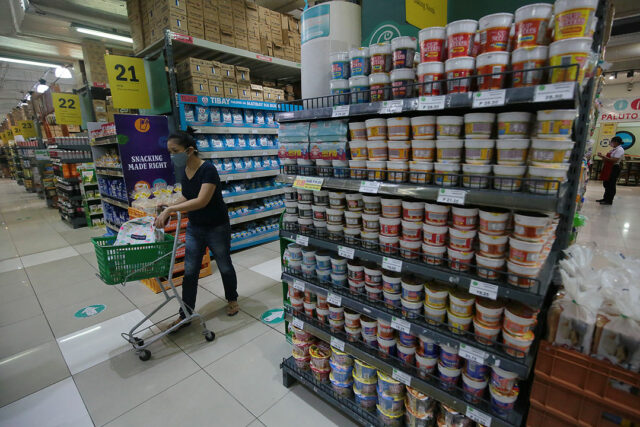
A woman buys food items at a supermarket in Quezon City, March 4, 2022. — PHILIPPINE STAR/ MICHAEL VARCAS

SUPERMARKETS said prices are rising for goods not subject to government price ceilings.

Steven T. Cua, Philippine Amalgamated Supermarkets Association, Inc. president, said such price behavior has been observed in grocery items not covered by the suggested retail price scheme.

“Prices continue to surge for (grocery) items not monitored by the Department of Trade and Industry (DTI). These products belong to all categories especially if imported, repacked, or re-canned but manufactured abroad such as bread spreads and luncheon meat,” Mr. Cua told BusinessWorld via mobile phone.  

“(The) increases would range from 5% to 10% for local goods and 12% to 25% for imported items during the last few months. This is due to the cost of bringing in imported raw materials, intermediate goods which need repacking or processing, and finished goods,” he added.

Under Republic Act No. 7581 or the Price Act, the DTI issues suggested retail prices (SRPs) for basic necessities and prime commodities that it monitors.

The DTI defines basic necessities as products deemed important to the needs of consumers for their sustenance, while prime commodities are products not considered basic necessities but otherwise deemed essential. 

Some of the basic necessities covered by the DTI include bread, canned fish, detergent, processed milk, and locally manufactured instant noodles, while prime commodities include flour, toilet soap, vinegar, and soy sauce.  

The latest SRP bulletin was issued in May, which reflected price increases ranging from 2% to 10% for 82 stock keeping units (SKUs) such as bread and coffee, while 136 SKU prices were maintained.

On July 12, the DTI said that the current price hike petitions by makers of canned meat, coffee, bread, and detergent are in the final review stages and may take a few more weeks before obtaining approval.

It added that the proposed price increases were caused by rising input costs, which are thus far being absorbed by manufacturers.

“It could take us probably a couple of weeks for us to complete and submit our recommendation for approval, and another couple of weeks probably for the Secretary to approve and for us to (move to) publication,” Trade Undersecretary Ruth B. Castelo said.

Meanwhile, Mr. Cua said foot traffic in supermarkets has increased despite the new surge in coronavirus disease 2019 (COVID-19) cases. 

“There is a need for continuous urging of the population to get their COVID-19 booster shots,” Mr. Cua added.

On Saturday, the Health department announced that there were 2,578 new COVID-19 cases, bringing the country’s case count to 3,730,545. — Revin Mikhael D. Ochave

May debt service bill rises nearly 52%

BW FILE PHOTO

THE National Government paid P57.44 billion to service its debt in May, up 51.96% from a year earlier, with both interest and amortization components rising, the Bureau of the Treasury (BTr) said, citing preliminary data.

In May, around 58.9% of debt repayments serviced interest, while the rest went to amortization, it said.

Overall interest payments rose 16.93% to P33.83 billion in May, with interest paid on domestic debt up 19.74% year on year at P28.87 billion. This consisted of P19.41 billion for Treasury bonds, P7.94 billion for retail Treasury bonds, and P1.53 billion for Treasury bills.

Interest paid on foreign debt rose 2.86% to P4.96 billion.

Amortization payments rose 166.3% to P23.61 billion in May. All payments of principal during the month went to foreign creditors. The BTr settled no outstanding principal with domestic lenders.

The five-month debt service bill dropped 33.6% year on year to P414.07 billion, with around 53.24% going towards interest payments, and the rest to amortization.

Principal payments from January to May stood at P193.61 billion, down 56.49% from a year earlier. This consisted of P153.02 billion in domestic debt and P40.59 billion in foreign obligations.

Interest payments rose 23.43% to P220.46 billion in the five months. These included P172.36 billion worth of payments to domestic creditors and P48.11 billion to external creditors.

The government borrows from foreign and local sources to fund its budget deficit as it spends more than the revenue it generates to support programs to stimulate economic growth.

The government wants to raise P2.47 trillion to help fund its budget deficit this year, with about 77% coming from domestic sources.

Fitch Ratings in February maintained the country’s investment grade “BBB” rating, but kept the “negative” outlook as it flagged uncertainties surrounding medium-term growth and hurdles to bringing down debt. A negative outlook means a downgrade is possible within the next 12 to 18 months.

S&P Global Ratings last affirmed the Philippines’ “BBB+” rating with a stable outlook in May 2021. Meanwhile, Moody’s affirmed its “Baa2” credit rating with a stable outlook for the Philippines in July 2020.

The National Government has taken on P883.11 billion in gross borrowing as of May, down 43.38% year on year, according to the BTr data.

The government plans to spend P1.298 trillion on debt payments this year, with P785.21 billion budgeted for principal and the remaining P512.59 billion for interest.

The Philippines registered a debt-to-gross domestic product (GDP) ratio of 63.5% as of the first quarter, higher than the 60% debt-to-GDP ratio considered manageable by multilateral lenders for developing economies. — Diego Gabriel C. Robles

Transforming with humans at center

(First of two parts)

Transformation has always been integral to the long-term success of a business. But for many years, the process by which businesses overhauled their operations to boost productivity and promote sustainable growth was sporadic. In many instances, changes in stakeholder expectations or market sentiment would prompt leaders to rethink their organizations from the ground up or make small changes to adapt.

However, both the nature and rate of transformation have changed in the past few years. In the EY 2021 Global Board Risk survey, as much as 82% of board members and CEOs stated that market disruptions have increased in frequency and severity. Companies have started to transform more regularly to keep up — amplifying the need to successfully transform and do so consistently.

A research collaboration established in 2021 between EY and the Saïd Business School of the University of Oxford determined the need for a more effective and contemporary means to sustain organizational change. Specifically, it has to employ a strategy that takes into account the sentiments of both leaders and workers to focus on human factors, which are frequently cited as one of the main reasons why transformations fail. Moreover, the research posited that apart from the transformation failure rate being too high, organizations can no longer afford the human cost associated with it.

HUMAN EMOTIONS AT THE HEART OF TRANSFORMATION SUCCESS
Leaders usually invest early to create the circumstances for a successful transformation on both an emotional and a rational level. The research observed that, along the way, confidence in the process may ebb as tensions arise, but also noted that the support usually increases to match the pressure. Workers will feel positive by the end of the transformation with proper and timely support. The study has found that positive worker sentiment increased by 50% after successful transformations.

The emotional state of both leaders and employees at the start of a successful transition is comparable, but there will be a point in the transformation when things start to go awry. This is where supportive intervention is needed as up to 66% of employees feel stressed with an underperforming transformation. The impact of a failed transformation can be severe, with up to 75% of the workforce experiencing negative feelings and an extreme of 31% feeling angry, depressed or sad.

This is particularly noteworthy in situations where a series of transformations is planned. While negative emotions in the workforce can rise by 25% during successful transformations, it rises dramatically to 130% during unsuccessful ones. Going into the next transformation with this negativity can be devastating for any new transformation efforts. This makes it even more important for organizations to revisit their transformation plans and keep humans at the center in order to better turn transformation failure into success.

Research findings from the study identified six key drivers that can help increase the likelihood of transformation success. In the first part of this article, we discuss the first three: adapting and nurturing the necessary leadership skills, creating a vision that everyone can believe in, and building a culture that encourages and embraces all opinions.

LEAD: ADAPT AND NURTURE THE NECESSARY LEADERSHIP SKILLS
Regardless of whether a transformation was successful or not, employees in the study ranked leadership as the most important factor. Interestingly, while leaders considered leadership as the primary factor in successful transformations, they also saw it as irrelevant when the transformation failed. Given the importance of personal emotional development, leaders must be aware of their own mental and physical limitations. Moreover, they must be absolutely open and honest about their worries, fears, and self-doubt regarding the transformation journey, as well as admit what they don’t know and still need to learn.

Leaders need to have the courage to admit they may not have all the solutions and be willing to demonstrate the humility to search both inside and outside the company for such solutions. For instance, compared to respondents in low-performing transformations, respondents in high-performing transformations were more likely to say that leaders embraced ideas from more junior staff.

To demonstrate that the entire team is participating in the transformation together, leaders must take responsibility for both the good and the bad. By promoting collaboration, achieving consensus, and establishing consistent two-way communication with those driving the execution, leaders can highlight that everyone contributes. Successful transformation executives have reportedly spoken with employees directly to ascertain their concerns. Others made investments in technological platforms that enabled two-way communication and united diverse viewpoints.

Key driver: Leaders must invest in their own transformation and place a strong emphasis on teamwork and communication.

INSPIRE: CREATE A VISION EVERYONE CAN BELIEVE IN
Vision establishes the transformation tone and foundational framework. In order to find a compelling vision, leaders must look outside of themselves, their company, and their sector. They should cast a wide net to find inspiration and employ future-back planning to locate exciting new opportunities, creating a compelling vision that can inspire everyone. Compared to 26% of respondents in a low-performing transformation, 47% of those in a high-performing transformation thought the vision was compelling and clear.

As much as 71% of employees think that this can increase the success of a transformation, making it imperative for leaders to effectively convey why change is necessary rather than merely state what they must do if they want the vision to become a reality. Instead of just encouraging their people to understand the vision, leaders must nurture genuine belief in it.

Compared to 25% of respondents in low-performing transformations, 50% of respondents in high-performing transformations said that leadership made it obvious why the organization needed to change.

Key driver: Leaders must manifest a vision that everyone can support, motivating employees to go above and beyond.

CARE: BUILD A CULTURE THAT ENCOURAGES AND EMBRACES ALL OPINIONS
Emotions are the key to a successful transition, but if the business is unprepared, it can doom the transformation to failure. In the study, 50% of the employees who went through a successful transformation felt that transformation was merely another word for layoffs. Workers involved in poorly executed transformations reported feeling ignored, unsupported, and stressed both during and after the transition. Leaders admitted in follow-up meetings that they were shocked by these results and were not aware of the severe toll that a poorly executed change had taken on their workforce.

In addition to giving enough emotional support to minimize anxiety and burnout, leaders must be able to manage emotions to keep employees motivated and engaged. According to the prediction model used in the study, extending emotional support increased the average likelihood of transformation success by 17%.

Understanding the emotional condition of the workforce during the transformation process will help leaders spot early warning signs and make the necessary modifications to set the transformation back on track.

Key driver: Leaders will have to pay close attention to what their people are saying, identify the cause of their anxiety, and try to solve problems in a way that is both productive and emotionally supportive.

In the second part of this article, we will discuss the next three key drivers: setting clear responsibilities and preparing for change, using technology to quickly drive visible action, and finding the best ways to connect and collaborate.

This article is for general information only and is not a substitute for professional advice where the facts and circumstances warrant. The views and opinions expressed above are those of the author and do not necessarily represent the views of SGV & Co.


Rossana A. Fajardo is the EY ASEAN business consulting leader and the consulting service line leader of SGV & Co.

Aaron Judge aims to eclipse Roger Maris homerun mark as New York Yankees host Red Sox

NEW York Yankees center fielder Aaron Judge (99) bats during the game against the Houston Astros at Minute Maid Park. — REUTERS

IN 1961, Roger Maris reached 33 homers before the All-Star break on his way to hitting 61 homers and breaking Babe Ruth’s single-season record.

Sixty-one years later, Aaron Judge has matched the mark set by Maris and gets one more day to see if he can surpass him when the New York Yankees conclude the first half of the season by hosting the struggling Boston Red Sox on Sunday afternoon.

Judge leads the major league home run race by five over Philadelphia slugger Kyle Schwarber after getting his seventh multi-homer game this season with a solo shot and matched Maris with a two-run drive in Saturday’s 14-1 win.

Since the All-Star game began in 1933, Judge is the sixth player in major league history with 30 homers in multiple seasons before the break. Judge also hit 30 of his 52 homers before the break in 2017 on his way to winning AL Rookie of the Year honors.

Judge will play in his 89th game, six more than Maris before the break in 1961.

Judge will make his first attempts at breaking the team record against Chris Sale (0-0, 0.00 ERA). Judge is 5-for-25 against Sale with one homer and 15 strikeouts.

New York is coming off one of its most lopsided wins of the season after dropping five of its previous six games for its first slump this season. The Yankees also cruised to the win by getting a pair of three-run homers and seven RBIs from Matt Carpenter after playing three straight extra-inning games and losing four times in the final at-bat.

The Red Sox head into the finale of an inconsistent first half with five losses in their last six games and still seek their first series win against an AL East opponent, whom they are 12-25 against.

The Red Sox are facing Cole (8-2, 3.05) for the third time this season after tagging him for eight runs and nine hits in their first 10 innings against the right-hander.

Sale is making his second start since returning from a broken rib. In his season debut, Sale pitched five scoreless innings and threw 78 pitches on Tuesday at Tampa Bay when his fastball averaged 95.1 mph and topped out at 96.9.

Sale is 6-8 with a 2.98 ERA in 21 career appearances (18 starts) against the Yankees. He last faced the Yankees Aug. 3, 2019, in New York, where he was tagged for eight runs and nine hits in 3 2/3 innings. — Reuters