Home Blog Page 6108

Red Bull’s Max Verstappen claims inaugural Miami Grand Prix title

SUNDAY’s inaugural Miami Grand Prix Formula One race in Miami Gardens, FL, lived up to its billing as a heavyweight battle between the series’ two points leaders — Charles Leclerc of Ferrari and Max Verstappen of Red Bull.

Verstappen came away with the victory, the second in a row for the 2021 F1 drivers’ champion. His earlier wins had come in Saudi Arabia and Italy.

Leclerc, who led the championship by 27 points at the start on Sunday, had won in the season-opener in Bahrain and in Australia in Race 3.

He finished second on Sunday, 3.7 seconds behind Verstappen. Carlos Sainz finished third in his Ferrari while Sergio Perez was fourth for Red Bull. Fifth was George Russell in a Mercedes.

He was followed by teammate and seven-time champion Lewis Hamilton. Verstappen had started the race alongside teammate Perez in the second row behind the Ferraris of pole-sitter Leclerc and Sainz.

But the Dutch-Belgian Red Bull driver passed Sainz just after the standing start. He then tracked down Leclerc, caught him on Lap 8 and passed the Monaco driver on the first turn of Lap 9.

Verstappen worked his way out to a 4.6-second lead over Leclerc when the Ferrari driver pitted on Lap 25. The stop was a slow one. Verstappen pitted a lap later and responded with a quick stop. 

With stops completed, Verstappen’s lead had jumped to over 7 seconds. On Lap 41 of 57, Pierre Gasly in an AlphaTauri and Lando Norris in his McLaren made contact to bring out a safety car. The crash sent some teams scrambling to pit and move to different tire compounds.

Verstappen, Leclerc, Sainz and Perez stayed out, but suddenly tightly packed at the front of the field in that order when the safety car retired on Lap 47 of 57. Leclerc kept the pressure on Verstappen over the next seven laps until Verstappen pulled away over the final three laps.

The race was conducted on a purpose-built, 19-turn, 3.36-mile street circuit around the Hard Rock Stadium where the NFL’s Miami Dolphins play. The circuit did not get much love from drivers before the race because the surface proved extremely slippery on the portions that were not rubbered up, making for one-groove racing.

The racing turned out to be better than predicted. The two Aston Martin cars of Lance Stroll and Sebastian Vettel started the race from the pits. It was discovered that their fuel was too cold and they opted to start from the pits to avoid a penalty.

They had qualified 10th and 13th, respectively, and started last and second to last. The only American-based team, Haas F1 Racing, had a so-so day. Mick Schumacher appeared to be on the verge of collecting his first points but while running ninth, he made contact with Vettel and slipped to a 15th-place finish. Kevin Magnussen finished 16th for Haas. — Reuters

Dallas Mavericks bury 20 3-pointers, even series with Phoenix Suns

LUKA Dončić had a double-double, and Dorian Finney-Smith led a 3-point shooting barrage as the host Dallas Mavericks defeated the Phoenix Suns 111-101 on Sunday to even their Western Conference semifinal series at 2-2.

Dončić had 26 points and 11 assists, and Finney-Smith scored 24 points, making 8 of 12 3-pointers as the Mavericks finished 20 of 44 from beyond the arc.

Jalen Brunson scored 18 points, and Davis Bertans had 12, Maxi Kleber 11 and Spencer Dinwiddie 10.

Devin Booker scored 35 points, Jae Crowder had 15, Deandre Ayton added 14 and 11 rebounds, and Cameron Johnson scored 11 to lead the Suns, who made 9 of 25 3-pointers.

Suns guard Chris Paul played just 23 minutes, finishing with five points and seven assists before fouling out with 8:58 left.

Game 5 will be on Tuesday night in Phoenix.

The Mavericks led 87-78 when Paul returned to the game with five fouls and 10:28 remaining. The lead was still eight when he fouled out a minute and a half later.

Mikal Bridges’ basket got Phoenix within six points before Finney-Smith made consecutive 3-pointers to complete an 8-0 run that gave Dallas a 97-83 lead midway through the fourth quarter.

Dallas led by seven when Paul went to the bench after committing his fifth foul with 9:32 left in the third quarter.

Shortly after Paul’s departure, the Mavericks scored seven straight points for a 75-63 lead. Booker scored six points to help Phoenix trim the lead to four, but Dallas scored the last five points to push the lead to 87-78 at the end of the quarter. 

Finney-Smith and Bertans each made two 3-pointers as the Mavericks turned a 19-13 lead into a 37-25 advantage at the end of the first quarter.

Bertans made consecutive 3-pointers, and Dinwiddie added another as they built a 46-29 lead.

Crowder made back-to-back 3-pointers, and Paul added five points as Phoenix closed within 54-48.

Dončić made seven free throws in the first half for Dallas, which rebuilt the lead to 68-56 at half time. His last two free throws came after Paul committed his fourth foul with one second left. — Reuters

Celtics must contain Bucks’ Antetokounmpo in Game 4

GIANNIS Antetokounmpo will look to lead Milwaukee to a 3-1 series advantage when the Bucks host the Boston Celtics on Monday night in Game 4 of the Eastern Conference semifinals.

The two-time MVP led Milwaukee to a 103-101 win in Game 3 on Saturday, pouring in 42 points, 12 rebounds and eight assists. It was the sixth time he has scored at least 40 points in a playoff game.

“I just try to do whatever is in front of me. Play to my strengths as much as possible, and I know what my strengths are,” Antetokounmpo said. “As long as I play within my strengths, I’m going to be in a good place and I just try to take it a possession at a time.”

Jrue Holiday contributed 25 points and seven rebounds, and Brook Lopez went for 13 points and 10 rebounds.

Although Khris Middleton is still out with an MCL sprain, George Hill has returned to the Bucks’ rotation after dealing with an abdomen injury. Hill was quiet in his postseason debut in Game 3, as he was held scoreless in 11 minutes off the bench.

With Hill back in action, Milwaukee is hoping for more production from a bench that has averaged 22.0 points per game in this series.

Monday’s game on the defending NBA champions’ home floor is now essentially a must-win for the Celtics, who will host Game 5 on Wednesday night.

While no loss is easy to swallow, especially in the playoffs, Boston mounted a late-game surge that could give it some momentum heading into Game 4.

After trailing by 13 with 9:48 left to play in the fourth quarter, the Celtics stormed all the way back and eventually went ahead 100-99 after a pair of free throws from Jaylen Brown.

Following buckets from Antetokounmpo and Holiday that put the Bucks up by three, Boston’s Marcus Smart sank the first of two free throws before intentionally missing the second.

Robert Williams and Al Horford each missed putback layups.

“Didn’t even have to come down to that last play honestly. We were sloppy in the third and execution-wise at times,” Celtics coach Ime Udoka said. “Battled back well in the fourth, but can play a whole lot better.”

The Celtics were outscored 34-17 in the third quarter. Brown paced Boston with 27 points and 12 rebounds on 8-of-16 shooting. Al Horford supplied 22 points and 16 rebounds, and Derrick White posted 14 points off the bench.

Jayson Tatum struggled heavily on the afternoon and was held to just 10 points on a lackluster 4-of-19 shooting which included an 0-for-6 effort from 3-point range.

Smart is back with the Celtics after missing Game 2 with a thigh contusion, but Sam Hauser will be out on Monday with a right shoulder issue.

With Saturday’s loss, Boston is still searching for its first win in Milwaukee this season after it dropped both regular-season contests on the Bucks’ home floor. Reuters

Vote machines break down on ‘blockbuster’ day

PHILIPPINE STAR/ RUSSELL PALMA

FILIPINOS on Monday endured long queues as malfunctioning vote-counting machines caused delays on election day, which the local body tasked to oversee it called a blockbuster.

Long lines were seen at voting centers nationwide, while people ignored health protocols amid a coronavirus pandemic, election watchdog Legal Network for Truthful Elections (LENTE)  said in a statement.

LENTE also said it had received reports of some people handing out campaign flyers and sample ballots outside election precincts, which is illegal.

It also cited heated arguments and shooting incidents between mayoral candidates in several villages in Ilocos Sur province in northern Philippines.

“LENTE expresses its concern about these reports of violence on election day as they may instill fear or intimidate voters from exercising their right to vote,” the watchdog said.

“Blockbuster,” Election Commissioner George Erwin M. Garcia told reporters in a Viber message. Filipinos wanted to be heard and heard loudly.”

But LENTE’s election observers reported that in the first hour of voting in Zamboanga province in the nation’s south, paper jams in vote-counting machines had caused delays.

The Commission on Elections (Comelec) was prepared for any contingencies, including sending staff to repair vote machines on site, spokesman John Rex C. Laudiangco told a news briefing.

Election watchdog Kontra Daya urged the election body to extend voting hours past 7 p.m. to let everybody vote.

“The breakdown of vote-counting machines and the long lines, among other issues, have affected the turnaround time in voting,” it said in a statement. “Extending voting hours can help prevent disenfranchisement.”

Epi (not her real name), a 52-year-old laundrywoman from Manila, said their village captain started going from house to house on the eve of election day to give away P200 ($3.80) to every household.

“Isn’t that too little?” she asked, adding that she did not receive any money after being told she had not been registered in the city. “We will accept the money but we won’t vote for them.”

“In vote-buying incidents, the burden is always in the hands of witnesses because complainants will have to file cases in court,” said Maria Ela L. Atienza, a political science professor from the University of the Philippines.

“The process is tedious, which may just discourage complainants,” she said in a Viber message.

Vote-buying proves how weak Comelec is as an institution, said Jan Robert Go, who also teaches political science at UP. “It also proves that “laws are made to favor the interests of politicians.”

Election Commissioner George Erwin Garcia told reporters in a Viber message that common issues encountered on election day were paper jams, rejected ballots and vote-counting machines not printing returns properly.

He noted that as of 10 a.m., 1,867 machines encountered these “common issues,” which were promptly resolved.

As of noon, 143 vote-counting machines and 124 SD cards had to be replaced, Election Commissioner Marlon S. Casquejo told a news briefing. He added that Comelec had about 1,900 extra voting machines in case of technical difficulties.

“Our vote-counting machines are a bit old and every machine has a life-span,” he said. “We will change these machines in 2025.”

“As of now, nothing will justify the extension of voting past 7 p.m.,” Mr. Garcia told the same briefing.

Reports of a shooting in Buluan, Maguindanao province and altercations that led to the destruction of ballots in the Bangsamoro region went viral on social media hours into voting.

Mr. Garcia said Comelec had ordered the election director in the Bangsamoro region to investigate the quarrel between supporters and the tearing of ballots in Lanao del Sur.

The military was also investigating whether the shooting in Buluan was election-related, he added.

A voter in Ilocos Sur posted on social media claiming that his vote had been counted for another candidate. Mr. Garcia said the claim had not been backed by evidence.

Ballots between neighboring precincts in Maguindanao province had been inadvertently swapped, but this was fixed and voting proceeded as planned, Mr. Laudiangco said. 

ACTIVISM
John (not his real name), one of the more than 600,000 teachers hired to facilitate voting, said a faulty vote-counting machine at a Manila precinct delayed had caused delays.

Affected voters rejected the offer of local election officials for them to vote manually. “They waited for almost an hour because they were afraid that someone might steal their votes.”

Lawyer Ibarra M. Gutierrez III, a spokesman for Vice-President and presidential candidate Maria Leonor “Leni” G. Robredo, also reported a malfunctioning voting machine in his area.

“After more than four hours, voters in line were finally offered the option to vote manually then leave their ballots to be fed into the (hopefully) working machine later,” he tweeted at 10:56 am. “Some of us chose this option, but a substantial number of voters chose to wait.”

Reports of faulty voting machines were not yet a cause for alarm, said Myla Villanueva, chairperson of the Parish Pastoral Council for Responsible Voting. She called on voters to be patient amid long queues at some election centers.

These are computing systems,” she told reporters at a news briefing. “There will always be a certain percentage that will break down, but it’s not yet of an alarming level.”

Jean Encinas-Franco, another political science professor from UP, said active citizenship is needed given questions about Comelec credibility.

“Social media activism is very important during these times since Comelec cannot solely monitor irregularities,” she said in a Viber message.

“People should not be lining up under the summer heat for hours with the fear that the vote-counting machines will be out of order by the time they cast their votes,” Ms. Atienza said. “There should be reforms in the conduct of voting in the future.”

Mr. Go said social media could be a double-edged sword. “You can air sentiments and post observations, but it can also be an avenue for misinformation.”

The Comelec en banc on Monday afternoon convened as the National Board of Canvassers, which will tally the votes for senatorial and party-list candidates. — John Victor D. Ordoñez, Kyle Aristophere T. Atienza and Norman P. Aquino


Namfrel says voter turnout likely to exceed 2016 level

PHILIPPINE STAR/ WALTER BOLLOZOS

THE NATIONAL Citizens’ Movement for Free Elections (Namfrel) on Monday expressed confidence that voter turnout for this year’s elections would exceed the 81% level from 2016.

“That’s expected,” Namfrel Chairman Augusto Lagman said in an interview.

The election watchdog’s observers reported that in most election centers, voting took five minutes to an hour, though the average was probably 20 minutes.

Most election centers allowed as many as 10 voters inside at a time. More than 65 million Filipinos have registered to vote.

Many voters ended up ignoring social distancing because of the high turnout amid a coronavirus pandemic.

Many voting centers were overwhelmed, which led to their inability to enforce health protocols, especially physical distancing and wearing of face masks, Namfrel said.

Voters’ temperatures were also not consistently checked at the entrance.

The long queues were a “good sign,” Management Association of the Philippines President Alfredo E. Pascual said in a mobile phone message. “That’s good, indicating a high turnout of voters and making the results more reflective of the will of our people.”

“We applaud Filipinos for exercising their right to vote as well as remaining vigilant in this monumental moment,” European Chamber of Commerce of the Philippines (ECCP) President Lars Wittig said.

“We stand ready to work with the incoming set of government leaders in shaping a more inclusive and sustainable growth story for the Philippines.”

Investors expect to see credible elections “because that has happened in the past,” British Chamber of Commerce of the Philippines Executive Director Chris Nelson said. “What they are really looking for is after the elections are over, whoever wins, that the policy is continued.”

Health Undersecretary Maria Rosario S. Vergeire told reporters in a Viber message they were monitoring the situation to determine if a new coronavirus infection forecast was needed.

“We have updated projections for the end of May, assumed a 30% to 50% reduction in minimum public health standards,” she said in mixed English and Filipino.

“Namfrel will continue observing the different processes of the elections throughout the day and week, and will release another update soon covering the afternoon voting, counting, transmission of results and canvassing,” it said in a statement.

“NAMFREL will submit to Comelec a more comprehensive report with recommendations after it has gathered all observations from the field,” it added. — Alyssa Nicole O. Tan and Revin Mikhael D. Ochave

FDI growth momentum could dissipate due to RCEP delay

By Revin Mikhael D. Ochave, Reporter

GAINS made in building momentum for foreign investment are at risk if the Philippines further delays participation in the Regional Comprehensive Economic Partnership (RCEP) trade agreement, according to the Department of Trade and Industry (DTI).

Trade Secretary Ramon M. Lopez told BusinessWorld in a phone interview that not signing up to RCEP will result in missed opportunities for the Philippines.  

“We will waste our momentum on huge FDI growth during President Rodrigo R. Duterte’s administration. Our annual average foreign direct investment (FDI) from 2016-2021, even with the coronavirus disease 2019 (COVID-19) pandemic, is almost 3 times more (than in previous periods) at $9.1 billion. We are now ranked 4th in Southeast Asia as recipient of FDI, from 6th before 2016,” Mr. Lopez said.

“Investors will shift to RCEP participating countries which have better market access to RCEP markets (if the Philippines stays out), and this will affect job generation. The labor sector will be affected,” he added.

The Philippines is still not signed up for RCEP as after Senate failed to ratify the treaty before adjourning on Feb. 3 for the election break. President Rodrigo R. Duterte signed the trade deal on Sept. 2.      

The Senate is set to resume session on May 23, sitting until June 3 before it is replaced by the newly-elected legislators.

According to Mr. Lopez, the DTI has briefed various senators and their staff who had questions regarding RCEP.

“I think there’s just about a week for Senate session, starting May 23. We have given all the data and information and did the briefing,” Mr. Lopez said.

RCEP, which started taking effect on Jan. 1, is a trade deal involving Australia, China, Japan, South Korea, New Zealand and the 10 members of the Association of Southeast Asian Nations.

It is touted as the world’s biggest trade deal as its prospective members represent 30% of the world’s gross domestic product.

DoF warns against fuel excise suspension, backs targeted relief for vulnerable sectors

PHILSTAR FILE PHOTO

THE Department of Finance (DoF) once again warned against any moves to suspend the fuel excise tax, saying that it would have the perverse effect of providing relief to well-off consumers, who are the country’s leading fuel users.

DoF Chief Economist Gil S. Beltran, in an economic bulletin on Monday, said that while high global energy prices eventually flow on to domestic prices, any suspension of the fuel excise ultimately provides relief to those who need it least, even if the intent is to dampen inflation.

“Higher energy prices in the world market ultimately get translated into higher local pump prices,” Mr. Beltran said. “However, it would be a policy mistake to suspend fuel taxes since it will be the top 10% of the population that will gain the most as they account for nearly half the fuel consumption in the country.”

In April, inflation came in at 4.9%, the highest reading in over three years.

According to the Department of Energy, the price of diesel has risen P30.30 per liter in the year to date, kerosene P23.90, and gasoline P17.80.

He said the preferred response is targeted fund transfers to vulnerable groups, and a suspension of the excise.

“The lingering effects of the African Swine Fever (ASF) continue to threaten food security… further complicated by (geopolitical uncertainties) that have implications on both food and energy security,” Mr. Beltran said. “Moreover, avian flu outbreaks in parts of the country pose a threat to the poultry sector.”

Mr. Beltran recommended the restoration of hog populations while importing meat as a temporary measure to boost supply, and moving decisively to contain the avian flu outbreak.

“Non-food price inflation will continue to be driven by developments in the global energy market,” Mr. Beltran said. 

Dubai crude, the benchmark oil price for Asia, averaged $102.68 a barrel in April, up 64.6% from a year earlier. It declined 9.2% month on month. — Tobias Jared Tomas

PCCI seeks immediate action on NCR traffic to remove drag on economy

PHILSTAR FILE PHOTO

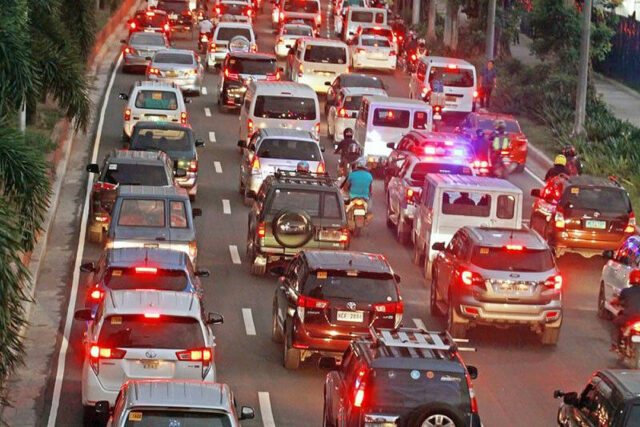
IMMEDIATE ACTION is needed to address Metro Manila road congestion in order to reduce the drag of heavy traffic on the economy, according to the Philippine Chamber of Commerce and Industry (PCCI).

PCCI President George T. Barcelon said during a recent general membership meeting that P3.5 billion is lost daily due to the congested Metro Manila roads. Economic losses could swell to P5.4 billion a day by 2035 if the issue is not addressed, he added, citing projections by the Japan International Cooperation Agency.

“There are a lot of concerns besetting our transportation and logistics industry. These issues need a comprehensive set of measures to curb further problems and avoid more losses to the economy,” Mr. Barcelon said.

“Transportation and logistics are essential to sustaining economic gains and building on the reform measures that are aimed at making the country attractive to investments and conducive to jobs-creating activities,” he added.

Transportation expert Rene S. Santiago said there should be more public transportation for commuters and fewer vehicles overall.

Mr. Santiago added that 246 kilometers of mass transit lines and 78 kilometers of urban expressways need to be built, while pending projects should be completed like the Quezon Avenue bus rapid transit, LRT-1 Extension to Bacoor and LRT-2 East Extension, and the addition of trains to the MRT.

“Long-term (measures) would be to manage population size and distribution. The private sector can take the lead proactively through programs supporting balik-probinsya new growth centers and accelerating the shift to the Fourth Industrial Revolution work-style or hybrid work and hybrid school arrangements,” Mr. Santiago said.

“These would reduce vehicles (by) at least 250,000 cars, on the roads and one million riders of public transport. In addition, hybrid schooling would address shortage in classrooms,” he added.

Vincent Rondaris, president of the Nagkakaisang Samahan ng Nangangasiwa ng Panlalawigan ng Bus sa Pilipinas, Inc., said the government should steer away from car-centric policies.

“We should have long-term solutions including the creation of a Mega Manila Transport Authority that will be in charge of a unified traffic system and the issuance of all transport franchises for land, sea, rail, and air operating in Mega Manila; develop a credible database to determine patterns and volumes of commuters and transfer of government offices away from congested areas,” Mr. Rondaris said.  

Meanwhile, Supply Chain Management Association of the Philippines President Pierre Carlo Curay said Philippine costs as a share of sales are the highest in the Association of Southeast Asian Nations at 25%, compared to an average of 10% in developing countries.

“Transport faces a lot of challenges in terms of policies as it is one of the primary focus of penalties that slows down traffic but increases costs. Examples of these are the truck ban, single lane, and number coding scheme which adds to the cost of deliveries. If the cost of transport is high, the cost of commodities also increases,” Mr. Curay said.  

“Existing policies only allow deliveries once every two days and if you can deliver only that little, that is basically doubling your cost. The best way to have deliveries is if you can deliver thrice or thrice per day and that will significantly lower the cost,” he added.

Christian Martin R. Gonzalez, executive vice-president of the International Container Terminal Services, Inc., proposed the establishment of purpose-built infrastructure to support the movement of cargo.

“With all the consumption that is being driven out of Metro Manila, we must ensure that we plan the infrastructure as well as the services that surround it in such a way that it facilitates movement,” Mr. Gonzalez said. — Revin Mikhael D. Ochave

More reforms needed to support investment liberalization — economist

PHILSTAR FILE PHOTO

FOLLOW-UP REFORMS are needed to build on the progress made in opening the economy up to foreign investment and ensure that the Philippines becomes a viable investment destination for the long haul, an Ateneo de Manila economist said.

“All these steps are intended to attract foreign investors into the country,” Economics Professor Leonardo A. Lanzona said in a Viber message. “The crucial question is whether we have instituted enough reforms to make the country attractive.”

He was referring to recent laws easing foreign ownership restrictions in industries like telecommunications, railways, and retail.

However, he cited workforce skills and technical proficiency as a possible deal-breaker for foreign investors, even when they are allowed to take full ownership of more types of companies, making any gains in investment unsustainable.

“Unless these questions are addressed, capital will increase, but eventually diminishing returns will emerge. Capital formation is necessary, but it will not be sufficient.”

Mr. Lanzona said there is some uncertainty surrounding the government’s 7-9% growth target this year, because many micro, small and medium enterprises (MSMEs) were rendered “no longer viable” by the pandemic.

Mr. Lanzona said the reforms should center on stepping up the pace of technological adoption and the corresponding upskilling of the workforce.

“We need to have policy of technological change so that investors are induced to create the appropriate technology suited for our resources,” he said. “Technological innovation should not just be the responsibility of the government, the private sector needs to take part in it.”

“Second, we need to have a policy of skill development and employment creation. This will ensure that benefits of the reforms will reach the poor.”

“Third, institutions should be created to maximize technological change.”

“The structural reforms initiated by this government has to create better and more efficient enterprises to replace this,” Mr. Lanzona added. “But without the reforms I indicated, this objective (7-9% GDP target) will not be reached.”

On Sunday, the National Economic and Development Authority said in a statement that Socioeconomic Planning Secretary Karl Kendrick T. Chua is projecting a return to pre-pandemic growth levels by this year.

He cited the amendments to the Retail Trade Liberalization Act, the Public Service Act, and the Foreign Investment Act, liberalizing investment in many industries.

In addition, he also said that the 10-point policy agenda, which is the government’s approach to reviving the economy, centers on accelerating the vaccination program, reducing restrictions on foreign and domestic travel, and fast-tracking digitalization.

GDP grew by 5.7% last year, recovering from a contraction of 9.8% in 2020.

The growth outlook is also clouded because of external factors, another Ateneo economist said.

Ser Percival K. Peña-Reyes, associate director at the Ateneo de Manila University Center for Economic Research and Development, said in an e-mail: “With developed economies adapting to the pandemic, many find themselves experiencing the aftereffect of port congestion and supply chain disruptions leading to delays in the movement of output.”

He said the US economy is currently being overwhelmed by supply shortages, high wages, and pressures from rising oil prices. These effects are expected to linger due to the extra pressure exerted by the Russia-Ukraine conflict and China’s zero-COVID policy, which is hindering factory output.

“At the same time, higher prices are exerting upward pressure on wages,” Mr. Peña-Reyes said. “The Bangko Sentral ng Pilipinas (BSP) has no recourse but to eventually follow suit. Higher interest rates will affect the recovery efforts of many small and medium enterprises that will have to pay more for loans.”

BSP Governor Benjamin E. Diokno said last month that a rate hike could be in the cards by June, when more data on economic growth and employment are available to prove that the recovery is more firmly established.

The more US interest rates increase, more funds will be attracted back to US markets and away from the Philippines, thereby weakening the peso.

Last week, the Federal Reserve raised its key policy rate by 50 basis points, the highest in 22 years.

“This could significantly affect our trade, which depends heavily on imports,” Mr. Peña-Reyes added. “Most likely, we will also import inflation.” — Tobias Jared Tomas

A valid assessment emanates from a valid authority

Yesterday’s election was a defining moment for all Filipinos as voters selected the country’s next leaders. The sovereignty of the people manifested itself once again, with hopes high that elected government officials and representatives embody their aspirations and dreams. Representatives of the people are there with a mandate from the people. Thus, whenever an elected official exceeds the authority delegated to him, he acts without legitimacy, and such authority may be withdrawn.

The same is true in tax assessment cases — the BIR’s power exercised without authority is void. Thus, an assessment without a valid Letter of Authority (LoA) cannot prosper and must be withdrawn.

An LoA is the authority given to the appropriate revenue officer assigned to perform assessment functions. It empowers and enables the revenue officer to examine the books of account and other accounting records of a taxpayer for the purpose of collecting the correct amount of tax.

As set forth in Section 6 (A) of the Tax Code, as amended, the authority to examine and assess the taxpayer for the correct amount of tax is restricted only to the CIR or his duly authorized representatives such as the Deputy Commissioner, Assistant Commissioners (ACIRs) and Head Revenue Executive Assistant (HREA).

However, by way of exception, Section 10 (c) of the Tax Code, as amended, allows the Revenue Regional Directors to issue an LoA in favor of revenue officers performing assessment functions in their respective region and district offices for the examination of any taxpayer within such region. Thus, the issuance of an LoA is premised on the fact that the examination of a taxpayer who has already filed his tax returns is a power that statutorily belongs only to the CIR himself or his duly authorized representatives. Therefore, before any revenue officer can conduct an examination or assessment, there must be a grant of authority, in the form of an LoA. In the absence of such an authority, the assessment or examination is a nullity.

In a recent Court of Tax Appeals (CTA) decision (CIR vs. EDS Manufacturing, Inc., CTA EB No. 2411, promulgated on April 22, 2022), the CTA nullified the Final Decision on Disputed Assessment issued against the taxpayer and cancelled the tax assessment worth P223.8 million of the taxpayer because the names of the revenue officers who actually examined and recommended the PAN were not found in the LoA.

The CTA held that the LoA is the concrete manifestation of the grant of authority bestowed by the Commissioner of Internal Revenue (CIR) or his authorized representatives to the revenue officers. The LoA gives notice to the taxpayer that it is under investigation for possible deficiency tax assessment and at the same, it authorizes or empowers a designated revenue officer to examine, verify, and scrutinize a taxpayer’s books and records in relation to internal revenue tax liabilities for a particular period. Hence, the absence of such an authority renders the assessment or examination a patent nullity.

The CTA emphasized that the issuance of a valid LoA by the CIR or his duly authorized representatives in favor of revenue officers performing assessment functions, except when the examination is conducted by the CIR himself, or the BIR officials duly authorized by law, is a pre-requisite for the validity of their tax examination and assessment. It stated that a LoA is not a general authority to any revenue officer. It is a special authority granted to a particular revenue officer. Hence, the claim of the petitioner CIR that the continuation of the examination of a taxpayer may be re-assigned to another revenue officer and group supervisor within the same RDO without issuing a new LoA is devoid of merit. 

The CTA explained that the practice of reassigning or transferring revenue officers who are the original authorized officers named in the LoA, and subsequently substituting them with new revenue officers who do not have a separate LoA issued in their name, is in effect a usurpation of the statutory power of the CIR or his duly authorized representatives. Since the memorandum of assignment, referral memorandum, or such other internal document of the BIR directing the reassignment or transfer of revenue officers is typically signed by the revenue district officer or other subordinate official, and not signed or issued by the CIR or his duly authorized representatives, such issuance and its subsequent use as a proof of authority to continue the audit or investigation supplants the functions of the LoA since it seeks to exercise a power that belongs exclusively to the CIR himself or his duly authorized representatives.

Further, the CTA also disagreed with the petitioner’s assertion that a valid LoA only applies to revenue officers in the revenue district office (RDO). It did not accept the contention of the petitioner that since revenue officers who performed the audit and examination were under the Office of the Commissioner of Internal Revenue (OCIR)-Large Taxpayer Service (LTS), the issuance of a valid LoA may be dispensed with. It pointed out that the necessity for the issuance of an LoA is premised on the persons who would perform the audit and examination of the taxpayer and is not based on the office where the revenue officers is stationed or detailed.

This has been consistently held by the court, and in the case of CIR vs. McDonalds Philippines Realty Corp., G.R. 242679, promulgated on May 10, 2021 (McDonald Case), no less than the Supreme Court emphasized the importance of identifying the revenue officer authorized to continue the tax audit or investigation in the LoA. It held that the issuance of an LoA prior to examination and assessment is a requirement of due process and not a mere formality or technicality. As part of due process requirement, taxpayers have the right to know that the revenue officers are duly authorized to conduct the examination and assessment, and this requires that the LoAs must contain the names of the authorized revenue officers. Accordingly, identifying the authorized revenue officers in the LoA is a jurisdictional requirement of a valid audit or investigation by the BIR, and therefore of a valid assessment.

In another case, the CTA in GS MTE Grains Corporation vs. CIR (CTA Case No. 8837 dated March 19, 2018) had the occasion to rule that failure to revalidate the LoA before the expiration of the 120-day period renders the LoA invalid, and the resulting assessment or examination a nullity. Under Revenue Memorandum Circular (RMC) No. 36-99, the revenue officer is allowed only 120 days from the date of the receipt of the LoA by the taxpayer to conduct the audit and submit the required report of investigation. If the revenue officer is unable to submit the final report of investigation within the 120-day period, he must then submit a Progress Report to the head office and surrender the LoA for revalidation. The CTA, in this case, held that by continuing with the audit beyond the prescribed 120-day period without submission of a Progress Report and without the surrender of the LoA for revalidation, the revenue officer acted without authority and the deficiency tax assessments issued against petitioner, arising from the audit conducted, is void ab initio.

In the exercise of the government’s right to assess, it must, in the first place, ensure that any examination of the taxpayer by the BIR’s revenue officers is properly authorized by those to whom the discretion to exercise the power of examination is given by statute. The power of the State to collect tax must be balanced with the taxpayer’s right to substantial and procedural due process. In balancing the scales between the power of the State to tax and the constitutional rights of a citizen to due process of law, the scales must tilt in favor of the individual, for a citizen’s right is amply protected by the Bill of Rights under the Constitution. Thus, while taxation is the lifeblood of the government, the power to tax must be exercised reasonably and in accordance with the prescribed procedures.

For the taxpayer, it would be helpful to always be mindful to check the validity of the LoA, that is, a LoA that emanates from a valid authority, for it pays to know that a void assessment bears no fruit.

Let’s Talk Tax is a weekly newspaper column of P&A Grant Thornton that aims to keep the public informed of various developments in taxation. This article is not intended to be a substitute for competent professional advice.


Paraluman Andres-Neagoe is a director from the Tax Advisory & Compliance division of P&A Grant Thornton, the Philippine member firm of Grant Thornton International Ltd.

pagrantthornton@ph.gt.com

Police records less election-related violence so far this year 

Tighter security measures have been put in place in Cotabato City following several election-related incidents on the weekend before the May 9 elections. — POLICE REGIONAL OFFICE-BANGSAMORO REGION 

REPORTED incidents during this years election period, which started in the second week of January, reached 71 including 16 that have been confirmed to be election-related as of Monday morning, according to the police.  

Philippine National Police Spokesperson Jean S. Fajardo said in a media briefing that of the total, 41 have been determined to be non-election related while 14 are still being investigated.   

An election-related violence is defined as an incident involving candidates or their supporters and family members, and the motive is to disrupt or influence the electoral exercise, Ms. Fajardo explained.   

She said this years record is still lower than the 133 confirmed election-related incidents in the 2016 presidential election and 60 in the 2019 mid-term polls.  

Police Major General Valerian T. De Leon, deputy commander of the police election task force, said in the same briefing that the overall situation across the country remained peaceful and they were focusing on areas declared under the Commission on Electionscontrol. 

These are: Pilar in Abra province; the entire province of Misamis Occidental; Marawi City and the towns of Tubaran, Malabang, and Maguing in Lanao del Sur; and the towns of Buluan, Datu Odin Sinsuat, Datu Piang, Mangudadatu, Pandag, and Sultan Kudarat in Maguindanao.   

Cotabato City, the political center of the Bangsamoro region, has also been placed under tight watch following several election-related incidents over the weekend up to Monday morning.   

About 500 trained police officers have been assigned to take over the functions of the electoral boards in several voting precincts of the city, where tensions have been high due to intense political rivalry among candidates.   

The Bangsamoro regional police office, in a statement on Monday, said security forces have also increased the checkpoints and patrol operations around the city.”   

Further, intensified police visibility and Quick Reaction Teams were also in placed for immediate response when necessary,it said. MSJ 

DepEd condemns killing of teacher in Himamaylan City, Negros Occidental on eve of election 

DEPED PHILIPPINES

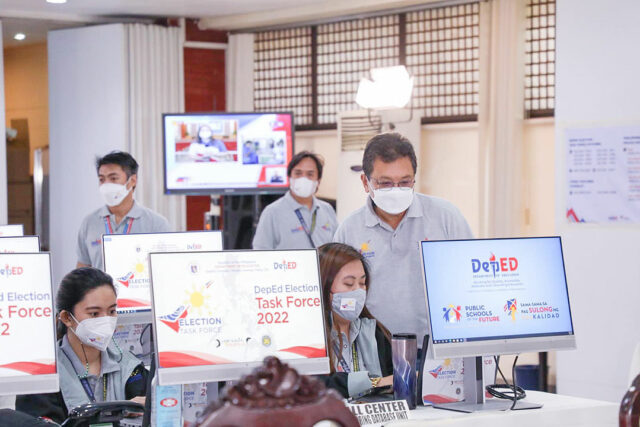
THE DEPARTMENT of Education has condemned the killing on Sunday night of a teacher designated to serve in the May 9 elections in Himamaylan City, Negros Occidental in central Philippines.  

Though it is unclear yet if such brutality was election-related, we denounce any acts of violence and injustice towards our teachers, who have dedicated their lives to the Filipino children and are now selflessly serving the country in this years election,the department said in a statement on Monday.    

Education Undersecretary Alain Del B. Pascua, the departments Election Task Force chair, is coordinating with field offices and law enforcement agencies for the investigation and assistance to the teachers family.   

Himamaylan Mayor Raymund I. Tongson, in a statement on his Facebook page late Sunday, said he has ordered the local police force to exhaust all efforts to arrest the killers.”  

A report from the city police office identified the victim as Mercy B. Miguel, a teacher at the Himamaylan National High School.   

Initial police investigation showed the victim and her husband were on board a motorcycle on their way home when they stopped at a crossing to move stones that were on the road. They were then fired upon by still unidentified suspects.  

The city is not categorized as an election hotspot. — MSJ