Home Blog Page 6026

DepEd condemns killing of teacher in Himamaylan City, Negros Occidental on eve of election 

DEPED PHILIPPINES

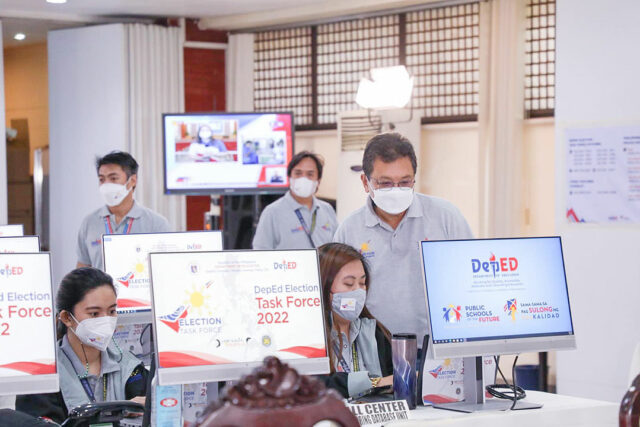
THE DEPARTMENT of Education has condemned the killing on Sunday night of a teacher designated to serve in the May 9 elections in Himamaylan City, Negros Occidental in central Philippines.  

Though it is unclear yet if such brutality was election-related, we denounce any acts of violence and injustice towards our teachers, who have dedicated their lives to the Filipino children and are now selflessly serving the country in this years election,the department said in a statement on Monday.    

Education Undersecretary Alain Del B. Pascua, the departments Election Task Force chair, is coordinating with field offices and law enforcement agencies for the investigation and assistance to the teachers family.   

Himamaylan Mayor Raymund I. Tongson, in a statement on his Facebook page late Sunday, said he has ordered the local police force to exhaust all efforts to arrest the killers.”  

A report from the city police office identified the victim as Mercy B. Miguel, a teacher at the Himamaylan National High School.   

Initial police investigation showed the victim and her husband were on board a motorcycle on their way home when they stopped at a crossing to move stones that were on the road. They were then fired upon by still unidentified suspects.  

The city is not categorized as an election hotspot. — MSJ

Lacson to quit politics if he loses presidential race

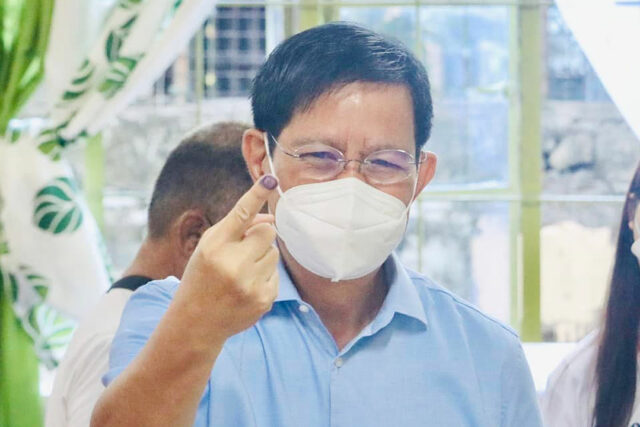
PRESIDENTIAL aspirant Senator Panfilo M. Lacson, Sr. — PING LACSON OFFICIAL FB PAGE

PRESIDENTIAL aspirant Senator Panfilo M. Lacson, Sr. on Monday said he does not plan on continuing his political career if he loses in the May 9 election.   

Mr. Lacson, in a media interview after casting his vote in his hometown Imus, said he is not interested in holding a Cabinet position under the next administration.  

No. I wont even speculate but like I said, Im more inclined not to accept anything anymore,he said in a mix of English and Filipino based on a transcript sent by his team.   

Under Philippine law, losing candidates may be appointed to a government position a year after the electoral exercise.  

The senator, a former police chief, said he feels he has done enough public service.   

Its already been 50 years and that’s it for me as far as government service,he said. But, as I said, it depends on the conditions, he added.   

The conditions, he said, includebaseline principles,which will not sacrifice the values he protected in his years as a public servant.   

If that will be compromised in exchange for a position as Cabinet secretary, then never mind, I will not.”  

When asked who among his rivals matched his principles, he said no one. 

In any case, Mr. Lacson said he expects that all animosities between candidates will be cast aside after the elections.  

It is understandable that during the campaign, someone will come out with a statement against any or some of the candidates, but that is normal. Now that it is over, I hope all of it will be forgotten after today,he said.  

Let us be one nation, one people again,he added.  

If he does retire from politics, the senator said his plans include farming in Silang, another town in his home province Cavite. Alyssa Nicole O. Tan 

Philippine labor force situation

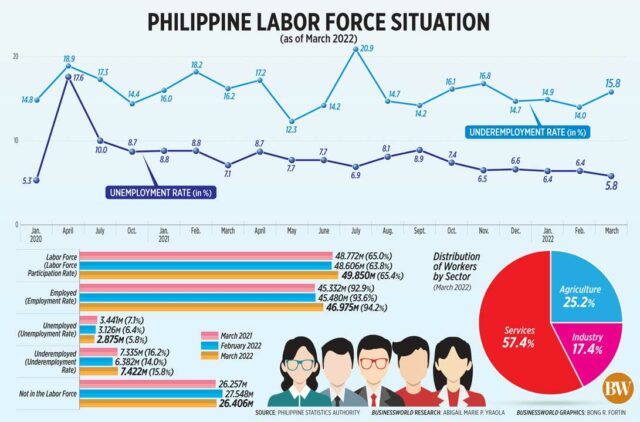
The country’s unemployment rate in March eased on a monthly basis to its lowest since the start of the coronavirus pandemic due to further loosening of mobility restrictions, but job quality worsened to a four-month high. Read the full story.

Philippine labor force situation

World determined to make sure Putin loses in Ukraine — Trudeau

CANADIAN Prime Minister Justin Trudeau and Ukraine’s President Volodymyr Zelensky attend a news conference, as Russia’s attack on Ukraine continues, in Kyiv, Ukraine, May 8, 2022. — REUTERS

KYIV — The world will do everything possible to ensure that Russian President Vladimir Putin loses his war in Ukraine, including keeping Moscow under sanctions for years, Canadian Prime Minister Justin Trudeau said late on Sunday.

“What Putin needs to understand is that the West is absolutely determined and resolved to stand against what he is doing,” Mr. Trudeau told Reuters in an interview.

“His illegal war, his escalations, his crossing of red lines by choosing to further invade Ukraine means that we will do as a world everything we can to make sure that he loses.”

Speaking on the sidelines of an unannounced visit to Ukraine for talks with President Volodymyr Zelensky, whom he calls a friend, Mr. Trudeau said Mr. Putin is making a terrible mistake.

“He is inflicting atrocities upon civilians, and it’s all something that he is doing because he thought he could win. But he can only lose,” Mr. Trudeau said when asked what he would tell Mr. Putin on the eve of Russia’s commemorations of the defeat of Nazi Germany in World War II, which Moscow calls the Great Patriotic War of 1941-45.

On Sunday, Europe commemorated the 77th anniversary of the surrender of the Nazis. Russia celebrates the victory on May 9. Nazi Germany’s unconditional surrender came into force at 11:01 p.m. on May 8, 1945, which was May 9 in Moscow.

Trudeau also echoed a statement from the Group of Seven issued earlier on Sunday, following a video call of G7 leaders with Zelensky, on how Mr. Putin’s “actions bring shame on Russia and the historic sacrifices of its people” during World War II.

“Quite frankly, on Victory in Europe Day, when we all celebrate the victory over fascism of so many decades ago,” Mr. Trudeau said, “Vladimir Putin is bringing shame upon the memory of the millions of Russians who fought and died in the fight for freedom and the fight against fascism.”

Mr. Putin, Russia’s paramount leader since 1999 who will preside over the anniversary celebrations on Monday, in recent years has used Victory Day to needle the West from a tribute in Red Square before a parade of troops, tanks, rockets and intercontinental ballistic missiles.

Earlier, Mr. Trudeau said Canada will provide new weapons and equipment for Ukraine and will reopen its embassy in Kyiv, the country’s capital.

Mr. Putin says that he launched a “special military operation” on Feb. 24 to disarm Ukraine and rid it of anti-Russian nationalism fomented by the West. Ukraine and its allies say Russia launched an unprovoked war.

Mr. Trudeau said all the countries that have imposed sanctions on Moscow, which have taken a steep toll on the Russian economy, are determined to keep them in place as long as necessary, even for years.

“Vladimir Putin cannot upend over 70 years of stability and growth and prosperity for the world and expect to continue to benefit from that stability, growth and prosperity,” he said. — Reuters

Elon Musk’s tweet on Japan doomed by low birthrate provokes anger

A WOMAN smiles between the early flowering cherry blossoms in Kyoto, Japan, March 13, 2020. — REUTERS

TOKYO — An Elon Musk tweet saying Japan would “eventually cease to exist” without a higher birthrate set off a flood of sarcasm and anger on Monday — though much of the angst was aimed at a Japanese government many said did little to address the issue.

Mr. Musk, the head of electric vehicle maker Tesla, Inc., at the weekend tweeted, “At risk of stating the obvious, unless something changes to cause the birth rate to exceed the death rate, Japan will eventually cease to exist. This would be a great loss for the world.”

The comment hit a nerve among Japan watchers and in Japan, whose population peaked in 2008 and has declined since due to its low birthrate to about 125 million as of last year despite government warnings and sporadic attempts to grapple with the issue.

But Japan remains the world’s third-largest economy, host to global heavyweights ranging from car manufacturers to games developers, and is a key link in global semiconductor supply chains.

“What is even the point of tweeting this?” wrote Tobias Harris, senior fellow at the Center for American Progress.

“The anxieties surrounding Japan’s demographic future is not that ‘Japan will eventually cease to exist’ but rather the profound social dislocations that are occurring as a result of the decline to a lower population level.”

Others noted sluggish birthrates plague many nations besides Japan, including Germany — where Tesla has just opened a new factory — and that Japan was simply being hit first.

But many Japanese commentators said the situation was not surprising and slammed their government for not doing enough to fight it, such as by providing more daycare centers and making it easier for women to return to work after having children.

“They keep saying the birthrate’s falling, but given that the government isn’t taking thorough steps to deal with it, what can we say? Everything they say and do is contradictory,” wrote Twitter user SROFF. “In this environment, who’s going to say ‘Okay, let’s have a child’? I despair for Japan.” — Reuters

China’s sea levels touched new high in 2021, gov’t study shows

SHANGHAI — China’s sea levels reached their highest on record last year, swelled by rising water temperatures and the melting of glaciers and polar icecaps, the government said in a report.

Coastal sea levels were 84 mm (3.3 inches) higher in 2021 than the average over the period from 1993 to 2011, the National Marine Environmental Monitoring Center said in an annual bulletin.

Saturday’s report warned that rising sea levels brought by climate change were having a “continuous impact” on the development of coastal regions, and urged authorities to improve monitoring and bolster early warning and prevention efforts.

The long-term effects of such rise include erosion of coastal ecosystems and the loss of tidal flats, while coastal cities face greater risks of floods and salt tides, said the center, a research unit of the national resources ministry.

Coastal sea levels around China have now risen by an average of 3.4 millimeters (0.13 inch) a year since 1980, higher than the global rate over the period.

Although the temperatures of China’s coastal waters fell slightly in 2021 from the previous year, they were still the third highest on record and 0.84 degrees Celsius above the 1993-2011 average.

Last year, the environment ministry forecast a rise of another 55 mm to 170 mm (2 inches to 7 inches) in coastal water levels during the next 30 years, which would require a greater effort by China to protect its coastline.

Its east coast cities have begun making contingency plans against rising sea levels, with the commercial hub of Shanghai looking into building new drainage tunnels and tidal gates. — Reuters

China says it conducted exercises near Taiwan

REUTERS

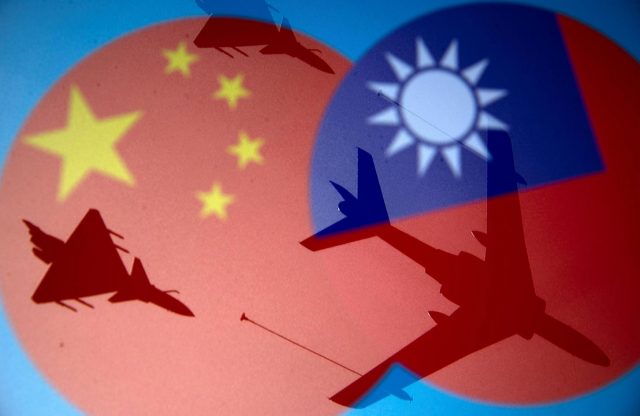
SHANGHAI — China’s armed forces carried out another round of exercises near Taiwan last week to improve joint combat operations, the People’s Liberation Army said on Monday, after the Chinese-claimed island reported a spike in activity. 

Taiwan has complained for the past two years about frequent Chinese military activity near it, mostly concentrated in the southern and southwestern part of the island’s air defense identification zone (ADIZ). 

Taiwan’s air force scrambled planes on Friday to warn away 18 Chinese aircraft that entered its air defense zone, and reported further incursions on Saturday and Sunday, though with fewer aircraft. 

The People’s Liberation Army’s Eastern Theater Command said in a statement that naval and air force assets carried out drills from Friday to Sunday to the east and southwest of Taiwan to “further test and improve the joint combat capability of multiple services and arms.” It did not elaborate. 

Taiwan’s Defense Ministry said China deployed bombers, fighters and anti-submarine aircraft. 

No shots were fired and the Chinese aircraft had not been flying in Taiwan’s air space, but in its ADIZ, a broader area Taiwan monitors and patrols that acts to give it more time to respond to any threats. 

Taiwan has raised its alert since Russia invaded Ukraine, wary of China making a similar move, though the government in Taipei has not reported any signs this is about to happen. 

Taking questions in parliament on Monday, Taiwan Foreign Minister Joseph Wu said China was continuing to pose a threat. 

“But we have the determination to defend our country,” he said. 

Japan last week reported eight Chinese naval vessels, including an aircraft carrier, passed between islands in Japan’s southern Okinawa chain, to the northeast of Taiwan. 

Taiwan also carried out pre-announced missile and other drills off its southern and southeastern coasts last week. 

China has never renounced the use of force to bring democratically ruled Taiwan under its control, and the Taiwan Strait remains a potential military flashpoint. 

Taiwan’s government rejects China’s sovereignty claims, saying only the island’s 23 million people can decide their future. — Reuters

Judgment Day for Pulse Asia

PHILIPPINE STAR/ RUSSELL PALMA

After every election I write in this space that the results bear out the forecasts of the two major pollsters — Social Weather Stations (SWS) and Pulse Asia (PA). In 2016, not only did I note that the results of the 2016 presidential election validated the two pollsters’ projections, I also wrote that the rankings of all the presidential and vice-presidential candidates in the two polls jibed with how they placed in the actual elections.

I defend election polling when detractors question the integrity of surveys. In 2010, presidential candidates Gilbert Teodoro and Richard Gordon asked how 2,000 respondents in a survey can represent the sentiments of an electorate made up of 50 million voters. Teodoro’s campaign manager said that Teodoro ranked No. 1 in all the universities in which the candidate spoke and that the students who said they will vote for him numbered in the tens of thousands. The late Senator Miriam Defensor Santiago raised the same issue when she ran for president in 2016. Like Teodoro, she ranked first in a survey of university students.

In reaction I wrote that it can also be asked how 10, 20, or even 30,000 university students can reflect the sentiments of 50 million voters or how students from the middle to upper income classes of the national capital region can possibly represent the entire electorate. University students belong to the middle to upper income groups, are 18-22 years old, mostly single, highly educated, well-informed by mass media, and highly politicized. Their choice of candidate differs from the voting preference of the electorate taken as a whole.

This trust in election polling stems from my having worked for Robot Statistics, the first public opinion pollster/market research firm in the country. In fact, it was my first job right after college. It was the Philippine affiliate of Gallup Polls when I was with the firm. I had also earned enough credits in Statistics — as an AB-Commerce student, then as a graduate student of Psychology, and subsequently as an MBA student — to have a good understanding of random sampling, margin of error, and confidence level. (Robot enrolled me in Ateneo’s Graduate School of Psychology as it was then planning to go into motivation research.)

But when the results of the survey conducted by Pulse Asia from Jan. 19 to 24 showed Bongbong Marcos as the preferred presidential candidate of 60% of the respondents and Leni the choice of only 16%, doubts lurked in my mind. In the three elections where Bongbong ran for national office, he got no more than 35% of the votes of the electorate.

When Bongbong first ran for senator in 1995, he got 8,168,788 votes, or 31.7% of the votes cast that year, short of the number of votes needed to land one of the 12 Senate seats to be filled up. He ran again in 2010. He garnered 13,169,634 votes or 34.5%, good enough to win him a Senate seat. When he ran for vice-president in 2016, he got 14,155,314 or 34.5%. But Leni Robredo bested him with her 14,418,817 votes or 35.1%.

Bongbong had not done anything from the elections of 2016 to 2021 to have raised his political stock or gained the admiration, gratitude, or goodwill of the electorate. I asked how he could be preferred by 60% of the respondents when he is running for president against the same person who beat him for the vice-presidency, who is now preferred by only 16%?

Leni as vice-president had not done a bad job for people who voted her vice-president to diminish in number by half. In fact, she did a lot for the people, especially the marginalized, in spite of the fact that President Rodrigo Duterte hindered her efforts to serve the people. In contrast, Bongbong was preoccupied with his electoral protest during the same period.

Some political pundits say Bongbong’s message of “Babangon muli” (“Rise again”) instills nostalgia of the “Golden Age” during his father’s presidency. Bongbong’s army of trolls had flooded social media with narratives of a robust economy, grandiose infrastructure, and lasting peace and order that his father’s reign was. As the youth did not experience life under Martial Law, they believe what they read in social media.

But netizens saturated social media with factual evidence that belie the claim that Ferdinand Marcos’ 20-year rule was the “Golden Age” of Philippine history. Their posts show that his reign was marked by massive corruption, unbridled human rights abuses, and an economy ever on the verge of collapse.

Also, the Catholic Bishops Conference of the Philippines (CBCP) issued a pastoral letter on Feb. 25 that spoke of “blatant and subtle distortion” of history, the trivialization of the People Power Revolution, and the seeding of false information to influence the opinion of the people and to malign and blackmail people. The pastoral letter called attention to “troll farms which sow the virus of lies.”

Detractors of Bongbong have said that even if the narrative of a “Golden Age” were true, it does not necessarily follow that the son can duplicate what his father had achieved. He doesn’t have the brilliant mind, the zeal for work, and the doggedness to finish what he had set out to accomplish — qualities that his father had. He has shown during the campaign that he lacks the oratorical skills or the persuasive power to be able to lead people.

He has been branded a coward for not participating in the Comelec-sponsored debates and for refusing to be interviewed by respected local broadcast journalists and foreign correspondents.

All that bashing seems to have had little effect on his rating in Pulse Asia surveys. In the March 17 to 21 survey, Bongbong’s score was 56%, down by 4% from his 60% in January. That is still 21% higher than the 35% he got in actual elections. The April 16 to 21 survey didn’t reflect any change in the attitudes of people towards him. Fifty-six percent still preferred him over the other candidates.

This almost constant high rating of Bongbong in Pulse Asia’s surveys has been met with skepticism if not criticism, not from politicians who fare badly in election polls, but from respected professional statisticians. Dr. Romulo Virola, former secretary-general of the National Statistical Coordination Board and a professor of Statistics in UP, Diliman, found numerous “flaws” in Pulse Asia’s current election surveys. He pointed out overrepresentation and underrepresentation of certain demographic groups. Such over and under representation of sub-groups could have corrupted the survey results.

Arvin Boller, lecturer at the Ateneo School of Social Science, says not one presidentiable since 1986 has won the votes of the majority of Filipinos. The Pulse Asia surveys show Bongbong could potentially pull it off. He sees three possible reasons for the 56% rating: 1. Bongbong’s campaign is extremely effective; 2. there is a methodical flaw in the conduct of the survey; 3. there is a conspiracy behind the survey results.

Well, we will know today the results of yesterday’s elections. If the Pulse Asia numbers for Bongbong Marcos and Leni Robredo match or approximate closely the results of the elections, then Pulse Asia will be affirmed as a credible forecaster of election outcomes. If the results show a Leni Robredo victory, Pulse Asia will crumble, bringing down with it the entire polling industry.


Oscar P. Lagman, Jr. is a retired corporate executive, business consultant, and management professor. He has been a politicized citizen since his college days in the late 1950s.


After the elections

PHILIPPINE STAR/ RUSSELL PALMA

By the time you read this, it would be the day after E-day. The voters would have fulfilled their duty and chosen their candidates. Between now as I write this and then, exactly a week would have lapsed. The mitings de avance haven’t taken place yet. The last-minute frenzied campaigning in “must win” areas are ongoing. So far, it’s been a peaceful campaign, except in cyberspace where fake news, calumny, and uncivil behavior abound. I hope and pray that the overzealous don’t spill blood before, during, and after E-day.

The worrisome time is after the counting. There’s been so much talk about violence, that the losing candidate/s will cry foul and rampage. That’s because the political environment is so poisoned and corrupted that nothing is believable. We steadily slid to reach this abysmal point. Everything’s under suspicion: the vetting process, the candidates, the surveys, the news, the printed ballot, the distribution of ballots, the voting, and the count. Worse, speculating over a violent outcome is enough to place investments on hold and shift capital to safe havens.

Who will emerge victorious? The surveys have consistently shown that presidential candidate Ferdinand Marcos, Jr. and his vice-presidential running mate Sara Duterte are the clear leaders. A distant second is the incumbent Vice-President Leni Robredo and her running mate former Senator Kiko Pangilinan. But lately, there has been a counterpoint to the local surveys — Google Trends (GT) — which is touted to be an accurate predictor of political outcomes in various parts of the world since 2004. GT points to a Robredo-Pangilinan vote outcome. Who to believe?

In our obviously polarized, color- and meme-dominated political environment, the partisans of these top two pairs of contenders are being watched closely. Whichever way the needle points, the persistent belief is that supporters of the losing side won’t have it; that violent protests would erupt. Additionally, if the violence gets out of hand, proponents of “RevGov” — basically the rabid supporters of the incumbent administration — would step in with the AFP and PNP (Armed Forces of the Philippines and Philippine National Police) in tow, restore order, and extend their stay indefinitely. Maybe, maybe not.

The Filipino people wield ultimate power exercised through the Executive, Legislative, and Judicial branches of government. It’s in that context that I scrutinized the personal character and record, vision, priorities, capabilities, personality, preparedness, readiness, and potential for greatness. It’s borne out of duty and responsibility to choose the best one who can be relied upon to uphold and advance our national interests. After six months of observation and assessment, it turned out that the best man was a woman. So, may the best woman win!

In any case, here’s the painful truth and harsh reality: whoever wins the top posts of the land will inherit all the rising external risks, internal crises, and accumulated burdens of the country. Selecting the right mix of Cabinet and Sub-Cabinet team members based on merit, instead of political payback, is essential to their success. They must hit the ground running as soon as they’re declared winners of the 2022 elections. The transition period will be crucial in ensuring a proper handover of the records or paper trail for seamless continuity of public governance.

The rising external risks are: inflation, food and energy supply contraction due to the pandemic, extreme weather, supply chain disruptions, and recessionary pressures amid great power competition in strategic areas of the world. Internal crises could be political instability, the resurgence of violent armed groups, organized crime in the private and public sectors, and rising street crime. The country’s accumulated burdens or inter-generational problems begging for attention and resolution are poverty, injustice, corruption, exclusion, and division.

There’s this viewpoint though that the outcome of our elections is being keenly watched by the great and middle powers in the region, particularly ASEAN, the USA, China, Japan, South Korea, and Australia. The Philippines is strategically located. So, the belief is that whoever is most influential will have the upper hand in projecting power throughout the Indo-Pacific region. All eyes are on the USA and China, with imaginations running wild as to who would have the better “inside track” on our electoral system to obtain a favorable result. Who knows?

This much I know — there’s much to do in the years ahead just to survive. The quality of our governance and citizenship must be our main agenda. I foresee big trouble requiring us all to unite and focus on a common purpose to protect our national interest, and to look after each other. Perhaps the coming storm will be compelling enough to move us from division to unity, apathy to empathy, self-interest to the common good, pettiness to worthiness. Just like young soldiers in their teens who are thrust into battle and emerge from it as men and women.

Whoever takes over must be risk and crisis management conscious, and organize the teams accordingly to address inherited problems, deal with emerging risks and crises, and pursue its vision and mission. The new administration will need to form multi-disciplinary teams to apply diverse solutions aimed at lifting the nation from its knees. Enough of incompetent political “solutions” for every business, technological, technical, cultural, and social issues confronting us. Enough of that silly posturing as if we’re on top of the situation and know what we’re doing. No mas! (No more!)

The new administration will need an army of implementors backed by a Legislature that will remove, amend, or pass new laws to facilitate the implementation of the Executive’s initiatives to clean house, reorganize, deliver services, and transform mindsets. The years ahead won’t just be about the incoming administration. It will be about us — our preparedness and readiness to face any risk and survive any crisis coming our way in these perilous times, to perform selflessly and emerge from it transformed for the better. We must, for the sake of future generations.

That’s my hope and prayer from this day forward.

This article reflects the personal opinion of the author and does not reflect the official stand of the Management Association of the Philippines or MAP.


Rafael “Raffy” M. Alunan III is a former governor of the MAP. He is the chair of the Philippine Council for Foreign Relations, vice-chair of Pepsi-Cola Products Philippines, Inc., and sits on the boards of other companies as an independent director.

map@map.org.ph

rmalunan@gmail.com

Post-election economic issues to prepare for

By the time this column is printed and posted online, the elections would have ended and counting should have started. I want to share some things related to the campaign rallies, then some post-election economic scenarios.

THE LENI-KIKO MITING DE AVANCE
I attended the last campaign sortie of the Leni Robredo-Kiko Pangilinan tandem on Ayala Ave., Makati City on Saturday, May 7. I was there for about 10 hours — afternoon to midnight — and here are some of my observations.

1. It was a huge crowd — estimates range from 700,000 to one million people. Ayala is long, eight-lanes wide, with wide sidewalks, and several wide perpendicular streets, which were all filled with people.

2. There were lots of freebies — from many private volunteer groups giving free medical assistance to free ice cream, taho (street food of tofu, syrup, and sago pearls), bread, cookies, and candies, to plastic fans and even free condoms. But there were no free T-shirts and caps from the candidates — people had to buy these from ambulant shops in the area.

3. They were civilized citizens — no pushing or shoving by people when they moved in an already dense area. After the event ended, there were many groups of volunteer sweepers and cleaners. One group I saw were rich-looking Filipino-Chinese who were awkwardly sweeping, suggesting that they are not used to doing it and have helpers at home who sweep the floor for them.

4. Security was decentralized — everyone has a mobile phone so any attempt at sowing disorder will likely be recorded and perpetrators likely be apprehended. But there were a few reports of petty stealing, like lost cell phones and wallets, or perhaps people dropped them somewhere.

5. High police visibility — most were unarmed, they just held a baton. After the concert ended and shortly before midnight, I looked for the PNP (Philippine National Police) head in the rally. I was guided to Police Lt. Col. Randy Moratalla, Deputy Chief for Administration of Makati PNP. He was the highest PNP official at the time when I came. I introduced myself as a BusinessWorld columnist and wanted to congratulate them on a peaceful rally. He quickly accommodated me and said that the PNP National Capital Region Police Office (NCRPO) plus Makati police had deployed around 700 police officers that day. The high visibility of uniformed cops not carrying guns helped preserve order and trust. Good job, PNP.

6. High visibility of Ayala security — to remind people that it is not a public park and there are private properties that can be damaged if there are unruly people, like the center-island flowers and glass buildings. Thanks for the nice wide venue, Ayala Corp.

ISSUES TO PREPARE FOR
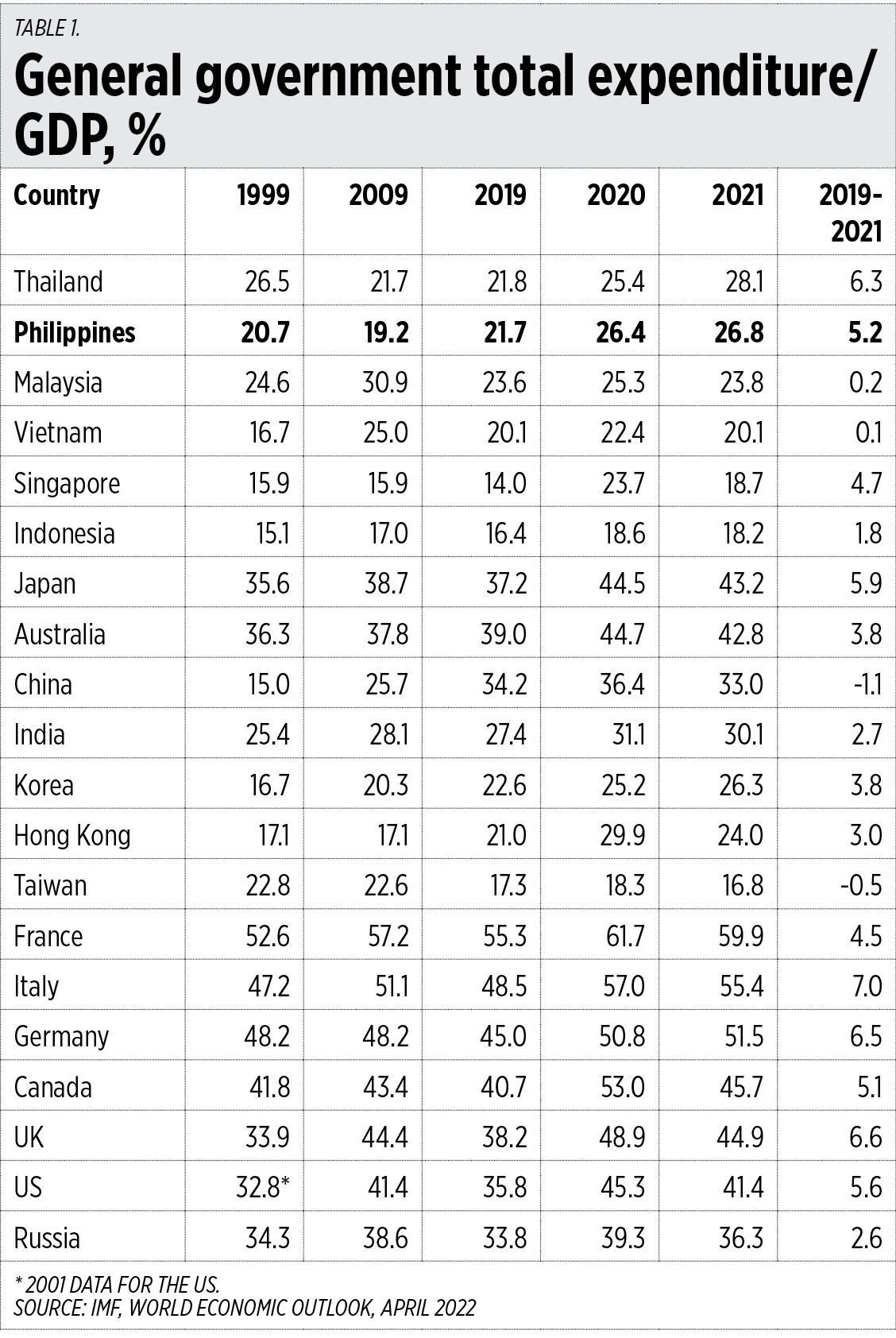
When the next administration comes in, among the high-profile economic issues they will face will be the high government spending that will require high borrowing and high taxes. The Philippines’ government spending share to GDP (G/GDP) ratio was 21.7% in 2019, and it rose to 26.8% in 2021 or a 5.2 percentage point increase in just two years. This is the second highest increase in the ASEAN-6.

Take note that this is only general or national government spending and does not include spending by local governments. If local government spending is included, we would likely be in the 32-35% of GDP level or nearly twice that of Singapore which has no local governments. Socialist Vietnam has a low G/GDP ratio of only 20%. Very likely excluded in their numbers are the spending of state-owned enterprises and banks, and local governments (Table 1).

The Philippine bureaucracy and political class, from national down to barangay level, kept receiving their salaries, allowances, and bonuses even when many people in the private sector lost their businesses, jobs, and income during the lockdowns of 2020-2021. Really unfair.

The pandemic per se cannot be blamed for this anomaly because the same virus affected Asia and the rest of the world, which had different economic outcomes because different governments have different responses. In 2020, while the Philippines had a GDP contraction of 9.6%, Vietnam grew by 2.9% and Taiwan had growth of 3.4%.

Rising government spending even if revenues are declining means increased borrowing.

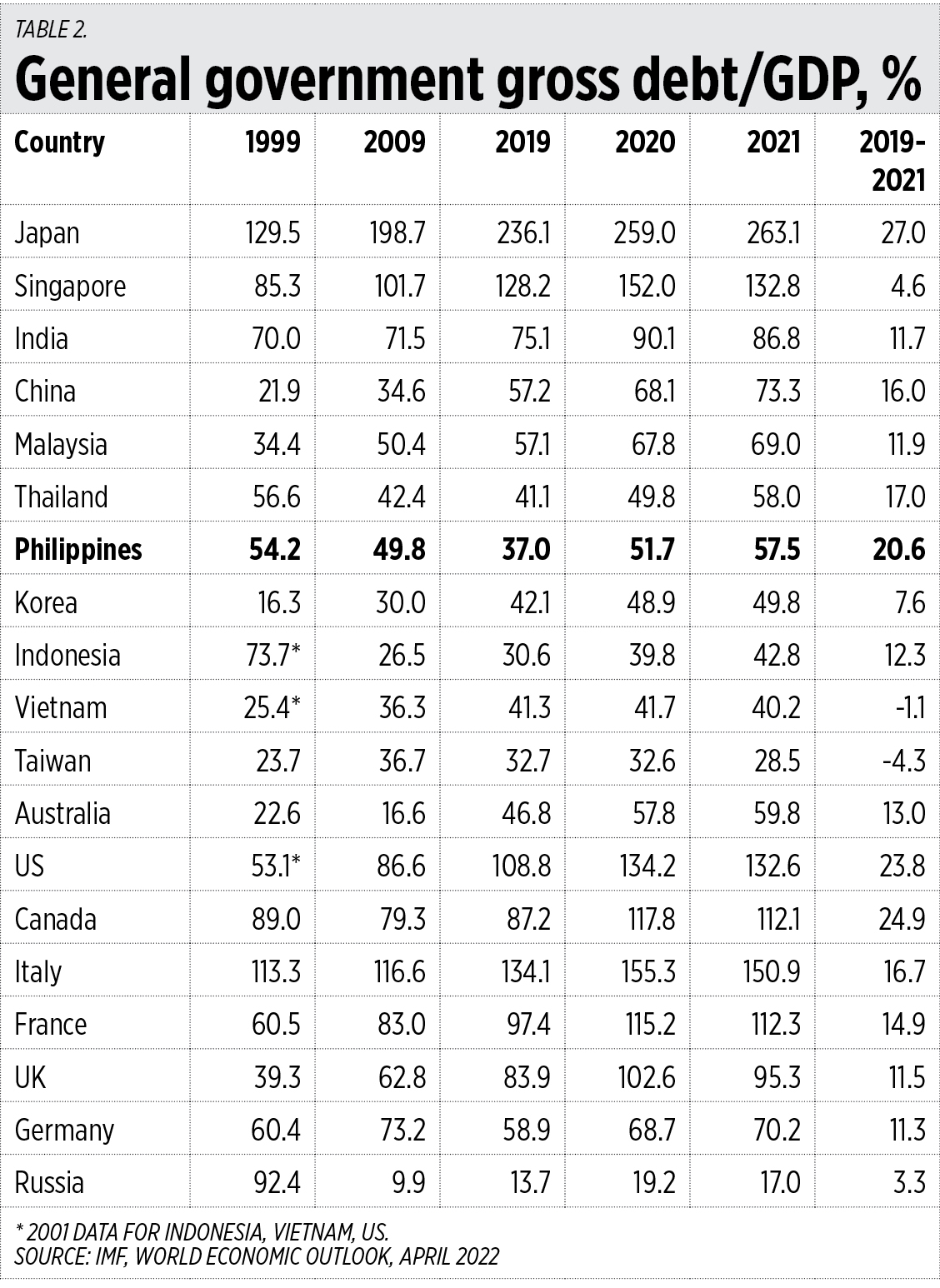
The Philippines’ gross debt/GDP ratio of 37% in 2019 rose to 57.5% in 2021 or 20.6 percentage points increase in just two years. It is the highest increase in the ASEAN-6.

Note also the huge increase in public debt of G7 countries including Japan. Only Germany in the G7 has not reached the 100% debt/GDP ratio in 2020-2021. This means those huge governments will keep borrowing huge amounts to pay old debts and push global interest rates even higher, which is not good (Table 2).

Overall, we will have more bad news than good news on the economic front. As US-EU economic sanctions against Russia expand, more commodities — from oil-gas-coal to minerals to agriculture and livestock — will be affected, supply restricted, and prices, and national and global inflation rates will further rise. Then global interest rates will further rise, and the taxes needed to pay high spending and borrowings will rise too.

There are many other economic issues to prepare for but suffice it to say that the next administration should make serious cuts in spending, cuts in borrowings, in order to limit tax hikes. Campaign promises to expand subsidies and spending should be relegated to one side as much as possible.

If spending cuts cannot be done, another option is to have large-scale privatization of government assets and enterprises, from wide lands to non-essential “services” like operating casinos and lotteries. Use privatization proceeds to retire some public debt to reduce principal and interest expenses.


Bienvenido S. Oplas, Jr. is the president of Minimal Government Thinkers.

minimalgovernment@gmail.com

Reflections on the Philippine presidential race

PHILIPPINE STAR/ MIGUEL DE GUZMAN

The race for the presidency in the 2022 Philippine elections may be the most highly divisive and contested referendum for the highest public office in the country. It is a high-stakes and high-risk contest with intense pressures to win from both the top contenders for the office and those who support them. Focusing on the top two contenders, it is a race between stopping one seeking a path back to power and electing one seeking a great reset of powers in the government.

Instead of focusing on what challenges await the next President and the country, we focus on what we can learn from the race for the presidency.

1. Elections are not just about voting candidates into or out of office. These are not merely about the change of names and faces. Elections are about the transfer and legitimation of power. Should we take a step forward to usher in a new (or reformed) governance system or take two steps back to restore an old, tarnished, and contested rule?

2. Elections should not be about those who run for office. It is about the people who should be served — their needs, rights, interests, and demands. Don’t we all deserve a new government that helps more (or mostly) the vulnerable and the marginalized while seeking to protect all regardless of any markers of differences?

3. People cannot be restrained or constrained. Filipinos are resilient. True. But when it’s their future and their loved ones’ future at high stake, they mobilize and organize. Doesn’t the spirit of volunteerism we all witnessed renew and give new meaning to the Filipino’s “bayanihan,” from that of communal cooperation to collective action and accountability?

4. Conventional politics must end. Political parties cannot effectively steer the public space until genuine political party reforms are made. Shouldn’t we sustain the “people’s movements” seeking to expand the political space available and bring in the concerns of everyday life that are silenced by dominant powers operating in the society?

5. No issues are either politically or morally compelling. Politically contentious or not, all issues are and should always be both politically and morally compelling. Shouldn’t we stand up for the oppressed and unjustly persecuted and the basic sectors who are really in need? Shouldn’t we stand against the politically and morally corrupt?

6. Public service is the name but public accountability is the rule of the game. Article XI, Section 1 of the 1987 Philippine Constitution states that “Public office is a public trust … officers and employees must at all times, be accountable to the people…” Why is it so difficult to execute? Shouldn’t all those who run audit themselves first even before running?

Instead of focusing on what opportunities await the next President, we focus on the salient issues and tasks for the next President to act on. These issues and tasks echo those of the Ateneo de Manila University’s Department of Political Science published in a working paper series related to the 2022 presidential and vice-presidential elections and accessible via admupol.org.

1. Pass a Security of Tenure (SOT) law that will protect workers against abusive contractualization. The next President must certify the SOT bill as urgent and mobilize support from both the House of Representatives and the Senate. Review overseas employment and prioritize the creation of jobs locally and the organization of a task force on reintegration while sustaining protection mechanisms. Forge bilateral agreements to safeguard Filipinos abroad and create migration resource centers outside of the NCR (National Capital Region) and urban areas to assist families back home.

2. Stop the misogyny and privileging of men over women that still envelope Philippine governance and politics. Socio-economic targets should not be gender-blind. They should be specific and implicit in achieving gender equality and underscore bringing people together instead of polarizing the polity as well as framed and executed with an ethic of care.

3. Declare and address a crisis in education aggravated by the COVID-19 pandemic. Provide higher funding for education where the Philippines’ current 3% budget is lower than what is required by UN standards. The next President must be able to resolve issues concerning the mismatch of the skills and talents of graduates that our education system produces and the needs of our society as well as demands of industries.

4. Develop a strong public healthcare system with strong public health infrastructure throughout the country that are able to respond to any pandemics like COVID-19, non-communicable diseases, and other-health related concerns. Toward this end, the next President must ensure the effective and efficient implementation of the Universal Health Care law, the provision of free and accessible healthcare through the National Health Insurance Program and Health Care Provider Network in provinces and cities.

5. Synergize the imperatives of the security sector and justice sector reforms with Sustainable Development Goal 16 which includes the promotion of peaceful and inclusive societies for sustainable development, the provision of access to justice for all, and building effective, accountable institutions at all levels. There is a need to shift from a militaristic, anti-insurgency approach toward human security and a whole-of-government approach to addressing the root causes of rebellion.

6. Put inclusivity, transparency and accountability at the core of the government. Don’t we all deserve public officials who do not only demonstrate excellence in public service but also maintain a culture of excellence? Under the leadership of the next President, can all agencies and instrumentalities of the government aim for a culture of excellence by meeting International Public Sector Accounting Standards and earn the Commission on Audit’s seal of approval? Can the next President direct all government agencies to an audit of its management system to meet the international standard for quality management systems? To start the process, will the next President boldly order a full disclosure policy that can promote greater transparency in public service, and hence, start combating problems of corruption and patronage politics?

In light of these salient lessons and tasks, will the next President of the Philippines draft a new history with a renewed faith in democracy? Or will the next President thrust the country and its people back to a history that will forever remain tarnished, mired, and highly contested?


Diana J. Mendoza, PhD is faculty and former chair (2017-2021) of the Department of Political Science, Ateneo de Manila University.

Japan to take time phasing out Russian oil imports — PM Kishida

WIRESTOCK-FREEPIK

TOKYO — Japan will take time to phase out Russian oil imports after agreeing on a ban with other Group of Seven (G7) nations to counter Moscow’s invasion of Ukraine, Prime Minister Fumio Kishida said on Monday. 

The G7 nations committed to the move “in a timely and orderly fashion” at an online meeting on Sunday to put further pressure on President Vladimir Putin, although members such as resource-poor Japan depend heavily on Russian fuel. 

“For a country heavily dependent on energy imports, it’s a very difficult decision. But G7 coordination is most important at a time like now,” Mr. Kishida told reporters, repeating comments he made at the G7 meeting. 

“As for the timing of the reduction or stoppage of (Russian) oil imports, we will consider it while gauging the actual situation,” he said. “We will take our time to take steps towards a phase-out.” He did not elaborate. 

There have been no ships loading Russian oil for Japan since mid-April, according to Refinitiv data. About 1.9 million barrels were exported from Russia to Japan in April, 33% down from the same month a year ago. 

The Ukraine crisis has highlighted Japan’s energy dependence on Russia even as Tokyo has acted swiftly and in tandem with the G7 in instituting sanctions. 

The latest ban underlines a turn in Japan’s policy. Japan has said it would be difficult to immediately cut off Russian oil imports, which accounted for about 33 million barrels of Japan’s overall oil imports, or 4%, for 2021. 

It has already said it will ban Russian coal imports in stages, leaving just liquefied natural gas (LNG). Japan is in a particularly tough spot since it shut down the bulk of its nuclear reactors following the 2011 Fukushima nuclear disaster. 

Russia was Japan’s fifth-biggest supplier of crude oil and LNG last year. 

The Japanese government and companies own stakes in oil and LNG projects in Russia, including two on Sakhalin Island from which partners Exxon Mobil Corp and Shell PLC have announced they will exit. 

Still, Japan’s biggest oil refiner, Eneos Holdings Inc., has already stopped buying Russian crude, saying it would get supplies from the Middle East. 

On Friday, trading firm Marubeni Corp said it wanted to withdraw from the Sakhalin-1 oil project but was keeping its stake in line with government policy. 

Mr. Kishida said on Monday there was no change to the government’s policy of keeping business interests in the various Russian energy assets. — Reuters