Home Blog Page 5970

ADMU ignites young technology entrepreneurs to ‘launch their purpose’

Photo from Freepik

By Allyana A. Almonte

Through a four-day tech startup conference, the Ateneo de Manila University (ADMU) featured thought-provoking keynote sessions, personal interactions with global thought leaders, and internships and networking opportunities for young entrepreneurs.

Building Young Tech Entrepreneurs (BYTE), the home organization of ADMU’s B.S. Information Technology Entrepreneurship students, facilitated the conference dubbed as Startup Summit 2022: Launch Your Purpose last April 6 to 9 via Hopin and Zoom virtual meeting platforms.

The summit mapped out the journey towards becoming a tech industry leader. It was attended by around 400 participants in each session who learned the steps to constructing a startup.

Through 10 high-caliber resource speakers from the technological entrepreneurship sector, the summit featured the ideation, development and growth stages that every entrepreneur takes in their journey as a startup founder.

Angkas Founder Angeline Tham, SariSuki CEO and Founder Brian Cu, and MedGrocer Co-Founder and COO Germaine Erika Kaw helped and pondered with the participants in exploring motivations and advocacies that build the backbone of startups on the first day of the summit.

“Issues are opportunities. If there are no problems, there is no business. Expect people to say no to you but press upon them what your belief is to improve the system. Keep to your core the values and purpose to navigate forward,” Ms. Tham said as participants asked questions about the ideation and adversities of a startup. She also mentioned how impactful are Angkas’ viral social media posts in driving sales.

On the second day of the summit, participants discovered more about ensuring a startup’s success by taking a deep dive into the technical aspects and hard skills needed, through learning from the best minds in the industry.

Kinobi Co-Founder and COO Hafiz Kasman, 917Ventures Head of Growth & Programs Group Natasha Dawn Bautista, and DEEPCORE Director of Investment Jin Tanaka discussed the learnings they have accumulated for years of running startups and on how to build one from the roots up.

“Having an entrepreneurial mindset like analytical and critical thinking, with the right balance of crazy, insane, or experimental strategy, are two of the characteristics one startup dream team should have. A startup shouldn’t be obsessing with the solution, but should be obsessed with the problem instead,” Ms. Bautista advised the young entrepreneurs.

The third day of the summit featured four multi-awarded startup founders who delved into the courses of action needed to scale, thrive, and grow amidst the long-term changes inside the startup ecosystem.

Pick.A.Roo CEO & Co-Founder Crystal Gonzalez, Brainsparks Co-Founder Artie Lopez, Great Deals E-Commerce Corp. Founder and  CEO Steve Sy, and Foxmont Capital Partners Managing Partner Franco Varona shared their notable experiences as entrepreneurs who made a mark as they ventured into the startup scene.

“Sometimes, the most important validation you can get is a ‘no’, for failure is always a part of the process in ideating, building, and growing a startup,” Mr. Lopez said.

Alongside the talk sessions, the conference became an avenue to present partner startups in Expo Booths as they showcased their innovative solutions.

Participants were GrowSari, a tech-enabled B2B platform that helps the Philippines’ over one million sari-sari stores and other retail outlets transform themselves from simple neighborhood outlets to comprehensive service hubs; Splore, a wellness marketplace that envisions a world where fitness and health are both accessible and attainable; Eskwelabs, an online data upskilling school in the Philippines with the mission of driving social mobility in the future of work through data skills education; Mayani, an agritech startup empowering local farmers and fisherfolk; and Unawa, a regulatory tech startup making ‘ease of doing business’ a reality in the country.

The summit also offered young learners and entrepreneurs with endless opportunities of getting a real-work experience through the activities’ partner companies.

On the last day of the summit, a roundtable discussion served as the post-event and networking night for the participants to make new connections and find the right blend of a startup dream team.

BYTE Heads Camille Go and Justine Ngo wrapped up this year’s summit by appreciating all the sponsors, media partners, and partnered startups and companies for helping make the conference an airstrip where dreams take into flight.

Various ways to save the Earth

In the past years, country leaders, global companies, and private organizations are seen joining hands to usher food security, transportation, and energy away from the traditional economy flow to a more circular motion. However favorable and impactful the results, research shows that these collaborations alone are still not enough to combat the climate crisis.

According to Kathleen Rogers, Earth Day Network president, “We must collectively act now.” While leaders can be at the forefront of the change, individuals around the world have tremendous power in instigating improvement through being mindful of daily actions towards the environment.

In time with the Earth Day, the world is uniting behind the theme “Invest In Our Planet,” putting the spotlight towards shifting to a more sustainable way of living to save the environment.

Global institutions like National Geographic Society and World Wide Fund for Nature (WWF) continuously promote simple things anyone can do to help save the planet such as cutting down on what to throw away, following the three “R’s” (reduce, reuse, and recycle) to accommodate shrinking landfill spaces, conserving water, shopping wisely with reusable bag, and using of long-lasting light bulbs.

In addition to these steps, WWF also urges young people to keep being informed, use their voices, and speak up in social media about how saving the Earth is a responsibility of everyone.

The National Geographic also calls on the youth to become habitat heroes through volunteering for cleanup drives, tree-planting activities, and environmental teaching in communities.

However, as environmental problems grow bigger, the United Nations Foundation crafted a new game plan for countries to become climate ready and achieve a future-proof environment.

According to the foundation, investing in renewable energy and improving energy efficiency can curb greenhouse gas (GHG) emissions, make energy more accessible other than using carbon-intensive energy sources, improve the poor air quality brought by the burning fossil fuels, and preserve the millions of people who may die each year due to toxic smoke inhalation.

Investing in clean transportation comes in the second spot as many developing countries are now building bike-friendly roads to reduce carbon emissions brought about by cars. Two billion bikes are being used around the world, according to the World Economic Forum (WEF), and the number could rise to five billion by 2050.

Like the energy sector, today’s transportation is almost entirely dependent on fossil fuels, producing one-fourth of the world’s GHG emissions. With alternative clean transportation, UN believes that it can also enhance access to education, health care, and economic opportunity by providing more sustainable, accessible ways for people to get to and from their destinations.

Agriculture and food production also hold promising solutions to climate change, the foundation points out. Use of conventional plowing as it harnesses the soil’s natural ability to store carbon, developing solar-powered irrigation, hydroponic growing, and meat alternatives are other innovations UN mentioned that could transform how communities can grow food and lead to a more sustainable way of managing land and water.

UN Foundation Senior Advisor for Ocean and Climate Susan Ruffo persuaded leaders to invest in research and development of nature-based solutions found in the world’s seawaters for nature-based remedies can also be found in the ocean.

Aside from investing in the nature itself, UN also highlights how investing on people and peace can drive the planet away from catastrophe.

Because of indigenous communities’ cultural, social, and physical connection to the environment, climate change is threatening their very existence. Public discourse and policy decisions on climate change should include their unique perspectives and traditional knowledge of land stewardship.

Across the globe, girls and women depend more on natural resources, according to the UN. This makes them uniquely vulnerable to climate change. But as the primary stewards of their households and communities, they are also effective agents of change and defenders of the environment.

Finally, war doesn’t only cost human lives and cause widespread hunger, poverty, and suffering. The environment is the “silent victim of a violent conflict.” By investing in peace and diplomacy, future generations can be spared from further rage and protect the planet at the same time. Allyana A. Almonte

Konstruk revolutionizes shopping experience for construction material needs

With more Filipinos working on do-it-yourself (DIY) projects and home repairs since the start of the pandemic, there has become a demand for an accessible platform for construction and repair materials.

 Konstruk (www.konstruk.ph), the country’s premier e-hardware store, offers a venue for customers to shop for their construction material needs right in the comfort of their homes.

Since the company’s launch in February this year, Konstruk has maintained to be the first and only e-commerce marketplace in the country that focuses solely on the Home Improvement and Construction supply (HICS) segment.

Konstruk is continually upgrading its app to provide easy access for merchants and customers on specific categories of products and services. The upgrade gives contractors the avenue to conduct business in the digital supply and install market.

“We are also looking into the supply & install market which we see is critical for the e-commerce of construction,” said Hiram Yuseco, Konstruk’s business development manager.

It gives the HICS practitioners who are now embracing the idea to digitize their business at low cost the platform to realize their goal.

Konstruk is also upgrading its contents to widen the selection of home improvement as it accommodates, among others, merchants who provide plumbing, gardening, and cleaning services.

With Konstruk, both merchants and customers can enjoy the benefits of hassle-free online shopping.

 Konstruk provides ways for clients to save money and time as they can canvas for their needs safely and easily at home and enjoy loyalty perks with every purchase. Customers need not go through slow and long lines or go out and drive to purchase their construction needs.

 “We will be your e-hardware store and online shop for home improvement and construction supplies. With a variety of payment gateway systems and multiple logistics partners for our delivery services — we have ensured that our consumers will have a safe and convenient time navigating through our website,” said Rommel Bulalacao, Konstruk founder and chief executive officer.

Just a few clicks on their laptop or mobile phone can lead them to a wide variety of construction and home improvement products from smart door locks, automated gates to prefabricated homes and cement materials.

“Right now, we have products such as cement, roofing, furniture, prefabricated units, gypsum boards, etc. The goal is to have all materials available to build your dream structure which could be a house, office or condominium buildings,” Mr. Yuseco said.

These items can be delivered at the day and time of their convenience through Konstruk’s partnership with logistics companies, such as Transportify, Lalamove, Toki-Toki & BAC Trucking.

Soon, customers and merchants alike will enjoy more loyalty perks that Konstruk is now developing.

Konstruk empowers customers to finally complete their DIY repairs and home improvement projects safely and comfortably as purchases can be done through credit or debit cards or any e-wallet mode of payment.

 For this, Konstruk has partnered with Metrobank for a payment gateway system gives consumers flexibility in payment using credit cards and debit cards via Visa and Mastercard. Other payment facilities such as Gcash, Instapay and Pesonet will also be available.

 “We want to create a new, revolutionary shopping experience for our industry — and Konstruk is here to do just that,” Mr. Bulalacao said.

UnionBank, AEV to roll out tech-focused training courses for Tourism Promotions Board member-MSMEs

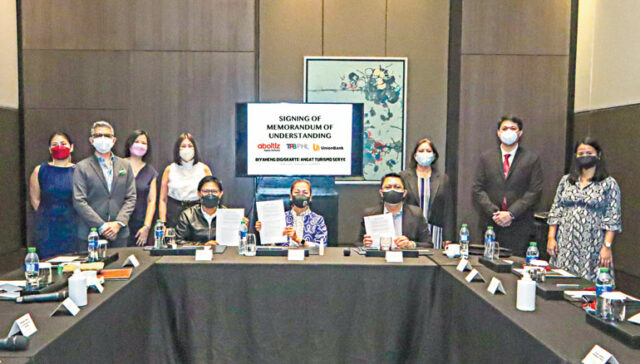
Union Bank of the Philippines (UnionBank), the country’s leading banking partner of Filipino entrepreneurs, has teamed up with Aboitiz Equity Ventures, Inc. (AEV) for an initiative to ‘tech-up’ micro, small, and medium enterprises (MSMEs) in the tourism sector. The drive is part of UnionBank’s efforts to help entrepreneurs thrive in the digital economy, pushing its Tech-Up Pilipinas advocacy.

A Memorandum of Understanding was signed between UnionBank, AEV and the Tourism Promotions Board (TPB) for the launch of the “Biyaheng Digiskarte: Angat Turismo” project.

UnionBank, through its MSME platform GlobalLinker (UBGL), together with AEV, will be offering technology-focused training courses to MSMEs that are with the Tourism Promotions Board Membership Program. The said courses are designed to provide learning opportunities that will enable capacity-building and address various gaps in digital competencies for the tourism MSMEs.

“The country’s tourism sector was one of the hardest hit during this pandemic, which is why we want to offer additional training to help MSME owners in the sector hone their digital entrepreneurship skills,” UnionBank Vice-President and SME & Micropreneurs Segment Head Jose Paulo Soliman said.

“With this, not only will it become easier for them to acclimate to the growing digital economy, it will also help revitalize the tourism sector in general, and somehow the country’s economy,” he added.

Tourism Promotions Board Chief Operating Officer Ma. Anthonette Velasco-Allones shared about the relevance and foreseen impact of the project.

“There is a need on our part, in the tourism sector, in terms of building capacities for our stakeholders – to come to terms with the reality that if we don’t go digital, we will be sidelined and get left behind,” she said.

Ms. Velasco-Allones said that close to a hundred percent of bookings and channels are being taken advantage of by those who already have online platforms. The rest who have not shifted nor adapted to the technologies have yet to leverage these opportunities.

“We are grateful to Aboitiz and UnionBank for this timely, relevant and much needed partnership,” Ms. Velasco-Allones added.

Meanwhile, AEV First Vice-President for Corporate External Relations Christopher Camba said, “Partnerships like this, where the private sector and the government join forces and work together, make great impact and clear results. We are more than glad to share our expertise to the tourism industry MSMEs because we strongly believe that in order to achieve economic recovery, all stakeholders must collaborate. And in this case, building digital competencies is the way to go.”

Part of the webinar series is “Biyaheng Digiskarte: Angat Turismo Serye,” to be facilitated by experts in the field led by Eric Caeg, president and founder of the Retail Academy Philippines (RAP).

The initiative is also part of UnionBank’s GoBeyond Communities, the bank’s corporate social responsibility and employee volunteering program that encourages UnionBankers to support their personal advocacies through active participation in select projects benefitting chosen communities.

Steering the country towards a greener tomorrow

As we approach the middle of 2022, the world inches closer to the agreed upon deadline for the Paris Agreement on Climate Change, the international treaty pledging the cooperation of 196 countries towards tackling the threat of artificially-induced global warming.

With a goal to achieve a climate-neutral world by mid-century and limit global warming to 1.5 to 2 degrees Celsius, the agreement is a massive undertaking that would mark one of the biggest collaborative efforts in history, a common cause that brings all the world’s nations together.

For its part, the Philippines has pledged to cut greenhouse gas emissions to a 75% reduction by 2030 in the agriculture, waste, industry, transport, and energy sectors. Broken down, 72.29% is conditional on the support of climate finance, technologies and capacity development provided by developed countries, as prescribed by the Paris Agreement, while the remaining 2.71% of the target would be implemented mainly through domestic resources.

As one of the countries most vulnerable to the adverse effects of climate change, the Philippines should spare no effort in transitioning the country towards an adaptable, carbon-neutral, environmentally sustainable society.

In pursuit of this, the government had implemented a number of programs like the National Framework Strategy on Climate Change that lays the foundation for national and local government policies toward a climate-resilient Philippines with “healthy, safe, prosperous and self-reliant communities, and thriving and productive ecosystems”. Of which, adaptation is the anchor strategy, using the Philippine Agenda 21 for Sustainable Development, and with mitigation actions pursued as a function of adaptation.

There is also the National Climate Change Action Plan, which focuses on public financing that prioritizes adaptation for vulnerable and marginalized communities, and policymaking that encourages the private sector to optimize mitigation opportunities toward sustainable development. The seven key outcomes of the plan are food security; water sufficiency; ecological and environmental sustainability; human security; climate-friendly industries and services; sustainable energy; and knowledge and capacity development.

Furthermore, eleven chapters in the Philippine Development Plan 2017-2022 involve climate-related policies and measures. These promote climate-resilient infrastructure, energy-efficient technologies, forest rehabilitation, and improved health services for disaster and climate-related illnesses.

Most recently, the government further enhanced its efforts this year to build climate resilience among communities nationwide and address climate change to better protect the environment, lives and property.

“We have drawn up a Sustainable Finance Roadmap to help orchestrate public and private sector efforts to green our economy,” Department of Finance Secretary and Climate Change Commission (CCC) chairperson-designate Carlos Dominguez III said in his 2021 message for the country’s annual Global Warming and Climate Change Consciousness Week observance.

The government identified the Philippines’ top climate-induced risks as rising sea level, coastal erosion, flooding, increasing frequency and severity of tropical cyclones, extreme drought, temperature increase and rising urban heat index, extreme rainfall, climate-influenced diseases, wind patterns and biodiversity loss.

Calling for stronger international collaboration, Mr. Dominguez raised the urgency for action, noting climate change “is a battle we cannot afford to lose.”

“We expect that developed nations, which historically caused the global climate crisis, will deliver their commitments to Paris Agreement with the right speed and scale to keep global average temperature from breaching the 1.5 degrees Celsius survival threshold,” he said.

Moreover, he added that he considers the present time until 2030 “critical”, noting this period is an opportunity to undertake low-carbon and resilient development as well as other climate action that will ensure Earth’s well-being “before it’s too late.”

The Philippines is “very reliant” on international financial support for capacity-building and technology transfers which climate projects need, he admitted.

“We hope this COP26 will result in positive action and will start the flow of funds to help countries,” he said at the conference.

In the conference, the CCC revealed that various local projects worth an estimated P310 million have already been supported through the government’s People’s Survival Fund, a fund created in 2012 to help local government units and accredited community organizations implement climate change adaptation projects in the country.

Furthermore, to help promote public and private investment in green undertakings nationwide, the government developed the Philippine Sustainable Finance Roadmap anchored on three strategic pillars: policy (creating a conducive environment), financing (mainstreaming sustainable finance) and investment (developing a sustainable pipeline).

The government also reconstituted the CCC’s National Panel of Technical Experts to include Filipino experts who can help promote doable climate action on the ground.

“We are no longer in the business of building a grand theory about climate change. Science has accumulated enough evidence about what is happening and what all of humanity needs to do to reverse the apocalyptic course of planetary warming. We are now in the business of implementing concrete projects and programs to build the resilience of our communities, reverse degradation and protect our vital food sources,” Mr. Dominguez said.

“What is global must now be addressed at the local level. What was theoretical now demands practical applications on the ground. No red light can stop us from moving towards a greener future. We have brought together brilliant minds to ensure that our race towards our planet’s survival will be coherent, concerted and compelling,” he added. — Bjorn Biel M. Beltran

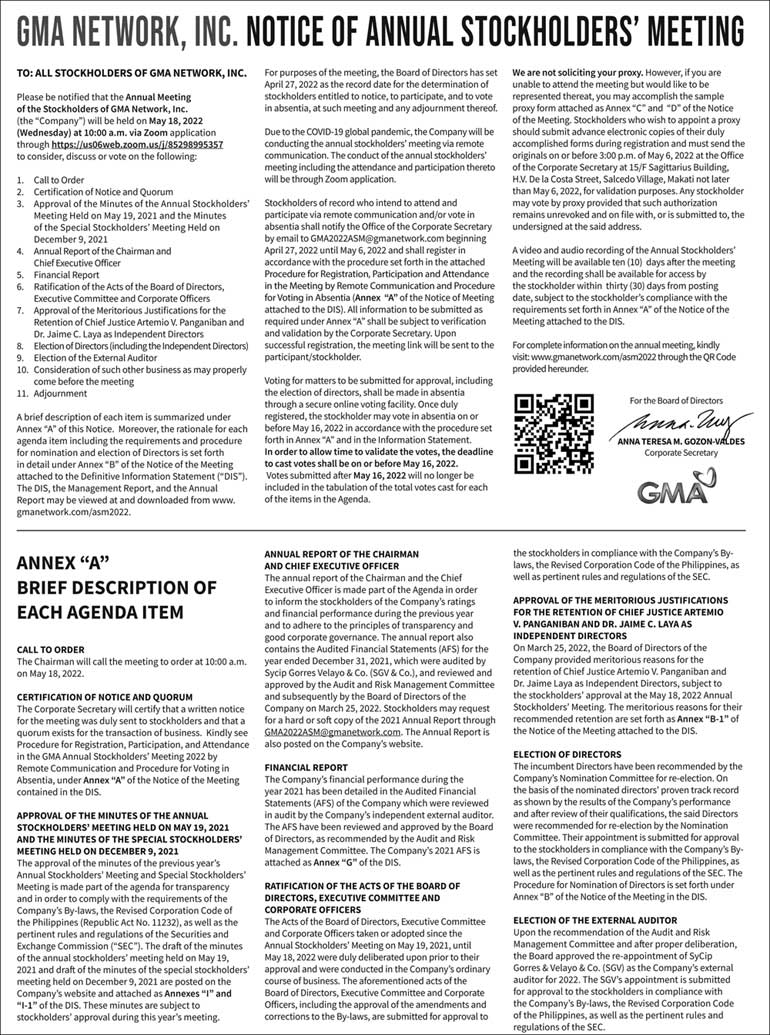
GMA Network, Inc. to conduct annual stockholders’ meeting on May 18

Click to enlarge.
Click to enlarge.


Spotlight is BusinessWorld’s sponsored section that allows advertisers to amplify their brand and connect with BusinessWorld’s audience by enabling them to publish their stories directly on the BusinessWorld Web site. For more information, send an email to online@bworldonline.com.

Join us on Viber to get more updates from BusinessWorld: https://bit.ly/3hv6bLA.

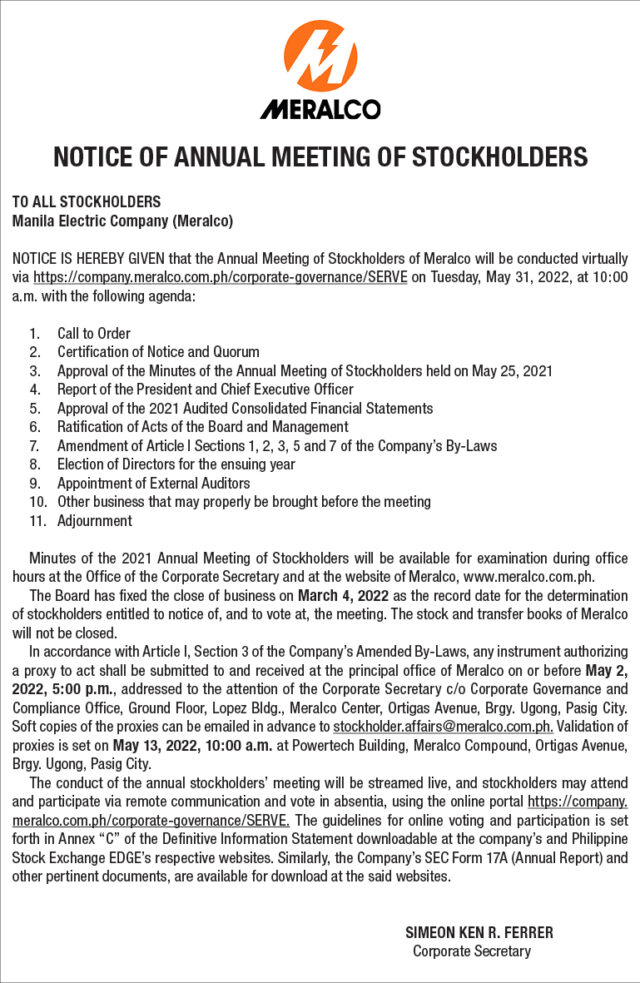
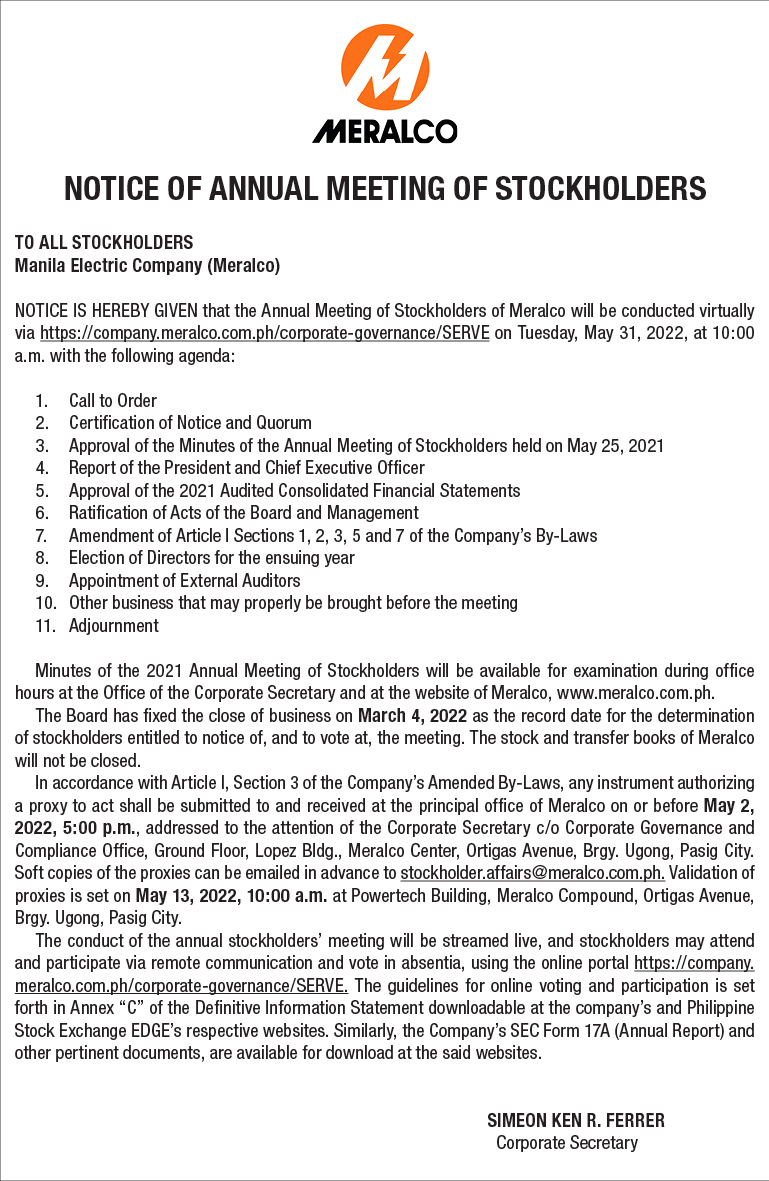
MERALCO to hold annual meeting of stockholders virtually on May 31


Spotlight is BusinessWorld’s sponsored section that allows advertisers to amplify their brand and connect with BusinessWorld’s audience by enabling them to publish their stories directly on the BusinessWorld Web site. For more information, send an email to online@bworldonline.com.

Join us on Viber to get more updates from BusinessWorld: https://bit.ly/3hv6bLA.

UnionBank sets stock price offering at P64.81 apiece


Spotlight is BusinessWorld’s sponsored section that allows advertisers to amplify their brand and connect with BusinessWorld’s audience by enabling them to publish their stories directly on the BusinessWorld Web site. For more information, send an email to online@bworldonline.com.

Join us on Viber to get more updates from BusinessWorld: https://bit.ly/3hv6bLA.

BSP bullish on PHL’s ‘full recovery’

PHILIPPINE STAR/ MIGUEL DE GUZMAN
The moon is seen beyond the buildings of Mandaluyong City, April 22. — PHILIPPINE STAR/ MIGUEL DE GUZMAN

By Luz Wendy T. Noble, Reporter

THE central bank is confident that the Philippine economy is on track for a “full recovery,” although analysts warned of headwinds from the Russia-Ukraine war and a potential US economic slowdown. 

“The Philippines is on its way to full recovery. From a recession in 2020, it bounced back with a 5.7% [growth] last year and we’re looking at a growth rate of 7-9% this year,” Bangko Sentral ng Pilipinas (BSP)Governor Benjamin E. Diokno said in an interview with CNN in Washington.

Government officials earlier said they expect the economy to return to its pre-pandemic level in the second half of 2022. The BSP has said this has been factored in for its decision to keep policy rates unchanged at record lows in March.

Economic activity appears to have gradually improved in the first quarter, despite tighter lockdown restrictions to curb an Omicron-driven surge in January.

Several multilateral institutions recently raised their gross domestic product (GDP) growth projections for the Philippines this year, although still below the government’s 7-9% target.

The International Monetary Fund (IMF) and ASEAN+3 Macroeconomic Research Office both gave a 6.5% GDP growth forecast for the Philippines this year, while the Asian Development Bank expects a 6% expansion. The World Bank is targeting a 5.7% GDP growth for the Philippines this year.

The first-quarter GDP data will be released on May 12.

Mr. Diokno said countries should work together to manage the impact of the war on the supply of staple commodities like oil. He said Middle East economies should consider expanding oil production to ease price pressures.

“There’s really a need for international coordination at this time. There should be a coordinated expansion of output. On the demand side there should also be coordination, how do you reduce energy consumption?” he said.

Headline inflation in the Philippines climbed to a six-month high of 4% in March, reflecting the impact of the oil price surge fueled by the war. The BSP said inflation could breach the 2-4% target range by the second half of the year.

Even after raising its inflation forecast for 2022 to 4.3%, Mr. Diokno has said the BSP is still keen to start raising rates in the second semester.

The BSP will have its next policy review on May 19, while its first rate-setting meeting in the second half is on Aug. 18.

US SLOWDOWN?
Meanwhile, economists warned a possible slowdown in the US economy could spill over to Asia-Pacific economies, including the Philippines.

The IMF last week cut its growth outlook for the world’s biggest economy by 0.3 point to 3.7% this year, amid the war in Ukraine.

Former BSP Deputy Governor Diwa C. Guinigundo said the monetary policy tightening in the US could upset financial markets and affect emerging economies.

“There’s a great deal of possibility of capital flight from the Asia-Pacific region including the Philippines. Recession or a simple slowdown in the US economy could affect our exports, BPO (business process outsourcing) and overseas remittances,” he said in a Viber message.

“Setting aside timing, we could find ourselves in a situation where monetary policy might default in arresting the rising inflation and face the prospect of addressing both high inflation and weak economic growth, rather than just doing immediate moderation of price movements and in the process safeguard financial stability and foster the resiliency of the recovery,” he added.

Meanwhile, ING Bank N.V. Manila Senior Economist Nicholas Antonio T. Mapa said slower US growth or a recession will greatly affect the Philippines’ economic trade.

“Slowing demand from a major market like the US would slow overall global trade, which would also negatively impact demand for Philippine products purchased by our other trading partners,” he said.

Bank of the Philippine Islands Lead Economist Emilio S. Neri, Jr. said talk of a possible US recession still seems to be premature.

However, he said the Philippines should be focused on how monetary policy tightening in the US is already affecting the peso’s strength.

“We will have to wait for the implementation of quantitative tightening in the US before we can validate whether yield inversion or other early warnings are going to persist or not. The [US] rate hikes will have to be delivered before we can affirm the possibility of a recession soon,” he said in a Viber message.

The US Federal Reserve will have its policy review from May 3 to 4. It began increasing interest rates by a quarter percentage point in March, and signaled more hikes this year.

Finance Secretary Carlos G. Dominguez III last week said the Philippines would be closely watching the Federal Reserve’s monetary policy normalization before making its own policy adjustments.

“We don’t want to be behind the eight ball here because if the US raises their interest rates, people in the Philippines will, of course, want to follow those rates. We have to make sure we balance the need to grow, the need to fight inflation and the need to preserve our capital,” Mr. Dominguez, who sits on the Monetary Board, said in a Bloomberg Television interview last week.

Political alliances shift as presidential contest set to become 2-way race

IMAGES of presidential candidates are printed on drinking cups sold at a popular convenience store. — PHILIPPINE STAR/ RUSSELL PALMA

By Kyle Aristophere T. Atienza, Reporter

BOBBY YADAO, 25, was inspired by the rags-to-riches story of Manila City Mayor Francisco “Isko” M. Domagoso, a former matinee idol who’s running for Philippine president this year.

But he changed his mind and is now supporting Vice-President Maria Leonor “Leni” G. Robredo after hearing about her platforms and seeing his friends campaign for the opposition leader at a rally near the Philippine capital last month.

“I was inspired by the event,” he said in an interview. “‘What could have motivated at least 137,000 people to attend the rally?’ I asked after seeing photos of the event online,” said Mr. Yadao, who works at a laundry shop in Manila.

He isn’t bothered by presidential opinion polls that former Senator Ferdinand “Bongbong” R. Marcos, Jr. has dominated. Ms. Robredo remains a distant second, though her ratings continue to rise.


Groups and powerbrokers continue to change their strategies two weeks before Filipinos choose President Rodrigo R. Duterte’s replacement, as the presidential contest shapes up to become a two-way race, according to political analysts.

Shifting alliances is nothing new as far as Philippine politics is concerned, said Maria Ela L. Atienza, who teaches political science at the University of the Philippines (UP).

“Some of these organizations and traditional politicians tend to flock to perceived stronger candidates,” she said in a Viber message. “They can easily flip-flop compared with more progressive and principled politicians and groups.”

Ikaw Muna Pilipinas, a political group formed in 2021 to push the presidential bid of Mr. Domagoso, this month shifted its support to Ms. Robredo, who it said has a better chance of winning against the son and namesake of the late dictator Ferdinand E. Marcos.

This comes after a key official of Aksyon Demokratiko, Mr. Domagoso’s political party, left his post to endorse Ms. Robredo for president.

Partido Reporma, which is headed by a former administration ally and powerbroker in southern Philippines, withdrew its support for Senator Panfilo “Ping” M. Lacson and endorsed Ms. Robredo.

Meanwhile, One Cebu Party, a political group in central Philippines, has endorsed Mr. Marcos for president. The group is led by the family of Cebu Governor Gwendolyn F. Garcia, whose brother Pablo resigned as party secretary-general to continue supporting Mr. Domagoso.

Ms. Atienza noted that the Remulla political clan from vote-rich Cavite province had campaigned hard for the presidential run of ex-Vice President Jejomar C. Binay, only to shift its support at the last minute to Mr. Duterte, who was his rival then.

“What is possibly novel in the 2022 elections is that we have sectoral and professional groups that have not been very vocal in previous elections coming out to support the Robredo-Pangilinan tandem,” she said, referring to the tandem of Ms. Robredo and her running mate Senator Francis N. Pangilinan.

“In a presidential campaign, any form of endorsement is indispensable, and more so in a tight race,” said Jan Robert R. Go, an assistant political science professor at UP.

Local government officials usually endorse their national bets based on consultations with the governor and other higher-level politicians.

“So, if one candidate at the national level can penetrate this system, there is a chance of being considered and eventually being elected to the position,” Mr. Go said in a Facebook Messenger chat.

He added that national candidates have to balance their focus between national and local politics, which is more close-knit and could influence the results.

Ms. Atienza said the test on election day is whether the endorsements by traditional politicians would make a difference. “Will voters be influenced more by other factors? We can probably expect more shifts in the coming days until May 9.”

‘SOLID NORTH’
Jean Encinas-Franco, a political science professor at UP, expects Mr. Marcos to lose supporters given that his ratings have been falling and issues against him and his family including billions of unpaid estate tax pile up.

“April is crunch time for all candidates so these developments are expected,” she said in a Messenger chat.

Leaders of the Kilusang Bagong Lipunan chapter in Baguio City recently withdrew their support for Mr. Marcos, whose poll rating at Pulse Asia Research, Inc.’s March opinion poll fell by 4 points.

Ms. Franco said it’s unlikely for Ms. Robredo’s supporters to change their mind at the last minute since they have been organizing and joining rallies that have drawn thousands of people and have managed to run the campaign like a social movement.

Mr. Go said the opposition candidate must sustain her campaign and convince more voters given her relatively lower ratings.

“It seems that she’s gaining momentum because of a more personal way of campaigning,” he said. “If sustained, this can make a difference in her favor. A lot can still happen between today and election day.”

Mr. Marcos kept his lead in Pulse Asia presidential opinion poll last month, with 56% of Filipinos saying they would vote for him, even if his rating fell by 4 points.

Still in second place was Ms. Robredo, whose rating rose by 9 points to 24%. She was followed by Mr. Domagoso (8%), Senator and boxing champion Emmanuel “Manny” D. Pacquiao (6%) and Mr. Lacson (2%).

Earlier this month, the opposition bet drew more than 200,000 supporters at a rally in Pampanga province, the bailiwick of President Gloria Macapagal-Arroyo, who has endorsed Mr. Marcos and his vice-presidential running mate, Davao City Mayor and presidential daughter Sara Duterte-Carpio.

Analysts have said youth voters, who make up more than 50% of registered voters, are unlikely to be swayed by the endorsements of local politicians.

“I do not consider Pampanga a bailiwick of Arroyo or any of the politicians out there,” said Wenry Manaloto Basa, one of the thousands of youngsters who joined Ms. Robredo’s Pampanga rally.

“We’re not going to let any local politician dictate who we should vote for,” he said in a Messenger chat. “We are tired of dynasties. We will vote for someone who we think will help not just our province and our Cabalens but all Filipinos.”

“There is no Solid North,” supporters shouted at Ms. Robredo’s recent rally in La Union province in the country’s north, which is part of the regional bloc known for supporting the late dictator’s family.

“I joined the rally to prove that there is no Solid North,” Bret Jarod Sean Ordoño, one of the thousands of youngsters who joined the event, said in a Messenger chat. The 22-year-old student from UP joined the La Union rally with his friends from Baguio, Ilocos Sur and Ilocos Norte, which are considered part of the pro-Marcos regional bloc.

“The so-called unity dubbed as Solid North is a hoax,” he said, noting that his ancestors had fought to prevent the return of the Marcoses to power. “It is used to gain the bandwagon voters.”

Mr. Yadao, the laundry shop worker, said his voting decision is based on a candidate’s platforms and track record, not opinion polls. “Poll results can still change.”

Bank chiefs offer optimistic outlook despite uncertainty

PHILIPPINE banks are optimistic about the outlook for business recovery this year despite uncertainty arising from the Russia-Ukraine war and the upcoming election.

BDO Unibank, Inc. President and Chief Executive Officer Nestor V. Tan said the bank expects profit to grow by 5-10% this year, after the good start seen in the first three months.

Mr. Tan said loans are projected to expand by 8-12% amid the relative stability of the markets, and normalization of asset quality and delinquencies.

BDO, the country’s largest bank by assets, on Friday reported net profit increased by 13% year on year to P11.7 billion in the first quarter.

Despite the improvement seen in the economy as restrictions eased, Mr. Tan said there is still a “mixed outlook” for 2022 due to local and international developments.

“Mobility is back. However, inflation remains a worry driven by supply chain disruptions and due to geopolitical conflicts,” Mr. Tan said at the bank’s annual stockholders’ meeting held on Friday.

Metro Manila and most provinces have been under the most lenient Alert Level 1 since March as coronavirus disease 2019 (COVID-19) infections have declined. This allowed more businesses to resume full operations.

Central bank officials said the impact of the Russia-Ukraine war on the country will be seen through higher inflation as oil prices surge. Headline inflation quickened to 4% in March from 3% in February, matching the upper end of the BSP’s 2-4% target. 

The central bank last month raised its inflation forecast for 2022 and 2023 to 4.3% and 3.6%, respectively, taking into account the elevated prices of oil and commodities.

Bangko Sentral ng Pilipinas (BSP) Governor Benjamin E. Diokno previously said the cross-border financial exposure of Philippine banks to both Russia and Ukraine is very minimal.

BDO’s Mr. Tan also pointed out the risk-off sentiment ahead of the upcoming national elections on May 9.

“The elections will clearly bring different expectations and different policies. Businesses have taken a pause before investing,” Mr. Tan said.

Separately, East West Banking Corp. President and Chief Executive Officer Antonio C. Moncupa said the COVID-19 pandemic remains a risk until its end is officially declared.

“We also need to consider the geopolitical tension as it affects world prices and affects our imports, economy and inflation,” he said at EastWest’s annual stockholders’ meeting also held on Friday.

Mr. Moncupa said loan losses are likely to continue declining although the bank’s earnings are unlikely to return to pre-pandemic level in 2022.

The lender’s net profit in 2021 dropped by 30.8% to P4.5 billion from a year earlier.

“Our earnings capacity should have increased significantly this year and we should be back closer to 2019 income levels by 2023,” he said.

Meanwhile, Mr. Tan said recent economic reforms, such as the passage of laws amending the Retail Trade Liberalization Act, the Foreign Investment Act, and Public Service Act could open up growth opportunities for the local banking industry.

“If crafted well in terms of implementing rules, (the laws) will help spur economic activity. And generally, increased economic activity helps the banking sector. So, we expect that this would benefit our clients and effectively benefit the bank,” he said.

CYBERCRIME
Mr. Tan is hopeful that the next administration will also prioritize policies  that will deter cybercrime and boost regulation of nonbank financial service providers.

“We need to be tighter on cybercrimes, we need to make sure that we do our part in preventing or discouraging the perpetrators from committing cybercrimes,” he said.

While banks are heavily regulated, Mr. Tan noted there has been a proliferation of nonbank financial service providers that do not fall within the regulatory ambit of financial supervision.

“So, for the health of the industry, and for public policy, they should look at how these entities should be managed relative to banks,” he said.

The Philippine banking industry’s collective net income surged by 44% to P223.66 billion in 2021 from P155.22 billion in 2020. — Luz Wendy T. Noble

Villar group plans 3 IPOs in 2022

By Luisa Maria J.C. Jocson

THE Villar group is targeting three initial public offerings (IPOs) this year, with its real estate investment trust (REIT), coffee shop business, and power company, its top official said.

VistaREIT, Inc., the REIT company of Vista Land & Landscapes, Inc., is set to debut on the stock exchange in the second quarter.

“We still have a lot we haven’t added to VistaREIT. We already have a decent amount to place for its second phase,” Vista Land & Landscapes Chairman Manuel B. Villar said at a press conference last week.

The Securities and Exchange Commission said in March that it had received the registration statement of VistaREIT, Inc. for an initial public offering of P9.18-billion shares on the stock exchange’s main board.

The offering consists of around 3.34 billion secondary common shares priced at up to P2.50 each, with an overallotment option of up to 333.75 million secondary common shares.

“VistaREIT is envisioned to be the flagship office and mall REIT of Vista Land, one of the country’s largest integrated real estate developers, and aims to be among the leading diversified commercial REITs in the Philippines in terms of portfolio, profitability, growth, sustainability, and dividend yield,” according to the prospectus.

Mr. Villar said the group intends to list Siquijor Island Power Corp. in the third quarter of the year.

The power generation company has facilities in Siquijor and Camotes Islands with a combined capacity of 21.7 megawatts.

At the same time, the group is eyeing to launch its coffee business, the Coffee Group, in the latter part of the year or early in 2023, Mr. Villar noted.

It is expected to raise over P1 billion from its offering and will have over 200 branches by the time of its listing.

The Coffee Group is the company’s restaurant and coffee shop businesses, which will include Bread Basket, a pastry shop and cafe, and the Crossings Cafe, one of its latest launches.

“I’m building everything around coffee. It will have good profitability,” Mr. Villar said.