Home Blog Page 5900

PSE index inches up in thin trade amid weak peso

PHILIPPINE STAR/KRIZ JOHN ROSALES

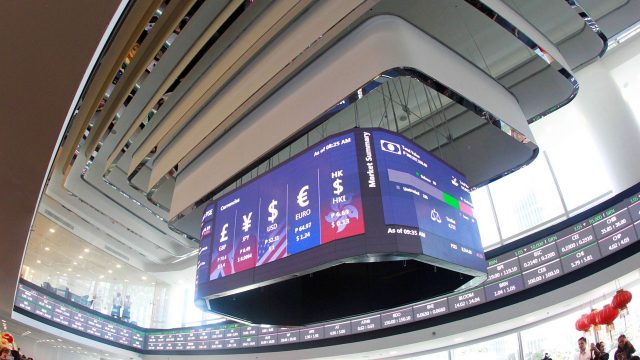
THE MAIN INDEX inched higher on Monday amid weak trading as the peso closed at the P54-per-dollar level and with US markets closed for a holiday.

The benchmark Philippine Stock Exchange index (PSEi) inched up by 2.38 points or 0.03% to close at 6,333.94 on Monday, while the broader all shares index went down by 7.17 points or 0.21% to 3,387.78.

“The stock market opened the week in a listless mood after the Philippine peso fell against the US dollar. The local stock barometer managed to post a slight gain after trading within a narrow band. The peso declined on Monday to its lowest level in more than three years due to the general strength of the greenback on the aggressive monetary stance from the Federal Reserve,” Papa Securities Corp. Equities Strategist Manny P. Cruz said in a Viber message.

The peso closed at P54.065 versus the greenback on Monday, shedding 31.5 centavos from its previous finish of P53.75. This was the first time the peso ended at the P54-per-dollar level since its P54.08 close on Oct. 15, 2018.

“Local trading was lethargic as US stocks will be on holiday today and as the global markets await US Federal Reserve’s chairman’s semiannual monetary policy testimony before the US Senate Banking Committee and before the US House Financial Services Committee on June 23,” Mr. Cruz added.

Regina Capital Development Corp. Head of Sales Luis A. Limlingan likewise said the Philippine market saw a quiet start to the trading week as Wall Street was closed for a holiday.

“Last Friday, sentiment improved after traders parsed comments from Federal Reserve officials who reiterated that the central bank needs to do more to curb the hottest inflation in 40 years,” he said.

US financial markets are closed on June 20 in commemoration of Juneteenth or the end of slavery in the world’s largest economy.

Federal Reserve Governor Christopher Waller on Saturday said he would support another 75-basis point (bp) hike at their July review amid rising inflation.

Majority of the sectoral indices ended in the red except for holding firms, which gained by 53.08 points or 0.91% to 5,841.09, and industrials, which rose by 4.79 points or 0.05% to 8,789.96.

Meanwhile, property declined by 34.48 points or 1.16% to 2,933.96; mining and oil fell by 114.33 points or 0.98% to 11,470.63; services gave up 11.50 points or 0.67% to end at 1,696.11; and financials lost 1.05 points or 0.06% to close at 1,553.53.

Decliners outnumbered advancers, 108 versus 81, while 52 names ended unchanged.

Value turnover decreased to P3.57 billion on Monday with 764.92 million shares changing hands from the P11.71 billion with P917.40 million issues seen on the previous trading day.

Net foreign selling went down to P215.28 million on Monday from the P292.27 million seen on Friday. — Luisa Maria Jacinta C. Jocson

PCCI presses new gov’t to pass remaining tax reform packages

THE Philippine Chamber of Commerce and Industry (PCCI) said the incoming Marcos administration must focus on passing key legislation like the remaining components of the tax reform program, which the current government was not able to shepherd through Congress.

In a statement on Monday, the PCCI said its legislative committee’s list of priority laws was headlined by the remaining elements of the Comprehensive Tax Reform Program like Property Valuation and Assessment reform and a Capital Income and Financial Taxes bill.

Other measures declared priorities are a Capital Markets Development Act; an Open Access in Data Transmission Act; a Better Internet Act; and amendments to the Philippine Qualifications Framework Act and the Dual Training System Act.

The list was compiled in consultation with partners like the Philippine Exporters Confederation, Inc. and Employers Confederation of the Philippines.

The remaining items on the PCCI’s wish list are a Successful Farmers Development Act to amend the Comprehensive Agrarian Reform Law; amendments to the Magna Carta for micro, small, and medium enterprises Act; amendments to the Philippine Warehouse Receipts Act; the amendment or repeal of the Act for Salt Iodization Nationwide; a National Quality Infrastructure Act; and a International Maritime Trade Act.

“The remaining packages in the tax reform program will help the administration to strengthen government’s fiscal position and meet urgent calls on public funds,” PCCI Director for Legislative and Taxation Benedicta Du-Baladad said.

Ferdinand A. Ferrer, PCCI Innovation and Science and Technology committee head, said that measures related to internet connectivity will attract more market entrants to build out the national digital infrastructure, especially in the countryside.

“Internet connectivity has been made more urgent as the digitalization process started at the height of the coronavirus disease 2019 (COVID-19) lockdowns,” Mr. Ferrer said.

President-elect Ferdinand R. Marcos, Jr. is set to take his oath as the 17thPresident of the Philippines on June 30, succeeding President Rodrigo R. Duterte. The 19th Congress will open on July 25. — Revin Mikhael D. Ochave

Local specialty coffee gets trial orders from Japan

REUTERS

THE PHILIPPINES is hoping to expand its share of the Japanese coffee market following the introduction of specialty coffee varieties to potential large-scale buyers, the Department of Trade and Industry (DTI) said.

In a statement on Monday, the DTI confirmed Japanese interest in Philippine specialty coffee, following a report from Japan-based Commercial Counselor Dita Angara-Mathay regarding three promotional events staged between June 10 and 14, including a coffee tasting.

“The (coffee tasting) event opened up much interest in Filipino coffee among those in the Japanese coffee industry. There are now talks between Japanese importers and Philippine coffee exporters for trial orders ranging from 1,000 kilos of green beans to 25 kilos of roasted specialty beans. If the trial orders go well, the importers committed to have repeat orders in larger amounts,” the DTI said.

According to the DTI, the coffee tasting event was attended by 41 industry participants, including coffee chain operator UCC, roaster Doutor, food company AGF Ajinomoto; importers Marubeni Foods, Sojitz, Aoyama Tsusho and CocoCures; retailer Don Quijote; and other specialty coffee companies like Horiguchi, Cerrad, Mobius, Tailwinds and Woodberry. 

The specialty coffee beans were provided by VerraCoffee, a social enterprise currently exporting coffee to Filipino entrepreneurs in Australia, New Zealand, Malaysia, and the US.

Ms. Mathay said that the DTI is pushing Barako coffee from Southern Luzon, Peaberry Coffee from the Cordillera highlands, and Davao del Sur Peaberry from Mount Apo in Mindanao.

“These are rare and exotic coffee beans that we hope will satisfy the discriminating tastes of coffee drinkers on the lookout for specialty coffee. We want to push it in Japan, Asia’s largest coffee market, as a niche gourmet product. We are confident a few Japanese coffee shops will feature it among their small-lot coffee lines,” Ms. Mathay said.

The DTI said Barako coffee, also known as Philippine Liberica, is considered rare, accounting for 2% of global coffee production.

“Very few people are aware that the Philippines was one of the top producers of coffee in the world in the 1880s. Fast forward to today, opportunities abound in the rising wave of coffee consumption and increasing number of people who actively search and prepare specialty coffee in their homes or pursue it as a business,” the DTI said. — Revin Mikhael D. Ochave

Government revenue-to-GDP ratio performance seen ranking middle of the pack within ASEAN

DOF.GOV.PH

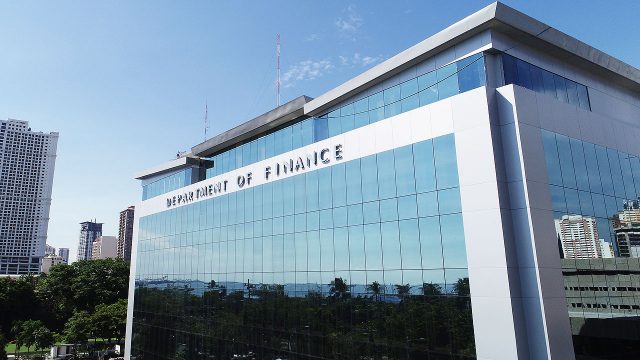
THE Department of Finance (DoF) said National Government (NG) revenue performance, as a proportion of gross domestic product (GDP), would place the Philippines at around the median of the Association of Southeast Asian Nations (ASEAN).

In a statement on Monday, the director of the DoF’s Domestic Finance Group, Rowena S. Sta. Clara, was quoted as saying in a report to a recent meeting of the DoF executive committee that the average revenue effort of the Duterte administration between 2016 and 2021 was 15.6% of GDP, the highest in over 20 years.

The DoF said the improved revenue levels were posted despite restrictions imposed during the various stages of the pandemic.

The report used data from the International Monetary Fund, which forecast the revenue effort of other ASEAN members. Philippine data were taken from the Cash Operations Report of the Bureau of the Treasury, Ms. Sta. Clara said.

Brunei tops the list with a revenue effort of 19.1%, followed by Singapore’s 18.7% and Thailand’s 17%. Malaysia and Indonesia’s revenue efforts are projected at 14.3% and 11.8%, respectively.

All data, except for the Philippines and Indonesia, are forecasts.

On the expenditure side, the Philippines was second in ASEAN with P4.7 trillion or 24.1% of GDP, Ms. Sta. Clara said.

She also noted that the 10.6% growth in NG expenditure in 2020 and 2021 was a result of infrastructure and other capital spending, spending for pandemic recovery measures, equity infusions in support of the government’s lending programs, and spending on personal services, which has increased to 30% of NG expenditures in the past decade.

Brunei had an expenditure-to-GDP ratio of 28.4%, while Singapore was third at 21.1%.

All six ASEAN countries posted budget deficits in 2021. The Philippine deficit was second-largest at 8.6% of GDP, topped only by Brunei at 9.3%. Malaysia came in third at 6.4%.

During the Development and Budget Coordination Committee’s 181st meeting on May 24, the target deficit-to-GDP ratio for this year was set at 7.6%, easing to 6.1% in 2023.

NG debt rose to a record P12.76 trillion in April, due to COVID-19-related borrowing and to support the economic recovery.

The DoF has said that debt would have been much higher at P15.4 trillion in 2022, had it not blocked revenue-eroding measures and scaled back COVID-19 stimulus bills. These would have led to additional spending amounting to P2.2 trillion, had these measures been passed by Congress. — Tobias Jared Tomas

One-stop company registration portal relaunched as Philippine Business Hub

THE Philippine Business Hub (PBH), the government’s online business registration portal, was relaunched by the Department of Information and Communications Technology (DICT) and various other agencies on Monday.

“Through the establishment of the PBH, the (number of) days for registering businesses was reduced from 33 and 13 steps to only seven with only one step,” the Bureau of Internal Revenue said in a statement on Monday.

At the launch, Anti-Red Tape Authority (ARTA) Officer-in-Charge Ernesto V. Perez said the ultimate target is to bring down processing time to just one day.

“It is our hope what we are doing today will serve as a model for all other local government units to follow,” Mr. Perez said, following an initial rollout in Quezon City. He added that the new process aims to rid registration of corruption and red tape.

“The end goal is not just to register a business. The dream is for the PBH to be the only place you go to as a business, to register, to pay taxes, pay social services for your employees, and the like,” DICT Acting Secretary Emmanuel Rey R. Caintic said. “The Quezon City integration is an important thing. The Quezon City government has the largest number of businesses nationwide.”

“I told the mayor, if we hit Quezon City, everyone else will follow. Because the biggest, largest (LGU) is already integrated, there’s no more reason for other cities not to integrate,” he added.

Initially the Central Business Portal, it was rebranded as the PBH.

Mr. Caintic told BusinessWorld by phone that the rebranding was resorted to after the pandemic stalled the portal’s momentum after earlier launches in 2020 and 2021.

“This is (a) one-pass through for everyone. Apply at PBH now, and you automatically have SSS, Pag-IBIG, PhilHealth, etc.,” he added. “This is just phase one. How often do you register a business? Once in a blue moon. The recurring things are paying taxes, the renewal of applications.”

Republic Act 11032, or the Ease of Doing Business and Efficient Delivery of Government Services Act, provides for the creation of an online portal to streamline the process of applying for business permits and other applications, which the DICT is tasked with operating.

The relaunch is headed by the DICT, ARTA, the Department of Trade and Industry, and the Securities and Exchange Commission. This iteration will involve localizing the program and refreshing the website.

President Rodrigo R. Duterte urged subsequent administrations to continue using the PBH at his last State of the Nation Address on July 26, 2021.

“We have this legacy, and we hope to pass on this establishment of the Central Business Portal, a single site for all business-related transactions, such as securing business permits, licenses, and clearances,” he said. “This shall certainly elevate our global business standing in the doing business arena and improve our country’s competitiveness.”

ARTA plans to further improve the PBH over the years through its Business Process Mapping project, which includes mapping all permits and licenses involved in the business cycle, right up to business closures, and integrating them into the PBH. — Tobias Jared Tomas

Tax court declines to review geothermal company’s P30.43-M refund claim

THE Court of Tax Appeals (CTA) has affirmed a division ruling which had rejected Philippine Geothermal Production Company, Inc.’s (PGPCI) refund claim worth P30.43 million representing excess input value-added tax (VAT) paid on zero-rated sales dating back to 2013.

In an 11-page decision on June 14 and made public on June 17, the full CTA court said the company had failed to present a certificate of endorsement from the Department of Energy (DoE) to avail of tax incentives provided to renewable energy developers.

“In this case, petitioner (PGPCI) failed to produce the DoE certificate of endorsement relative to its alleged sales of renewable energy for the second and third quarters of the taxable year 2013 as mandated by the DoE,” according to the ruling, written by Associate Justice Marian Ivy F. Reyes-Fajardo. “Therefore, the court in division is correct in denying the petitioner’s refund of alleged excess and unutilized input VAT.”

PCPCI had argued that its certification as a renewable energy developer of geothermal sources proved its entitlement to VAT zero-rating on its sales.

The tax court ruled that despite its registration as a developer, the company failed to comply with the requirements set forth by the Energy department.

“A claim for unutilized input value-added tax is in the nature of a tax exemption,” the court said. “Thus, strict adherence to the conditions prescribed by the law is required of the taxpayer and petitioner failed in this regard.”

Under the DoE’s rules and regulations, renewable energy developers may avail of tax incentives only after securing a certificate of endorsement from the department.

In a dissenting opinion, Associate Justice Jean Marie A. Bacorro-Villena argued that the company did not need to secure the endorsement to apply for a refund.

“It is clear from the foregoing that the DoE certificate of endorsement is only required in order for the petitioner to enjoy the income tax holiday and the duty-free incentives; however, such requirement is not needed for VAT zero-rating purposes,” she said. “Hence, the non-presentation of the same should not bar petitioner from applying for a refund of its excess input VAT.”

Ms. Villena voted to remand the case to another division of the CTA for proper calculation of the excess input VAT due to the company. — John Victor D. Ordoñez

Sugar industry: Diverting imports from manufacturers to consumers will cause prices to fall

UNSPLASH

THE sugar industry said prices will fall if imports are diverted to the end-user market instead of their current role servicing manufacturer demand.

“If you want sugar prices to go down, flood the market. Oversupply it. If you put 200,000 metric tons (MT) on the market, then prices will go down,” United Sugar Producers Federation President Manuel R. Lamata said in a televised radio briefing over DZBB.

He was responding to a question about the Sugar Regulatory Administration’s (SRA) Sugar Order (SO) No. 3, which authorized the import of 200,000 MT of refined sugar to serve as a supply buffer.

“The premise of the SO is to bring down sugar prices to help consumers. The problem when you read it is that it’s exclusive for industrials, meaning that all that sugar is for soft drink makers. How will that bring down prices?,” he said.

Mr. Lamata said that the government should survey sugar mills to forecast supply and production.

“We need to find out how much sugar was left in warehouses, if it will tide over to the next milling season. We need data like that,” he said.

The SRA has said that sugar production for the current crop year was 1.8 million MT.

“The unusual decline in sugar production was explicitly observed in Negros from March to May production data. The aberrant decline during these months was due to the residual effect on the damaged leaves of sugarcane caused by strong winds during the onslaught of Super Typhoon Odette,” the SRA said. — Luisa Maria Jacinta C. Jocson

Fuel marking program collections top P453 billion

TAXES collected from marked fuel products amounted to P453.43 billion as of mid-June, counting back to when the program started in September 2019, the Department of Finance said.

This total includes P423.615 billion from customs duties as of June 16, and P29.81 billion in excise taxes collected as of Oct. 28, 2021, according to Finance Secretary Carlos G. Dominguez III in a Viber message.

The volume of marked fuel totaled 43.048 billion liters as of June 17.

Luzon accounted for nearly 74% of all marked fuel, or 31.8 billion liters, followed by Mindanao at roughly 20%, or 8.8 billion liters. The Visayas accounted for 5.4% of the total at 2.3 billion liters.

Diesel made up the bulk of marked fuel at 60.65%, while gasoline and kerosene consisted of 38.85% and 0.51%, respectively.

Twenty-eight oil companies are currently participating in the government’s fuel marking program.

Petron Corp. accounted for 10.46 billion liters or marked fuel, or 24.31% of the total, followed by Pilipinas Shell Petroleum Corp. at 7.69 billion liters or 17.86%.

Unioil Petroleum Philippines, Inc. came in at 4.47 billion liters of marked fuel, while Insular Oil Corp. and Seaoil Philippines, Inc. posted 3.71 billion and 3.57 billion, respectively.

The fuel marking program started on Sept. 4, 2019. Fuel is marked with a special dye in order to signify tax compliance, while the absence of the dye is considered an indication that the fuel may be smuggled. The program is authorized by Republic Act 10963, or the Tax Reform for Acceleration and Inclusion (TRAIN) law.

Last year, P158.44 billion was collected via duties. In 2022 so far, collections have totaled P154.40 billion, while the volume of marked fuel for the period was 12.97 billion liters.

Mr. Dominguez has said that the government expects to collect P147.1 billion in fuel excise tax and VAT in 2022.

In its 2021 Annual Report, the Bureau of Customs said it seized P6.7 billion worth of smuggled fuel and oil. — Tobias Jared Tomas

The 2022 SIPP: What’s next for registered enterprises

Four hundred and twenty-five days after the effectivity of the Corporate Recovery and Tax Incentives for Enterprises (CREATE) Act or Republic Act (RA) No. 11534 on April 11, 2021, one question still lingers among the registered business enterprises (RBEs) doing business with the country’s 19 Investment Promotion Agencies (IPAs): How can RBEs maximize their fiscal and non-fiscal incentives under the new tax rules and evolving market environment?

The key lies in the 2022 Strategic Investment Priority Plan (SIPP). Following the provisions of the CREATE Act, the SIPP refers to the priority projects or activities, including the scope and coverage of location and industry tiers, determined by the Board of Investments (BoI), in coordination with the private sector, Fiscal Incentives Review Board (FIRB), IPAs, and other government agencies administering tax incentives.

Prior to the effectivity of the CREATE Act and the 2022 SIPP, the 2020 Investment Priorities Plan (IPP) issued on Nov. 18, 2020, lists the industries and activities that may be subject to fiscal and non-fiscal incentives.

The newly formulated 2022 SIPP is aligned with the goals, priorities, and strategies of the  revised Philippine Development Plan 2017-2022 and the development agenda and strategy of the DTI and DoST. It continues to adopt the projects or activities in the 2020 IPP, while expanding the priority list to address the growing concern on climate change, economic and medical challenges in managing the COVID-19 pandemic, international and local security relations, and lack of innovation and technological advancements.

PROJECTS OR ACTIVITIES UNDER THE 2022 SIPP
The CREATE Act introduced fiscal and non-fiscal incentives in tiers such that the qualified projects or activities are also categorized in industry tiers. Tier 1 covers all activities listed in the 2020 IPP, unless specifically listed under Tiers 2 or 3. Tier 2 covers all activities that address value chain gaps and promote green ecosystems, dependable health systems, and self-reliant defense. Tier 3 covers all activities that focus on the application of research and development and attracting technology investments. The table below summarizes the projects or activities.

The 2022 SIPP excluded RBEs engaged in customs brokerage, trucking or forwarding services, janitorial services, security services, insurance, banking and other financial services, consumers’ cooperatives, credit unions, consultancy services, retail enterprises, restaurants, public administration, or such other similar services. Further, it is projected that at least 30% of the gross domestic product earned in the National Capital Region (NCR) will be reallocated to provincial areas.

The list of priority projects or activities detailed in the 2022 SIPP is not entirely new. Similarities can be found in the IPPs from prior years. The 2014-2016 IPP included regional dispersal of industries and locational restriction in NCR, creation of specialty hospitals, and manufacture of alternative fuel vehicles, while the 2017-2019 IPP emphasized research and development activities, commercialization of new and emerging technologies, and climate change–related projects.

The 2022 SIPP is effective June 11, 2022, or 15 days after the date of publication in a newspaper of general circulation, and is valid for three years until June 10, 2025, subject to review and amendment every three years thereafter, unless a supervening event necessitates an earlier review.

WHAT DO RBES STAND TO GAIN UNDER THE 2022 SIPP?
RBEs can either be export market enterprise or domestic market enterprise, depending on its total export commitment. Export market enterprises refer to RBEs that export at least 70% of its total revenue or production output while domestic market enterprises refer to RBEs that export below the minimum threshold for export enterprises.

Regardless of which IPA the RBEs will apply, the period of availment of incentives is based on the combination of location and industry summarized as shown above.

In addition, qualified RBEs enjoy duty exemption on imports of capital equipment, raw materials, spare parts or accessories, and value-added tax (VAT) exemption on imports and VAT zero-rating on local purchases that are directly and exclusively used in the registered activity of the RBEs.

As such, the farther the RBEs are located from metropolitan areas and the more the projects or activities involve research and development applications and highly advanced technologies, the greater the incentives.

MAXIMIZING INCENTIVES UNDER THE NEW RULES
It is prudent for the RBEs to weigh the pros and cons on whether to continue with the status quo, restructure their business model, or transfer their registration to another IPA or location. A carefully laid out tax study may prove beneficial in assessing the best option that is most suitable to the RBE in the long run.

WHAT’S NEXT FOR RBES?
Investment prospects in the Philippines remain robust. According to the Philippine Statistics Authority, total approved foreign and Filipino investments in the first quarter of 2022 increased to P190.87 billion as compared to P164.9 billion in the same quarter of 2021. The BoI approved 95% of the total investments, representing a 32% increase from the first quarter of 2021. On the other hand, investments approved by PEZA decreased by 68% from 25 billion in the first quarter of 2021 to P8 billion in the first quarter of 2022.

The top three projects or activities pertain to electricity and gas, real estate activities, and manufacturing while the top three investing countries are Japan, South Korea, and Singapore.

With the effectivity of the 2022 SIPP, the issuance of synchronized implementing regulations from various concerned government agencies is necessary in addressing gray areas. These include the criteria and guidelines on green ecosystems and artificial intelligence projects. Priority must also be given to expediting the setting up and conduct of registered projects or activities, anchored on the principles of the Ease of Doing Business and Efficient Government Service Delivery Act of 2018. One of the salient features under the amended Foreign Investment Act (RA No. 11647) is the creation of an Inter-Agency Investment Promotion Coordination Committee among the IPAs. This Committee will promote a unified and efficient approach on evaluation of investments and granting of incentives for RBEs.

So, to all the RBEs, stay vigilant as interesting developments will be rolled out in the foreseeable future.

Let’s Talk Tax is a weekly newspaper column of P&A Grant Thornton that aims to keep the public informed of various developments in taxation. This article is not intended to be a substitute for competent professional advice.


Sheena Marie D. Daño is a senior manager of Tax Advisory & Compliance division of P&A Grant Thornton, the Philippine member firm of Grant Thornton International Ltd.

pagrantthornton@ph.gt.com

Philippines’ weekly COVID infections jump by 82%

FILIPINOS in face masks visit a market in Marikina City. — PHILIPPINE STAR/ WALTER BOLLOZOS

By Kyle Aristophere T. Atienza, Reporter

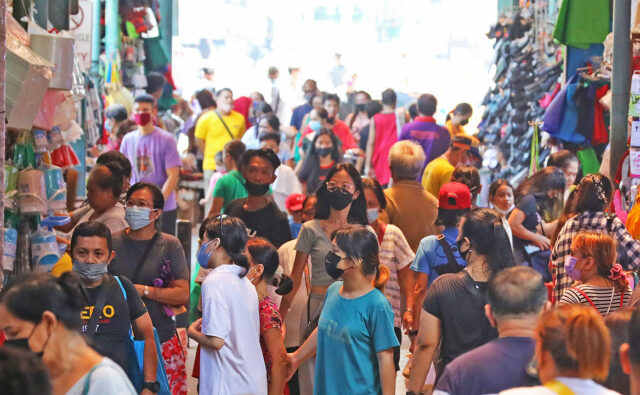
CORONAVIRUS infections in the Philippines rose by 82% to 3,051 in the past week from a week earlier, according to health authorities.

Of the total for June 13 to 19, less than 1% or 15 were critical, the Department of Health (DoH) said in a bulletin on Monday. Six more patients died.

The agency said 385 or 14.6% of the country’s intensive care unit (ICU) beds had been used as of June 19, while 4,033 or 18.2% of non-ICU beds were occupied.

It added that 554 severe and critical coronavirus patients or 10.2% of total admissions were staying in hospitals.

DoH said 70.03 million people had been fully vaccinated against the coronavirus as of June 19, while 14.85 million people have received booster shots.

Manila, the capital and nearby cities would unlikely be placed under a moderate risk classification for coronavirus disease 2019 (COVID-19) soon despite rising infections, Edsel T. Salvana, a member of a DoH-led technical advisory group, told a televised news briefing.

“We’re still far from the parameters used by DoH in terms of moving from low risk to moderate risk,” he added.

The daily attack rate in Metro Manila was “a little bit above” one out of 100,000 cases, Mr. Salvana said. Under a moderate risk classification, the attack rate must be at least six out of 100,000, he added. 

The hospitalization rate in Metro Manila was still in the low 20s, when it should be 50% or above for it to be considered under a moderate risk classification.

“The actual number of cases is still manageable in terms of our healthcare capacity,” he added.

Metro Manila must post at least 800 coronavirus infections daily in the next two weeks before it can be placed under a moderate risk classification, Mr. Salvana said, citing the World Health Organization.

There is no indication that the government would be raising the alert in Metro Manila to Level 2 soon.

“There is really no indication that we should move to Alert Level 2 because, again, the ultimate objective of our alert level system is really to preserve the healthcare system.”

He noted that even as cases in the capital region have been steadily increasing, “the number of people who need urgent medical care, acute medical care in the hospitals is very, very low.”

Mr. Salvana partly traced the low hospitalization rate in Metro Manila to its high vaccination rate. 

Meanwhile, the government adviser said giving Filipinos a second COVID-19 booster shot now “does not make sense” because it would not benefit them.

“It is better for us to wait for newer formulated vaccines that target the Omicron variant,” he said. “So far, a second booster shot for the general population did not show significant benefits compared with the immunocompromised and the elderly.”

“For the general population, the benefit is not that big yet. Vaccines in the works may actually be more beneficial than giving a second booster to the general population,” he added.

“It will not make sense to give it to them just because the vaccines are about to expire.”

Mr. Salvana said the government should focus on ensuring that the fully vaccinated get their first top-up shot. “It is the first booster which has incremental, big benefits.”

“The vaccines are doing what they’re supposed to do,” the doctor said. “The uptick in cases is expected because of these new Omicron lineages that are entering the country, but it all remains manageable at this time because our healthcare utilization remains low.”

Physical distancing in schools may be relaxed in August

PHILIPPINE STAR/ MICHAEL VARCAS

THE GOVERNMENT might ease physical distancing rules in schools holding limited face-to-face classes this school year in areas under the lowest coronavirus alert level, according to Philippine health authorities.

This would allow educational institutions to admit more students attending schools physically, Education Undersecretary Nepomuceno Malaluan told a televised news briefing on Monday.

“There’s a limitation now on the number of students that we can accommodate in a classroom so they can observe the physical distancing requirement,” he said in Filipino. “In the next school year, physical distancing can be relaxed if a school is in an area under Alert Level 1, according to the new protocol issued by the Department of Health (DoH).”

Mr. Malaluan said the Department of Education (DepEd) is crafting guidelines for learning in the next school year, including blended learning.

“The extent [of blended learning] will be contained in the guidelines — how many days will be face-to-face and how many will be allowed for remote learning,” he added.

Schools now know how to deal with a potential surge in coronavirus infections and a higher alert level that goes with it, Mr. Malaluan said.

Only schools under Alert Levels 1 and 2 may hold physical classes in basic education.

“It really works like our storm signal,” he said. “Our schools know the protocols for each of these alert levels.”

Schools will open on Aug. 22.

Meanwhile, incoming Vice-President Sara Duterte-Carpio said President-elect Ferdinand R. Marcos, Jr. had asked her to review the country’s K-12 educational system.

“He already gave instructions with regard to the review of the implementation of the K-12 program of the Department of Education,” she separately told a televised news briefing. K-12, enacted in 2012, cannot be decided overnight, she added.

Some civic groups pushing for the abolition of K-12 earlier said the “congested curriculum” was a failure.

Ms. Duterte-Carpio also expressed hope that policymakers would push the revival of a mandatory training program for Filipino students.

“The Executive and legislative agenda will be decided between the president and Congress so I hope that will be included since there are many pending bills in Congress with regard to that,” she said.

The program was abolished in 2002 after the death of a university student who exposed the anomalies in the training corps.

Investigations led by Congress showed that the program had enabled implementers to commit abuses in schools.

Raymond Basilio, secretary-general of the Alliance of Concerned Teachers, urged Ms. Duterte-Carpio to address the “problem of learning loss, learning poverty and the quality of and access to education” instead of reviving the mandatory military training for students. — Norman P. Aquino and Kyle Aristophere T. Atienza

Typhoon-prone households in 2 provinces to get pre-disaster aid under DSWD-UNICEF program

HOMES built with light materials at a coastal community in Catanduanes were destroyed during Typhoon Goni, known locally as super typhoon Rolly, which made its first landfall on the island province on Nov. 2, 2020. — LGU PANDAN-MAYOR’S OFFICE 

THE PHILIPPINE Social Welfare department and the United Nations Childrens Fund (UNICEF) have launched a program that will provide financial assistance to vulnerable households on the path of an incoming typhoon to help them prepare better for the disasters impact.    

Around 22,000 households have been identified as beneficiaries of the unconditional cash transfer, which will be distributed three days before a predicted landfall of a Category 4 typhoon, UNICEF said in a statement on Monday.  

Tropical cyclones under this category have winds of 118 to 184 kilometers per hour (km/h) within 12 hours.  

This is the first time that we will test the concept of anticipatory action through a shock responsive social protection model,UNICEF Philippines Deputy Representative Behzad Noubary said in a statement.  

The support for typhoon-vulnerable areas was finalized after the Department of Social Welfare and Development (DSWD) and UNICEF sealed the agreement on June 14 under the United Nations Central Emergency Response Fund for Anticipatory Action for predictable hazards.  

Through this intervention, the most at-risk communities will have better financial resources to bounce back after a typhoon,Mr. Noubary said.   

Traditional disaster response, when complemented with anticipatory actions, can significantly reduce the impact of disasters and allow for a faster recovery.”  

Every family will receive P1,000, which was calculated based on a childs minimum expenditure needs for nutrition, education, water, sanitation, hygiene and protection services.  

The cash assistance will be provided through the LANDBANK of the Philippines, the governments depository bank.  

UNICEF will test the provision of the anticipatory multi-purpose cash transfers using existing national government social protection systems. It aims to contribute to DSWD policy development for improved humanitarian and disaster response.  

Beneficiaries are those listed under the DSWDs Pantawid Pamilyang Pilipino Program in Catanduanes, including the municipalities of Baras, Bato, San Andres and Virac; and Northern Samar, specifically the municipalities of Catarman, Catubig, Gamay, Mondragon, and San Roque.   

The provinces of Catanduanes and Northern Samar, both located on the eastern side of the country facing the Pacific Ocean, are often on the path of typhoons.   

The Philippines, situated within the typhoon belt, is struck by an average of 20 typhoons per year. Alyssa Nicole O. Tan