Home Blog Page 5897

Marcos says he didn’t spend own money on campaign

BONGBONG MARCOS FB PAGE

PRESIDENT-ELECT Ferdinand “Bongbong” R. Marcos, Jr. did not spend his own money for his campaign, having received more than P600 million in contributions from various sources, according to an expense statement he submitted on Tuesday.

He spent P623 million of the P624.68 million campaign contributions, according to his statement of contributions and expenditures filed with the Commission on Elections.

Mr. Marcos will pay income tax on the unspent balance, Drixel Jann S. Dabatos, a member of Mr. Marcos’ legal team, told reporters.

Mr. Marcos got cash contributions from “other sources” worth P373.25 million and in-kind contributions worth P4.2 million. He also received P247.234 million in in-kind donations from his political party.

A report by the Philippine Center for Investigative Journalism (PCIJ) in May showed that Mr. Marcos Jr. and his main rival, outgoing Vice-President Maria Leonor G. Robredo topped ad spending on mainstream media among presidential bets from January 2021 to March 2022 at P1.4 billion each.

Mr. Marcos did not record any ad spending on Facebook, PCIJ said in a January report. — Kyle Aristophere T. Atienza

Tiger Woods declines ‘enormous’ offer to join LIV Golf — Norman

LIV GOLF will make its debut this week at London without Tiger Woods, but it made a substantial offer to lure the 15-time major winner to the new international golf league, according to a new report.

In an interview with the Washington Post, LIV Golf CEO Greg Norman said that Woods was offered a “mind-blowingly enormous (deal); we’re talking about high nine digits.”

Woods, who has played in just two tournaments since a devastating leg injury after a car crash in February of 2021, has maintained his loyalty to the PGA Tour as recently as last month at the PGA Championship.

The new Saudi-backed golf league has landed some top names, though, with reports on Monday that Phil Mickelson will play in the inaugural event which starts on Friday at the 7,100-yard Centurion Club outside London. Dustin Johnson also will be participating, along with Sergio Garcia, Louis Oosthuiszen and Kevin Na, among other top names.

The PGA Tour has threatened a ban of any players that compete in a LIV Golf event. Woods, 46, was not ready to sever ties with the tour where he made a name for himself and where he has won 82 total events. — Reuters

I would probably not have played any other Grand Slam with my injury, says Nadal after French win

PARIS — Rafael Nadal would probably not have played any Grand Slam other than the French Open with the chronic foot injury that needed numbing injections in Paris, the 14-time Roland Garros champion said on Monday.

The Spaniard’s record-extending triumph on the Paris clay earned him an all-time best 22nd men’s singles major with a 6-3, 6-3, 6-0 crushing of Norway’s Casper Ruud and put him two titles clear of Roger Federer and Novak Djokovic.

It was the “most unexpected” of his French Open titles, Nadal told Reuters on Monday after limping into the scintillating salon of a central Paris hotel.

Asked if he would have played any other Grand Slam with the injury that forced him to have injections to numb his foot, Nadal said: “Probably not.”

“We have been through a lot of emotions. Probably the most unexpected, surprising (title) and all the things I had to do to play the event makes the title one of the most special,” the 36-year-old said.

Nadal said that because of the injury, which also meant he arrived in Paris with no title on the European clay, he was not confident he would be able to fight for the Musketeers’ Cup.

“Of course, when you arrive with a poor preparation like I did, every day is a challenge; you need to increase your level of tennis every single day,” he explained.

Nadal has traditionally started his French Open campaigns with at least one claycourt title under his belt but this year got to the French capital empty-handed.

“(Winning those titles) gives you an extra security if you want to reach at least the level you need to fight for the final rounds,” the Mallorcan said.

“This time before the tournament started I didn’t know if I would be able to fight for the second week so I just took it one (round) at a time.”

DEFEAT OF DJOKOVIC
While there was no doubt in his mind that he would take part in the claycourt major, whether he would be capable of gunning for the title was another matter, especially with world number one Novak Djokovic awaiting in the quarterfinals.

“I always had the confidence that I would be able to play because I played with no feeling in the foot, with a foot asleep because of the anaesthetic injections into the nerve,” he said.

“But the problem is not just the match, it’s also the practice. I never thought about not playing here, but I thought it would be very difficult to be competitive.”

While he appeared below his best physically at times, Nadal still managed to beat Felix Auger-Aliassime in five sets in the last 16 before taking down Djokovic in a four-set thriller.

He had already been on court for more than three hours, sweating like never before, when Alexander Zverev sustained a freak ankle injury that ended their semifinal contest with the Spaniard leading 7-6, 6-6.

While he still does not know what his schedule will look like in the coming weeks, Nadal agreed to cast his mind forward to two years from now, when Roland Garros will host the Olympics after the French Open.

Nadal has won both titles, but should he have to choose between the two tournaments in 2024, the French Open would have his preference.

“Roland Garros is part of the history of my career, it’s the most important place in my career and of course, the Olympics is the most important event in the world of sports,” he said.

“So it’s difficult to choose but possibly Roland Garros (the French Open) is a little more special for me.” — Reuters

Curry’s improved defense shows he is more than just a sharpshooter

SAN FRANCISCO — The “Baby-Faced Assassin” is all grown up. Stephen Curry’s youthful appearance mixed with his lethal shooting earned him that moniker early in his career and while opposing teams feared him pulling up from just about anywhere on court, they saw him as a defensive liability.

Not anymore.

Curry not only led the Warriors offense in the team’s 107-88 Game Two win in the Finals on Sunday, at the other end of the floor he disrupted passing lanes, contested shots and recorded three steals against the Celtics.

“Teams used to try to call him into every action and just try to pick on him,” Warriors forward Draymond Green told reporters.

“That doesn’t work anymore. We are all there behind him if he does need help, but he hasn’t been needing that often, and it’s great.”

Curry’s more muscular frame has played a big role in his transformation, Green said.

“I’ve spoke about how much stronger he is. He’s able to hold his ground, so you’re not able to bump him off his spot, and that’s been huge for us,” Green said.

“I’m not shocked he’s playing that type of defense. He’s been doing that for the last couple years.”

Curry, who is searching for his fourth championship and first Finals MVP, said getting better on the other side of the ball has long been a goal for him.

“Over the course of my career, it’s been a physical development that’s happened over time that obviously helps, a lot of work has gone into that,” Curry said.

“But at the end of the day, from my rookie year to now, it’s always been about effort and just a care factor, overcoming physical limitations with matchups or whatever it is.

“If you try hard, good things will happen. And you’ll continue to get better.”

The best-of-seven series is tied 1-1 and will resume in Boston on Wednesday. — Reuters

Quin Snyder on leaving Jazz: ‘It was time’

THE UTAH Jazz held their public farewell to departing coach Quin Snyder on Monday, with Snyder saying the time was right for him to step down while team CEO Danny Ainge said the team had hoped Snyder would stay.

The sides’ recent contract-extension talks failed, prompting Snyder to resign on Sunday.

“It was time,” Snyder said at a Monday press conference. “Time for the Jazz to move forward. Time for me to move forward. It just made the most sense to me.”

Snyder added of Utah, “Two of my kids have lived here their whole lives, so this is a special place, and that’s not going to change for us. What makes it difficult is there are a lot of people in this room that I will really miss. A silver lining is that I will get to go to Halloween with my daughter.”

Ainge said, “We have spent the last few weeks talking, Quin and I, a lot about a lot of different things, and I think it’s pretty clear, we desperately wanted him to stay. And at the same time, I’ve walked away from coaching and I walked away from being a general manager after 18 years in Boston, and so I trust that Quin knows more what’s best for him and his family, much more than we do.”

Snyder, 55, produced a 372-264 (.585) record in eight seasons as the Jazz’s head coach, which includes six consecutive seasons with a winning percentage higher than .580. Only Hall of Famer Jerry Sloan, with 1,127 victories, notched more wins on the Utah bench than Snyder.

“There’s a real sense of sadness and sorrow and loss,” Snyder said of exiting. “That’s to be expected. I gave this everything I had. You try to be introspective and you try to analyze. But, this was a decision to where I just kept coming back to the same place. It was time for me to move on.”

Team owner Ryan Smith said of the process of finding Snyder’s replacement, “We’re going to take our time with the coaching search. We have to get it right.” — Reuters

To keep fighting

Rafael Nadal looked none the worse for wear in the aftermath of his remarkable run in the French Open. He understood the significance of his record-extending 22nd major title, of course; in claiming his unprecedented 14th La Coupe des Mousquetaires, he cemented his status as the greatest clay court player of all time. To argue that he has lived and breathed Roland Garros would be to understate the obvious. Never mind that he headed into the fortnight seeded fifth, or that he continued to suffer from the degenerative Mueller-Weiss syndrome. Forget that he stood to be an old 36, what with a style of play that taxed his body as much as it punished his opponents. When the battlesmoke cleared, he was in his familiar place at the top of the sport.

Considering the relative ease with which Nadal took the championship, it’s significant to note his sobering assessment of his plight. He didn’t want to talk about his ailing left foot throughout the tournament in part because he wanted to focus on the task at hand, and in larger measure out of respect for the competition. Once the trophy was in hand, however, he explained his condition with marked candor. Under the circumstances, he noted, “I can’t and I don’t want to keep going. I’m going to keep working to try to find a solution and an improvement for what’s happening.”

How long Nadal will be able to keep going is subject to speculation. This time last year, he didn’t even make the French Open final; World Number One Novak Djokovic made short work of him in the Round of Four, seemingly an indication that the end was near. As things turned out, he had more — make that much more — in the tank; including the Australian Open crown that came after a long hiatus, he has moved two Grand Slam wins clear of the other members of the Big Three. It’s a decided advantage given their advancing age and increasingly fewer chances of winning.

True, Nadal has been the beneficiary of unforeseen turns of events. Djokovic’s deportation led to smooth sailing at Melbourne Park. He then had a semifinal-round walkover in Paris, avoiding what seemed a surefire five setter; third seed Alexander Zverev had to be carted off in a wheelchair after an unfortunate ankle twist. That said, there can be no discounting the weight of his achievement. And, needless to say, he plans to “keep fighting to try to keep going.”


Anthony L. Cuaycong has been writing Courtside since BusinessWorld introduced a Sports section in 1994. He is a consultant on strategic planning, operations and Human Resources management, corporate communications, and business development.

ISIS spokesperson in east Asia killed by Philippine forces 

EXTREMIST group Islamic State of Iraq and Syrias (ISIS) alleged spokesperson for east Asia has been killed by security forces in southern Philippines, the military reported on Tuesday.   

The fatality was identified as Abdulfatah Omar Alimuden, who also went by the name Abu Huzaifah, according to a statement from the Western Mindanao Command. 

Huzaifah was also known to be in charge of financial transactions between the ISIS and local terrorist group Daulah Islamiyah, WestMinCom said.   

The ISIS leader was killed in the town of Datu Saudi Ampatuan in Maguindanao on Monday afternoon.   

Meanwhile, five members of the Abu Sayyaf, a kidnap-for-ranson group that has also pledged allegiance to ISIS, surrendered to the military in Sulu on Sunday, WestMinCom said in a separate statement on Tuesday.  

This brings to 44 the total number of the Abu Sayyaf members who have left the group since the start of the year, it said. 

Agricultural damage from Mt. Bulusan eruption at P20.2B 

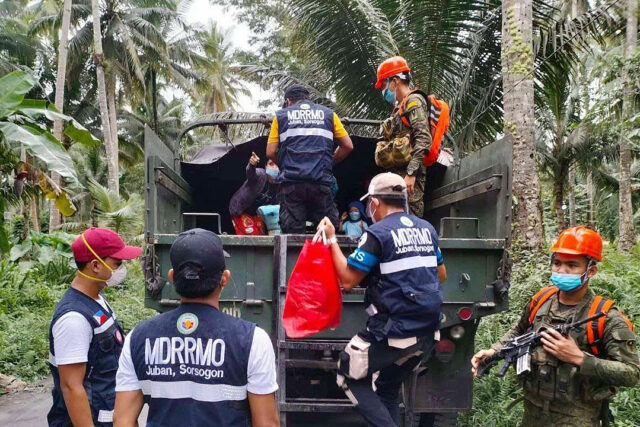
SORSOGON PIO

DAMAGE to crops due mainly to ashfall from Mt. Bulusans eruption on Sunday was estimated at over P20 billion, according to the head of the national disaster response agency.   

Undersecretary Ricardo B. Jalad, executive director of the National Disaster Risk Reduction and Management Council, said almost 3,700 hectares of farmland around the mountain volcano in Sorsogon were affected.    

The Department of Agriculture monitored damagein 3,698 hectares of crops with a monetary value of about P20.2 billion,Mr. Jalad said in mixed English and Filipino based on a transcript of a Cabinet meeting with President Rodrigo R. Duterte on Monday night.   

No further details were discussed. Sorsogons major crops are rice, coconut, pili nuts, corn and bananas, based on data from the Agriculture department.  

Meanwhile, clearing operations are continuing in communities that were covered in ash after Mt. Bulusan erupted for 17 minutes on Sunday morning and spewed gray plumes.   

A total of 2,784 families or 13,920 individuals have been affected, Mr. Jalad said. Of these, 75 families composed of 278 individuals have been moved to the evacuation center in the town of Juban.   

The towns disaster management head, Arvee Ledronio, said some of the evacuated residents might be allowed to return home by Tuesday.   

Its possible that some residents would be allowed to go back home today, June 7, as soon as the clearing operations are done,he said in Filipino in an interview over state television network PTV-4.   

Alert level 1, which means a low level of volcanic unrest, was still up over Mt. Bulusan, according to the Philippine Institute of Volcanology and Seismology (Phivolcs) bulletin on Tuesday.   

Mr. Jalad said all emergency response agencies, including security forces and local government teams, remain on full alert for a worst-case scenarioof a violent eruption. MSJ

Solon renews push for disaster management department following Bulusan eruption 

PHILIPPINE ARMY

A REELECTED solon has renewed his push for the establishment of a department focusing on disaster management following the latest natural calamity to hit the Philippines, a volcanic eruption in his home region Bicol.   

Albay Rep. Jose Maria Clemente S. Salceda, who authored a bill in the previous Congress on the creation of a Department of Disaster Resilience, said 

such an agency is necessary to ensure the national governments capacity to provide help to local governments that deliver immediate responses.   

Im sure Sorsogon can handle it,he said, referring to the province where Mt. Bulusan, which erupted Sunday and spewed ash, is located.  

But what matters is we are able to bring back to the national conversation the need for an appropriate institution for national capacity [to respond to disasters] and general welfare,Mr. Salceda said in a statement released late Monday.  

He noted that the Philippines has some of the largest number of disaster events in the whole world.”   

The country, located along the Pacific typhoon belt, gets hit by an average of 20 typhoons annually. It is also vulnerable to volcanic eruptions and earthquakes being situated in the so-called Ring of Fire.  

Mr. Salceda said he is optimistic that the proposed law will be passed under the incoming Congress with support from the administration of President-elect Ferdinand R. Marcos, Jr.    

It does not need to be a full-fledged department,he said. 

Under the existing setup, the National Disaster Risk Reduction and Management Council (NDRRMC) serves as the main agency for emergency preparedness and response. It is under the Department of National Defense and is composed of various government and non-government organizations. 

NDRRMC also serves as the overall coordinating agency for all local-level disaster management offices.   

What matters is, nothing surprises the national governments capacity to respond to big, sudden emergencies that local government simply cannot handle on its own,Mr. Salceda said.   

The Department of Disaster Resilience bill was approved by the House of Representatives in the 18th Congress but its counterpart measure did not hurdle the Senate as several legislators questioned its practicality and the funding required for setting up another department. Alyssa Nicole O. Tan 

Bomb detectors

PNP

FORTY-FIVE dogs trained to detect explosives are among the new assets presented on June 7, 2022 by the Philippine National Police in a blessing ceremony at its headquarters. The police recently acquired P764 million worth of new vehicles, night vision devices, and protective vests.

An opportune time to restrategize foreign policy

PHILEMBASSY.NO

The Philippines is at a turning point in its foreign policy and national security agenda. These will be defined by the direction that the Marcos Jr. administration will take. So far, given the President-elect’s recent pronouncements, the outlook seems positive.

Addressing the long-standing concern over the West Philippine Sea (WPS), Mr. Marcos Jr. reassured the public that he would not “allow a single millimeter of our maritime coastal rights to be trampled upon.” Citing the 2016 arbitral ruling, he emphasized that WPS is “already a territorial right” and not a claim.

This is a major shift from the Duterte administration’s failed appeasement policy toward a more Philippine-centered policy agenda.

Having a clear, cohesive, and unequivocal foreign policy and national security agenda cannot be overemphasized. Lessons from the previous administration show that lack of such resulted in delays in economic growth, a slowdown in national development, and the decline of strategic autonomy.

As geopolitics and geoeconomics continue to influence the external environment of the Philippines, Marcos Jr. must set the course of our foreign and security policies to be both adaptive and resilient to potential threats and to be driven by national interests. Beyond policy pronouncements, clear and definitive actions need to be taken.

THE LOW-HANGING FRUITS: REALIZING PHL MARITIME SECURITY POTENTIAL

On May 31, the Stratbase Albert del Rosario Institute held a virtual townhall discussion titled, “The Future of Philippine Foreign Policy: On Maritime Security Capability and Strategy.” This public forum witnessed a gathering of experts and thought leaders who provided their own insights on the possible next steps for the Marcos Jr. administration.

The forum highlighted the need to synergize foreign policy with the country’s defense security posture to foster greater capability with regard to external security changes, better cooperation with key partners and allies in the region, and increased trust and confidence in governance capability.

From Duterte’s independent foreign policy, I emphasized that we lost the opportunity to harness our international political capital among countries with shared values, with those who believe in a rules-based international order. To regain our footing, Marcos Jr. will need to divert their attention to crafting a more responsive and strategic foreign policy that would implement a clear, cohesive, and consistent foreign policy direction and develop the country’s comprehensive power according to its military, economic, scientific, and cultural capabilities.

Specifically, on harnessing our maritime security strategy, Admiral Rommel Jude Ong emphasized that retaining agency over its maritime interests in the near future requires the formulation of a whole-of-government strategy, integrating the country’s foreign policy direction, its maritime defense and security posture, and its plans to harness key components of the blue economy.

In line with this is the need to develop our modernization efforts. Dr. Renato de Castro stressed that it is time to shift away from a legislative-based modernization program to one that is based on capability-driven modernization. This entails formulating a new national security strategy based on the 2016 arbitral ruling and refocusing on maritime capabilities emanating from our maritime domain.

Dr. Chester Cabalza also emphasized the need to focus on Territorial Defense Operations rather than Internal Defense Operations, which entails investing more in the Philippine Navy and the Philippine Coast Guard. He said that these defense agencies, “should maintain sovereignty patrols on the country’s maritime domains, ensuring a surface force to meet the current mission and long-term obligations, including the safeguard of sea control and denial, projecting power, maintaining maritime security, and also performing functions to support its mission other than war.”

At the international level, the Philippines also has various opportunities to not only push its defense and security potential forward but also to maximize and leverage its position in the region. In the Center for a New American Security’s report titled, “Revitalizing the US-Philippines Alliance to Address Strategic Competition in the Indo-Pacific,” the critical importance of the US-Philippines alliance goes beyond maintaining its historical and cultural ties and gears more on maintaining stability within the Indo-Pacific region.

The report emphasized two things. First, the most important aspect of the security alliance is prioritizing existing defense and security cooperation frameworks and elevating it to meet current and emerging threats in the region, including gray zone threats and potential adversarial events within the Philippines’ maritime territory. This also looks into enhancing “allied and partner capabilities and enable collective responses to regional security challenges.”

Second, and the most significantly stated in this report, the “Philippines’ relationships with US allies and partners” forms an empowered and deeper security Indo-Pacific network that supports a rules-based order in the region and encourages “further minilateral defense arrangements” that address the capability and capacity development.

These recommendations and the low-hanging fruit of opportunities cannot be ignored any longer. While the new administration is formulating its next steps, it must be able to integrate these in its policy priorities to ensure a Filipino forward approach and to secure a better roadmap toward national security and development.


Victor Andres “Dindo” C. Manhit is the president of the Stratbase ADR Institute.

The state of mass housing

THE LOCAL government of Manila turned over 83 out of 168 units of Tondominium 2 in Vitas, Tondo Manila, early this year. — PHILIPPINE STAR/ RUSSELL A. PALMA

(Part 1)

As the Philippines transitions from a low-middle income country to an upper-middle income country in the next decade or so, it will be increasingly urbanized, with more of the population migrating from the rural areas to the cities. The next and subsequent administrations must ensure that with higher per capita incomes, the country will at the same time provide the lower-income groups with decent and affordable housing. The Philippines cannot become a First World country without addressing the problem of mass housing. We should avoid like the plague the model of some Latin American countries with already high per capita incomes of over $10,000 but with millions of people still living in dehumanizing conditions in squatter areas.

What is the state mass housing today in the Philippines? This article will summarize the study carried out by the Center for Research and Communication (CRC) on mass housing in the Philippines, done in partnership with the Subdivision and Housing Developers Association, Inc. (SHDA), the Organization of Socialized and Economic Housing Developers of the Philippines, Inc. (OSHDP), and the National Real Estate Association, Inc. (NREA). Conducted during the height of the pandemic in 2021 and dated January 2022, the study is entitled “Inclusion of Mass Housing in the Strategic Investment Priorities Plan (SIPP) and for Fiscal Support,” outlining the needed cooperation between the public and private sectors to address the huge backlogs in housing in the Philippines today.

Through the years, it was clear in the minds of those who crafted a Philippine mass housing policy that unlike in Singapore in which the Government was the main provider of mass housing, it has to be the private sector — with some help from the State — that will address the serious shortage of housing for the lower-income households. The study reviewed the housing policy followed in the Philippines over the last three decades.

From the late 1980s until the East Asian Financial crisis of 1997, the government’s direct cross-subsidy scheme extended to private developers under the National Shelter Program (NSP), offering buyers long-term fixed interest rates. With the start of the new millennium, the government assisted programs for certain sectors through fiscal incentives extended to socialized, economic, and low-cost private housing developers, including mandatory contributions to the balanced housing requirement.

Since the 1970s, the government-assisted public housing projects have been coursed through the National Housing Authority (NHA). Unfortunately, low budget allocation from the National Government and the multiplication of tasks assigned to it (e.g., relocation of informal settlers affected by government infrastructure projects, provision of housing for households affected by national calamities or along disaster prone areas) has weakened seriously the impact of the NHA on the housing crisis. In contrast, one successful program introduced in the late 1980s was the Community Mortgage Program (CMP). It allowed legally organized associations and their qualified members to acquire land and/or build community housing with concessional long-term loans. The success was short-lived, however, because of perceived association management issues and conflicts among the various stakeholders.

With the passage of the Tax Reform for Acceleration and Inclusion (TRAIN) Law of 2017, housing policy support has included extending fiscal incentives in the form of income tax holidays and VAT exemptions to socialized subdivision and condominium housing with price ranges from P480,000 to P750,000 and VAT exemption for economic and low-cost housing with price ranges between P750,001 to P1.75 million and to transactions exceeding P3.2 million, respectively.

Given other priority public expenditures of the Government, such as those on education, health, and rural development, addressing the housing backlog in mass housing has been largely left to private developers. Unfortunately, the private sector was not up to the task.

In 2019, OSHDP presented the obstacles facing a marketing-oriented approach to solving the housing shortage. First, there is the limited ability to pay of the low-income and urban poor groups involved. There were the physical and administrative difficulties encountered by the urban poor in accessing credit for housing, coupled with the absence of long-term, low-interest rate financing. On the supply side, the problems were even more numerous: limited access to land and dysfunctional land markets; unclear and highly bureaucratic land administration, management, and conversion processes; inadequate housing subsidies; and limited financing available for low-income and pro-poor housing production.

To make matters worse, the additional strict criteria that the CREATE (Corporate Recovery and Tax Incentives for Enterprises) Act, passed during the Duterte administration, for certain segment of mass housing to be eligible for incentives, have made it more difficult for private developers to make socialized housing available to the poor.

Meanwhile, the balanced housing requirement imposed on developers of open- and upper-market subdivision projects under the Urban Development and Housing Act of 1992 (RA 7279) to put up socialized housing precisely to allocate private sector resources to fill in the housing backlog was expanded under RA 10884 which now covers vertical housing. There were other measures of putting up socialized housing requirement through modes such as joint venture projects with local government units (LGUs), nongovernment organizations (NGOs), private developers’ subsidiaries, and other priority development projects under the Building Adequate, Livable, Affordable, and Inclusive (BALAI) Filipino Communities program.

The bureaucratic maze that made it very difficult to implement mass housing programs in the past has been partly eased by RA 11202 passed in early 2019 which established the Department of Human Settlements and Urban Development (DHSUD) which is mandated to oversee the national housing program. There used to be a myriad of housing programs and agencies. Now DHSUD merges the Housing and Urban Development Coordinating Council (HUDCC) and the Housing and Land Use Regulatory Board (HLURB). The Office of the DHSUD Secretary now supervises the NHA, the Social Housing Finance Corp. (SHFC), the Home Development Mutual Fund (HDMF), and the National Home Mortgage Finance Corp. (NHMFC).

(To be continued.)


Bernardo M. Villegas has a Ph.D. in Economics from Harvard, is professor emeritus at the University of Asia and the Pacific, and a visiting professor at the IESE Business School in Barcelona, Spain. He was a member of the 1986 Constitutional Commission.

bernardo.villegas@uap.asia