Home Blog Page 5663

Donovan Mitchell, dominant rally lead Cavs past Lakers

BEHIND 33 points from Donovan Mitchell and a dominant fourth quarter, the Cleveland Cavaliers scored their eighth consecutive win with a 114-100 defeat of the host Los Angeles Lakers on Sunday.

Cleveland trailed throughout the first half on the second installment of a five-game road swing. But after a sluggish start, the Cavaliers settled in and took control in the second half.

Los Angeles held an 80-77 lead with less than four minutes to go in the third quarter. Cedi Osman knocked down a game-tying 3-pointer at the 3:28 mark, and Cleveland never trailed again.

The Cavaliers scored the final 10 points of the period, then the first seven to open the fourth for a decisive 17-0 run. Mr. Mitchell’s and-one play to open the fourth quarter pushed the lead to 10 points, and it never dipped to single digits again.

Mr. Mitchell’s backcourt mate, Darius Garland, added 24 points, while Jarrett Allen scored 16 with a team-high 11 rebounds for a double-double. The trio shot a combined 25 of 26 from the free-throw line, with Mr. Mitchell’s 12-of-13 performance accounting for the sole miss.

Cleveland went 32 of 36 at the charity stripe as a team, compared to a dismal 12 of 21 for Los Angeles.

The Lakers also shot eigth of 27 from 3-point range. LeBron James, who was a combined 0-for-12 from beyond the arc in Los Angeles’ previous two games, finally connected on one Sunday but was just one-for-four from deep.

Mr. James scored a team-high 27 points.

Anthony Davis added 19 points and grabbed a game-high 12 rebounds, while Russell Westbrook came off the bench to chip in 19 points and dish 10 assists. Mr. Westbrook shot 3-for-5 from 3-point range.

Cleveland’s Kevin Love was responsible for the fourth different double-double of the day, posting 10 points and 10 rebounds off the bench. Mr. Osman added another nine points in reserve duty as the Cavaliers continued their early-season roll. — Reuters

The Generational Shift: Mindsets, motivations, management

CHRISTINA MORILLO-PEXELS

When I joined the Management Association of the Philippines (MAP) in 2009, I was 33 and president of Pacific Sun Solutions. I wondered what MAP could do for me as a young female CEO.

Thirteen years later, it’s 2022, and I am happy to say I am glad that I joined MAP! Here’s why:

MAP worked very hard to increase diversity among its members. The new MAP Governors for 2023-2024 have four women and five men of various backgrounds and ages, with a mix of younger (NextGen) CEOs. This diversity reflects MAP’s advocacy for diversity in the workplace — a driver of team performance.

I also met MAP female CEOs who inspired me. These women were relatable. I was amazed at what they built, which gave me the confidence to work towards creating a similarly sustainable and productive organization.

Through MAP, I connect to accomplished CEOs who are just a meeting, e-mail, or Viber message away. Attending MAP meetings allows me and others to share our experiences, knowledge, opinions, and concerns about the business environment. During the challenging COVID-19 lockdown, MAP members united to provide reliable support and information, which allowed me to navigate the pandemic wilderness.

Three years ago, MAP launched the NextGen Committee to focus on a younger demographic, much to my delight. It advocates ideas relevant to this group of CEOs, resulting in the MAP NextGen CEO Conference. We will have our first in-person conference on Nov. 11 at the Sheraton Manila Hotel, a step up from our last two virtual events.

Last year, SyCip Gorres Velayo and Co. (SGV) and MAP initiated the SGV-MAP NextGen CEO Transformative Leadership Program with participants from the MAP NextGen. International and local resource speakers introduced the key themes of the program:

• Leading with Purpose,

• Humans@Center,

• Technology@Speed, and,

• Innovation@Scale.

Each participant has an Innovation Challenge. The Innovation Challenge is a challenge or opportunity in their company that brings the four key themes together to address the challenge or opportunity with the help of a MAP mentor.

SGV-MAP will award the 2022 winner of the SGV-MAP Transformation Challenge (known last year as the Innovation Challenge) at the NextGen conference. Although I was not last year’s winner, I participated in this program and was thrilled with the results. These results include sharpening my leadership skills, starting a new company project via the Innovation Challenge, and building new networks and friendships.

With the NextGen committee and the SGV-MAP Leadership Program, I met those who understand the challenges that I go through. They make it easier to talk about things I can’t talk about within my organization. They have become unbiased friends who understand my business problems and give me objective opinions. As one of my MAP NextGen friends pointed out, “We try to focus on the mental health of our employees, but what about the mental health of the CEO?” We CEOs are human, too, and need to take care of our mental health by talking with others.

At the NextGen conference, we will have Speed Networking for participants to speak with each other and swap calling cards or virtual cards via QR codes. Afterwards, MAP will sponsor a two-hour cocktail to further these conversations.

There will be a Reciprocity Wall at the NextGen conference: you post what you need help with on the assigned wall, and maybe someone will help you. May your request be granted!

Now that I am 40-secret, I have my ear to the ground and can relate to baby boomers, Gen X, and Gen Y (millennials). As for Gen Z, they make me feel OLD. As digital natives, they adapt fast. They can make a marketing poster in minutes with apps like Canva and share real-time spreadsheets with Google Sheets. A few years ago, none of my employees wanted to use any other spreadsheet besides Microsoft Excel. Today, about 30% of spreadsheet users in my office use Google Sheets. Having exposure to Gen Z makes me want to compare notes with my fellow CEOs about this new generation entering the workforce.

We need to make the Philippines better because we lag behind our Southeast Asian neighbors in many metrics. Fortunately, our Filipino sports champions inspire us to be better and to manage better. Hidilyn Diaz — the first Filipino to ever win an Olympic gold medal — spoke at last year’s NextGen CEO Conference. This year, we are excited to have Gen Z Alex Eala. She is making exciting headlines as a rising star in the international tennis scene. Alex won the 2022 US Open Girls Juniors Championship. Understanding what drives her to excellence can help us better manage our Gen Z workers.

Flying to Manila from Australia for the conference is Nadia Woodhouse. Nadia, the conference keynote speaker, is passionate about creating positive change in business at the board level. Her focus on sustainability, purpose, board governance and oversight helps the EY Global Center for Board Matters engage company boards through provocative insights on disruptive global trends and governance matters.

Expect to hear panel discussions about diversity, creativity, innovation, and technological change from NextGen speakers and CEOs, such as Er Rollan (Growsari), Steve Sy (Great Deals Ecommerce), Micah Del Carmen (NOAHSys), Zahra Zanjani (CUBO), Georgina Romero (Connected Women), David Leechiu (Leechiu Property), Chito Maniago (Zuellig), and Raoul Villegas (PwC). Other CEOs participating in the event are Georgina Carlos (Fetch! Naturals), Donna May Lina (Ube Media), Dr. Karen Remo (New Perspective Media), RJ Ledesma (Mercato Centrale Philippines), Cliff Eala (Synerbyte), Wilson Tan (SGV), Babes Singson (Metro Pacific Water), and more.

See you there!

(Register via https://map.org.ph/events/3rd-map-nextgen-conference-2022/ for the MAP NextGen CEO Hybrid Conference on Nov. 11, Friday, at the Sheraton Manila from 2 to 8 p.m. In-person activities include the conference, Reciprocity Wall, Speed Networking, cocktails, and an open bar.)


Deliza G. Ridoloso is vice-chair of the MAP NextGen Committee, and president of Pacific Sun Solutions, Inc.

map@map.org.ph

ridoloso@pacificsun.ph

Congressmen not inclined to ‘outlaw’ disasters

With his island province of Catanduanes often pounded by furious typhoons, some times in the dead of night, causing loss of many lives and wreaking serious damage on property and crops, Rep. Francisco Perfecto filed a bill in Congress in the late 1950s to address the problems caused by typhoons. A cynical member of the House of Representatives immediately named the bill as the “Bill to Outlaw Typhoons.”

Nowhere in the bill was there any statement or even a hint to declare typhoons outlaws. The label “A bill to outlaw typhoons” was only the product of the satirical mind of another congressman as the true intent of Perfecto’s bill was to study typhoons with a view to dissipating their force and reducing the damage they wreak. The bill included provisions for funding the acquisition of technical equipment and the specialized training of personnel. For that reason, a political rival of Rep. Perfecto mocked, unjustly, the bill as being tantamount to outlawing typhoons.

The press lapped up the derisive label, prompting political pundits to comment that the bill was reflective of the shallowness of the occupants of the Lower House. Because of the jeers rained down on his bill and the snide remarks blown his way, Perfecto allowed his bill to die a quick death. He retired from politics after the end of his term in 1957.

We do not know how many lives could have been saved and damage to property reduced had the bill to study typhoon prospered in the halls of Congress and passed into law before the end of the 1950s. On May 28, 1960 a strong typhoon hit Metro Mania in the dead of night, cutting off power and dumping so much rain as to plunge the metropolis in total darkness and placed it under water. So many lives were lost and so much property was destroyed. On Nov. 19, 1970, super typhoon Yoling raged over Metro Manila in the morning of that day, knocking down power and communication lines and destroying many homes and business structures. Regular activities ground to a halt as the capital region lay in ruins.

Painful lessons were learned from the death and destruction wrought upon Metro Manila, the seat of government and the center of the country’s economy. So, in December of 1972, two years after super typhoon Yoling devastated Metro Manila, the Weather Bureau was reorganized into the Philippine Atmospheric, Geophysical and Astronomical Services Administration, abbreviated as PAGASA. It was mandated to provide flood and typhoon warnings, public weather forecasts and advisories, meteorological, astronomical, climatological, and other specialized information and services for the protection of life and property.

In 2010, the National Disaster Risk Reduction and Management Council (NDRRMC), was established to provide a comprehensive, all-hazard, multi-sectoral, inter-agency, and community-based approach to disaster risk management. The Council plans and leads the guiding activities in the field of communication, warning signals, emergency, transportation, evacuation, rescue, engineering, health and rehabilitation, public education, and auxiliary services.

It is a working group of various government, non-government, civil sector and private sector organizations administered by the Office of Civil Defense under the Department of National Defense (DND). The chairperson is the Secretary of Defense, vice-chairperson for Disaster Preparedness is the Secretary of the Department of Interior and Local Government (DILG), the vice-chairperson for Disaster Prevention and Mitigation is the Secretary of the Department of Science and Technology (DoST), and the vice-chairperson for Disaster Response is the Secretary for Social Welfare and Development (DSWD).

In November of 2015, or after the passage of 43 years since PAGASA was established, a law was passed to modernize PAGASA’s technological operational capacity. The modernization program included the acquisition of state-of-the-art equipment, facilities, and systems, the establishment of a technology-based data center that is consistent with international standards, the creation of a human resource development program that will include a new salary scale, and the establishment of regional weather service centers. Its current top officials — the administrator and the three deputy administrators — all have doctoral degrees.

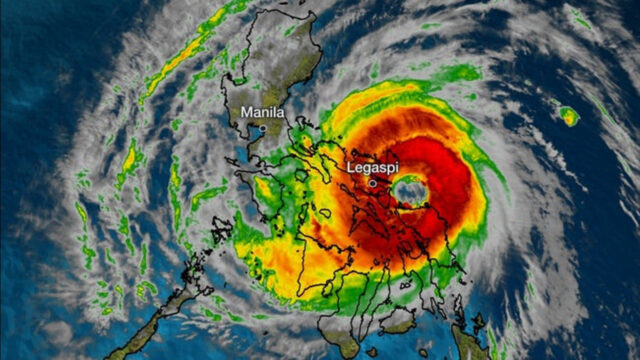
Today, thanks to weather satellites and Doppler radar, we can track a typhoon days before it makes landfall, and even before it enters the Philippine area of responsibility, enabling people to ensure their safety and to secure their property. But in spite of all the extensive advances in weather forecasting and damage control, severe tropical storm Paeng caused the loss of at least 150 lives and about P2.74 billion worth of crops. It also rendered hundreds of thousands of homes across 64 provinces, from Ilocos Norte to Maguindanao, roofless, flooded, or totally destroyed.

Michael Rama, mayor of Cebu City and president of the City Mayors League, blames PAGASA for giving inaccurate information, leading some other city mayors to take inadequate or inappropriate emergency measures to protect lives and property. He also points to quarrying as the major cause of landslides. Others hold local government officials responsible for the unusual enormous damage wrought by a tropical storm.

Naguib Sinarimbo, Minister of the Interior and Local Government of the Bangsamoro Autonomous Region of Muslim Mindanao attributes much of the devastation of Maguindanao to the logs that the continuous rain of Paeng caused to cascade from the mountains of Bukidnon. The province accounts for 68 of the total fatalities caused by the tropical storm.

Dino Reyes Chua, mayor of Noveleta, Cavite said the town’s preparations for Paeng’s impact turned out to be inadequate as floodwaters rose much higher than in past storms. He also attributes the cause of the unusually high floodwaters to the logs and debris that came down from the nearby mountain and Tagaytay. They wrecked the wall on the river bank, allowing the river’s rampaging water to surge into the barangays, causing more damage than in previous floods.

PAGASA top officials acknowledged their shortcomings. But they in turn blame the Department of Budget and Management for not giving them the funds necessary to equip and man the 32 weather stations. Administrator Vicente Malano says PAGASA needs 700 more people to staff all 32 stations 24 hours seven days a week. They also admit they are wrong in using technical terms when disseminating weather forecasts to the public. “Winds of 120 kph” and “24 Inches of rainfall” are meaningless to ordinary folks. They resolved to translate technical terms into description of impacts of such winds and rainfalls.

Alexander Pama, former head of the NDRRMC, attributes the high number of casualties and extensive damage to crops and property to the lack of a government agency empowered to directly do damage control. While there is the NDRRMC, it is only a policy formulating body. Actual damage control — from prediction to preparation to protection of lives and property to rehabilitation — is performed by units of the different departments (DND, DILG, DoST, and DSWD).

Each unit is accountable to the secretary of the department it belongs to. The level of performance and coordination among these separate units is dependent on the capabilities and resources of their respective departments. Incompetence of the personnel of one unit or the inadequacy of resources of another unit would result in failure in disaster risk reduction and damage control. He recommends the creation of an authority or a whole department for disaster management.

Well, in his State of the Nation Address in July 2018, President Rodrigo Duterte urged Congress to pass a bill creating the Department of Disaster Management. He said:

“To help safeguard the present and the future generations, we have to earnestly undertake initiatives to reduce our vulnerabilities to natural hazards, and bolster our resilience to the impact of natural disasters and climate change. As I had stated last year, we must learn from the experiences from the super typhoon Yolanda, and other mega disasters, and from global best practices.

“We need a truly empowered department characterized by a unity of command, science-based approach and full-time focus on natural hazards and disasters, and the wherewithal to take charge of the disaster risk reduction; preparedness and response; with better recovery and faster rehabilitation.

“Hence, we, in the Cabinet, have approved for immediate endorsement to Congress the passage of a law creating the Department of Disaster Management, an inter-agency crafted and a high-priority measure aimed at genuinely strengthening our country’s capacity for [resilience] to natural disasters. I fervently appeal to Congress to pass this bill with utmost urgency. Our people’s safety requirements cannot wait.”

In the 1950s congressmen dismissed derisively a bill to study typhoons and to acquire the necessary technical equipment as “The Bill to Outlaw Typhoons.” In the 2020s, it appears congressmen dismiss facetiously Duterte’s proposal as “The Bill to Outlaw Disasters” as the proposal has been given only cursory attention.


Oscar P. Lagman, Jr. is a retired corporate executive, business consultant, and management professor. He has been a politicized citizen since his college days in the late 1950s.


Inflation and illicit trade

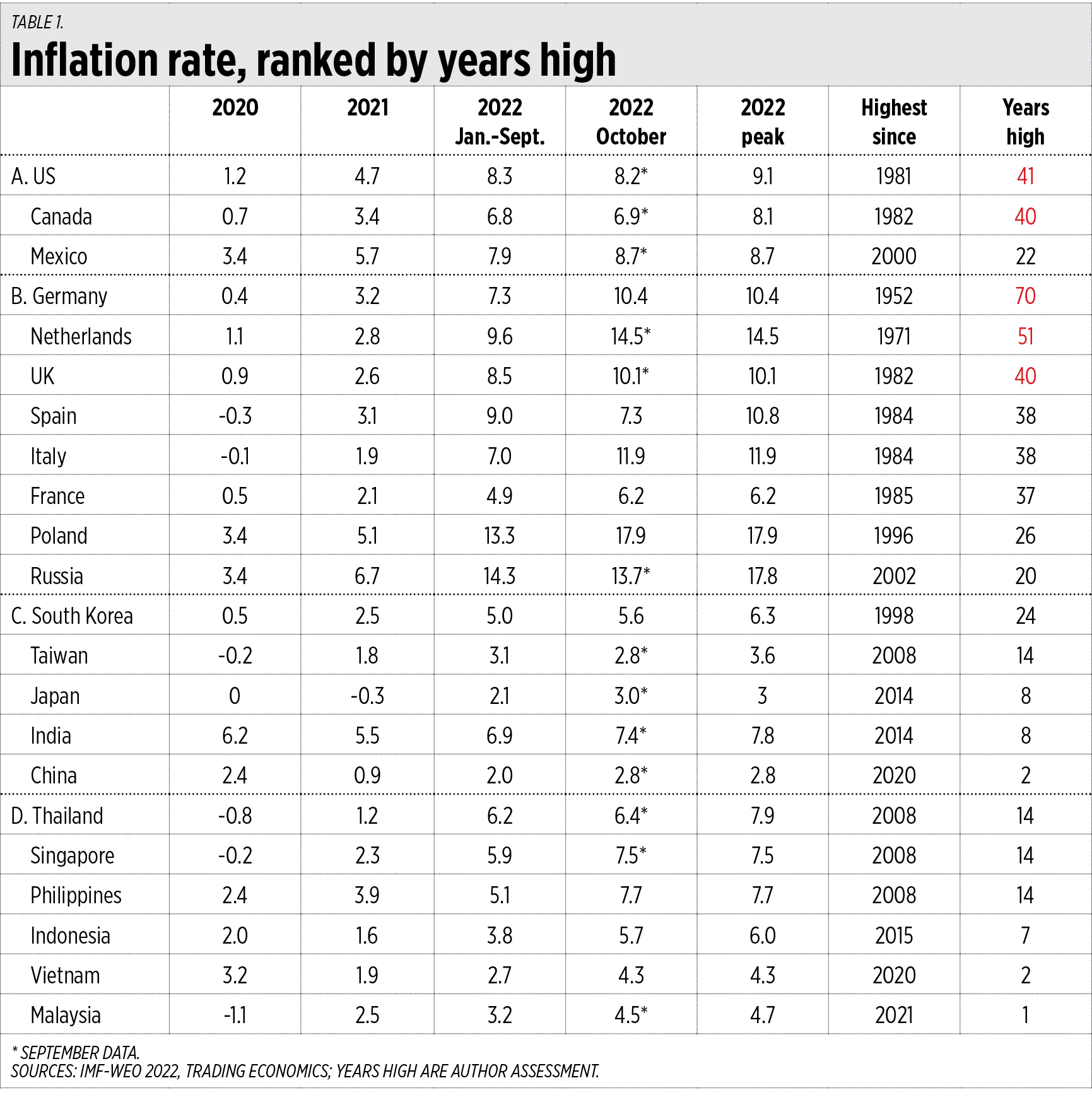
Last week, the big national news was the leap in the country’s inflation rate to 7.7% in October from 6.9% in September, according to the Philippine Statistics Authority (PSA). Meanwhile, the big international news was the high October inflation in Europe, with Germany hitting 10.4%, Italy with 11.9%, and so on. The Philippines now is one of four Asian economies with 14-year high inflation rates, the other three being Singapore, Thailand, and Taiwan (see Table 1).

Practically all of these countries’ central banks have raised their interest rates to fight high inflation, and inflation is not tamed yet, suggesting the policy is not working or working only mildly.

High inflation means that demand is higher than the supply of goods and services. It also means that the money supply is high relative to commodities supply — there is more money chasing fewer commodities.

To really fight inflation, non-monetary policy measures must be done. One, more people should be working and the endless no-timetable welfare and subsidies should shrink. Two, the various government bureaucracies, national and local, should also shrink because expenditures for their salaries, bonuses, offices, etc. are so high relative to revenues, leading to huge borrowings, huge interest payment that will require huge taxes, fines, and penalties today and tomorrow to offset. And, three, huge leakages in revenues should be plugged, which includes a vigorous fight against smuggling and/or reducing tax rates to realistic levels that make smuggling less attractive.

Last Saturday, Nov. 4, I attended the Anti-Illicit Trade Awareness Conference with the theme, “Plugging Revenue Leakage by Curbing Illicit Tobacco Trade,” held at the Marriott Clark, Pampanga, and jointly sponsored by VMJ Law and Japan Tobacco International (JTI).

The speakers were Department of Finance (DoF) Assistant Secretary Dakila Elteen Napao; John Freda, General Manager of JTI Philippines; Julian Cheung of JTI Asia Pacific Ltd.; Maria Rhona Vergara and Marie Hope Jamero, both of VMJ Law; Christine Pangilinan-Canlapan of the Intellectual Property Office Philippines (IPOPHIL); and former Congressman Jericho Jonas “Koko” Nograles.

There were many participants from the Bureau of Customs (BoC), the Bureau of Internal Revenue (BIR), the Crime Investigation and Detection Group (CIDG) of the police, the Philippine Coast Guard (PCG), the National Bureau of Investigation (NBI), and staff from the Senate and House of Representatives.

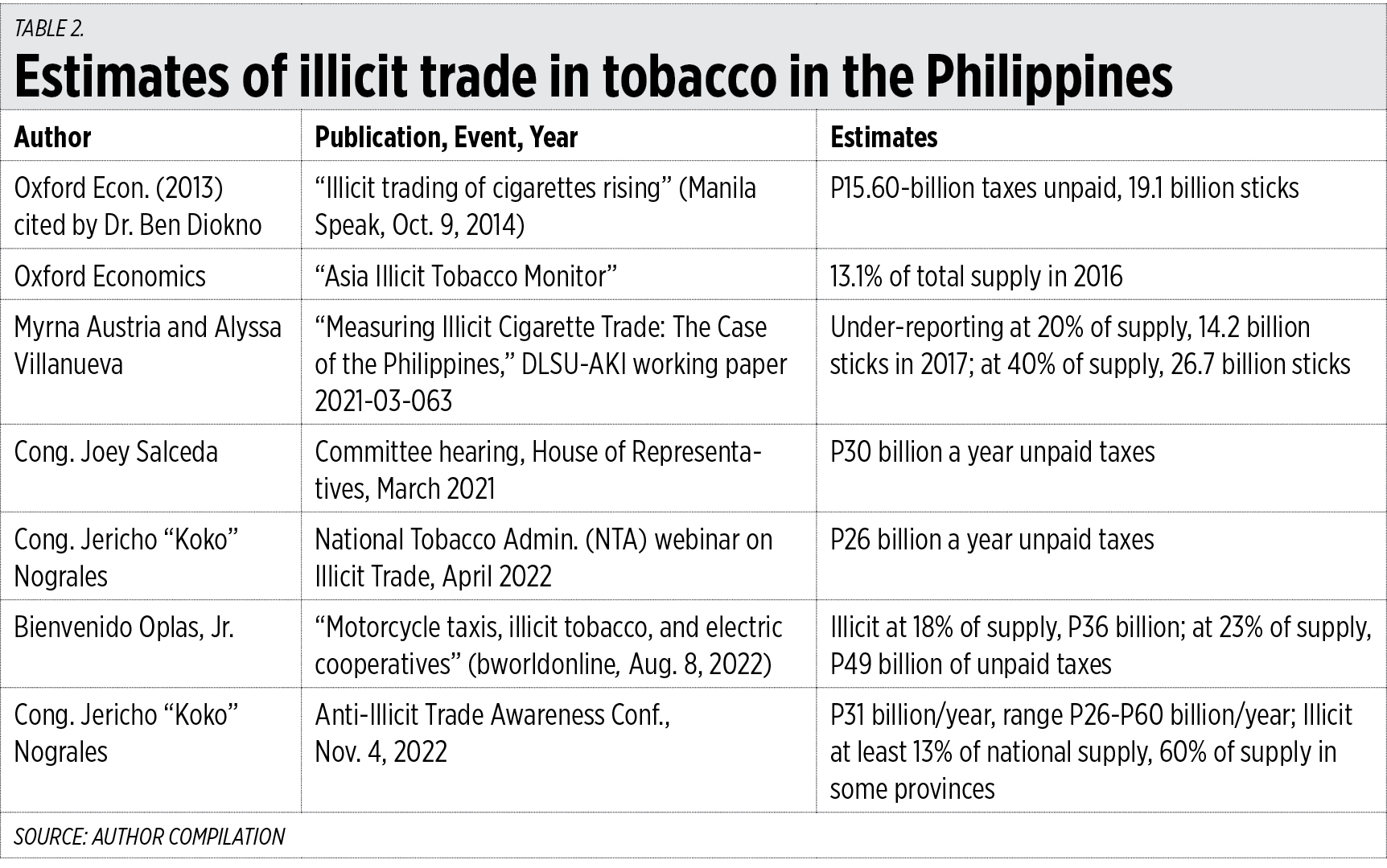
How big or how serious is smuggling and the illicit trade of tobacco alone (not including the smuggling of alcohol, petroleum, electronics and gadgets, etc.) in the Philippines? I reviewed some literature and reports, including my own estimate, and the figures range from P15 billion in unpaid taxes in 2013, to a high of P60 billion a year (see Table 2).

If we take the median of P30 billion/year in unpaid tobacco taxes as estimated by Congressman Joey Salceda, and assuming that vigorous implementation of anti-smuggling operations by various lead enforcement agencies (LEAs) and local governments, the DoF can realize at least P15 billion in additional revenues yearly. That P15 billion can fund the full year budget of the BIR and BoC, or the PCG, or the NBI and CIDG (see Table 3).

A Coast Guard officer from Sulu made a good observation that there has been free trade between Sulu-Tawi Tawi and Sabah, and other islands of Malaysia and Indonesia. Getting just the annual business permits of National Government agencies in Zamboanga makes it very costly to do legal business. Which implies that free trade — which is pro-consumer — is more dynamic when there are fewer permits, and less taxes and tariffs.

In many areas and cities of coastal Mindanao, illicit tobacco is sold for as low as P35/pack while the cheapest legal tobacco is P95/pack because the excise tax alone is already P55/pack in 2022, and will rise to P60/pack in 2023, then increase by 5% yearly from 2024 onwards. As the tax increases, the price gap between the legal and illegal products also increases and more people will shift to the illicit products and government will earn less after some time. This is the essence of the “Laffer Curve” in economics: as tax rates increase, revenues initially increase then reach a curve plateau, and as tax rates further increase, revenues begin to fall. People either reduce their consumption of the taxed products, or they shift to the alternative un-taxed, smuggled products.

One revenue measure that should be considered by Congress to avoid this situation of the Laffer Curve, is to stop the high if not progressive increase in taxes for “sin” products: alcohol, tobacco and sugar. Having a big nanny state is not good for people. A consistent nanny state should also regulate and tax many other “dangerous” activities like downhill cycling, rock climbing, sky jumping, deep sea diving, speed racing, etc. Just one big mistake in these activities can mean severe injuries if not deaths. The government should focus on expanding information awareness to people then let them live their own lives.

Meanwhile, there will be another BusinessWorld Economic Forum, with the theme “Forecast 2023: Opportunity in Uncertainty,” on Nov. 29 at the Grand Hyatt Hotel BGC. Among the Keynote Speakers will be House Speaker Martin Romualdez, DoF Secretary Benjamin Diokno, and IMF Director for Asia Pacific Krishna Srinivasan.


Bienvenido S. Oplas, Jr. is the president of Minimal Government Thinkers.

minimalgovernment@gmail.com

Taiwan injects momentum into the global transition to net-zero emissions

XANDREASWORK-UNSPLASH

THE WORLD has embarked on the transition to net-zero emissions. The innovative approaches to international cooperation highlighted in the Paris Agreement — which calls for wide cooperation by all countries to meet global reduction targets — are gradually taking shape. Taiwan is willing and able to cooperate with international partners to jointly achieve net-zero transition, mobilize global climate action, and ensure a sustainable environment for future generations.

As the world’s 21st largest economy, Taiwan has an important influence on economic prosperity and stability in the Indo-Pacific region. In particular, Taiwan’s semiconductor industry occupies a pivotal position in international supply chains. The industry actively cuts the use of energy resources in its production processes by developing new technologies and new models. Through ever-evolving semiconductor innovations, it has developed numerous smart applications of electronic devices and promoted global energy conservation. Taiwan is carrying out substantial climate actions and vigorously advancing energy transition. As of May 2022, cumulative installed renewable energy capacity had reached 12.3 gigawatts (GW), a significant 60% increase from 2016. From 2005 to 2020, Taiwan’s gross domestic product (GDP) grew by 79%. Over the same period, greenhouse gas emission intensity fell by 45%, demonstrating that economic growth has been decoupled from greenhouse gas emissions.

On Earth Day of April 22, 2021, President Tsai Ing-wen announced Taiwan’s goal of net-zero emissions by 2050. In March 2022, the Executive Yuan published “Taiwan’s Pathway to Net-Zero Emissions in 2050.” The roadmap outlines four major transition strategies in energy, industry, lifestyles, and society. Resting on the twin governance foundations of technology research and development (R&D) and climate legislation, the strategies are supplemented by 12 key substrategies. These are wind and solar power; hydrogen; innovative energy; power systems and energy storage; energy conservation and efficiency; carbon capture, utilization, and storage; carbon-free and electric vehicles; resource recycling and zero waste; natural carbon sinks; green lifestyles; green finance; and just transition. By integrating intragovernmental resources, Taiwan will develop a step-by-step action plan to reach its targets.

In building the foundations of technology R&D needed to achieve net-zero transition, Taiwan will focus on five areas: sustainable energy, low carbon, circularity, carbon negativity, and social science. The Greenhouse Gas Reduction and Management Act is being amended and will be renamed the Climate Change Response Act. The amendments will make net-zero emissions by 2050 a long-term national reduction target, improve the effectiveness of climate governance, add a chapter on climate change adaptation, strengthen information disclosure and public participation, and introduce a carbon pricing mechanism. The act will provide economic incentives for emissions reduction, guide low-carbon and green growth, and contribute to completing the foundations of national climate legislation and governance. Taiwan’s long-term vision for 2050 is to make the transition to net-zero emissions the new driving force of national development. By creating competitive, circular, sustainable, resilient, and secure transition strategies and governance foundations, Taiwan will stimulate economic growth, encourage private investment, create green jobs, promote energy independence, and improve social well-being.

Due to political factors, Taiwan is excluded from international organizations and cannot participate substantively in discussions on global climate issues. It is difficult for Taiwan to stay abreast of current developments and properly implement related tasks. This will create gaps in global climate governance. Taiwan has limited independent sources of energy and an economic system that is oriented to foreign trade. If it cannot seamlessly link with the international cooperation mechanisms under the Paris Agreement, this will not only affect the process of Taiwanese industries going green but will also undermine the stability of international supply chains. Presented with the threat of carbon border adjustment measures, Taiwan’s overall competitiveness could be seriously hit if it is unable to fairly participate in international emission reduction mechanisms. This will also weaken the effectiveness of international cooperation and undermine the global economy.

Making the transition to net-zero emissions is an inescapable collective responsibility of this generation. It will only be possible to achieve the target if the international community works together. In the spirit of pragmatism and professionalism, Taiwan is willing to make concrete contributions to tackling global climate change. The COVID-19 pandemic has shown that whatever the situation, Taiwan has enormous potential to contribute to the world in extremely helpful ways. Taiwan should be given equal opportunity to join international cooperation mechanisms in response to climate change. We hope the international community will support Taiwan’s immediate, fair, and meaningful inclusion.


Chang Tzi-Chin is the minister of the Environmental Protection Administration of the Republic of China (Taiwan).

Discover the secrets of Sonya’s Garden in Cavite

By Chelsey Keith P. Ignacio, Special Features Writer

Sonya’s Secret Garden (Sonya’s Garden) is a breath of fresh air. Not only because of the greeneries and flowers that decorated the place. Its spaces let guests have a unique idyllic experiences which focus on health and wellness.

Nestled in the Buck Estate, Alfonso, Cavite, Sonya’s Garden can be one’s ideal (and hidden) destination to go to when yearning to escape from the city and seek refuge in nature. With the woods in the backdrop, the country cottages designed distinctively, the fresh organic foods, and an array of relaxing activities to do within and beyond the garden, being at Sonya’s is a break away from a lifestyle of hustles and bustles to embracing the ‘art of doing nothing’.



“I want everyone to enjoy the kind of lifestyle I have,” said Sonya Garcia, owner of Sonya’s Garden.

Sonya’s Garden blossomed from Ms. Garcia’s desire to have a garden akin to her grandmother’s, where she said she was “most happy” growing up.

“There was no business plan,” she said. “I just wanted to build a small cottage with a swing outside and flowers.” It was initially made to be a personal sanctuary, where she also invite friends over for a visit.

Then, whispers about her secret garden began to travel around, enticing others’ curiosity. Eventually, in 1998, Ms. Garcia opened the doors of her home, which many people have now also considered a sanctuary to sojourn.

Since then, Sonya’s Garden grew. The garden is around 2.5 hectares, but Sonya’s has more spaces for guests to visit and relax outside the garden itself.

From its first cottage, Lavender, Sonya’s now has 25 cottages. All are named after flowers and herbs such as Rosemary, Mint, Thyme, Chamomile, Basil, Dandelion, and the like.

Guests can have their much-needed break and get cozy at Sonya’s cottages. They do not have televisions and air-conditioners, but the surrounding windows displaying the view of the woods make the room comfortable enough, if not better.

The cottages also have different capacities, with Lavender being the largest one, which can accommodate up to 13 guests.

Near the Lavender cottage is the restaurant. At Sonya’s, the concept of farm-to-plate is put into practice. The components of its signature salad, for instance, are freshly harvested from its greenhouses. This makes the garden its pantry as well.

Guests can also experience the healing power of acupuncture and various spa services offered at Sonya’s, helping them to recuperate in addition to having their respite in the garden.



Beyond the main garden, Sonya’s also offers more activities for its Bed and Breakfast guests to practice the art of doing nothing in its other properties.

Sonya’s champions farm tourism, as guests can visit its farm where they grow their vegetables and fruits.

They can also get closer to nature as they explore Sonya’s Secret Haven and Healing Haven.

Five kilometers away from the main garden, guests can find a pool to wind down. At Sonya’s Secret Haven lies a river with running spring water, where guests can take a dip.

Farther from the Secret Haven, guests can also travel by car to Sonya’s Healing Haven.

A walk at the Healing Haven leads guests to various activities such as fishing and capturing photos of the rescued horses and goats at the place, or just chilling out while sipping a buko juice from the shell. There is also a healing pool, where guests can have a quick soak in and enjoy the spring water.

But people do not only look forward to visiting Sonya’s Secret Garden for an escape from city life to get closer to nature, some also come there to create indelible memories.

Through the years, Sonya’s has been a favorite setting for marriage proposals and tying the knot, making the garden a famous romantic destination as well.

Asking for a special someone’s hand to be wed can be more fairytale-like as couples share a table for two surrounded by colorful flowers and lights at Sonya’s Proposal Garden.

Wedding ceremonies or receptions can also take place at Sonya’s. It has three main venues for such gatherings, named Morning Glory, which can accommodate up to 300 guests; Sunflower for 200 guests; and Conservatory for 80 guests.

The Proposal Garden and the three events places are located within the garden.

There are also shops in the garden, such as the Panaderia and the Apothecary, so guests can surprise their loved ones or treat themselves with delights or gifts from Sonya’s Garden to bring back home.
Indonesia’s economy grows at fastest pace in over a year in Q3

REUTERS

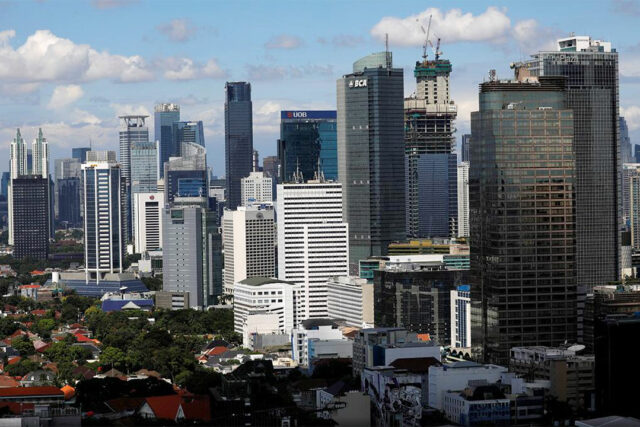
JAKARTA — Indonesia’s economy expanded at its fastest pace in more than a year in the third quarter (Q3), as improved investment and government spending underpinned growth in Southeast Asia’s largest economy.

Gross domestic product (GDP) expanded 5.72% year on year, up from 5.44% growth in the second quarter but below a forecast of 5.89% in a Reuters poll of economists.

Unadjusted for seasonal factors, GDP grew 1.81% from the previous three months, above the 1.62% growth forecast in the poll.

Investment expanded 4.96% annually in the third quarter — at its fastest pace in over a year — while government spending shrank more slowly than in the previous quarter.

Exports expanded nearly 22% year on year in the third quarter, picking up pace from growth of just under 20% in the April-June quarter. Indonesia expects to post the country’s largest ever export earnings in 2022 as the resources-rich country has benefited from rising commodity prices.

While Indonesia’s economy has seen an export boom this year, the outlook looks uncertain as tightening monetary policies across the world and soaring inflation risk derailing the global economy. An economic slowdown in China — Indonesia’s biggest trade partner — and the Bank Indonesia’s own rate-hiking campaign could also cloud the country’s growth prospects.

“Indonesia’s economic activity will tend to decline in the 4Q22 period, in line with the current declining global conditions … as well as a restrained increase in purchasing power due to inflationary pressures,” said Myrdal Gunarto, an economist at Maybank Indonesia.

He said the “strong” third-quarter figures reflected the normalization of economic activities after the easing of COVID-19 restrictions earlier this year.

Bank Indonesia has raised interest rates by a total of 125 basis points since August to contain inflation, which hit a seven-year high in September after the government raised subsidized fuel prices that month.

Finance Minister Sri Mulyani Indrawati has said the government would work to maintain Indonesia’s position as a relative “bright spot,” but warned about the impact of a potential global recession.

Growth accelerated in the manufacturing, transport, warehousing and hospitality industries; the data also showed. — Reuters

Ukraine braces for power blackouts, fresh Russian attacks on infrastructure

Army soldier figurines are displayed in front of the Ukrainian and Russian flag colors background in this illustration taken, Feb. 13, 2022. — REUTERS/DADO RUVIC/ILLUSTRATION

KYIV — Ukraine is bracing for fresh Russian attacks on its infrastructure, President Volodymyr Zelensky said Sunday, after Kyiv’s mayor urged residents to prepare for a worst-case scenario by making emergency plans to leave town and stay with friends or family.

The country faced a 32 percent deficit in projected power supply Monday, Sergei Kovalenko, CEO of YASNO, a major supplier of energy to the capital, said on his Facebook page.

“This is a lot, and it’s force majeure,” he said. Meanwhile national energy authorities warned of planned outages but also possible further restrictions in the capital and the region around it as well as six further regions of the country.

The warnings followed remarks by Kyiv Mayor Vitali Klitschko urging residents to “consider everything” including a worst-case scenario where the capital loses power and water.

“If you have extended family … or friends outside Kyiv, where there is autonomous water supply, an oven, heating,” he said in a weekend television interview, “please keep in mind the possibility of staying there for a certain amount of time.”

Mr. Zelensky said in his nightly video address that more than 4.5 million consumers were already without power.

“We also understand that the terrorist state is concentrating forces and means for a possible repetition of mass attacks on our infrastructure,” he said. “First of all, energy. In particular, for this, Russia needed Iranian missiles. We are preparing to respond.”

Zelensky did not elaborate on his statement that Russia needed Iranian missiles to target Ukraine’s energy infrastructure.

Iran acknowledged for the first time Saturday that it had supplied Russia with drones Moscow has been using to target power stations and civilian infrastructure but said it did so before the war. Iran’s foreign minister also denied Iran had provided Russia with missiles.

Ukrenergo, the grid operator, said power consumption would have to be cut by 30 percent. — Reuters

South Korea’s Yoon apologizes for deadly Halloween crush, vows justice

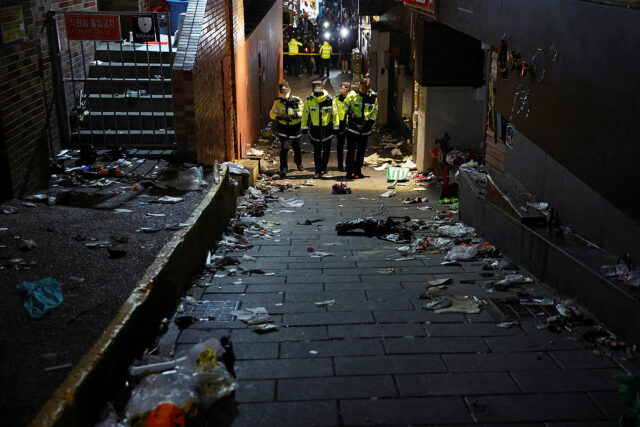
POLICE OFFICERS walk at the scene where many people died and were injured in a stampede during a Halloween festival in Seoul, South Korea, Oct. 30, 2022. — REUTERS

SEOUL — South Korean President Yoon Suk-yeol apologized on Monday for the deadly Halloween crush in Seoul, pledging to hold to account any officials found to be responsible for sloppy responses and to reform police and safety management systems.

The Oct. 29 crush killed 156 people, mostly in their twenties and thirties, and injured another 197 when revelers flooded the narrow alleyways of the popular nightlife district of Itaewon to celebrate the first COVID-19 curbs-free Halloween festivities in three years.

Mr. Yoon offered the apology during a meeting to review safety rules, as the country continues to mourn the crush victims. An investigation is under way into authorities’ responses to the accident.

“I do not dare to compare myself to the parents who lost their sons and daughters, but as the president who ought to protect the people’s lives and safety, I am heartbroken,” he said.

“I am sorry and apologetic to the bereaved families who are suffering an unspeakable tragedy, and to the people who share the pain and sorrow.”

Police have faced stringent public criticism and scrutiny over its responses during the tragedy, having dispatched just 137 officers to the area despite estimating in advance as many as 100,000 people would gather.

Last week, transcripts of several emergency calls made from the hours leading up to the accident showed that people had warned of a potential crush and urged interventions.

Mr. Yoon initially ascribed the authorities’ poor handling to flaws in the country’s crowd management and safety regulations. Following the reports of the call transcripts, however, he sharply rebuked the police and apologized to the victims and wider public.

At Monday’s safety meeting, he vowed to overhaul the national safety management system, carry out a thorough investigation and bring those responsible for failings to account.

“In particular, extensive reform is needed in the police work, which is essential to preparing for danger and preventing accidents, in order to protect the safety of the people,” Mr. Yoon said.

National Police Commissioner General Yoon Hee-keun told parliament on Monday that more officers were dispatched than compared to pre-COVID-19 years and the 137 would have been sufficient to manage crowds of similar scale in general, but authorities could not expect that people would be concentrated into alleyways.

Opposition lawmakers demand the police chief and the interior minister be sacked. Mr. Yoon has rejected such calls. — Reuters

US Powerball jackpot climbs to record-breaking $1.9 billion

TIMIS ALEXANDRA-UNSPLASH

AN ALREADY record-breaking US Powerball jackpot grew to a whopping $1.9 billion one after no one secured a winning ticket in Saturday night’s drawing, according to lottery officials.

The estimated $1.6 billion that was up for grabs on Saturday had been the largest lotto prize ever offered, Powerball said.

To win the big prize, a player must guess all six lucky numbers, including the final “Powerball.” The winning numbers drawn on Nov. 5 were 28,45,53,56,69 and the Powerball 20.

The next chance for ticket buyers to clinch the jackpot will be Monday’s draw, although they would have to overcome the steep odds of 1 in 292.2 million to secure a win.

No one has won the jackpot since Aug. 3, when a lucky ticket holder from Pennsylvania took home over $200 million, according to Powerball.

The prize money has since mushroomed, generating lots of business at gas stations and newsstands around the United States, where Americans buy Powerball tickets for $2 a pop.

Winners may decide to receive their money as an annuity, paid in 30 graduated payments over 29 years, or a lump sum cash payment. Both types of winnings are subject to federal and local taxes. — Reuters

Once again, Malaysia’s Anwar bids to become prime minister

REUTERS

TAMBUN — After two decades as opposition leader, Malaysia’s Anwar Ibrahim was poised to finally become prime minister in 2020. But his alliance collapsed from infighting, leaving him as far away as ever from the top job.

Now, Anwar, 75, is hitting the national campaign trail again, trying to convince Malaysians to vote for him in the Nov. 19 election as he looks to finally fulfil his long-held dream of becoming prime minister.

He was in his element on the stump: joking with supporters as he peppered his speech with Quranic verses and Malay folklore to condemn his rivals and burnish his leadership credentials.

“I’m optimistic,” Mr. Anwar told Reuters late on Friday after a packed day of campaigning at his constituency Tambun in west Malaysia, referring to his coalition’s chances of victory and changing the political landscape in multi-ethnic, Muslim-majority Malaysia.

“We are here to emphasize governance and anti-corruption, and rid this country of racism and religious bigotry,” he said.

Mr. Anwar’s alliance faces two other coalitions in the election — one led by incumbent Prime Minister Ismail Sabri Yaakob and the other by former premier Muhyiddin Yassin. There are several other parties in the running, including one founded by another former prime minister Mahathir Mohamad, a factor that is expected to split the votes more than ever before.

Opinion polls predict a tight race with no single party or coalition being able to win a simple majority needed to form the government.

Anwar has support from the ethnic-Chinese and Indian minorities, who form a third of the electorate, and from voters in urban areas. In Tambun town, he attracted hundreds at a campaign stop, with crowds spilling onto the road and the driver of a passing ambulance flashing Mr. Anwar a thumbs-up sign.

But he lacks widespread appeal among majority Malays due to his opposition to affirmative action favoring them and past allegations of sodomy, a crime in Malaysia. Mr. Anwar has spent around a decade in jail on sodomy and corruption charges.

A survey by independent pollster Merdeka Center showed that Mr. Anwar lags behind his two rivals in popularity by 8 to 12 percentage points despite a recent uptick.

However, his multi-ethnic coalition was the most favored by voters at 26%, although nearly 31% were yet to decide who to vote for, Merdeka said. Ismail’s Barisan Nasional coalition came in second at 24%.

NO ALLIANCE
Mr. Anwar said he will not work with Mr. Ismail’s or Mr. Muhyiddin’s coalitions due to “fundamental differences,” despite polls saying that alliances would be necessary to form the next government.

“Any form of coalition will be a major setback because you are having a coalition with essentially racist or Muslim fanatics,” said Mr. Anwar. He also ruled out working with friend-turned-foe Mr. Mahathir.

Barisan is led by a Malay nationalist party. Mr. Muhyiddin’s coalition also prioritizes ethnic Malay interests and includes an Islamist party that has touted shariah law.

Mr. Anwar, who was deputy to Mr. Mahathir when he was prime minister in his first term, came close to the premiership after the opposition defeated Barisan for the first time in Malaysia’s history in the 2018 election. His party had joined hands with Mr. Mahathir amid widespread anger against the government over the multi-billion-dollar 1MDB corruption scandal.

Mr. Anwar was in prison during the 2018 election on what he says were politically-motivated sodomy charges, and later pardoned.

Mr. Mahathir became prime minister and promised to hand over power to Mr. Anwar in two years. Mr. Anwar’s wife took over as deputy prime minister, but the coalition collapsed in 22 months due to infighting over the transition.

Mr. Muhyiddin briefly became prime minister but Barisan came back to power in 2021 with Mr. Ismail at the helm as part of another alliance.

Oh Ei Sun, a senior fellow with Singapore’s Institute of International Affairs, said Mr. Anwar was not likely to get enough Malay support to reach the finish line.

“More of the rural Malay voters will flow back to (Barisan) in particular and Malay parties in general,” he said.

Mr. Anwar is also facing pressure from some in his own coalition to step down and make way for new leadership after over two decades at the helm.

Asked if this election would be his last, Mr. Anwar said he knew his limits.

“Whether I am considered relevant or not in the next few years, that’s for the people to decide,” he said. — Reuters

Pope: Male chauvinism still around, ‘kills humanity’

ANNETT KLINGNER-PIXABAY

ABOARD THE PAPAL PLANE — Pope Francis said on Sunday the fight for women’s rights was a “continuous struggle,” and condemned male chauvinism as deadly for humanity and female genital mutilation as a crime that must be stopped.

Speaking to reporters on the plane returning from a four-day trip to predominantly Muslim Bahrain, he also praised women he has appointed to managerial jobs in the Vatican, saying they had improved things there.

He made no mention of campaigns to let women move on beyond that and become clergy — the pope and his predecessors have said the question of women priests is closed.

Francis was responding to a question about women protesting in Iran but turned to the topic of women’s rights in general.

“We have to tell the truth. The struggle for women’s rights is a continuing struggle,” he said, listing historic struggles such as the fight for the right to vote.

“We have to continue struggling for this because women are a gift. God did not create man and then give him a lapdog to play with. He created both equal, man and woman,” he said.

“A society that is not capable of (allowing women to have greater roles) does not move forward,” he added.

Pope Francis denounced male chauvinism, acknowledging there was still too much of it around the world, including in his native Argentina. “This chauvinism kills humanity,” he said.

He also condemned as a “criminal act” female genital mutilation (FGM), repeating a major call he made in February on the U.N. International Day of Zero Tolerance for Female Genital Mutilation.

According to the United Nations, FGM is concentrated in about 30 countries in Africa and the Middle East but is also practiced by immigrant populations elsewhere. More than four million girls are at risk of undergoing FGM this year, the U.N. says.

He spoke of women he has appointed to managerial roles in the Vatican, mentioning by name Sister Raffaella Petrini, a nun who as the deputy governor of Vatican City is effectively the most powerful woman there.

“I have noticed that every time a woman is given a position (of responsibility) in the Vatican, things improve,” he said.

He also cited the impact of five women he appointed to a department that oversees Vatican finances.

“This is a revolution (in the Vatican) because women know how the find the right way to go forward,” he said.

Francis also has appointed women as deputy foreign minister, director of the Vatican Museums, deputy head of the Vatican Press Office, as well as four women as councillors to the Synod of Bishops, which prepares major meetings.

The Church teaches that only men can become priests because Jesus chose men as his apostles. — Reuters