Home Blog Page 5502

Bank borrowing remains robust in Q3: Hefty rate hikes to be felt in 2023 — analysts
By Ana Olivia A. Tirona, Researcher

LISTED BANKS saw their loan books increase in the third quarter as the economy further reopened but analysts warned the massive rate hikes to curb multi-year high inflation could dampen this next year.

The Philippine Stock Exchange (PSEi) fell by 6.7% in the third quarter, a slower quarter-on-quarter contraction from the 14.5% in the second quarter but a reversal from the previous year’s 0.7% growth.

Meanwhile, the financials subindex, which includes the banks, grew by 1.7%, slightly reversing the 14.9% decline in the previous quarter and the 6.3% fall in third quarter 2021.

“Most banks reported faster loan growth amid improving economic activity, better lending margins as interest rates rise, and continued downtrend in nonperforming loans (NPLs), which allowed them to substantially reduce provisioning costs. The aggregate impact of these factors boosted bank earnings during the quarter,” BDO Securities Corp. said in an e-mail.

Latest available data by the Bangko Sentral ng Pilipinas (BSP) showed aggregate net income of universal and commercial banks (U/KBs) grew by 45.7% to P227.11 billion as of end-September from P155.86 billion a year ago.

Meanwhile, provision for credit losses by U/KBs fell at a slower pace by 12.3% to P71.29 billion versus the P81.28 billion last year.

Gross total loan portfolio of the big banks also rose to 12.7% annually to P11.31 trillion as of end-September from P10.04 trillion in 2021.

Nonperforming loans ratio further improved to 3.10% in September from 3.19% in August and the 3.99% last year.

Regina Capital Development Corp. Head of Sales Luis A. Limlingan said in an e-mail that main factors which drove listed banks’ stock performance in the period were rate hikes by the Monetary Board and the “non-reimposition of a stricter alert level in the National Capital Region.”

In the third quarter, the Monetary Board raised its interest rates four times. Year to date, a total of 300 basis points (bps) was raised by the central bank to curb high inflation. Since March of this year, the Metro Manila and the rest of the country operated under Alert Level 1.

In another separate interview, Globalinks Securities and Stocks, Inc. Head of Sales Trading Toby Allan C. Arce said the slowing global economy and quickening inflation also influenced the performance of listed banks in the third quarter.

“The banking sector has remained resilient amid shocks on the back of their strong capital positions. The sector’s good capital position and provisioning cushioned against any moderate rise in credit stress from higher inflation and a rising interest rate environment,” Mr. Arce said in an e-mail.

Inflation reached 6.9% in September, a much faster pace than the 4.2% seen in the previous year. In the nine-months to September, headline inflation averaged 5.1%. As of this writing, latest inflation data from the Philippine Statistics Authority reported inflation rose to 8% on November, highest in 14 years since the global financial crisis in 2008.

BANK STOCK PICKS
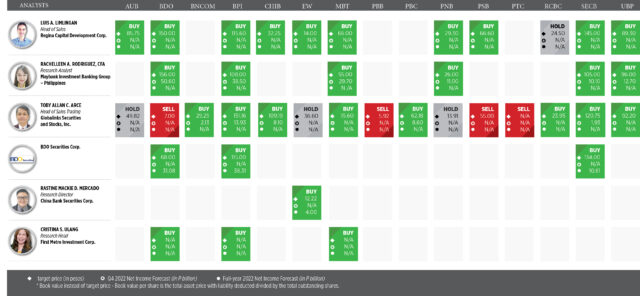
The third quarter saw six out of 16 listed banks stock prices decrease on a quarter-on-quarter basis. The Philippine Bank of Communications (PBC) led with a 27.6% decline in its share price from P17.98 in the previous quarter. This was followed by East West Banking Corp. (EW, -13.9%), Security Bank Corp. (SECB, -11.4%), China Banking Corp. (CHIB, -5.8%), Philippine National Bank (PNB, -5.5%), and Asia United Bank (AUB, -4.0%).

On the other hand, top gainers in the July to September period were Rizal Commercial Banking Corp. (RCB, 10.2%), Bank of Commerce (BNCOM, 10%), UnionBank of the Philippines (UBP, 8.2%), Philippine Business Bank (PBB, 7%), and Bank of the Philippine Islands (BPI, 5.5%).

China Bank Securities Corp. Research Director Rastine Mackie D. Mercado said overall price movement of banks were mixed in the third quarter as the market turned volatile.

“However, price performance between the end of the third quarter to end-November was generally more upbeat as market conditions improved. Furthermore, a robust third-quarter earnings season provided incremental tailwinds, with some banks now trading close to their year-to-date highs,” Mr. Mercado said in an e-mail.

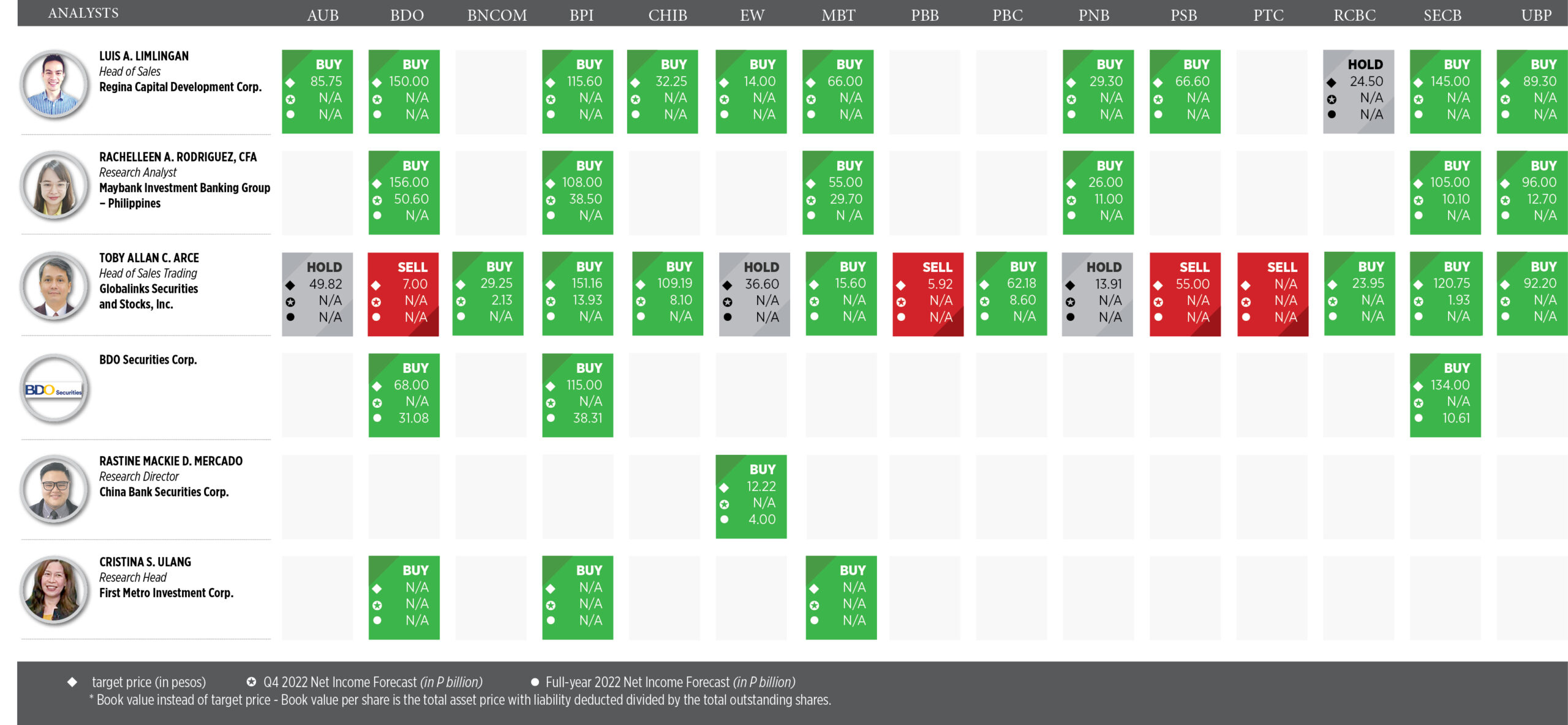
Meanwhile, Rachelleen A. Rodriguez, research analyst at Maybank Investment Banking Group-Philippines, picked out BDO and BPI as outperformers in the July-to-September period.

“BDO’s September-end earnings beat our expectations due to its higher-than-expected fee income. For BPI, although its year-to-date operating income was within expectations, it delivered above-peers loan growth of 15.4% year on year,” Ms. Rodriguez said in an e-mail.

For Cristina S. Ulang, research head at First Metro Investment Corp. (FMIC), Metropolitan Bank & Trust Co. (Metrobank, MBT) was notable due to its consistent “strong capitalization with the highest capital adequacy ratio (CAR) of 18% and earnings growth year-to-date, beating market expectations.”

OUTLOOK
Analysts point out the probable effects of further policy tightening on banks as this could potentially drive net interest margin (NIM).

“Investors should pay close attention to the future actions of the US Federal Reserve and how the BSP will react on such,” Mr. Limlingan said.

“Usually, it paves the way for NIM expansions for banks but at the same time it introduces more odds of having higher bad loans. Additionally, the holiday season is expected to impact the lenders’ performance in the fourth quarter. However, the positive impact that it may have might be deterred by inflation,” Mr. Limlingan added.

The NIM of universal and commercial banks — a ratio that measures banks’ efficiency in investing their funds by dividing annualized net interest income to average earning asset —increased to 3.38% in the third quarter from the 3.29% in the April-to-June period.

Similarly, Ms. Rodriguez sees better NIM expansion in the coming quarters which would be driven by a hawkish US Fed stance and the BSP’s decisions to defend the Philippine peso.

“Nevertheless, we are closely monitoring the impact of a steep and accelerated rate hike on businesses, which may decide to defer expansion plans. This could lead to a deceleration in credit growth, which would heighten competition among banks, ultimately reducing their pricing power or ability to pass on rate hikes. Rising commodity prices is likewise a double-edged sword,” Ms. Rodriguez said.

For Mr. Mercado, U/KBs should refine foreign fund flows as this may lead to better performance.

“Especially against prospects of easing macro uncertainties. Nevertheless, a significant deterioration in offshore market sentiment is likely to still lead to negative spill over effects in the domestic market,” Mr. Mercado said.

“In terms of stock price effect, expectations of a further weakening in the peso may affect foreign funds’ appetite for local equities given that prospective currency returns form part of their total return considerations,” Mr. Mercado added.

Ms. Ulang sees a robust loan spread for banks as interest rates increase while loan demand will continue to pick up due to further economic reopening.

“Retail banking and microfinance are picking up too as banks compete with fintech and small entrepreneurs require higher working capital. Corporate capital expenditure programs continue to be upbeat in step with the strong GDP (gross domestic product) growth which means higher loan demand and need for capital market access, funding raising through IPOs (initial public offering) and bonds,” Ms. Ulang said.

“Only one weak spot is [the] property development lending due to higher mortgage rates, undermining affordability of housing loans and higher construction cost nudging up residential unit prices,” she added.

However, Mr. Arced said loan demand would be dampened by further monetary policy tightening as inflation continues to increase.

“But banks should see improved margins as loans are repriced, which will sustain healthy revenue growth for the full year. Large banks are in a good position to weather incremental asset quality weakness resulting from higher interest rates over the next 12 months, supported by their loan loss buffers. Therefore, an improving outlook on the banking sector is maintained,” Mr. Arce said.
How PSEi member stocks performed — December 16, 2022

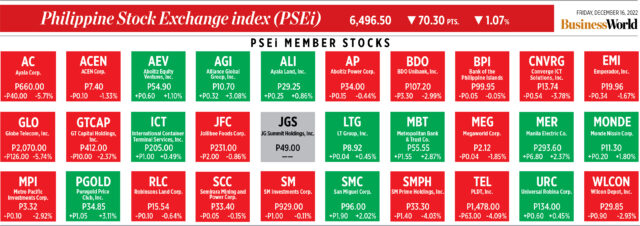
Here’s a quick glance at how PSEi stocks fared on Friday, December 16, 2022.


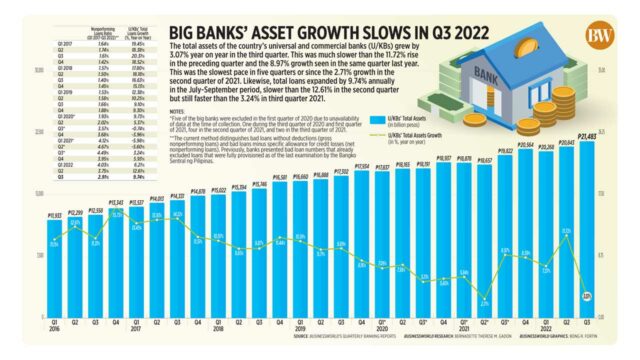
Big banks’ asset growth slows in Q3 2022

THE COUNTRY’S biggest banks reported slower annual growth in assets and loans in the third quarter of 2022. Read the full story.

Big banks’ asset growth slows in Q3 2022

Bargain hunting seen amid Fed, BSP rate bets

BW FILE PHOTO

THE MARKET may see bargain hunting this week due to dampened investor sentiment and expectations of further interest rate hikes.

On Friday, the benchmark Philippine Stock Exchange index (PSEi) fell by 70.30 points or 1.07% to end at 6,496.50 points, while the broader all shares index went down 30.76 points or 0.89% to close at 3,400.13. 

Week on week, the PSEi dropped 83.62 points or 1.27% versus its close of 6,580.12 on Dec. 9. 

For this week, analysts said investors may pick up bargains.

“We may see bargain hunting [this] week following [last] week’s decline. However, the market is still expected to go through a rough path as monetary outlooks weigh on growth prospects, which in turn may still cloud sentiment,” Philstocks Financial, Inc. Senior Research Analyst Japhet Louis O. Tantiangco said in a mobile phone message.

“The Federal Reserve’s policy outlook poses recession risks on the US which may spill over to the rest of the global economy. Meanwhile, the Bangko Sentral ng Pilipinas (BSP), which is still on a tightening path, may slow down our local economic growth,” he added.

The US Federal Reserve last week hiked its benchmark overnight interest rate by 50 basis points (bps) to the 4.25%-4.5% range and projected it could go up to 5%-5.25% next year.

The US central bank has now raised borrowing costs by 425 bps since March.

Meanwhile, the BSP raised benchmark interest rates by 50 bps at its meeting on Thursday, bringing its policy rate to 5.5%. Rates on the central bank’s overnight deposit and lending facilities were likewise raised to 5% and 6%, respectively.

The Philippine central bank has now raised rates by 350 bps since May.

Chiefs of both central banks said last week that they need to tighten further to bring down elevated inflation.

Online brokerage 2TradeAsia.com likewise said in a market note that bargain hunting is expected in the upcoming trading week. 

“Last-minute shopping for beaten down plays in the last few sessions of 2022 might prove itself rewarding, as intraday volumes tend to get thinner around the holidays and there is more opportunity to quietly snap some bargains,” it said. 

“Sentiment weakened alongside the Fed’s and the BSP’s 50-bp rate hikes, as the former hinted of a more hawkish 2023 that what was initially expected,” it added. 

Mr. Tantiangco said the PSEi’s major support is at 6,400, while major resistance is at 6,600.

“Last week, the market has fallen below its 200-day exponential moving average. If it is unable to get back above the said line in the immediate term, then we may see more bearish movements from the market moving forward,” Mr. Tantiangco said. 

2TradeAsia.com said the PSEi’s immediate support is seen at 6,350-6,400, while resistance is at 6,600. — R.M.D. Ochave

Peso likely to move sideways on rate hike bets

BW FILE PHOTO

THE PESO is expected to move sideways against the dollar this week as both the US Federal Reserve and the Bangko Sentral ng Pilipinas (BSP) are likely to continue hiking rates to bring down inflation.

The local unit closed at P55.56 per dollar on Friday, rising by 12.5 centavos from its P55.685 finish on Thursday, Bankers Association of the Philippines data showed.

However, week on week, the peso weakened by 19 centavos from its P55.37 close on Dec. 9.

The peso opened Friday’s session weaker at P55.85 per dollar. It dropped to as low as P55.88, while its intraday best was at P55.56 against the greenback, which was also its closing level.

Dollars exchanged dropped to $902.27 million on Friday from the $1.055 billion recorded on Thursday.

The peso strengthened on Friday on the back of seasonal dollar inflows as the holidays draw near and as the BSP kept the door open for further rate hikes, a trader said in a Viber message.

The Philippine central bank on Thursday raised its benchmark interest rate to its highest in 14 years and signaled more tightening to bring inflation back within its target.

The Monetary Board increased its overnight borrowing rate by 50 basis points (bps) to 5.5%. The rates on the BSP’s overnight deposit and lending facilities were also increased to 5% and 6%, respectively.

Since May, the central bank has increased borrowing costs by a cumulative 350 bps.

The move followed a 50-bp hike by the Fed at its Dec. 13-14 meeting, which brought its own policy rate to 4.25-4.5%. The Fed has raised borrowing costs by 425 bps since March.

BSP Governor Felipe M. Medalla on Friday said the Monetary Board will likely continue hiking borrowing costs next year to ensure that inflation will return to its 2-4% target range next year.

Rizal Commercial Banking Corp. Chief Economist Michael L. Ricafort said in a Viber message that the peso ended stronger on Friday amid the seasonal increase in remittances and holiday spending.

He added that the downward correction in global crude oil prices supported the peso.

Oil fell by more than $2 per barrel on Friday, with Brent crude futures settling at $79.04 per barrel, down $2.17 or 2.4%, while West Texas Intermediate futures fell by $1.82 or 2.4% to settle at $74.29 per barrel.

For this week, UnionBank of the Philippines, Inc. Chief Economist Ruben Carlo O. Asuncion said the peso could move sideways as the Fed also hinted at further tightening, which could support the dollar.

Fed Chair Jerome H. Powell on Wednesday said the US central bank will deliver more interest rate hikes next year to get a firmer grip on inflation.

Still, the BSP’s own hawkish stance will provide some support for the peso, Mr. Asuncion added.

Mr. Ricafort said the release of balance of payments data on Monday will affect peso-dollar trading.

“The seasonal surge in remittances and conversion to pesos to finance the seasonal increase in holiday spending will factor into this week’s peso movement, especially with measures to further reopen the economy, including the optional wearing of face masks,” he added.

For this week, Mr. Ricafort expects the local unit to move from P55.30 to P55.80 per dollar, while Mr. Asuncion gave a wider forecast range of P54 to P56. The trader said the peso might move from P55 to P56 this week. — A.M.C. Sy

Agriculture industry lobbies for ‘mandatory’ Maharlika allocation

THE AGRICULTURE industry said it is hoping to capture as much as 30% of the proposed sovereign wealth fund’s investable capital, saying that the wealth fund will draw away funding from the farm sector.

Danilo V. Fausto, president of the Philippine Chamber of Agriculture and Food, Inc. (PCAFI), told reporters Friday, “We demand a mandatory Maharlika Investment Fund share for agriculture productivity.”

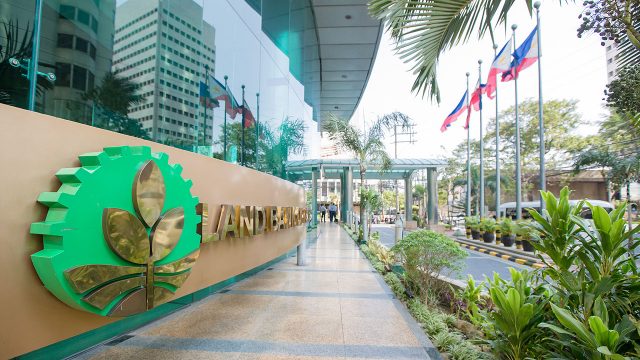
Mr. Fausto said 25 to 30% of any “activity, investment or investable funds” of the MIF should go to agriculture, because Maharlika draws its funding in part from the Land Bank of the Philippines (LANDBANK) and the Development Bank of the Philippines (DBP).  

“These are our agricultural banks. I do not see in the Maharlika Investment Fund anything on the agricultural sector. I want to make it mandatory in the law that a portion of that fund should be invested in the agricultural value chain,” Mr. Fausto said.

Last week, the House of Representatives approved on third and final reading the Maharlika bill, with 279 legislators voting in the affirmative and six against.

The Maharlika bill, or House Bill (HB) No. 6608, had been certified as urgent by President Ferdinand R. Marcos, Jr.

The bill lists as “allowable investments” foreign currency, metals, fixed-income instruments, domestic and foreign corporate bonds, equities, real estate, infrastructure projects, loans and guarantees, and joint ventures or co-investment projects.

The initial capital of the Maharlika fund will be put up by LANDBANK, the DBP, and Bangko Sentral ng Pilipinas (BSP).

Mr. Fausto noted that the government should focus on agriculture because it will “certainly generate profit.”

“If you put it in processing, milling, drying, logistics, it will make money and I suggest it should not be run by the government,” Mr. Fausto added.

The proposed MIF also generated backlash after the initial involvement of pension funds in putting up the capital and the designation of the President as chairman of the fund’s board.  

On Dec. 15, legislators agreed to remove the Government Service Insurance System (GSIS) and Social Security System (SSS) as Maharlika funders. — Ashley Erika O. Jose

Hybrid exclusion from zero-tariff policy meant to spur EV charging station development — BoI

REUTERS

HYBRID vehicles were excluded from zero-tariff treatment because their widespread adoption could delay the development of charging infrastructure for electric vehicles (EVs), the Board of Investments (BoI) said.

Ceferino S. Rodolfo, Trade undersecretary and Board of Investments (BoI) managing head, said:

“We want to develop the infrastructure, the charging stations. The problem with hybrid (vehicles) is that most of them will not need any charging stations,” Mr. Rodolfo told reporters last week.

“The charging stations would not be developed if hybrid vehicles (are allowed for import at zero tariffs). Pure EVs… would spur investment in charging stations,” he added.

The National Economic and Development Authority (NEDA) Board announced in November that it endorsed the issuance of an executive order (EO) that would lower the most favored nation tariff rates to zero percent on imported completely built-up units of EVs for a five-year period.  

The endorsed EO did not include zero tariffs for imported hybrid vehicles.

Once signed by President Ferdinand R. Marcos, Jr., the zero tariffs will cover electric passenger cars, buses, mini-buses, vans, trucks, motorcycles, tricycles, scooters, and bicycles. The current tariff rates for EVs range from 5% to 30%.

According to the NEDA Board, the EO seeks to expand market sources, boost adoption of EVs, and reduce the dependence on imported fuel.

Mr. Rodolfo added that the decision to exclude hybrid vehicles is in line with the government objective of attracting investment in the local production or assembly of EVs.

“Our ultimate goal is for local assembly, the manufacturing of electric vehicles, which will be leveraging our abundance of green metals, which we want to further add value to. Add to that our strength in software development and strength in electronics manufacturing,” Mr. Rodolfo said.  

Mr. Rodolfo said that the decision not to include hybrid vehicles is still subject to review in the draft EO.

“The decision of the NEDA Board is to provide a review clause. After one year, we will review the coverage of the products in the EO,” Mr. Rodolfo said.  

Foreign business chambers have urged the government to reconsider the EO and include hybrid in the zero-tariff order.  — Revin Mikhael D. Ochave

Moody’s Analytics says lack of capital formation recovery a drag on Philippine growth potential

PHILSTAR FILE PHOTO

MOODY’S ANALYTICS said that while parts of the Philippine economy have shown signs of recovery, capital formation continues to lag, possibly signifying economic scarring over the medium term.

Moody’s Analytics said it now sees the Philippines’ medium-term growth potential at 6%, down from 6.6 % previously, due to the delayed recovery in investment to pre-pandemic levels.

“In the midst of the ongoing recovery, gross fixed capital formation (GFCF) has yet to be restored to pre-pandemic levels, contributing to our view that potential growth may have deteriorated to around 6%,” Moody’s Senior Vice President and Manager Christian de Guzman said to BusinessWorld.

The Philippine Statistics Authority (PSA) estimates GFCF at $21.534 billion in the third quarter, well below the $28.279 billion posted in the last pre-pandemic quarter ending December 2019.

The 6% outlook is supported by other signs of recovery, like the 4.5% unemployment rate, which is below the 4.6% rate reported in the quarter ending December 2019.

“Labor market indicators — such as employment and, conversely, unemployment — have largely recovered, mirroring the very healthy rates of growth since the economy accelerated its reopening in late 2021,” Mr. De Guzman said

“However, there has been a partial reversal of the pre-pandemic gains in poverty reduction, suggesting that the financial health of a number of households has not been restored,” he added.

Moody’s Analytics added that this may be in part to to a greater share of workers involved in “elementary occupations,” or informal work, compared to the period before 2020.

Moody’s Investment Service has said in a report that the duration of pandemic restrictions means large portions of the school-age population were deprived of formal education with inadequate access to computers, broadband internet and other tools needed to facilitate remote learning.

“If not fully addressed, the lack of a significant catch-up in educational outcomes would weigh on the competitiveness of the Philippine economy in relatively high-skilled sectors, such as business process outsourcing,” the report said.

“Against this backdrop, higher inflation could further undermine household balance sheets and dampen the outlook for continued employment growth,” Mr. De Guzman said.

“The primary driver of economic scarring for the Philippines has been the combination of the deep recession in 2020 on account of one of the longest and strictest containment regimes in the region, and the delayed reopening of the economy. These factors highly impacted consumption, which is still the most important driver of Philippine growth, and investment as mentioned above,” Mr. De Guzman told BusinessWorld. — Aaron Michael C. Sy

BCDA, Singapore agency promote New Clark City to SME investors

NEW CLARK CITY

THE BASES Conversion and Development Authority (BCDA) and Enterprise Singapore said they promoted New Clark City to investors from the information and communications technology (ICT) and smart city industries.

In a statement over the weekend, the BCDA said that together with Enterprise Singapore, they conducted a second round of business-to-business and industry-focused meetings with urban development leaders in Singapore.

Enterprise Singapore is an arm of the Ministry of Trade and Industry. Its mission is to support Singapore small and medium enterprises (SME) and boost enterprise development.  

The companies met by the BCDA and Enterprise Singapore include those involved in ICT, diversified environmental services, engineering, aviation solutions, and smart city technologies.

Some of the New Clark City projects pitched during the meetings include the common ICT infrastructure network, the data center colocation facility project, the New Clark City affordable housing project, the New Clark City estate and facilities management services, and the operations and maintenance of New Clark City’s sports facilities.

“As urbanization continues, we at BCDA understand that smart city technologies and public transport solutions are important in realizing a sustainable and inclusive future for New Clark City. We are very fortunate to partner with Enterprise Singapore who helps us forge connections with some of the global urban mobility and smart city leaders,” BCDA President and Chief Executive Officer Aileen R. Zosa said.  

“Through their expertise and experience, we will be able to embed global best practices not just in New Clark City but across all the infrastructure projects we are developing,” she added.

In September, the BCDA and Enterprise Singapore signed a memorandum of a understanding (MoU) on collaboration with regard to investment opportunities in New Clark City, technology exchange, and bilateral promotion of businesses.

“The MoU with Enterprise Singapore enables the BCDA to increase its understanding of emerging technologies and solutions used in urban development via knowledge sharing and awareness building activities. The MoU also facilitates access for Singapore companies and relevant stakeholders interested to partner in the development of New Clark City,” the BCDA said. — Revin Mikhael D. Ochave 

DoJ clears power co-ops for tax exemptions without needing to register with regulator

PHILSTAR

The Department of Justice (DoJ) said all electric cooperatives may apply for tax exemptions without prior registration with the Cooperative Development Authority.

In a six-page legal opinion dated Dec. 13 addressed to Energy Secretary Raphael Perpetuo M. Lotilla, the DoJ said registration with the CDA is not specified as a requirement by the National Electrification Administration Reform Act (NEA) of 2013.

“Notably, no other requirement for the availment of these preferential rights, other than the compliance of electric cooperatives with the financial and operational standards set by the NEA, like the supposed CDA registration, is mentioned in the law,” Justice Secretary Jesus Crispin C. Remulla said in the opinion.

He added that the law does not conflict with the local government code (LGC).

Under the NEA law, electric cooperatives that comply with financial and operational standards enjoy preferential rights that include tax exemptions. Cooperatives are also given the option to remain non-stock and non-profit under the law.

Mr. Remulla said that incentives specified by the law should be made available to all cooperatives as long as they comply with the standards.

The DoJ overturned its 2014 opinion that said electric cooperatives are still liable to pay local taxes and real property taxes.

It previously said that non-stock cooperatives may not avail of preferential rights under the LGC since it said the NEA law had required them to register with the CDA.

The Dec. 13 opinion stemmed from separate requests of former Energy Secretary Alfonso G. Cusi, Philreca Party-List Rep. Presley C. De Jesus and APEC Party-List Rep. Sergio C. Dagooc to revisit the DoJ’s 2014 opinion.

Mr. Remulla said a review of the NEA law showed that only compliance with financial and operational standards was required to avail of the preferential rights.

The Justice secretary noted that the DoJ’s current position is in line with NEA’s goal of empowering electric cooperatives to deal with changes in the power industry.

“Thus, when Congress enacted the NEA Law, which extends preferential rights being enjoyed by cooperatives registered with CDA to electric cooperatives, there nothing to amend in the (LGC) there being no conflict between these laws,” he said.

“It must be emphasized that the opinion of the Secretary of Justice is merely advisory in nature, such that the same need not bind the requesting agencies or parties if it be their pleasure.” — John Victor D. Ordonez

Cybersecurity as a board priority

Cybersecurity came to the forefront of critical concerns when companies had to shift to remote working at the height of the pandemic. Businesses continued to accelerate their transformation to address disruption, but many did not consider cybersecurity as part of the decision-making process — likely due to business urgency or oversight. As a result, as much as 73% of Asia-Pacific businesses saw an increase in disruptive attacks, according to the EY Global Security Survey 2021 (GISS), with new vulnerabilities entering the rapidly evolving business environment.

The industrialization of cyberattacks led to an increase in their volume and severity, but Chief Information Security Officers (CISOs) are faced with challenges that inhibit the cybersecurity function. These include inadequate budgets, which can be seen in the cyber spend of Asia-Pacific businesses totaling only 0.05% of their annual revenue, according to the GISS. This cost-cutting has severe implications, as the GISS reveals that 41% of businesses in the APAC region expect major breaches that could be anticipated and averted with better investment. There is also a lack of preparedness due to the limited visibility of cyber risk within an organization, coupled with outdated or disparate regulations.

The GISS further shows that CISOs demonstrate a lack of confidence when faced with threat actors. Cybersecurity strikes a fine balance between usability, security and cost, but it is only possible if the board is proactively testing and challenging the existing status quo.

BOARD RESPONSIBILITIES TOWARDS CYBERSECURITY
Board members must review the company organizational structure to ensure that the cyber security function is adequately represented, and should promote systemic resilience and collaboration to account for risks stemming from broader industry connections. They should encourage a continuous analysis of comparative metrics, such that industry-accepted cyber frameworks guide data driven decisions, aligning risk appetite with organizational goals and strategy. It is imperative to understand tomorrow’s cyber threats today by proactively investigating emerging threats.

Board directors will have to identify their business-critical systems and data, and how their criticality is assessed. They are responsible for key business risks per local applicable Corporations law requirements. In some jurisdictions such as Oceania, directors are now required to take all reasonable steps to be in a position to “monitor and guide” the company and have information made available to them to exercise their responsibilities.

The board must also determine how effective the controls protecting their critical systems and data are, and how often these are tested. In addition, they have to be aware of how their current data privacy and data retention policies align with government and industry regulations, and how third-party suppliers are protecting the company systems and data. Moreover, cyber investments must be focused on mitigating the risk scenarios that the company would be most exposed to.  In case of a cyber incident, there has to be an organization-wide response plan capable of addressing it, where employees understand their roles in managing the crisis.

It is the responsibility of directors to consider proactive management of the risks associated with critical assets and data to maintain market and consumer trust, as well as adhering to legislative obligations or best practice expectations to secure personal information.

Thus, it is important to hear from external sources, not just management, about the potential threats and the independent assessed level of controls currently in place. While management can provide updates on the status of the company’s cybersecurity programs, an independent party can help the board gain assurance that the programs are adequate with respect to the existing cyber threats that the company is facing.

CYBERSECURITY INSIGHTS FOR BOARDS TO CONSIDER
According to the EY Global Risk Survey (2020), boards stay updated through external advisors or industry analysts (40%), interactions with or data on peer companies (32%), and through management briefings (20%). Almost half of the surveyed respondents consider unfavorable economic conditions, cyber incidents and the pace of technology change to be their top risks.

In light of this, there are several insights gleaned through director dialogues held through the survey. One is to set the cultural tone — boards must demonstrate that cybersecurity and privacy risk are critical business issues by increasing the board and/or committee’s time and effort spent discussing the topic. They must also stay updated by increasing the frequency of board and/or committee updates on specific actions to address new cybersecurity and privacy issues and threats.

Moreover, boards must understand the necessary protocols. They have to obtain a thorough understanding of the cybersecurity incident and breach escalation process and protocols, including a defined communication plan for when the board should be notified. By understanding the processes of management to identify, assess and manage the risk associated with service providers and supply chains, they can better manage third party risk. Boards also have to test response and recovery by enhancing enterprise resilience and having the company’s ability to respond and recover tested through simulations and arranging protocols with third-party professionals before a crisis. Lastly, boards must monitor evolving practices. They should stay attuned to evolving board and committee cybersecurity oversight practices and disclosures, including benchmarking against peer disclosures for the last two to three years.

SUCCESSFUL AND SECURE TRANSFORMATION
Boards must have a clear understanding of the company’s cybersecurity program and how they are effectively implemented to address immediate and near-term cyber threats.  Fortifying cyber resilience requires boards to act decisively as major pressures threaten the ability of cybersecurity to effectively address potential risks. They must play an active role in bringing cybersecurity to the rest of the business. By taking more time to discuss cybersecurity risks, the board can send a clear message that the cybersecurity function is a strategic business partner, and that the risks involved are critical business issues. Not only will this help the cybersecurity function work more effectively with the business, but it will also help the function execute transformation programs that are successful and cyber secure.

This article is for general information only and is not a substitute for professional advice where the facts and circumstances warrant. The views and opinion expressed above are those of the author and do not necessarily represent the views of SGV & Co.


Warren R. Bituin is the Technology Consulting Leader of SGV & Co.

PHL given 3 months to comply with EU standards on seafarers

SEAFARER OATHTAKING — MARINA.GOV.PH

THE PHILIPPINE Maritime Industry Authority (Marina) on Sunday gave assurance that it is working to improve the country’s standards on seafarer training and certification as President Ferdinand R. Marcos, Jr. announced on Saturday that the country had been given three months to comply with European Union (EU) standards.

“Marina is doing its best and exploring all possible measures,” Marina Officer-in-Charge Samuel L. Batalla said in a Viber message.

He said among the steps taken include “technical cooperation projects and bilateral agreements, to sustain the recognition of the European Union to the STCW ( Standards of  Training Certification and Watchkeeping for Seafarers) certificates issued by the Philippines to seafarer officers.”

The president, during his visit to Brussels for the ASEAN-EU Commemorative Summit last week, ordered the creation of an advisory board that would address concerns relating to Filipino seafarers.

The Philippines was given three months from the creation of the advisory board by the European Commission to remedy all the deficiencies pointed out by the European Maritime Safety Agency (EMSA), Mr. Marcos noted in his return speech from Belgium streamed live on Facebook.

EMSA raised the issues following an inspection in March.

Mr. Batalla noted that the president invited Marina to a Cabinet meeting on October 11 to work on improving the accreditation of seafarers.

This was the first time the agency was invited to a Cabinet meeting since its creation in 1974, he said.

EMSA’s review pointed out that Marina and the Commission on Higher Education had failed to ensure that all training and assessment activities were administered in compliance with global maritime standards.

Since the assessment, Marina has been holding workshops with its partner institutions to cooperate on the maritime industry’s shortcomings, Mr. Batalla said.

Almost 50,000 Filipino seamen working in European vessels could lose their jobs if the Philippines did not address these deficiencies, the EU agency noted.

Filipino seafarers sent home $6.5 billion in remittances last year, according to the Bangko Sentral ng Pilipinas.

The United Nations Conference on Trade and Development said in a report last year that the Philippines was the top global provider of seafarers.

The proposed advisory council will be made up of various government agencies with the goal of preventing job losses of almost 600,000 Filipino seafarers worldwide.

“As part of the whole of government approach, Marina involved and consulted with all concerned stakeholders on the corrective actions being undertaken by the Maritime administration,” Mr. Batalla said. — John Victor D. Ordoñez