Home Blog Page 5422

Don’t worry about being happy

JACQUELINE MUNGUIA-UNSPLASH

I’M ALL for life and liberty. But the pursuit of happiness? In penning his famous line in 1776, Thomas Jefferson may have been spot-on about unalienable rights. But as a life coach — which, admittedly, he wasn’t claiming to be — he and the entire Western Enlightenment caused lasting and unquantifiable damage.

As the festive and allegedly soulful season approaches, I want to take some pressure off of you. Happiness shouldn’t be your goal, nor is it the point of life. In fact, dwelling on it will only make you and others miserable. So don’t worry about it.

The Western tradition wasn’t always fixated on happiness. Aristotle, for one, set off in a more mature direction, by contemplating the “good life” more broadly and the role in it of eudaimonia. Regularly mistranslated as “happiness,” that word in fact means “good spirit.”

What Aristotle had in mind had nothing to do with smiley faces, and lots to do with what we would call flourishing. Basically, he viewed the good life as fulfilling your purpose, whatever that may be. If you’re a knife, you cut; if you’re Aristotle, you think; if you’re me, you write and parent.

Another way of thinking about purpose might be duty. Aeneas, as Virgil described the Trojan hero, was rarely happy and often wretched. But he was “pius” — meaning dutiful; the connotation “pious” came much later — and therefore lived well.

There’s absolutely no need to make this notion either complicated or epic. Ralph Waldo Emerson brought Aristotle right down to earth: “The purpose of life is not to be happy. It is to be useful, to be honorable, to be compassionate, to have it make some difference.”

Of course, people who strive to live an Aristotelian life also pause occasionally to ponder where they are on their paths, just as seasoned travelers like to look back on their peregrinations. And then, for fleeting moments, they may feel an uplifting sensation that maybe all of this was, if not always fun, at least worthwhile. Go ahead and call that happiness. But recognize that it’s retroactive, and will be gone again in a jiffy.

That’s because these sporadic warm and fuzzy, or bright and bubbly, feelings usually evaporate as soon as people turn back to the present moment — the famous “Now” of New Age lore. In that here and now, most of us can’t help but notice that life frequently just sucks.

For many people, life offers up a diet of pain, poverty, disease, or hunger. And even when the menu features ease, wealth, health, and cornucopia, people are still stuck with their own minds. And oh, how the human psyche knows to torture. Its tricks range from anxiety to depression, anger, envy, and all the rest.

The Athenian philosophers coming just after Aristotle understood this and therefore tried to refine notions about the good life. The results were Stoicism, Epicureanism, Skepticism and Cynicism — in their original, not their modern, senses, mind you. But the Hellenistic thinkers too weren’t really aiming at happiness as such. Their goal was instead equanimity.

The world champions of thinking about the mind and equanimity were the Buddhists. The first of their four noble truths states that life is duhkha. This is usually translated as “suffering” but means something closer to unease or discomfort. According to yoga scholar T.K.V. Desikachar, the etymology ultimately comes from the Sanskrit for “dark chamber.”

Basically, Buddhism recognizes that our natural state resembles being in a dark space, something like the opposite of happiness. The blame for that, again, belongs to the mind. Even if we’re momentarily happy, for example, we’ll be unhappy as soon as that high is gone. And then we’ll forever crave another hit of happiness, like junkies needing their next fix.

The rest of Buddhism basically elaborates how — sort of, maybe, possibly — we can get ourselves “at ease” again. That involves observing the mind doing its stuff — by watching, but not judging, our thoughts. One thing meditators eventually notice is that bad emotions enter the mind but also leave it again just as easily. So Buddhists practice politely seeing their inner nasties to the door and letting them go.

If all goes well, a person can eventually climb out of the dark chamber into a permanently lit place. But that’s rare. And the Sanskrit words for that experience don’t exactly translate to happiness either. Instead they have meanings like liberation, release, emptiness, or even “being blown out” (nirvana) like an extinguished candle. Enlightenment, in short, is quite a different idea in East and West. As an unalienable Jeffersonian right, the pursuit of being blown out doesn’t cut it.

Having forgotten the legacy of the ancient Greeks and at best dabbled in Eastern thought, we in the West therefore went in a different direction. Sometimes we equate happiness with the bouncy optimism of Pollyanna, the title character in an American novel from 1913. More generally, it implies cheer and joy no matter what’s going on. As that most annoying of songs puts it: “Don’t Worry, Be Happy.”

The psychology behind such Hallmark-Card happiness falls somewhere between denial, escapism, and self-deception. At one extreme, putting on a happy face when your situation objectively leaves much to be desired might make you stop or delay planning, saving, getting an education, sobering up, or getting fit, thereby pre-programming future misery.

The modern happiness cult has other pernicious side effects. It leads to what some authors call a “Happycracy” or “Toxic Positivity.” That’s when the onus of not just pursuing but actually catching up with happiness falls on the individual person. If you’re not happy, you must be doing something wrong. It’s your fault.

That’s a lot of pressure, and causes a lot of guilt — moving you even further away from happiness. Often, it’s also downright, if inadvertently, cruel. The author Whitney Goodman, a psychotherapist, lists some particularly common and inappropriate positivity reflexes when we encounter grief: “You’ll be fine.” “Just smile.” “You have so much to be grateful for.” “Time heals all wounds.” “Be grateful for what you learned.” “It could be worse.”

Spouting cliches such as these borders on sadistic if you’re with somebody who just lost a job, got divorced, had a cancer diagnosis, suffered a miscarriage, got bombed out of Mariupol — or indeed somebody who simply feels lonely and down. The better response to somebody who’s unhappy — in the mirror or across the table — is to validate the pain, making it legitimate.

But we shouldn’t overshoot in the other direction either, by dwelling on the bad that may or may not be yet to come. Unsurprisingly, our foes are once again our own minds. The problem is that in imagining future outcomes, human cognition has evolved a “negativity bias”: For purposes of survival in the ancestral savannas, it was better to assume the worst, whereas natural selection never cared a whit about anybody’s happiness.

That heritage makes us prone to what psychologists call “catastrophizing.” It’s the recurring temptation, especially late at night or when we can’t sleep, to worry about the worst that could happen, rather than picturing more likely scenarios. This can lead to unwarranted and excessive anxiety.

Here’s the advice I’ll try to follow, and not just during the upcoming holidays. First, ignore silly “happiness indices” and other claptrap. Second, strange as it sounds, don’t feel bad if you’re not happy. Third, remember that, like Aeneas, you have more important things to do in this world, so stay focused on those. And fourth, keep watching your own mind, lest it gallop off too wildly in the wrong directions.

I’ll admit the possibility of one other secret weapon: a macabre sense of humor. “Much will be gained,” as Sigmund Freud allegedly put it, “if we succeed in transforming your hysterical misery into ordinary unhappiness.” On that note, Happy Holidays.

BLOOMBERG OPINION

Impunity plus

DYNAMIC WANG-UNSPLASH

Every government official of this country, whether elected or appointed, is supposedly in office in accordance with Constitutional processes. Their power to appoint their subordinates is based on their presumed legitimacy and that of the President, who assumes that post as a result of constitutionally mandated elections.

The President and Vice-President take an oath to “preserve and defend (the) Constitution, execute (the Philippines’) laws, do justice to every man, and consecrate (themselves) to the service of the Nation.” Every government official is bound by the same oath: as the highest official of the land, the President may be said to be speaking for every bureaucrat in all three branches of government.

Preserving and defending the Constitution and doing justice to every man are their common mandate. Both are best achieved by respecting and complying with the provisions of the Constitution. Among the most important, if not the most important of those provisions is the Bill of Rights (Article III, Sections 1 to 22), which limits the powers of government over its constituents and defines the rights to which every citizen is entitled. It makes individual rights the paramount value in Philippine governance.

Among others, those provisions mandate the equal protection of the law; the right to life and to be secure in one’s home; the right to due process and the privacy of communication and correspondence; the inviolability of the rights to free speech, free expression, press freedom, and freedom of assembly and of organization; freedom of religion; the right to information; freedom from torture; the right to be presumed innocent until proven guilty; and the right to hold contrary opinions without being persecuted for them. There is also a ban on the passing of any ex-post facto law and bill of attainder, which protects individuals from prosecution for acts that prior to the enactment of a law were not illegal, and from being penalized without trial.

The 1987 Constitution’s Bill of Rights has been hailed by lawyers, media advocacy groups and political scientists as a major contribution to the defense and enhancement of human rights. Its protection of free expression and press freedom is the envy of independent journalists and media communities in much of Asia where the practice of journalism, unlike in the Philippines, is usually regulated by “press laws.”

Unfortunately, however, what is on paper is hardly what goes on in practice. The Constitution’s Article III has not prevented the worsening of the human rights crisis in the Philippines about which not only human rights defenders but also press freedom watch groups both here and abroad have expressed grave concern.

The principal reason for that crisis is the ruling oligarchs’ use of the power the people have delegated to them to either completely ignore, or interpret according to their personal, familial, and class interests, the meaning and intent of whatever the Constitution and the rest of the country’s laws say. As a consequence, the country’s basic law is becoming, by itself, only “the piece of paper” former President Rodrigo Duterte described it in 2019, when he expressed his contempt for human rights and in effect sanctioned the use of force rather than the rule of law as the only solution to such complex, multi-dimensional problems as drug addiction and the illegal drug trade.

But Mr. Duterte is alone only in his quite candid airing of his views. While they believe as he does, much of the Philippine political class and the bureaucracy they command reveal it only in their actions even as they pledge their respect for and allegiance to the Constitution at every opportunity.

An outstanding example of where their true allegiance lies is their support for the use of force against supposed wrong-doers. Despite the all-too obvious conflict between, on the one hand, the extrajudicial killings that characterize the so-called “war on drugs,” and on the other, the right to life and due process, most of the country’s officials, from the lowliest policemen to the representatives and senators of the realm, approve of that approach and are still enabling the campaign to continue unabated.

As for the “equal protection of the law,” the same oligarchs have demonstrated time and again how tenuously they observe that principle, as those who steal a can of corned beef to feed their starving children are quickly imprisoned while they set loose those of their ilk guilty of the plunder of billions of pesos from the public treasury.

Equally telling is the continuing campaign, despite Article III Section 4, to intimidate and silence independent journalists and government critics. Rather than check each other, practically all the bureaucrats in the three branches of government are united in their support for it.

While the killing of journalists continued, with the perpetrators and brains behind them rarely prosecuted and punished, most of the same worthies in Congress supported the shutdown of the free TV and radio services of ABS-CBN network, and with their silence or tacit consent colluded with those responsible for the harassment, threats against, and even the killing of activists, human rights defenders, and government critics.

A throwback to the US colonial period — it was passed because, according to the then Governor General, Filipinos did not understand press freedom — the 1932 libel law criminalizing libel is still in force 90 years later. This despite the United Nations’ declaring it as excessive, and a decades-long campaign for the decriminalization of libel by media advocacy, human rights defenders, and journalists’ groups — and despite its obvious conflict with the Constitutional protection of free expression and press freedom.

Even worse is the inclusion of criminal libel and even harsher prison terms in the provisions of the Cyber Crime Prevention Act that the late former President Benigno Aquino III signed into law in 2012 despite his often-expressed commitment to human rights.

At least three journalists including Nobel Peace Prize laureate Maria Ressa have been convicted of cyber libel and sentenced to years of imprisonment. The latest is the Baguio-based journalist Frank Cimatu who has been sentenced to a maximum of five years in prison for a Facebook post about a former government official — which should qualify as privileged communication —consisting of about a dozen words.

What should be evident in these instances is that not only those accused of this or that offense but also those who persecute and condemn them should be accountable for acts contrary to law and the Bill of Rights and other provisions of the Constitution that protect citizen lives and liberties. Equally evident, however, is the likelihood that the latter will never be called to account.

The culture of impunity in these isles of fear is in that sense far more pervasive than is suggested by the view that it consists solely of the exemption from punishment of those petty tyrants responsible, whether as killers or as masterminds, for the killing of journalists. That culture consists as well of the exemption from accountability of those other officials — whether presidents, senators, congressmen, police chiefs, judges or whatever else — who in far too many instances have made such provisions of the Constitution as the right to life and due process and freedom of expression and press freedom worth only the paper they are printed on.

What obtains in the Philippines is not just a culture of impunity, but a culture of impunity plus — and it is the lawless few who are supposed to implement the law but who are the first to break it who are responsible.


Luis V. Teodoro is on Facebook and Twitter (@luisteodoro).

www.luisteodoro.com

How accurate are China’s COVID-19 death numbers?

CLAY BANKS-UNSPLASH

By David Stanway and Nancy Lapid

CLAY BANKS-UNSPLASH

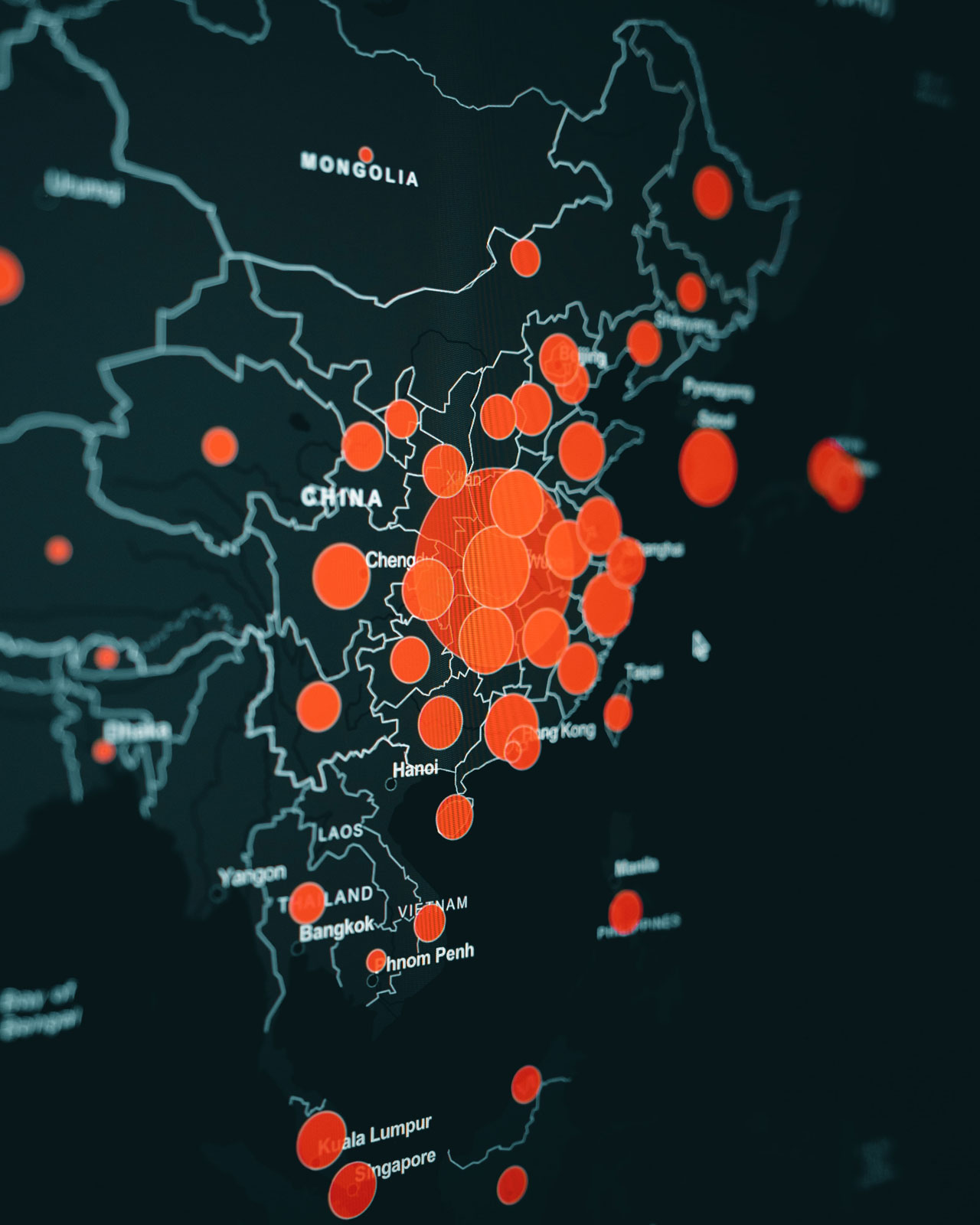
CHINA’s narrow criteria for identifying deaths caused by COVID-19 will underestimate the true toll of the pandemic’s current wave there and could make it harder to communicate the best ways for people to protect themselves, foreign health experts warn.

Only deaths caused by pneumonia and respiratory failure after contracting COVID will be classified as having been caused by the coronavirus, a leading Chinese medical expert said on Tuesday.

Deaths from complications at other sites in the body, including underlying conditions made worse by the virus, would be excluded from the official toll, said Wang Guiqiang, head of the infectious disease department at Peking University First Hospital.

Experts familiar with hospital protocols in China told Reuters that such cases were not always excluded previously, though sometimes COVID would be ruled out as a cause of death if a formerly positive patient had tested negative a day or two before dying.

Wang said the criteria had changed because the Omicron variant is less likely to cause other life-threatening symptoms, though China’s hospitals are still required to judge each case to ascertain precisely whether or not COVID was the ultimate cause.

The methods for counting COVID deaths have varied across countries in the nearly three years since the pandemic began.

Yet disease experts outside of China say this specific approach would miss several other widely recognized types of potentially fatal COVID complications, from blood clots to heart attacks as well as sepsis and kidney failure.

Some of these complications can increase the chances of death at home, particularly for people who are not aware that they should seek care for these symptoms.

The new definition “clearly won’t capture all deaths from COVID,” said Dr. Aaron Glatt, an infectious diseases expert at Mount Sinai South Nassau Hospital in New York and a spokesperson for the Infectious Diseases Society of America. “To say you’re going to ignore anything else going on in the body makes no sense and is scientifically inaccurate.”

Last month, Korean researchers reported that 33% of Omicron-related deaths between July 2021 and March 2022 at one large hospital were due to causes other than pneumonia.

CAN CHINA’S COVID DATA BE TRUSTED?
With one of the lowest COVID death tolls in the world, China has been routinely accused of downplaying infections and deaths for political reasons.

A June 2020 study of the country’s initial outbreak in Wuhan starting in late 2019 estimated 36,000 could have died at the time, or 10 times the official figure.

A study published by the Lancet in April, which looked at COVID-related mortality in 74 countries and territories over 2020-2021, estimated there were 17,900 excess deaths in China over the period, compared to an official death toll of 4,820.

Globally, the study estimated 18.2 million excess deaths in 2021-2022, compared with reported COVID deaths of 5.94 million.

The new announcement from China raised concerns the government was seeking to disguise the true impact of relaxing its draconian “zero-COVID” controls after nearly three years of disruptive lockdowns and mandatory mass testing.

Despite widespread reports that funeral homes and crematoriums are struggling to cope with a surge in demand, China’s official death numbers have not spiked, with no new fatalities reported for Dec. 21 and only seven deaths reported since the government announced on Dec. 8 that “zero-COVID” restrictions would be removed.

China actually cut its accumulated death toll by one on Dec. 20, bringing the total to 5,241.

China’s National Health Commission did not immediately respond to requests for comment about the country’s COVID statistics and excess mortality.

Even if China were to continue defining COVID deaths more broadly, the official data is still unlikely to reflect the situation on the ground, given how quickly infections are now spreading, said Chen Jiming, a medical researcher at China’s Foshan University.

“The reported counts of cases and deaths are only a very small portion of the true values,” he said.

Ben Cowling, an epidemiologist at the University of Hong Kong’s School of Public Health, said the official death tally would be very low even if a broader definition were in use, “because so little testing is being done” now that China has discontinued mass surveillance.

On the other hand, Cowling said, labeling every person who died while positive for COVID as having died from the disease could lead to an over-count. Such an approach “can also be criticized because it can, and has, included coincidental deaths such as in people hit by a bus while having mild COVID.”

Dr. Mai He, a pathologist at Washington University in St. Louis who was involved in the Wuhan study published in 2020, said there was still a lack of faith in the integrity of China’s numbers.

“The persistent critical issue is a lack of transparency; people cannot use their data to do research and analysis, (or) provide guidance for the next step,” he told Reuters.

The lack of trust in China’s statistics is also causing panic among members of the public, said Victoria Fan, senior fellow in global health at the Center for Global Development.

“It’s in the best interest of the government to be more transparent, because a lot of the behaviors that the public is exhibiting is because they don’t have information,” she said.

REUTERS

Ukraine’s Zelensky tells US Congress aid is ‘not charity’

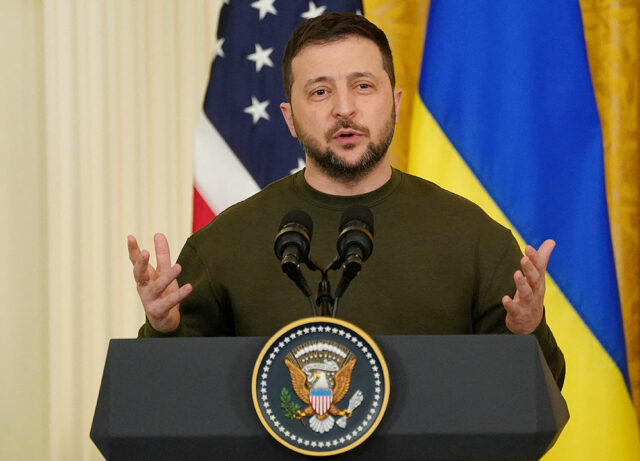
UKRAINE’s President Volodymyr Zelensky speaks during a joint news conference with US President Joseph R. Biden (not pictured) in the East Room of the White House in Washington D.C., Dec. 21, 2022. — REUTERS

WASHINGTON/KYIV — President Volodymyr Zelensky told the US Congress that aid to Ukraine was an investment in democracy and “not charity” as he invoked American battles against the Nazis in World War II to press for more assistance for his country’s war effort.

Mr. Zelensky’s comments on Wednesday come as Republicans — some of whom have voiced increasing scepticism about sending so much aid to Ukraine — are set to take control of the US House of Representatives from Democrats on Jan. 3.

Some hardline Republicans have even urged an end to aid and an audit to trace how allocated money has been spent. “Your money is not charity. It is an investment in the global security and democracy that we handle in the most responsible way,” Mr. Zelensky told a joint session of the US Senate and House of Representatives, speaking in English.

The world is too interconnected to allow any country to stand aside and feel safe, Mr. Zelensky said as he appealed for bipartisan support.

Earlier, Zelensky, wearing his trademark olive green trousers and sweater on his first foreign wartime visit, met President Joseph R. Biden, who called for support to keep flowing in 2023.

The United States also announced another $1.85 billion in military aid for Ukraine, including a Patriot air defense system to help it ward off barrages of Russian missiles.

Mr. Zelensky said the Patriot system was an important step in creating an air shield.

“This is the only way that we can deprive the terrorist state of its main instrument of terror — the possibility to hit our cities, our energy,” Mr. Zelensky told a White House news conference, standing next to Mr. Biden.

“We would like to get more Patriots … we are in war,” Mr. Zelensky told reporters at the White House.

Russia says it launched its “special military operation” in Ukraine in February to rid it of nationalists and protect Russian-speaking communities. Ukraine and the West describe Russia’s actions as an unprovoked war of aggression.

Ukraine has come under repeated Russian strikes targeting its energy infrastructure in recent weeks, leaving millions without power or running water in the dead of a freezing winter.

TASS news agency cited Russia’s US ambassador as saying that Mr. Zelensky’s visit confirmed that US statements about not wanting a conflict with Russia were empty words.

America’s provocative actions in Ukraine were leading to an escalation the consequences of which were impossible to imagine, TASS cited Anatoly Antonov as saying.

Russia said last week, Patriot systems, if delivered to Ukraine, would be a legitimate target for Russian strikes.

INVOKES WORLD WAR II
Mr. Zelensky joined a long list of world leaders to address joint meetings of the US Senate and House, a tradition that began in 1874 with a visit by Hawaiian King Kalakaua and included almost legendary wartime visits by British Prime Minister Winston Churchill, kings, queens and one pope.

House members and senators from both parties leaped to their feet to cheer parts of Mr. Zelensky’s speech as he likened his country’s battle to World War II and even the American Revolution.

Referencing former US President Franklin D. Roosevelt, who served between 1933 and 1945, and efforts to liberate Europe from Nazi occupation, Mr. Zelensky appealed to Americans as they gathered with family for Christmas.

“Just like the brave American soldiers, which held their lines and fought back Hitler’s forces during the Christmas of 1944, brave Ukrainian soldiers are doing the same to Putin’s forces this Christmas,” he said.

Congress is on the verge of approving an additional $44.9 billion in emergency military and economic assistance, on top of some $50 billion already sent to Ukraine this year as Europe’s biggest land conflict since World War II drags on.

QR STARTS HERE

White House National Security Council spokesman John Kirby said Washington was seeing no sign that Russian President Vladimir Putin was willing to engage in peacemaking.

Kremlin spokesman Dmitry Peskov said more Western arms supplies to Ukraine would lead to a “deepening” of the conflict.

Mr. Zelensky said a “just peace” with Russia meant no compromises on Ukraine’s sovereignty and territorial integrity.

BAKHMUT
Russian forces attacked targets in the Zaporizhzhia region and pushed to advance near the battered eastern front-line towns of Bakhmut and Avdiivka, the focal point of fighting in the Donetsk region, Ukraine’s military said on Wednesday evening.

The commander of Ukraine’s “Freedom” battalion, Petro Kuzyk, helping to defend Bakhmut, told the website of Espreso TV: “Each day, there are anywhere from seven to 10 attempts to storm our positions. And it’s the same at night.”

“They won’t be able to take Bakhmut, but if they take the heights above it and set up their artillery and cut our logistical arteries, that will make the situation much more difficult,” Mr. Kuzyk said.

Mr. Putin has promised to give his military whatever it needs to prosecute the war nearing the end of its 10th month and backed a plan to boost the size of the armed forces by more than 30%. — Reuters

Taiwan scrambles combat jets to warn away China’s air force incursion

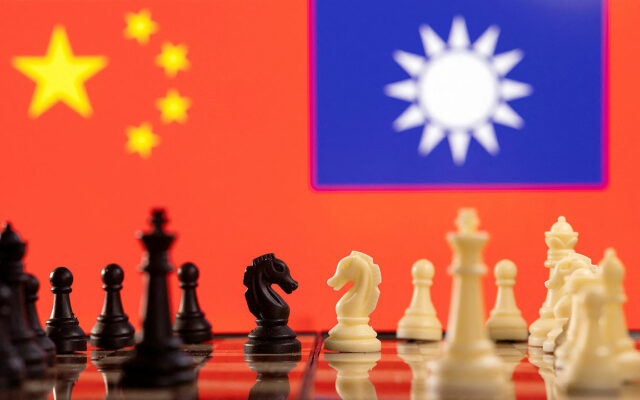
CHESS PIECES are seen in front of displayed China and Taiwan’s flags in this illustration taken Jan. 25, 2022. — REUTERS

TAIPEI — Taiwan scrambled combat jets to warn away 39 Chinese aircraft that entered its southeastern air defense zone, the island’s defense ministry said on Thursday.

Taiwan has complained of repeated missions by the Chinese air force over the last two years, often in southern areas of its air defense identification zone, or ADIZ.

Thursday’s incursion included 21 fighters and four H-6 bombers, as well as early warning, antisubmarine and aerial refueling aircraft, Taiwan’s defense ministry said in a report detailing Chinese activities in its ADIZ over the last 24 hours.

Many of the aircraft flew over a waterway known as the Bashi Channel to an area off the island’s southeastern coast, according to a map provided by the ministry. Three Chinese navy ships were also detected near Taiwan, the ministry said.

Taiwan sent unspecified combat aircraft to warn away the Chinese planes, while missile systems monitored their flight, the ministry said, using standard wording for its response.

Separate Taiwan government notices have said the defense ministry’s research and development arm, the National Chung-Shan Institute of Science and Technology, is holding a missile firing drill this week on the island’s southeastern coast.

China, which claims Taiwan as its own, has stepped up pressure in recent years on the self-governed island to accept Beijing’s rule. Taiwan’s government rejects the Chinese claims and says it wants peace but will defend itself if attacked. — Reuters

Trump paid no income tax in 2020, records show

US President Donald Trump speaks at an event in the State Dining Room of the White House, in Washington, U.S., Feb. 24, 2019. — REUTERS

WASHINGTON — Donald Trump paid no income tax during the final full year of his presidency as he reported a loss from his sprawling business interests, according to tax figures released by a congressional panel.

The records, released late on Tuesday by the Democratic-led House of Representatives Ways and Means Committee after a years-long fight, show that Mr. Trump’s income, and his tax liability, fluctuated dramatically during his four years in the White House.

The records cut against the Republican ex-president’s long-cultivated image as a successful businessman as he mounts another bid for the White House.

Mr. Trump and his wife, Melania, paid some form of tax during all four years, the documents showed, but were able to minimize their income taxes in several years as income from Trump’s businesses was more than offset by deductions and losses.

The committee questioned the legitimacy of some of those deductions, including one for $916 million, and members said on Tuesday the tax returns were short on details. The panel is expected to release redacted versions of his full returns in coming days.

Mr. Trump refused to make his tax returns public during his two presidential bids and his campaign for office, even though all other major-party presidential candidates have done so for decades.

The committee obtained the records after a years-long fight and voted on Tuesday to make them public.

A Trump spokesman said the release of the documents was politically motivated.

“If this injustice can happen to President Trump, it can happen to all Americans without cause,” Trump Organization spokesman Steven Cheung said on Wednesday.

Democrats on the panel said their review found that tax authorities did not properly scrutinize Mr. Trump’s complex tax returns to ensure accuracy.

Though the US Internal Revenue Service (IRS) is supposed to audit presidents’ tax returns each year, it did not do so until Democrats pressed for action in 2019.

The IRS assigned only one agent to the audit most of the time, the panel found, and did not examine some of the deductions claimed by Trump.

The IRS declined to comment.

Prior to taking office, Mr. Trump reported heavy losses for many years from his business to offset hundreds of millions of dollars in income, according to media reports and trial testimony about his finances.

The documents released by the committee showed that pattern continued during his time in the White House.

During that time Mr. Trump and his wife were liable for self-employment and household employment taxes. As a result, they paid a total of $3 million in taxes over those four years.

But deductions enabled them to minimize their income tax liability in several years.

In 2017, Mr. Trump and his wife reported adjusted gross income of negative $12.9 million, leading to a net income tax of $750, the records showed.

They reported adjusted gross income of $24.3 million in 2018 and paid a net tax of $1 million, while in 2019 they reported $4.4 million of income in 2019 and paid $134,000 in taxes.

In 2020, they reported a loss of $4.8 million and paid no net income tax. —  Reuters

Expensive energy cuts short free visits to Belgium’s ‘Garden of Santa Claus’

LA BRUYERE, Belgium — The Belgian “Garden of Santa Claus,” which every year offers a free visit to Santa’s office, bedroom, train and sleigh, will be open only 23 days this year instead of the usual 34 days because of a surge in energy prices, its organizer said.

The work of a Belgian aeronautical engineer, Serge Hennebel, 54, the “Garden of Santa Claus” is a seasonal entertainment venue located in a small village of La Bruyere, in central Belgium, 38 km (24 miles) south-east of Brussels.

Lit by more than 52,800 lights, it attracts visitors from across the world who can enjoy a walk in the village, crossing the path of a giant snowman and taking souvenir photos next to Santa’s sleigh and Santa’s Train.

Energy prices in the euro zone were 35% higher in November than 12 months earlier, boosting the costs of powering the venue and forcing the earlier closure, Mr. Hennebel said. — Reuters

Legalize motorcycle taxis to ease public transportation woes, say commuter advocates

PHILIPPINE STAR/ MICHAEL VARCAS

By Brontë H. Lacsamana, Reporter

THE LEGALIZATION of motorcycle (MC) taxis will ease the nightmarish commute conditions in Metro Manila, which have worsened during the holiday rush, transport advocates said.  

“It’s good that we have motorcycle taxis which commuters appreciate, but if they continue to imitate the negative character of taxis of snubbing people when they’re needed, then the TWG (technical working group) should monitor this,” said Primo V. Morillo, convener of The Passenger Forum, in a Dec. 22 Zoom interview. 

The Department of Transportation’s (DOTr) TWG reviews and revises guidelines regarding MC taxis and oversees the ongoing pilot implementation of their operations.  

House Bill 10571, or the Motorcycle Taxi bill, is already in the works, with three MC taxi companies — Angkas, JoyRide and Move It — given special provisions to operate MC taxis as part of the government’s pilot-testing program. 

“We know that, out of all road-based transport, motorcycles are the most accident-prone. Given that, it’s important that we have a system for it, proper training for it, and insurance for it. That’s why our call to the TWG is to design the MC taxi to discourage the use of habal-habal (another name for motorcycles-for-hire),” said Mr. Morillo. 

A digital advocacy group also said that a proper motorcycle taxi law will allow more riders to operate safely under ride-hailing companies. 

“This law, if enacted, aims to legitimize or legalize the use of motorcycles as vehicles for hire. Right now, it’s not allowed, which is why there are many illegal habal-habal riders on the road, and passengers don’t have protection for that,” Digital Pinoys convener and national campaigner Ronald Gustilo said in a Zoom conversation on Dec. 21.  

On Dec. 20, a public Facebook post by Ghint Prns that went viral shed light on the practice of Angkas riders turning off their app in order to offer their services as habal-habal motorcycles: 

The user detailed trying to book a rider in Makati City on Dec. 19 and paying a premium because of the Christmas rush.

Delivery platform Lalamove also issued a Dec. 20 statement saying that its vehicles are “not licensed to transport people, only items for delivery,” making the practice illegal. 

On social media, netizens have denounced the state of Philippine public transportation given the fact that such an announcement was even necessary: 

“Started booking Angkas, Joyride and Grab from 6:00pm and only got a ride at 11:20pm. Taxi drivers asking php 500 for Makati-to-BGC ride + metro rate. When you got barely any options in transpo here, in a car-centric, mostly unwalkable areas in the city, u got nowhere else to go” 

— Been Sent (@vincentcastor09) December 14, 2022 

“So if it hasn’t dawned on people yet and if people are still trying to defend it. The transportation system in the Philippines is so broken that people have been literally dehumanizing themselves by using transportify and lalamove and basically getting transported as human cargo” 

— The Norman Whore (@emkey) December 16, 2022 

Diane, 25 years old, has been resorting to this since 2017 just to get from one point to another, sometimes even within the same city. 

“I only do it when I can’t get a ride on any public transport and have a hard time booking a Grab or Angkas,” she told BusinessWorld via Messenger on Dec. 21. 

For Lalamove and Transportify riders, being booked to deliver a package only to find a human asking to be transported has become a common phenomenon. 

A rider from one of these services shared in a Dec. 22 face-to-face conversation with BusinessWorld that while these requests are often refused,  riders can’t help but consider striking an agreement with the customer if the price is right. 

“This ‘hack’ emerged when I was a college student and it’s still something I’ve had to do even now when I’m already working. Nothing has changed,” Diane said. 

Meanwhile, the rider explained that these kinds of deals are unavoidable: “Ganun talaga dahil sa kahirapan ngayon. Nasisilaw yung iba sa pera. Yung sasakay naman, diskarte niya yun. (That’s just how it is in difficult times. More money is tempting. As for the commuter, they’re just being strategic.)” 


Traffic and commute nightmare in Metro Manila worsens due to holiday rush

THE LEGALIZATION of motorcycle (MC) taxis will ease the nightmarish commute conditions in Metro Manila, which have worsened during the holiday rush, transport advocates said.

House Bill 10571, or the Motorcycle Taxi bill, is already in the works, with three MC taxi companies — Angkas, JoyRide and Move It — given special provisions to operate MC taxis as part of the government’s pilot-testing program.

“This law, if enacted, aims to legitimize or legalize the use of motorcycles as vehicles for hire. Right now, it’s not allowed, which is why there are many illegal habal-habal riders on the road, and passengers don’t have protection for that,” Digital Pinoys convener and national campaigner Ronald Gustilo said in a Zoom conversation on Dec. 21.

Interviews and text by Brontë H. Lacsamana.
Video editing by Earl R. Lagundino and Sam L. Marcelo.

Cocolife celebrates solidarity and kinship this holiday season in its Christmas video for 2022

How have we managed to withstand the challenges and uncertainties during the COVID-19 crisis? Even though we were physically apart from our loved ones, friends, and colleagues, we definitely were not alone in coping with the situation. Throughout life’s countless adversities, they’ll always be there for us to lean on and gather strength from.

As we emerge from the COVID-19 crisis, we recognize those who have lent a hand and made our burdens lighter. As such, Cocolife celebrates solidarity and kinship in this year’s holiday season; appreciating those who became the “sandalan” of their families. They are the highlight of Cocolife’s Christmas music video for 2022 entitled “Sumandali Ka Lang.”

The video honors Lanie Calapiz and Roselo Baynosa, serving as utility workers for Cocogen and Cocolife, respectively.

Cocolife employees expressed their gratitude to Mr. Baynosa for his dependability, someone that they have been able to lean on during the pandemic. He did his job diligently day in and day out, and never failed to treat his fellow coworkers with care and respect.

Maliit na bagay man o malaking bagay, lagi kang nandyan para i-assist kami,” one of the employees added.

They also expressed their appreciation to Ms. Calapiz for her patience and for the lessons they have acquired from her. “Thank you sa pagiging pasensyosa. Kasi alam mo naman, alam kong mahirap,” an employee told her. “Pero kaya mo, para sa pamilya.”

They have not only been providing support to the people at Cocolife and Cocogen, but also to their loved ones’, which drive them to work every single day.

Ms. Calapiz is a single mother with three children who are all studying. “Ako lang po mag-isa nagtataguyod sa kanila,” she shared.

Meanwhile, Mr. Baynosa is a father to three children. “Ang pinakanakakapagod ko pong parte is kung naiisip ko po na ako’y malayo sa pamilya ko eh,” he expressed. “Yung asawa ko may sakit, bilang may diabetes, tapos marami na siyang sakit na komplikado, so hindi na siya masyado makapagtrabaho, makatulong sa akin.”

Their families also expressed their gratitude for their efforts and love for them.

Salamat sa pag-alaga, paggabay, at pagpapasaya mo samin,” Mr. Baynosa’s daughter tells him in a video message. “Sana maging okay na ang lahat para makauwi ka na din dito tapos magsama-sama na tayong pamilya.”

Ms. Calapiz was also surprised by her children and her mother. “Gusto ko magpasalamat sa mga ginagawa at binibigay mo samin,” one of her children expressed.

Through the video, Cocolife also reminded everyone that we are each other’s “sandalan” not only this Christmas but for all seasons.

Filipinos are assured that they can lean on Cocolife in times of uncertainty, and that Cocolife will always support them in whatever capacity they can in order to reach their dreams – through the company’s insurance products and investment services.

“It is our duty to serve our clients with the best insurance products, life and healthcare insurance, together with the 24/7 customer servicing to cater to our clients’ needs,” Cocolife President and CEO Atty. Martin Loon said.

“We assure you that Cocolife will provide you with only the highest quality of service, as we have done for the past 40 years,” he added.


Spotlight is BusinessWorld’s sponsored section that allows advertisers to amplify their brand and connect with BusinessWorld’s audience by enabling them to publish their stories directly on the BusinessWorld Web site. For more information, send an email to online@bworldonline.com.

Join us on Viber to get more updates from BusinessWorld: https://bit.ly/3hv6bLA.

Two Bankman-Fried associates plead guilty to fraud as FTX founder heads to US

Sam Bankman-Fried, founder and former chief executive officer of now-bankrupt crypto exchange FTX. — WIKIMEDIA COMMONS

NEW YORK/NASSAU FTX founder Sam Bankman-Fried left the Bahamas on Wednesday on a US-bound flight to face fraud charges as federal prosecutors announced that two of his former associates had pleaded guilty to similar charges and were now cooperating with the government.

Manhattan US Attorney Damian Williams said in a video posted on Twitter late Wednesday night that Caroline Ellison, former CEO of Alameda Research, and Gary Wang, co-founder of FTX, had pleaded guilty to defrauding investors in the crypto trading platform.

The revelation that two of Mr. Bankman-Fried’s closest former associates had decided to cooperate with the government significantly ramped up pressure on the former billionaire.

Mr. Williams said that Mr. Bankman-Fried is now in FBI custody and on his way to the US and urged others involved in the alleged fraud to come forward.

“If you participated in misconduct at FTX or Alameda, now is the time to get ahead of it,” Mr. Williams said. “We are moving quickly and our patience is not eternal.”

“I also said that last week’s announcement would not be our last, and let me be clear once again, neither is today’s,” he added.

The US Securities and Exchange Commission (SEC) in a separate statement on Wednesday evening said it had also charged Ms. Ellison and Mr. Wang for their roles in a multiyear scheme to defraud equity investors of FTX.

The US Commodity Futures Trading Commission also said it had filed fraud charges against Ms. Ellison and Mr. Wang.

An attorney for Ms. Ellison did not respond immediately to request for comment.

“Gary has accepted responsibility for his actions and takes seriously his obligations as a cooperating witness,” Ilan Graff, a lawyer for Mr. Wang, said in a statement.

Federal prosecutors in Manhattan last week charged Mr. Bankman-Fried with stealing billions of dollars in FTX customer assets to plug losses at his hedge fund, Alameda Research, in Mr. what Williams called “one of the biggest financial frauds in American history.”

The 30-year-old cryptocurrency mogul has acknowledged risk-management failures at FTX, but has said he does not believe he has criminal liability.

A spokesman for Mr. Bankman-Fried’s legal team declined to comment.

‘MAKE THE RELEVANT CUSTOMERS WHOLE’
Mr. Bankman-Fried rode a crypto boom to become a billionaire several times over and an influential U.S. political donor, before FTX’s crash wiped out his wealth and tarnished his reputation. The collapse was driven by a wave of customer withdrawals amid concerns over commingling of funds with Alameda.

The announcements from Williams and regulators came just hours after Mr. Bankman-Fried took off from The Bahamas where he consented at a courthouse to be extradited to the United States.

Ms. Ellison and Mr. Wang signed the plea deals on Monday, court records show, after Reuters and other outlets reported over the weekend that Mr. Bankman-Fried would waive his right to fight extradition.

The agreements call for Ellison and Wang to each post a $250,000 release bond, and states that prosecutors may call for a judge to take their cooperation into account at sentencing if they “provided substantial assistance in an investigation or prosecution.”

Mr. Bankman-Fried is likely to appear before a US federal court in Manhattan on Thursday. At his court appearance, known as an arraignment, he is expected to be asked to enter a plea. The US judge would determine whether to grant him bail, and if so, on what conditions.

Mr. Bankman-Fried was arrested on a US extradition request last week in The Bahamas, where he lives and where FTX is based. He ultimately agreed to extradition in part out of a “desire to make the relevant customers whole,” according to an affidavit read in court on Wednesday and dated Dec. 20.

Dressed in a suit, Mr. Bankman-Fried stepped up to the witness box in court, where he spoke clearly and steadily as he was sworn in.

“Yes, I do wish to waive my right to such formal extradition proceedings,” he told Judge Shaka Serville on Wednesday.

Mr. Bankman-Fried’s defense lawyer, Jerone Roberts, said his client was “anxious to leave.”

The judge said he was satisfied that Mr. Bankman-Fried had not been “forced, coerced or threatened” into making the extradition decision.

The $32 billion exchange declared bankruptcy on Nov. 11, and Mr. Bankman-Fried stepped down as CEO the same day. — Reuters

UN council demands end to Myanmar violence in first resolution in decades

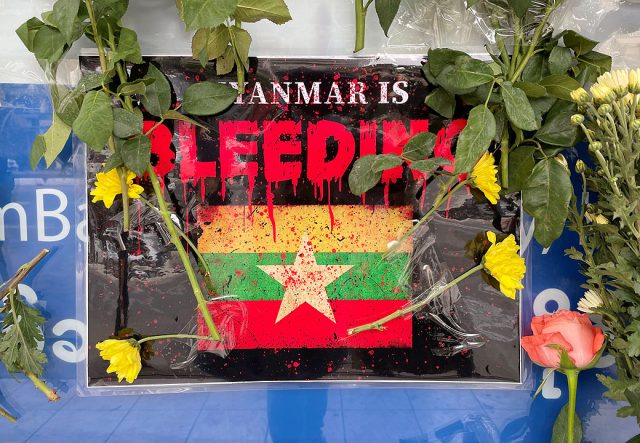
FLOWERS hang during a nationwide flower campaign against the military coup in Yangon, Myanmar, April 2, 2021. — REUTERS

UNITED NATIONS The United Nations (UN) Security Council adopted its first resolution on Myanmar in 74 years on Wednesday to demand an end to violence and urge the military junta to release all political prisoners, including ousted leader Aung San Suu Kyi.

Myanmar has been in crisis since the army took power from Ms. Suu Kyi’s elected government on Feb. 1, 2021, detaining her and other officials and responding to pro democracy protests and dissent with lethal force.

“Today we’ve sent a firm message to the military that they should be in no doubt we expect this resolution to be implemented in full,” Britain’s UN Ambassador Barbara Woodward said after the vote on the British-drafted resolution.

“We’ve also sent a clear message to the people of Myanmar that we seek progress in line with their rights, their wishes and their interests,” Ms. Woodward told the 15-member council.

It has long been split on how to deal with the Myanmar crisis, with China and Russia arguing against strong action. They both abstained from the vote on Wednesday, along with India. The remaining 12 members voted in favor.

“China still has concerns,” China’s UN Ambassador Zhang Jun told the council after the vote. “There is no quick fix to the issue … Whether or not it can be properly resolved in the end, depends fundamentally, and only, on Myanmar itself.”

He said China had wanted the Security Council to adopt a formal statement on Myanmar, not a resolution.

Russia’s UN Ambassador Vassily Nebenzia said Moscow did not view the situation in Myanmar as a threat to international peace and security and therefore believed it should not be dealt with by the UN Security Council.

US Secretary of State Antony Blinken welcomed the resolution’s adoption. “This is an important step by the Security Council to address the crisis and end the Burma military regime’s escalating repression and violence against civilians,” he said in a statement.

‘FIRST STEP’
Until now the council had only agreed formal statements on Myanmar, where the army also led a 2017 crackdown on Rohingya Muslims that was described by the United States as genocide. Myanmar denies genocide and said it was waging a legitimate campaign against insurgents who attacked police posts.

Negotiations on the draft Security Council resolution began in September. The initial text seen by Reuters urged an end to the transfer of arms to Myanmar and threatened sanctions, but that language has since been removed.

The adopted resolution expresses “deep concern” at the continuing state of emergency imposed by the military when it seized power and its “grave impact” on Myanmar’s people.

It urges “concrete and immediate actions” to implement a peace plan agreed by the Association of Southeast Asian Nations (ASEAN) and issues a call to “uphold democratic institutions and processes and to pursue constructive dialogue and reconciliation in accordance with the will and interests of the people.”

The only other resolution adopted by the Security Council was in 1948, when the body recommended the UN General Assembly admit Myanmar then Burma as a member of the world body.

Myanmar’s UN Ambassador Kyaw Moe Tun, who still holds the UN seat and represents Ms. Suu Kyi’s government, said while there were positive elements in the resolution the National Unity Government comprised of remnants of the ousted administration
would have preferred a stronger text.

“We are clear this is only a first step,” he told reporters. “The National Unity Government calls on the UNSC (to build) on this resolution to take further and stronger action to ensure the end of the military junta and its crimes.” Reuters