Home Blog Page 5406

India’s rice export curbs paralyze trade in Asia as prices rise

FARIS MOHAMMED-UNSPLASH

MUMBAI — India’s restrictions on rice exports have paralyzed trading in Asia, with buyers scouring for alternative supplies from Vietnam, Thailand and Myanmar where sellers are holding off on deals as prices rise, industry officials said.

India, the world’s biggest exporter of the grain, banned shipments of broken rice and imposed a 20% duty on exports of various other types on Thursday as the country tries to boost supplies and calm prices after below-average monsoon rainfall curtailed planting.

Rice is the latest in a string of commodities that have faced export curbs this year as governments struggled to raise supplies and fight inflation amid trade disruptions triggered by the Ukraine war. Rice prices have jumped 5% in Asia since India’s announcement and are expected to rise further this week keeping buyers and sellers on the sidelines.

“Rice trading is paralyzed across Asia. Traders don’t want to commit anything in a hurry,” said Himanshu Agarwal, executive director at Satyam Balajee, India’s biggest rice exporter.

“India accounts for more than 40% of global shipments. So, nobody is sure how much prices will rise in the coming months.”

Rice is a staple for more than 3 billion people, and when India banned exports in 2007, global prices shot to record highs of around $1,000 per ton.

India’s rice exports reached a record 21.5 million tons in 2021, more than the combined shipments of the world’s next four biggest exporters of the grain: Thailand, Vietnam, Pakistan and the United States.

LOADINGS HALTED
Rice loading has stopped at Indian ports and nearly one million tons of grain are trapped there as buyers refuse to pay the government’s new 20% export levy on top of the agreed contract price.

Though there are some buyers ready to pay higher prices for new contracts, shippers are currently sorting out pending contracts, Nitin Gupta, vice president for Olam India’s rice business.

As Indian exporters stopped signing new contracts, buyers are trying to secure supplies from rival Thailand, Vietnam and Myanmar, which have raised the price of 5% broken white rice by around $20 per tonne in the past four days, dealers said.

But even these suppliers are reluctant to rush for contracts as they are expecting prices to strengthen.

“We expect prices to rise further over the coming weeks,” a trader based in Ho Chi Minh City said.

Vietnam’s 5% broken rice was offered at $410 per ton on Monday, up from $390-$393 per ton last week, traders said.

China, the Philippines, Bangladesh and African countries such as Senegal, Benin, Nigeria and Ghana are among leading importers of common grade rice, while Iran, Iraq and Saudi Arabia import premium grade basmati rice.

Supply disruptions from the COVID-19 pandemic and more recently the Russia-Ukraine war has jacked up the prices of grains but rice has largely bucked the trend due to bumper crops and ample inventories at exporters over the past two years.

Buyers now fear India’s move could boost rice prices and make the staple expensive like wheat and corn, said a Mumbai-based dealer with a global trading firm. — Reuters


Airfares may never go back to pre-pandemic levels, CEO says

BERLIN — Lufthansa Chief Executive Carsten Spohr said on Monday that flight prices will never return to where they were before the pandemic, forecasting stable or increasing prices in future.

Tickets selling for under 20 euros was irresponsible and too low, Mr. Spohr said at an event in Berlin. The industry needed rising prices to finance greater investment and be more resilient to shocks like the COVID-19 pandemic, he added.

Still, a recession was to be expected at this stage in Germany, the chief executive warned, which would dampen consumer demand. — Reuters

Australia open to replacing queen’s image on banknotes

JOE GIDDENS/ POOL VIA REUTERS

SYDNEY — The Australian government said on Tuesday that the image of King Charles III would not automatically replace Queen Elizabeth II’s on A$5 notes, and it may be replaced by Australian figures.

While coins are mandated to carry the image of the British monarch, Federal Assistant Minister for the Treasury Andrew Leigh said on Tuesday the decision to include the queen’s image on the A$5 dollar note was about her personality as opposed to her status as the monarch, and any changes would not be “automatic”.

Asked by a reporter if the government would consider replacing the British monarch with an Australian such as indigenous land rights activist Edward Mabo, Leigh said: “It will be a conversation to be had down the track.

“It is a conversation that will take place in government. There’s no rush about it. The priority now is changing over the coins.”

The Queen’s death has reignited debates about Australia’s future as a constitutional monarchy. Voters narrowly chose to maintain the British monarch as its head of state in a 1999 referendum.

Prime Minister Anthony Albanese said on Tuesday that he had yet to turn his attention to whether an Australian should be on the A$5 note.

“I think this is a time where a bit of respect is required. We will deal with these issues appropriately, in an orderly way, in a way that is respectful.”

The Royal Australian Mint, the sole producer of coins in the country, said on Tuesday that it will issue no circulating coins bearing the effigy of Queen Elizabeth II in 2023.

Roughly 15 billion coins have been minted in the likeness of Queen Elizabeth II since her coronation in 1953. The mint produces between 110 million and 150 million coins annually. — Reuters

Premium bicycles gaining new fans among city folk in China

A Brompton B75 folding bicycle, folded.

BEIJING — Zhou Changchang likes to spend his spare time cruising along the streets of China’s capital with his cycling club friends, on his Tiffany Blue bicycle made by the British company Brompton.

The 42-year-old teacher is part of a growing army of cycling enthusiasts in China, who are splashing out on premium bicycles made by the likes of Brompton, Giant and Specialized, fueling a market that consultancy Research & Markets estimates could be worth $16.5 billion by 2026.

Social media and e-commerce platforms say there has been a surge of interest in cycling over the past year and sales of bicycles and gear are booming.

Typically, Chinese cyclists will pay more than 13,000 yuan ($1,870) for an inner-city, high-end foldable bike made by the likes of Brompton. High-performance road bikes, made for longer journeys, start at around 10,000 yuan ($1,450) and can go many times higher.

Last month, media reported that a bicycle made by luxury brand Hermes sold for 165,000 yuan ($24,500).

“The majority of riding hobbyists are willing to splurge,” e-commerce platform JD.com said last month.

It said road bike sales on its platform had more than doubled from June to August compared with the same time last year, while riding apparel sales had jumped 160%.

China has had a long love affair with bicycles and was once known as the “kingdom of bicycles”.

For decades, bikes made by the likes of the Flying Pigeon company filled the streets.

Cycling fell out of fashion when a growing middle class turned to cars but bike manufacturers saw a revival in 2014 as bike-sharing companies like Mobike and Ofo sprang up to flood cities with their fleets, offering rides as cheap as 1 yuan.

Mr. Zhou, like many cyclists, said he got into biking to get fit. COVID-19 and its lockdowns also created a urge for the open road.

“I really longed for the outdoors and fresh air,” said Shanghai office worker Lily Lu who went out and ordered a Brompton bike for 13,600 yuan ($1,965) the day after she was released from a three-month lockdown.

As the craze gathers pace, manufacturers are struggling to meet demand. Ms. Lu said she had to wait two months to get her bicycle. Brompton did not respond to a request for comment.

China’s Pardus, which makes racing bikes that can cost more than 30,000 yuan ($4,335), said sales doubled from last year and its factory was operating around the clock.

“Everything is out of stock,” said Pardus branding director Li Weihai. — Reuters

US Senate panel presses Twitter CEO on whistleblower claims

AKSHAR DAVE-UNSPLASH

 – The chair of the Senate Judiciary Committee and the panel‘s top Republican on Monday asked Twitter Inc. Chief Executive Parag Agrawal to answer questions about a former company executive turned whistleblower who is set to testify.

Peiter “Mudge” Zatko, a famed hacker who served as Twitter‘s head of security until he was fired last year, will appear Tuesday before the committee.

Senate Judiciary chair Dick Durbin and Republican Chuck Grassley on Tuesday asked Agrawal to answer questions by Sept. 26 including on Mr. Zatko’s allegations Twitter “turned a blind eye to foreign intelligence infiltration, does not adequately protect user data and has provided misleading or inaccurate information about its security practices to government agencies.”

The senators said they had invited Mr. Agrawal to testify on Tuesday, but he had declined.

Twitter declined comment.

Mr. Durbin and Mr. Grassley outlined some concerns raised by Mr. Zatko, including potentially more than half of Twitter full-time employees having privileged access to company production systems. With that capability, several thousand employees can access sensitive user data, according to Mr. Zatko.

“… at the same time, Twitter reportedly lacks sufficient capacity to reliably know who has accessed specific systems and data and what they did with it,” the senators wrote in a letter to Mr. Agrawal.

“With tens of millions of users in the U.S. and hundreds of millions of users worldwide, your company collects and is responsible for vast troves of sensitive data,” they wrote. “If accurate, Mr. Zatko’s allegations demonstrate an unacceptable disregard for data security that threatens national security and the privacy of Twitter‘s users.”

Mr. Zatko has claimed Twitter had misled regulators about its compliance with a 2011 settlement with the Federal Trade Commission over improper handling of user data.

Mr. Durbin, while speaking to reporters on Monday, said Mr. Zatko’s claims were “a matter of grave personal and privacy concern.”

Twitter has said the former executive was fired for “ineffective leadership and poor performance,” and that his allegations appeared designed to capture attention and inflict harm on Twitter. – Reuters

Mexico eyes possible energy dispute fix, welcomes new US ‘tone’

STOCK PHOTO

 – Mexico on Monday voiced hope it could work out a major dispute with the United States over energy policy as it welcomed a top US delegation and President Andres Manuel Lopez Obrador struck a conciliatory note in the critical stand-off.

Mr. Lopez Obrador was speaking before he met with US officials led by Secretary of State Antony Blinken, visiting to mark the annual so-called High-Level Economic Dialogue (HLED), which both sides hailed as a pathway toward deepening economic ties.

The energy row broke in July, when the US government demanded dispute settlement talks, arguing Mr. Lopez Obrador’s drive to tighten state control of the energy market was unfair to US companies and likely breached a regional trade deal.

The energy complaint, which Canada immediately joined, is arguably the biggest dispute to surface under the United States-Mexico-Canada Agreement (USMCA) since the North American trade deal came into effect in 2020. If unresolved, it could lead to the imposition of hefty trade tariffs against Mexico.

Officials said the dispute was not central to Monday’s talks, though Mexican Foreign Minister Marcelo Ebrard expressed optimism that a deal could be hashed out.

“That wasn’t the purpose of the meeting, because as we know that’s in a process of dialogue and I would hope that an agreement will be reached at some point,” Mr. Ebrard told a news conference with Mr. Blinken and others following the talks.

Mexican Economy Minister Tatiana Clouthier, who oversees trade in Latin America’s no. 2 economy, underlined the point, saying the two governments would work toward a fix.

Mr. Lopez Obrador, who has made his energy policy a matter of national sovereignty, had previously responded defiantly to the United States, saying he would defend Mexico‘s position at an independence day military parade taking place this Friday.

However, on Monday he said he would no longer talk about the energy dispute during his Friday speech because US President Joe Biden had responded to his concerns positively.

“There’s a different tone. There’s a respectful attitude. Rather, it’s a reaffirmation of respect for our national sovereignty,” Mr. Lopez Obrador told a news conference, referring to a letter he said had received from Mr. Biden.

After meeting with the US officials, Mr. Lopez Obrador said on Twitter he had a “productive and friendly” meeting with Mr. Blinken and US Commerce Secretary Gina Raimondo.

Mr. Blinken and the Mexican president spoke about joint efforts to tackle climate change by investing in clean energy and areas like electric vehicles, solar power, and semiconductor output, US State Department spokesperson Ned Price said.

The United States and Mexico also said they would work together on a pilot project to determine the feasibility of near-shoring semiconductor manufacturing inputs in a joint statement later in the day.

The two countries boast one of the world’s largest trading relationships, and officials said the efforts to modernize their economies would boost growth and jobs.

US Commerce Secretary Raimondo said the United States and Mexico have identified areas of collaboration on supply chains. She saw great potential for Mexico not just in manufacturing of semiconductors but also their testing, packaging and assembly.

“The best is yet to come,” said Ms. Raimondo, who declared she was “thrilled” with progress the two sides had made on a range of issues, including bolstering energy security.

Still, while observing the two sides did not discuss the energy controversy “extensively”, Ms. Raimondo said businesses wanted “predictability, fairness and transparency” in an apparent nod to companies’ concerns about Mexico‘s policies. – Reuters

Blinken says Ukraine has made ‘significant progress’ in counteroffensive

US Secretary of State Antony Blinken. Official White House — CAMERON SMITH VIA FLICKR

 – US Secretary of State Antony Blinken said on Monday that it was still early days in Ukraine‘s counteroffensive against the Russian military, but Ukrainian forces have made “significant progress.”

Mr. Blinken, in Mexico for economic talks, was asked for his assessment of recent developments in Ukraine.

Ukrainian troops have recaptured dozens of towns in recent days, after Moscow abandoned its main bastion in northeastern Ukraine on Saturday marking its worst defeat since the early days of the war. Read full story

“What they have done is very methodically planned out and of course it’s benefited from significant support from the United States and many other countries in terms of making sure that Ukraine has in its hands the equipment it needs to prosecute this counteroffensive,” Mr. Blinken said during a news conference in Mexico City.

Mr. Blinken said the Ukraine conflict was likely to continue for some time as Russia still has very significant forces and arms in Ukraine that it was still using “indiscriminately” against civilians and civilian infrastructure.

“Russia committed this aggression. I think given the price that it’s paying, it can and should stop it,” he said.

Mr. Blinken also said Iran’s response to a European Union proposal on reviving the 2015 nuclear deal makes the prospects for an agreement in the near term unlikely. Read full story

“I can’t give you a timeline except to say, again, that Iran seems either unwilling or unable to do what is necessary to reach an agreement.” – Reuters

New Zealand may become a republic but not anytime soon, Ardern says

Image via Anup Shah/Flickr/CC BY-SA 2.0

 – New Zealand will not actively take any measures to become a republic in the short-term after the death of Queen Elizabeth, Prime Minister Jacinda Ardern said, though she expects the Pacific nation will eventually become one.

“I’ve never sensed the urgency. There’s so many challenges we face. This is a large, significant debate. Don’t think it’s one that would or should occur quickly,” Ms. Ardern told reporters on Monday when asked whether the change in the British monarch will spark talks of republicanism in the country.

New Zealand is one of 15 realms to count the British Monarch as head of state including Australia and Canada, although the role is largely ceremonial. But there has been debate for some time on whether the Pacific nation should become a republic, with a citizen as the head of state.

“I do believe that is where New Zealand will head in time. I believe its likely to occur in my lifetime but I don’t see it as a short-term measure or anything that is on the agenda anytime soon,” Ms. Ardern said.

New Zealand will mark the passing of Queen Elizabeth with a state memorial service and a one-off public holiday on Sept. 26, Ms. Ardern said. Ms. Ardern will represent New Zealand, alongside the Governor General, at the Queen’s funeral, and will leave for London on Wednesday.

The Queen’s passing has also reignited debates over the future of the monarchy across the Tasman Sea in Australia. Prime Minister Anthony Albanese, who has previously voiced support for a republic, has said his Labor government would not seek a referendum in its first term. Read full storyReuters

‘Challenge’ to maintain world’s focus on global health after COVID-19: Bill Gates

 – Asking the world to prioritize saving lives in the world’s poorest countries is increasingly challenging in a world still rocked by the COVID19 pandemic, the threat of climate change, rising energy costs and the war in Ukraine, according to Bill Gates.

The Microsoft co-founder turned philanthropist said it was a “paradox” that in the wake of a huge global health threat, funding for tackling diseases like malaria and AIDS could actually drop this year.

“I am very worried… ironically, in the face of the clearest indication of why infectious disease is not a thing of the past, in fact, the funding levels could go down,” said Gates in an interview with Reuters last week.

He was speaking ahead of the publication of the Bill and Melinda Gates Foundation’s annual Goalkeepers report, which tracks progress on the United Nations Sustainable Development Goals (SDGs), around reducing poverty and improving health.

The report finds that the pandemic has knocked the world off-course on almost every indicator, and progress would need to speed up by a factor of five in order to reach the targets set for 2030 on issues like reducing maternal mortality or ending malnutrition.

“It’s hard to overstate what a setback the pandemic has been and it’s hard to overstate what a setback the war in Ukraine is,” said Gates, who pointed out that pre-2019, global health was improving in most areas.

“It is fair to say that saving lives in Africa and caring about the poorest countries, we’ll be challenged to maintain that as a priority and not cut back on those things,” he added.

Gates has channeled more of his own money into the foundation this year and it will up its annual budget from $6 billion to $9 billion by 2026, but he said he was concerned about the competing pressures on the budgets of donor governments.

However, Gates said there was still hope, particularly in areas like food security, if the world invests in innovation. – Reuters

ACCESS continues to pave the way for excellence in online MCLE in PH

The pioneer and principal proponent of offering online Mandatory Continuing Legal Education (MCLE) program in the country is at it again. This time, ACCESS is calling on other MCLE centers to elevate the way online courses are delivered especially in the next normal.

“We hope other providers will make an effort to deliver the online MCLE courses using the gold standard,” says ACCESS MCLE Co-Founder Atty. Ma. Louella M. Aranas.

Atty. Aranas notes that there are several aspects of online program provision that need more attention — the technical details, the selection of lecturers and topics, and the gamification of the courses, among others. In her words: “All aspects need to be excellent.”

Setting the bar higher

A frontrunning pioneer in offering online MCLE in the country, ACCESS has always made sure to elevate the industry standard. Following the Supreme Court’s approval of the Rules and Regulations in conducting online MCLE (effective Feb. 5, 2020), ACCESS has so far been the only provider to invest in shooting online program videos professionally. In so doing, they make it a point to ensure superior audio and visual quality by working inside a studio, operating with the technical expertise provided by sound engineers and video editors.

At the same time, ACCESS MCLE is the only one in the country to truly facilitate interactive courses, in comparison with its competitors who still maintain the use of simple videos in mp4 format.

“Being interactive is not only an effective mode of facilitating MCLE courses online. It is also a simple way to make sure the lawyers themselves are attending the online sessions, not their legal secretaries or paralegals,” says Atty. Aranas. She also recalls that, in the year 2019, it took ACCESS a while to convince the Supreme Court about ways to verify the identity of lawyers attending the online MCLE programs; she also recalls the time it took to convince stakeholders about the safety of the online platform.

ACCESS as proponent to online MCLE

A little known fact: prior to the pandemic, ACCESS did most of the push to make MCLE available online to members of the Integrated Bar of the Philippines. The team patiently endured a year making presentations and attending meetings with the MCLE Office, the Office of Supreme Court Justice Marvic Leonen, and the Supreme Court en banc under Chief Justice Diosdado Peralta to persuade them to consider adopting the idea.

ACCESS MCLE Co-Founder Atty. Ma. Louella M. Aranas

“We made several iterations on the proof of concept, ensuring that the requirements of Bar Matter 850 are complied with while maintaining the highest quality of online training delivery,” recalls Atty. Aranas. Thus, ACCESS is leading the charge and keeping its commitment to prove the effectiveness, safety, and reliability of online MCLE by setting the best example.

“ACCESS is leveling up the playing field among lawyers from across the country. The team is adopting the best practices in content production, design, and overall online delivery of courses. We aim to make fellow lawyers realize that MCLE is worthwhile and necessary. It is never a waste of time and money,” Atty. Aranas continues.

Continuous innovations

Aside from curating the best topics, tapping today’s legal luminaries, and offering convenience through offering continuing education online, ACCESS continues to introduce new and exciting innovations to their delivery of online MCLE to Filipino lawyers.

Under ACCESS, MCLE learners can opt to learn through an online on-demand (asynchronous) or online class (synchronous) setup. It has recently introduced a new version of the synchronous program — the Flexi-Synch, which makes MCLE courses available all-year round. If a learner misses a lesson, that exact lesson will be offered on the same day and time on the following month.

“We set the difference in providing online MCLE to Filipino lawyers, wherever they may be, whenever. But we are at the same time carrying on that commitment to excellence when face-to-face sessions return as an option for learning. We will continue to be exemplary. That is because we at ACCESS believe that the legal industry deserve only the best,” Atty. Aranas concluded.


Spotlight is BusinessWorld’s sponsored section that allows advertisers to amplify their brand and connect with BusinessWorld’s audience by enabling them to publish their stories directly on the BusinessWorld Web site. For more information, send an email to online@bworldonline.com.

Join us on Viber to get more updates from BusinessWorld: https://bit.ly/3hv6bLA.

InLife empowers policyholders in navigating their financial journey

Insular Life (InLife) recently introduced a life insurance product that gives its policyholders the freedom to craft a personalized policy that best caters to their priorities at different points in their life.

“Filipinos’ perception of life insurance has changed through the years. Now, they see it as something not just for the loved ones that they will leave behind, but for them to enjoy as well while they are still living,” said InLife Chief Marketing Officer Gae Martinez.

She shared that in a focused group discussion held by InLife and Kantar Media, most of the participants associated an insurance plan with “financial preparedness.” They feel secure that they have set aside something to cover their present and future financial necessities.

Policyholder needs, however, vary. Their priorities also change as they become older, face unforeseen challenges, and explore opportunities.

“This is why some policyholders don’t want cookie cutter insurance products; they want to set up their own financial master plan with their financial advisors acting as guides,” Martinez said.

To address this need, InLife came up with Wealth Assure Plus (WAP), a life insurance plan that can be customized according to a policyholder’s preferences. It has investment components and provides policyholders with higher life insurance coverage and living benefits.

Increased Potential for Growing Money

WAP offers policyholders the advantage of more financial benefits. It also gives them additional financial protection through an optional critical illness benefit that can cover the soaring cost of medical care.

With WAP, a policyholder’s money grows faster because of a shorter paying period of admin charges. It has a low insurance cost and premiums are exposed to global equity markets for more earning potential.

Its annual premiums are affordable for as low as P10,000. Regular top-up premiums, meanwhile, are as low as P500 monthly.

Personalized and Adaptive

Policyholders can choose to set up a variable unit-linked (VUL) plan. Attachable rider options include renewable term insurance, critical illness, accidental death benefit, and waiver of premium because of disability.

They can also select their preferred payment and payout schemes. It also has options that address different risk profiles.

The plan can adapt to the policyholder’s new goal or need, pursued priorities, and current realities and circumstances. They can customize it within the duration of the plan. WAP’s life insurance coverage period is until 99 years old.

Addressing Current Needs While Preparing for the Future

Martinez noted that the pandemic has made Filipinos more aware of the value of having an insurance policy.

“In getting one, they consider a lot of factors and not just their own needs. They think of their family, events that may affect their financial standing in the future, their long-term goals, and their present and most urgent needs. InLife understands their concerns. The Company has been in the industry for 112 years, and have seen how people’s priorities change as the world also changes,” she said.

Through WAP, InLife delivers what customers want in the current climate and also helps them prepare for the coming years.

“InLife remains steadfast in its promise of providing a Lifetime for Good to Filipinos,” Martinez said.

Learn more about WAP through https://www.insularlife.com.ph/wealth-assure-plus. InLife’s financial advisors are also ready to answer your questions about the new product and help you create your plan, so don’t hesitate to get in touch with them.

For more of InLife’s latest products and events, follow the Company’s official social media accounts.


Spotlight is BusinessWorld’s sponsored section that allows advertisers to amplify their brand and connect with BusinessWorld’s audience by enabling them to publish their stories directly on the BusinessWorld Web site. For more information, send an email to online@bworldonline.com.

Join us on Viber to get more updates from BusinessWorld: https://bit.ly/3hv6bLA.

Corruption could delay economic recovery, CEOs say

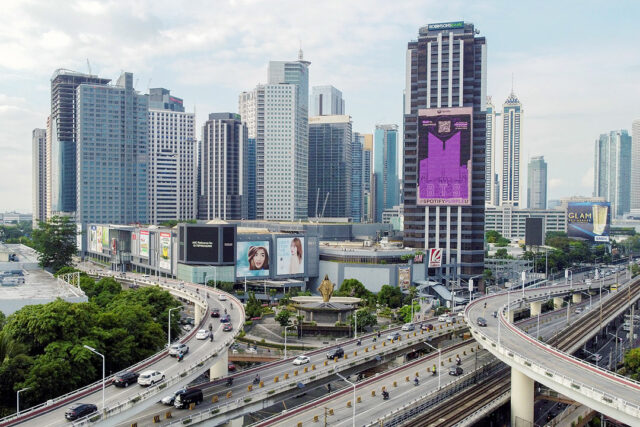
AN AERIAL VIEW shows the Ortigas business district in Pasig City, June 10, 2022. — REUTERS

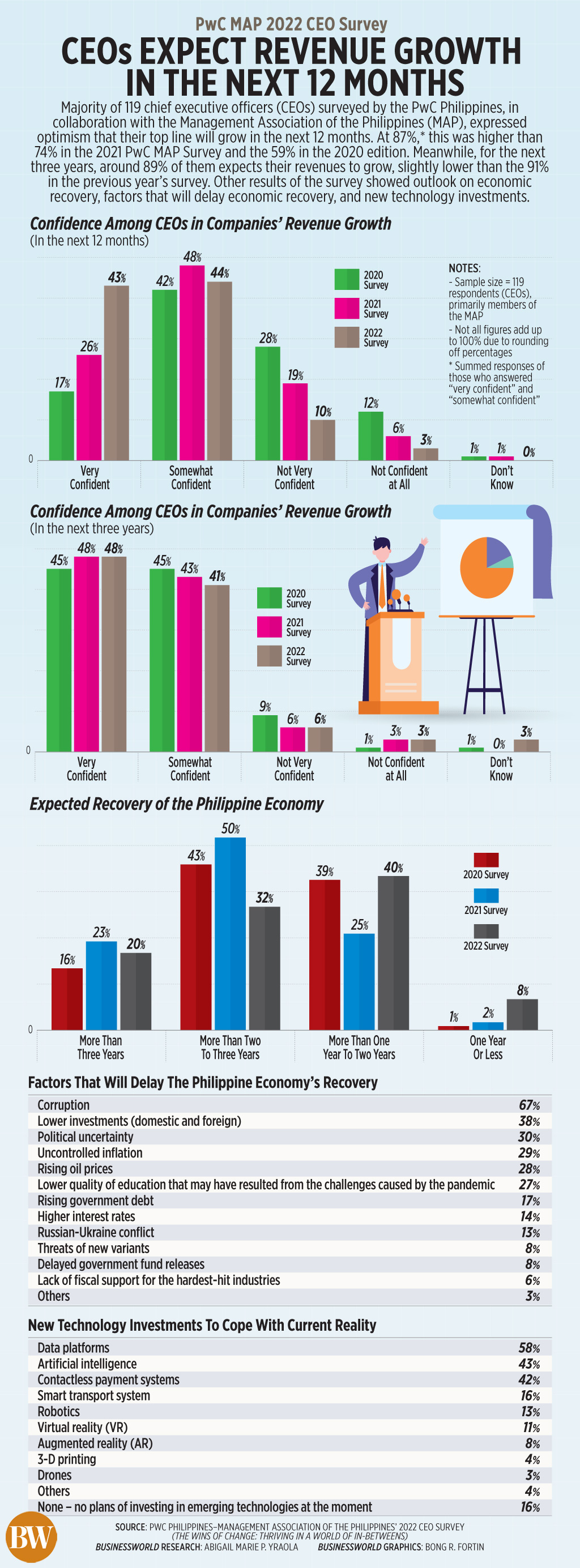
CORRUPTION is the biggest risk to the Philippine economy’s recovery from the coronavirus disease 2019 (COVID-19) pandemic, according to a survey of the country’s top chief executive officers (CEOs).

A survey by PwC Philippines in partnership with the Management Association of the Philippines (MAP) also showed over half of CEOs expect the recovery to take more than two years.

The country’s top executives also urged the Marcos administration to prioritize accountability and transparency and anti-corruption efforts.

CEOs expect revenue growth in the next 12 monthsAsked which factors will delay the economy’s recovery, 67% of CEOs answered corruption.

Other factors cited included lower domestic and foreign investments (38%), political uncertainty (30%), uncontrolled inflation (29%), rising oil prices (28%) and lower quality of education (27%).

Inflation averaged 4.9% as of August, as food and oil prices continue to spike.

PwC Philippines Chairman and Senior Partner Roderick M. Danao said corruption is hurting the country’s ability to attract investments.    

“Whenever we deal with multinational companies trying to expand, corruption is always one of their significant factors for them to decide whether to go or not. It is very painful for the country because perception alone erodes trust,” Mr. Danao said at a virtual briefing on Monday.

“Unless we address the root cause of corruption, we cannot really accelerate foreign direct investments to the country compared to our neighbors like Vietnam and Thailand,” he added.   

PwC Philippines Chairman Emeritus Alexander B. Cabrera said that the private sector should also play a role in addressing corruption.    

“Corruption is like a dance. It takes two to tango. If the private sector would not give in, there would also be no corruption. We cannot miss that element that corruption is not one-sided, it is two-sided,” Mr. Cabrera said.    

According to the survey, CEOs want President Ferdinand R. Marcos, Jr., who assumed office on June 30, to prioritize accountability and transparency; the fight against corruption; attracting more foreign investments; job generation; and public-private partnerships for infrastructure projects.

MAP President Rogelio L. Singson said that one way to attract more investors is to honor existing government contracts.    

“If we really want to develop a good investment climate both for local and foreign investors, start with honoring existing contracts. There are many contracts in the government that has been either brought to arbitration, already won, but have yet to execute,” Mr. Singson said.   

OUTLOOK
“At the macroeconomic level, however, 52% of the CEOs believe that the Philippine economy still needs over two years to recover from the impact of COVID-19,” the PwC MAP 2022 Philippine CEO survey report said.

In the 2021 survey, 73% of CEOs said the expected recovery of the economy will take more than two years. 

This year’s survey also showed 40% of CEOs think recovery will take more than one to two years, while 8% said they expect a rebound within a year.

The Philippine economy grew by 7.8% in the first half of 2022. The government is targeting 6.5-7.5% gross domestic product (GDP) growth this year.

Infrastructure development will be a key growth driver for the Philippine economy in the next 12 months, according to 62% of CEOs. Other growth drivers include domestic consumption (59%), government spending (46%), and foreign direct investments (41%).    

The majority of CEOs (87%) are confident that their companies will see higher revenues in the next 12 months. The survey showed 38% said they expect significantly higher sales than pre-pandemic levels this year, while 21% see a return to pre-pandemic sales levels.

However, 35% of CEOs anticipate their companies’ revenues will still be lower than before the pandemic, citing factors such as the threat of new COVID-19 variants, potential lockdowns and talent constraints.    

Mary Jade T. Roxas-Divinagracia, PwC Philippines deals and corporate finance managing partner, said the CEOs’ outlook are affected by external and domestic challenges.

“In terms of the concerns of the business leaders, they have identified the higher prices, supply chain issues, as well as labor concerns as possible continuing problems even after the pandemic,” Ms. Roxas-Divinagracia said. 

“These (concerns) will be coupled with the global concerns…in terms of higher inflation, higher interest rate, and higher fuel costs. All these things combined are actually giving some of our business leaders sleepless nights, so to speak,” she added.    

The survey, which was conducted between mid-July and August, covered 119 CEOs from industries such as financial services, manufacturing, energy and utilities, technology, among others. — Revin Mikhael D. Ochave