Home Blog Page 5404

Analysts’ August 2022 inflation rate estimates

INFLATION likely held steady in August, but still above the Philippine central bank’s target band for a fifth straight month as lower pump prices and power rates offset higher food costs, a BusinessWorld poll showed. Read the full story.

Headline inflation rates in the Philippines (Aug. 2022)

PSE says relaxed listing rules bring IPOs to 26-year high

BW FILE PHOTO

THE number of initial public offerings (IPOs) this year is a result of the relaxed listing rules last year and the repealed IPO tax under a pandemic response law, according to the Philippine Stock Exchange (PSE).

“It helps that we relaxed our listing rules last year and the government repealed the IPO tax under Republic Act No. 11494 also known as the Bayanihan to Recover as One Act or Bayanihan II,” PSE President and Chief Executive Officer Ramon S. Monzon said in a statement on Friday.

Under Bayanihan II, Section 127(B) of the National Internal Revenue Code of 1997, which required tax on safe, barter or exchange of shares of stock listed and traded through IPO based on the gross selling price or gross value in money of the shares of stock sold, was repealed.

The amendments to PSE’s consolidated listing and disclosure rules were approved by the Securities and Exchange Commission (SEC) in March last year.

One of which is the inclusion of a time-bound relief for IPOs filed in 2021 and 2022 which permits the PSE to consider the profitability of the applicant for any two fiscal years in the three most recent fiscal years excluding the years which were affected by the pandemic.

The market capitalization test was removed from the requirements for main board listing, and the profit test was revised to show an aggregate net income of P75 million for the last three years and a net income of P50 million in the most recent financial year.

The profit test used to have the requirement of P50 million for the last three years and minimum earnings before interest, taxes, depreciation, and amortization (EBITDA) of P10 million for each of the three years as a gauge.

For the small, medium and emerging (SME) board listing, applicants now have the option to satisfy either the EBITDA requirement or the net sales or operating revenue.

Under the amended rules, applicants need to have cumulative net sales or operating revenues of at least P150 million for the last three years.

PSE also shortened the SME board applicants’ operating history requirement to two years from the previous three years requirement.

Other amendments to the PSE listing rules include the removal of the P500-million minimum market capitalization and the imposition of P500-million minimum stockholders’ equity as a measure of financial condition for the main board applicants.

SME board applicants are no longer required to have a positive EBITDA in the last two-three fiscal years, preceding application, and to have a P100-million minimum authorized capital stock.

PSE also introduced a sponsor model provision for listing applicants in the SME board which allows sponsors accredited by the PSE to endorse applicants which did not qualify based on listing requirements alone.

“There are several companies that do not qualify to list based solely on the SME Board listing requirements. We want the stock market to be accessible to these businesses and give them equal opportunity to raise capital through equity financing, especially if they are profitable and have rosy growth prospects,” Mr. Monzon said.

PSE expects at least three more IPOs in the second half, bringing this year’s number of IPOs to a 26-year high.

“We see companies requiring capital to fund their post-pandemic recovery plans. At this time of high-interest rate regime, selling shares to the public is a more viable option than taking out loans,” Mr. Monzon said.

Year to date, the PSE had eight IPOs, which is the total number of IPOs for the entire 2021.

“While it is far from the PSE’s record of 21 IPOs, this will put an end to the single-digit IPOs since 1997,” PSE said.

The amount of capital raised from the sale of primary and secondary shares during the first half of the year reached P61.92 billion, lower by 49.4% year on year from the fund-raising amount of P122.46 billion in the same period last year.

Analysts said that the ongoing market volatility due to the Russia-Ukraine conflict that led to elevated global commodity prices and inflation could still be a drag on IPO for the second half of the year.

“Increased market volatility due to the Russia-Ukraine conflict since February 24 [t]hat led to elevated global commodity prices and inflation, as well as the more aggressive Fed rate hikes or monetary tightening to clamp down elevated inflation could lead to risks of economic slowdown or even recession in the US, [t]hereby could be a drag on IPOs and other share sales amid less favorable market conditions,” Rizal Commercial Banking Corp. Chief Economist Michael L. Ricafort said in a text message.

Globalinks Securities and Stocks, Inc. Head of Sales Trading Toby Allan C. Arce pointed out that there is still a lot of uncertainty which continues to add pressure this year.

“Companies must be properly prepared and have an astute strategy in place if they are planning an IPO. They must be ready to take advantage whenever an opening in the market occurs,” Mr. Arce said in a Viber message.

Mr. Ricafort said that as the economy reopens towards greater normalcy, it will be “creating greater certainty on new investments and expansion plans, as well as greater decisiveness to raise capital to finance them.”

PSE will be hosting Road to IPO 2022 on Sept. 15 to help business owners appreciate the value of becoming a publicly listed company.

“We want this Road to IPO activity to dispel the notion that an IPO is a daunting undertaking. Through this forum, we want to demystify the IPO process and simplify what is seemingly technical about going public with the help of speakers that have conducted their own IPOs and those who are tapped by companies to help them in their IPO journey,” Mr. Monzon explained.

The Road to IPO is a key initiative of the PSE in partnership with the SEC and the Department of Trade and Industry.

Companies interested in joining the event may register for free at https://bit.ly/TheRoadtoIPO2022.Justine Irish D. Tabile

Here are the fuel-efficiency ratings of MG cars, SUVs

PHOTO FROM MG PHILIPPINES

MG PHILIPPINES recently released its vehicles’ fuel economy figures based on an officially approved and recorded test by the Automobile Association of the Philippines (AAP).

The test was done to formalize the fuel-efficiency ratings of MG vehicles while providing car-buying Filipinos with unbiased and impartial data on a very important feature for automobiles nowadays. This AAP fuel eco run validates yet another winning asset of MG cars and SUVs — apart from modern style, advanced tech features, rich British heritage, and attainable price points.

Among the MG Philippines vehicles subjected to the test, the MG 5 Alpha variant registered the highest fuel-efficiency rating: 20.20kpl. The MG 5 is MG Philippines’ entry in the local subcompact sedan segment and is recognized by Filipino car buyers for its great value for money, vis-à-vis the vehicle’s size, tech and safety features, cabin comfort and NVH, cargo space, and impeccable styling. Filipino car buyers can also now officially add fuel efficiency to the MG 5’s long list of product wins, making it a top option in one of the most competitive automobile segments in the country.

Said MG Philippines President Atty. Alberto B. Arcilla in a release, “Our effort to formalize and document the fuel economy figures of our MG vehicles aims to strengthen the already high inherent value for money offered by our numerous product offerings here at MG Philippines.” He added, “Our MG cars and SUVs feature top-notch tech and safety features, space, comfort, and easy drivability, and are given support by innovative after-sales services from our dealership network, of which we have 42 dealers nationwide. We at MG Philippines are proud to offer vehicles that can be considered ‘responsible purchases’ because of their high value for money proposition; and now, with their impressive fuel-efficiency ratings confirmed by the AAP, we can add yet another aspect that makes a responsible purchase out of these modern, global MG cars and SUVs.”

Following strict test protocols monitored by the AAP, the fuel eco run mimicked real-world driving conditions which included normal usage of air-conditioning, rolling up of windows, keeping within regulated road speed limits, and with tires pumped to factory-recommended pressure.

All traffic laws and regulations were strictly followed, where no extreme “hypermiling” driving techniques such as drafting or slipstreaming were employed in order to augment the fuel-efficiency ratings of these MG vehicles.

For more information about MG Philippines, visit MGMotor.com.ph and follow the official Facebook (OfficialMGPhilippines) and Instagram (mg_philippines) accounts.

World food price index falls for fifth month in August

TWITTER.COM/FAOSOCIOECON

PARIS — The United Nations food agency’s world price index fell for a fifth month in a row in August, further from all-time highs hit earlier this year, as a resumption of grain exports from Ukrainian ports contributed to improved supply prospects.

The Food and Agriculture Organization (FAO) said on Friday that its price index, which tracks the most globally traded food commodities, averaged 138.0 points last month versus a revised 140.7 for July.

The July figure was previously put at 140.9.

The index has fallen from a record of 159.7 in March, hit after Russia’s invasion of Ukraine. The August reading was, however, 7.9% higher than a year earlier.

FAO’s cereal price index fell 1.4% month on month in August, with the reopening of Ukrainian Black Sea ports under a diplomatic deal as well as favorable wheat harvest prospects in North America and Russia weighing on prices, the agency said.

But the maize price index rose 1.5% last month as hot, dry weather reduced the outlook for production in Europe and the US, it said. The vegetable oil, sugar, dairy and meat price indices all fell, partly reflecting improved supplies.

In separate cereal supply and demand estimates, FAO lowered its forecast for global cereal production in 2022 to 2.774 billion tons from a previous projection of 2.792 billion in early July. That is 1.4% below estimated output for 2021.

The cut to its prediction for 2022 cereal production was due to the weather-reduced corn prospects in the northern hemisphere, with European Union yields notably seen falling 16% below their five-year average, FAO said.

World cereal use in 2022/23 is expected to surpass production at 2.792 million tons, leading to a projected 2.1% fall in global stocks compared with 2021/22 to 845 million tons. That would represent a stocks-to-use ratio of 29.5%, down from 30.9% in 2021/22 but still relatively high historically, FAO said. — Reuters

BBC donates $1.6 M to charity over Diana interview

PRINCESS DIANA — RUSS QUINLAN/ EN.WIKIPEDIA.ORG

LONDON — The BBC said on Friday it had donated to charities £1.42 million ($1.64 million) of sales it made from an interview that it conducted with Princess Diana in 1995 and which was obtained after deceit by one of its journalists.

The broadcaster last year came under fire from critics, including Prince William, after an inquiry concluded that it tried to cover up the deceptive tactics used by its journalist Martin Bashir to secure the interview with Diana.

“The BBC had indicated its intention to donate to charity the sales proceeds derived from the 1995 Panorama interview with Diana, Princess of Wales,” the corporation said.

“The BBC has now done so. Given the findings of (the inquiry), we think this is the right and appropriate course of action.”

The donation was divided equally between seven charities linked with the late princess, including public health and homelessness organizations, the English National Ballet, and The Diana Award.

This year marks 25 years since the 1997 car accident that killed Diana, the anniversary of which was observed last Wednesday. — Reuters

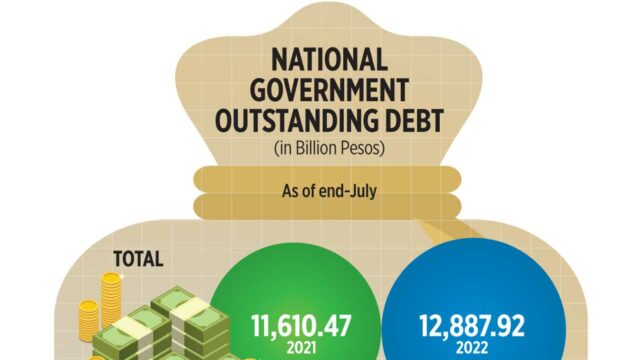
National Government outstanding debt

THE NATIONAL Government (NG) debt hit another record as of end-July, but economists expressed concern whether the government can generate enough revenues for the eventual repayment of the large borrowings incurred during the pandemic. Read the full story.

National Government outstanding debt

PLDT dips after ABS-CBN–TV5 deal ends

BW FILE PHOTO

MARKET PLAYERS were cautious of PLDT, Inc. last week after its affiliate company’s landmark partnership with former broadcast giant ABS-CBN Corp. was terminated.

Data from the Philippine Stock Exchange showed the telecommunications giant trading P686.13 million worth of 409,460 shares from Aug. 30 to Sept. 2, making it the 11th most actively traded stock last week.

The stock’s price slid by 2.5% to close at P1,669 per share last Friday on a week-on-week basis. Similarly, PLDT has declined by 2.5% since the start of the year.

“PLDT fell last week due to the news that its unit TV5 Network, Inc. had terminated a landmark investment deal with ABS-CBN Corp., as well as investors being concerned about external factors, specifically concerns that the US Federal Reserve would continue to tighten policy aggressively,” Marc Kebinson L. Lood, Timson Securities, Inc. head of online trading said in a Viber message.

Manuel V. Pangilinan-led MediaQuest Holdings, Inc., a unit of PLDT Beneficial Trust Fund, is the parent company of TV5.

The investment deal between the Lopez-owned media company and TV5, signed last Aug. 10, was scrapped last Thursday.

The landmark deal would have let ABS-CBN buy a 34.99% stake in TV5 for P2.16 billion.

The two companies also ended their subsidiaries’ agreement. Cignal Cable Corp. was supposed to acquire a minority 38.88% stake in Sky Cable Corp. worth P2.86 billion.

The underwriting could have opened revenue-generating “synergies,” but lawmakers questioned the contract’s legality.

Globalinks Securities and Stocks, Inc. Head of Sales Trading Toby Allan C. Arce said in a Viber message that politics just entered the conversation but should not “take away anything from its core business” and shall be seen as a strategic move for both parties to avoid any “significant blow.”

Both analysts said traders should keep an eye on the telco group’s latest launch of Tindahan Ni Bossing (TINBO).

Last week, PLDT Global Corp., the technology services arm of PLDT, announced the launch of TINBO, a one-stop gateway for overseas Filipino workers (OFWs). This payment medium allows Filipino employees abroad to manage personal transactions for their families.

A TINBO virtual number, which lets the user receive calls and texts, enables them to receive a secured one-time password for bills payment, e-government services, and other related transactions.

Other than finances, the TINBO number can also be used to buy prepaid loads for cellular phones, Pay TV, and internet needs.

Mr. Lood said traders are still testing the waters on TINBO’s developments as a payment medium for OFWs.

“In the long term, we expect it to be a convenient way for OFWs to manage their finances and a widely used fintech, potentially bringing in more revenue for PLDT,” he said.

“In the short term, we believe it will have little impact on PLDT’s revenue because only a small percentage of OFWs will have access for the time being, and there are already existing Fintech mobile applications in the Philippines and abroad that OFWs are using,” Mr. Lood said.

The net income attributable to equity holders of PLDT increased by 7.6% year on year in the second quarter to P7.66 billion. This brought the first-half attributable net earnings to P16.74 billion, a 29.6% jump from the same period last year.

Service revenues picked up by 7% to P49.13 billion in the second quarter. In the six months to June, service revenues rose by 6% to P97.10 billion.

Mr. Lood expects PLDT’s net income to reach P33.56 billion by yearend.

He sees the stock’s support level to stay at P1,650 while resistance at P1,830 for this week.

Mr. Arce, for his part, projects the telco company’s net earnings in the third quarter to hit P6.9 billion, while full year at P31.4 billion.

For the week, he also pegs PLDT’s support price at P1,650.00 and resistance at P1,775 to P1,800.

Hastings Holdings, Inc., a unit of PLDT Beneficial Trust Fund subsidiary MediaQuest, has a majority stake in BusinessWorld through the Philippine Star Group, which it controls. — Ana Olivia A. Tirona

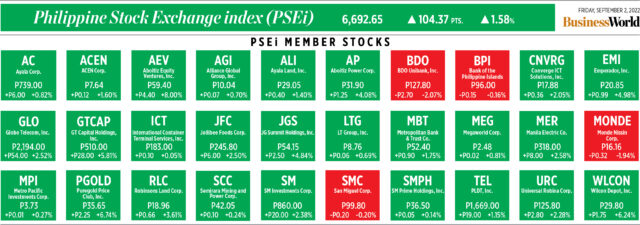
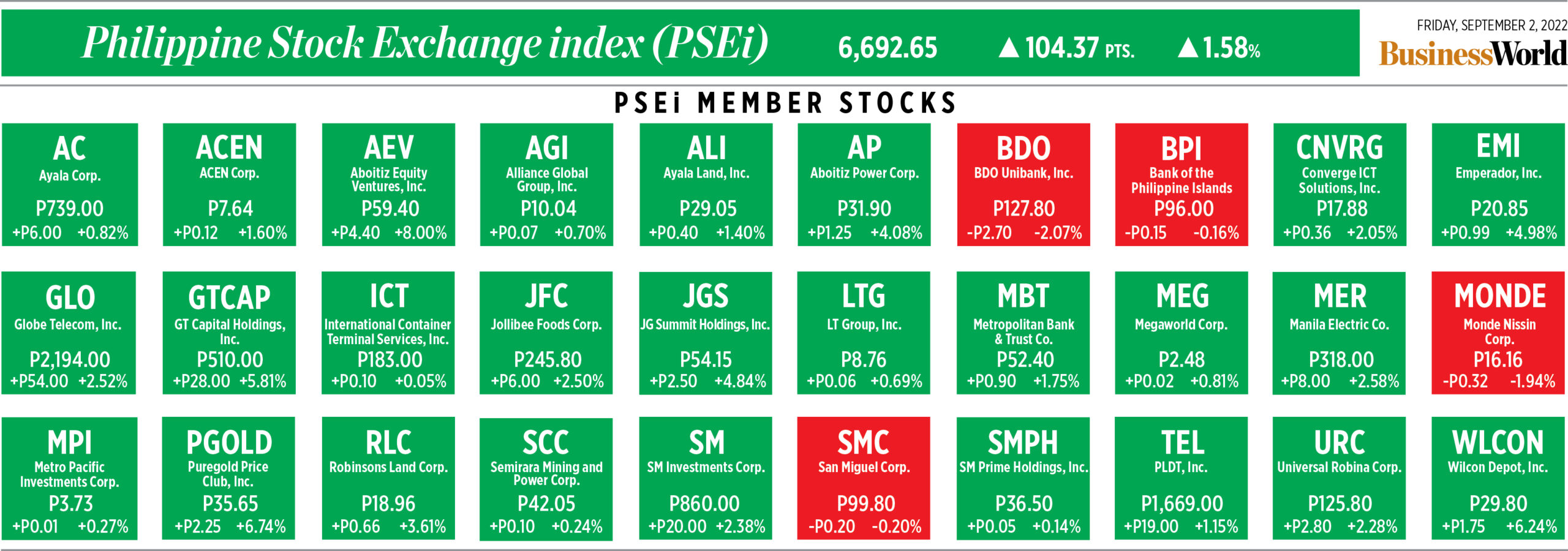
How PSEi member stocks performed — September 2, 2022

Here’s a quick glance at how PSEi stocks fared on Friday, September 2, 2022.


Peso may rise ahead of inflation data

BW FILE PHOTO

THE PESO may rebound against the dollar this week as its recent decline and expectations of still-elevated August inflation may prompt the Bangko Sentral ng Pilipinas (BSP) to continue hiking borrowing costs.

The local unit closed at a new all-time low of P56.77 on Friday, weakening by 35 centavos from its P56.42 finish on Thursday, data from the Bankers Association of the Philippines showed. This eclipsed the previous record of P56.45 set in 2004.

For the year so far, the peso has weakened by P5.77 or 11.31% from its Dec. 31, 2021 close of P51 per dollar, making it the third worst performer in Asia in 2022, after the Japanese yen and South Korean won.

Week on week, the local unit sank by 75 centavos from its P56.02 close on Aug. 26.

The peso opened Friday’s session at P56.50 per dollar, which was also its intraday best. Its weakest showing was at P56.90 against the greenback.

Dollars exchanged dropped to $936.95 million on Friday from $1.09 billion on Thursday.

The peso weakened on Friday amid hawkish signals from the US Federal Reserve, Rizal Commercial Banking Corp. Chief Economist Michael L. Ricafort said in a Viber message.

Fed Chair Jerome H. Powell last month said the US central bank will continue hiking rates and keep them elevated to bring inflation back within its target. The Fed has raised rates by 225 basis points (bps) so far since March.

The peso also weakened on “the expected seasonal increase in importation in Q3 in preparation for the expected increase in sales during the holiday season in Q4,” Mr. Ricafort said.

Still, the peso could be supported by the traditional increase in remittances and export sales during the holiday season in the Philippines, he said.

For this week, UnionBank of the Philippines, Inc. Chief Economist Ruben Carlo O. Asuncion said the peso may rebound ahead of the release of August inflation data, which could provide clues about the BSP’s next move.

Mr. Asuncion said high inflation and the peso’s recent depreciation may give the central bank a reason to continue hiking benchmark interest rates. Another off-cycle move may even be in the cards if the peso posts massive losses against the dollar, he added.

BSP Governor Felipe M. Medalla on Friday said the Fed’s next policy move will be a “big factor” to consider for the Monetary Board at their Sept. 22 meeting, especially as the US central bank will also meet on Sept. 20-21.

“You cannot not react to what the Fed is doing,” Mr. Medalla said during the virtual Reuters NEXT Newsmaker event on Friday. “We are concerned about the effects of the exchange rate on inflation.”

He noted that the peso’s recent decline was due to the dollar’s continued strength amid rate hike expectations in the world’s largest economy.

The BSP has hiked benchmark rates by 175 bps since May to keep rising prices in check. It sees inflation averaging 5.4% this year, beyond its 2-4% target.

Headline inflation hit a near four-year high of 6.4% in July, bringing the seven-month average to 4.7%.

A BusinessWorld poll of 13 analysts yielded a median estimate of 6.4% for August inflation, well within the BSP’s 5.9-6.7% forecast for the month and unchanged from July pace.

For this week, Mr. Ricafort expects the local unit to move from P56.50 to P56.90 per dollar, while Mr. Asuncion gave a wider and lower forecast range of P56.20 to P56.80. — Keisha B. Ta-asan

Volatile trading seen ahead of Aug. inflation data

BW FILE PHOTO

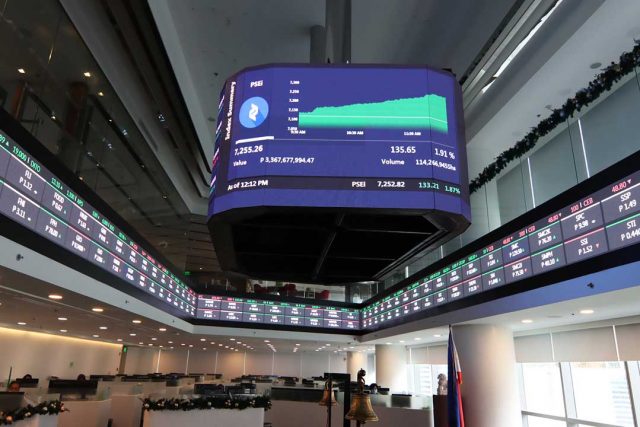
SHARES may continue to climb this week on sustained bargain hunting, but trading may be volatile as investors await the release of August inflation data.

The Philippine Stock Exchange index (PSEi) went up by 104.37 points or 1.58% to close at 6,692.65 on Friday, while the broader all shares index rose by 50.49 points or 1.44% to 3,548.53.

Week on week, the PSEi declined by 59.85 points or 0.89% from its close of 6,752.50 on Aug. 26.

“The index posted a strong uptick [on Friday] as bargain hunters picked up shares following the recent pullback, which resulted in the successful test of the 6,500-6,600 support level,” China Bank Securities Corp. Research Director Rastine Mackie D. Mercado said in an e-mail.

“The local market ended the week on a strong note, almost erasing a 183-point drop midweek, as investors repositioned ahead of US labor data,” online brokerage 2TradeAsia said in a report.

For this week, Mr. Mercado said that the market could move with an upward bias early on amid momentum from Friday’s climb.

“We see [Friday’s] bullish momentum carrying over into the early part of next week following the successful test of the 6,500-6,600 support,” Mr. Mercado said.

However, this upward momentum will likely be accompanied by higher volatility as investors react to key economic data, he said. These include US job data released on Friday and the August Philippine inflation report set to come out on Sept. 6, Tuesday,

The US Labor department’s employment report released on Friday showed nonfarm payrolls increased by 315,000 jobs last month after surging 526,000 in July, marking the 20th straight month of job growth.

Meanwhile, a BusinessWorld poll of 13 analysts yielded a median estimate of 6.4% for August inflation, within the 5.9-6.7% forecast of the Bangko Sentral ng Pilipinas and steady from the July level.

If realized, it would exceed the central bank’s annual 2-4% target for the fifth straight month and its 5.4% forecast, and would also be quicker than the 4.4% print in the same month last year.

Philstocks Financial, Inc. Senior Research Analyst Japhet Louis O. Tantiangco said hawkish signals from the US Federal Reserve will continue to affect the local market.

“The aggressively hawkish policy outlook of the Federal Reserve is still expected to weigh on the local market [this] week, especially if the rise in US interest rates and the decline in Philippine peso continues,” Mr. Tantiangco said in a Viber message.

The peso closed at a new all-time low of P56.77 on Friday, down by 35 centavos from its P56.42 finish on Thursday, data from the Bankers Association of the Philippines showed.

Year to date, the peso has weakened by P5.77 or 11.31% from the P51 close on Dec. 31, 2021.

China Bank Securities’ Mr. Mercado placed the PSEi’s support at the 6,500-6,600 range and resistance at 6,900, while Philstocks Financial’s Mr. Tantiangco put support at 6,600 and immediate resistance at its 200-day exponential moving average of 6,734.81. — Justine Irish D. Tabile
Customs exceeds August collection target by 34.1%

THE Bureau of Customs (BoC) said on Sunday that it exceeded its August collection target by 34.1%, which it credited to the digitalizing and streamlining of its processes, and as imports rose following the reopening of the economy.

In a statement, the BoC said August collections hit P78.902 billion, exceeding the target of P58.849 billion. This is the eighth consecutive month it has exceeded its monthly target.

It collected P77.9 billion from 17 ports, all of which surpassed their targets by a combined P15.8 billion or 25%.

The rest of the revenue consists of P248.2 million from the Post Clearance Audit Group and P677.4 million from the Tax Expenditure Fund.

As early as Aug. 25, the BoC said it had exceeded its revenue target for the month.

In the first eight months of the year, the BoC collected P559.2 billion, surpassing by 35.6% the P412 billion collection target for the period.

On Wednesday, Budget Secretary Amenah F. Pangandaman said that P3.56 billion of the 2023 proposed national budget will be allocated for the digital transformation programs of the BoC and the Bureau of Internal Revenue.

“We will prioritize digitalization and accelerate digital transformation… the improvement of revenue collection through digitalization will also be a priority,” Ms. Pangandaman said, noting that the amount is equivalent to 28.6% of the Department of Budget and Management’s proposed P12.4 billion for information and communications technology projects.

The World Bank is currently supporting the digitalization of the BoC through a $88.28-million facility for the Philippine Customs Modernization Program.

The BoC was given a P765.59-billion collection target for 2023, up 6.11%. — Diego Gabriel C. Robles