Home Blog Page 5402

Climathon Pasig 2022: From competition to cooperation

New format embraces stronger collaboration for climate action

What happens when students, professionals, climate experts, the academe, the government, and private citizens, come together to create solutions to fight climate change?

Climathon Pasig, the annual ideathon for climate action that is part of a wider global movement, has revitalized its format for this year, to promote a collaborative approach in solving the city’s most pressing environmental issues.

Apart from asking participants to pitch in their solutions for its two design challenges, they will be invited to join working groups, where coaches, mentors, and even fellow participants, can build on and refine the ideas, to improve their feasibility and maximize its local impact.

The winning idea will then receive funding from Climathon Pasig, thanks to its co-presenter, Union Bank of the Philippines.

This is different from previous years, where teams compete on the merit of their individual pitches.

“It’s already our fourth year of doing Climathon Pasig, and we’ve seen a lot of great ideas come up over the years. What we realize is that a lot of these ideas are complimentary, or that they can be combined to create an even stronger climate program for Pasig,” said Carla Mumar, CEO of Scale Solutions and one of the organizers of Climathon Pasig. “With the launch of the working groups, we hope to maximize this opportunity, where citizens are freely contributing their own ideas and expertise to build a more sustainable city,” she adds.

Climathon Pasig launched its two Design Challenges last June, which focuses on two perennial problems faced by Pasig City citizens. First is on Kitchen Waste: How might we turn kitchen waste into a useful resource for the community? The second one is on Renewable Energy: How might we be able to make renewable energy more affordable and accessible to each household?

Interested participants were asked to register and select which Design Challenge they wanted to pitch for, and on  Oct. 14 and 15, will take part in a Working Group for the Kitchen Waste design challenge and the Renewable Energy design challenge.

The Kitchen Waste working group will be facilitated by Erwin Lizarondo of Saliksik, while the Renewable Energy group will be led by Lei Sta. Maria of CROSS Education. Both will run Design Sprints to help the working group navigate and collaborate to come up with the best ideas. A team of coaches will also be available for consultations, to help the participants refine their ideas. Coaches include Von Payumo of Spayce, Leslie Anne Yasis of HKUST,  Edgardo de Jesus of the Business for Sustainable Development, Kath Khoo of Villgro Philippines, Jan Ralph Ebora of New Nexus Philippines, Karen Lee Hizola of Global Seed Savers Philippines, and former Climathon Pasig winners, Prisando Francisco of Saricycling, Ricardo Alindayu III of Cloop.

Each working group can submit two final outputs, to be presented during the Global Climathon Week in front of a jury panel, from Oct. 28-29. Winners will be announced live online, on Oct. 30, via the Climathon Pasig Facebook Page.

Apart from the winners’ presentation, Climathon Pasig will also stream free talks and messages from sustainability experts during Climathon Week.

This year’s jury panel consists of Pasig City Mayor Vico Sotto, Pasig City Councilor Paolo Santiago, Allen Angeles of Pasig City Environment and Natural Resources Office (CENRO), Engr. Isabelo Rebula of the University of San Carlos and ICLEI Resource for Renewable Energy, and a seat for the co-presenter, UnionBank.

The winning idea for each design challenge will get the chance to implement a pilot in one of the barangays in Pasig City. They will also get support and mentorship from experts in sustainability.

To watch the pitches on Oct. 28 and 29, tune in to the Climathon Pasig Facebook Page.

Climathon Pasig is organized by SCALE Solutions and Future Proof PH, and is made possible by the support of its co-presenter, Union Bank of the Philippines. The organizers would also like to thank its Media Partners, BusinessWorld and Manila Bulletin.


Spotlight is BusinessWorld’s sponsored section that allows advertisers to amplify their brand and connect with BusinessWorld’s audience by enabling them to publish their stories directly on the BusinessWorld Web site. For more information, send an email to online@bworldonline.com.

Join us on Viber to get more updates from BusinessWorld: https://bit.ly/3hv6bLA.

China to slash winter gas purchases easing Europe’s supply pressures

UNSPLASH

SINGAPORE/LONDON — China’s liquefied natural gas (LNG) importers will stay out of the spot market this winter as demand growth has skidded to the slowest since 2002, meaning the world’s top importer of the fuel will likely avoid competing with crisis-hit Europe for supplies.

That reduced demand means China should yield its top importer title back to Japan this year, easing pressure on the global market and offering much-needed relief to Europe, which is scrounging for cargoes after top supplier Russia cut pipeline gas flows amid the Ukraine crisis.

China’s total LNG imports are expected to post their first major annual decline since 2006, with estimates from consultancies JLC, ICIS and Rystad Energy ranging between 65 million to 67 million tonnes. That would be down from a record 78.9 million tonnes in 2021, according to data from China’s General Administration of Customs.

Fourth-quarter shipments may fall by one-fifth from a year earlier to 22.4 billion cubic meters, or 16.4 million tonnes, according to estimates from JLC analyst Ricki Wang.

Independent gas distributors ENN Group and JOVO Energy plan to cut their LNG imports, company sources said. ENN and state-run Sinochem are expected to continue diverting term cargoes to Europe or other North Asian buyers, according to four traders that participate in the market.

“China basically stopping bidding for spot is great because (there is) one less party to fight for cargo,” said Alex Siow, ICIS’ lead Asia gas and LNG analyst.

Reducing its demand for gas means China is over-contracted for LNG, “and this is big news for the market because being over-contracted means that China is essentially growing the spot pie,” he said, adding this was good news for Europe as “Europe is basically just going for spot right now.”

Analysts at JLC, SIA Energy and Rystad Energy expect China’s overall gas consumption to hold steady or even decline by 2% to around 370 billion cubic meters this year, the slowest growth since at least 2002.

LNG imports also fell after Asian spot prices surged this summer, eventually peaking at a record $70 per million British thermal units (mmBtu), as Europe drew cargoes away from the region to refill inventories in the wake of the Russian disruptions.

With Chinese wholesale prices capped at about $20 per mmBtu, that would mean losses of over $100 million per cargo.

China is also pumping more gas domestically and receiving more from Russia both by pipeline and as LNG shipments.

JOVO Energy expects to cut imports by 20% this winter from a year earlier, a senior company trader told Reuters.

“We are not making any spot purchases this winter, but rather focusing on shipping in short-term cargoes signed last year and term cargoes,” he said.

CARGOES REDIRECTED

Chinese LNG buyers have redirected numerous LNG cargoes to Europe as a result of the muted domestic demand.

Since July, ENN Group has been diverting its US LNG shipments contracted in late 2021 to Europe and Northeast Asia and privately run Guanghui Energy has also diverted its term cargoes, traders said.

“Our domestic gas sales were disappointing, but we’re doing well in the overseas market,” an ENN trader said.

With independent firms shying away from spot purchases, it would be up to large national energy companies like PetroChina and Sinopec, which typically have a broader supply base, to continue spot imports to fill supply gaps, traders said.

PetroChina, the country’s largest natural gas producer and top client of pipeline gas from Russia and Central Asia, is widely believed to be the most active Chinese trader optimizing cargoes.

“National firms will continue to ship in pricey spot cargoes if needed, but they’ll often swap out lower-priced term cargoes for a profit in the international market for optimization,” said a Beijing-based state trader.

Several Europe-based traders expect the trend of China diverting cargoes to Europe to last for at least the next couple of years, especially given the savings that can be made on shipping costs for cargoes redirected from the United States.

LNG shipped for the next 12 months from US exporter Cheniere Energy’s Sabine Pass plant in Louisiana will be much more profitable sailing to Northwest Europe than Asia, said Henry Bennett, head of pricing at LNG freight pricing agency Spark Commodities.

“For a December-loading cargo from US Gulf Coast, it’s almost $4 (per) mmBtu in extra freight costs to send to Asia versus Northwest Europe,” he said. — Reuters


IMF sees ad hoc taxes on excess profits as ‘problematic’

WASHINGTON — The International Monetary Fund (IMF) backs moves by governments to tax companies’ excess profits, but believes such changes must be clearly communicated and cannot apply to already realized profits, the IMF’s top fiscal expert told Reuters.

Vitor Gaspar, who heads the IMF’s fiscal affairs department, said taxing excess profits could provide permanent revenue for a country’s budget, but the European Union initiative now being considered was “problematic” because it violated tax certainty.

Mr. Gaspar, a former Portuguese finance minister, said the IMF believed that the tax system should be clear, predictable and ruled by law, which meant a proposal to tax windfall profits “on profits that have already occurred is a problematic initiative.”

He said the European Commission argued such a solution was appropriate at the moment, given the considerable size of the profits and the need to protect vulnerable people.

But the IMF believed that an ad hoc windfall profits tax would violate the principle of tax certainty. “It is clear that the rules of the game are being changed,” he said in an interview.

European countries are debating whether oil companies making record profits because of the energy crisis triggered by Russia’s invasion of Ukraine should pay additional taxes to help consumers cope with soaring inflation.

French energy company TotalEnergies last month said it was likely to face more than 1 billion euros in additional levies if the EU approved plans to impose extra taxes on oil and gas companies.

In its new Fiscal Monitor, the IMF said a permanent tax on windfall profits from fossil fuel extraction could be considered if another adequate fiscal mechanism was not in place.

Doing so could raise revenues for a government without increasing inflation or reducing investment, and avoided distortions from a temporary tax on windfall profits, it said.

Such measures also allowed for better risk-sharing between government and the private sector, Mr. Gaspar said. In the case of the pandemic, for instance, governments boosted fiscal spending to protect the vulnerable, in turn also benefiting businesses.

“The public sector insures society against the downside, but in order for that to be viable, it should participate in the upside as well,” Mr. Gaspar said. “An excessive profit tax can help a lot in that endeavor.”

He said the IMF was taking a “detached systemic view” while the European Commission was managing a crisis that threatens to push Europe into recession.

“We don’t know the details,” Mr. Gaspar said. “What we are basically discussing at this point in time are possibilities (and) exactly how the policy options will be implemented,” he said. — Reuters

Buy anything from Robinsons Malls using images from your phone gallery

Have you ever had an item where you know exactly what it looks like but not what it’s officially called?

You’re not alone! Decades of market research on consumer behavior has proved that we remember products much easier by their image, than by their actual name. That is because our brains are actually hardwired to construct mental representations of information!

Being limited to names for our search engines can make the once convenient e-commerce experience a hassle. That is what Robinsons MallDash is here for!

What is MallDash?

MallDash.ph is Robinson Mall’s hyperlocal online shopping platform where you can find and combine various mall items in just one go! Get your essentials in just one 1 hour from Robinsons Antipolo, Ilocos, Magnolia (Quezon City), Las Piñas, and Manila.

What is Snap and Pabili?

Snap and Pabili is MallDash’s exclusive feature that enhances your online shopping experience through the use of images. Say goodbye to the hassle of scrolling up and down the e-commerce app, looking for each and every item, and get your shopping bags at your front door with just 4 easy steps:

Once you have signed up, log in, select the Robinsons Mall you want to order from, and head over to Pabili Service.

Click ‘upload file’ and choose your image from your device.

This can be a picture of the product that you need but do not know its name, a medical prescription, or even a picture of your listahan for a completely hassle-free experience!

Click ‘Add to Cart’ then proceed to “My Cart” on the upper-right corner of the page.

Checkout, confirm your details, and place the order. If you went this far, congrats! Here’s a promo code for you: MALLDASHNOW. Get a ₱100 discount for a minimum spend of ₱200. Full promo mechanics here.

BONUS: Our Dependable Dashers will do the shopping for you while you rest, relax, and spend time on your other needs. It’s that easy!

  • Can I upload a medical prescription or reseta? YES!
  • Can I take a picture and upload my handwritten listahan? YES!
  • Can I upload images of multiple items from different stores? Definitely YES!

“Magaling, magaling. Very interesting.”

So what are you waiting for? MallDash.ph is here to stay and we’re gearing up to make your online mall shopping experience easier and faster in 1 GO!

PS: Follow @MallDashPH on Facebook, Instagram, and TikTok to discover the latest updates, such as the up-and-coming app available on the App Store and Google Play very soon!


Spotlight is BusinessWorld’s sponsored section that allows advertisers to amplify their brand and connect with BusinessWorld’s audience by enabling them to publish their stories directly on the BusinessWorld Web site. For more information, send an email to online@bworldonline.com.

Join us on Viber to get more updates from BusinessWorld: https://bit.ly/3hv6bLA.
Pag-IBIG home loan releases grow 27% to record-high P83.31B in Q3 2022

Home loan releases of Pag-IBIG Fund in the last three quarters posted double-digit growth and reached P83.31 billion – the highest ever amount released by the agency for any January to September period, its top officials announced last Wednesday, Oct. 12.

From January to September, the amount of home loans released by the agency increased by 27%, or P17.83 billion compared to the P65.48 billion in home loans released for the same period last year. The number of financed homes also grew 17% year-on-year to 74,708.

“Pag-IBIG Fund’s performance in the first nine months of 2022 now stands as the best in our history. Higher loan releases and an increasing number of borrowers mean that more and more Filipino workers are being helped by Pag-IBIG Fund to have their own homes.  All these are part of our efforts to achieve the goal of President Ferdinand R. Marcos, Jr. under the Pambansang Pabahay Para sa Pilipino program, as we continue our pursuit of providing each Filipino family an opportunity to own a home,” said Secretary Jose Rizalino L. Acuzar, who heads the Department of Human Settlements and Urban Development and the 11-member Pag-IBIG Fund Board of Trustees.

Acuzar added that out of the total amount of home loans, P5.72 billion were released as socialized home loans benefitting 13,131 Pag-IBIG Fund members belonging to the minimum-wage and low-income sectors.

Meanwhile, Pag-IBIG Fund Chief Executive Officer Marilene C. Acosta noted that the record-high amount of home loans was further driven by a strong third quarter, with the agency releasing a record-high P31.35 billion for the period alone. She added that at this record-setting pace, the agency expects to again surpass P100 billion in home loans this year.

“With our home loan releases amounting to P83.31 billion in the last nine months, we have nearly surpassed the amount released for the entire year in 2019, which was one of our best performing years. By the end of 2022, home loan releases may reach P110 billion, surpassing yet again the P100 billion housing loan takeout level for a single year.  We shall do our best to achieve this, as this figure will translate to over 100,000 Filipino workers who shall fulfill their dreams of homeownership. This is one of our many ways of delivering Lingkod Pag-IBIG: Tapat na Serbisyo, Mula sa Puso to our members,” said Acosta.

Acosta added that the strong demand for the agency’s home loans can be attributed to its interest rates which remain low despite the current market trend, high loan-to-appraised value ratio, long repayment period and much-improved insurance terms.


Spotlight is BusinessWorld’s sponsored section that allows advertisers to amplify their brand and connect with BusinessWorld’s audience by enabling them to publish their stories directly on the BusinessWorld Web site. For more information, send an email to online@bworldonline.com.

Join us on Viber to get more updates from BusinessWorld: https://bit.ly/3hv6bLA.

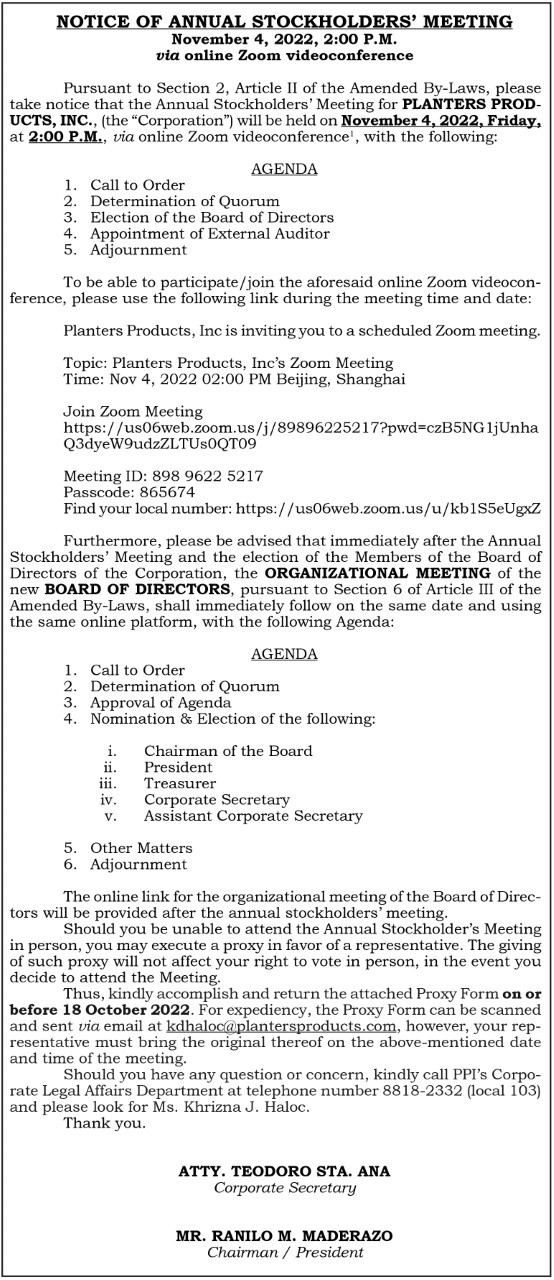
Planters Products, Inc. to conduct annual stockholders’ meeting on Nov. 4


Spotlight is BusinessWorld’s sponsored section that allows advertisers to amplify their brand and connect with BusinessWorld’s audience by enabling them to publish their stories directly on the BusinessWorld Web site. For more information, send an email to online@bworldonline.com.

Join us on Viber to get more updates from BusinessWorld: https://bit.ly/3hv6bLA.

Amid peso depreciation: Medalla vows to ‘act decisively’

REUTERS

THE BANGKO SENTRAL ng Pilipinas (BSP) on Wednesday said the peso depreciation has been fueling inflationary pressures, adding that this strengthens the case to “act decisively.”

The Philippine peso closed at P58.965 against the dollar on Wednesday, losing 10 centavos from its P58.865 finish on Tuesday. This is just 3.5 centavos away from the local currency’s record close of P59 on Oct. 10.

“The BSP does not normally react too much to movements in the exchange rate in keeping with our market-determined exchange rate policy. We view such moves as healthy market adjustment that sets appropriate signals to producers and consumers,” BSP Governor Felipe M. Medalla said during a virtual convention hosted by the Chamber of Thrift Banks on Wednesday.

“But the peso depreciation, while remaining in line with regional peers, has been adding to the buildup of inflationary pressures. This strengthens the case (for us) to act and to act decisively,” he added.   

The BSP earlier said financial markets around the world have been disrupted by the strong US dollar, which has caused other currencies such as the peso to depreciate.

For the year so far, the peso has weakened by 15.6% or P7.965 from its P51 close on Dec. 31, 2021.

Headline inflation quickened to 6.9% in September after easing slightly to 6.3% in August from 6.4% in July. In the nine months to September, inflation averaged 5.1%.

Mr. Medalla noted inflation will likely exceed the central bank’s 2-4% target band this year and in 2023.

“But as our rate hikes kick in, remember our tools act with a six-to-18-month lag, inflation for the second half of 2023 will likely be closer to 3% than to 4%. With full-year averaging slightly above 4.1%… We might slightly miss our headline target of 4%,” he said.

The BSP expects inflation to ease to 3% by 2024, Mr. Medalla added.

The Monetary Board has hiked borrowing costs by 225 basis points (bps) so far this year, in a bid to cool inflation.

“Our policy settings remain accommodative. Real policy rate is still quite low. Achieving a target consistent path of inflation is of paramount concern to us,” Mr. Medalla said.

‘SPECULATIVE ACTIVITIES’
Meanwhile, the Bankers Association of the Philippines (BAP) said on Wednesday it will work with the BSP to fight “speculative activities that tend to distort market prices and hurt the economy.”

“With global headwinds adversely affecting inflation and foreign exchange rates across the world, the BAP joins national efforts to minimize its impact on our people by avoiding activities that can only worsen the situation,” BAP President Antonio C. Moncupa said in a statement.

“In order to be part of the solution, the banking industry continues to work closely with the BSP for orderly, fair, and transparent markets minus the unproductive activities that only hurt the public,” he added.

UnionBank of the Philippines, Inc. Chief Economist Ruben Carlo O. Asuncion welcomed the BAP’s statement, saying this is a step in the right direction.

“Although it is widely expected that the BSP should allow market forces to move by itself, it is good to forge a stronger partnership with the market like the way various ASEAN (Association of Southeast Asian Nations) countries in the past have worked together to prevent financial market stress that can be detrimental for everyone,” Mr. Asuncion said in a Viber message.   

“I have seen this cooperation among ASEAN countries and cooperation within these economies should also be a welcome development especially during uncertain times,” he added.   

The peso opened Wednesday’s session at P58.95 versus the dollar. Its weakest showing was at P58.999, while its intraday best at P58.888 against the greenback. 

Dollars exchanged inched down to $505.37 million on Wednesday from $642.35 million on Tuesday.

“The peso weakened amid hawkish remarks by Fed official Mester and global slowdown concerns due to rising (coronavirus) cases in China,” a trader said in an e-mail.   

Federal Reserve Bank of Cleveland President Loretta J. Mester on Tuesday said the US central bank has yet to tame surging inflation and will continue to tighten monetary policy.

The Fed has raised interest rates by 300 bps since March.   

“The local currency might depreciate ahead of potentially elevated US consumer inflation reports,” the trader said.

For Thursday, the trader gave a forecast range of P58.90 to P59. — Keisha B. Ta-asan

PHL garments industry warns of more layoffs, temporary closures

REUTERS

THE PHILIPPINE garments industry is struggling amid a slump in global demand, warning of temporary closures and more worker layoffs in the next few months.

Confederation of Wearable Exporters of the Philippines (CONWEP) Executive Director Maritess Jocson-Agoncillo said factories may have to further cut their workforce if demand continues to decline. This after around 4,000 workers were laid off by garment firms in Mactan, Cebu. 

“What happened to our Mactan, Cebu-based members should not be singled out at this moment. This will be a trend for some factories whose customers are starting to cut their projections, so we expect temporary closures or partial retrenchment of workforce in the next few months,” she said at a virtual briefing on Wednesday.

In a separate Viber message, Ms. Jocson-Agoncillo clarified that around 9,440 workers employed by CONWEP members are temporarily on forced leave or have been laid off. This represents 3.5% of the 270,000-worker base, and covers four sectors: apparel, shoes, bags, and textile, she added.

“It might reach to a maximum range of 8-10% if the current trend extends longer or global demand conditions worsen,” Ms. Jocson-Agoncillo said.

The global apparel market has weakened amid the pandemic, rising inflation, supply chain disruptions and the ongoing Ukraine-Russia conflict.

Ms. Jocson-Agoncillo noted there has been a drop in consumer confidence in the United States, which is the top garments export market of the Philippines.

“This is brought about by current global trend wherein consumers tend to spend less, hold back on discretionary spending such as apparel and other consumer goods,” she said.

“The uncertainty of the war in East-Central Europe, rising fuel cost, the disrupted supply chain, and trepidation of another pandemic directly impacts on consumer behavior across the globe,” she added.   

Global clothing brands are now reducing their order projections.

“Brands and buyers would rather move their existing inventories. This is what the wearables sector is up against, when orders are canceled midstream. Some exporter-manufacturers are struggling to maintain full operations and need to lay off workers given fewer orders and operate in lesser capacity required. Affected brands are buying less,” Ms. Jocson-Agoncillo said.

She noted companies are looking to shift their portfolios out of the Philippines and into other Southeast Asian countries such as Vietnam, Cambodia and Indonesia over high labor costs, logistics and production flexibility.

“The recent wage hire order further aggravated the competitiveness of our export sector,” she added.

Based on data from the Philippine Statistics Authority, the combined Philippine exports of apparel, textile, travel goods, and footwear from January to July this year rose by 14% to $1.155 billion from $1.009 billion in the same period last year. — Revin Mikhael D. Ochave

World Bank ready to boost support for PHL

Annual Meetings signage greets participants and staff members at the International Monetary Fund-World Bank headquarters in Washington, DC, Oct. 11. — WORLD BANK/ SIMONE MCCOURTIE

THE WORLD BANK Group (WBG) is ready to increase its support for the Philippines, especially in agriculture, education, tourism, water and energy.

WBG President David Malpass on Tuesday met with Finance Secretary Benjamin E. Diokno on the sidelines of the International Monetary Fund-World Bank annual meetings in Washington, DC.

“President Malpass affirmed to Secretary Diokno the WBG’s readiness to increase support to the Philippines — particularly in the areas of agriculture, tourism, water, energy, and education — and was glad to hear Secretary Diokno’s thoughts on priority projects for fiscal year 2024,” the multilateral lender said in a readout from the meeting posted on the World Bank’s website.

As of March, the World Bank was the Philippines’ third-largest source of official development assistance, with loans and grants representing 23.38% of the total.

The World Bank is currently supporting 15 ongoing programs and projects worth $4.96 billion, in areas like transport, rural development, disaster risk reduction and management, social protection, Customs modernization, and COVID-19 response.

During the meeting, Mr. Malpass also stressed the importance of the continuation of tax reforms in the Philippines, and discussed the economy’s growth outlook and vulnerabilities with Mr. Diokno.

“President Malpass noted the importance of the Philippine’s continuation of tax reform efforts and work to broaden the tax base and affirmed the WBG’s readiness to support further work on domestic revenue mobilization, including the digitalization of the tax system to increase compliance,” it said.

Mr. Diokno previously said he will focus on digitalizing tax administration, leveraging technology to improve tax collections.

The World Bank upgraded its growth forecast for the Philippines for this year and 2023, citing an “accommodative” fiscal policy conducive to recovering domestic demand.

The World Bank projects the Philippine economy will grow by 5.8% in 2023, from 5.6% previously, but still below the government’s 6.5-8% assumption for next year. — KBT

DTI imposes safeguard duty on polyethylene imports

FREEPIK

THE DEPARTMENT of Trade and Industry (DTI) ordered the imposition of safeguard duties on imports of high-density polyethylene (HDPE) pellets and granules for three years in a bid to protect the local industry.

In Department Administrative Order (DAO) No. 22-13 dated Sept. 30, the DTI said the safeguard duty will be slapped on imported HDPE pellets and granules from various countries “to implement the adjustment plan of the local HDPE industry within that period.”

For the first year, a safeguard duty of P1,338 will be slapped on each metric ton (MT) of HDPE pellets and granules. This will go down to P1,271 per MT for the second year, and to P1,208 per MT for the third year.

HDPE resins are used in consumer and industrial packaging.

DTI-Bureau of Import Services Director Maria Guiza B. Lim said in a Viber message that safeguard duties will be imposed on imports from countries such as Thailand and Malaysia.

The DTI’s decision comes after the Tariff Commission (TC) in June recommended safeguard measures against HDPE imports.

The TC had noted a “sudden, sharp and significant enough” increase in the volume of imports of HDPE pellets and granules beginning the first half of 2021.

“There exists an imminent threat of serious injury and significant overall impairment to the position of the domestic HDPE industry in the near future,” the TC said, citing the high likelihood that HDPE imports will continue to spike in the near future.

It also cited the “substantial freely disposable production capacities of top suppliers Malaysia, Thailand, Singapore and Indonesia,” as well as the significant deterioration in the overall position of the domestic HDPE industry during the surge in imports.

“While the DTI is mandated to protect consumers, there is a need to balance this with other sectors such as investors and industries which provide employment to Filipinos,” the department said in the DAO.

The DTI said users of HDPE pellets and granules will still be able to choose between the local and imported products.

“The imposition of the safeguard measure will only be temporary and is not expected to cause shortage of HDPE pellets and granules in the domestic market considering that the HDPE manufacturer has sufficient capacity to meet domestic demand,” the DTI said.

JG Summit Olefins Corp. (JGSOC), which merged with JG Summit Petrochemical Corp. (JGSPC), had sought the imposition safeguard duty on imported HDPE pellets and granules.

JGSOC is the lone domestic manufacturer of HDPE pellets and granules, which are used for film extrusion process, injection molding process, blow molding process, pipe extrusion process, and monofilament extrusion process. — Revin Mikhael D. Ochave

New BOT Law IRR in effect

Estrella-Pantaleon bridge pictured on July 8, 2021. — PHILIPPINE STAR/ MICHAEL VARCAS

THE revised implementing rules and regulations (IRR) for the Build-Operate-Transfer (BOT) Law took effect on Wednesday, which the Finance department hopes would help the Philippines attract more private investments in infrastructure projects.

“The revised IRR of the BOT Law will allow us to mobilize private sector resources as an engine for capital and a catalyst for growth. This move will produce exponential returns for our country that will span generations to come,” Finance Secretary Benjamin E. Diokno said in a statement.

The IRR, which was published on Sept. 27, amended key provisions that addressed concerns “over the financial viability and bankability of public-private partnership (PPP) projects as well as clarify ambiguous provisions that might have caused delays in the PPP process.”

For instance, the definition of the Material Adverse Government Action (MAGA) was revised to cover all government actions, not just the Executive branch.

The IRR was amended in response to criticisms by business groups that the previous version of the rules compels private proponents to shoulder more risk while relieving the government of responsibility for delayed deliverables.

Mr. Diokno said the new rules will be crucial in unlocking the benefits of PPP, as well as “reap higher multiplier effects for the economy.”

“Projects that fit into the approved master plans and connect regions would be given priority to ensure that all Filipinos benefit from economic growth,” Mr. Diokno said.

Meanwhile, PPP Center Executive Director Ma. Cynthia C. Hernandez said the amended rules will boost PPP projects.

“The PPP Center is hopeful that the amended IRR will speed up the process of doing viable PPPs and bring in more jobs and help deliver better services to the public,” she said in a separate statement.

The PPP Center said there are currently 74 projects worth P2.25 trillion in the pipeline as of end-August. These include 53 national projects and 21 local projects. — A.O.A.Tirona

DoE: Oil contracts assure ‘just returns’ on risks

PHILIPPINE STAR/KRIZ JOHN ROSALES

THE Energy department expects an initial investment of $72 million in two adjacent offshore petroleum exploration projects northwest of Palawan island, calling early activities in the “indisputable” Philippine waters a start of more foreign investors coming in and taking risks.

“Initially, with the drilling of these two wells, one in each service contract, the well cost would be around $16 million per well as per the project they have submitted,” said Department of Energy (DoE) Undersecretary Alessandro O. Sales in a media briefing on Wednesday.

He was referring to Service Contract (SC) 6B and SC 54A, which are under Nido Petroleum Philippines Pty. Ltd., the local unit of Australian energy firm Sacgasco Ltd.

SC 6B, which covers the Cadlao oil field, is expected to be ahead with a production test. Energy officials described the areas as closer to Palawan island than the country’s operating Malampaya gas field and Galoc oil field.

“In Cadlao, they will be undertaking an extended production test and the budget submitted for this is an additional $40 million. So when they drill it, they will test the flow rate for a period of time to determine how to optimize future production and determine the more appropriate way in installing the permanent production facilities,” Mr. Sales said.

“So if you count that, that’s $16 [million], $16 [million] and another $40 [million], [for a total of] $72 [million] for both contracts,” he added.

However, he said that the expected oil recoveries In the area should be framed from the proper perspective. He said in Cadlao, the target is a “small volume” of 5 million to 6 million barrels.

In terms of daily production, the volume could be a high of 15,000 barrels to a low of 5,000 barrels from the oil fields, which will decline in time.

“In terms of actual impact, I think in fluid consumption, [the] Philippines consumes about 320,000-barrel-equivalent of fuel [per day],” he said.

For DoE Secretary Raphael P.M. Lotilla, the Cadlao drilling is just “a first step.”

“What is important and significant in this is that foreign investors have taken the assurances made by the Philippine government that our PD (Presidential Decree) 87 framework for giving incentives to the service contractors is going to be upheld,” he said.

He said PD 87 talks about hastening the discovery and production of indigenous petroleum through the use of government or private resources, either local or foreign.

“The ultimate objective is to yield the maximum benefit to the Filipino people and at the same time, to assure just returns to participating private enterprises, particularly those that will provide the necessary services, financing, and technology, and fully assume all exploration risks,” Mr. Lotilla said.

On Tuesday, the DoE announced that it had allowed Nido Petroleum to proceed with the on-site survey for drilling locations under SC 6B by the fourth quarter of this year.

Meanwhile, Mr. Lotilla said that the DoE approval of the sale of the 45% stake of Shell Philippines Exploration B.V. (SPEx) in the Malampaya deepwater project to a subsidiary of Prime Infrastructure Capital, Inc. was premised on the Razon-led company’s commitment to expand gas production, and develop nearby indigenous sources.

“I am confident that this trend will continue as we reaffirm to prospective investors the openness of our economy to foreign and local investors and we assure them of the continued stability of our legal framework, especially in the upstream oil and gas sector,” he said.

The Malampaya project is one of the country’s most important power assets, producing natural gas for power plants in Batangas City that provide up to 20% of Luzon’s total electricity needs. Its concession agreement is set to expire in 2024. — Ashley Erika O. Jose