Home Blog Page 5213

Human Rights Watch warns against Mexico’s ‘regressive’ electoral overhaul

STOCK PHOTO | Image by Jorge Carlos from Pixabay

 – A leading rights group on Monday called for Mexican lawmakers to vote against a proposal to overhaul the electoral system, warning it could seriously undermine electoral authorities’ independence, putting free and fair elections at risk.

President Andres Manuel Lopez Obrador’s proposal to reform Mexico’s National Electoral Institute (INE) would cut the INE’s budget and change how electoral authorities are elected.

If Congress approves the reform, candidates for the INE’s board would be put forward by the legislative, judicial and executive branches of government, which critics see as a power grab by the president, due to his influence over those bodies.

Human Rights Watch (HRW) said in a statement that legislators should reject the changes, which would “contravene international human rights standards.”

“President Lopez Obrador’s proposed changes to the electoral system would make it much easier for whichever party holds power to co-opt the country’s electoral institutions to stay in power,” said Tyler Mattiace, Mexico researcher at the New York-based HRW.

“Given Mexico’s long history of one-party rule maintained through questionable elections, it is extremely problematic that legislators would consider a highly regressive proposal that would weaken the independence of the elections authority.”

Lopez Obrador says the reform will strengthen democracy and reduce the influence of economic interests in politics.

A protest against the reform in November drew tens of thousands, which Lopez Obrador dismissed as “racist” and “classist.”

The proposal is currently awaiting a vote in Congress, where Lopez Obrador’s Morena party alone does not have the 2/3 majority needed to secure its passage. – Reuters

Indonesia parliament ratifies criminal code that bans sex outside marriage

STOCK PHOTO | Image by Tú Anh from Pixabay

 – Indonesia’s parliament on Tuesday approved a criminal code that bans sex outside marriage with a punishment of up to one year in jail, part of a raft of legal changes that critics say undermine civil liberties in the world’s third-largest democracy.

The controversial new laws, which apply to Indonesians and foreigners alike, also include a ban on insulting the president or state institutions and expressing views counter to state ideology.

Legislators hailed the passage of the criminal code that the Southeast Asian nation has been discussing revising since declaring independence from the Dutch.

“The old code belongs to Dutch heritage... and is no longer relevant now,” Bambang Wuryanto, head of the parliamentary commission in charge of revising the code told lawmakers.

The approval comes even as business groups warned it could harm Indonesia’s image as a tourism and investment destination.

Indonesia, the world’s largest Muslim-majority nation, has seen a rise in religious conservatism in recent years with legal experts suggesting the new laws around morality, and a separate article on customary law will reinforce discriminatory and sharia-inspired bylaws at the local level.

Opponents of the bill have highlighted articles they say are socially regressive, will curb free speech and represent a “huge setback” in ensuring the retention of democratic freedoms after the fall of authoritarian leader Suharto in 1998. – Reuters

NASA’s Orion capsule makes its closest approach to moon

STOCK IMAGE | Image by 0fjd125gk87 from Pixabay

The uncrewed Orion capsule of NASA’s Artemis I mission sailed within 80 miles (130 km) of the lunar surface on Monday, achieving the closest approach to the moon for a spacecraft built to carry humans since Apollo 17 flew half a century ago.

The capsule‘s lunar flyby, on the return leg of its debut voyage, came a week after Orion reached its farthest point in space, nearly 270,000 miles from Earth while midway through its 25-day mission, the U.S. space agency said on its website.

Orion passed about 79 miles above the lunar surface on Monday as the spacecraft fired its thrusters for a “powered flyby burn,” designed to change the vehicle’s velocity and set it on course for its flight back to Earth.

NASA said the 3-1/2-minute burn would mark the last major spaceflight maneuver for Orion before it was due to parachute into the sea and splash down on Dec. 11.

The last time a spacecraft designed for human travel came as close to the moon as Orion was the final mission of the Apollo program, Apollo 17, which carried Gene Cernan and Harrison Schmitt to the lunar surface 50 years ago this month. They were the last of 12 NASA astronauts who walked on the moon during a total of six Apollo missions from 1969 to 1972.

Although Orion has no astronauts aboard – just a simulated crew of three mannequins – it flew farther than any previous “crew-class” spacecraft on the 13th day of its mission. It reached a point 268,563 miles from Earth, nearly 20,000 miles beyond the record distance set by the crew of Apollo 13 in 1970, which aborted its lunar landing and returned to Earth after a nearly catastrophic mechanical failure.

The much-delayed and highly anticipated launch of Orion last month kicked off Apollo’s successor program Artemis, aimed at returning astronauts to the lunar surface this decade and establishing a sustainable base there as a stepping stone to future human exploration of Mars.

If the mission succeeds, a crewed Artemis II flight around the moon and back could come as early as 2024, followed within a few years by the program’s first lunar landing of astronauts with Artemis III. Sending astronauts to Mars is expected to take at least another decade and a half to achieve.

“We couldn’t be more pleased about how the spacecraft has been performing really beyond all our expectations,” Debbie Korth, deputy manager for NASA’s Orion program, told reporters in a news briefing on Monday.

Orion was carried to space atop NASA’s towering, next-generation Space Launch System (SLS) rocket, which blasted off on Nov. 16 from NASA’s Kennedy Space Center on Cape Canaveral, Florida. Read full story

The mission marked the first flight of the combined SLS rocket and the Orion capsule, built by Boeing Co. and Lockheed Martin Corp., respectively, under contract with NASA.

The chief objective of Orion‘s inaugural flight is to test the durability of its heat shield as it re-enters Earth’s atmosphere at 24,500 miles per hour, much faster than spacecraft returning from the International Space Station. – Reuters

Musk’s Neuralink faces federal probe, employee backlash over animal tests

STOCK PHOTO | Image by Gerd Altmann from Pixabay

Elon Musk’s Neuralink, a medical device company, is under federal investigation for potential animal-welfare violations amid internal staff complaints that its animal testing is being rushed, causing needless suffering and deaths, according to documents reviewed by Reuters and sources familiar with the investigation and company operations.

Neuralink Corp. is developing a brain implant it hopes will help paralyzed people walk again and cure other neurological ailments. The federal probe, which has not been previously reported, was opened in recent months by the US Department of Agriculture’s Inspector General at the request of a federal prosecutor, according to two sources with knowledge of the investigation. The probe, one of the sources said, focuses on violations of the Animal Welfare Act, which governs how researchers treat and test some animals.

The investigation has come at a time of growing employee dissent about Neuralink’s animal testing, including complaints that pressure from CEO Musk to accelerate development has resulted in botched experiments, according to a Reuters review of dozens of Neuralink documents and interviews with more than 20 current and former employees. Such failed tests have had to be repeated, increasing the number of animals being tested and killed, the employees say. The company documents include previously unreported messages, audio recordings, emails, presentations and reports.

Mr. Musk and other Neuralink executives did not respond to requests for comment.

Reuters could not determine the full scope of the federal investigation or whether it involved the same alleged problems with animal testing identified by employees in Reuters interviews. A spokesperson for the USDA inspector general declined to comment. US regulations don’t specify how many animals companies can use for research, and they give significant leeway to scientists to determine when and how to use animals in experiments. Neuralink has passed all USDA inspections of its facilities, regulatory filings show.

In all, the company has killed about 1,500 animals, including more than 280 sheep, pigs and monkeys, following experiments since 2018, according to records reviewed by Reuters and sources with direct knowledge of the company’s animal-testing operations. The sources characterized that figure as a rough estimate because the company does not keep precise records on the number of animals tested and killed. Neuralink has also conducted research using rats and mice.

The total number of animal deaths does not necessarily indicate that Neuralink is violating regulations or standard research practices. Many companies routinely use animals in experiments to advance human health care, and they face financial pressure to quickly bring products to market. The animals are typically killed when experiments are completed, often so they can be examined post-mortem for research purposes.

But current and former Neuralink employees say the number of animal deaths is higher than it needs to be for reasons related to Mr. Musk’s demands to speed research. Through company discussions and documents spanning several years, along with employee interviews, Reuters identified four experiments involving 86 pigs and two monkeys that were marred in recent years by human errors. The mistakes weakened the experiments’ research value and required the tests to be repeated, leading to more animals being killed, three of the current and former staffers said. The three people attributed the mistakes to a lack of preparation by a testing staff working in a pressure-cooker environment.

One employee, in a message seen by Reuters, wrote an angry missive earlier this year to colleagues about the need to overhaul how the company organizes animal surgeries to prevent “hack jobs.” The rushed schedule, the employee wrote, resulted in under-prepared and over-stressed staffers scrambling to meet deadlines and making last-minute changes before surgeries, raising risks to the animals.

Mr. Musk has pushed hard to accelerate Neuralink’s progress, which depends heavily on animal testing, current and former employees said. Earlier this year, the chief executive sent staffers a news article about Swiss researchers who developed an electrical implant that helped a paralyzed man to walk again. “We could enable people to use their hands and walk again in daily life!” he wrote to staff at 6:37 a.m. Pacific Time on Feb. 8. Ten minutes later, he followed up: “In general, we are simply not moving fast enough. It is driving me nuts!”

On several occasions over the years, Mr. Musk has told employees to imagine they had a bomb strapped to their heads in an effort to get them to move faster, according to three sources who repeatedly heard the comment. On one occasion a few years ago, Musk told employees he would trigger a “market failure” at Neuralink unless they made more progress, a comment perceived by some employees as a threat to shut down operations, according to a former staffer who heard his comment.

Five people who’ve worked on Neuralink’s animal experiments told Reuters they had raised concerns internally. They said they had advocated for a more traditional testing approach, in which researchers would test one element at a time in an animal study and draw relevant conclusions before moving on to more animal tests. Instead, these people said, Neuralink launches tests in quick succession before fixing issues in earlier tests or drawing complete conclusions. The result: More animals overall are tested and killed, in part because the approach leads to repeated tests.

One former employee who asked management several years ago for more deliberate testing was told by a senior executive it wasn’t possible given Musk’s demands for speed, the employee said. Two people told Reuters they left the company over concerns about animal research.

The problems with Neuralink’s testing have raised questions internally about the quality of the resulting data, three current or former employees said. Such problems could potentially delay the company’s bid to start human trials, which Musk has said the company wants to do within the next six months. They also add to a growing list of headaches for Musk, who is facing criticism of his management of Twitter, which he recently acquired for $44 billion. Musk also continues to run electric carmaker Tesla Inc and rocket company SpaceX.

The US Food and Drug Administration is in charge of reviewing the company’s applications for approval of its medical device and associated trials. The company’s treatment of animals during research, however, is regulated by the USDA under the Animal Welfare Act. The FDA didn’t immediately comment.


MISSED DEADLINES, BOTCHED EXPERIMENTS

Mr. Musk’s impatience with Neuralink has grown as the company, which launched in 2016, has missed his deadlines on several occasions to win regulatory approval to start clinical trials in humans, according to company documents and interviews with eight current and former employees.

Some Neuralink rivals are having more success. Synchron, which was launched in 2016 and is developing a different implant with less ambitious goals for medical advances, received FDA approval to start human trials in 2021. The company’s device has allowed paralyzed people to text and type by thinking alone. Synchron has also conducted tests on animals, but it has killed only about 80 sheep as part of its research, according to studies of the Synchron implant reviewed by Reuters. Musk approached Synchron about a potential investment, Reuters reported in August.

Synchron declined to comment.

In some ways, Neuralink treats animals quite well compared to other research facilities, employees said in interviews, echoing public statements by Musk and other executives. Company leaders have boasted internally of building a “Monkey Disneyland” in the company’s Austin, Texas facility where lab animals can roam, a former employee said. In the company’s early years, Musk told employees he wanted the monkeys at his San Francisco Bay Area operation to live in a “monkey Taj Mahal,” said a former employee who heard the comment. Another former employee recalled Mr. Musk saying he disliked using animals for research but wanted to make sure they were “the happiest animals” while alive.

The animals have fared less well, however, when used in the company’s research, current and former employees say.

The first complaints about the company’s testing involved its initial partnership with University of California, Davis, to conduct the experiments. In February, an animal rights group, the Physicians Committee for Responsible Medicine, filed a complaint with the USDA accusing the Neuralink-UC Davis project of botching surgeries that killed monkeys and publicly released its findings. The group alleged that surgeons used the wrong surgical glue twice, which led to two monkeys suffering and ultimately dying, while other monkeys had different complications from the implants.

The company has acknowledged it killed six monkeys, on the advice of UC Davis veterinary staff, because of health problems caused by experiments. It called the issue with the glue a “complication” from the use of an “FDA-approved product.” In response to a Reuters inquiry, a UC Davis spokesperson shared a previous public statement defending its research with Neuralink and saying it followed all laws and regulations.

A federal prosecutor in the Northern District of California referred the animal rights group’s complaint to the USDA Inspector General, which has since launched a formal probe, according to a source with direct knowledge of the investigation. USDA investigators then inquired about the allegations involving the UC Davis monkey research, according to two sources familiar with the matter and emails and messages reviewed by Reuters.

The probe is concerned with the testing and treatment of animals in Neuralink’s own facilities, one of the sources said, without elaborating. In 2020, Neuralink brought the program in-house, and has since built its extensive facilities in California and Texas.

A spokesperson for the US attorney’s office for the Northern District of California declined to comment.

Delcianna Winders, director of the Animal Law and Policy Institute at the Vermont Law and Graduate School, said it is “very unusual” for the USDA inspector general to investigate animal research facilities. Winders, an animal-testing opponent who has criticized Neuralink, said the inspector general has primarily focused in recent years on dog fighting and cockfighting actions when applying the Animal Welfare Act.


‘IT’S HARD ON THE LITTLE PIGGIES’

The mistakes leading to unnecessary animal deaths included one instance in 2021, when 25 out of 60 pigs in a study had devices that were the wrong size implanted in their heads, an error that could have been avoided with more preparation, according to a person with knowledge of the situation and company documents and communications reviewed by Reuters.

The mistake raised alarms among Neuralink’s researchers. In May 2021, Viktor Kharazia, a scientist, wrote to colleagues that the mistake could be a “red flag” to FDA reviewers of the study, which the company planned to submit as part of its application to begin human trials. His colleagues agreed, and the experiment was repeated with 36 sheep, according to the person with knowledge of the situation. All the animals, both the pigs and the sheep, were killed after the procedures, the person said.

Mr. Kharazia did not comment in response to requests.

On another occasion, staff accidentally implanted Neuralink’s device on the wrong vertebra of two different pigs during two separate surgeries, according to two sources with knowledge of the matter and documents reviewed by Reuters. The incident frustrated several employees who said the mistakes – on two separate occasions – could have easily been avoided by carefully counting the vertebrae before inserting the device.

Company veterinarian Sam Baker advised his colleagues to immediately kill one of the pigs to end her suffering.

“Based on low chance of full recovery … and her current poor psychological well-being, it was decided that euthanasia was the only appropriate course of action,” Mr. Baker wrote colleagues about one of the pigs a day after the surgery, adding a broken heart emoji.

Mr. Baker did not comment on the incident.

Employees have sometimes pushed back on Mr. Musk’s demands to move fast. In a company discussion several months ago, some Neuralink employees protested after a manager said that Musk had encouraged them to do a complex surgery on pigs soon. The employees resisted on the grounds that the surgery’s complexity would lengthen the amount of time the pigs would be under anesthesia, risking their health and recovery. They argued they should first figure out how to cut down the time it would take to do the surgery.

“It’s hard on the little piggies,” one of the employees said, referring to the lengthy period under anesthesia.

In September, the company responded to employee concerns about its animal testing by holding a town hall to explain its processes. It soon after opened up the meetings to staff of its federally-mandated board that reviews the animal experiments.

Neuralink executives have said publicly that the company tests animals only when it has exhausted other research options, but documents and company messages suggest otherwise. During a Nov. 30 presentation the company broadcast on YouTube, for example, Mr. Musk said surgeries were used at a later stage of the process to confirm that the device works rather than to test early hypotheses. “We’re extremely careful,” he said, to make sure that testing is “confirmatory, not exploratory,” using animal testing as a last resort after trying other methods.

In October, a month before Mr. Musk’s comments, Autumn Sorrells, the head of animal care, ordered employees to scrub “exploration” from study titles retroactively and stop using it in the future.

Ms. Sorrells did not comment in response to requests.

Neuralink records reviewed by Reuters contained numerous references over several years to exploratory surgeries, and three people with knowledge of the company’s research strongly rejected the assertion that Neuralink avoids exploratory tests on animals. Company discussions reviewed by Reuters showed several employees expressing concerns about Sorrells’ request to change exploratory study descriptions, saying it would be inaccurate and misleading.

One noted that the request seemed designed to provide “better optics” for Neuralink. – Reuters

Philippines inflation at 14-year high, backs case for 50 bps rate hike

MANILA – Philippine annual inflation surged to a 14-year high in November driven mainly by higher food prices, the statistics agency said on Tuesday, with the pickup in prices seen supporting the case for a half-percentage point interest rate hike this month.

The consumer price index (CPI) rose 8.0% in November from a year earlier, higher than the previous month’s 7.7% and the 7.8% forecast in a Reuters poll, but within the central bank’s 7.4%-8.2% forecast for the month.

Costlier vegetables drove food inflation up to 10.0% in November from a year earlier, the fastest pace since September 2018, due to supply constraints caused by a typhoon.

Excluding the volatile food and energy components, the core CPI rose 6.5%, faster than October’s 5.9%.

Following the data’s release, the Bangko Sentral ng Pilipinas (BSP) reiterated it “remains prepared to take all further monetary policy actions necessary to bring inflation back to a target-consistent path over the medium-term.”

Year-to-date inflation stood at 5.6%, well outside the central bank’s 2%-4% target for the year.

The Philippine central bank has raised rates six times this year including two 75-basis point increases in July and November, and its governor last week flagged another 25 basis points or 50 basis points hike at the Dec. 15 meeting.

ING economist Nicholas Mapa said the central bank would likely opt for a 50-basis point rate hike this month, which would take the policy rate to 5.50%.

“Demand side pressures persist with revenge spending related items like restaurant and personal services seeing higher inflation,” Mapa said in a message on Twitter. — Reuters

DBCC trims growth target for 2023

BUILDINGS are seen from the Estrella-Pantaleon Bridge in Makati City, Dec. 4. The Development Budget Coordination Committee (DBCC) on Monday said the Philippine economy is now expected to expand by 6-7% in 2023. — PHILIPPINE STAR/ MIGUEL DE GUZMAN

ECONOMIC MANAGERS trimmed the Philippines’ gross domestic product (GDP) growth target for 2023, citing the anticipated global economic slowdown.

The Development Budget Coordination Committee (DBCC) on Monday said the Philippine economy is now expected to expand by 6-7% in 2023, narrower than the previous DBCC target of 6.5-8%.

However, it kept the 6.5-7.5% growth target this year after the economy grew by 7.7% in the first nine months.

“As the economy continues to reopen, domestic demand increased, and services and industry sectors improved,” the DBCC said in a statement after its meeting on Monday. “This momentum is expected to slightly decelerate in 2023 and range from 6% to 7% considering external headwinds such as the slowdown in major advanced economies.”

Finance Secretary Benjamin E. Diokno said at a briefing  the global economic slowdown had prompted the downgrade of next year’s growth target.

International Monetary Fund (IMF) Managing Director Kristalina Georgieva last week said global growth might fall below 2% in 2023 due to the Russia-Ukraine war and a slowdown in the United States, Europe and China.

The IMF slashed its global growth forecast for 2023 to 2.7% in October, from 2.9% in July.

Despite the lower target for next year, Socioeconomic Planning Secretary Arsenio M. Balisacan said the Philippine economy “remains among the bright stars in Asia.”

“But of course, we have a strong domestic demand and we are actually banking on that,” National Economic and Development Authority (NEDA) Undersecretary Rosemarie G. Edillon said at the briefing.

Meanwhile, the DBCC kept its growth target at 6.5-8% for 2024-2028, to reflect the impact of government strategies and the Philippine Development Plan.

“These include modernizing agriculture and agribusiness, revitalizing the industry sector and reinvigorating the service sector, among others,” it said.

It also raised the average inflation assumption to 5.8% for 2022 from 4.5-5.5% due to elevated food prices and transport costs.

This matches the average inflation forecast of the Bangko Sentral ng Pilipinas (BSP) for the year.

However, the DBCC expects inflation to ease to 2.5-4.5% in 2023, and return to the 2-4% target in 2024 to 2028.

The DBCC tweaked the assumption for the price of Dubai crude oil per barrel to $98-$100 this year, from $90-$110 per barrel. Dubai crude oil prices are expected to drop to $80-$100 per barrel in 2023, and $70-$90 per barrel in 2024 and 2025 “as oil supply catches up with demand,” it said.

Foreign exchange rate assumptions for 2023 and 2024 were also adjusted as “the peso continues to depreciate due to heightened global uncertainties and aggressive monetary policy tightening of the US Federal Reserve,” the DBCC said.

The peso is expected to range from P54-P55 a dollar this year, further weakening to P55-P59 in 2023. It is expected to appreciate and stabilize in 2024-2028, moving within P53 to P57-a-dollar range.

For this year, the DBCC lowered the export growth target to 4% from 7%. Next year, export growth is expected to slow to 3% before picking up to 6% in 2024-2028.

This year’s import growth projection was raised to 20% from 18%. However, the growth is seen to slow to 3% in 2023, before rising to 8% in 2024-2028.

FISCAL PROGRAM
The DBCC also increased revenue projections as it expects sustained economic activity over the medium term.

It now targets to generate P3.516 trillion in revenues (16.1% of GDP) for this year from P3.304 trillion previously.

“Meanwhile, revenue projections in the medium term are expected to be from P3.7 trillion in 2023 to P6.6 trillion in 2028, as tax reforms from the previous administration and strategies to ensure environmental sustainability are continuously being pursued,” the DBCC said.

The expenditure program was also increased to P5.018 trillion (23% of GDP) this year, and to P5.177 trillion (21.5% of GDP) for 2023. Disbursements are seen to hit P5.557 trillion (20.2% of GDP) in 2024 and up to P7.72 trillion in 2028.

“Given the revised revenue and disbursement program, the DBCC revised its deficit projection to 6.9% of GDP for 2022 but maintained its target deficit for 2023 to 2028, which shall progressively decline from 6.1% of GDP in 2023 to the pre-pandemic level of 3% of GDP in 2028,” it said.

The DBCC said the proposed national budget for fiscal year 2024 is now at P5.8 trillion.

“This proposed budget will continue to provide the necessary funding requirements to support the administration’s overarching goal of economic recovery and prosperity towards inclusivity and sustainability, as encompassed in the Eight-Point Socioeconomic Agenda,” it said. — K.B.Ta-asan

Business groups express concern over proposed sovereign wealth fund

TWELVE BUSINESS associations and economic policy groups, including the Makati Business Club (MBC) and the Management Association of the Philippines (MAP), expressed “serious concerns and reservations” over the proposed Maharlika Wealth Fund (MWF), saying it will do more harm than good in the long run.

“There is at present no gap or ‘missing institution’ in the economy that needs to be solved by the creation of a sovereign wealth fund. The country does not have a bonanza of commodity surpluses that need to be deployed,” the groups said in a joint statement signed by the MBC, MAP, Foundation for Economic Freedom (FEF) and Financial Executives Institute of The Philippines (FINEX), among other groups.

“Instead of leaving a legacy of surplus funds to be managed for future generations, the current generation is leaving a legacy of heavy indebtedness that future generations need to pay or refinance. There is no need, or even justification, to pool the reserves of government financial institutions and pension funds into larger amounts in order to earn higher returns,” they said.

Several lawmakers led by House Speaker Ferdinand Martin G. Romualdez, a cousin of President Ferdinand R. Marcos, Jr., recently filed a bill seeking to create a sovereign wealth fund.

The proposed fund will make investments by pooling money from the Government Service Insurance System (GSIS), Social Security System (SSS), Land Bank of the Philippines (LANDBANK) and Development Bank of the Philippines (DBP).

However, the groups said there is no reason why GSIS and SSS funds should be diverted to a sovereign wealth fund “as it would simply expose the members’ retirement funds to investments in assets with additional market and performance risks.”

Under the latest version of the bill, the Bangko Sentral ng Pilipinas (BSP) must contribute 50% of its annual dividends to the fund.

“Instead of putting in more capital to the BSP, the bill, in effect, deprives it of quicker capitalization and in the process, undermines the BSP’s independence and its ability to discharge its role as the country’s central monetary authority and systemic risk regulator,” the groups said.

‘ENOUGH RESERVES’
The Philippines has more than sufficient foreign exchange reserves that can be set aside for a proposed sovereign wealth fund, Finance Secretary Benjamin E. Diokno said, allaying the central bank’s concerns about the plan.

There’s “too much ammunition,” Mr. Diokno, a former central bank governor, told reporters, referring to the foreign reserves. He was responding to questions on whether using the reserves for the wealth fund would hurt the central bank’s ability to use it as a tool against foreign exchange volatility.

Establishing the Maharlika fund won’t affect the Bangko Sentral ng Pilipinas’ independence, he said, adding that the central bank should have a say on how much foreign reserves it will contribute to the fund.

BSP Governor Felipe M. Medalla last week cautioned against the sovereign wealth fund plan, raising issues on governance and the central bank’s independence.

‘POWERFUL STATEMENT’
The House ways and means committee on Monday approved the tax provisions of the fund, which would ensure the tax savings will go back to the investment fund.

“Some P680 million in tax savings will inure to the fund every year as a result of this exemption. That goes towards making the SSS and GSIS funds more robust. That means more funds for pensions,” Albay Rep. Jose Ma. Clemente “Joey” S. Salceda, who chairs the committee, said.

In response to criticisms, Mr. Salceda also proposed safeguards for the Maharlika bill. He introduced an amendment that will ensure all transactions follow the “arm’s length principle and the prudent person rule.”

“This ensures that the fund does not take positions that disadvantage it,” he said.

Mr. Salceda noted the fund would have several layers of accountability, such as the board of directors, advisory board and the joint congressional oversight committee composed of five members from the House and Senate. The proposed board will be headed by the president of the Philippines, and include representatives from government financial institutions and two independent directors.

He also proposed that at least one of the independent directors be an SSS or GSIS member or pensioner, to address concerns about pensioner representation on the board.

Also on Monday, House Senior Deputy Speaker and Pampanga Rep. Gloria Macapagal-Arroyo endorsed the creation of the wealth fund.

“In the current version of the Maharlika Wealth Fund, the President of the Philippines chairs its governing Board. This is a powerful statement that the highest official of the land will hold himself as ultimately accountable to the Filipino people for the performance of the fund,” the former Philippine president said in a statement.

Meanwhile, Philippine Chamber of Commerce and Industry (PCCI) President George T. Barcelon said in a Viber message lawmakers should delay the creation of the fund “due to the funding issue coming from government agencies.”

Mr. Barcelon is the private sector representative to the Legislative Executive Development Advisory Council.

“(We should) put this (MWF) in the backburner in the meantime because we don’t want to do something that might affect our credit standing… With a good credit standing, we do get preferential or lower rates from foreign banks. That is more important for us — maintain our good credit standing,” Mr. Barcelon said in a television interview.

The Philippines currently has investment grade ratings from Fitch Ratings, S&P Global Ratings and Moody’s Investors Service. — Luisa Maria Jacinta C. Jocson, Bloomberg with Beatriz Marie D. Cruz

Congress ratifies 2023 national budget

PHILIPPINE STAR/ MICHAEL VARCAS

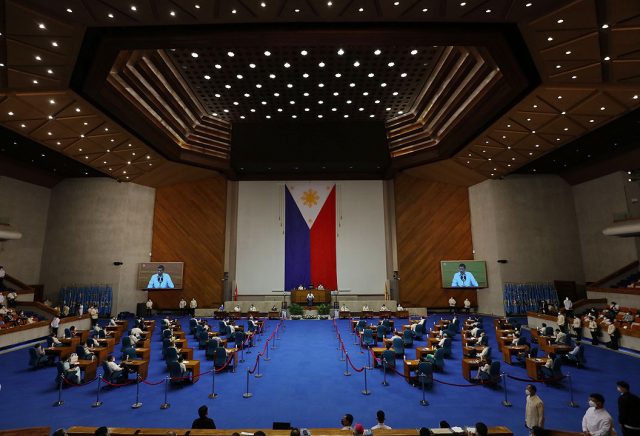
CONGRESS on Monday ratified the Bicameral Conference Committee report on the proposed P5.268-trillion national budget for next year, with leaders hoping it will be signed into law by President Ferdinand R. Marcos, Jr. before the Christmas break. 

Under the consolidated version of the 2023 national budget, the Bicameral Conference Committee restored the confidential and intelligence funds of the Department of Education (DepEd), among other things. 

“It was returned but for the other agencies whose funds were reduced, it was no longer returned,” Senator Juan Edgardo M. Angara, who heads the Senate Committee on Finance, told a press conference in Filipino. A copy of the recording was provided to reporters.

The Senate earlier slashed the DepEd’s P150-million confidential and intelligence fund to P30 million, moving it to the agency’s maintenance and operating expenses.

Marikina Rep. Elizaldy S. Co, chairman of the House Appropriations Committee, said it was the House contingent’s decision to restore the DepEd’s confidential funds, adding the DepEd should “secure the future of our children.”

Senate Minority Leader Aquilino Martin D. Pimentel III said he was disappointed with the bicam panel’s decision to restore the confidential funds of the DepEd.

During the period of amendments, he had proposed to scrap the confidential budgets of the Office of Vice-President Sara Duterte-Carpio and the DepEd, which she leads.

Meanwhile, Mr. Angara said the budget for the education sector was also increased to P900.9 billion under the bicameral report, from the Senate’s proposal of P884.6 billion.

The bicameral panel also restored the budget of the National Task Force to End Local Communist Armed Conflict to P10 billion after the Senate reduced it to P5 billion.

“What they said is that they need that budget, so we respected the wishes of the agency,” Mr. Angara said.

The bicameral panel also raised the infrastructure budget, as well as the allocations for the Department of Justice (DoJ), Department of Interior and Local Government (DILG) and the Judiciary, Mr. Angara said, without giving details.

The budget of the Energy Regulatory Commission was also increased by P453.11 million to support its operations and capital outlay, he said in plenary.

“For those (budgets) that were decreased, the special funds were slightly cut. The budget for other foreign-assisted projects, we put under programmed funds because under the unprogrammed fund, if there is foreign funding, once the loan has materialized, it can already be funded,” he added.

The senator said the final version of the 2023 national budget leaned more towards the House version, but said the deliberations were “fair.”

The reconciled version of the budget also increased funding for targeted financial assistance, the aid for people in crisis situations, free tuition and assistance to poor patients in government hospitals, among others.

Mr. Co said that an additional P10 billion was given to the Department of Public Works and Highways to address delays in project implementation and to repair school buildings and bridges.

The national budget includes funding for COVID-19 vaccination procurement worth P3.5 billion under unprogrammed appropriations, but lawmakers said the Health department would be given leeway to use the funds for other illnesses if necessary.

Mr. Angara said they hope the president would sign the 2023 national budget bill into law before Congress goes on a holiday break on Dec. 17.

“It looks to be on schedule before Christmas. The only issue is that the President is leaving, so we don’t know if it will reach him before he leaves for Europe or when he returns,” he said.

Mr. Marcos is scheduled to attend the Association of Southeast Asian Nations-European Union Summit in Brussels on Dec. 14. — Alyssa Nicole O. Tan

Customs exceeds full-year revenue target by 9.5%

AUTHORITIES seized over 1,000 sacks of illegally imported white onions in Divisoria, Manila on Dec. 2 amid high retail prices of red onions nationwide. — PHILSTAR/MIGUEL DE GUZMAN

THE BUREAU of Customs (BoC) has exceeded its full-year revenue collection target by 9.5% as of end-November.

Based on preliminary data, the BoC collected P76.77 billion in November, exceeding the P60.6-billion target by 26.7%. This brought the 11-month collection to P790.301 billion.

“The Bureau also marked its highest collection performance in history and reached this year’s revenue target of P721.52 billion as early as Nov. 11. This means the bureau was already P68.781 billion or 9.5% above its annual target as of Nov. 30,” the agency said.

It noted that all 17 collection districts had achieved their revenue targets for January to November.

The BoC said it would prioritize efforts to improve revenue collection, curb smuggling and streamline processes.

The agency said it has also implemented measures to help plug revenue leakages and sustain positive collection performance.

At a forum last week, Finance Secretary Benjamin E. Diokno said the BoC’s revenue surplus would likely cover the shortfall of other revenue-generating agencies.

As of end-October, the National Government’s revenue collections increased by 18.31% to P2.9 trillion, accounting for 89% of the P3.3-trillion goal for the year. — L.M.J.C.Jocson

Semirara sees steady coal output on strong demand

FREEPIK

SEMIRARA Mining and Power Corp. (SMPC) is targeting to produce 14.5 million metric tons (MMT) of coal in 2023 as it expects steady demand for the commodity.

The Consunji-led firm said in a statement on Monday that its coal production reached 13.7 MMT in January to September, already close to its goal of 14.5 MMT to 15 MMT in output this year.

“We expect stable demand for coal and electricity next year so we’re continually investing in our production and generation capacities,” SMPC President and Chief Operating Officer Maria Cristina C. Gotianun said in a statement.

For 2023, SMPC has set aside P5.6 billion for its capital expenditure (capex) projects, up by 8% compared to P5.2 billion in 2022.

The energy firm said P4.1 billion will be allocated for the mining equipment refleeting of its coal business, while P1.5 billion will be spent on maintenance activities plans for Sem-Calaca Power Corp. (SCPC) and Southwest Luzon Power Generation Corp. (SLPGC).

SMPC has spent P3.6 billion of its 2022 capex as of end-September. Of this, P2.2 billion was allotted for the acquisition of mining and support equipment while P1.4 billion went to the repair and replacement of plant components of SCPC and SLPGC.

The listed integrated energy firm posted a net income of P10.15 billion in the third quarter, almost three times higher the P4.01 billion recorded a year ago on high coal production and electricity prices.

Its revenues rose by 51.1% to P21.16 billion from the P14 billion recorded in the same period last year. Of its revenues, coal accounted for the biggest share at P15.04 billion or 71%, with power contributing P6.12 billion or 28.9%.

On Monday, shares of SMPC at the stock exchange closed 1.98% or 65 centavos lower to end at P32.20 per share. — AEOJ

D&L Industries to start plant operations by mid-2023

D&L INDUSTRIES, Inc. has moved the start of commercial operations of its Batangas plant to mid-2023 from early 2023 due to delayed permits and shipments.

“As mentioned during our third-quarter briefing, while the plant is substantially complete, some steps in the final stages are currently taking longer than expected,” D&L President and Chief Executive Officer Alvin D. Lao said in a disclosure.

The company said there were delays in processing permits and certifications, as well as in the arrival of shipments from overseas suppliers affected by the global chain supply disruptions.

“While Philippine Economic Zone Authority (PEZA) has granted an extension until the end of 2023, providing allowances in case of a force majeure, D&L’s management is committed to start commercial operations by mid-2023,” the company said.

Mr. Lao said the delay will not have any material impact on the company’s current operations as its current capacity is still enough to cover its requirements in the near term.

The plant will sit on a 26-hectare property in First Industrial Township – Special Economic Zone in Batangas. The plant will be part of the first phase of the company’s expansion which will cover 16 hectares of the PEZA area.

As of end-October, the company spent has around P8.6 billion for the project, which leaves it with around P1.6 billion in capital expenditure budget until early next year.

Once completed, the plant is seen to help the company develop more high value-added coconut-based products and penetrate new international markets.

“It will mainly cater to D&L’s growing export business in the food and oleochemicals segment. It will add the capability to manufacture downstream packaging, thus allowing the company to capture a bigger part of the production chain,” D&L Industries said.

In the nine-month period, the company posted a record-high income of P2.54 billion, up by 17.4% from P2.16 billion in 2021.

Its topline during the period rose by 57.5% to P33.9 billion from P21.53 billion revenues a year ago.

D&L Industries engages in product customization and specialization for food, chemicals, plastics and consumer products original design manufacturer industries. — Justine Irish D. Tabile

PLDT looking to ramp up Mindanao network rollout

BW FILE PHOTO

THE PLDT group announced on Monday that it is looking to further ramp up its network rollout in the southern regions of the Philippines.

The group intends to add around 6,000 fiber ports in Davao de Oro, Davao del Norte, Davao del Sur, Davao Occidental, Davao Oriental, and Davao City, as well as Smart wireless sites before the end of the year, PLDT said in an e-mailed statement.

PLDT’s fiber network has reached 17,000 villages as of end-September.

“This accounts for roughly 40% of all barangays (villages) in the Philippines,” the telecommunications company said.

According to PLDT, its wireless arm Smart Communications, Inc. recently beefed up its network in Northern Mindanao.

There were “additional sites and base stations in the cities of Cagayan de Oro  and Iligan, and additional LTE (long-term evolution) base stations in the provinces of Bukidnon, Misamis Oriental, Misamis Occidental, and Lanao del Norte,” it noted.

The group aims to upgrade its services across the country amid digitalization efforts from both the private sector and the government.

The Philippines ranked 55th out of 117 countries in the Digital Quality of Life Index 2022 by virtual private network service provider Surfshark from 48th last year. In Asia, the Philippines placed 14th out of 34 countries.

It performed the worst in internet affordability, ranking 98th globally, down 26 places from 72nd a year prior.

“Internet in the Philippines is not affordable compared to global standards,” Surfshark said.

The country placed 60th in terms of time needed to work to afford the cheapest mobile internet, up 44 places from 104th the prior year.

The report said that a 1-gigabyte (GB) mobile internet package costs 4 minutes and 51 seconds of work per month in the Philippines, 59 times more than the 5 seconds of work needed to buy a 1-GB package in Israel, which has the most affordable mobile Internet in the world, based on the index.

Hastings Holdings, Inc., a unit of PLDT Beneficial Trust Fund subsidiary MediaQuest Holdings, Inc., has a majority stake in BusinessWorld through the Philippine Star Group, which it controls. — Arjay L. Balinbin