Home Blog Page 521

Lenovo ThinkPad X1 Carbon Gen 13 Aura Edition

Lenovo ThinkPad X1 Carbon Gen 13 Aura Edition — BETTINA V. ROC

By Bettina V. Roc, Associate Editor

THE Lenovo ThinkPad X1 Carbon Gen 13 Aura Edition is part of the brand’s lineup of artificial intelligence (AI) PCs. It is primarily marketed as a commercial Copilot+ PC and is powered by Intel Core Ultra 7 processors.

Lenovo Philippines lent BusinessWorld a unit of the notebook for this review.

The review unit came with a 2.2 GHz Intel Core Ultra 7 256V processor on the Intel Evo Edition platform with integrated Intel Arc graphics, 16GB in installed RAM in a dual channel configuration (soldered), and a 1TB SSD. These are all upgradeable when purchasing, depending on your needs, but maxing out configurations can get expensive.

It features a 14-inch 2.8K OLED anti-glare, anti-reflection, and anti-smudge touch display with a 120Hz refresh rate, a ThinkPad TrackPoint backlit keyboard and a three-button TrackPad. It has a clamshell design with a 180-degree hinge, and the box also included a GaN 65-watt USB-C charger for the laptop’s 57Whr CRU battery.

The first thing I noticed about the ThinkPad X1 Carbon Gen 13 was how light it was, even inside the sealed box. When the review unit was delivered, I had to do a double take and check if it was really sealed to make sure there was a laptop inside. The brand said this is the thinnest and lightest ThinkPad X1 Carbon ever, weighing just 980 grams for the TrackPad version with dimensions of 312.8 x 214.75 x 8.08-14.37 mm.

According to Lenovo, the laptop is made up of various sustainable materials, including recycled carbon fiber contained in its plastic frame and recycled magnesium and post-consumer recycled content plastic for other parts of the chassis and even its AC adaptor. But even with the plastic frame and lightweight body, build quality feels very premium and sturdy, although with its Eclipse Black color and soft-touch finish, it easily collects smudges and also attracts dust. It’s easy to lift the display even with just one hand because of the notch part that also houses its camera, and it has enough grip and heft so its bottom half does not leave the desk.

Also, even with its thin form factor, the ThinkPad X1 Carbon Gen 13 comes with a wide array of ports. For this particular unit, there are two Thunderbolt 4 USB-C ports and one USB-A 3.2 Gen 1 (5Gbps) port on the left edge, while the right side has another USB-A port, an HDMI port, and an audio jack, along with a lock slot and the power button. Part of me wishes one of the two USB-C ports was also placed on the right side so users have the option to charge that way as well. Another small design issue is that having the small power button placed at the side could sometimes lead to accidental presses when lifting or even just adjusting the notebook’s placement (happened to me a few times).

The keyboard’s layout and the slightly curved keycaps allow for a smooth typing experience, and the TrackPoint is always useful if you’re familiar with how it works. The review unit also had a dedicated Copilot key beside the fingerprint sensor and came with the standard three-button TrackPad that is very responsive and is big enough to use comfortably (there’s also an option for a glass haptic TouchPad).

The 14-inch display’s color reproduction is great, and it has good contrast, brightness, and fairly crisp visuals. I can imagine that the touchscreen, combined with the 180-degree hinge, would be a great tool to have for small office meetings or presentations and collaborative work. The sound output when playing high-quality audio files was also decent for a notebook.

As for the performance, while I couldn’t really replicate my real-world work use case with the review unit for security reasons, I tried to test it with the usual heavy tasks I subject my office PC to, which are firing up browsers with a ton of open tabs for research, word processing, online and offline spreadsheet work, and moderate graphic design work (layout for newspaper publishing and batch photo editing). Because this is marketed as an AI PC, I also ran some AI tasks via Copilot+.

The notebook was able to handle most of these with no problem, even simultaneously, but there were times when you could hear the fan working overtime and you could feel some heat from behind the keyboard. Battery life is enough for normal office use at about 11 hours on a single 100% charge (which takes about two hours to get), depending on your workload.

Because this is an Aura Edition PC, it comes with several preloaded productivity, security, and utility features from Lenovo and Intel, which add to the user experience.

The ThinkPad X1 Carbon Gen 13 is a premium business PC that can handle most day-to-day office tasks for moderate users, and the best part is it’s as portable as portable notebooks get at below a kilogram and its thin form factor, making it perfect for those who work on the go, and even personal users looking for a productivity laptop in a very compact package.

However, it also comes at a premium price (starts at about P130,000 locally), and while it can hold its own in terms of performance, those that have more demanding workloads, especially those who need more GPU power, may need to consider other options.
SEC to ramp up outreach as FARMS program draws no participants

BW FILE PHOTO

NO COMPANY has joined the Securities and Exchange Commission’s (SEC) Financing Agribusiness through Responsible Market Solutions (FARMS) program since its launch in 2023, the commission said.

“There is currently no company that has availed of the SEC FARMS program since its launch in 2023. However, the commission has seen a growing interest from the sector, with one agribusiness already expressing its interest in availing of the program,” the SEC Markets and Securities Regulation Department said in an e-mailed reply to questions on Tuesday.

“We [are] focusing on building a strong foundation for the program by raising awareness, strengthening partnerships, and ensuring that the program’s benefits are well-communicated and accessible to qualified agribusinesses,” it added.

Formalized under SEC Memorandum Circular No. 8, Series of 2023, the FARMS program allows agribusiness companies to raise up to P500 million per project, with a 28-day review period from filing.

Under the memorandum, a corporation must be specifically established for agri-based projects and register securities not exceeding P500 million per project, either through a single registration or a series of registrations. Proceeds from the sale of registered securities must not exceed 50% of the total project cost.

To qualify for the program, companies must have secured seed money equivalent to the remaining 50% of the total project cost.

If the project has already begun, the company must report its completion percentage and show that available funds amount to at least half of the total project cost.

The SEC said it aims to boost participation in the FARMS program by encouraging more agribusinesses and micro, small, and medium enterprises (MSMEs) to tap capital markets. These efforts include offering a 50% discount on securities registration fees valid until June 30 next year, implementing the “Call a Friend and Engage with SEC” (CAFE SEC) program that provides consultations to assist with regulatory filings, and conducting webinars and seminars to promote financial inclusion and access to capital for rural and agricultural enterprises. — Alexandria Grace C. Magno

How PSEi member stocks performed — October 8, 2025

Here’s a quick glance at how PSEi stocks fared on Wednesday, October 8, 2025.


Senator flags potential P10-billion loss from overpriced farm-to-market roads

DPWH.GOV.PH

By Adrian H. Halili and Kenneth Christiane L. Basilio, Reporters

A PHILIPPINE senator on Wednesday said the government might have lost more than P10 billion to overpriced farm-to-market road projects from 2023 to 2024, calling it a clear sign of corruption.

“Not only is it overpriced; it’s extremely, extremely overpriced,” Senator Sherwin T. Gatchalian told a Senate hearing on the Department of Agriculture’s (DA) 2026 budget. “For me, this is an obvious sign of corruption.”

The senator said 1,653 farm-to-market road projects approved in the past two years were overpriced, resulting in estimated losses of P10.34 billion — equivalent to about 689 kilometers of farm roads.

The Bicol Region accounted for the highest number of overpriced projects, with 80 contracts worth P1.74 billion, followed by Eastern Visayas with P791 million and Central Luzon with P476.58 million, Mr. Gatchalian said.

He added that the amount lost could have been used to build a two-lane road stretching “from Manila to Aparri.”

He cited an estimated benchmark of P15,000 per meter for farm-to-market road construction, which he said was already high given the terrain. “The benchmark is only P15,000 per meter, which is already high considering the soil is soft,” he said.

Agriculture Secretary Francisco P. Tiu Laurel, Jr. said the DA would coordinate with the Department of Public Works and Highways (DPWH), which oversees the construction of farm-to-market roads.

He added that the cost of building a one-kilometer farm-to-market road should be about P15 million.

“This is a bit of a problem,” Mr. Tiu Laurel said at the hearing. “Based on the information I got just now, the Department of Agriculture did not concur in those projects.”

On the sidelines, he told reporters that the DA would conduct an internal probe into the overpriced contracts. “I’m asking for a copy, then we will do our internal investigation. I’m curious also about what this is and who these are. Of course, we will coordinate with the DPWH,” he said.

The DA has been allotted P16 billion for its 2026 farm-to-market road program, but the agency still faces a 64,000-kilometer backlog and can only fund the construction of about 1,100 kilometers of roads next year.

Meanwhile, the House of Representatives subcommittee on Budget Amendments Review started revising the proposed P6.793-trillion spending plan for next year, with the amendments expected to be incorporated ahead of the budget bill’s second-reading approval later this week.

The body has raised funding for select programs under the Education, Health and Agriculture departments, as lawmakers aim to prioritize human capital development in the 2026 national budget.

“This is the second official meeting of the Budget Amendment Review Subcommittee, and this is where the remaining amendments to be made before the second reading on Friday will be discussed,” Bataan Rep. Albert Raymond S. Garcia told reporters in mixed English and Filipino before the panel convened.

Changes to the budget bill were previously handled by a closed-door “small committee” of select lawmakers.

This year’s budget process underwent reforms after Nueva Ecija Rep. Mikaela Angela B. Suansing, who heads the House appropriations panel, pushed greater transparency following last year’s controversy involving alleged insertions in the spending plan.

BUDGET CHANGES
The subcommittee has raised the Education department’s allocation for classrooms by 56% or P13 billion to P35 billion. This would support the construction of 25,000 public school classrooms nationwide, Ms. Suansing told the panel.

“We have found the fiscal space to add more towards the… construction, completion and rehabilitation of classrooms,” she said. “We’ll be able to address 25,000 of the 40,000 target [classrooms] come 2026.”

Lawmakers also added P414 million towards DepEd’s computerization program and P50 million for textbook procurement.

Meanwhile, it cut the Commission on Higher Education’s Tertiary Education Program to P2.97 billion from the P6.61 billion approved by the subpanel last month, while hiking the Tulong Dunong Program’s funding to P2.72 billion from P2.69 billion.

“This is actually not a reduction in the general sense,” Ms. Suansing said. “We simply adjusted it based on the actual funding requirements as requested and estimated by the Social Welfare department itself.”

Lawmakers also added P3.2 billion for the Health department’s construction of clinics and public health centers, while increasing the budget of the Philippine Children’s Medical Center by P150 million to support its cancer care and support programs.

The subcommittee also increased the Agriculture department’s farm-to-market road initiative by 86% to P16.78 billion. Congressmen also increased funding for farmers’ financial aid to P10 billion from P7 billion.

The subpanel also increased funding for the repair of the country’s irrigation system to P8.5 billion from P1.5 billion.

Meanwhile, it reduced the Labor department’s flagship aid program for displaced workers to P10 billion from P14.82 billion.

Funding for the Metro Rail Transit Line 3’s rehabilitation was also slashed by 50% to P500 million.

Also on Wednesday, Mr. Garcia said the Senate has granted the House’s request to extend Congress’ legislative calendar until Oct. 13, as the chamber begins amendments to the proposed spending bill.

Congressmen are set to finalize the tweaks to the spending bill and approve it on second reading on Friday, he said, meeting the required three-day interval between congressional readings.

AMLC freezes 12 more bank accounts in flood scandal

PHILIPPINE STAR/EDD GUMBAN

By Katherine K. Chan and Erika Mae P. Sinaking

THE Court of Appeals (CA) has frozen another batch of bank accounts linked to the Philippines’ flood control scandal, raising the total value of restrained assets to P4.4 billion, the Anti-Money Laundering Council (AMLC) said on Wednesday.

The latest freeze order covers 12 more bank accounts connected to persons of interest, including an entity whose license was allegedly used for “ghost” infrastructure projects, the council said in a statement. It did not identify the account holders.

“Every freeze order matters,” AMLC Executive Director Matthew M. David said. “Each freeze order secured strengthens the evidentiary trail, ensuring that illicit funds cannot be concealed or dissipated.”

In the past month, the appellate court issued five separate freeze orders covering 1,632 bank accounts, 54 insurance policies, 163 vehicles, 40 properties and 12 e-wallets tied to the scheme. Each order takes effect immediately for 20 days and may be extended by up to six months.

Mr. David earlier said the AMLC typically files a petition for civil forfeiture before the six-month period lapses to ensure that frozen assets are eventually turned over to the government.

“It will not necessarily be returned [to the owners] because before the six-month period, the AMLC will file a petition for civil forfeiture with the regional trial court,” he told DZBB radio.

The AMLC is also working with foreign financial intelligence units to trace potential offshore holdings of people and companies implicated in the fund diversions.

“We are coordinating with our foreign counterparts to determine if the respondents have financial transactions abroad,” he said, adding that the agency has requested information on any overseas properties or assets.

The AMLC said more assets could be frozen as investigations deepen.

“The AMLC assures the public that it will continue to work closely with relevant stakeholders and government agencies to pursue all leads and ensure that funds intended for public welfare are not diverted for unlawful gain,” it said.

Meanwhile, the Bureau of Internal Revenue (BIR) filed tax evasion complaints worth P7.18 billion against two contractors implicated in the flood control scandal.

The cases lodged before the Department of Justice cover unpaid income, excise and documentary stamp taxes of Cezarah Rowena C. Discaya and her husband Pacifico F. Discaya from 2018 to 2021, the agency said in a statement. Also impleaded was a corporate officer of St. Gerrard Construction Gen. Contractor & Development Corp.

Internal Revenue Commissioner Romeo D. Lumagui, Jr. said the complaints stem from the couple’s failure to file income tax returns and pay excise taxes on nine luxury vehicles, as well as their nonpayment of documentary stamp taxes on the transfer of shares in four construction companies.

“Although we have already discovered P7.1 billion in tax deficiencies, today’s filings are merely the tip of the iceberg,” Mr. Lumagui said in the statement. He added that further audits of the Discaya-owned companies — St. Gerrard, St. Timothy, St. Matthew and Alpha & Omega — could uncover more liabilities.

The BIR said the spouses’ failure to pay taxes on share transfers nullified their supposed divestment from the firms. The agency cited Land Transportation Office data showing they did not pay excise taxes for vehicles under their names.

Mr. Lumagui said contractors working on government-funded projects must meet their tax obligations, warning that more cases could follow once audits are finished.

Meanwhile, Mr. Discaya, who is under provisional acceptance to the Witness Protection Program (WPP), was seen at the DoJ for the continuation of his evaluation. Former Public Works engineers Brice Ericson D. Hernandez and Jaypee D. Mendoza were also present for their assessments.

Mr. Lumagui, however, clarified that the Discayas’ status under the WPP would not relieve them of their tax liabilities.

“Even if they become state witnesses… they must still pay it regardless of their status in the criminal cases they are facing,” he told reporters.

The BIR said it had conducted lifestyle checks, with similar audits and background reviews on other contractors and people linked to public works projects.

President Ferdinand R. Marcos, Jr. earlier said corruption cases tied to infrastructure spending must be backed by solid evidence, warning that weak filings could lead to failed prosecutions.

“We have to follow the law, otherwise whatever we do is not legitimate,” he said in a podcast released by the Presidential Communications Office on Sunday. “We know many of these people are not innocent. But if you’re going to bring them to court, you must have a very strong case.”

He said incomplete evidence could result in dismissals, which he described as “much, much, much worse.”

The Department of Public Works and Highways is under mounting scrutiny over multibillion-peso anomalies in flood control projects, where state funds were allegedly siphoned off by contractors and officials.

Philippines asks Ireland to join naval drills in disputed South China Sea

PHILIPPINE COAST GUARD PHOTO

THE PHILIPPINES’ top Defense official has invited Ireland to join naval exercises, as Manila looks to expand its network of security partners amid lingering tensions in the South China Sea.

The Philippine Defense department said Defense Secretary Gilberto C. Teodoro, Jr. met with Ireland’s Ambassador to the Philippines Emma Hickey at the military headquarters in Manila on Monday to discuss strengthening defense cooperation, including maritime security and peacekeeping cooperation.

“This effort is aligned with the department’s efforts in building its capabilities through establishing cross-regional linkages,” the agency said in a statement, adding that the invitation for joint maritime exercises reflects the “manifestation of both countries’ commitment to uphold a rules-based international order.”

Ireland’s peacekeeping reputation could bolster the Philippines’ push for legitimacy in the South China Sea and counter China’s narrative of regional destabilization, Chester B. Cabalza, founding president of Manila-based think tank International Development and Security Cooperation, said in a Facebook Messenger chat.

The Southeast Asian nation has boosted efforts to expand its web of alliances as it pushes back against China’s sweeping claims in the South China Sea, organizing naval drills with allies as it turns to multinational cooperation to bolster maritime security.

The South China Sea has become a regional flashpoint as Beijing asserts sovereignty over nearly the entire waterway despite a 2016 ruling by the Permanent Court of Arbitration in The Hague that voided its claims.

Manila and Beijing have repeatedly locked horns over maritime features that both nations claim in the resource-rich waters, leading to confrontations that involve the use of water cannons and repeated sideswipes by Chinese vessels against Philippine ships.

“While the Philippines and Ireland currently have no existing formal defense cooperation framework, Secretary Teodoro and Ambassador Hickey discussed opportunities in enhancing both country’s defense capabilities,” the Defense department said.

“In this regard, Secretary Teodoro welcomed exchanges of best practices with Ireland on force recruitment and sustainment,” it added.

The Philippines is expanding its defense partnerships with European nations, entering talks for visiting forces agreements with France and the UK.

A Philippine Navy spokesman in September said Chinese activity in contested maritime features in the South China Sea typically dials back in the presence of foreign navies during joint maritime drills.

Security cooperation with allies were boosted under President Ferdinand R. Marcos, Jr., who has taken a firmer stance against China’s sweeping maritime claims compared with his predecessor. — Kenneth Christiane L. Basilio

ICI seeks travel ‘lookout’ on 33 people

PHILIPPINE STAR/JOHN RYAN BALDEMOR

THE Independent Commission for Infrastructure (ICI) on Wednesday asked the Department of Justice (DoJ) to issue immigration lookout bulletin orders against 33 people including lawmakers, government officials and contractors allegedly linked to anomalous flood control projects.

In a letter to the DoJ, ICI Chairman Andres B. Reyes, Jr. said the orders are “of utmost necessity” to prevent potential flight and ensure the commission’s probe proceeds without delay.

The list includes former Speaker Ferdinand Martin G. Romualdez, Senators Francis Joseph G. Escudero, Jose “Jinggoy” P. Estrada and Emmanuel Joel J. Villanueva and former Senator Ramon “Bong” B. Revilla, Jr. Also on the list are 17 incumbent and former lawmakers, several mayors, Public Works officials and private contractors.

The ICI also asked the Bureau of Immigration to immediately alert the commission if any of the people try to leave the country.

Ombudsman and outgoing Justice Secretary Jesus Crispin C. Remulla has signed the lookout orders, DoJ spokesman Jose Dominic F. Clavano IV told reporters in a Viber message.

“Their names have been immediately included in our centralized database, and their travels will be strictly monitored,” Immigration spokesperson Dana Krizia M. Sandoval told reporters in a separate Viber message.

Separately, the commission summoned Mr. Romualdez and former Party-list Rep. Elizaldy S. Co to testify and submit documents including contracts, accounting records, corporate registrations and financial statements related to budget insertions and flood control projects of the Department of Public Works and Highways.

Budget Secretary Amenah F. Pangandaman and other Budget officials were invited to meet with the ICI on Oct. 14 to discuss procedures for the release of unprogrammed funds and allocations for flood control projects flagged as ghost or incomplete. The meeting will be held at the ICI headquarters in Fort Bonifacio, Taguig City.

Under Executive Order No. 94, the ICI has the authority to issue subpoenas, request documents and coordinate with other agencies in investigating corruption in public infrastructure projects.

Presidential Communications Office Undersecretary Claire A. Castro said President Ferdinand R. Marcos, Jr. supports transparency in the ICI’s probe but would leave the scope of public disclosure to the commission’s discretion.

“In every investigation, there must be transparency and nothing should be hidden,” she told a news briefing.

Mr. Reyes warned that people who ignore subpoenas or violate travel restrictions could face legal consequences.

“If I faced my previous plunder cases and didn’t run away — why would I now, when there isn’t even the slightest bit of evidence against me?” Mr. Estrada told reporters in a Viber group chat.

In a statement, Mr. Romualdez confirmed receiving the summons and said he “welcomes the opportunity to cooperate” and is “prepared to appear before the commission.”

The Office of Mr. Escudero did not immediately reply to a Viber message seeking comment. Mr. Revilla and Mr. Villanueva also did not immediately respond to separate Viber messages for comment. All have denied any wrongdoing. — Erika Mae P. Sinaking

No coup attempt vs Sotto — Cayetano

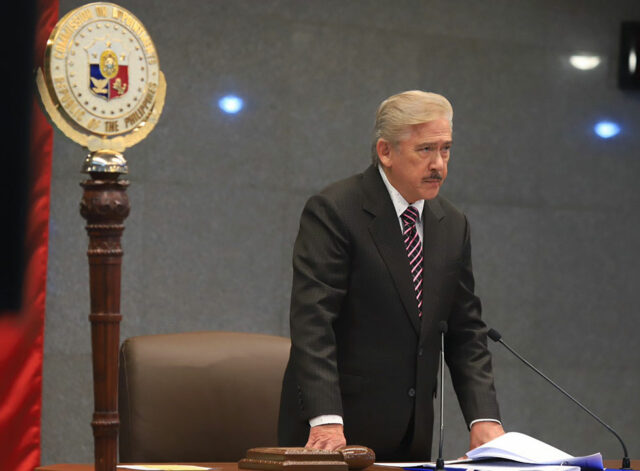
SENATE PRESIDENT VICENTE C. SOTTO III — SENATE PRIB

A SENATOR on Wednesday said that there is no attempt by the minority bloc to remove Senate President Vicente “Tito” C. Sotto III, amid rumors of another leadership shakeup in the chamber.

“There is no active courting of signatures like before,” Senate Minority Leader Alan Peter S. Cayetano told a news briefing, following alleged talks of another change in the Senate’s leadership.

The rumors of a possible shakeup could have come from both the supporters of the majority and minority blocs, he said.

“We in the minority are not talking about whether there is someone, or who it might be, or how and what would happen. Because we think that the majority is still happy, and I think we have a role to play in the minority,” Mr. Cayetano said.

He added that the Senate should instead focus on its investigation into the multi-billion-peso flood control scandal.

“The Senate must continue to be the salt and light — the institution that provides a vision for our people. Right now, the Senate should be part of the solution, not the problem,” he said.

Last month, the Senate appointed Mr. Sotto as Senate president amid concerns over former Senate chief Francis “Chiz” G. Escudero’s links to the flood control controversy.

The Senate is investigating irregularities in multi-billion-peso flood control projects, following reports that lawmakers and officials received kickbacks from infrastructure funds allocated since 2022. — Adrian H. Halili

Unprogrammed fund cut unlikely

STOCK PHOTO | Image by iiijaoyingiii from Pixabay

REMOVING unprogrammed appropriations (UA) from the 2026 national budget is unlikely, Malacañang said, stressing the funds play a vital role in addressing unforeseen emergencies and urgent national needs.

Party-list Rep. Jose Manuel Tadeo “Chel” I. Diokno’s suggestion to remove all UA seems unlikely, said Palace Press Officer Clarissa A. Castro on Monday.

“The government implements many programs, and these funds can be used when needed, especially in emergency cases or situations. But let’s remember, they’re not spent carelessly,” she said in Filipino in a news briefing.

In a privilege speech before the House plenary on Tuesday, Mr. Diokno raised concerns over the growing UA in the national budget, warning that it allows projects to be hidden from public scrutiny.

He criticized the UA as a “magic pot” used without accountability and proposed reducing its allocation to zero.

Despite this, Ms. Castro noted that while these funds are part of the UA, it does not mean they can be accessed immediately without proper documentation.

“It’s clear that any funds under unprogrammed appropriations are still subject to oversight,” she said.

In the proposed 2026 national budget, UA amounts to P250 billion, earmarked not for emergency contingencies but for major, pre-planned initiatives.

Among the key allocations are: P80.86 billion for enhancing government infrastructure and social programs; P97.3 billion for foreign-assisted projects; P50 billion for the updated Armed Forces of the Philippines modernization plan; and P6.7 billion for health emergency allowances. — Chloe Mari A. Hufana

One-month tax holiday sought

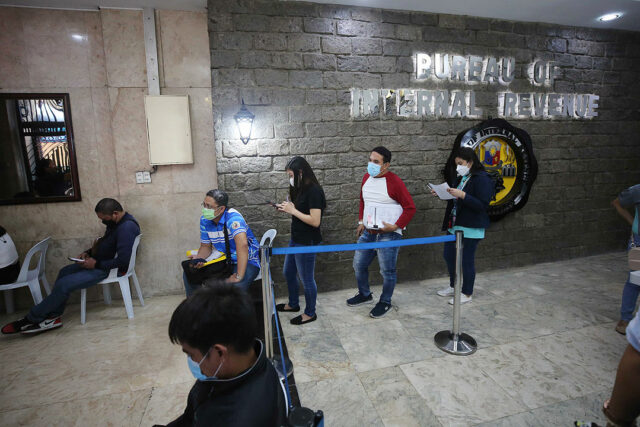
People line up to file their income tax returns at the Bureau of Internal Revenue office in Intramuros, Manila, April 18, 2022. — PHILIPPINE STAR/ RUSSELL A. PALMA

A MEASURE providing for income tax relief for one month has been filed in the Senate, in a bid to improve public trust amid the multi-billion-peso flood control scandal.

“The welfare of the people is the supreme law. It is therefore just and necessary that the State respond by providing tangible relief to the very taxpayers who sustain it,” Senator Erwin T. Tulfo said in his explanatory note.

Senate Bill No. 1446, the One-Month Tax Holiday bill, proposes a one-time, one-month income tax holiday for individual taxpayers receiving compensation income which will be on the first payroll month immediately following the approval of the bill.

For mixed income earners, only the portion classified as compensation income will be exempted from income tax.

“While taxation is recognized as the lifeblood of the State, we must equally recognize that his lifeblood flows from the people themselves,” he added.

The proposed tax holiday will not cover mandatory contributions to the Government Service Insurance System, Social Security System, Philippine Health Insurance Corp., and the Home Development Mutual Fund.

It will not cover loan amortizations and other payments voluntarily authorized by the worker.

The proposed measure also included a non-diminution clause which will ensure that employers could not reduce employee wages during the tax holiday month.

“The exposure of alleged anomalies on flood control projects, involving billions of pesos in public funds have gravely eroded public trust in government fiscal stewardship,” Mr. Tulfo said. “The Filipino people have raised a clear and resounding clamor— Return the people’s money, and lower taxes.”

The administration has come under pressure after reports of billions of pesos allegedly siphoned off through irregular flood mitigation projects. — Adrian H. Halili

Marcos signs law extending IBC’s franchise

PRESIDENT FERDINAND R. MARCOS, JR. — PHILIPPINE STAR/NOEL PABALATE

PRESIDENT Ferdinand R. Marcos, Jr. signed into law a measure extending the franchise of state-owned International Broadcasting Corp. (IBC-13) for another 25 years.

Republic Act (RA) No. 12311, signed on Oct. 3, grants IBC-13 the authority to build, install, maintain, and operate radio and television stations across the Philippines, wherever available frequencies or channels exist.

Under the renewal, IBC-13 must secure all necessary permits and licenses from the National Telecommunications Commission (NTC) to operate its facilities, and the NTC is prohibited from “unreasonably” delaying or withholding those permits.

RA 12311 also mandates that within five years, IBC-13 must offer at least 30% of its outstanding capital stock to Filipino citizens via a securities exchange.

The law takes effect 15 days after its publication in the Official Gazette or a widely circulated newspaper. — Chloe Mari A. Hufana

Law expanding Philippine Science HS system signed

PSHS

PHILIPPINE PRESIDENT Ferdinand R. Marcos, Jr. signed into law the Expanded Philippine Science High School (PSHS) System Act to strengthen its governance and management.

Republic Act No. 12310, signed on Oct. 3, aims to enhance the holistic development of students, faculty, and staff by fostering international collaboration and expanding access to scholarships for gifted learners in science and mathematics.

The measure also emphasized equal scholarship opportunities for students with exceptional aptitude in science and mathematics, ensuring that talent — not economic status — determines access to quality education.

It mandates the PSHS System to streamline its scholarship mechanisms and outreach programs to identify and support promising students nationwide.

The system’s enhanced participation in research partnerships and innovation ecosystems is expected to bolster the country’s human capital and competitiveness in emerging industries. — Chloe Mari A. Hufana