Home Blog Page 477

Stocks rise on slower-than-expected inflation
BW FILE PHOTO

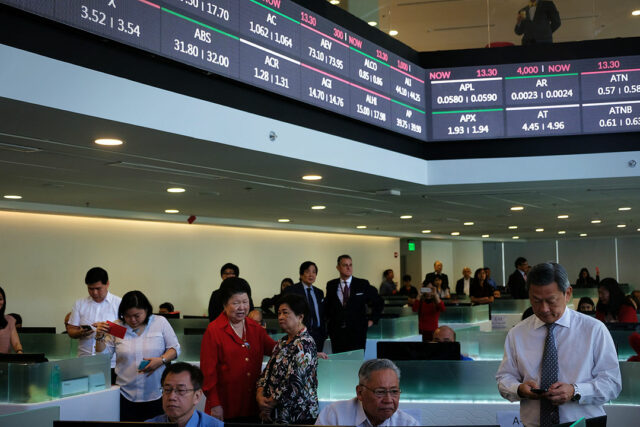
PHILIPPINE SHARES rebounded on Tuesday as data showed slower-than-expected inflation in September and as investors went bargain hunting.

The Philippine Stock Exchange index (PSEi) jumped by 1.39% or 83.51 points to close at 6,083.83, while the broader all shares index rose by 0.8% or 29.27 points to end at 3,673.22.

“The PSEi rose today as the market reacted positively to the latest inflation rate, which came in lower than expected. This figure helped restore confidence among market participants, boosting sentiment and encouraging renewed buying interest across key sectors,” Regina Capital Development Corp. Head of Sales Luis A. Limlingan said in a Viber message.

“The local market bounced back this Thursday following its drop near the 6,000 support as investors hunted for bargains,” Philstocks Financial, Inc. Research Manager Japhet Louis O. Tantiangco said in a Viber message. “The favorable inflation figure supports the country’s consumer outlook and raises the possibility of further easing by the BSP (Bangko Sentral ng Pilipinas).”

Headline inflation picked up to 1.7% in September from 1.5% in August, the Philippine Statistics Authority reported on Tuesday.

This was the fastest pace in six months or since the 1.8% print in March, but was within the BSP’s 1.5-2.3% forecast for the month and below the 1.9% median estimate in a BusinessWorld poll of 12 analysts.

For the first nine months, the consumer price index (CPI) averaged 1.7%, matching the BSP’s forecast for the year and still below its 2-4% annual target.

The Monetary Board will hold its penultimate policy meeting for the year on Thursday (Oct. 9), with analysts divided on their rate call. Ten of the 16 analysts in a BusinessWorld poll expect the central bank to pause anew after it delivered three straight cuts, while the remaining six said a fourth consecutive 25-basis-point (bp) reduction could happen this week to help support domestic demand and boost the economy.

The central bank has lowered benchmark borrowing costs by a total of 150 bps since it kicked off its easing cycle in August 2024, with the policy rate now at 5%.

All sectoral indices closed in the green on Tuesday. Financials jumped by 2.22% or 45.48 points to 2,087.52; property surged by 1.49% or 33.75 points to 2,295.62; industrials rose by 1.13% or 100.50 points to 8,969.07; holding firms increased by 0.83% or 40.50 points to 4,908.72; mining and oil climbed by 0.47% or 64.35 points to 13,669.64; and services went up by 0.42% or 9.63 points to 2,262.11.

Value turnover declined to P10.35 billion on Tuesday with 2.37 billion shares traded from the P12.12 billion with 2.07 billion stocks that changed hands on Monday.

Advancers outnumbered decliners, 97 to 92, while 60 names closed unchanged.

Net foreign selling went down to P218.1 million on Tuesday from P341 million on Monday. — A.G.C. Magno

Gas turbine backlog expected to delay PHL LNG expansion

The ISH floating storage unit berths at the AG&P’s Philippines LNG terminal in Batangas. — COMPANY HANDOUT

THE ORDER backlog among major suppliers of gas turbines is expected to hamper Philippine plans to transition its energy industry to liquefied natural gas (LNG), the Institute for Energy Economics and Financial Analysis (IEEFA) said.

“For emerging Asian economies like Vietnam and the Philippines, where (the transition to gas is) already behind schedule and struggling to compete economically with coal and renewables, global turbine shortages present yet another obstacle to deployment,” according to a report written by Sam Reynolds, lead LNG/Gas researcher for IEEFA Asia.

Major gas turbine manufacturers — GE Vernova, Siemens Energy, and Mitsubishi Heavy Industries — face “extensive backlogs” and delivery timelines of up to eight years, due to increased demand in the US and Middle East, IEEFA said.

The report found that 80 gigawatts (GW) worth of orders were placed in 2024, far exceeding the combined capacity of about 30 GW for the three largest original equipment manufacturers.

“As a result of higher gas turbine demand in wealthier regions, turbine prices are rising, and price-sensitive economies once again find themselves unable to access key gas and LNG supplies,” IEEFA said.

The Philippine Energy Plan set a goal of 2.4 GW worth of additional gas-fired capacity by 2028. About 10.7 GW of planned gas capacity is at various stages of development.

The IEEFA said that proposed greenfield LNG-fired power projects mostly remain in early development stages and are unlikely to have procured gas turbines.

“With long delivery timelines and higher costs, LNG power plants have become even less competitive with cheaper, domestically sourced renewable energy and storage. Every year of delay for LNG-fired power plants means that less LNG will be needed in the long run.” — Sheldeen Joy Talavera

Crop insurance coverage targeted for expansion to 4.2 million farmers in 2026

THE Department of Agriculture said it requested P8 billion in funding to expand the Philippine Crop Insurance Corp.’s coverage to 4.2 million farmers from the current 2.3 million.

In a statement, Agriculture Secretary Francisco P. Tiu Laurel, Jr., also cited the need to raise the coverage per hectare to P60,000 from P20,000 to better reflect actual production costs, which he estimated at P60,000.

Mr. Laurel said climate change and low prices are threatening rice yields and livelihoods.

“When typhoons, droughts, or pest outbreaks hit, insured farmers can recover faster and get back to planting. Without it, many are left in debt or forced to abandon farming altogether,” Mr. Laurel added. — Andre Christopher H. Alampay

Jan. rice import window plan under DEPDev review

REUTERS

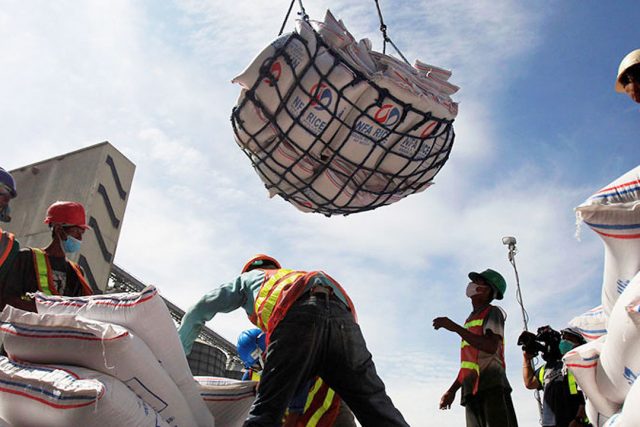
THE Department of Economy, Planning, and Development (DEPDev) said it is reviewing a proposal to allow rice imports for one month in January and to reimpose the import freeze between February and April next year, Malacañang said on Tuesday.

“We have spoken with Economy Secretary Arsenio M. Balisacan, and right now this matter is being studied and evaluated,” Palace Press Officer Clarissa A. Castro said at a briefing.

“There will likely be a recommendation by next week — let’s see if the DEPDev has one by then,” she added.

On Monday, Agriculture Secretary Francisco P. Tiu Laurel, Jr. said President Ferdinand R. Marcos, Jr. has “more or less” approved a plan to allow about 300,000 metric tons of rice imports in January.

Mr. Marcos earlier ordered a 60-day suspension of rice imports beginning Sept. 1 as a form of price relief to farmers during the harvest.

The suspension, which was initially set to conclude on Nov. 2, covers only regular milled and well-milled rice.

The Philippines imported around 4.7 million metric tons (MMT) of rice last year. The US Department of Agriculture projected in August that Philippine rice imports this year will total 4.9 MMT. — Chloe Mari A. Hufana

Tourism, BPOs most affected by Cebu earthquake, BMI says

STOCK PHOTO | Image by Zany Jadraque from Unsplash

CEBU’s tourism and business process outsourcing (BPO) industries were the most disrupted parts of the province’s economy in the wake of the Sept. 30 earthquake, Fitch Solutions’ unit BMI said, though the impact on economic growth is expected to be minimal.

“We expect the overall GDP (gross domestic product) impact to be minimal, given the localized nature of the earthquake,” BMI Country Risk Analyst Brandon Ong said in a statement dated Oct. 6.

He noted that the damage estimates are smaller than those for major typhoons or the 2013 earthquake in Bohol.

“The recent Cebu earthquake damaged infrastructure, with the local government estimating at least P3 billion in damage or 0.01% of GDP,” Mr. Ong said, referring to the quake centered on northern Cebu island.

The 6.9-magnitude earthquake with an offshore epicenter killed 72, with Bogo City the hardest-hit municipality.

The National Disaster Risk Reduction and Management Council said the quake caused landslides, collapsed structures, fires, and chemical leaks. Images of cracked roads also circulated in the days after the quake.

“The sectors most likely to be affected are tourism, given reports of damage to cultural landmarks and hotels, and the business process outsourcing industry, which accounts for about 15% of the nationwide BPO workforce,” Mr. Ong said.

The Department of Tourism said several tourist destinations and hotels in Cebu were damaged including the Archdiocesan Shrine of Santa Rosa de Lima, the San Isidro Labrador Church, the Museo Sugbo and the NUSTAR hotel.

The BPO industry’s labor practices have come under the spotlight after evening-shift workers were ordered to return to work shortly after the tremor, while others were allegedly threatened with sanctions if they did not show up for work in the days after Sept. 30.

The Department of Labor and Employment in Region 7 cited a BPO after finding that it lacked disaster preparedness plans. — Aubrey Rose A. Inosante

PHL seen hindered  by high power costs in bid to graduate to higher-value manufacturing

ROBERT LINDER-UNSPLASH

THE electronics and service industries form the core of the Philippines’ competitiveness, but its potential as a site for other types of high-value production is hindered by high power costs and gaps in its infrastructure, according to consulting firm Roland Berger.

“Upstream geothermal leadership and a 10% global share of semiconductor ATP (assembly, testing and packaging) give the Philippines competitive niches, complemented by world-scale BPO (business process outsourcing) revenue,” it said in a report.

“However, Asia’s second-highest electricity prices, limited wafer fabrication, a 40% export dependence on China and the US, and costly, slow logistics constrain the shift into higher-value production and broader markets.”

Other key challenges include infrastructure gaps, natural disaster exposure, and limited high-value-add midstream industries, it said. 

The report noted the country’s geothermal, solar, wind and hydro resources, and incentives from the Renewable Energy Act, which hold the potential to lower carbon intensity and present investment opportunities in clean-power infrastructure.

The Philippines is aiming to raise the share of renewable energy in its power generation mix to 35% by 2030 and to 50% by 2040.

The US tariffs on Chinese goods makes the Philippines exposed to a flood of Chinese imports, Roland Berger added.

China remains the Philippines’ the top source of imports, accounting for 30.1% of the total in August.

“Conversely, the country’s relatively low US tariff and protection of key semiconductor exports create a competitive opening – provided policymakers broaden import sources, modernize infrastructure and promote the Philippines as a reliable, cost-effective alternative manufacturing base.”

US President Donald J. Trump in July imposed a 19% tariff on many goods from five Association of Southeast Asian Nations countries — the Philippines, Cambodia, Malaysia, Thailand and Indonesia. — Beatriz Marie D. Cruz

VAT accounts for 62.9% of first-half Customs revenue

PHILSTAR FILE PHOTO

VALUE-ADDED TAX (VAT) accounted for 62.9% of Customs revenue in the first half, led by collections generated by non-oil imports, the Development Budget Coordination Committee (DBCC) said.

In its Midyear Report, the DBCC said the Bureau of Customs (BoC) collected P288.4 billion in VAT, which dominated its overall revenue of P458.8 billion for the six-month period.

VAT revenue rose 5.2% from the end of June.

“Such a rise is primarily driven by the 10.2% or P21.0 billion uptick in VAT collections for non-oil imports, but this was notably offset by the 10.2% decline in VAT collections from oil,” the DBCC said.

The value and volume of non-oil imports rose 10.9% and 1.6%, respectively, while petroleum product imports declined 8.7% by value and 2.1% by volume.

The DBCC said the value of oil imports tracked the decline in Dubai crude prices, the benchmark for petroleum products shipped to Asia. Dubai crude fell from a monthly average of $70.8 per barrel in the first half from $83.0 a year earlier.

“Recently, geopolitical tensions affecting global oil prices have eased, and the global oil supply has been outpacing demand, explaining the drop in Dubai crude oil prices,” it said.

Customs excise tax collections totaled P116.5 billion in the first half, up 2.5%, it said.

“Among the biggest contributors to the positive growth in excise collections was motor vehicles, at 16.5% or P3.2 billion,” it said, which tracked the 2.1% increase in vehicle sales for the first half as reported by the Chamber of Automotive Manufacturers of the Philippines, Inc. and Truck Manufacturers Association.

Customs collected P622.468 billion in the eight months to August, up 1.3% year on year. It is expected to collect P958.7 billion for the year and P1.285 trillion by 2030. — Aubrey Rose A. Inosante

Spanish firms being considered for infra, port projects in Casiguran economic zone

FACEBOOK.COM/APECOGOVPH

THE Aurora Pacific Economic Zone and Freeport Authority (APECO) said it is exploring potential partnerships with Spain’s IDOM Consulting, Engineering, Architecture S.A.U. and Fira Barcelona to develop a logistics hub and port infrastructure in the Casiguran ecozone.

In a statement on Tuesday, APECO said it is exploring a possible memorandum of agreement with the firms following an investment mission to Spain.

During the mission, APECO President and Chief Executive Officer (CEO) Gil G. Taway IV said the discussions with IDOM Director for Logistics and Operations Jaume Mas Vilella focused on the development of a food and cold chain hub as well as a port. 

“IDOM’s expertise in large-scale infrastructure will help strengthen the ecozone’s logistics and agri-industrial capabilities,” Mr. Taway said.

“It complements the agricultural and fisheries-based economic activities in Casiguran, giving our farmers and fisherfolk direct and closer access to markets.”

APECO’s pitch involves a feasibility study for a five- to 10-hectare food and logistics hub.

Mr. Taway also noted IDOM’s interest in participating in the design of port facilities. It is looking to support investment-ready projects pre-vetted by partners like the Asian Development Bank.

“IDOM’s proposal aligns with our goal to make Casiguran the Fishing Capital of the Pacific and our vision of boosting agricultural output while promoting value-adding activities for Aurora’s agri-based industries,” Mr. Taway said. “This partnership can help us build the infrastructure backbone that supports food security, investment, and job creation.”

APECO also met with Fira Barcelona International CEO Ricard Zapatero to discuss the development of a convention center.

Fira, one of Europe’s largest consulting firms for exhibitions, is majority-owned by the Catalonia regional government and the Barcelona city government.

The company said it was willing to assist APECO in conducting a feasibility study. — Beatriz Marie D. Cruz

Emirates recruiting PHL aircraft maintainers

EMIRATES.COM

EMIRATES GROUP, the Dubai-based airline, said it is recruiting aircraft engineers and technicians in the Philippines.

“Our engineers enjoy a rewarding career in Dubai, working on the world’s largest fleet of widebody aircraft as part of a dynamic, multicultural team of talented professionals… We are building a future-ready workforce capable of supporting our global operations with precision and excellence,” Emirates Philippine Country Manager Saeed Abdulla Miran said in a statement.

Emirates said it is looking to hire about 750 aircraft maintainers globally.

The airline is organizing a recruitment roadshow in Manila on Oct. 14-15, it said.

“The recruitment initiative taps into the Philippines’ strong and growing aviation talent pool,” it said.

Emirates started serving the Philippines in 1990. It offers 28 weekly flights, or about 22,700 weekly seats, between the Philippines and Dubai. — Ashley Erika O. Jose

Farmers say P20/kilo a fair price for palay

A farmer threshes newly harvested palay grains at a ricefield in Mogpog, Marinduque in central Philippines, March 22, 2016. — REUTERS

RICE FARMERS from Central Luzon said the government is not doing enough to raise the price of palay (unmilled rice), and called P20 per kilo a fair price for their harvest at farmgate level.

The farmers from Region III, the country’s leading producer of the grain, said in a briefing that they support the repeal of the Rice Tariffication Law, which liberalized rice imports and imposed tariffs on inbound rice shipments brought in by private traders.

The briefing in Quezon City organized by the Nagkakaisang Magsasakang Novo Ecijano (NAMANE) highlighted the government’s failure to achieve food security.

Sa baba po ng halaga ng palay, wala na kaming tinatanaw na kinabukasan,” (With palay prices so low, we see no future in rice farming),” NABATE Spokesman Crisostomo Marzan said.

Palay prices are currently at P10-11 per kilo, with some regions reporting prices as low as P8.

Mr. Marzan said farmers are unable to support their families at these prices, adding that they consider P20 per kilo to be fair.

The National Food Authority (NFA) lists a buying price of P23-30 per kilo for dry palay and P17-23 for wet palay, depending on location. The NFA can buy only a small percentage of the harvest because of storage or budget constraints.

The NFA has insufficient funds, trucks, and dryers to buy directly from farmers, Mr. Marzan said, adding that the Rice Tariffication Law has made the Philippines too dependent on imports.

NAMANE said the Department of Agriculture (DA) has refused to engage with the group, and announced plans to protest at the Quezon Memorial Circle on Oct. 15.

The circle is the site of the two key agriculture-related agencies — the DA and the Department of Agrarian Reform.Andre Christopher H. Alampay

Philippines rejects ‘misleading’ foreign claims on South China Sea boundaries

BW FILE PHOTO

By Adrian H. Halili, Reporter

THE Department of Foreign Affairs (DFA) on Tuesday rejected what it called misleading claims by certain countries about the extent of Philippine territory in the South China Sea, saying these distort historical and legal facts.

“Some countries have been articulating an erroneous opinion that intentionally misreads certain treaties upon which the extent of Philippine territory is partly based,” it said in a statement, without naming the countries involved.

The agency said it remains vigilant against any effort to spread misinformation about the Philippines’ territorial boundaries. “It will continue to assert and preserve its territorial integrity, and strongly uphold its sovereignty, sovereign rights and jurisdiction in accordance with international law,” the DFA said.

The agency said the Philippines has full sovereignty over its archipelago and other territories, including Bajo de Masinloc (Scarborough Shoal) and the high-tide features of the Kalayaan Island Group (Spratly Islands).

It said the country’s rights to these maritime features are “incontrovertible and firmly founded on international law, legal principles, effective control and recognition through international treaties and agreements.”

The DFA cited the 1898 Treaty of Paris and the 1900 Treaty of Washington as defining instruments that established the limits of Philippine sovereignty.

“These treaties clearly and firmly state the extent of Philippine territory as well as their meaning derived from the consistent demonstrations of sovereign authority and jurisdiction exercised by the Philippines over its territory through the centuries,” it said.

It added that the country’s 1935, 1973 and 1987 Constitutions further clarify the legal basis and extent of the national territory.

The statement comes amid rising tensions in the South China Sea, where Beijing continues to assert its sweeping “nine-dash line” claim covering over 80% of the disputed waterway. The Permanent Court of Arbitration in The Hague ruled in 2016 that China’s expansive claim had no legal basis under international law — a decision Manila has repeatedly invoked and which Beijing continues to ignore.

The waterway remains a major global trade route, with more than $3 trillion worth of goods passing through annually. Manila has recently increased maritime patrols and diplomatic protests in response to Chinese incursions in areas within its exclusive economic zone.

Meanwhile, the Philippines remains confident that the resignation of French Prime Minister Sébastien Lecornu would not disrupt talks for a visiting forces agreement between Manila and Paris that aims to deepen security cooperation.

“We are now in the final round of negotiations,” Defense Secretary Gilberto C. Teodoro, Jr. told a Senate budget hearing. “Hopefully, their country acts on it given the occurrences in France now. I am confident that their foreign policy will not change.”

Mr. Lecornu announced his resignation on Monday amid a political crisis in France.

France first proposed the military pact in 2023, followed by the signing of a letter of intent between Mr. Teodoro and Mr. Lecornu. The deal seeks to strengthen bilateral defense cooperation through joint training, strategic collaboration and defense industry development.

Mr. Teodoro said he had also received a letter of intent from the UK for a similar agreement. “In particular, land forces, because the UK’s land force is more like the Philippine Army than larger armed forces,” he said. “We will learn a lot from them.”

The Philippines and the UK last year agreed to craft a defense and security cooperation framework covering training, peacekeeping operations, humanitarian assistance, disaster relief, weapon development and research.

Manila has been expanding its defense partnerships as tensions rise in the South China Sea, where China continues to block Philippine vessels within the country’s exclusive economic zone.

The Philippines has strengthened military exercises with the US and Australia and is pursuing security arrangements with other allies.

“All of these countries that we have entered a status of visiting forces agreement with respect the arbitral award and recognize that China’s nine-dash line is baseless,” Mr. Teodoro said. “They respect the sovereign rights [of the Philippines] in its exclusive economic zone.”

Marcos appoints Justice secretary as ombudsman

JESUS CRISPIN C. REMULLA — PHILIPPINE STAR/JOHN RYAN BALDEMOR

By Chloe Mari A. Hufana, Reporter

PRESIDENT Ferdinand R. Marcos, Jr. has appointed Justice Secretary Jesus Crispin C. Remulla as ombudsman, filling a key post that has been vacant since the retirement of Samuel R. Martires in July.

“The administration remains firm in its commitment to fight corruption wherever it exists,” the Presidential Communications Office (PCO) said in a statement on Tuesday. “There will be no sacred cows, no exemptions and no excuses.”

Mr. Marcos said Mr. Remulla’s appointment reaffirms his administration’s dedication to transparency, fairness and the rule of law in public service.

The appointment comes as the government intensifies efforts to root out corruption, particularly in infrastructure projects. In August, Mr. Marcos created the Independent Commission for Infrastructure to investigate questionable public works deals.

The commission is tasked with filing cases before the Office of the Ombudsman, which handles administrative, civil and criminal complaints against government officials.

Mr. Remulla’s appointment followed his recent clearance from kidnapping and arbitrary detention complaints filed by Senator Imee R. Marcos in connection with the controversial arrest of ex-President Rodrigo R. Duterte.

The Justice chief was later included in the Judicial and Bar Council short list for the ombudsman post, submitted to Malacañang on Oct. 7.

At a press briefing, acting PCO Secretary Dave M. Gomez defended the President’s choice, saying the nominee “underwent a very rigorous selection process provided for by our Constitution and laws.”

A former Cavite representative, Mr. Remulla also served as Cavite governor before joining the Marcos Cabinet in 2022. As Justice secretary, he was known for supporting the government’s drug rehabilitation framework and the cleanup of the Bureau of Corrections after several high-profile scandals.

The Office of the Ombudsman is constitutionally mandated to promptly act on complaints against government personnel, including officials of state-owned corporations. Under the law, it must prioritize cases involving senior officials, grave offenses and those concerning large sums of public funds or property.

Political observers said Mr. Remulla’s appointment could reshape the administration’s anti-corruption agenda.

Justice Undersecretary Fredderick A. Vida will serve as officer-in-charge of the Justice department, Mr. Remulla told reporters after his appointment.

Ms. Marcos told reporters his appointment could be used to imprison Vice-President Sara Duterte Carpio.

“It seems like everything is ironed out,” she told reporters in mixed English and Filipino. “I have already expected this with how the ombudsman has dismissed [Mr. Remulla’s] cases so quickly.”

Gary D. Ador Dionisio, dean of the De La Salle–College of St. Benilde School of Diplomacy and Governance, described it as “one of the most pragmatic and consequential moves” of the Marcos administration so far.

“At a time when public trust in institutions is fragile, the decision raises both hope and doubt — hope that a seasoned lawyer and former legislator can strengthen the fight against corruption, and doubt that his political proximity could undermine the very independence the office is sworn to uphold,” he said in a Facebook Messenger chat.

Mr. Ador Dionisio said Mr. Remulla is expected to take decisive measures in carrying out his office’s mandate, which could put him on a collision course with the Dutertes and other administration allies as he pursues the government’s campaign against corruption.

The Vice-President has a pending case before the Ombudsman following allegations of her misuse of public funds when she was Education secretary.

Earlier this year, she faced impeachment raps before the Supreme Court ruled the articles of impeachment were unconstitutional.

Hansley A. Juliano, a political science lecturer at the Ateneo de Manila University, said Mr. Marcos had long intended to appoint Mr. Remulla to the post, viewing him as a political counterweight to the Dutertes.

“The Remulla family is nothing but a pragmatic political dynasty,” he said via Messenger chat. “They’re not known to be ideologically loyal to anybody, if how they ran Cavite is any indication.”

Mr. Remulla is likely to act based on shifting political tides — aligning with the Marcos administration for now but remaining open to reconciling with the Dutertes if their influence grows again, he added. — with Adrian H. Halili and Erika Mae P. Sinaking