Home Blog Page 4728

Netflix plans second season of XO, Kitty as branding ties pay off

ANNA Cathcart in XO, Kitty —IMDB.COM

LOS ANGELES — The Netflix romantic comedy XO, Kitty is returning for a second season, becoming the No. 1 streaming service’s first television series to be spun-off from an original Netflix film, the To All the Boys I’ve Loved Before movie trilogy.

Netflix’s Bridgerton Regency period drama series has also spawned a spin-off, the Queen Charlotte prequel which became one of the platform’s most popular series after its debut in May.

Queen Charlotte remained No. 1 on the English TV list ahead of Firefly Lane and Sweet Tooth during the week of May 8.

The To All the Boys and Bridgerton franchises reflect Netflix’s objective to expand brands to create content across film, television, games, and consumer products, with greater diversity in casting.

XO, Kitty has a Korean lead character and Queen Charlotte features a Black actress in the title role.

As Netflix’s growth has slowed, the service has begun developing franchises for more revenue from original programs.

The 2016 science fiction series Stranger Things was its first successful entertainment franchise, with related merchandise and plans for a spin-off series and a stage play.

Bridgerton, adapted from Julia Quinn’s book series, has inspired a merchandise line in partnership with tea retailer Republic of Tea that includes wedding products. A book inspired by the Queen Charlotte character, penned by Ms. Quinn and the show’s creator, Shonda Rhimes, cracked the New York Times bestseller list.

Netflix also has live immersive experiences, including The Queen’s Ball: A Bridgerton Experience. The pop-up exhibition in different cities allows fans to experience the Regency London portrayed in the series.

The XO, Kitty brand has a partnership with Sanrio, a Japanese entertainment company, and American fashion retailer Forever 21 for a clothing line. — Reuters

GCash targets Middle East expansion 

BW FILE PHOTO

ELECTRONIC wallet giant GCash is eyeing to expand in the Middle East this year to boost its market presence, according to its operator G-XChange, Inc.  

“We have many Filipinos in the Middle East. We really want to be able to serve them. Of course, we need clearance from the Bangko Sentral ng Pilipinas (BSP),” G-XChange President and Chief Executive Officer Oscar A. Reyes, Jr. told reporters in a chance interview in Taguig City on Wednesday.

Mr. Reyes said GCash is hoping that it would be able to push through with the expansion within the year after sending its application to the BSP.

“When we get approval from the BSP, we’re ready to go… We’re trying to expand further internationally. We’re just trying to get BSP’s go-signal to do so,” Mr. Reyes said.

Currently, GCash is available in France, Germany, Japan, Australia, Italy, the United States, the United Kingdom, and Canada, with users being able to access the e-wallet using an international subscriber identity module or SIM card.

Meanwhile, Mr. Reyes said GCash’s plan for an initial public offering (IPO) still has a long way to go before engaging in the full process.

“There are still a lot of things that we need to do, especially from a regulatory standpoint,” he said.

Mr. Reyes said GCash is making sure that it is IPO-ready, adding that the plan is also market-dependent.

“The important thing there is that we are ready. So, we are IPO-ready as a company. We need to make sure that all the businesses are doing well and everything internally is doing well. Compliance as well,” Mr. Reyes said.

He added that the platform has yet to determine where it would use the proceeds to be generated from an IPO.

“That is still to be determined. I think there’s a lot of things that we can do for the market. That would have to go through some strategic planning,” Mr. Reyes said. — Revin Mikhael D. Ochave

Bounded rationality?

BW FILE PHOTO

If they were dead serious about getting the Maharlika Investment Fund (MIF) bill signed by the President and announced during the forthcoming State of the Nation Address in late July, our economic managers should have refrained from issuing their eight-page joint statement. Now going through legal brushing in Congress, the bill was trashed in various forums and parliaments of the street. The UP School of Economics professors joined the choir with their 25-page discourse challenging the premises and the fundamentals of doing a Maharlika Investment Fund.

The joint statement, without exaggeration, leaves readers with more questions than answers it sought to provide for the skeptical among us.

Since we are all in this together, groupthink should have produced better results. Is the MIF bill truly consistent with the 8-Point Program of this Administration, the Medium-Term Fiscal Framework, and the Philippine Development Plan 2023-2028?

Hundreds of billions of pesos have been earmarked for the 8-Point Program covering food security, improved transportation, affordable and clean energy, healthcare, education, social services, sound fiscal management, and bureaucratic efficiency from the budget for the year, and presumably for the next few years.

To the extent that part of the budget will be used to fund the MIF, reason tells us that for these programs to continue receiving their just share, the National Government (NG) will either increase taxes or borrow more. Since we wish to sustain economic growth and avoid economic scarring from the pandemic, we don’t expect the NG to reduce public spending.

How then this will promote the 8-Point Program escapes us.

During the presentation of this program before the new Cabinet last year, it was claimed that “in the near term, we will address the most pressing issues faced by our people: rising prices, socio-economic scarring from the pandemic, and ensuring sound macroeconomic fundamentals.” If we wish to address these urgent social issues, this is not exactly the best time to divert public funds from them. The MIF is not the best vehicle because it is weak on funding sources. Nothing wrong with focusing on job creation, quality jobs, infrastructure, human capital development, or even the digital economy. But the issue is more of opportunity cost, it’s a question of today’s survival against tomorrow’s speculative higher returns.

In the first place, and this is again an old issue, we have no surplus funds to invest at this time.

In particular, the MIF bill does not exactly promote the 7th point, sound fiscal management, because it mandates Congress to invest the MIF virtually with the power over the purse. Not only will MIF be deciding on the use of public funds, but it will also determine the disposition of their returns. This is a clear violation of the budget process enshrined in the Constitution.

Neither does the MIF promote the 8th principle, bureaucratic efficiency, because it creates another layer of the bureaucracy with clear duplication of functions. As also pointed out by the UP professors, MIF will be doing part of what the National Development Corp. is doing in terms of investing for national economic development. The founder GFIs are also investing on their own account to spur development. MIF could also be encroaching on the National Economic and Development Authority (NEDA) Board functions in terms of investment cherry picking and programming.

Make no mistake about this, but we welcomed the rollout of the Medium-Term Fiscal Framework (MTFF) with congressional support last year as it could likely anchor market expectations and encourage more investment flows. It very much established the government’s commitment to both growth and fiscal sustainability.

But again, the proposed diversion of funds to cover the financial requirements of the MIF could pull us back because there are many dark clouds of uncertainty about the prospects of the MIF.

First, how this P500-billion fund could outperform those trillion-dollar sovereign wealth funds which lose money now and then should be explained. During this period of sustained volatility in the global markets, it is tough to justify that a mere consolidation of funds could bring in higher returns. Since there are opportunity costs involved with fund diversion, the MIF is challenged to exceed what the funders could otherwise realize on their own. With the looming increase in taxes and borrowings, there is a great chance our fiscal targets might be compromised.

Plus, and we should not forget this — the MIF may incur debt as part of its corporate power. It may choose to issue bonds, debentures, and securities. Since it is a public entity, should it go into distress and be unable to repay its obligations, its liabilities may have to be shouldered by NG.

In my column in another broadsheet yesterday, we wrote that MIF could totally change the equation of fiscal responsibility in the Philippines. If this controversial bill is signed into law by the President, it could send a different signal to the market. The kind of fiscal consolidation that the MTFF is envisioning could turn out to be more contractionary than expansionary.

The President should be advised by some independent legal minds about this real risk to his leadership and government.

What about the MIF’s consistency with our Development Plan?

In their opening statement, the economic managers argued that the MIF operationalizes the Plan, “specifically Chapter 11.2 in which it is stated under Outcome 4 that one of the strategies included is to ‘diversify and explore alternative sources of financing…new instrument formats will also be explored to reach new markets and investors.”

Even under the assumption of bounded rationality, it is easy to see that the MIF does not constitute “an alternative source(s) of financing.” It is to be supported from existing funds of the public sector. MIF is adding nothing. In fact, it even sequesters part of the budget that should otherwise go to those projects in the 8-Point Program. If at all, it is an alternative disposition of public funds.

We don’t know if the allowable investments as contained in Article IV of the MIF bill may be considered new ways of wealth creation: “cash, foreign currencies, metals, other tradeable commodities… loans and guarantees to corporations and joint ventures; and other investments with sustainable and developmental impact.”

Many of them are known investment vehicles; nothing is new. Loans to corporations and joint ventures are scary. Big sovereign wealth funds must have known all these investment vehicles and yet last year, they lost billions and billions of dollars.

What is it that the incoming management and board of MIF would know that those trillion-dollar wealth and investment funds would not know? What is the guarantee they would never lose public money or pension funds?

The joint statement also made the point about safeguards, and they are considered enough. The Santiago Principles prescribing best international practices for operating sovereign funds are only as good at the sovereign fund’s adherence to them. The Commission on Audit will not be too useful here because its audit is to be done once every five years. All board members are to be appointed by the President including the independent directors. This being the case, even the independence of the board-appointed risk management and investment management committees may be open to question. This basic issue of governance explains the downfall of many sovereign funds in the past including the cautionary tale of Malaysia’s 1MDB.

Finally, Argument 8 of the joint statement commends the Senate for trying to protect pension funds. This is not accurate for in the version prior to the final one, Senate actually inserted another provision that would allow pension funds to invest in the MIF. In the final version, the absolute prohibition was maintained against pension fund investment into the Maharlika fund. But we hear some dissonance. Some Senate officers and members of the cabinet have started to clarify that pension funds can still invest, in the projects where the Maharlika will choose to invest in, rather than investing in the MIF itself.

It is too coincidental that these statements have a similar logic, and the drift is unmistakable. The MIF needs the SSS, GSIS, PhilHealth, Overseas Workers Welfare Administration, and the Philippine Veterans Affairs Office.

Even the letter of the law cannot protect the private money of our people.

Even for us with bounded rationality, the MIF, based on these flaws, would hardly qualify as “good enough.” On the other hand, decision makers may be restricted by a variety of constraints, not the least of which is wrong information.

The President and the rest of the Filipino people deserve more time and more complete information before we plunge into this new brave world of investing our scarce public funds.


Diwa C. Guinigundo is the former deputy governor for the Monetary and Economics Sector, the Bangko Sentral ng Pilipinas (BSP). He served the BSP for 41 years. In 2001-2003, he was alternate executive director at the International Monetary Fund in Washington, DC. He is the senior pastor of the Fullness of Christ International Ministries in Mandaluyong.

After ‘Rapper’s Delight,’ hip-hop went global — its impact has been massive; so too efforts to keep it real

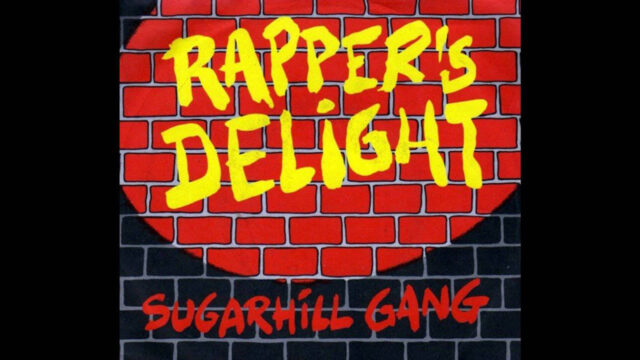
SOON after the fall 1979 release of “Rapper’s Delight,” versions of the first commercially successful rap recording began cropping up around the world.

Two Portuguese-language versions, “Bons Tempos” and “Melô Do Tagarela,” were put out in Brazil. One version from Jamaica provided a relatively faithful recreation of the Sugarhill Gang original, while “Hotter Reggae Music” slowed down the track, transforming it into reggae. Other local language versions came from the Netherlands with “Hallo, Hallo, Hallo,” Venezuela with “La Cotorra Criolla” and Germany with “Rapper’s Deutsch.”

Within a few years, one could hear the song’s DNA being altered in disparate parts of the world, as in Japanese artists Yellow Magic Orchestra’s 1981 “Rap Phenomena,” Nigerian Dizzy K. Falola’s 1982 “Saturday Night Raps,” and the French duo Chagrin d’amour’s 1982 “Chacun fait (c’qui lui plait).” Even Soviet Russia got into the act with Chas Pik’s “Rap” in 1984.

The rapid spread of “Rapper’s Delight” is an important milestone in hip-hop’s first 50 years. It marked the beginning of the globalization of rap music and the broader hip-hop culture in which it is embedded, which includes deejaying, break-dancing, and graffiti-tagging.

More milestones in hip-hop’s global spread soon followed. In 1984 in France, H.I.P.H.O.P. hosted by DJ Sidney became the first nationally televised weekly show devoted to rap, preceding Yo! MTV Raps in the US by some four years. In the early 1990s, a vibrant French rap scene produced the first internationally touring, platinum-selling rap star outside the US: MC Solaar. France became — and remains — the second-biggest market for rap in the world.

Indeed, by 2000 the term “global hip-hop” had entered commercial and scholarly discourse. Soon, new styles partially informed by hip-hop emerged, like grime in London, which cultivated its own unique identity.

But the global expansion of hip-hop rides on a paradox. The Black American urban culture that birthed rap and hip-hop makes up its very fabric. But so does the core idea of representing one’s own experience and place. When hip-hop and rap travel abroad, does one or the other have to give?

To an ethnomusicologist like myself, this paradox goes right to the heart of identity and authenticity. How do people use, shape and transform cultural elements from elsewhere to make it speak to their own experience? And in the process, how do markers of authenticity become redefined?

With hip-hop, I believe it is helpful to imagine a wide spectrum of possible markers of authenticity — that is, what it means to stay “true” to the art form.

At one end lies the integration of Black American performance styles and fashion. Some efforts may border appropriation or mimicry.

At the other end lies hip-hop’s potential to inspire global rappers to dig deep into the well of local performance traditions. This could mean sampling music from their own countries or exploring the quirks and intricacies of their own languages and dialects.

Pioneering hip-hop scholar Halifu Osumare explored authenticity in her concept of “connective marginalities,” which established the blueprint for theorizing about global hip-hop. This key concept concerns “social resonances between Black expressive culture” on the one hand and similar dynamics in other nations and cultures on the other hand.

These connections or resonances can be tied to a shared culture among different parts of the African diaspora or through social class, historical oppression, or the marginalization of youth.

Expanding this framework a bit, almost anyone feeling marginalized can draw on a hip-hop ethos. This could include Ukraine’s Alyonna Alyonna, who was bullied for the way she looked, and even Nordic white supremacists.

Hip-hop scholar and political activist Yvonne Bynoe presented an alternative view on the genre’s worldwide spread. Writing in 2002, she noted: “While rap music has been globalized, hip-hop culture has not been and cannot be.” To Bynoe, it is irrational to expect that a cultural expression that is centered around Black American experiences and vernacular can speak for all.

“While ‘rap’ as a creative tool is portable and adaptable, it belittles hip-hop culture to continue to insist that as a cultural entity it can be disassociated from its roots,” she wrote.

A 2007 documentary about hip-hop in Kenya, with the on-point title Hip Hop Colony, addresses the issue from a different standpoint: “Today, Kenya tackles a new breed of colonization,” the narrator notes, “Its chameleon-like quality has allowed it to integrate with cultures around the world. … It is hip-hop [and] in the vein of colonialism it’s dictating the choice of attire, language and lifestyle in general. Unlike the colonists, its presence is welcomed and widely embraced by the majority.”

In a clever twist, the filmmaker, Michael Wanguhu, sets up an initial neo-colonial framework and then dismantles it by showing how Kenyans have made hip-hop their own.

Moreover, hip-hop has been seen as a catalyst for cultural self-reflection and revival wherever it lands.

“The first time we heard Grandmaster Flash rapping on a hip-hop track,” Senegalese rapper Faada Freddy of the group Daara J said in 2006, “everybody was like, ‘OK we know this, because this is taasu,’” referring to a Senegalese verbal art form accompanied by drumming.

“We’ve been rhyming like that for a long time,” he added.

Australian aboriginal rapper Wire MC similarly sees a connection between traditional Indigenous gatherings known as “corroboree” — which involve singing, dancing and telling stories — and hip-hop, which he says “is just a modern corroboree.”

“Hip-hop is a part of aboriginal culture; I think it always has been,” he added.

Native American rapper Frank Waln, of the Sicangu Lakota tribe, also notes a resonance between hip-hop and Indigenous culture.

“I definitely think there’s a connection between traditional storytelling and hip-hop,” he said. “My people have been storytellers for thousands of years, and this is just a new way to tell our stories.”

Almost anywhere rap and hip-hop have traveled, people have pointed to its resonance with homegrown traditions. Some have employed those traditions to transform hip-hop into something with deep local roots. In this way, Japanese rapper Hime has used the ancient poetic form tanka for the chorus of her song “Tateba Shakuyaku.” In the song, she raps about the Japanese concept of “kotodama,” or “the spirit of the language” embedded in the 5-7-5-7-7 syllable count in that chorus.

Similarly, Ghanaian rapper Obrafour has drawn on esoteric proverbs in his native Twi language, and Somali Canadian rapper K’Naan has drawn on and paid tribute to Somali oral poetry.

Historical connections between modern-day French rappers and French song have also been fruitfully explored. This should be no surprise, given the dual identities of the children of African immigrants in France, like rapper Abd al Malik.

The indelible link between hip-hop and Black American culture remains a constant theme in how to understand its transformations around the world. Take one of China’s most well-known rappers, Vava.

In a 2018 interview in Esquire Singapore, she said that hip-hop “helps us to express our innermost emotions and thoughts about how we understand the world we’re living in.” When asked, “American hip-hop has grown out of the African American struggle. So where does Chinese hip-hop come from?” she replied, “Chinese hip-hop comes from rebellion in young people’s lives. … The generation before us were rockers, but today, we use rap to express ourselves.”

The “global spread of authenticity,” as linguist Alastair Pennycook called it in 2007, has been a concern in the genre ever since “Rapper’s Delight” sparked its travel across the world.

In 1982, pioneering deejay Afrika Bambaataa advised French rappers to “Rap in your own language and speak from your own social awareness.”

Jay-Z addressed the issue in the conclusion of his 2010 memoir, Decoded. Implicitly noting the distinction between the culture hip-hop and the art form rap, he wrote:

“Rap … is at heart an art form that gave voice to a specific experience, but, like every art, is ultimately about the most common human experiences. … The story of the larger culture is a story of a million MCs all over the world … and inside of them the words are coming, too, the words they need to make sense of the world they see around them. … And when we decode that torrent of words — by which I mean really listen to them with our minds and hearts open — we can understand their world better. And ours, too. It’s the same world.”

Eric Charry is a Professor of Music at Wesleyan University.

Shang Properties, Inc. resets 2023 Annual Stockholders’ Meeting to June 29


Spotlight is BusinessWorld’s sponsored section that allows advertisers to amplify their brand and connect with BusinessWorld’s audience by enabling them to publish their stories directly on the BusinessWorld website. For more information, send an email to online@bworldonline.com.

Join us on Viber at https://bit.ly/3hv6bLA to get more updates and subscribe to BusinessWorld’s titles and get exclusive content through www.bworld-x.com.

Prime Media sells shares to fund investments

PRIME Media Holdings, Inc. is selling 150 million common shares to two companies as it seeks to boost its financial position for investments.

In a disclosure to the stock market, the company said Angel Maple Properties, Inc. is set to acquire 125 million shares while Cymac Holdings Corp. will take 25 million shares from the listed firm’s unissued common shares.

“Angel Maple and Cymac are property investment and holding companies, who are capable of providing financial and business support to the strategic direction of Prime Media in venturing into the media and entertainment industry,” the company said.

The shares will be issued at P2.70 each based on the 30-day volume-weighted average price of P2.6197 as of May 22, plus a 2.97% premium.

The company said it would raise a total of P405 million from the transaction, which will be paid in cash on or before June 30.

Prime Media said proceeds from the infusion will be used for its working capital and future investments “such as, but not limited to, capital contribution to the joint venture with ABS-CBN Corp.”

The company earlier announced a partnership with the Lopez-led media company to develop, produce, and finance content for distribution to local and international broadcast networks, channels and platforms.

Under the agreement, Prime Media will be the majority stakeholder owning 51% while ABS-CBN owns 49% of the outstanding capital stock of the joint venture company.

In an earlier disclosure, Prime Media said that it would have an initial subscription of 20.4 million shares priced at P20.4 million and ABS-CBN shall have a subscription of 19.6 million shares valued at P19.6 million.

Prime Media shares slid by 0.47% or a centavo to P2.12 apiece on Thursday. — Adrian H. Halili

BPI fined for failing to cut authorized stock

BPI FACEBOOK PAGE

THE BANGKO SENTRAL ng Pilipinas (BSP) has fined Bank of the Philippine Islands (BPI) P1 million for failing to cut its authorized capital stock on time, the lender said on Thursday.

In a stock exchange filing, the Ayala-led bank said it got fined for failing to comply with the General Banking Law of 2000 in the disposal of its Treasury shares arising from its merger with BPI Family Savings Bank, Inc.

BPI shares gained 0.96% or a peso to end at P105 apiece.

The Philippine central bank had given it six months to cut its authorized shares.

In a disclosure on Sept. 29 last year, the lender said it had abandoned a plan to retire Treasury shares from the merger with its thrift banking arm after the BSP said this could violate the law. The merger between BPI and its thrift bank unit took effect on Jan. 1 last year.

“Eventually, BPI informed the BSP of the approval of the declaration of property dividends as BPI’s mode for disposal of the Treasury shares, which, however, will only be completed after obtaining regulatory approvals,” BPI said.

The bank went past the six-month deadline for declaring property dividends as a way to dispose of the Treasury shares, it added.

The Securities and Exchange Commission approved the declaration of property dividends on Wednesday.

BPI declared property dividends by issuing 406.18 million common shares worth P33.04 billion.

BSP Deputy Governor Chuchi G. Fonacier declined to comment when asked to provide details of the fine. BPI Corporate Communications Manager Josefina Silvestre did not immediately reply to a Viber message seeking comment.

The lender booked an attributable net income of P12.134 billion in the first quarter, 51.98% higher year on year. — Aaron Michael C. Sy

Fans celebrate K-Pop supergroup BTS’ 10th anniversary

BTS

SEOUL — Fans of K-Pop supergroup BTS gathered in the heart of the South Korean capital Seoul on Monday to celebrate the 10th anniversary of the boy band’s debut.

Although the group is on hiatus with two of the members currently doing mandatory military service, many of their loyal global fanbase called “ARMY” still gathered in Seoul this week.

The seven-member group have gained a huge international following after breaking ground for K-Pop’s global success including in the US music charts and industry awards.

Landmarks such as Seoul City Hall and Namsan Tower were lit purple, BTS’ signature color, while dozens of fans from France, Mexico and elsewhere came to enjoy the sights.

“I came to Korea last week and I am very surprised and excited to see the Namsan Tower purple,” said Rita, a 20-year-old student from France who has been an ARMY since 2018.

Organizations and businesses are also joining the celebration, with the city of Seoul working with BTS’ management agency HYBE to set up a tour of landmarks associated with BTS. South Korea’s postal service released special commemorative stamps of BTS’ debut anniversary.

Companies such as Hyundai Department Stores, Lotte Shopping unit Lotte Cinema, and S-Oil have introduced special offers or events.

The celebrations are expected to hit a climax on Saturday, when BTS leader RM is expected to meet fans — followed by fireworks near the Han River, which bisects Seoul.

“Thank you for teaching us a little, or maybe even too much, about happiness and love,” member JungKook told fans in a Twitter message on Sunday. “I want to keep walking with you all for the next 10 years as well.” — Reuters

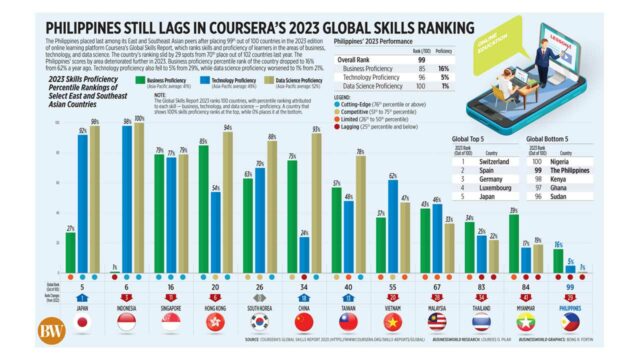
Philippines still lags in Coursera’s 2023 global skills ranking

The Philippines placed last among its East and Southeast Asian peers after placing 99th out of 100 countries in the 2023 edition of online learning platform Coursera’s Global Skills Report, which ranks skills and proficiency of learners in the areas of business, technology, and data science. The country’s ranking slid by 29 spots from 70th place out of 102 countries last year. The Philippines’ scores by area deteriorated further in 2023. Business proficiency percentile rank of the country dropped to 16% from 62% a year ago. Technology proficiency also fell to 5% from 29%, while data science proficiency worsened to 1% from 21%.

Philippines still lags in Coursera’s 2023 global skills ranking

Get ready for carbon capture’s second coming

MACROVECTOR-FREEPIK

FOR those who’ve followed the energy transition over the past few decades, there’s one technology that is treated as much as a punchline as a serious industry: Carbon capture and storage (CCS).

A decade or so ago, many still thought it the best hope for decarbonizing the world’s power systems. CCS was “the Google and Intel of the energy world,” the Atlantic magazine declared in a 2010 cover story that predicted solar and wind would never get above 10% of power supply.

In the following decade, it was renewables that boomed while CCS went bust. Wind and solar accounted for 39% of generation in Germany in the first quarter of 2023 and will hit 50% over the full year in Spain. Meanwhile, only a handful of demonstration CCS plants went into operation — and one of the biggest was switched off in 2021 as oil prices plummeted, since it had only been able to make money from the decidedly dirty business of driving carbon dioxide into depleted oil wells to force out fresh crude.

There are signs that CCS may be about to get the last laugh, though. In the UK, the government has promised as much as £20 billion ($25 billion) in spending to kickstart the sector. A tender to scope out sites that could store as much as 10% of the country’s emissions in old North Sea oilfields closed comfortably oversubscribed last month. In the Gulf of Mexico, Exxon Mobil Corp. has spent about $25 million in two recent rounds bidding for nearly 170 blocks of depleted offshore acreage that might be able to store carbon from a planned hub in Houston. The world’s first CCS project at a cement plant is slated to start next year at a Heidelberg Materials AG facility in Norway.

What’s different now? In essence, a business that was always viable technologically has finally found an economic rationale. The problem with CCS was never that it didn’t work: Norway’s Sleipner carbon capture project has been quietly pumping about 1 million tons annually under the North Sea for nearly 20 years since it was built to evade a 1991 carbon tax. Elsewhere in the world, however, there was no way to get paid.

That’s changed with the US Inflation Reduction Act and the surging value of the European Union’s carbon permits. CCS doesn’t really become viable anywhere south of $70 a metric ton, and until about 18 months ago the only countries putting a price on carbon at that level were in Scandinavia and the Alps.

Since the start of 2022, however, European carbon has averaged $89 a ton, while the Biden administration’s climate bill has introduced an $85/ton tax credit for CCS. Roughly a third of the world economy has suddenly priced CO2 at a level where, in theory, there should be good money in locking it up underground.

All the hype from the 2000s has cast a long shadow. CCS is still seen by many energy specialists as a pipe dream at best, and at worst a mendacious attempt to rebrand fossil fuels without doing the hard work of decarbonization. The main end-use for which it was pitched a decade ago — power generation — has also been invalidated by the slumping costs of renewable power.

Even if you exclude electricity, however, there’s a big slice of industry where CCS could yet be crucial. Power generation accounts for about 40% of the world’s CO2 emissions, but another fifth comes from steel, cement and chemicals — and renewables aren’t well-suited to abating that pollution. Until technologies such as green steel and green hydrogen get up to speed and someone invents a viable way of making zero-carbon cement, we could use a functioning CCS sector to keep that CO2 out of the atmosphere.

CCS has another benefit, too. The developed world’s shift to a more aggressive decarbonization pathway risks leaving many emerging economies stranded. Falling fossil fuel demand will kill off one of their main raw materials export industries while carbon border taxes threaten future manufacturing sectors. A global carbon trade offers a solution to that problem, giving nations with the right geology the ability to make money from sequestering other people’s carbon.

In places, the carbon content of a barrel of oil is already worth more than the fuel. EU pricing for the emissions from heavy Canadian crude is currently about 25% above the cost of the crude itself. That’s potentially a revenue stream that oil-dependent nations in Africa and the Middle East could monetize.

Governments should do everything they can to foster this trend — and to encourage China, attempting a crackdown on the heavy industries that account for more than half of its pollution, to lift its own anemic $8.24 a ton carbon price to similar paradigm-changing levels.

Swaths of the world made money in the 20th century from selling the carbon currently devastating our natural environment. In the 21st century, the same nations might make money from burying it instead.

BLOOMBERG OPINION

Alliance Select to appeal SEC ruling on private placement, stock rights offering

ALLIANCE Select Foods International, Inc. on Thursday said it would ask the Securities and Exchange Commission (SEC) to reconsider its decision to nullify the private placement of the company’s shares in 2014 and its stock rights offering in 2015.

In a regulatory filing, the company said it had received a resolution from the SEC ordering the commission’s sheriffs to implement the cancellation of the shares acquired by Strongoak, Inc. via the private placement and stock rights offering.

“[Alliance Select] will file a Motion for Reconsideration with the SEC and exhaust all other available remedies,” it said.

The company said it would also file with the Court of Appeals a manifestation with an urgent reiterative motion for the issuance of a temporary restraining order and/or writ of preliminary injunction.

“[The company] will continue its business operations of processing, canning, distributing, and exporting tuna products,” it said.

“It continues to implement strategic plans and initiatives to grow the business and improve the Company’s financial condition,” it added.

The legal proceedings stemmed from a complaint filed against Alliance Select in November 2020, which alleged that Strongoak acquired a majority stake in the company without first conducting a tender offer in violation of Section 19 of the Securities Regulations Code.

In May 2022, the SEC’s Markets and Securities Regulation Department (MSRD) dismissed the complaint for prescription and forum shopping.

In January this year, the company received an SEC en banc decision dated Dec. 15, 2022 reversing the MSRD ruling.

According to Alliance Select’s latest public ownership report, Strongoak is its majority shareholder owning 55.32% or 1.38 billion shares.

Alliance Select is a “private label” manufacturer of canned tuna. It processes and cans tuna in institutional and retail pack can sizes using its customers’ brands.

Its subsidiaries include Big Glory Bay Salmon & Seafood, Inc.; PT International Alliance Food Indonesia; and Alliance MHI Properties, Inc.

On Thursday, its shares closed unchanged at P0.53 apiece. — Adrian H. Halili

Landbank cuts InstaPay fee

LANDBANK

LAND Bank of the Philippines (LANDBANK) on Thursday said it had cut transaction fees for fund transfers via InstaPay to P15 from P25.

“By lowering the fund transfer rate, more customers will benefit from the convenience and efficiency of our products,” LANDBANK President and Chief Executive Officer Lynette V. Ortiz said in a statement.

“This is part of our commitment to provide accessible and affordable digital banking solutions, and to help expand financial inclusion,” she added.

“In full support of the National Government’s financial inclusion agenda, the reduction of transaction rates underscores LANDBANK’s steadfast commitment to meeting the evolving needs of customers, in line with its expanded mandate of serving the nation,” the bank said.

The Bangko Sentral ng Pilipinas wants to digitize 50% of the volume and value of retail transactions and to have 70% of Filipino adults become part of the formal financial system by yearend.

Digital fund transfers are being facilitated in LANDBANK’s mobile app, as well as through iAccess, its internet mobile banking for retail clients, and weAccess for corporate accounts.

About P266 billion worth of transactions went through iAccess and weAccess in the first quarter, it said.

LANDBANK’s digital transactions had risen by 5% year on year to 41.2 million transfers as of end-March, translating to 30% growth in the value of transactions to P735.95 billion, it said in a previous statement. — Aaron Michael C. Sy