Home Blog Page 4485

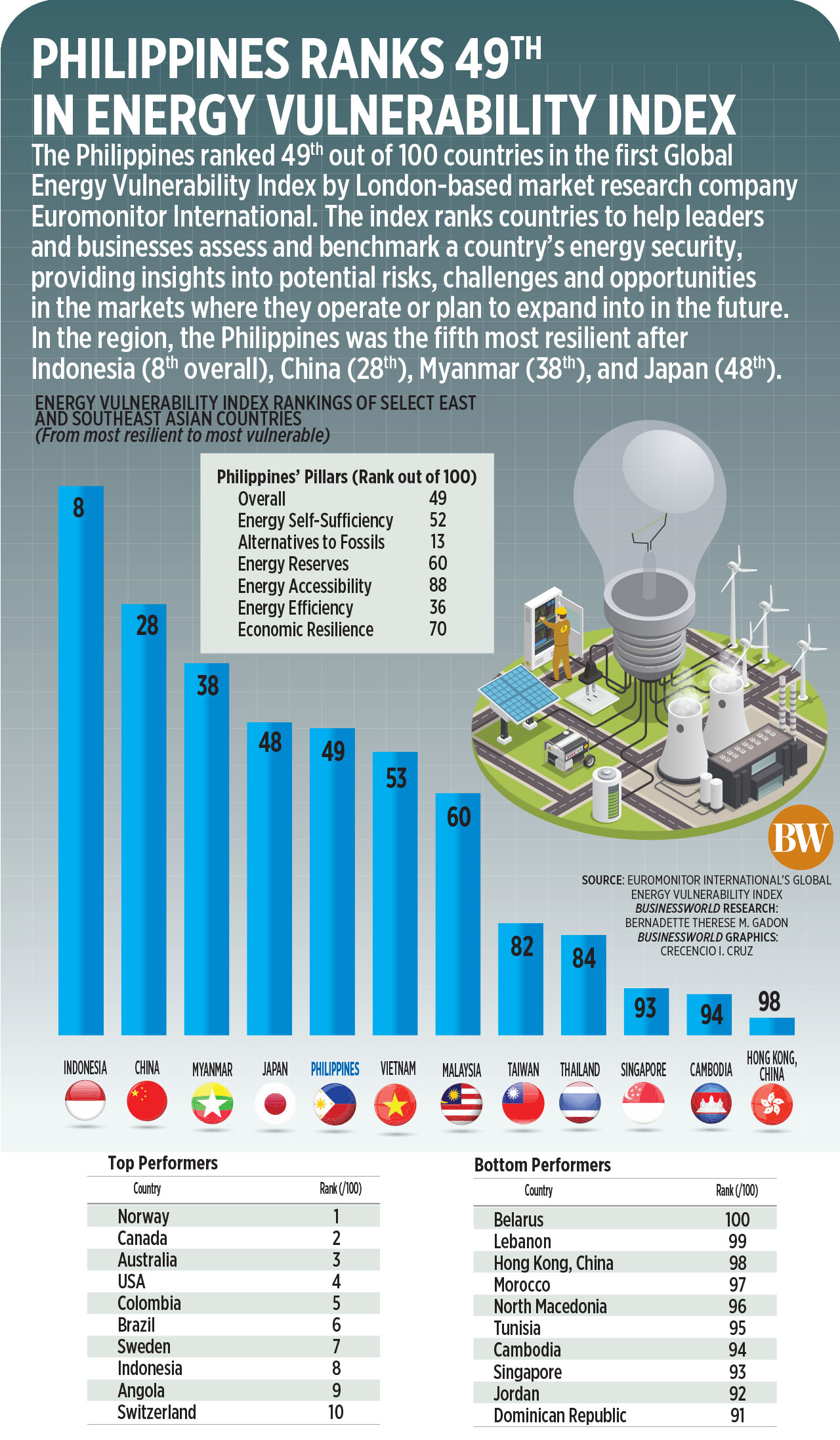
Philippines ranks 49th in Energy Vulnerability Index

The Philippines ranked 49th out of 100 countries in the first Global Energy Vulnerability Index by London-based market research company Euromonitor International. The index ranks countries to help leaders and businesses assess and benchmark a country’s energy security, providing insights into potential risks, challenges and opportunities in the markets where they operate or plan to expand into in the future. In the region, the Philippines was the fifth most resilient after Indonesia (8th overall), China (28th), Myanmar (38th), and Japan (48th).

How PSEi member stocks performed — August 18, 2023

Here’s a quick glance at how PSEi stocks fared on Friday, August 18, 2023.


Diokno: Tuition-free college education ‘unsustainable’

THE UNIVERSITY of the Philippines Diliman campus in Quezon City. — UP.EDU.PH 

By Keisha B. Ta-asan, Reporter

FREE ACCESS to state university education is “unsustainable,” Finance Secretary Benjamin E. Diokno said on Saturday, signaling a possible push to amend a signature piece of legislation signed into law during the Duterte administration. 

Speaking at a forum organized by the University of the Philippines School of Economics, Mr. Diokno said he had been opposed to Republic Act (RA) 10931, or the Universal Access to Quality Tertiary Education Act of 2017, when he was part of the economic team in the previous government.

Mr. Diokno, who had served the last government as budget secretary and central bank governor, also called the law “anti-poor” because “there are more poor people who do not attend college.”  

“This is really a subsidy to those who can pay for their college education,” Mr. Diokno said. “Plus, it really consumes a lot of funds.”  

The law provides eligible students free tuition and renders them exempt from other fees charged by state universities and colleges (SUCs), as well as local universities and colleges.

It was passed at a time when government finances were looking solid, but before it took on massive debt to fund its pandemic containment measures.

According to Mr. Diokno, if the government wants to help the poor, it should focus more on enhancing basic education.

“If you improve elementary and secondary education, then you increase the chances of (gaining entry into) SUCs. So, I think we should focus more on (the basic education system) rather than the SUCs,” he said.

Mr. Diokno also noted that if a fixed number of students enter SUCs and benefit from the free tuition fee, funding for the law’s entitlements will be “adequate.”

“But now, a lot of students want to enroll, but drop out after a year in college. Nasasayang ang pera (the money is wasted),” he said.  

Under the 2024 National Expenditure Program, education was granted an allocation of P924.7 billion, 3.3% higher than this year’s budget.

This includes P51.12 billion to implement RA 10931, P12.04 billion for textbooks and other instructional materials and P11.71 billion for feeding programs in schools. 

The Department of Education will see its budget rise 5.37% to P758.6 billion in 2024.

Shares decline on concerns over growth, China

BW FILE PHOTO

LOCAL STOCKS declined on Friday due to negative sentiment following slower Philippine economic growth last quarter and concerns over China’s property sector.

The benchmark Philippine Stock Exchange index (PSEi) fell by 74.70 points or 1.17% to close at 6,290.27 on Friday, while the broader all shares index went down by 26.39 points or 0.77% to end at 3,383.41.

Week on week, the PSEi went down by 115.64 points or 1.81% from its close of 6,405.91 on Aug. 11.

“The local market closed last week at 6,290.27, its lowest close since Nov. 11, 2022’s 6,286.77. The bourse has hit a nine-month low as confidence towards the economy gets strained following the slowdown in our economic growth as seen in the Q2 figures,” Philstocks Research Associate Japhet Louis O. Tantiangco said in a Viber message.

“Adding to this are the clouds hanging over our economic outlook including the mounting food inflationary risks to our country mainly due to El Niño, rallying oil prices, and the Federal Reserve which continues to be in a hawkish stance,” Mr. Tantiangco added.

Philippine gross domestic product (GDP) grew by 4.3% in the second quarter, slower than the 6.4% seen in the first quarter and the 7.5% in the same period a year ago.

For the first half, GDP growth averaged at 5.3%, below the government’s 6-7% target for the year.

Meanwhile, the US central bank last month raised borrowing costs by 25 basis points (bps), bringing its target interest rate to a range between 5.25% and 5.5%. It has now hiked rates by a total of 525 bps since March 2022.

The market slumped last week due to contagion concerns amid issues in the Chinese property market, Rastine Mackie D. Mercado, research director at China Bank Securities Corp., said in an e-mail.

Chinese property developer Country Garden last week sought to delay payments for its private onshore bond, further showing signs of a possible cash crunch in the country’s property sector, Reuters reported.

Back home, sectoral indices sank on Friday, except for mining and oil, which went up by 24.04 points or 0.24% to 9,898.69.

Meanwhile, financials dropped by 34.55 points or 1.82% to 1,862.04; industrials went down by 118.09 points or 1.32% or 8,795.80; services declined by 16.23 points or 1.03% to 1,547.80; property sank by 26.79 points or 1.01% to 2,624.91; and holding firms fell by 13.32 points or 0.22% to 5,961.15.

Value turnover slipped to P4.48 billion on Friday with 348.61 million shares changing hands from the P4.92 billion with 343.14 million issues seen on Thursday.

Decliners outnumbered advancers, 104 versus 66, while 57 names closed unchanged.

Net foreign selling stood at P566.44 million on Friday versus the P76.12 million in net buying seen on Thursday.

The market is closed on Monday in observance of Ninoy Aquino Day. — A.H. Halili with Reuters

Peso may move sideways vs the dollar

BW FILE PHOTO

THE PESO could trade sideways against the dollar this week ahead of US Federal Reserve Chair Jerome H. Powell’s speech on Friday and after the Bangko Sentral ng Pilipinas (BSP) kept borrowing costs unchanged.

The local unit closed at P56.18 versus the dollar on Friday, strengthening by 59 centavos from Thursday’s P56.77 finish, data from the Bankers Association of the Philippines’ website showed.

Week on week, the peso dropped by 13.50 centavos from its P56.315 close on Aug. 11.

The local unit opened Friday’s session at P56.65 per dollar, which was also its weakest showing. Its intraday best was at P56.14 against the greenback.

Dollars traded rose to $1.46 billion on Friday from the $960.55 million recorded on Thursday.

The peso strengthened against the dollar on Friday after the BSP kept its key rate unchanged in a “hawkish pause,” Rizal Commercial Banking Corp. Chief Economist Michael L. Ricafort said in a Viber message.

The BSP kept its benchmark interest rates steady for a third straight meeting on Thursday, but signaled that it is prepared to resume tightening if needed amid risks to inflation.

The Monetary Board left its overnight reverse repurchase rate unchanged at a near 16-year high of 6.25%, as expected by 13 economists in a BusinessWorld poll. Interest rates on the overnight deposit and lending facilities were maintained at 5.75% and 6.75%, respectively.

The BSP has raised borrowing costs by 425 basis points (bps) from May 2022 to March 2023 to tame inflation.

BSP Governor Eli M. Remolona, Jr. said in an interview with CNBC on Friday that the BSP has room to resume hiking interest rates without contracting the economy, Reuters reported.

The Philippines has ample foreign exchange reserves to weather external shocks, Mr. Remolona told CNBC, a day after monetary authorities kept benchmark rates unchanged for the third straight meeting.

He likewise said after the meeting on Thursday that the BSP is “ready to tighten” if necessary, as it keeps a close eye on developments that may impact inflation.

Headline inflation eased for the sixth consecutive month to 4.7% in July from 5.4% in June, bringing the seven-month average to 6.8%.

The BSP will next meet on Sept. 21 to review policy.

For this week, the peso could trade sideways due to the BSP’s hawkish stance and as the market awaits Mr. Powell’s speech on Friday for signals on the US central bank’s next move, Mr. Ricafort said.

Mr. Powell is scheduled to deliver a speech on the economic outlook at the Kansas City Jackson Hole Economic Policy Symposium on Aug. 25.

The Fed raised interest rates by 25 bps last month, bringing its benchmark overnight rate to a range between 5.25% and 5.5%.

The US central bank has hiked rates by a cumulative 525 bps since it began its tightening cycle in March last year.

The Federal Open Market Committee will next meet on Sept. 19-20 to review policy.

For this week, Mr. Ricafort expects the peso to range from P56 to P56.50 per dollar. — A.M.C. Sy with Reuters

Passenger screen doors to feature in new rail stations

PHILIPPINE STAR/MIGUEL DE GUZMAN

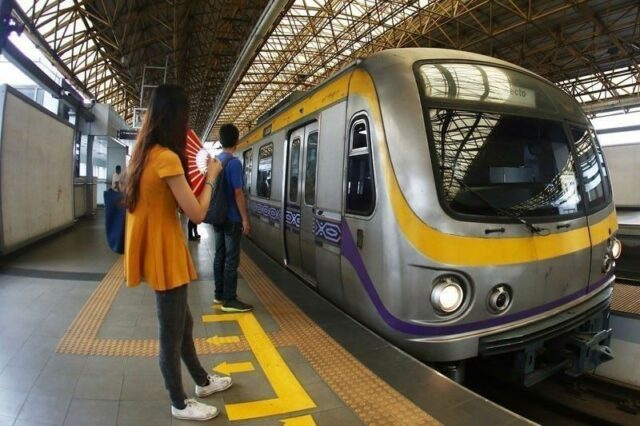
THE Department of Transportation (DoTr) said it is looking into the installation of passenger screen doors at new railway stations, including those on the North-South Commuter Railway (NSCR) and Metro Manila Subway, following an incident at Light Rail Transit Line 1 (LRT-1) on Saturday.

“We have learned a lot and because of that, all the stations of our NSCR project or the 147-kilometer Calamba-Clark Railway will have passenger screen doors. Even our subway and Metro Rail Transit Line 4 will also have these so that we can avoid such accidents,” Transportation Undersecretary for Railways Cesar B. Chavez told reporters on Sunday.

On Saturday, a 26-year-old male passenger was reported to have jumped onto the southbound tracks of LRT-1 Blumentritt station.

Asked about plans for existing rail lines, Mr. Chavez said their feasibility is under study.

“It will be difficult for us to put up passenger screen doors in the existing lines, but we are currently studying their feasibility. Right now, we do not have a definitive plan yet,” said Mr. Chavez.

For the meantime, the DoTr will continue to deploy security guards to intervene should such incidents recur.

Separately the DoTr and LRT-1 operator Light Rail Manila Corp. (LRMC) held a ceremony on Sunday to rename Roosevelt station along EDSA in Quezon City to Fernando Poe, Jr. station.

The change was authorized by Republic Act No. 11608 and Light Rail Transit Authority Resolution No. 002-2023.

“In renaming (the station), we hope that Filipinos will always remember and will be inspired by how Fernando Poe, Jr. lived with values of determination, courage, and hope. LRMC shares these values and supports the promotion of local arts and culture,” LRMC President and Chief Executive Officer Juan F. Alfonso said.

Mr. Chavez said the necessary system updates will be effected to avoid confusion.

“All the systems will be updated. The signage and tickets, even the stored value cards, (among others), will be updated. All of these changes are already programmed,” Mr. Chavez said. — Justine Irish D. Tabile

Pakistan textile mills pledge to supply Philippine garment exporters

RIO LECATOMPESSY-UNSPLASH

PAKISTAN is seeking to build on the trade momentum created by its textile mills, which have pledged to supply the Philippine garment industry, according to an official from the Philippine Exporters Confederation, Inc. (PhilExport).  

Robert M. Young, PhilExport trustee for the textile, yarn and fabric sector, said in a statement over the weekend that Philippine Consul General in Karachi, Muhammad Imran Yousuf, and Economic Diplomatic officer Digna Khan are planning to arrange a visit by a Pakistan business delegation soon.

He had attended the ASEAN (Association of Southeast Asian Nations)-Pakistan Business Opportunities Conference at Lahore and Karachi between Aug. 7 and 11. 

Mr. Young, who is also the president of the Foreign Buyers Association of the Philippines, said Pakistan’s 10 biggest textile companies have pledged to supply textiles to the Philippine garment industry.  

“Mainly 100% cotton sheets and denim… as the Philippines has no such industry,” Mr. Young said.

According to Mr. Young, Pakistan’s textiles have a 15% to 20% cost advantage over those from other major suppliers.

“Pakistan has a lower production costs than China, India and Vietnam, while offering the same high-quality fabrics due to its skilled workers and yarn quality,” Mr. Young said.  

According to Mr. Young, Pakistan has expressed interest because of the advantages presented by upcoming free trade agreements, the Regional Comprehensive Economic Partnership, and Philippine economic reforms such as the amended Foreign Investment Act.

“The Philippines’ location is a critical entry point to over 600 million people in the ASEAN market and a natural gateway to the East Asian economies. It is likewise placed at the crossroads of international shipping and airlines,” Mr. Yousuf said in an e-mail to Mr. Young. — Revin Mikhael D. Ochave

Site blocking touted as anti-book piracy measure

BW FILE PHOTO

THE Intellectual Property Office of the Philippines (IPOPHL) said it is planning a system that will block sites containing pirated copies of Philippine books.

IPOPHL Director General Rowel S. Barba said the book publishing industry is facing the threat of digital piracy, which is being practiced more and more brazenly.

The pirates are “no longer just hiding in the shadows. They’re sailing digital seas… making it tougher than ever to keep them at bay,” Mr. Barba said during a briefing at the Philippine Book Festival in Davao City last week.  

“(What) we want is to keep the book industry’s treasure locked while still letting people have a (access),” he added.

According to Mr. Barba, the IPOPHL has been promoting legal frameworks such as the draft guidelines on voluntary site-blocking that could help book publishers. The guidelines have been finalized and are awaiting the signing of a memorandum of understanding with internet service providers (ISPs).

Under the guidelines, Mr. Barba said rights holders can ask IPOPHL to order the blocking of a site containing pirated material. 

He added that the IPOPHL could request ISPs to act on site-blocking requests if the IP Rights Enforcement Office confirms that the sites are committing piracy.

Mr. Barba said House Bill No. 7600 and Senate Bill No. 2150, written by Albay Rep. Jose Maria Clemente S. Salceda and Senator Jose P. Ejercito, Jr., respectively, would also authorize site-blocking. Both bills represent proposed amendments to the IP Code of the Philippines.  

The House bill was approved on third and final reading in May while the Senate bill was filed in May.

“If signed into law, these measures will allow IPOPHL to issue the appropriate site-blocking orders and ISPs will have to comply with the order within 48 hours,” Mr. Barba said.  

Separately, Bureau of Copyright and Related Rights (BCRR) Director Emerson G. Cuyo, speaking in Davao, touted the benefits of registering copyrighted works.

“Year to date, the BCRR has surpassed its goal of hitting 4,000 copyright registrations for 2023, indicating just how eager Filipinos are in protecting their creative assets. I’m sure Davao has a treasure trove of artistry to guard, so I hope each of you protect them through the BCRR,” Mr. Cuyo said.

In the first half, the IPOPHL fielded 200 piracy and counterfeiting complaints, up 284.6% from a year earlier.

Piracy reports accounted for 76% of the total, against nine incidents logged a year earlier. Incidents of piracy involving software totaled 145, followed by movies at six, and e-books one.  

Counterfeiting incidents increased 9% to 48, including 35 reported in the apparel sector. — Revin Mikhael D. Ochave

Gov’t urged to pair lower agri tariffs with measures boosting domestic output

THE government’s tariff-lowering on agricultural commodities must be accompanied by measures boosting domestic production, analysts said.

“It is crucial that for this policy to work that programs intended to increase productivity be initiated at the same time to support producers who may be adversely affected,” Ateneo de Manila economics professor Leonardo A. Lanzona told BusinessWorld in an e-mail.

Mr. Lanzona said that a comprehensive industrial policy should ensure “greater utilization of domestic resources,” alongside reforms that will support the short-term needs of domestic producers.

“I am in favor of removing all forms of tariff that limit the entry of basic commodities to consumers and provide protection to selected group of industries,” he said.

“However, while this policy may benefit consumers, this can prove detrimental to firms and other producers, making this policy unsustainable,” he added.

Industrial policy should promote expanded exports, which will generate resources to import goods that the Philippines cannot produce efficiently, he said.

In March, the Tariff Commission (TC) announced that it has started a comprehensive tariff review of the most-favored nation (MFN) tariff schedule covering the period 2024 to 2028.

The review is undertaken every five years to adjust the MFN tariff schedule as authorized by Republic Act No. 10863 or the Customs Modernization and Tariff Act.

The Management Association of the Philippines has asked the National Economic and Development Authority (NEDA) to consider reducing tariffs on agricultural products to ensure the affordability of produce.

Citing a TC report, it said that the average tariff applied on agricultural products is 12% while the average for all products is 8%.

Jesus C. Cham, president emeritus of the Meat Importers and Traders Association (MITA), said the meat industry cannot continue to supply directly to supermarkets with a target retail price due to “uncertainty over the tariff rates.”

In May, MITA also urged NEDA to further lower tariffs on imported pork as the current tariff rates are set to expire by the end of the year.

“Industries have been over protected. Economists say that protection should not exceed 5 years, but in our case it is already 27 years. As a result our industry constantly demanded protection and use high tariff in lieu of becoming competitive,” he said.

Raul Q. Montemayor, national manager of the Federation of Free Farmers, said via Facebook Messenger that lower tariffs for rice, pork and sugar “have not proportionately reduced retail prices.”

“Without measures that will enhance the competitiveness of the affected sectors and help them cope with diseases and other emerging problems, the lowered tariffs will only discourage domestic production and make us even more dependent on imports for our basic food needs,” he said.

He also said that the proposal to reduce tariffs “goes against the assurances made” during hearings for the Regional Comprehensive Economic Partnership treaty. The farm industry had been assured that tariffs on sensitive products will not be touched, he said. — Sheldeen Joy Talavera

How generative AI creates value for financial services

The artificial intelligence (AI) landscape is constantly evolving, and large language models (LLMs) have gained global traction for their bespoke capabilities. Notably, ChatGPT reached 100 million users merely two months after its launch, making it the fastest-growing application in history. These developments showcase generative AI’s abilities, pushing the boundaries of what technology can do with text and language.

However, the utilization of LLMs is controversial and has been the subject of debate among academia, regulatory bodies, and the general public. Skeptics point to hallucination as a significant drawback of AI models, which would be pronounced in cases where the model provides responses based on pattern recognition rather than reasoning. Various entities have urged the government to hasten AI-related regulation in response to the extensive adoption of generative AI models. Moreover, there are significant concerns with privacy, security, trust, and reliability. There is a serious threat of ‘model collapse’ when the knowledge base underpinning generative AI systems is inundated with imperfect information, deliberate misinformation, and uncontrolled synthetic data. The proverbial GIGO is at play — garbage in, garbage out.

Despite these apprehensions, generative AI is a comprehensive technology that can transform work for different sectors. Corporations have been rapidly spending on AI, with several industries investing considerable time, money, and resources. While some organizations are moving at a steady pace, others have shared a multiyear commitment to integrating this technology across their functions.  While there are sectors that find the current imperfections of generative AI unacceptable, there are those, such as financial institutions, that have actively experimented and deployed use cases in lower-risk areas.

THE VALUE PROPOSITION FOR FINANCIAL SERVICES
While banks and financial institutions have already been utilizing AI applications for different areas like credit risk and fraud, generative AI could further enhance other services, streamlining a broad array of business functions and uses that can elevate core offerings. Several applications and functions are suitable for AI adoption, including customer marketing, insurance claims processing, and financial planning. Internal services like application development, compliance monitoring, and maintenance also have potential.

 Technological advancements help expand business-use cases, particularly when dealing with unstructured data like text. Thus, organizations can create or refine business content using generative AI’s ability to query data in a natural, humanlike manner. However, the technology is still in its nascent stage, meaning AI should be synergized with human expertise to generate accurate insights and create long-term value.

OPERATIONAL EFFICIENCY AND AUGMENTED INTELLIGENCE 

Financial services firms could slowly integrate AI in lower-risk areas like augmented intelligence and operational efficiency to minimize risk. Differing views have tempered AI adoption, but organizations have been experimenting with various use cases due to the technology’s reported benefits and strengths. To retain their competitive positioning, firms should assess and leverage AI in controlled environments.

Operational efficiency involves enhancing productivity and reducing costs by automating tasks like information categorization, review, and synthesis. On the other hand, augmented intelligence entails assisting experts by providing content, insights, and recommendations for clients.

CROSS-FUNCTIONAL CAPABILITIES
In the following areas, AI can support operational efficiency, reallocating human effort to other critical tasks:

Tax and legal. Augment tax file generation, streamline contract organization and refine diligence processes for legal teams.

 Product, technology and IT. Create new product or service functionalities, generate natural-language-based code blocks and make test cases for evaluating code vulnerabilities.

Risk and compliance. Map risk controls with corresponding regulations and flag missing disclosures or regulatory risks like fair customer treatment and sales practice concerns.

FUNCTIONAL SOLUTIONS
Generative AI can also be leveraged in the following functions to streamline operations and innovate new ways of doing business:

Chatbots and virtual assistants. Provide tailored, end-to-end support using natural language. Specialists can configure this functionality based on internal or external knowledge or information, subject to the organization’s discretion.

Knowledge management and generation. Appropriately sift through and retrieve institutional knowledge and intellectual property. Organizations can utilize generative AI to augment and create content based on internal or external knowledge databases.

Document intelligence. Execute advanced information extractions from unstructured or semi-structured data formats. The process can also focus on specific attributes and elements or generate insights from available information.

THE FUTURE OF AI IN FINANCIAL SERVICES
Generative AI has the power to transform businesses. For financial services firms, transformation entails capitalizing on the technology’s strengths while managing the corresponding risks. Successfully creating value from AI involves a synergy between the latest technology and an organizational culture that invests in various capabilities and develops a framework for risk management.

The financial services sector has a head start with deploying generative AI, given its experience with navigating AI-related regulation. Hence, many financial institutions have become market leaders in devising an AI governance framework, which includes setting policies, standards, and procedures. In the same vein, other industries and organizations should address critical areas like AI governance and oversight frameworks when integrating this technology into their operations.

Lastly, effective board governance is crucial for the management of generative AI.

While these practices will need to be polished and redefined, financial services institutions should use this time to identify and invest in potential applications for the technology. Organizations that successfully integrate generative AI into their organizational makeup can differentiate themselves and remain competitive. 

This article is for general information only and is not a substitute for professional advice where the facts and circumstances warrant. The views and opinions expressed above are those of the author and do not necessarily represent the views of SGV & Co.


Christian G. Lauron is the Financial Services Organization (FSO) leader of SGV & Co.

China’s nationalism push to cause more tensions at sea, analysts say

AN AERIAL VIEW of the BRP Sierra Madre at the contested Second Thomas Shoal on March 9, 2023. — REUTERS

By Kyle Aristophere T. Atienza, Reporter

THE PHILIPPINES should brace for increased tensions in the South China Sea and Taiwan Strait as Chinese President Xi Jinping uses nationalism to rally support for his regime amid an increasingly sluggish economy, geopolitical analysts said at the weekend.

China is expected to experience a long-term economic slowdown mainly due to declining export demand and domestic consumption. Its economy slipped into deflation as consumer prices declined in July for the first time in more than two years.

China’s slowing economic growth is also driven by years-long domestic issues such as its real estate problems and aging population, which have affected foreign investors’ confidence in the world’s second largest economy.

“In times of economic crisis, the Chinese military will act for a heroic mission as a façade to the world that Xi Jinping remains in control of his revisionist country,” Chester B. Cabalza,  founder of the Manila-based International Development and Security Cooperation, said in a Facebook Messenger chat.

“China might even stage a shooting war in the South China Sea as a wag-a-dog strategy to divert the attention of Chinese people from their financial woes and gather strong sentiment for nationalism,” he added.

Nontraditional security challenges such as the coronavirus pandemic and anti-China protests in Hong Kong before the global health crisis had not stopped China from enforcing its “rejuvenation policy of forcibly reclaiming and expanding territories,” Mr. Cabalza said.

“Amid the economic woes of China, President Xi Jinping will remain adamant on the People’s Liberation Army and Chinese Coast Guard’s battle-readiness in the South China Sea,” he added.

China has become more assertive in the South China Sea, making it more difficult for the Philippines, now considered as an Asian middle power, to ignore the situation.

On Aug. 5, the Chinese Coast Guard, backed by its maritime militia and People’s Liberation Army ships, fired water cannons at Philippine vessels trying to bring food and other supplies to a grounded ship at Second Thomas Shoal.

The shoal is about 200 kilometers from the Philippine island of Palawan and more than 1,000 kilometers from China’s nearest major landmass, Hainan Island.

“Beijing’s position in the South China Sea continues to harden despite economic setbacks at home,” said Lucio B. Pitlo III, a research fellow at the Asia-Pacific Pathways to Progress Foundation. “Far from slackening, I expect that posture to stiffen. Beijing is likely to call on its people and army to stay firm to weather these challenges.”

The Philippines this month filed a diplomatic protest against China over the water cannon incident, with countries including the US, Japan, Australia, South Korea and members of the European Union expressing concern.

China’s trade war with the US has instensified, with Beijing announcing last month export controls on two metals used in producing chips and solar panels, in an apparent response to years of trade restrictions by the US and allied countries aimed at restricting Chinese access to high-end semiconductor technology.

Enrico Cau, chief advisor for geopolitical affairs at the Taiwan Business Leaders’ Forum, said imposing more Western sanctions on China could lead to a violent reaction from the Xi regime and could spur a global security crisis.

“China’s economic slump is caused by a complex combination of economic and geopolitical factors over an underlying background rooted in the zero COVID policies that helped trigger a series of negative effects hitting several key sectors,” he said via Messenger chat.

He noted that China’s exports, manufacturing and property sectors as well as its labor force have been affected the most.

Foreign domestic investment is likely to be affected as well, Mr. Cau said, “as a result of China’s sharply veering away from pure economics and adopting a more security-oriented approach to domestic investment.”

DETERRENCE
He cited China’s recent anti-spy laws that include a whole-of-society approach to counterespionage. “While none of these issues per se is unsolvable, when combined with China’s deteriorating geopolitical situation both regionally and globally, the potential for growing domestic instability and escalation abroad could grow,” Mr. Cau said.

“While the risk of a full-fledged conflict in the region remains unlikely under the current conditions, decoupling and derisking processes, sanctions and other measures designed to contain China could result in escalating dynamics, both globally and regionally,” he added.

The Indo-Pacific region also has to contend with the conflict involving Taiwan, which China claims as its own. Taiwan is about 1,200 kilometers away from the Philippines. 

Mr. Cau said China would not give up on Taiwan and should the need arise, “it will go as far as needed to ensure the island does not become independent or ends up under foreign influence.”

“While also the risk of conflict is relatively low for now, real or perceived variations in a number of variables could potentially lead China to think that a coercive course of action is better than dialogue.”

An economic downturn could shrink China’s so-called “window of strategic opportunity” — the perceived period of maximum power relative to its objectives — said Gordian Knot Center for National Security Innovation fellow Raymond Michael Powell.

“If Xi Jinping believes this window closes sooner than he previously believed, it’s possible that he may try to force the Taiwan issue,” he said in an e-mail.

Deterrence becomes more urgent, and the US and its allies must convince Mr. Xi that resolving China’s security concerns by force would have devastating military, economic, diplomatic and humanitarian consequences and that “his legacy would not be that of a conquering hero but as the disastrous leader who lost a catastrophic war,” Mr. Powell said.

He said any conflict over Taiwan would affect the Philippines, even if it isn’t directly involved.

“Refugees — including over 150,000 overseas Filipino workers — will almost certainly pour across the Luzon Strait,” he said. “Economic activity with China will be severely curtailed if not stopped. Trade routes across the Indo-Pacific region will be severely disrupted.”

Mr. Powell said it would be very hard for the Philippines to stay out of such a war because it has a mutual defense treaty with the US, whose forces are very likely to become involved.

“While President Ferdinand R. Marcos, Jr. has ruled out offensive operations from EDCA (Enhanced Defense Cooperation Agreement) sites, what happens when the Philippines’ treaty ally is attacked by Chinese forces?” he asked. “The Philippines rightly expects US support if it is attacked, but the treaty is mutual by definition — it works both ways.”

Deterring conflict is very much in the Philippines’ interest, Mr. PowelI said, noting that efforts to expand its security network not only with the US but also with Japan, Australia and European countries “helps complicate Beijing’s strategic calculus.”

“Anything that sows more doubt in Xi’s mind that war could be in China’s national interest serves the cause of deterrence, and thus serves the Philippines’ national interest.”

Hansley A. Juliano, a political economy researcher studying at Japan’s Nagoya University, said bleak prospects for China’s economy could translate to any potential aggression “if China intends to bolster its economy by securing resources or maintaining economic hegemony over its neighbors to ensure that foreign patronage of Chinese products will make up for their other economic weaknesses.”

“That can indeed translate to greater pressures on Taiwan, possibly short of any invasion,” he said, adding that China has seen “what happened to territorially aggressive strategies the way Russia did it, and how it crippled its economy in turn.”

Mr. Juliano said the plan of the Peoples’ Liberation Army to recruit more graduates to help ease record joblessness among the youth was seen in imperial Japan’s recruitment during the Sino-Japanese War that led to World War II. “We remember how horrific that ended up.”


Activists look back on democracy icon Ninoy’s death four decades ago

FILIPINO activists held an information drive on Sunday to commemorate the death of democracy icon Benigno “Ninoy” Aquino, Jr.

His death on Aug. 21, 1983 led to a popular street uprising that toppled the regime of the late dictator Ferdinand E. Marcos less than three years later.

Ninoy’s death upon his arrival from US exile was an “act of defiance against fake news and widespread deception,” said Akbayan Party President Rafaela David, whose group held a program dubbed “Historyahan” at a Makati City monument of the Filipino hero.

“Without memory, all that remains is a hollow democracy,” she said in a statement. “While we no longer live under Martial Law, the constant attempts to distort the truth are the gravest threats to democracy in the country.”

The presidential palace under President Ferdinand R. Marcos, Jr. had yet to issue a statement about Ninoy Aquino Day, which is a nonworking holiday under the law.

“In 1983, they assassinated a brave and selfless man,” Ms. David said. “In 2022, they tried to assassinate history using our own democratic elections, but no bullet can kill the truth.”

The group vowed to preserve the country’s collective memory of the February 1986 uprising that sent the late dictator and his family into exile in the US.

“Through our storytelling, and the preservation of collective memory, we will keep the truth alive, and it will have its day.”

Critics have said President Ferdinand R. Marcos, Jr. benefited from a well-organized presidential campaign last year that sought to whitewash the country’s history under his late father and namesake.

Fact-checking organization VERA Files in a Dec. 2021 report said election-related online disinformation that year benefited Mr. Marcos the most.

It noted that out of 120 election-related false information propagated in 2021, 52 “either promoted Marcos… or distorted facts about his family’s ill-gotten wealth cases and the atrocities committed under the administration of his father.”

During Sunday’s program, Kiko Aquino-Dee described Mr. Aquino, his grandfather, a “boy wonder” who became a hero for making himself “one with the country and its suffering.”

“When we become one with our country’s suffering and its struggles, it can create a huge impact,” he said in Filipino.

“That is the lesson of the EDSA People Power Revolution,” said Mr. Dee, who is also the deputy executive director of the Ninoy & Cory Aquino Foundation.

The death of Mr. Aquino, who was assassinated moments after deplaning from Manila’s international airport, led to the creation of a movement named August Twenty-One Movement or ATOM.

The group organized mass mobilization campaigns that drew hundreds of thousands during Mr. Aquino’s funeral parade in different parts of the country.

ATOM, which has been revived by young Filipinos seeking to preserve the country’s history under the senior Marcos, is set to lead a motorcade on Monday “that will trace back the route of Ninoy’s burial march.”

Public outrage over Mr. Aquino’s death catapulted his wife Corazon into the limelight, with many pushing her to challenge the elder Marcos’ rule.

Private and unofficial counts by watchdogs led by the National Movement for Free Elections showed that Ms. Aquino and her running mate won the 1986 snap election. 

On the last of the four-day People Power uprising, Ms. Aquino took her oath as the first female president of the Philippines.

“Ninoy’s death will inspire a large segment of Filipinos who have remained apathetic to the abuses of Martial Law to finally break their silence and join the cause to break free from the chains of the Marcos dictatorship,” ATOM said in a statement. — Kyle Aristophere T. Atenza