Home Blog Page 4482

Sub-P1M crossover Geely GX3 Pro now here


PHOTO BY KAP MACEDA AGUILA

GEELY IN THE PHILIPPINES surely made its bones with the Coolray — a popular crossover that further helped to shore up the reputation of Chinese car makers.

Sojitz G Auto Philippines (or Geely Philippines), local distributor of the Hangzhou, Zhejiang-headquartered automaker, looks to build on its popularity and growing consumer base in the country with the release of the GX3 Pro. The A-segment crossover is said to target the “young and entry-level market,” with a price point well below the P1-million mark.

Measuring 4,005-mm long (with a 2,480-mm wheelbase), 1,760-mm wide, and 1,575-mm tall, the GX3 Pro is powered by a 1.5-liter, 16-valve DOHC mill with DVVT (Dual Variable Valve Timing). Mated to either a five-speed manual (S trim) or CVT (Comfort trim), the engine submits 102hp and 142Nm — the latter achieved from 4,400rpm to 4,800rpm. It clears the ground by 185mm. The five-seater is said to boast a maximum cargo volume of up to 400 liters.

The GX3 Pro gets three driving modes (Normal, Eco, and Sport) and rolls on 16-inch alloys. It wears halogen headlamps, with the Comfort variant getting Auto Headlight Control. Both trims have LED daytime running lamps, power side mirrors, a glass-printed antenna, and silver roof rails.

Inside, its instrument panel boasts a 3.5-inch multi-information display, while the eight-inch infotainment screen can support mobile devices through CarbitLink. Audio content is expressed via two speakers on the S variant and six speakers on the Comfort. The driver can manually adjust his/her seat in six ways, while the front passenger gets four-way manual adjustment.

For safety, Isofix anchors are available in the rear seats, and both trims receive driver and passenger air bags, electronic brake distribution with brake assist, a reversing camera, rear parking sensors, low-tire pressure warning, and a central locking system. The Comfort additionally features traction and stability control, hill start assist, hill descent control, cruise control, and an anti-theft system with immobilizer.

“This model holds a strategic significance for Geely, as it aims to capture an entirely new customer base, particularly Gen Z. With its enticing introductory pricing and an emphasis on an enjoyable driving experience, the GX3 Pro is poised to play a pivotal role in expanding our reach and achieving five-digit annual sales figures,” said Geely Philippines President and CEO Yugo Kiyofuji.

During the launch event held recently, Geely Philippines also stressed its efforts and focus on improving after-sales experience with the launch of the so-called G-Serv+. “(We) take pride in having garnered over 20,000 customers to date, a number that is set to grow exponentially. Over the past year and beyond, we have dedicated significant efforts to revamp our after-sales operations,” continued Mr. Kiyofuji. “With G-Serv+, we are confident that Geely owners will enjoy peace of mind throughout their ownership journey, further solidifying our customer base and fostering a sense of belonging within the Geely family.”

The Geely GX3 Pro is priced at P698,000 for the S variant, and P798,000 for the Comfort. It is available in four exterior colors: red, white, blue, and gray. Geely Philippines says that each purchase comes with a five-year/150,000-km warranty and one year of free emergency roadside assistance. — Kap Maceda Aguila


Empowering patients for enhanced healthcare

FREEPIK

In recent years, patient-centered care has been the center of discussion in the healthcare community as well as a buzzword for excellence in care delivery. Yet patients still have little influence in matters that impact them the most, observed the New England Journal of Medicine (NEJM).

In its publication “The Power of Patient Voice,” NEJM added that patients are said to be the center of healthcare but too often their voices are ignored or put to the side when decisions are being made. These decisions include those relating to their health, their treatment plans, the cost of their care, and more. It asserted that care is patient-centric if input from patients themselves is a core part of the process.

Patient-centered healthcare has emerged in the past decades as an approach for better-functioning healthcare systems. It represents a shift from “doctor knows best” to a new pact between patients and healthcare professionals, where the patient is actively involved in any decisions about their wellbeing. To cite just one example, patients can provide feedback to healthcare professionals about how a medicine is working for them and which ones may be most fit for them.

Patient empowerment is both a pre-requisite for and an outcome of patient-centered healthcare — a goal as well as a process, according to the European Patients Forum (EPF). EPF defines patient empowerment as a “process that helps people gain control over their own lives and increases their capacity to act on issues that they themselves define as important.” Aspects of empowerment include health literacy, shared decision-making, and self-management.

Recognizing the vital importance of a strong patient voice in enhancing healthcare systems, the Philippine Alliance of Patient Organizations (PAPO) in partnership with the Asian Institute of Management (AIM) co-developed the Post-Graduate Certificate Course on Healthcare Leadership and Management.

This first-of-its-kind customized program under the AIM School of Executive Education and Lifelong Learning gives patient leaders the opportunity to hone their leadership skills in creating a people-centered approach to healthcare. It aims to enhance the capabilities of patient leaders and empower them to effectively lead and transform their organizations. By equipping them with the necessary skills and knowledge, patient leaders can play pivotal roles as members of local health boards, actively participate in decision-making processes, and contribute to the improvement of healthcare systems at the grassroots level.

The Universal Health Care (UHC) Act mandates the creation of local health boards that are responsible for setting the overall health policy directions and strategic thrusts, including the development and implementation of the integrated strategic and investment plans of the province-wide and city-wide health system. These health boards also oversee and coordinate the integration and delivery of health services; manage the Special Health Fund (SHF); and exercise administrative and technical supervision over health facilities and health human resources within their respective territorial jurisdiction.

“We want the patient’s voice to be represented in the local health boards, so we need to be prepared. This post-graduate course further enhances our leadership, strategic thinking, and empathy through design thinking,” said PAPO President Karen Alparce-Villanueva.

During the graduation ceremony, five groups presented their Action Learning Projects, which are real-life case studies designed to help ensure classroom learning is implemented in the real world. The patient leaders discussed Project Padayon, a toolkit guide for local health officials in organizing and partnering with patient groups; developing strategic partnerships for people-centered healthcare; automating medical records through mobile application development; increasing access to financing for patients with rare diseases; and enhancing the patient experience in accessing financial assistance through the Malasakit Centers.

PAPO trustee Mel Lamsin said that the course gave them more confidence as it equipped them with knowledge on how to frame problems and propose solutions in a better way.

“We stand with PAPO, AIM, and the broader community in championing patient-centered healthcare for Filipino patients. We laud PAPO for bringing this vision closer to reality by equipping patient leaders through this postgraduate course,” said Andreas Riedel, President and Managing Director, MSD Philippines.

Along with MSD, Roche Philippines, and Boehringer Ingelheim Philippines provided support to the strategic collaboration between PAPO and AIM.

Patient-centric care may be the latest byword for quality healthcare but for us to get there, patients must be part of the conversation and decision-making. Borrowing from PAPO on its discussion about patients: “It is not about us, without us.”


Teodoro B. Padilla is the executive director of Pharmaceutical and Healthcare Association of the Philippines (PHAP). PHAP represents the biopharmaceutical medicines and vaccines industry in the country. Its members are in the forefront of research and development efforts for COVID-19 and other diseases that affect Filipinos.

PFDA opens processing facility at Navotas fish port

THE Philippine Fisheries Development Authority (PFDA) inaugurated the new processing facility at the Navotas Fish Port Complex, which will be operated by a women’s organization producing smoked fish.

In a statement, the PFDA said that Eco-Friendly Women of Navotas Fish Port, Inc. will run the processing facility.

The PFDA also added 44 food stalls to the freshly renovated Market 3.

“This new infrastructure also aims to provide more employment opportunities and an additional sources of income for the members of the association,” the PFDA said.

The PFDA is also looking into constructing additional regional fish port (RFP) complexes and establishing modern fish trading centers elsewhere in the Philippines.

Six ports are being upgraded in Davao, Iloilo, Zamboanga, Camaligan, Camarines Sur, Sual, Pangasinan, as well as Navotas.

Fish landed at RFPs totaled 42,814.19 metric tons in May, down 4.26% from a month earlier, mainly due to the early onset of the rainy season. — Sheldeen Joy Talavera 

India faces record low rains in August, posing threat to summer crops

MUMBAI — India is heading for its driest August in more than a century, with scant rainfall likely to persist across large areas, partly because of the El Niño weather pattern, two weather department officials told Reuters on Friday.

August rainfall, expected to be the lowest since records began in 1901, could dent yields of summer-sown crops, from rice to soybeans, boosting prices and overall food inflation, which jumped in July to the highest since January 2020.

The monsoon, vital for the $3-trillion economy, delivers nearly 70% of the rain India needs to water farms and refill reservoirs and aquifers.

“The monsoon is not reviving as we had expected,” said a senior official of the India Meteorological Department (IMD), who sought anonymity as the matter is a sensitive one.

“We are going to end the month with a significant deficit in the southern, western, and central parts.”

India is on course to receive an average of less than 180 mm (7 inches) of rainfall this month, he added, based on rains so far and expectations for the rest of the month.

The weather authorities are expected to announce August totals of rainfall and the forecast for September on Aug. 31 or Sept. 1.

India received just 90.7 mm (3.6 inches) in the first 17 days of August, nearly 40% lower than normal. The month’s normal average is 254.9 mm (10 inches), he said.

Earlier, the IMD had anticipated a rainfall deficit of up to 8% in August. The lowest August rainfall on record was in 2005, with 191.2 mm (7.5 inches).

Monsoon rainfall is expected to improve over the next two weeks in the northeast and some central regions, but dry conditions in northwestern and southern states are likely to persist, said another IMD official.

“Normally, we experience a dry spell of five to seven days in August,” said the official, who also spoke on condition of anonymity. “However, this year the dry spell has been unusually prolonged in southern India. The El Niño weather pattern has begun to impact the Indian monsoon.”

El Niño, a warming of waters that usually stifles rainfall over the Indian subcontinent, has emerged in the tropical Pacific for the first time in seven years. This monsoon has been uneven, with June rains 10% below average but July rains rebounding to 13% above average.

Summer rains are crucial as nearly half of India’s farmland lacks irrigation. Farmers typically start planting rice, corn, cotton, soybeans, sugarcane and peanuts, among other crops, from June 1, when the monsoon begins to lash the southern state of Kerala.

The lengthy dry spell has led to extremely low soil moisture, which could inhibit growth of crops, said Harish Galipelli, director of trading firm ILA Commodities India Pvt Ltd. 

“Crops are in dire need of rainfall,” he added. “Any further delay could lead to reduced yields.” — Reuters

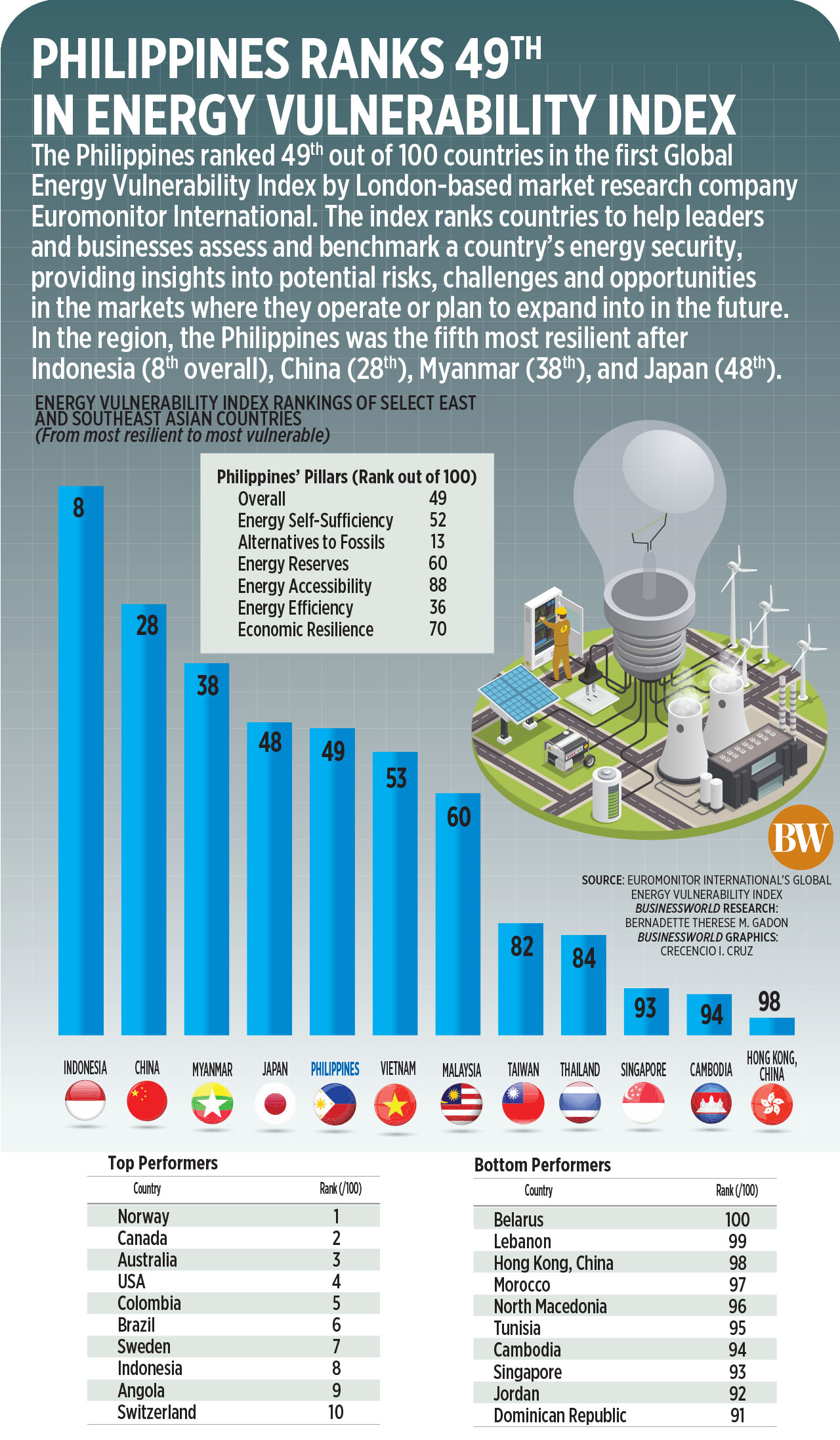
Philippines ranks 49th in Energy Vulnerability Index

The Philippines ranked 49th out of 100 countries in the first Global Energy Vulnerability Index by London-based market research company Euromonitor International. The index ranks countries to help leaders and businesses assess and benchmark a country’s energy security, providing insights into potential risks, challenges and opportunities in the markets where they operate or plan to expand into in the future. In the region, the Philippines was the fifth most resilient after Indonesia (8th overall), China (28th), Myanmar (38th), and Japan (48th).

How PSEi member stocks performed — August 18, 2023

Here’s a quick glance at how PSEi stocks fared on Friday, August 18, 2023.


Diokno: Tuition-free college education ‘unsustainable’

THE UNIVERSITY of the Philippines Diliman campus in Quezon City. — UP.EDU.PH 

By Keisha B. Ta-asan, Reporter

FREE ACCESS to state university education is “unsustainable,” Finance Secretary Benjamin E. Diokno said on Saturday, signaling a possible push to amend a signature piece of legislation signed into law during the Duterte administration. 

Speaking at a forum organized by the University of the Philippines School of Economics, Mr. Diokno said he had been opposed to Republic Act (RA) 10931, or the Universal Access to Quality Tertiary Education Act of 2017, when he was part of the economic team in the previous government.

Mr. Diokno, who had served the last government as budget secretary and central bank governor, also called the law “anti-poor” because “there are more poor people who do not attend college.”  

“This is really a subsidy to those who can pay for their college education,” Mr. Diokno said. “Plus, it really consumes a lot of funds.”  

The law provides eligible students free tuition and renders them exempt from other fees charged by state universities and colleges (SUCs), as well as local universities and colleges.

It was passed at a time when government finances were looking solid, but before it took on massive debt to fund its pandemic containment measures.

According to Mr. Diokno, if the government wants to help the poor, it should focus more on enhancing basic education.

“If you improve elementary and secondary education, then you increase the chances of (gaining entry into) SUCs. So, I think we should focus more on (the basic education system) rather than the SUCs,” he said.

Mr. Diokno also noted that if a fixed number of students enter SUCs and benefit from the free tuition fee, funding for the law’s entitlements will be “adequate.”

“But now, a lot of students want to enroll, but drop out after a year in college. Nasasayang ang pera (the money is wasted),” he said.  

Under the 2024 National Expenditure Program, education was granted an allocation of P924.7 billion, 3.3% higher than this year’s budget.

This includes P51.12 billion to implement RA 10931, P12.04 billion for textbooks and other instructional materials and P11.71 billion for feeding programs in schools. 

The Department of Education will see its budget rise 5.37% to P758.6 billion in 2024.

Shares decline on concerns over growth, China

BW FILE PHOTO

LOCAL STOCKS declined on Friday due to negative sentiment following slower Philippine economic growth last quarter and concerns over China’s property sector.

The benchmark Philippine Stock Exchange index (PSEi) fell by 74.70 points or 1.17% to close at 6,290.27 on Friday, while the broader all shares index went down by 26.39 points or 0.77% to end at 3,383.41.

Week on week, the PSEi went down by 115.64 points or 1.81% from its close of 6,405.91 on Aug. 11.

“The local market closed last week at 6,290.27, its lowest close since Nov. 11, 2022’s 6,286.77. The bourse has hit a nine-month low as confidence towards the economy gets strained following the slowdown in our economic growth as seen in the Q2 figures,” Philstocks Research Associate Japhet Louis O. Tantiangco said in a Viber message.

“Adding to this are the clouds hanging over our economic outlook including the mounting food inflationary risks to our country mainly due to El Niño, rallying oil prices, and the Federal Reserve which continues to be in a hawkish stance,” Mr. Tantiangco added.

Philippine gross domestic product (GDP) grew by 4.3% in the second quarter, slower than the 6.4% seen in the first quarter and the 7.5% in the same period a year ago.

For the first half, GDP growth averaged at 5.3%, below the government’s 6-7% target for the year.

Meanwhile, the US central bank last month raised borrowing costs by 25 basis points (bps), bringing its target interest rate to a range between 5.25% and 5.5%. It has now hiked rates by a total of 525 bps since March 2022.

The market slumped last week due to contagion concerns amid issues in the Chinese property market, Rastine Mackie D. Mercado, research director at China Bank Securities Corp., said in an e-mail.

Chinese property developer Country Garden last week sought to delay payments for its private onshore bond, further showing signs of a possible cash crunch in the country’s property sector, Reuters reported.

Back home, sectoral indices sank on Friday, except for mining and oil, which went up by 24.04 points or 0.24% to 9,898.69.

Meanwhile, financials dropped by 34.55 points or 1.82% to 1,862.04; industrials went down by 118.09 points or 1.32% or 8,795.80; services declined by 16.23 points or 1.03% to 1,547.80; property sank by 26.79 points or 1.01% to 2,624.91; and holding firms fell by 13.32 points or 0.22% to 5,961.15.

Value turnover slipped to P4.48 billion on Friday with 348.61 million shares changing hands from the P4.92 billion with 343.14 million issues seen on Thursday.

Decliners outnumbered advancers, 104 versus 66, while 57 names closed unchanged.

Net foreign selling stood at P566.44 million on Friday versus the P76.12 million in net buying seen on Thursday.

The market is closed on Monday in observance of Ninoy Aquino Day. — A.H. Halili with Reuters

Peso may move sideways vs the dollar

BW FILE PHOTO

THE PESO could trade sideways against the dollar this week ahead of US Federal Reserve Chair Jerome H. Powell’s speech on Friday and after the Bangko Sentral ng Pilipinas (BSP) kept borrowing costs unchanged.

The local unit closed at P56.18 versus the dollar on Friday, strengthening by 59 centavos from Thursday’s P56.77 finish, data from the Bankers Association of the Philippines’ website showed.

Week on week, the peso dropped by 13.50 centavos from its P56.315 close on Aug. 11.

The local unit opened Friday’s session at P56.65 per dollar, which was also its weakest showing. Its intraday best was at P56.14 against the greenback.

Dollars traded rose to $1.46 billion on Friday from the $960.55 million recorded on Thursday.

The peso strengthened against the dollar on Friday after the BSP kept its key rate unchanged in a “hawkish pause,” Rizal Commercial Banking Corp. Chief Economist Michael L. Ricafort said in a Viber message.

The BSP kept its benchmark interest rates steady for a third straight meeting on Thursday, but signaled that it is prepared to resume tightening if needed amid risks to inflation.

The Monetary Board left its overnight reverse repurchase rate unchanged at a near 16-year high of 6.25%, as expected by 13 economists in a BusinessWorld poll. Interest rates on the overnight deposit and lending facilities were maintained at 5.75% and 6.75%, respectively.

The BSP has raised borrowing costs by 425 basis points (bps) from May 2022 to March 2023 to tame inflation.

BSP Governor Eli M. Remolona, Jr. said in an interview with CNBC on Friday that the BSP has room to resume hiking interest rates without contracting the economy, Reuters reported.

The Philippines has ample foreign exchange reserves to weather external shocks, Mr. Remolona told CNBC, a day after monetary authorities kept benchmark rates unchanged for the third straight meeting.

He likewise said after the meeting on Thursday that the BSP is “ready to tighten” if necessary, as it keeps a close eye on developments that may impact inflation.

Headline inflation eased for the sixth consecutive month to 4.7% in July from 5.4% in June, bringing the seven-month average to 6.8%.

The BSP will next meet on Sept. 21 to review policy.

For this week, the peso could trade sideways due to the BSP’s hawkish stance and as the market awaits Mr. Powell’s speech on Friday for signals on the US central bank’s next move, Mr. Ricafort said.

Mr. Powell is scheduled to deliver a speech on the economic outlook at the Kansas City Jackson Hole Economic Policy Symposium on Aug. 25.

The Fed raised interest rates by 25 bps last month, bringing its benchmark overnight rate to a range between 5.25% and 5.5%.

The US central bank has hiked rates by a cumulative 525 bps since it began its tightening cycle in March last year.

The Federal Open Market Committee will next meet on Sept. 19-20 to review policy.

For this week, Mr. Ricafort expects the peso to range from P56 to P56.50 per dollar. — A.M.C. Sy with Reuters

Passenger screen doors to feature in new rail stations

PHILIPPINE STAR/MIGUEL DE GUZMAN

THE Department of Transportation (DoTr) said it is looking into the installation of passenger screen doors at new railway stations, including those on the North-South Commuter Railway (NSCR) and Metro Manila Subway, following an incident at Light Rail Transit Line 1 (LRT-1) on Saturday.

“We have learned a lot and because of that, all the stations of our NSCR project or the 147-kilometer Calamba-Clark Railway will have passenger screen doors. Even our subway and Metro Rail Transit Line 4 will also have these so that we can avoid such accidents,” Transportation Undersecretary for Railways Cesar B. Chavez told reporters on Sunday.

On Saturday, a 26-year-old male passenger was reported to have jumped onto the southbound tracks of LRT-1 Blumentritt station.

Asked about plans for existing rail lines, Mr. Chavez said their feasibility is under study.

“It will be difficult for us to put up passenger screen doors in the existing lines, but we are currently studying their feasibility. Right now, we do not have a definitive plan yet,” said Mr. Chavez.

For the meantime, the DoTr will continue to deploy security guards to intervene should such incidents recur.

Separately the DoTr and LRT-1 operator Light Rail Manila Corp. (LRMC) held a ceremony on Sunday to rename Roosevelt station along EDSA in Quezon City to Fernando Poe, Jr. station.

The change was authorized by Republic Act No. 11608 and Light Rail Transit Authority Resolution No. 002-2023.

“In renaming (the station), we hope that Filipinos will always remember and will be inspired by how Fernando Poe, Jr. lived with values of determination, courage, and hope. LRMC shares these values and supports the promotion of local arts and culture,” LRMC President and Chief Executive Officer Juan F. Alfonso said.

Mr. Chavez said the necessary system updates will be effected to avoid confusion.

“All the systems will be updated. The signage and tickets, even the stored value cards, (among others), will be updated. All of these changes are already programmed,” Mr. Chavez said. — Justine Irish D. Tabile

Pakistan textile mills pledge to supply Philippine garment exporters

RIO LECATOMPESSY-UNSPLASH

PAKISTAN is seeking to build on the trade momentum created by its textile mills, which have pledged to supply the Philippine garment industry, according to an official from the Philippine Exporters Confederation, Inc. (PhilExport).  

Robert M. Young, PhilExport trustee for the textile, yarn and fabric sector, said in a statement over the weekend that Philippine Consul General in Karachi, Muhammad Imran Yousuf, and Economic Diplomatic officer Digna Khan are planning to arrange a visit by a Pakistan business delegation soon.

He had attended the ASEAN (Association of Southeast Asian Nations)-Pakistan Business Opportunities Conference at Lahore and Karachi between Aug. 7 and 11. 

Mr. Young, who is also the president of the Foreign Buyers Association of the Philippines, said Pakistan’s 10 biggest textile companies have pledged to supply textiles to the Philippine garment industry.  

“Mainly 100% cotton sheets and denim… as the Philippines has no such industry,” Mr. Young said.

According to Mr. Young, Pakistan’s textiles have a 15% to 20% cost advantage over those from other major suppliers.

“Pakistan has a lower production costs than China, India and Vietnam, while offering the same high-quality fabrics due to its skilled workers and yarn quality,” Mr. Young said.  

According to Mr. Young, Pakistan has expressed interest because of the advantages presented by upcoming free trade agreements, the Regional Comprehensive Economic Partnership, and Philippine economic reforms such as the amended Foreign Investment Act.

“The Philippines’ location is a critical entry point to over 600 million people in the ASEAN market and a natural gateway to the East Asian economies. It is likewise placed at the crossroads of international shipping and airlines,” Mr. Yousuf said in an e-mail to Mr. Young. — Revin Mikhael D. Ochave

Site blocking touted as anti-book piracy measure

BW FILE PHOTO

THE Intellectual Property Office of the Philippines (IPOPHL) said it is planning a system that will block sites containing pirated copies of Philippine books.

IPOPHL Director General Rowel S. Barba said the book publishing industry is facing the threat of digital piracy, which is being practiced more and more brazenly.

The pirates are “no longer just hiding in the shadows. They’re sailing digital seas… making it tougher than ever to keep them at bay,” Mr. Barba said during a briefing at the Philippine Book Festival in Davao City last week.  

“(What) we want is to keep the book industry’s treasure locked while still letting people have a (access),” he added.

According to Mr. Barba, the IPOPHL has been promoting legal frameworks such as the draft guidelines on voluntary site-blocking that could help book publishers. The guidelines have been finalized and are awaiting the signing of a memorandum of understanding with internet service providers (ISPs).

Under the guidelines, Mr. Barba said rights holders can ask IPOPHL to order the blocking of a site containing pirated material. 

He added that the IPOPHL could request ISPs to act on site-blocking requests if the IP Rights Enforcement Office confirms that the sites are committing piracy.

Mr. Barba said House Bill No. 7600 and Senate Bill No. 2150, written by Albay Rep. Jose Maria Clemente S. Salceda and Senator Jose P. Ejercito, Jr., respectively, would also authorize site-blocking. Both bills represent proposed amendments to the IP Code of the Philippines.  

The House bill was approved on third and final reading in May while the Senate bill was filed in May.

“If signed into law, these measures will allow IPOPHL to issue the appropriate site-blocking orders and ISPs will have to comply with the order within 48 hours,” Mr. Barba said.  

Separately, Bureau of Copyright and Related Rights (BCRR) Director Emerson G. Cuyo, speaking in Davao, touted the benefits of registering copyrighted works.

“Year to date, the BCRR has surpassed its goal of hitting 4,000 copyright registrations for 2023, indicating just how eager Filipinos are in protecting their creative assets. I’m sure Davao has a treasure trove of artistry to guard, so I hope each of you protect them through the BCRR,” Mr. Cuyo said.

In the first half, the IPOPHL fielded 200 piracy and counterfeiting complaints, up 284.6% from a year earlier.

Piracy reports accounted for 76% of the total, against nine incidents logged a year earlier. Incidents of piracy involving software totaled 145, followed by movies at six, and e-books one.  

Counterfeiting incidents increased 9% to 48, including 35 reported in the apparel sector. — Revin Mikhael D. Ochave

ADVERTISEMENT
ADVERTISEMENT