Home Blog Page 416

New AFP generals urged to boost PHL defenses

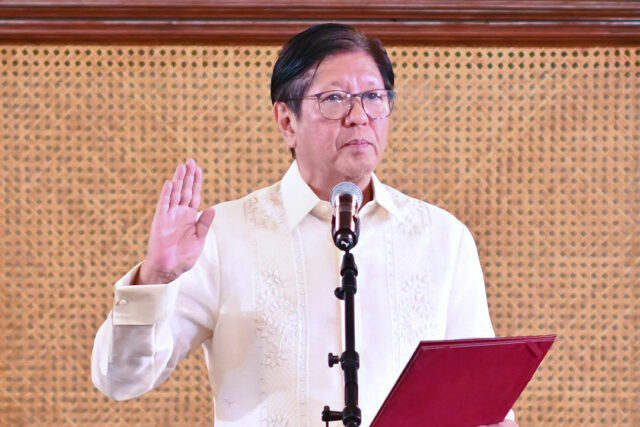
President Ferdinand R. Marcos, Jr. administered the oath of office to newly promoted generals and flag officers of the Armed Forces of the Philippines in Malacañan Palace, Oct. 1. — REVOLI CORTEZ/PPA POOL

PHILIPPINE PRESIDENT Ferdinand R. Marcos, Jr. on Wednesday urged newly promoted generals and flag officers of the Armed Forces of the Philippines (AFP) to bolster the country’s defenses against both internal and external challenges, warning of disinformation campaigns, radicalization, and heightened regional security tensions.

Speaking at a ceremony in Malacañang, he administered the oath of office to 29 newly promoted generals and flag officers, along with 14 newly commissioned second lieutenants and ensigns trained at foreign military academies.

The President said their new ranks carry not just authority but also the “weight of the people’s trust.”

“As we strengthen our external defense, we must always remain vigilant within,” he said, according to a transcript from his office. “Our nation continues to face challenges and pressures aimed at weakening our social foundations.”

He highlighted the AFP’s role beyond combat operations, pointing to recent disaster relief efforts in Masbate and Cebu and the military’s contribution to regional humanitarian missions, including the deployment of nearly 1,000 personnel to Myanmar.

He also cited the Philippines’ expanded participation in joint military drills such as Balikatan, ALON, and the recent Multilateral Maritime Cooperative Activities with the US, Australia, Canada, and India. — Chloe Mari A. Hufana

Marcos not linked to P214-B unprogrammed infrastructure deals, lawmaker says

PRESIDENTIAL COMMUNICATIONS OFFICE

PRESIDENT Ferdinand R. Marcos, Jr. was not involved in the approval of infrastructure projects funded through unprogrammed appropriations over the past two years, a congressman said on Wednesday, following questions raised about the deals earlier in the week.

“The only ones involved in the release of unprogrammed appropriations are the DBM (Department of Budget and Management), the requesting agency and the Bureau of the Treasury,” Bataan Rep. Albert Raymond S. Garcia told the House of Representatives plenary. “The Office of the President has no involvement.”

House Deputy Minority Leader and Party-list Rep. Antonio L. Tinio on Tuesday alleged Mr. Marcos was involved in about 3,700 public works projects worth P214 billion, mostly to regions previously flagged for questionable infrastructure deals.

Mr. Tinio said about P29.4 billion in public works funding was allocated to the Mimaropa region in the past two years, with P25 billion directed to infrastructure projects in central Luzon and P16 billion in the National Capital Region.

“I would like to clarify that these unprogrammed appropriations did not pass by the Office of the President,” Mr. Garcia said in Filipino. — Kenneth Christiane L. Basilio

Duterte Youth cancelation final

PHILSTAR FILE PHOTO

THE Commission on Elections (Comelec) said the cancelation of the Duterte Youth party-list’s registration is final and immediately executory, barring its entry to the 20th Congress.

“The Commission En Banc resolved to deny the Motion for Reconsideration of the Duterte Youth Partylist and affirmed the Resolution of the Commission Second Division in cancelling Duterte Youth’s party-list registration,” the Comelec said in a statement Wednesday.

The Comelec en banc found the party-list’s registration void ab initio, or right from the beginning, due to noncompliance with mandatory publication and hearing requirements, deemed jurisdictional.

It also cited other grounds for cancelation, including untruthful statements in its petition, lack of bona fide intention to represent its sector, and advocacy of violence or unlawful means to achieve its objectives.

Comelec further noted that “it was an adjunct of or an entity funded or assisted by the National Youth Commission,” and that the petition had been filed “to put the election process in mockery or disrepute.”

The commission highlighted procedural irregularities during the 2019 National and Local Elections, including “withdrawal and substitution en masse, as well as the back-and-forth switching of nominees,” which it said “undermine the spirit and intent of the party-list system and puts a mockery in the election process.”

The Davao-based organization garnered more than 2 million votes in this year’s midterm elections, placing second among party-list contenders, with Comelec now tasked to decide which party-lists will benefit from the three seats originally assigned to it. — Erika Mae P. Sinaking

DoE, DICT chiefs get CA nod

THE Commission on Appointments (CA) on Wednesday confirmed the appointment of Sharon S. Garin and Henry Rhoel R. Aguda as the secretaries of Energy and Information and Communications Technology.

During her confirmation hearing, Ms. Garin vowed to support the country’s move to lower electricity costs by 2030, through the implementation of renewable and nonrenewable energy projects.

“If we are able to execute all the projects that have been proposed, about 200 renewable and non-renewable, the simulation shows that there will be a decrease of about P2 to P3,” she told lawmakers in her appointment hearing.

Over 13.8 gigawatts of renewable and non-renewable energy projects nationwide are committed to go online in the next five years, data from the Department of Energy showed.

The CA also confirmed the appointment of Mr. Aguda as the secretary of the Department of Information and Communications Technology (DICT).

The DICT chief said that he will ensure every Filipinos access to information and communications technology and the internet.

“I need the legislative body so that laws will be enacted to enhance the visions and goals of the DICT,” he added. — Adrian H. Halili

MySSS Card launched

SSS FACEBOOK PAGE

THE SOCIAL Security System (SSS) has launched the MySSS Card, giving members a digital banking tool and replacing the Unified Multi-Purpose Identification (UMID) card.

“Once members apply for the MySSS Card, we will link their partner bank savings accounts to SSS for benefits, loans, and other proceeds. They no longer need to enroll the MySSS Card in the Disbursement Account Enrollment Module (DAEM),” SSS President and Chief Executive Officer Robert Joseph M. de Claro said in a statement on Wednesday.

MySSS Card acts as an official ID and operates as a fully functional debit card linked to a savings account.

It is also equipped with an EMV (Europay, MasterCard, and Visa) chip and is integrated with the Philippine Identification System (PhilSys) eVerify and features biometric authentication for security.

Through the card, members can access benefits, loans, and pensions conveniently. They can also use it for shopping, public transport fares, and online purchases.

The card will be issued starting October exclusively through SSS partner banks.

Issuance will start with Rizal Commercial Banking Corp.’s (RCBC) digital arm DiskarTech and will later include other banks such as Asia United Bank (AUB), China Bank, and Union Bank of the Philippines.

“The SSS and RCBC partnership marks a significant milestone in the digital transformation of government services,” Mr. de Claro said. “The MySSS Card’s rollout will expand as more partner banks join the program. This will provide more options for card issuance and banking features.”

To be eligible for a MySSS Card, SSS members, pensioners, individual claimants, beneficiaries, and representative payees must have a permanent SS number, have an active account on the My.SSS Portal with updated personal details, including local address, mobile number, and e-mail; and be registered with the Philippine Statistics Authority under the National ID system.

After online verification and identity confirmation, members open a bank account either using their online app or by visiting a branch.

Metro Manila residents will receive their cards within 15 working days, while those outside Metro Manila will receive theirs within 20 working days. — Aaron Michael C. Sy

Teduray tribe leader killed in BARMM

COTABATO CITY Gunmen beheaded a Teduray chieftain in another attack in a state-recognized non-Moro tribal domain in Datu Hoffer, Maguindanao del Sur on Tuesday afternoon.

Teduray representatives to the 80-seat Bangsamoro parliament and officials of the Police Regional Office-Bangsamoro Autonomous Region told reporters on Wednesday, that Ramon S. Lupos, a timuay, or chieftain, was going to harvest bananas in his farm in Sitio Kulab in Barangay Limpongo when gunmen flagged him down, hit him with pieces of wood in the head before one of them cut his neck with a machete.

Citing reports by his subordinate-officers in Maguindanao del Sur, Brig. Gen. Jaysen C. De Guzman, director of the Police Regional Office-Bangsamoro Autonomous Region (PRO-BAR), said the armed men behind the atrocity immediately escaped, now subject of an extensive manhunt.

Mr. Lupos was the 87th Teduray tribal leader killed brutally in Maguindanao del Sur since 2019, all unsolved.

A Teduray member of the Bangsamoro parliament, Froilyn T. Mendoza, and tribal leaders in two towns where they have bastions, Upi in Maguindanao del Norte and South Upi in Maguindanao del Sur, have urged the Maguindanao del Sur Provincial Police Office and PRO-BAR to exhaust all means of identifying the assailants of Mr. Lupos for prosecution.

He was the second tribal leader in Datu Hoffer killed and decapitated by gunmen within just 11 months. Three others were killed in gun attacks in different areas in the municipality in the past three years. — John Felix M. Unson

ERC to expedite applications considered ‘critical’

THE Energy Regulatory Commission (ERC) said it will identify pending applications that it deems critical and subject them to expedited approval processes.

“We will do everything we can to accelerate the resolution of applications filed before the ERC. Streamlining our processes is key to fulfilling our commitment to a more responsive and revitalized ERC,” ERC Chairman and Chief Executive Officer Francis Saturnino C. Juan said in a statement on Wednesday.

In a three-page resolution promulgated on Sept. 29, the ERC said it will resort to summary proceedings for critical applications instead of making them go through the regular process.

The summary proceedings apply to applications seeking authority to develop and own or operate dedicated point-to-point limited transmission facilities, capex project proposals, and confirmation of over/under recoveries.

The critical category also includes power supply agreements, issuance of certificates of public convenience and necessity, and business separation and unbundling plans.

The ERC noted, however, that summary proceedings will only apply in situations when applications require no intervenors or are not being contested. When there are intervenors, parties involved must agree to submit to summary proceedings.

Summary proceedings are authorized by the ERC’s Revised Rules of Practice and Procedures. — Sheldeen Joy Talavera

Voluntary tuition scheme for financially capable SUC students questioned

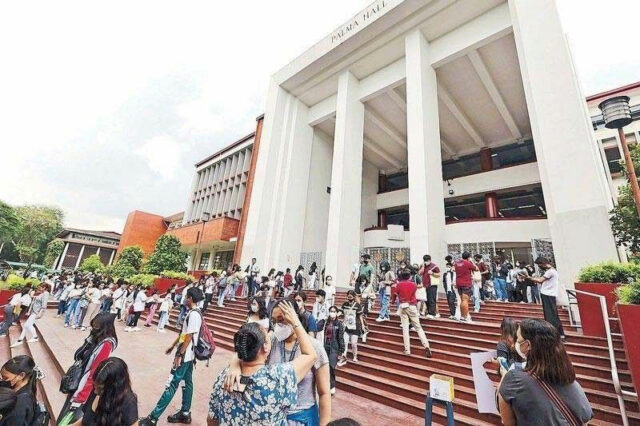
SENIOR HIGH School graduates preparing to take the UPCAT at the University of the Philippines in Diliman, Quezon City. — PHILIPPINE STAR/MICHAEL VARCAS

By Almira Louise S. Martinez, Reporter

THE practicality of allowing financially capable students of State Universities and Colleges (SUCs) to pay tuition voluntarily is under scrutiny after the University of the Philippines (UP) reported that 10% or less of its students made such payments.

UP President Angelo A. Jimenez noted that in 2024, the university recorded that 10% of its students paid tuition in the first semester and 9% paid in the second semester.

“Very few opted out (of the free SUC tuition scheme) although they are qualified. Many of these are those who exceeded (the duration of their program), or are taking their second degree. There are limits,” he said at a Senate budget hearing.

Mr. Jimenez’s income breakdown for families of UP students was about 50% earning P500,000 a year, with the families of 10% earning more than P1 million. Those with no income records account for 10%.

SUCs offer free tuition under Republic Act 10931 or the Universal Access to Quality Tertiary Education Act. Section 4 of the law requires SUCs, including those backed by local governments, to develop a “mechanism” that enables the financially capable to “voluntarily opt out of the tuition and other school fees subsidy or make a contribution to the school.”

Senator Paolo Benigno A. Aquino IV, one of RA 10931’s authors, said at the hearing on Sept. 27 that he expects UP to take the lead on voluntary payments, because “many students enrolled are financially capable,” and that the premier state university “must be the first to implement an opt-out program.”

“If you drive or have a driver going to UP or Batangas State University, maybe (such students) can opt out,” he said. “The social pressure should be that if you can afford the tuition fee, you should pay it.”

The opt-out “was created for that small set of students who are well-off who are in SUCs, but it should always be voluntary,” he added. “It was not meant to create another set of students who will pay. That’s not the intention of the opt-out provision.”

Youth and student organizations rejected the premise of the opt-out, taking the position that the government must fund public education.

According to Kabataan Party-list, the government can raise “more than enough funds for free, accessible and quality education” if it makes it a priority.

“The government should not be choosing who to give services to,” Kabataan Party-list Rep. Renee Louise M. Co said on Facebook statement. “The government should not pass up its responsibility of ensuring that students and families have access to education.”

“And students should also not have to prove that they are poorer than others to enjoy free education,” she added.

The Student Council Alliance of the Philippines (SCAP) called the implementation of opt-out scheme “problematic.”

“In several SUCs and LUCs, students are pressured to pay tuition before they can enroll, reducing what should be a voluntary option into a coercive practice,” it said.

“This undermines the spirit of the law and risks opening the door back to systems where access to education depends on one’s capacity to pay or endure bureaucratic hurdles,” it added.

Among the private schools, Karel S. San Juan, president of Ateneo de Davao University, said the opt-out can be used to redirect funds to support poor students.

“If the student can fund his or her education, why not use the resources set aside for that student to a poorer student,” Mr. San Juan told BusinessWorld.

“That seems to be an idea worth exploring to make the distribution of educational resources more equitable,” he added.


60-day freeze ordered on Cebu prices after quake

THE Archdiocesan Shrine of Santa Rosa de Lima in Daanbantayan, Cebu sustained heavy damage from the Sept. 30 quake. — ARCHDIOCESAN SHRINE OF SANTA ROSA DE LIMA FACEBOOK PAGE

THE Department of Trade and Industry (DTI) said it imposed a 60-day price freeze on basic necessities in Cebu following the magnitude 6.9 earthquake on Tuesday.

Trade Secretary Ma. Cristina A. Roque said the DTI is focused on ensuring the affordability and steady supply of essential goods.

“We recognized the heavy toll this disaster has taken on families. Beyond enforcing the price freeze, our priority is to ensure that prices and supplies are affordable and stable,” she said in a statement on Wednesday.

“The DTI will be vigilant in (protecting) consumers from undue price increase,” she added.

The price freeze automatically took effect after the declaration of a state of calamity in the province.

In a separate statement, the Department of Tourism (DoT) advised tourists to verify the state of their destinations before traveling.

“Several tourist sites in affected areas may be closed while safety inspections are ongoing,” the DoT said on Wednesday.

“The department, through its regional offices, is working closely with concerned agencies and local government units to assess the safety of access roads and bridges, as well as the condition of affected tourism establishments and workers,” it added.

In a separate Facebook post, Tourism Secretary Ma. Esperanza Christina G. Frasco said she has directed TIEZA to deploy inspectors to assess the damage to heritage churches and key establishments in Cebu.

“These assessments will guide the next steps to ensure safety and provide appropriate support,” she added. — Justine Irish D. Tabile

PHL international investment position net liability widens 9.8%

Bangko Sentral ng Pilipinas main office in Manila — BW FILE PHOTO

THE Philippines’ international investment position (IIP) came in at a net liability position of $68.3 billion at the end of June, up 9.8% from a quarter earlier, the Bangko Sentral ng Pilipinas (BSP) said.

Year on year, the net liability widened 44.1% to $47.4 billion.

“This increase was driven by inward foreign investments outpacing the country’s own investments abroad,” the central bank said in a statement.

The IIP is a gauge of the economy’s external exposure. The net position refers to the difference between assets and liabilities and represents either a net claim on or a net liability to the rest of the world.

External financial liabilities rose 2.7% quarter on quarter to $325.2 billion and by 11.8% from a year earlier.

Foreign direct investment rose 3.1% from a quarter earlier to $134.2 billion at the end of June, the BSP said.

“Nonresidents’ net investments in equity capital expanded 3.5% to $62 billion largely due to valuation adjustments from a broad decline of the dollar. Additionally, nonresidents’ net investments in debt instruments issued by residents increased 2.7% to $72.1 billion,” it added.

Foreign portfolio investment (FPI) rose 4.2% from a quarter earlier to $94.7 billion at the end of June.

Outstanding external financial assets rose 0.9% quarter on quarter to $256.9 billion and expanded 5.5% from a year earlier.

“The country’s external financial holdings rose by 0.9%, led by a 15.7% increase in loans extended by domestic banks to nonresidents, reaching $13.2 billion. Residents’ equity capital investments in their foreign affiliates likewise grew by 4.6% to $34.1 billion,” the BSP said.

The central bank held external financial assets worth $111.2 billion or 43.3% of the total, while the “other” category held $105.5 billion (41.1%) and banks $40.2 billion (15.7%). — Katherine K. Chan

Bargain hunting lifts PSEi back to 6,000 level

BW FILE PHOTO

PHILIPPINE SHARES rebounded on Wednesday as investors took advantage of lower prices following the market’s seven-day losing run.

The Philippine Stock Exchange index (PSEi) jumped by 1.21% or 72.57 points to close at 6,026.03, while the broader all shares index rose by 0.93% or 33.83 points to end at 3,654.62.

“The PSEi climbed back above the 6,000 mark, breaking its red streak as bargain hunters drove today’s trading session. Investors seized the opportunity to accumulate stocks at cheaper levels after the sharp declines over the past week.” Regina Capital Development Corp. Head of Sales Luis A. Limlingan said in a Viber message.

“The index reclaimed the 6,000 level, with bargain hunting fueling a rebound after seven consecutive days of decline,” AP Securities, Inc. said in a note.

The PSEi hit multi-month lows in the last few sessions as worries over domestic corruption issues and a lack of strong trading drivers caused sentiment to weaken.

“The market still needs stronger catalysts for a sustainable reversal of the prevailing downtrend,” Mr. Limlingan said.

He added that gains on Wall Street overnight also supported market sentiment.

“US equities finished the quarter on a solid note, with the S&P 500 and Nasdaq Composite advancing on the back of renewed interest in technology heavyweights. Investors focused on corporate momentum and the potential for future monetary easing.”

However, on Wednesday, Wall Street futures fell, gold struck a record high and the dollar eased as the US government shut down much of its operations, possibly delaying the release of crucial jobs data that could muddy the interest rate outlook, Reuters reported.

With no clear path out of the impasse over a funding deal, agencies warned the government shutdown would halt the release of a closely watched September employment report and lead to the furlough of 750,000 federal workers at a daily cost of $400 million.

Both S&P 500 futures and Nasdaq futures dropped 0.5% on Wednesday.

Back home, all sectoral indices closed in the green on Wednesday. Mining & oil jumped by 3.18% or 409.17 points to 13,246.67; services surged by 1.91% or 41.25 points to 2,193.64; industrials rose by 1.19% or 104.65 points to 8,882.30; property increased by 1.08% or 24.60 points to 2,302.79; financials climbed by 0.93% or 19.23 points to 2,072.77; and holding firms went up by 0.6% or 29.72 points to 4,910.45.

Value turnover went down to P6.8 billion on Wednesday with 2.46 billion shares traded from Tuesday’s P9.09 billion with 1.57 billion shares changing hands.

Market breadth was positive as advancers outnumbered decliners, 99 to 87, while 50 names closed unchanged.

Net foreign selling went down to P1.03 billion on Wednesday from P2.01 billion on Tuesday. — Alexandria Grace C. Magno with Reuters

Chip industry council unveils five-year workforce dev’t plan

REUTERS

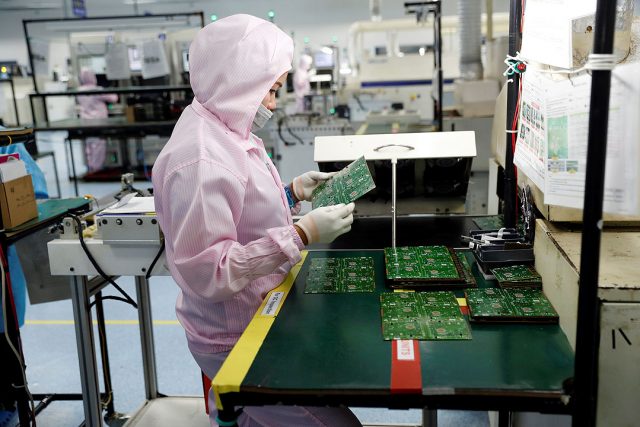
THE Semiconductor and Electronics Industry Advisory Council (SEIAC) said its five-year workforce development plan is intended to improve the school-to-industry pipeline.

Undersecretary Angel Ignacio of the Office of the Special Assistant to the President for Investment and Economic Affairs  said in a statement: “Investing in our people is the most critical component of building a resilient and globally competitive semiconductor industry.”

She added that the council’s long-term goal is to develop homegrown talent and encourage Filipinos to pursue careers in the country.

The workforce development plan features flexible learning pathways, including ladderized programs and micro-credentials, to nurture technical skills that meet global industry standards.

During its second meeting, the council also discussed initiatives to enhance the investment climate.

SEAIC proposed the development of strategic economic zones to follow a pilot site in Clark, as well as infrastructure audits to identify gaps in power, water, and logistics.

“The pilot project at New Clark City is expected to provide key insights for a nationwide rollout,” the council said.

It also reviewed efforts to streamline regulations, promote ease of doing business, and showcase the semiconductor industry to the global market.

The council will lead the Philippine delegation to SEMICON Europa 2025, where it will seek to “reduce reliance on traditional markets” and tap “Europe’s growing demand for alternative suppliers amid geopolitical shifts.”

“SEAIC aims to ensure alignment of all participating government agencies in their efforts to position the Philippines as a competitive hub for semiconductor and electronics manufacturing and innovation,” it added. — Justine Irish D. Tabile