Home Blog Page 3539

Global Ferronickel Holdings’ net income down 19.6%

GLOBAL Ferronickel Holdings, Inc. (FNI) registered an attributable net income of P1.5 billion for 2023, down 19.6%, the listed nickel ore producer said on Monday.

“Without the one-off impact in 2022, net income attributable to shareholders grew 3.9% and EPS (earnings per share) rose 5.8%,” FNI said in a statement.

The company’s consolidated net income declined by 15.9% to P1.8 billion in 2023 “due to the high base from last year that included a one-off gain.”

FNI’s revenues grew by 30.5% to P8.8 billion, driven by higher volume from full-year operations and medium-grade ores from the Palawan mine, which started commercial shipments in September 2022 and became a subsidiary in December 2022.

The strong performance from the Palawan mine offset the lower volumes at the Surigao mine, which FNI attributed to the weather, as well as weaker prices for low-grade ores amid expanded output from mines in Indonesia.

“Our revenues highlight our success in operating the Palawan mine reliably in its first full year of production. This diversification helps improve our cash flows and better positions us to take advantage of opportunities for short- and long-term growth,” FNI President Dante R. Bravo said.

During the period, the total sold volume reached 4.72 million wet metric tons (WMT), of which 3.3 million WMT were from Surigao and 1.42 million WMT were from Palawan.

FNI said that its sales mix went down to 64% for low-grade and 32% for medium-grade versus the 76% low-grade and 24% medium-grade in 2022.

“The average realized nickel ore price was US$33.28/WMT, rising 5.1% on a favorable mix combined with stronger prices for medium-grade ores, which were 11.6% higher than last year,” the company said.

The company’s cost of sales went up by 52.5% to P3.6 billion, driven by the “greater” contract hire and personnel costs following the increase in sales volume from the opening of the Palawan mine.

On Monday, shares of the company went up by P0.02 or 1.14% to close at P1.77 each. — Sheldeen Joy Talavera

Office sector recovery slower this year — Prime Philippines

LYCS ARCHITECTURE-UNSPLASH

THE OFFICE SPACE sector is expected to experience a slower rate of improvement this year, real estate consultancy firm Prime Philippines said.

“What we are seeing is that by 2024, this [trend] would continue to improve slightly as there are new supplies [entering] the market, possibly reaching around 80% to 85%,” Prime Philippines Chief Executive Officer and Founder Jettson “Jet” Yu said at a briefing last week.

The Bay area’s recovery is slow, facing significant challenges primarily due to the removal of Philippine Offshore Gaming Operators, he added.

In 2023, Bonifacio Global City had the highest occupancy rates at 89%, followed by Ortigas central business district (CBD) at 85%. A net take-up of 12.6 million square meters (sq.m.) was recorded by the end of the year.

According to Prime, major projects by 2024-2025, such as One Vertis Plaza in Quezon City, Cyberpark 3 in Araneta City, 378 Filinvest in Makati CBD, and others, will increase the office supply of Metro Manila to 13 million sq.m.

It also anticipates a gradual uptick in demand this year and potentially reverting to pre-pandemic numbers from 2018 to 2020, then reaching the same level by the year 2026.

In 2023, Metro Manila office supply went up by 3.3% to 12.6 million sq.m.

It said premium-grade buildings grew 9% year on year.

Prime expects the information technology and business process management industry to grow by 7% this year, from an 8% growth to $35.4 billion in revenue, according to IT and Business Process Association of the Philippines President Jack Madrid.

He said that an additional 130,000 jobs may be generated in 2024, up from the 1.7 million jobs achieved in the previous year.

Prime also saw an increase in rental rates, buoyed by higher pickups in CBD areas.

In line with this, Prime anticipates a flight-to-quality phenomenon due to the expanded supply and the diverse selection of premium-grade properties.

Mr. Yu also noted the emergence of the walk-from-home trend, suggesting a demand for walkable offices in key cities such as Iloilo, Bacolod, Davao, and Pampanga.

“In the US, for the past three to four years, there has been a growing realization among companies about the advantages of nearshoring. These countries are typically in South America,” he said.

He cited key advantages, such as much of the population in the US being Latin American and already having the preferred accent and a closer language.

However, Mr. Yu said that American clients are convinced it will take time before Mexico and the Dominican Republic catch up to the level of “prime” services offered by the Philippines. — Aubrey Rose A. Inosante

The Philippines and India: A natural and essential security partnership in a turbulent Indo-Pacific

FREEPIK

FROM March 23 to 27, Indian External Affairs Minister, Dr. S. Jaishankar, will embark on a three-country visit to the Southeast Asian region upon the invitation of his counterparts in Singapore, the Philippines, and Malaysia. Accordingly, Mr. Jaishankar’s visit to Manila merits an independent evaluation given the positive momentum surrounding the strengthening bilateral partnership. Moreover, this will be his second visit to the Southeast Asian country since his first trip in 2022.

The Philippine-India partnership is today emerging as one of the most notable elements in contemporary Indo-Pacific geopolitics. While relations between Manila and New Delhi remained friendly since the end of the Cold War, it was only eight years ago when both sides sought to take their partnership forward, particularly in defense and maritime security. This was catalyzed by the convergence between New Delhi’s desire to proactively engage in Southeast Asia as a reliable security partner and Manila’s willingness to diversify its defense partnerships beyond its traditional networks.

Consequently, since this period, a series of significant developments have taken place at an unprecedented pace — from regular high-level visits from both sides and the sale of the BrahMos supersonic cruise missiles to increasing the frequency of maritime exercises and institutionalizing maritime security cooperation with a long-term vision. While observers wonder how the Philippine-India partnership was able to achieve significant milestones in such a short period, it is important to note how, since the turn of the century, both countries were already like-minded in their desire to secure the established order and engage based on international law as responsible and democratic stakeholders of the region. However, the most critical impediment then was the lack of awareness about one another. Such a lack of awareness is now being replaced by mutual understanding and respect.

Under the current administration of President Ferdinand Marcos, Jr., the Philippines is firmly prioritizing the security of its sovereignty and sovereign rights based on international law. The passing of the Maritime Zones Act in February and the recently adopted Comprehensive Archipelagic Defense Concept aim to not only allow the Philippines to govern its seas based on international law more efficiently, but also to improve its capabilities in protecting and securing its entire territory and Exclusive Economic Zone. From a foreign policy angle, Manila seeks to deepen and broaden its security ties with like-minded traditional and non-traditional partners to keep the West Philippine Sea open and rules-based, while improving its maritime security and deterrence capabilities amidst an increasingly belligerent China with expansionist ambitions. As the fifth largest economy that is poised to become the third in less than seven years, India, under the leadership of Prime Minister Narendra Modi, has become more willing and confident in translating its growing material capabilities into more robust and proactive policies of external engagement throughout the entire Indo-Pacific. This stark contrast to New Delhi’s traditional foreign policy preoccupation in its immediate neighborhood stems from the realization that the security dynamics of the Indian Ocean and the Western Pacific are becoming increasingly interdependent. Moreover, by establishing the Act East Policy in 2014, New Delhi has illustrated its commitment to positioning itself as a reliable security provider in Southeast Asia amidst the polarizing dynamics of the United States-China competition. In fact, since 2014, India has become more vocal in keeping the greater South China Sea open, inclusive, free, and based on international law.

In this context, New Delhi’s growing support for Manila in the West Philippine Sea can be seen. It was in 2015 when New Delhi first used the term “West Philippine Sea” to indicate its recognition of Manila’s legitimate claims. At the 15th East Asia Summit in November 2020, Mr. Jaishankar stated how “Chinese actions and incidents in the South China Sea had eroded trust in the ongoing negotiations on the proposed code of conduct in the region.” Furthermore, during Philippine Foreign Affairs Minister Enrique Manalo’s visit to New Delhi in July 2023, both ministers emphasized the need to adhere to the 2016 Arbitral Ruling, which nullified China’s expansionist interests in the West Philippine Sea. Moreover, the foreign ministers also agreed to deepen the scope of their maritime security partnership.

As an illustration of both sides’ commitment to follow through with this roadmap, a Memorandum of Understanding was signed between the Indian and Philippine Coast Guards in August 2023 to institutionalize a more active maritime domain awareness and intelligence-sharing cooperative framework in the tumultuous waters of the region. Moreover, in December 2023, Indian Ambassador to the Philippines Shambhu Kumaran also noted that India is seeking to increase its maritime security activities with the Philippines regarding ship visits and exercises. Furthermore, at the Indian Embassy-led defense industry seminar in Makati City in February, Mr. Kumaran once again reiterated India’s willingness to build the Philippines’ defense capabilities by not only providing soft loans but also going beyond the buyer-seller framework by sharing best practices to support the Southeast Asian country’s self-reliance interests. Additionally, with Filipinos comprising the largest percentage of seafarers globally, the unfolding instability in the Red Sea provides another important area of cooperation between the Philippines and India, giving the Indian Navy a potent role as the first responder to any security issue in the Indian Ocean. For instance, in January, the Indian Navy thwarted a hijacking attempt on a merchant vessel in the Arabian Sea carrying six Filipino crewmembers.

Therefore, the quest to continuously deepen and broaden the already strengthening Philippines-India security partnership is a natural and necessary process for both countries during great geopolitical turbulence in the region. As a fellow democracy and rising great power with no narrowly driven ambitions in Southeast Asia, India is an undeniable element in Manila’s contemporary strategic calculations, especially since New Delhi maintains robust ties with other vital Philippine partners like Washington, Tokyo, and Canberra. While India’s influence in Southeast Asia may not yet be up to par with the US, China, or Japan, it is increasingly becoming a partner of choice among several Southeast Asian countries that seek to diversify their options without compromising their political autonomy and national interests.


Don McLain Gill is a Philippines-based geopolitical analyst, author, and lecturer at the Department of International Studies, De La Salle University.

Squid Game actor O Yeong-su gets suspended sentence in sexual harassment case

O YEONG-SU in a scene from Squid Game. — IMDB

SEOUL — South Korean actor O Yeong-su, who starred in the first season of the hit Netflix series Squid Game, was convicted on Friday on charges of sexual harassment and handed a suspended prison sentence, a court official said.

The Seongnam branch of the Suwon District Court sentenced Mr. O to eight months in prison, suspended for two years, as well as 40 hours of attendance at a sexual violence treatment program, the court official said by telephone.

The 79-year-old actor, who was charged with two counts of sexual harassment in 2017, had denied the accusations.

As he was leaving the court, Mr. O told reporters he planned to appeal against the decision. He has seven days to appeal or the ruling will be upheld.

Mr. O was indicted in 2022 and prosecutors had previously sought a sentence of one year in prison, according to media reports.

Womenlink, a women’s rights group in South Korea, welcomed the ruling and urged Mr. O to apologize to the victim.

“The defendant resembles other offenders of sexual violence in theater in the past who tried to cover up their sexual violence as ‘favor’ and ‘friendship’,’ the group said in a post on X.

Mr. O won best supporting actor in television at the Golden Globes for his role in Squid Game in 2022, becoming the first South Korean to receive the award.

He played the elderly character Oh II-nam, one of the main antagonists of the first season.

The controversy over the accusations of sexual harassment saw him dropping out of an upcoming film in South Korea. — Reuters

CIAC secures grant from USAID for its mega food hub 

THE Clark International Airport Corp. (CIAC) has secured a grant from the United States Agency for International Development (USAID) through the University of the Philippines for the establishment of its 64-hectare Clark National Mega Food Hub within Clark Airport Complex.

“The project’s success will no doubt increase overall agricultural productivity, revitalize our country’s exports sector, and boost the operations of the Clark airport,” Arrey A. Perez, president of the CIAC, said in a media release on Monday.

CIAC said it has forged a memorandum of understanding with the University of the Philippines Public Administration Research and Extension Services Foundation (UPPAF) for technical assistance and advice in CIAC’s 64-hectare Clark mega food hub.

The UPPAF has earlier secured a grant from the USAID for its regulatory reform support program for national development which it described as a policy regulatory reform program in the country.

The mega food hub project is valued at $152 million and is expected to be completed in 2028 via a public-private partnership or through a joint venture.

“The MoU is our initial move… to boost agriculture production, increase post-harvest facilities, improve the food logistical chain which the mega food hub in Clark will soon provide,” Mr. Perez said.

The project is one of the flagship projects being undertaken by CIAC. The mega food hub project is said to provide a “comprehensive range of services” like food warehousing, cold storage, processing, marketing and trading for local and international markets. — Ashley Erika O. Jose

Zed Philippines looks to launch first credit card

ZED PHILIPPINES, Inc. is aiming to roll out its credit card to the first cardholders on its waitlist in the next few months.

“Zed is the next-generation credit card designed to empower young professionals in the Philippines,” Zed co-founder Danielle Cojuangco Abraham said at a media roundtable on Monday.

“We believe that young Filipinos deserve not only better access to credit, but a better experience around credit,” she added.

The tech start-up currently has almost 25,000 applicants on its waitlist. However, the release will be on a controlled basis to “ensure the best customer experience,” it said.

“We’re not trying to flood the market really quickly and not be able to ensure that everybody is having the same level of experience. So in the next few months, you’ll start to see the first few cardholders from the waitlist,” Zed co-founder Steve Abraham said.

A private beta of around under 100 cardholders is also currently ongoing, according to Zed.

Zed is a MasterCard Titanium credit card with no interest, no foreign transaction fees and no annual fees.

“It’s powered by a groundbreaking app that puts unprecedented control into the hands of our customers. Since we don’t have to pay for costly infrastructure like physical bank branches or bloated headcounts, we’re able to pass those savings on to our customers with no revolving interest and no fees,” Mr. Abraham said.

“Zed will be the first locally issued credit card in the market, with no foreign transaction fees. With Zed, they can use their card anywhere globally, enjoy the best available exchange rates, and not have to worry about any hidden fees or charges.”

Zed’s underwriting model is also based on users’ current and future income.

“That not only opens up access to young professionals with high and stable incomes, but it also results in smarter credit limits for these customers, because their credit files don’t accurately reflect their earning power,” Mr. Abraham said.

Another feature of the card is that it allows “unlimited virtual cards.”

“In the Zed app, customers can create additional credit cards, each with its own unique card number, CVV, and expiration date. They can use these cards to transact online or over the phone with merchants, and they never have to worry about their primary card details being exposed,” Mr. Abraham said.

These virtual cards can be set to automatically close after a single purchase of a set amount of time, he added. Spending limits may also be set.

Zed said it is also working on creating a rewards program for its users, as well as other future financing options. — Luisa Maria Jacinta C. Jocson

2 logistics firms sign contracts to locate in Aboitiz’s West Cebu Estate

LOGISTICS firms Prestige Warehousing and Logistics (PWL) and JBY Equipment & Impex Logistics, Inc. have signed contracts with Aboitiz InfraCapital Economic Estate to locate in its West Cebu Estate in Balamban, Cebu.

The West Cebu Estate is a 540-hectare mixed-use development that hosts locators from medium to heavy industries.

“Choosing West Cebu Estate was a strategic decision,” PWL President Merlina Cayanong said in a statement on Monday. “The thriving shipbuilding industry and the escalating demand for industrial spaces perfectly align with our vision.”

She said that by being situated in West Cebu Estate, the company both accesses the market and becomes a crucial support system for manufacturing companies in need of logistics services.

This expansion will cover 2.1 hectares of West Cebu Estate and will be completed by the end of 2024 for road networks and utilities, the company said.

Aboitiz InfraCapital Economic Estates said the construction is nearing its final stages.

Meanwhile, the 3.3-hectare West Cebu Estate central business district, within the 540-hectare PEZA-registered economic estate, is expected to launch in 2025.

This is set to host commercial lots for sale, food outlets, retail shops, essential services, a supermarket, and a transportation hub. — Aubrey Rose A. Inosante

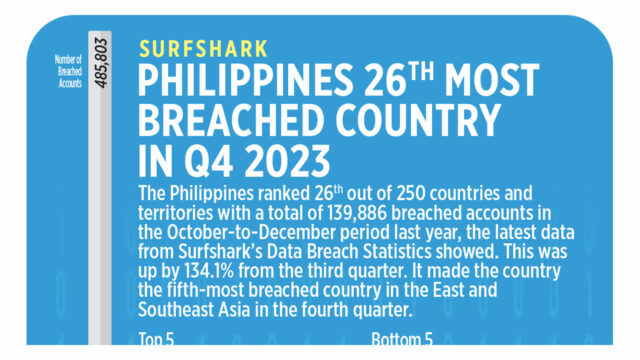
Surfshark: Philippines 26th Most Breached Country in Q4 2023

The Philippines ranked 26th out of 250 countries and territories with a total of 139,886 breached accounts in the October-to-December period last year, the latest data from Surfshark’s Data Breach Statistics showed. This was up by 134.1% from the third quarter. It made the country the fifth-most breached country in the East and Southeast Asia in the fourth quarter.


Surfshark: Philippines 26th Most Breached Country in Q4 2023

How PSEi member stocks performed — March 18, 2024

Here’s a quick glance at how PSEi stocks fared on Monday, March 18, 2024.


House passes CREATE MORE legislation on final reading

PCOO

By Kenneth Christiane L. Basilio

A BILL seeking to amend a law designed to revive the post-pandemic economy was approved on final reading by the House of Representatives on Monday.

The chamber approved House Bill No. 9794 with a vote of 238 legislators for, four against, and two abstentions.

CREATE MORE (CREATE to Maximize Opportunities for Reinvigorating the Economy) cuts the corporate income tax to 20% from 25% previously.

It also provides duty exemptions, value-added tax (VAT) exemptions on imports, and VAT zero-rating of local purchases for domestic-market and export companies.

Commenting on the bill, Jose Enrique A. Africa, executive director of think tank Ibon Foundation, said that repeated tax cuts on corporations reduce the National Government’s revenue.

“Taxes on corporations were equivalent to 3.5% of GDP (gross domestic product) in 2008 but tax cuts have brought this down to just 2.2% as of 2022,” he said.

“If the corporate tax effort had stayed the same, this would mean at least P276 billion more in revenue annually,” he told BusinessWorld in a Viber message. “In contrast, indirect consumption taxes (excise and VAT) increased from the equivalent of 2.5% to 3.6% of GDP over the same period.”

The proposed bill also harmonizes the Corporate Recovery and Tax Incentives for Enterprises (CREATE) Act and its implementing rules and regulations (IRR).

“Conflicting interpretations of the VAT regime under CREATE’s IRR also resulted in the loss of some 125,560 manufacturing jobs,” Albay Rep. Jose Ma. Clemente S. Salceda said in a statement, referring to the impact of the CREATE-IRR disparity.

“Manufacturing is sensitive to increases in cost, being a low-margin operation, so any undue increase in taxes in that sector also means job losses,” Mr. Salceda, who is also a proponent of the bill, added.

Filomeno S. Sta. Ana III, Action for Economic Reform coordinator, said that while “CREATE is a reform most lauded,” the problems surrounding its IRR should have been adjusted instead of being amended as a law.

“It undeniably is facing teething problems but that is a question of making implementation adjustments, not amending the law,” he told BusinessWorld via Viber. “The key reform behind CREATE is the rationalization of fiscal incentives.”

He said that the rigorous economic criteria of CREATE, where “economic benefits for the whole society, not private gains, are the prime consideration for the granting of incentives” is now facing amendment by CREATE MORE.

The proposed law returns the power to grant tax incentives to investment promotion agencies (IPA) such as the Philippine Economic Zone Authority and the Subic Bay Metropolitan Authority. The Fiscal Incentives Review Board (FIRB) will be turned into an oversight body for IPAs, according to the bill.

Mr. Salceda noted that the move to turn FIRB into an oversight body is due to the current FDI approval system “that requires multiple stages of submissions,” delaying their arrival in the country. “While the FIRB has resulted in a more complete analysis of where our tax incentives go, it also has the ability to delay the inflow of FDI by requiring multiple stages of submission.”

Ebb Hinchcliffe, American Chamber of Commerce of the Philippines, Inc. (AmCham) executive director, said in a Viber message: “AmCham welcomes final approval by the House of Representatives of the CREATE MORE bill. We look forward to the Senate deliberating and working on approval of its counterpart version when session resumes at the end of April.”

“We are hopeful that the final bill will be responsive to the needs of investors, especially on provisions related to work from home and the grant of incentives and tax refunds,” he added.

Information technology and business process outsourcing companies will also be allowed to “conduct business under alternative work arrangements,” according to the bill.

The bill also offers corporations a 200% deduction for power costs incurred during the Income Tax Holiday period. Trade fairs, missions, or exhibitions will also be allowed to deduct 100% of their accrued expenses.

“High power costs are an existential threat to Philippine industries, especially in the manufacturing sector,” Mr. Salceda said. “Because we cannot afford to subsidize power costs as our neighbors do, an enhanced deduction for power cost will be more targeted towards those who need competitive power rates to create jobs.”

Aside from the CREATE Act, the measure also seeks to amend the National Internal Revenue Code of 1997 and the Ease of Paying Taxes Act.


Weakening in big global economies a risk to BSP projection for BoP

REUTERS

SLOWER GROWTH in large economies will present downside risks to the central bank’s projection of a narrower current account deficit, analysts said.

“Global economic conditions, such as a slowdown in major economies, could impact Philippine exports and imports, influencing the current account. Fluctuations in oil prices, a major import for the Philippines, can likewise impact the current account,” Security Bank Corp. Chief Economist Robert Dan J. Roces said in a Viber message.

“Finally, overseas Filipino worker (OFW) remittances are a significant source of foreign currency for the Philippines. A sustained rise in remittances could help narrow the current account,” he added.

Last week, the Bangko Sentral ng Pilipinas (BSP) released revised balance of payments (BoP) projections, now seeing the current account deficit narrowing to $6.1 billion this year from an earlier projection of $9.5 billion. 

In 2023, the current account deficit was $11.2 billion, equivalent to 2.6% of gross domestic product, according to preliminary estimates.

Mr. Roces said that a narrower deficit will depend on the magnitude of potential shocks.

“The BSP’s revisions seem reasonable based on the flat electronics export projection, but external factors and potential changes in domestic economic activity can still influence the final outcome,” he added. 

The Philippine Statistics Authority reported that the trade deficit contracted 24% to $4.22 billion in January.

Rizal Commercial Banking Corp. Chief Economist Michael L. Ricafort said an improved BoP position and current account estimates would support the peso.

He said this was due to “continued growth in the structural dollar inflows such as OFW remittances, business process outsourcing (BPO) revenue, and the much faster recovery in foreign tourism receipts.”

The central bank reported that cash remittances coursed through banks increased 2.7% to $2.836 billion in January. However, the growth in cash remittances slowed to 2.7% from 3.8% in December. This represented the slowest pace of remittance growth since the 2.6% posted in September.

“On financial accounts, further improvements in net FDI and net foreign portfolio investment inflows would also support better BoP data and could also provide further support for the peso, as possible Fed and local policy rate cuts starting later in 2024 would support market sentiment and foreign investment inflows,” Mr. Ricafort added.

The peso closed at P55.58 to the dollar on Monday, weakening from its P55.53 finish on Friday, the Bankers Association of the Philippines reported. — Luisa Maria Jacinta C. Jocson

Israel’s Ratio Petroleum tapped for Sulu Sea seismic survey off Palawan

RATIOPETROLEUM.COM

ISRAEL’s Ratio Petroleum Ltd. will conduct a 3D seismic survey in the Sulu Sea east of Palawan within the month, according to the Department of Energy (DoE).

In a statement on Monday, the DoE said Ratio Petroleum, the operator of Petroleum Service Contract (SC) No. 76, has contracted Shearwater GeoServices for the use of its seismic survey vessel SW Thuridur.

The goal is to acquire 3D seismic data over an area in the SC 76 block, located about 150 kilometers east of Puerto Princesa.

The DoE said the seismic survey forms part of Ratio Petroleum’s work commitments for SC 76, and enjoys the support of the Palawan government and other agencies.

The other agencies were named as the Maritime Industry Authority, National Security Council, Philippine Coast Guard, Philippine Ports Authority, Department of National Defense, Department of Environment and Natural Resources, Bureau of Fisheries and Aquatic Resources, Bureau of Customs, Bureau of Immigration, Bureau of Quarantine, and Palawan Council for Sustainable Development.

According to the DoE, the survey will seek to acquire high-resolution imaging of the subsurface geology of the area.

The activity will take around 35 days, covering approximately 1,500 square kilometers.

The Ratio Petroleum aims to “enhance its understanding of the basin’s geological characteristics, gather high-quality geophysical data, identify optimal drilling locations with greater precision, and assess the potential for new oil and gas discoveries in offshore East Palawan,” the DoE said.

Ratio currently holds petroleum interests in Guyana, Atlantic Morocco, and the East Palawan Basin, according to its website.

The Philippines has experienced “a significant gap” in seismic surveys over the past eight years, according to the DoE.

“The DoE is confident that the insights gained from the 3D seismic survey will further de-risk prospects and unlock the hydrocarbon potential of East Palawan Basin,” it said.

In 2018, the DoE awarded SC 76 to Ratio Petroleum through the Philippine Energy Contracting Round. The company is expected to spend around $34.35 million for studies, data gathering, and drilling activity during its seven-year contract period. — Sheldeen Joy Talavera