Home Blog Page 3412

US think tank cites unusual Chinese moves near Palawan before war games

ARMED FORCES OF THE PHILIPPINES

By Kyle Aristophere T. Atienza, Reporter

A US think tank on Sunday said it had spotted unusual movements of Chinese maritime militia vessels in the South China Sea, days before the start of military drills with the United States beyond the Philippines’ 12-nautical mile territorial waters.

Two Chinese maritime militia ships were spotted just 24 nautical miles from the Philippines’ Palawan coastline on April 21, said Raymond M. Powell, director of SeaLight, a maritime transparency project at Stanford University’s Gordian Knot Center for National Security Innovation.

“It’s very hard to say why they chose to do this,” he said in an X message. “It may have been intended to send a message as the Balikatan exercise kicks off, or to probe the Philippines’ responses. It was a very unusual maneuver — nothing I’ve seen them do before.”

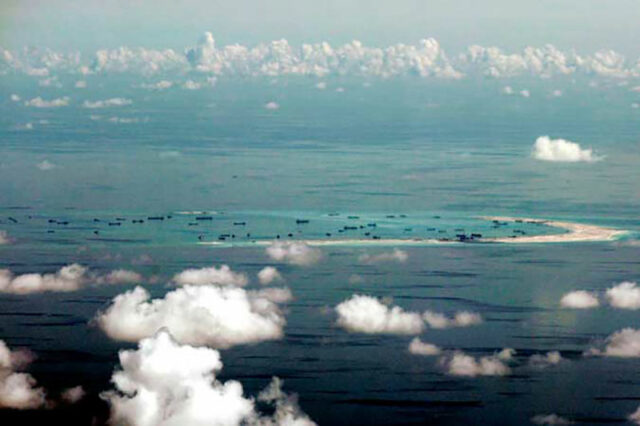
The two large Qiong Sansha Yu ships left China’s military base at Mischief Reef on Saturday, two days before the Philippines and the US hold their annual war games.

The Chinese ships had turned back in the direction of Mischief Reef after loitering outside the Philippines’ contiguous zone, Mr. Powell said.

China last week expressed “grave concern” over the deployment of an American medium-range missile system to the Philippines before the military drills, saying it increases “the risk of misjudgment and miscalculation.”

“China strongly opposes the US deploying medium-range ballistic missiles in the Asia-Pacific and strengthening forward deployment at China’s doorstep to seek unilateral military advantage,” Chinese Foreign Ministry spokesman Lin Jian said.

The joint military drills from April 22 to May 10 would be conducted in northern Luzon due its proximity to Taiwan, which China considers as a renegade province, Balikatan 2024 Executive Agent Colonel Mike Logico had said.

“The purpose of the armed forces — why we exist — is really to prepare for war,” he said on Thursday. “There’s no sugarcoating this. With or without China, let’s say for example in a parallel universe China did not exist, we would still be doing these exercises.”

On Saturday, National Security Council Assistant Director General Jonathan Malaya said the Balikatan drills are not a preparation for war but a means to boost the Philippines’ deterrence capability.

“War is not on the table, let me just make that very clear,” he said. “War is not one of the instruments of national policy of the Philippines. Just because we have Balikatan doesn’t mean we’re going to war. The only way to preserve peace is to have a strong deterrence capability.”

Citizens’ movement P1NAS earlier said the deployment of the missile launchers on Philippine soil was “openly signaling hostile intent against China, giving the US the capability to launch attacks on China’s homeland from our own territory.”

China claims the South China Sea almost in its entirety, including areas that are within the Philippines’ exclusive economic zone (EEZ).

The Philippines in February 2023 launched an assertive maritime transparency campaign that seeks to expose what it calls Chinese aggression within its EEZ in the South China Sea. It was launched with an initial focus on Second Thomas Shoal, where Manila grounded a World War II-ear ship in 1999 to assert its sovereignty.

Manila has accused Chinese coast guard vessels backed by maritime militia ships of dangerous maneuvers including firing water cannons to block Philippine resupply mission to BRP Sierra Madre, the grounded ship.

About 5,000 Filipino soldiers and 11,000 US servicemen will participate in this year’s Balikatan war games. For the first time, it will be held beyond the Philippines’ 12-nautical mile territorial waters, according to the Philippine military.

Fourteen countries will be observing the drills — Brunei, Canada, France, Germany, Great Britain, India, Indonesia, Japan, Malaysia, New Zealand, Republic of Korea, Singapore, Thailand and Vietnam.

“There are so many countries that want to sign visiting forces agreements [with the Philippines],” Mr. Malaya said. “Even New Zealand, which is very far from us, wants to have military exchanges with us to help us strengthen our defenses.”

Bagong Alyansang Makabayan on Sunday said it would hold a protest rally near the presidential palace in Manila on Monday to condemn the war games.

“After two decades of Balikatan, it has done nothing but undermine the country’s sovereignty aside from disrupting the livelihoods of local communities,” Bayan Secretary-General Raymond Palatino said in a Facebook Messenger chat.

Manila lauds G7 rejection of sweeping China claims

PHILSTAR FILE PHOTO

THE PHILIPPINES on Sunday said it shares the Group of Seven (G7) vision of a stable and secure Indo-Pacific region and stands firm against any actions that undermine international security and stability.

“We want to see a South China Sea of peace, stability and prosperity, and the cessation of interference, obstruction and harassment of the Philippines’ legal activities within our recognized maritime entitlements,” the Department of Foreign Affairs (DFA) said in a statement.

“We appreciate the G7’s support in rejecting China’s baseless and expansive claims, and their call for China to cease its illegal activities, particularly its use of coast guard and maritime militia in the South China Sea that engage in dangerous maneuvers and the use of water cannons against Philippine vessels,” it added.

The agency also said it appreciates the G7’s reaffirmation that the 2016 arbitral award is a significant milestone and a useful basis for the peaceful management and resolution of differences at sea.

China has rejected the ruling by the United Nations-backed tribunal in the Hague.

In a communiqué dated April 19 that was released after the group’s Foreign Ministers’ Meeting in Italy, the G7 said it is “seriously concerned” about the situation in the South China Sea and opposed China’s moves in blocking freedom of navigation in the waterway.

The group is composed of Canada, France, Germany, Italy, Japan, the United Kingdom and United States. The European Union is a “nonenumerated member.”

“There is no legal basis for China’s expansive maritime claims in the South China Sea, and we oppose China’s militarization, coercive and intimidation activities in the South China Sea,” the G7 said.

Tensions between the two neighbors have worsened in the past year as China’s coast guard continues to block resupply missions to the shoal, where the Philippines grounded a World War II-era ship in 1999 to assert its sovereignty.

A United Nations-backed tribunal in 2016 said China’s claim to nearly the entire South China Sea has no legal basis, but Beijing has largely ignored the ruling and continued its island-building activities.

The DFA said the Philippines is keen on working with the G7 on efforts to support economic growth in the Philippines and the Indo-Pacific region.

Last week, the agency urged China to reflect on its aggressive actions in the South China Sea, adding that the Philippine decision to boost ties with Japan and the US at a recent summit was a “sovereign choice” for the country.

Earlier this month, Philippine President Ferdinand R. Marcos, Jr. met with US President Joseph R. Biden and Japanese Prime Minister Fumio Kishida in the nations’ first trilateral summit in Washington.

They committed to boost ties in maritime security amid China’s growing assertiveness in the waterway.

The Philippine President earlier said the three-way summit was not directed at anyone and only seeks to boost relations among the three nations. — J.V.D. Ordoñez

Filipino fishermen blame sand mining for declining catch

XAVIER SMET-UNSPLASH

By Chloe Mari A. Hufana

FILIPINO fisherfolk on Sunday decried declining fish catch due to black sand mining in Cagayan province in northern Philippines.

“Due to the large amount of black sand extracted in Aparri, Cagayan, the land has been eroded,” Martin V. Solares, chairman of the Municipal Fisheries and Aquatic Resources Council, told a news briefing. “The fishes are disturbed; they’re no longer entering our nets and their offspring are dying.”

He said fish catch has dwindled to as low as three kilos daily from 300 kilos in 2012. Some of his fellow fishermen have shifted to construction work, he added.

Mr. Solares said the miners left two years ago but there are still remnants of black sand mining in his area that make it difficult for them to go back to normal. About 15,000 fishermen are affected by the mining.

At the briefing, Alyansa Tigil Mina campaign officer Bernie D. Llarin cited reports about a facility being set up in Cagayan for processing black sand for exports.

He told BusinessWorld later by telephone that in San Felipe, Zambales, 17 ships were dredging the river almost daily in March.

Dredging ships partly owned by Chinese companies have navigational systems that run over the fishing nets of the fisherfolk, Mr. Llarin said.

Dredging involves removing sediments and debris from the bottom of the lake, river, harbors and other bodies of water.

“One time in Zambales, we saw fishermen repairing their nets because of damage from the ships,” he said.

Mr. Llarin said the greatest challenge Zambales fisherfolk face is the declining fish catch, just like the fishermen in Cagayan. “Now, it’s hard to catch anything.”

Fisherfolk also have had to fish farther away from shore to avoid excavating ships, which means more gasoline and time.

About 100 houses had been damaged by soil erosion caused by dredging, he added, citing the Zambales Ecological Network.

Mr. Llarin said the provincial and local governments of Zambales have done little for the almost 18,000 fishermen in San Felipe, San Narciso and Botolan in Zambales.

Affected fisherfolk have petitioned the regional office of the Environmental department to stop the river dredging, he added.

Fernando L. Hicap, chairman of Pamalakaya, called for a halt to all reclamation activities, noting that the destruction of the marine ecosystem threatens the country’s food security of the country.

“The impact on the marine ecosystem is irreversible,” he said in a text message. “If this continues, it’s not far-fetched that we’ll be relying on imported fish. In fact, the volume of our imports is increasing every year.”

Gov’t urged to prioritize power grid projects

JUDGEFLORO

By Kenneth Christiane L. Basilio

ADDRESSING weaknesses in the power sector — as exposed by the past week’s red and yellow alerts issued by the National Grid Corporation of the Philippines (NGCP) — must be prioritized by the government, a coalition of energy consumers and stakeholders said over the weekend.

Nic Satur, Jr., chief advocate officer of Partners for Affordable and Reliable Energy, said these incidents must move the government to prioritize the implementation of delayed NGCP grid projects, particularly in areas hit by last week’s power supply problems.

“Red and yellow alerts in the Philippine energy sector indicate critical issues with power supply,” Mr. Satur said in a statement sent to BusinessWorld. “These alerts are crucial indicators of the stability and reliability of the energy infrastructure.”

He was referring to last week’s NGCP alerts in the Luzon and Visayas grids due to thin power supply as operating margins for electricity output were insufficient to meet its regulating requirement.

To mitigate weaknesses in the energy sector, Mr. Satur echoed a previous proposal made by Bienvenido S. Oplas, Jr., president of think tank Minimal Government Thinkers, urging the government to implement delayed NGCP grid projects such as the Visayas Voltage Improvement Project and the Cebu-Lapu-Lapu Transmission Project to improve electricity access in the region.

“Finishing long-delayed NGCP projects will ensure that areas with power deficits can access surplus energy from other regions, stabilizing the grid,” he said.

The NGCP did not immediately respond to a request for comment from BusinessWorld.

The energy advocate stressed that the country have to contend with red and yellow power alerts every summer due to “unscheduled power plant shutdowns, lack of firm ancillary services, (and) overall insufficient power supply significantly worsened by the El Niño phenomenon.”

The reliance of the country on imported energy resources such as fuel and coal exposes the country to “frequent issuance of red and yellow alerts,” he added.

He said accelerating the adoption of nuclear energy into the country’s power generation mix could enhance the grid’s capacity to meet electric consumer demand. “(It is) a stable and reliable energy source that does not depend on external market conditions,” he said.

Mr. Satur also recommended that the government increase the overall power generation to seven to eight terawatt hours (TWh) every year until 2026 and by eight to nine TWh subsequently until 2030, a proposal also raised by Mr. Oplas.

“To combat the recurring energy alerts, there is a pressing need to increase overall power generation,” he said. “This expansion is essential to keep up with the anticipated gross domestic product growth and the increasing energy demands of the population.”

The Energy Regulatory Commission (ERC) should also look to prohibit the use of battery energy storage systems due to their “limitations and unreliability in critical situations,” he said.

Coordinated traffic solutions urged

PHILIPPINE STAR/ RUSSEL PALMA

THE GOVERNMENT should coordinate efforts to ease traffic congestion, especially in the Philippine capital to minimize disruption to businesses, according to the American Chamber of Commerce of the Philippines (AmCham).

“Heavy traffic and uncoordinated traffic policies can definitely be disruptive to the conduct of business. It contributes to higher costs in the movement of goods and negatively affects the well-being of the workforce,” Ebb Hinchliffe, AmCham Philippines executive director, told BusinessWorld in a Viber message on Sunday.

His remarks came on the heels of the Metropolitan Manila Development Authority’s (MMDA) banning of e-bikes, e-tricycles, and other light vehicles on major roads. Three days after its implementation last week, President Ferdinand R. Marcos, Jr. ordered a grace period of one month until May 18 to properly inform those affected before it is implemented.

Mr. Hinchliffe said that while heavy traffic may mean high economic activity, there should be sound policies that mitigate it.

The MMDA said road apprehensions will continue, but no traffic violation tickets will be issued until May 18.

In a phone call with BusinessWorld, British Chamber of Commerce Executive Director and Trustee Christopher James Nelson said there is a waste of productive time spent sitting in Metro Manila traffic.

He voiced out the need for an overall traffic plan, not just for Metro Manila, but for other major cities in the country.

“There are conflicting policy directions between National Government Agencies–especially in the case of DoTr (Department of Transportation), DPWH (Department of Public Works and Highways), and MMDA,” AltMobility PH Director Ira F. Cruz said in a Viber message to BusinessWorld.

He said the DoTr has an Active Transport Office that promotes active transportation in the country. While DPWH has guidelines that “downgrade bike lanes as the lowest level on roads where bike lanes are most needed.”

Mr. Cruz said his group welcomes Mr. Marcos’ order to create a comprehensive plan to mitigate traffic.

“The ban on e-trikes is simply an example of a piece-meal “solution.” What we need now is a comprehensive plan that will start chipping away at the country’s transportation issues,” he added.

He suggested the President tap the DoTr as the leader of this plan and involve non-governmental organizations and transport industry representatives.

MOVING FORWARD
Mr. Hinchliffe said his organization recommends “the promotion of walkability and the use of non-motorized forms of transportation through the provision of pedestrian facilities and networks of greenways and bikeways as well as the implementation of smooth intermodal transport systems.”

While Mr. Nelson said the Philippines is the gateway to Southeast Asia, so the government must invest in infrastructure.

“[Foreign businesspeople’s] first view is the airport, and then obviously it’s [their] transport into [their] hotel or accommodation. So, an improved transportation system would definitely give a better view [of the Philippines],” he added.

He said that an improved transportation system in the Philippines can be more appealing to foreign investors.

“Traffic management and improvements in roads, and forms of public transport or transport is a critical arm, and it will assist economic growth,” he added. — Chloe Mari A. Hufana

Marcos seeks support vs hunger

BW FILE PHOTO

PRESIDENT Ferdinand R. Marcos, Jr. has called on local government units (LGUs) to help his administration enforce a partnership program that seeks to fight hunger by helping local producers.

In Memorandum Circular No. 47, he called for a whole-of-government approach to fight hunger and achieve nutrition security in the Philippines.

He asked all government agencies and local government units to support the implementation of the Enhanced Partnership Against Hunger and Poverty program, one of the Task Force on Zero Hunger’s banner projects.

The program seeks to link community-based groups with markets and provide credit assistance to support food production, processing and distribution.

The task force was first established through an executive order issued by his predecessor and was reorganized last year. — Kyle Aristophere T. Atienza

DoTr eyeing EDSA motorcycle lane

PHILIPPINE STAR/EDD GUMBAN

THE DEPARTMENT of Transportation (DoTr) is studying the dedication of a motorcycle lane along Epifanio de los Santos Avenue (EDSA) to help ease traffic congestion along the major highway.

“We already have a busway and on the right side we have a bicycle lane. We are looking at putting up a motorcycle lane in EDSA, next to the bicycle lane,” Transportation Secretary Jaime J. Bautista said in a media release on Sunday.

The DoTr along with other relevant government agencies, including the Metropolitan Manila Development Authority (MMDA), are now studying the feasibility of the proposal.

Mr. Bautista said the traffic congestion in Metro Manila costs the Philippine economy about P3.5 billion daily, citing a study of Japan International Cooperation Agency (JICA).

He said that the worsening traffic congestion could hurt the country’s economy by about P9 billion daily in 2030.

“This is the economic cost of traffic, the additional fuel, additional cost, lost opportunity for growth,” Mr. Bautista said.

Earlier this month, President Ferdinand R. Marcos, Jr. said the government will fast-track railway projects to address traffic congestion.

Further, the Department of Public Works and Highways (DPWH) outlined its traffic decongestion plan which focuses on the improvement and expansion of the national road network by building additional by-passes, diversion roads, expressways, flyovers, interchanges and underpasses. — Ashley Erika O. Jose

Bantag slips past NBI dragnet

Former Bureau of Corrections chief Gerald Q. Bantag gives a thumbs up sign to the media after attending the preliminary investigation on the murder of broadcast journalist Percy Lapid on December 5, 2022 at the Department of Justice in Manila. — PHILIPPINE STAR/KRIZ JOHN ROSALES

BAGUIO CITY — Despite a well-planned raid of one of one of his hideouts, former Bureau of Corrections (BuCor) chief Gerald Q. Bantag — wanted for allegedly plotting the murder of radio commentator, Percy Lapid (real name: Percival Mabasa) — slipped past the National Bureau of Investigation (NBI) dragnet in this city over the weekend.

Agents led by NBI Assistant Regional Director Daniel D. Daganzo swooped down on the building which serves as the headquarters of the Igorot Warriors International (IWI) in Barangay Mines View but failed to corner Mr. Bantag.

The IWI, which bid for a party-list seat in Congress in 2022, has been monitored for organizing solidarity street demonstrations and gatherings to rally support for Mr. Bantag in this city.

Saturday’s raid was the third attempt to serve the warrant for Mr. Bantag’s arrest, following similar operations to corner him at his houses in Laguna province and Marikina City.

Mr. Bantag has been sending surrender feelers to the government since last year but has not surfaced to fulfill his supposed promise to answer the charges against him. — Artemio A. Dumlao

Peace returns in ‘rido-torn’ village

LEADERS of feuding Moro groups in Barangay Matilac in Pigcawayan, Cotabato listen to representatives of the Army’s 6th Infantry Division explaining the need for them to forge a final peace compact. — PHILIPPINE STAR/JON FELIX M. UNSON

COTABATO CITY — Peace has been restored in the village of Matilac in Pigcawayan, Cotabato, following a concerted effort by military and Muslim leaders last week to convince two armed Moro groups to reposition themselves and halt their armed engagements.

Local officials and the commander of the Army’s 6th Infantry Division, Major Gen. Alex S. Rillera, separately told reporters on Sunday that the “rido” or clan conflict between Tong D. Talusan and Ebrahim L. Piang and their followers has been effectively suspended through their reciprocal agreement to disengage.

Mr. Talusan is a field commander in the 104th Base Command of the Moro Islamic Liberation Front (MILF), while Mr. Piang, alias “Kagui Sabod,” is a leader of the MILF’s 105th Base Command but backed by his relatives from the Moro National Liberation Front (MNLF).

“We are sure of the full restoration of normalcy in Barangay Matilac soon,” Mr. Rillera said as mediation continues to settle squabbles over control of strategic patches of lands in Barangay Matilac and some political differences.

The Cotabato Provincial Peace and Order Council under the administration of Gov. Emmylou Taliño Mendoza, who chairs the Regional Development Council 12, supported the 6th ID’s efforts to resolve the conflict between, said Mr. Rillera. — John Felix M. Unson

House bills limiting substitution of candidates face uphill battle — Kontra Daya

PHILIPPINE STAR/EDD GUMBAN

AMENDING the country’s election law, which allows the substitution of political candidates, will be difficult, election watchdog Kontra Daya said over the weekend.

Introduced last month, House Bill No. 10186 seeks to limit the grounds for candidacy substitution by removing voluntary withdrawal as a valid cause for swapping election candidates.

“Strong laws like these that aim to reform the electoral system have always been unpopular in the Lower House (of Congress), where many take advantage of the rottenness of the political system to maintain power,” Kontra Daya Spokesperson Maded N. Batara III told BusinessWorld in a Viber message over the weekend.

A prominent case of substitution would be then Davao City Mayor Rodrigo R. Duterte’s candidacy in 2016. He replaced Martin Diño as Partido Demokratiko Pilipino’s (PDP) candidate for the presidential elections, which he subsequently won.

Some congressmen see this kind of political move during election season as misleading and deceptive for voters.

“Substitution is being taken advantage (sic), which necessarily results in the deception of the electorate as to the identity of a party’s nominees,” Bulacan Rep. Florida P. Robes said in the bill’s introductory note.

The withdrawal and subsequent substitution of candidates have been abused by certain political parties, Mr. Batara said. “The withdrawal clause has been repeatedly abused… to ‘hold the spot’ for… candidates that have yet to fully commit to running in the elections,” he said.

Getting rid of the withdrawal clause would force political parties to field candidates committed to representing their constituencies instead of personalities known for name recall.

“The abuse of substitution comes from the prevalence of personality politics and a lack of strong political parties in the Philippines, which incentivizes parties to court personalities with ‘star power’ or name recall,” said Mr. Batara.

However, he said there are smaller political parties that “have valid reasons to fully withdraw,” necessitating a candidate substitution. “We must be cautious in removing withdrawal as a reason for substitution altogether and instead add safeguards against political parties that abuse the substitution process,” he said.

There are six House bills seeking to amend the election code allowing for candidacy substitution that remain pending before the House Committee on Suffrage and Electoral Reforms. — Kenneth Christiane L. Basilio

Rower Joanie Delgaco punches a ticket to Paris Olympic Games

ROWER JOANIE DELGACO — FACEBOOK.COM/PHILIPPINEROWINGASSOCIATION

WHEN Joanie Delgaco was starting as a national team member, she used to get awed by the stars of the sport.

But with relentless hard work and iron will, Ms. Delgaco will have a chance to compete against them in the biggest stage that every athlete dream of — the Olympics.

The ecstatic 26-year-old Ms. Delgaco, who yesterday rowed her way straight to this July’s Paris Games after finishing fourth in the Asia Oceania qualification tournament in Chungju, South Korea.

Needing to make the top 5 to punch a ticket to the quadrennial games, Ms. Delgaco responded to the challenge in did just that after she clocked seven minutes and 49.39 seconds in the women’s singles sculls.

Thanks to the effort, she became the first lady rower from the country to compete in the Olympics while joining a few good men who represented in the country in the discipline in the Mt. Everest of all sporting events — Ed Maeirina in 1998 in Seoul, South Korea, Benjie Tolentino in 2000 in Sydney, Australia and Cris Nievarez in three years ago in Tokyo, Japan.

She became the 11th member of that extraordinary team seeking Olympic glory in pole-vaulter EJ Obiena, gymnasts Carlos Yulo, Aleah Finnegan and Levi Jung-Ruivivar, boxers Eumir Marcial, Nesthy Petecio and Aira Villegas and weightlifters Vanessa Sarno, John Ceniza and Elreen Ando.

“This is our story: After 20 years of absence in the Olympics after Benjie Tolentino in 2000, the Philippine Rowing Association has contributed back-to-back Olympians — Cris Nievarez and Joanie Delgaco,” PRA President Pato Gregorio told The STAR.

“Hard work, determination and love for the sport. We can excel in rowing. It is a beautiful sport,” he added after thanking PSC, POC, MVPSF, Smart, Maynilad and MWSS. — Joey Villar

Yulo dominates parallel bars in Qatar World Cup

CARLOS YULO — FACEBOOK.COM/CARLOSEDRIELYULO

IF there are any more doubts over his form after training without a coach for almost a year now, Filipino world champion gymnast Carlos Yulo quashed it with impunity yesterday.

It came with a golden effort in the men’s parallel bars and a silver finish in vault in the FIG Artistic Gymnastics World Cup Series in Doha, Qatar that resonated back home that he is still a force to be reckoned with in the Paris Olympics.

Mr. Yulo was his old magnificent self again in registering a 15.200 and hauling that parallel bars gold ahead of Chinese Taipei’s Hung Yuan-Hsi and Brazilian Caio Souza, who settled for the crumbs with a 14.966 and a 14.566, respectively.

Before that, the diminutive but colossal Leveriza, Manila native claimed the silver in vault where he posted an average of 15.066, which was second only to eventual winner Artur Davtyan of Armenia, who had a 15.166.

It was a pair of efforts that resuscitated collective hopes of Yulo and the country at snaring an Olympic mint, the country’s second if it happens and the first in the sport, in Paris.

The feats were Mr. Yulo’s firsts after he ended up medalless in last year’s World Championships in Antwerp, Belgium.

It was quickly blamed on Mr. Yulo’s parting of ways with his former Japanese mentor Munehiro Kugimiya due to personal reasons.

But thanks to this most recent dominance by Mr. Yulo, all of those fears dissipated and turned it into great expectations of glory in Paris. — Joey Villar

ADVERTISEMENT
ADVERTISEMENT