Home Blog Page 3259

Is having kids bad for the planet?

ROBERT COLLINS-UNSPLASH

IN THE FICTIONAL WORLD of the P.D. James novel Children of Men and its movie adaptation, humanity has lost the ability to reproduce and thus faces certain extinction. We are meant to understand this as a bad thing. But there is a subset of people who would consider it a utopia. To them, Earth is doomed as long as it’s infested with humans.

One such person is a YouTuber named Sam Mitchell, who identifies as an “Eco-Nazi,” an “unapologetic doomer” and an “unrepentant collapsitarian.” In a recent Medium post titled “Why I Am Proud to Be an Eco-Nazi,” he explains that humanity is a plague upon the Earth, that all right-thinking people should therefore sterilize themselves immediately to avoid making more — as Mitchell claims he did when he was 22 — and that “breeders” are “clueless morons.”

Anybody who identifies as a “Nazi” of any sort should struggle to win converts. I probably wouldn’t be writing about this manifesto except for the fact that it was amplified by the much-better-known Twitter account of author and former math professor Eliot Jacobson, which was then re-amplified by the even-better-known Twitter account of Berkeley climate scientist Zeke Hausfather.

And it does get at the anxiety that breeders and the breeder-curious alike feel at a time of chaotic climate change (not to mention wars, pandemics, mass shootings, megalomaniacal leaders, and more): Should we really bring children into this world?

Jacobson’s tweet quoted this line from Mitchell’s post, one of the few that delivers anything like verifiable data: “[A] vegan electric car driver with one child will do a HELLUVALOT more damage to this planet, and cause countless more suffering to his or her fellow Earthlings, than a meat-eating, SUV-driving, jet-setting corporate executive with no children will ever do.”

The climate scientist took issue. “This is utterly untrue (and reprehensible),” Hausfather tweeted, correctly. “It assumes we fail at decarbonizing our economies within our children’s lifetimes. In reality, someone in the UK today emits half the emissions in a year that their grandparents did. In the US we emit about a third less than our parents did.”

It’s actually a little better than that: US per-capita carbon emissions fell 38% between 1973 and 2022 (the latest data available), according to Global Carbon Budget numbers crunched by the website Our World in Data. UK emissions fell about 60% in that time. China made up some of the difference, but the net effect was that global carbon intensity remained roughly flat for 15 years even as the global economy expanded by about 46%.

That is an extraordinary human accomplishment. And our political leaders have promised to do much more by eradicating emissions altogether in another generation. They aren’t on track to achieve that yet. But little humans are growing less polluting and wasteful by the year.

Meanwhile, the hot anxiety these days is not a population bomb but a population bust, with forecasts calling for humanity to peak sometime this century and decline, maybe sharply, thereafter. This makes economists anxious but should be good news for environmentalists.

Of course, people can have plenty of good reasons not to reproduce. And conscientious parents can’t deny fearing the impact their children could have on the planet, or vice versa. Polls and studies have shown climate change is a top factor in the decision not to have children. As my Bloomberg Opinion colleague Lara Williams has written, babies born today could see unimaginable economic and physical destruction in their lifetimes if we don’t get global heating under control.

Climate scientists often gear studies toward finding out how the world will look in 2100, when our environment could be in full boil. That feels unimaginably distant to me, a person born in the 20th century. But if my daughter, who was born in 2013, lives as long as my grandmother, who died at 96, then she will experience every bit of it.

This can seem like a terrifying prospect — except for the fact that my daughter is already far better off than a child born in, say, 1913, when the Spanish Flu, the Great Depression, World Wars I and II, the Holocaust and a Cold War were in store. Or 1313, when the Black Plague was around the corner. Or 513, not long before what historians agree was the worst year to be alive. Or 30,013 BCE, when just turning 30 was an accomplishment.

There has never been a perfect time to be a human baby, in other words. And yet we keep making them. That’s partially down to base stuff like biology and ego, but optimism plays a big role. As a three-time breeder, I am biased. But I would like to think that teaching my children to care for their neighbors and their environment will help them build a better world. And polls consistently show young people are more concerned about the climate than their elders and more likely to take action.

In turn, adults can start improving the world for children right now, as my Bloomberg Opinion colleague Faye Flam has written. Millions are already suffering the effects of climate change, particularly the poor in both developed and developing countries, who unfairly bear the brunt of conditions they didn’t create.

Telling people to simply stop having children is unrealistic at best and inhuman at worst. The best vision for the future treats both people and the planet with care and hope.

BLOOMBERG OPINION

PHRX, AAP hold Kagitingan Rally

Automobile Association Philippines (AAP) and Philippine Rallycross Series (PHRX) officials at the ceremonial flag-off for the Kagitingan Rally of Capas at the Estancia Mall in Pasig City: From left are Kagitingan Rally of Capas Deputy Clerks of Course Mike Reyes and Art Guevarra, PHRX Director Ronnie Trinidad, AAP Motorsport Chairman Mandy Eduque, AAP President Joe Ferreria, PHRX Director Olson Camacho, Kagitingan Rally of Capas Clerk of Course Bebot Reyes, and Kagitingan Rally of Capas Route Chief Sonny Oliveros. — PHOTO FROM PHILIPPINE RALLYCROSS SERIES

THE PHILIPPINE RALLYCROSS Series (PHRX) and the Automobile Association Philippines (AAP) recently held the Kagitingan Rally of Capas, in collaboration with the local government of Capas, Tarlac. The dirt rally featured 11 special stages covering 50 kilometers along the municipality’s inner dirt roads. Including transport stages, the rally’s total distance was 130 kilometers. The event kicked off last April 27 at the Capas Municipal Hall. Before that, a ceremonial flag-off event took place at Estancia Mall of Capitol Commons in Pasig City the week prior — presided over by AAP President Augustus “Joe” Ferreria, AAP Motorsport Committee Chairman Mandy Eduque, and PHRX Directors Olson Camacho and Ronnie Trinidad.

This event not only promoted rally motorsport to the public but also allowed mallgoers to get up close to the rally cars. Additionally, it served as the scrutineering process for all competing rally cars, ensuring they met the safety requirements, including the presence of safety roll cages.

Meanwhile, in another collaboration of the PHRX and AAP, the Jun Espino Memorial Rallycross was organized. This special event, held at the CCP Open Grounds last April 6, coincided with the 2024 edition of the Manila International Auto Show (MIAS), showcasing the vibrancy of rally racing in the country. Reflecting on the event, AAP Motorsport Manager Rikki Dy-Liacco expressed his excitement at the revival of rallycross racing at the familiar CCP Open Grounds.

Mr. Camacho paid tribute to the late Jun Espino, acknowledging his pivotal role in revitalizing rally racing in the Philippines. Mr. Espino, a legendary rally navigator during the ’70s and ’80s, not only excelled in local rallies but also represented the country in international competitions. The Jun Espino Memorial Rallycross, doubling as the fourth round of the PHRX 2024 season, drew 65 entries across various race classes, with a significant turnout of race fans, many of who attended MIAS. Notable figures from the local automotive industry, including AAP’s Mr. Ferreria, Mr. Eduque, and Isuzu Philippines Corp. Assistant Division Head Marketing Robert Carlos, were present to ceremonially flag off the special round.

The Kagitingan Rally of Capas was made possible by the Capas local government, Isuzu Philippines Corp., Autoplus Sports, Ravenol Motor Oils, CleanFuel, Aguila Auto Glass, Method Race Wheels, AC Delco, CDS Offroad Playground, and Arden Botanical Estate.

Grab PHL eyes new locations for delivery service

SUPER app Grab Philippines said it is looking to expand its food delivery service to at least seven new areas in the country within the year.

“I think it is very much one of our biggest strategies moving forward. We already have two cities locked in the following months,” Greg Camacho, Grab Philippines director for deliveries, said on the sidelines of the Grab Next Conference last week. 

Grab Philippines is eyeing to introduce its food delivery service to Laoag City, Ilocos, and Santiago, Isabela, in the next few months, he said. 

The company also plans to expand into five more areas by yearend, Mr. Camacho added.

Currently, the potential areas for its food delivery service expansions are Balanga, Bataan; San Fernando, La Union; Metro Zamboanga, and Butuan. 

He said the company is currently deciding on the right timing for expansion, as the areas being considered are still under study.

“But not just that, we also want to expand our coverage areas in our existing cities,” he said.

The company is planning to bring all its services like GrabMart or its grocery delivery services to all areas where it currently operates, Mr. Camacho said. 

“The plan is hopefully by the end of the year, we want GrabMart to be available in all the cities where we have grab food available. Expanding outside the Metro is a big priority to us,” he said. — Ashley Erika O. Jose

Consumer gulf widens as demand for premium and budget foods grows

REUTERS

LONDON — From Nestlé to Danone, food companies are seeing shoppers that want either premium or cheaper products, with less interest in items in the middle, particularly in developed markets like North America.

The packaged goods industry has for over two years hit shoppers with higher prices, citing higher costs that started with the pandemic and exacerbated by Russia’s invasion of Ukraine.

Everything from sunflower oil to freight has become more expensive, taking a toll on global supply chains and consumers struggling to make ends meet.

Executives have in recent quarters reported that costs are rising at a slower pace, and have eased up on price hikes. In some cases, prices are still rising because companies say they are innovating to create better products that are helping them win over wealthy shoppers.

At the same time, though, they say hard-up shoppers are more focused than ever on bargains, particularly in the US. Nestlé, the world’s biggest packaged food company, on Thursday highlighted growth for pricier varieties of its Purina pet food and Perrier bottled water, as well as for cheaper Maggi noodles.

“Regarding the US, it’s important to keep in mind something that you’ve also heard from other consumer companies and that’s the state of, what I call, the bifurcated consumer,” Nestlé CEO Mark Schneider told journalists on a call to discuss first quarter sales. “We’re seeing significant pressure at the lower income consumer level,” Mr. Schneider said, pointing to consumers in the US still feeling the hit of price increases from the last two years, and the reduction in US Supplemental Nutritional Assistance Program (SNAP) food stamp payments.

“But don’t forget there’s also the thriving premium (shoppers), where I think there are consumers that are very interested in a continuous stream of premium products,” he added.

Other consumer-facing industries, including luxury and fashion, have also seen a trend of affluent shoppers flocking to the most expensive brands while those that are struggling look for low prices, with the mid-market squeezed.

“We see the same development in the luxury goods industry,” Vontobel analyst Jean-Phillipe Bertschy said. “For Nestlé, this is corroborated by the ongoing weakness in the frozen food in the United States.”

Nestlé’s sales volumes in North America — where frozen foods tend to be mid-range products — fell 5.8% in the first quarter, mainly due to a decline in the freezer section. That contributed to the company missing quarterly sales growth estimates.

Nestlé shares were down 3.8% in early trading.

French dairy giant Danone said last week it was winning both cash-strapped and wealthy shoppers, recouping some of the market share it lost to retailers’ private label brands. “The low-price segment in Danone’s categories is growing fast, but the high price segment is also growing fast — but the middle segment is a bit squeezed,” finance chief Juergen Esser said in an interview following a sales update.

Consumers are hunting for value either via price, or quality and innovation, he added.

Unilever, maker of Knorr stock cubes and Hellmann’s condiments, also noted “premiumization” when describing first quarter results for four of its five product categories — including ice cream — in a trading update on Thursday.

Its first-quarter sales rose by a better than expected 4.4% as it also won back shoppers who had traded down to cheaper products, sending its share more than 4% higher. — Reuters

EU hits fast fashion giant Shein with new digital rules

FAST-FASHION firm Shein has been drawn under the scope of flagship European Union (EU) rules designed to clamp down on illegal and harmful content online, aimed at stopping the spread of counterfeit items on the platform.

Shein, which was founded in China but is now headquartered in Singapore, has an average of more than 45 million monthly users in the EU, meeting the threshold to be swept up by the bloc’s Digital Services Act (DSA), the European Commission said on Friday.

The move means Shein could be liable for fines of as much as 6% of global revenue for violating the law, designed to curtail the spread of illegal content online. In practice, it means that the company will have to more carefully monitor the spread of content on its websites, including the sale of counterfeit products.   

“Shein will have to comply with the most stringent rules under the DSA within four months of its notification,” the commission said. This includes “the obligation to adopt specific measures to empower and protect users online, including minors, and duly assess and mitigate any systemic risks stemming from their services.”

Platforms already drawn under the DSA include Alphabet Inc.’s YouTube, Meta Platforms Inc.’s Facebook, and Elon Musk’s X. Other marketplaces like Alibaba Group Holding Ltd.’s AliExpress and Amazon.com Inc.’s platform have also been designated, having met the criteria of having at least 45 million monthly active users in the bloc.

Leonard Lin, Shein’s global head of public affairs, said the company shares “the commission’s ambition to ensure consumers in the EU can shop online with peace of mind, and we are committed to playing our part.”

The DSA also requires online marketplaces to trace the sellers on their platform, add methods for customers to flag illegal content, and randomly test for illegal products.

The EU’s move is the latest attempt from regulators to clamp down on companies with links to China. Under the same rules earlier last week, ByteDance Ltd.’s TikTok was forced to halt a controversial rewards program on its Lite app before EU watchdogs carried out their threat to temporarily ban the feature over fears it could be addictive for children.

As part of a separate legal instrument — the Foreign Subsidies Regulation (FSR) — EU competition watchdogs raided the premises of Chinese security firm, Nuctech, under suspicions that it may have received subsidies that could distort competition on the EU’s prized single market.

Other recent EU probes under the FSR have similarly targeted Chinese firms, involved in clean energy and rail. The deluge of investigations is a reflection of the EU’s increasingly assertive approach to China, threatening restrictive trade measures that could result in tariffs, cutting China off from European markets, and potentially leading to a trade war. — Bloomberg

Sustaining Philippine gains in immunization

FREEPIK

Smallpox, an ancient scourge, is caused by a highly contagious airborne virus. In the 20th century alone, smallpox caused an estimated 300-500 million deaths worldwide. A 10-year vaccination campaign by the World Health Organization (WHO) led to the total eradication of smallpox in 1977, an accomplishment that has been hailed as one of greatest triumphs known to history.

Building on the momentum of the smallpox eradication effort, the WHO launched the Expanded Program on Immunization (EPI) in 1974 to provide universal access to life-saving vaccines for children worldwide.

This year’s World Immunization Week, which is celebrated annually in the last week of April, shone a spotlight on the 50th anniversary of the EPI. Today, every country has a national immunization program (NIP), and vaccines are universally recognized as among the safest, most cost-effective, and successful public health interventions to prevent fatalities and enhance quality of life.

The Department of Health (DoH) established the country’s EPI in 1976, initially providing six vaccines namely those against tuberculosis, poliomyelitis, diphtheria, tetanus, pertussis, and measles. Today, the DoH National Immunization Program offers a total of 13 vaccines against TB, diphtheria, tetanus, pertussis (whooping cough), polio, Hemophilus influenza type B (HiB), hepatitis B, measles, mumps, rubella, rotavirus, pneumococcal disease, human papilloma virus (HPV), influenza (flu), Japanese encephalitis, and COVID-19.

In celebration of World Immunization Week with the theme “Humanly Possible,” representatives from the government, private sector and civil society gathered for the “Health Connect” forum and shared their insights on the gains, challenges, and opportunities in improving the country’s immunization coverage.

Launched at the height of the COVID-19 pandemic in 2020, Health Connect aims to serve as a platform for medical experts and journalists to provide the general public with accurate, up-to-date health information. The media forum is led by the DoH with the support of the Philippine Medical Association, the Philippine Foundation for Vaccination, the Pharmaceutical and Healthcare Association of the Philippines and its member Sanofi.

The DoH-NIP target coverage for routine immunization among children is 95%. Unfortunately, from a peak of 75.4% in 2014, the country’s fully immunized child (FIC) coverage fell to 59.9% in 2022, a result of many factors including, but not limited to, increased misinformation that fueled vaccine hesitancy. COVID-19 pandemic-related issues such as service and supply chain disruptions, resource diversion to response efforts, and containment measures that limited immunization service access and availability, were also contributing factors to the shortfall.

But there’s good news. The country’s FIC coverage increased slightly in 2023 to 62.3% while our measles-containing vaccine (MCV2) coverage increased from 63.7% in 2022 to 69% in 2023, according to National Immunization Manager Dr. Janis Bunoan Macazo.

Regions 1 and 3, Metro Manila, and the Caraga Administrative Region in northeastern Mindanao had the highest FIC coverage rates (71% to 80%). FIC coverage rates in Regions 2, 6, 10, 11, 12 and the Cordillera Administrative Region range from 61% to 70%, while those in Regions 4A, 5, 7, 8, and 9 range from 51% to 60%.

The Bangsamoro Autonomous Region in Muslim Mindanao recorded the lowest FIC coverage rate of less than 50%. Dr. Macazo noted that these FIC coverage rates cover the public sector only, but cited surveys showing that the routine childhood immunization rate in private facilities is around 78%.

On the other hand, insufficient knowledge and understanding of vaccines are the root causes of vaccine hesitancy. As such, educating parents is key to improving routine childhood immunization coverage, said Rachel Alcalde-Dumlao, reach52 community operations and insight manager.

Dr. Fatima Gimenez, Philippine Pediatrics Society Immunization Committee Chairperson, called for multi-stakeholder collaboration to enhance awareness on the benefits of immunization and effect positive behavior change among the general public.

Dr. Faith Villanueva, Philippine Society for Microbiology and Infectious Diseases (PSMID) Adult Immunization Committee Co-Chair, urged healthcare professionals to promote vaccine confidence and maximize efforts to vaccinate the adult population.

Meanwhile, the important vaccines for senior citizens are those against influenza (flu), pneumococcal pneumonia, tetanus-diphtheria, hepatitis B, HPV, and herpes zoster, according to Dr. Shelly Ann dela Vega, Director of the Institute on Aging at the University of the Philippines-National Institutes of Health.

She stressed that older people need to stay up-to-date with recommended vaccines, noting that 2021 to 2030 is the United Nations Decade of Healthy Aging. People who care for the elderly should likewise get their recommended vaccines, she added.

Mayor Dahlia Loyola of Carmona City, Cavite called on her fellow local chief executives to work with the National Government and other key stakeholders in strengthening their community-based immunization programs.

Under her leadership, Carmona City achieved 85% FIC coverage rate in 2023; recorded zero cases of measles, polio, diphtheria, and neonatal and maternal tetanus for the past several years; and achieved an impressive 97.8% influenza immunization rate for senior citizens. In 2022 and 2023, the City Government of Carmona was among the DoH Golden Jab Awardees for achieving the highest vaccination coverage for measles and rubella supplemental immunization among LGUs nationwide.

In this age when vaccines are available, we believe that no Filipino should die from vaccine-preventable diseases.


Teodoro B. Padilla is the executive director of Pharmaceutical and Healthcare Association of the Philippines (PHAP). PHAP represents the biopharmaceutical medicines and vaccines industry in the country. Its members are in the forefront of research and development efforts for COVID-19 and other diseases that  affect Filipinos.

Carsome PHL, Seaoil hold ‘Free Fuel Frenzy’ campaign

IMAGE FROM CARSOME

CARSOME PHILIPPINES, said to be the largest online platform for certified pre-owned cars, has partnered with Seaoil, the country’s leading independent fuel provider, to present the “Free Fuel Frenzy” campaign. The campaign offers free fuel for a year (worth P60,000) with the purchase of a 2019 Ford Ranger Raptor 2.0 AT Diesel on or before April 30, and discounted fuel from April 1 to Dec. 31 — P3 off per liter of gas, P2 off per liter of diesel — at participating Seaoil stations.

“This partnership with Seaoil allows us to further enhance the car-buying experience in the Philippines. By combining Carsome’s wide selection of quality pre-owned cars with Seaoil’s extensive network of gas stations and controlled fuel rates with the PriceLocq app, we’re making car ownership a more accessible and rewarding experience for all Filipinos,” said Carsome Philippines Country Head Alan Cheah.

Added Seaoil Vice-President for Corporate and Consumer Marketing Jayvee Dela Fuente, “We are delighted to be part of the car ownership journey of Carsome customers. This partnership is also an opportunity to introduce more motorists to the ‘alagang Seaoil’ experience through the exciting deals available on the PriceLocq app. We also look forward to offering our top-quality products to them and enhancing their driving experience.”

For more information, visit www.carsome.ph.

Cemex shares down after DMCI acquisition

CEMEX

SHARES in Cemex Holdings Philippines, Inc. were volatile last week amid panic selling prior to DMCI Holdings, Inc.’s announcement of its acquisition of Cemex Asian South East Corp. (CASEC).

Data from the Philippine Stock Exchange (PSE) showed a total of 403.63 million shares worth P652.81 million were traded from April 22 to 26.

Shares closed at P1.36 apiece last Friday, falling 37% from its P2.16 close on April 19.

Year to date, the stock has surged by 44.7%.

Jervin De Celis, equity trader at Timson Securities, Inc., said in an e-mail that the stock had been experiencing volatility since Monday as players were clueless why the stock fell to P1.68 apiece.

“This fueled the speculation that there might have been issues with the deal between DMCI and Cemex Asian South East Corp., which owns 89% of Cemex. That speculation caused panic selling in the stock for two days before it bounced back on Wednesday and continued its ascent to [P1.90] on Thursday before any disclosures were published on PSE EDGE,” he said, referring to the disclosure system of the local bourse.

“[Last] week, an official statement confirmed the Cemex acquisition,” Jemimah Ryla R. Alfonso, an equity analyst at Regina Capital Development Corp., said in a separate e-mail interview. “However, this time around, the speculated acquisition price is lower than what was previously expected, leading to a decline in Cemex’s stock price [last] Friday.”

In a disclosure on Thursday, Cemex announced that DMCI, Dacon Corp., and Semirara Mining and Power Corp. would be acquiring CASEC, the majority owner of Cemex, in a share purchase agreement for $305.6 million.

“This acquisition will give DMCI another stream of revenue and will complement its property, construction, and infrastructure segment,” Mr. De Celis said.

Jemimah Ryla R. Alfonso, an equity analyst at Regina Capital Development Corp., said in a separate e-mail that Cemex could provide DMCI with the capacity it needs as it eyes to expand its cement business.

Cemex’s operations are expected to continue as usual prior to the closing of the transaction expected within the year.

The company’s revenues reached P17.32 billion last year, 15.8% down from P20.57 billion in 2022.

Cemex’s attributable net loss doubled to P2.02 billion last year from P1.01-billion loss in 2022.

Mr. De Celis said he does not expect the volatility to continue this week as players digest the disclosure by DMC.

“Future announcements such as Tender offers, and regulatory hurdles are developments to watch out for,” he added.

Mr. De Celis placed his potential short term support level at P1.23 to P1.25. He added that panic selling and uncertainties regarding tender offers make it difficult to plot a resistance level for the stock.

Ms. Alfonso placed the support level at P1.23 and the resistance at P1.40. — Karis Kasarinlan Paolo D. Mendoza 

Instant payment system Higala looks to boost rural banks’ online transactions

STOCK PHOTO | Image by Jonas Leupe from Unsplash

INSTANT PAYMENT platform Higala is looking to increase the share of rural banks’ transactions via InstaPay through cheaper onboarding and transaction fees, its top official said.

Higala, which was launched last week, is owned by Talino Venture Studios and Chemonics International.

The platform aims to onboard 100 financial institutions, with a particular focus on rural banks, by the end of 2024, Talino Venture Studios Chief Executive Officer Winston Damarillo said at the launch event on Thursday.

Higala has already partnered with the Rural Bank Association of the Philippines, he said.

“Despite the presence of 400 rural banks in the Philippines, only a mere 18 are part of InstaPay. This highlights a significant challenge: the lack of interoperability among these banks. As a consequence, the full potential of financial inclusion remains largely untapped, depriving many Filipinos of the benefits that modern banking technologies can offer,” the company said.

Higala targets to offer lower transaction fees with the help of an open-source software called Mojaloop, it said.

“In terms of switching fee, we cannot yet disclose the final pricing, but we’re definitely lower than what the market is offering,” Mr. Damarillo said.

“If you’re a rural bank with P50 million in capitalization, why spend that 50 million in tech when you can use it somewhere else? It’s very costly,” he added.

Higala aims to offer a switching and transaction fee of below P1 and an on-ramp fee of near zero.

“If we do that, we are now going to be among the cheapest in the world. Right now, we’re one of the most expensive,” Mr. Damarillo said.

This is in line with the central bank’s ongoing thrust to lower transaction fees to boost online payments, he said.

“We want to ensure that everyone is fully banked by lowering the bar of obtaining bank accounts, lowering the friction cost for digital payments, encouraging merchants to accept them, and empowering all financial institutions to be able to provide it to their constituents, especially rural banks,” he added. — AMCS

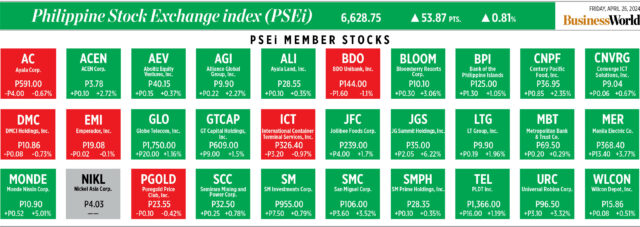
How PSEi member stocks performed — April 26, 2024

Here’s a quick glance at how PSEi stocks fared on Friday, April 26, 2024.


State of power plants in the Luzon grid

THE ENERGY REGULATORY Commission (ERC) should raise the required reserve power capacity of the grid to prevent more outages in the future, an energy think tank said. Read the full story.


State of power plants in the Luzon grid

Fed meeting, inflation outlook to drive trading

The lobby of the Philippine Stock Exchange in Taguig City, Sept. 30, 2020. — REUTERS

SHARES may continue to move sideways this week as investors await the US Federal Reserve’s policy meeting and the release of Philippine April inflation data, which could both affect the direction of local benchmark interest rates.

On Friday, the Philippine Stock Exchange index (PSEi) rose by 0.81% or 53.87 points to 6,628.75, while the broader all shares index climbed by 0.71% or 24.78 points to 3,492.75.

Week on week, the PSEi also climbed by 2.88% or 185.75 points from its 6,443 close on April 19.

The Philippine stock market saw “calmer” sessions last week following the recent rout as investors look ahead to the Fed’s April 30-May 1 policy meeting, online brokerage 2TradeAsia.com said in a note.

For this week, the US central bank’s meeting will be in the spotlight as investors await hints on their next move, Philstocks Financial, Inc. Senior Research Analyst Japhet Louis O. Tantiangco said in a Viber message.

“Investors are… expected to watch out for policy outlook clues from the Fed’s meeting [this] week following the latest macroeconomic data from the United States wherein first-quarter gross domestic product grew below expectations, but first quarter personal consumption expenditures inflation accelerated compared to the preceding quarter,” Mr. Tantiangco said.

The US central bank last month kept its target rate at the 5.25%-5.5% range for a fifth straight meeting after raising interest rates by a cumulative 525 basis points from March 2022 to July 2023.

The Fed is widely expected to keep the policy rate steady and to continue to signal no urgency on cuts, Reuters reported. Fed Chair Jerome H. Powell has said the central bank needs more confidence that inflation is heading towards their 2% goal before cutting rates.

The Fed’s policy hints and the release of Philippine inflation data for April, scheduled on May 7, could affect the local interest rate outlook, Mr. Tantiangco added.

Headline inflation rose for a second straight month to 3.7% in March, bringing the first quarter average to 3.3%, within the Bangko Sentral ng Pilipinas’ 2-4% annual target.

2TradeAsia.com placed the PSEi’s immediate support at 6,300 and resistance at 6,550-6,600.

“The PSEi’s solid bounce at the 6,400 zone is a relief signal in an otherwise lackluster week… The split week ahead may further dilute volumes but earnings results and annual stockholders’ meetings should help inject excitement throughout early May,” it added.

Philippine financial markets will be closed on May 1, Wednesday, for Labor Day.

Mr. Tantiangco put support at 6,400 and resistance at 6,700.

“Chart-wise, last week, the market was able to close above its 200-day exponential moving average (EMA). This week, the market may test the validity of its breach of the said line. If it is able to hold its position above its 200-day EMA, we may see more upward momentum moving forward,” he added. — RMDO with Reuters