Home Blog Page 32

Over 50% support VP’s impeachment

VICE-PRESIDENT SARA DUTERTE-CARPIO FACEBOOK PAGE PHOTO

MORE than half of Filipinos (51%) support the impeachment complaints against Vice-President (VP) Sara Duterte-Carpio, a nationwide survey found.

This is against 33% who oppose and 16% who remain unaware of moves to oust Ms. Duterte, according to the March PAHAYAG survey, conducted by PUBLiCUS Asia.

The same survey also found that 48% or nearly half of voters opposed the swift dismissal of impeachment complaints against President Ferdinand R. Marcos, Jr., compared to 29% who support it and 23% who are unaware.

The data also showed notable regional differences, with the strongest support for Ms. Duterte’s impeachment seen among respondents from the National Capital Region (66%) and South Luzon (62%); while opposition to the dismissal of impeachment complaints against Mr. Marcos is highest in the Visayas (50%) and Mindanao (60%).

This opposition is mainly driven by younger respondents, or those aged 18-24 years old (55%) and 25-29 (56%). 

The PQ1-2026 survey was conducted from March 21 to 24, 2026, among 1,509 registered Filipino voters from the PureSpectrum market research panel, with a national margin of error of ±3%. — Pexcel John Bacon

Slovenian Embassy to tackle energy security with PHL in two-day forum

THE Embassy of Slovenia to the Philippines will hold a two-day symposium in Manila to discuss energy initiatives that the country may adopt to bolster national security.

In a press briefing on Monday, Republic of Slovenia Ambassador in Manila Smiljana Knez said the panel discussions, which will take place on April 21 to 22, will touch on topics such as business innovation, digitalization and artificial intelligence for crisis management and disaster resilience, and defense energy efficiency.

“We want to explore best ways of transfer of science, research, innovation to business,” Ms. Knez said.

She added that Slovenian delegations are already in talks with the Department of National Defense, Office of Civil Defense, and Department of Energy.

During the briefing, Colonel Robert Šipec, Energy Efficiency and Green Transition Division head for the Slovenian Ministry of Defense, underscored their zero-emission target for their security sector and sustainable public transportation initiatives.

Mr. Šipec said the Slovenian defense sector has been promoting austerity measures, such as cutting down on transportation and integration of renewable energies like photovoltaics, windmills, and geothermal energy.

“We need to know how much we spend. That’s very important and where we are mostly vulnerable, and then there are some changes of mindset,” Mr. Šipec said. “Every soldier, everybody should be aware that energy is very costly, not money-wise, but supply-wise.”

He also noted that there is no confidentiality in their military expenditures to foster awareness on their spending.

Rupert Paul C. Manhit, chief operating officer of the Stratbase Institute, also welcomed the discussions, noting the connectedness of energy and defense.

“We believe that the changes of times in national security are not only because of war. It’s not only because of [the] tensions in our islands. Energy is one part; cybersecurity is one part as well. Artificial intelligence is also a very important section that we would like to discuss in this forum tomorrow and other days,” Mr. Manhit said. — Kaela Patricia B. Gabriel

Pangasinan farmers receive seed aid

BW FILE PHOTO

THE Department of Agrarian Reform (DAR) said it has distributed vegetable seeds to thousands of farmers in Pangasinan as part of efforts to support agricultural production amid the energy crisis.

In a statement on Monday, DAR said 3,725 agrarian reform beneficiaries (ARBs) received a total of 16,502 packs of vegetable seeds. The assistance was coursed through 113 agrarian reform beneficiary organizations (ARBOs) across the province’s six congressional districts.

The distributed seeds include varieties of ampalaya (bitter gourd), eggplant, red hot chili, string beans, tomato, and okra, which the agency said are climate-resilient and suitable for sustaining food production and generating additional income.

The agency said the initiative is part of the “Restoring the Livelihoods of ARBs in Agrarian Reform Communities Affected by Typhoons Nando and Opong” project, funded through the Agrarian Reform Fund.

DAR said the seed assistance aims to help farmers manage rising input costs and continue planting despite economic and energy constraints.

“Despite the challenges posed by the state of national energy emergency, the DAR is doing everything in its power to assist our ARBs and ARBOs,” Pangasinan Provincial Agrarian Reform Program Officer Charlotte F. Lasmarias said in the statement.

She added that the agency is coordinating with other government offices, including the Land Transportation Office, Philippine Carabao Center, and Bureau of Fisheries and Aquatic Resources, for additional support to farmers. — Vonn Andrei E. Villamiel

BuCor breaks ground on Nueva Ecija site

THE Bureau of Corrections (BuCor) on Monday led the groundbreaking of a P470-million prison facility to be constructed on a 60-hectare site in Palayan City, Nueva Ecija, following a land donation from the provincial government.

In a statement, BuCor said the project is part of its mandate to expand prison infrastructure and strengthen the safekeeping and rehabilitation of persons deprived of liberty (PDLs).

The project, awarded to the joint venture of Front Nine Konstruct Builders and Qonstech Construction Corp., is slated for completion by the end of 2027.

BuCor said the facility will have a capacity of up to 7,500 PDLs and will house maximum, medium, and minimum-security camps, a reception and diagnostic center, a drug treatment and rehabilitation unit, and a correctional institution for women. It will also include vocational and livelihood facilities, agricultural production areas, courtrooms, and personnel housing.

The agency added that the complex will be equipped with perimeter fortifications, guard towers, controlled entry points, surveillance systems, and solar-powered lighting to enhance security and efficiency.

BuCor said the project is expected to generate employment during construction and operations, stimulate local economic activity, and support infrastructure development in the area. — Erika Mae P. Sinaking

BoC hands P30.78-M drugs to PDEA

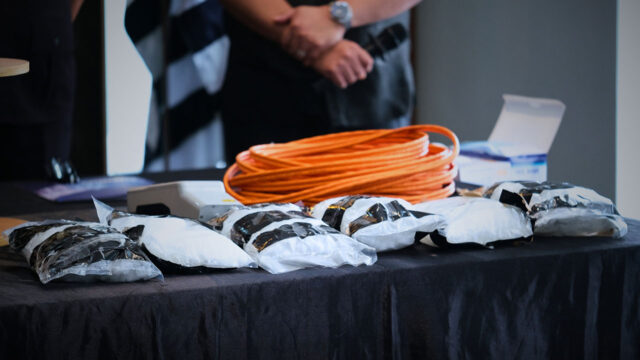
THE Bureau of Customs (BoC) seized six transparent plastic pouches containing 6,156 grams of ketamine concealed within a spool and wrapped cable wires. — BOC

THE Bureau of Customs (BoC) said on Monday that it turned over P30.78 million worth of ketamine to the Philippine Drug Enforcement Agency (PDEA).

Customs Deputy Commissioner Nolasco K. Bathan said that the turnover of the seized contraband reflects the agencies’ unified approach “to deter smuggling attempts and dismantle transnational drug trafficking networks.”

According to the BoC, the seized items were intercepted at the Port of Clark last month, following derogatory information received by the BoC from PDEA.

“The shipment was flagged for physical examination, while x-ray inspection revealed suspicious images, prompting further examination,” it added.

The authorities discovered six transparent plastic pouches containing 6,156 grams of ketamine concealed within a spool and wrapped cable wires.

“A Warrant of Seizure and Detention was subsequently issued for violations of the Customs Modernization and Tariff Act and Republic Act No. 9165,” the BoC said.

As of April, the BoC has already seized P2.531 billion worth of illegal drugs.

“Legal actions were likewise pursued, with the bureau successfully filing six criminal cases related to dangerous drugs from January 2025 to April 2026 before the Department of Justice,” it added. — Justine Irish D. Tabile

P12-M marijuana plants torched in Mountain Province

SADANGA, Mountain Province — Authorities torched down about P12 million worth of marijuana plants in a joint operation on Saturday, along the boundary of Saclit, Sadanga and Tinglayan, Kalinga.

The Philippine Drug Enforcement Agency-Cordillera Administrative Region (PDEA-CAR), with police units, found around 60,000 fully grown marijuana plants spread across a 5,000-square-meter plantation.

PDEA said they buried the ashes of the marijuana plants following proper disposal procedures.

No one was arrested, but authorities are working to identify those behind the plantation. — Artemio A. Dumlao

Bangsamoro cops seize P5.4-M smuggled cigarettes

COTABATO CITY — Policemen intercepted a convoy of three vehicles loaded with P5.4 million worth of imported cigarettes in an anti-smuggling operation in Parang, Maguindanao del Norte before dawn on Monday.

Local executives in Parang and the spokesperson of the Police Regional Office-Bangsamoro Autonomous Region (PRO-BAR), Capt. Steffi P. Salanguit, separately told reporters at noon on Monday that the 12 individuals escorting the contraband, intended for retailers in Cotabato City and in the adjoining Maguindanao del Sur, Maguindanao del Norte and Cotabato provinces, are now detained.

They are now undergoing procedural interrogation.

Their vehicles, a red Isuzu Elf truck, a silver minivan and a black Toyota Fortuner, were also impounded by policemen. All 12 of them are from different towns in Lanao del Sur, according to local executives.

Personnel of PRO-BAR’s Regional Mobile Force Battalion 14-A and anti-smuggling operatives from the Parang Municipal Police Station immediately blocked their route in Duran area in Parang, one of the 12 towns in Maguindanao del Norte, and held them immediately in an operation based on tips about the illegal shipment from legitimate cigarette dealers in Cotabato City.

Ronald Hallid D. Torres, chairman of the Bangsamoro Business Council, told reporters on Monday that they are grateful to the confidential informants who helped prevent the delivery of the smuggled cigarettes to illegal dealers in Cotabato City and in nearby provinces.

Ms. Salanguit and Police Brig. Gen. Jaysen C. De Guzman, director of PRO-BAR, separately told reporters that the 6,500 reams of Indonesian-made cigarettes will be turned over to the Bureau of Customs for its disposition. — John Felix M. Unson

April inflation seen topping 5%, raising odds of BSP rate hike

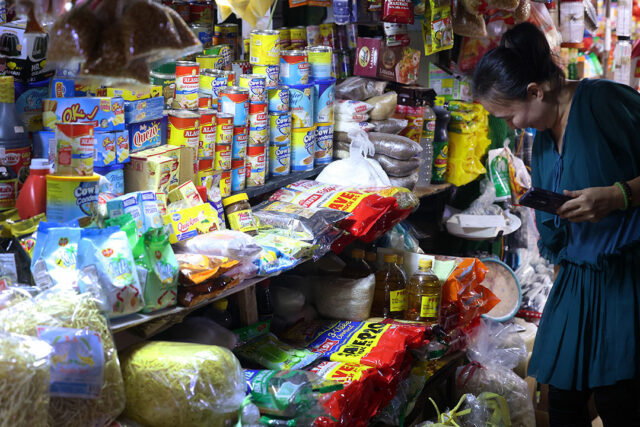
A woman shops for food items inside the Commonwealth Market in Quezon City, Nov. 22, 2024. — PHILIPPINE STAR/MIGUEL DE GUZMAN

RISING OIL PRICES and second-round effects could push inflation above 5% this month, increasing the odds of a 25-basis-point (bp) rate hike by the Bangko Sentral ng Pilipinas (BSP), according to the University of Asia and the Pacific (UA&P).

“Inflation will likely accelerate above 5% starting April, and the BSP has recently taken a more hawkish stance, which we think is uncalled for with the weak economy and job growth,” the UA&P said in its April Market Call.

“Oil prices are expected to stabilize below $90 a barrel as tensions ease, but inflation could rise above 5% from April due to second-round effects,” it added.

The UA&P said it maintained its 3.1% first-quarter gross domestic product (GDP) forecast, despite strong employment and a rebound in National Government spending in February.

“The Middle East war is dampening Philippine growth, especially with weakened global demand and inflation exceeding BSP targets in the coming months,” it said.

“Government spending and employment may pick up, but high inflation and interest rates will limit gains,” it added.

However, it said it expects an economic recovery in the second half of the year as government spending accelerates once the Middle East conflict nears resolution.

Growth in the consumer price index accelerated to 4.1% in March, breaching the BSP’s 2%-4% target.

The BSP expects inflation to average 5.1% this year. For 2027, the BSP’s inflation forecast is at 3.8%.

“With above-target inflation expected for this year, we see a more hawkish BSP treading an awkward policy path between lower growth prospects and supply-side-driven inflation,” the UA&P said.

“There is now more than a 50% chance for the BSP to hike by 25 bps in its April meeting to anchor inflation expectations and give relief to the peso,” it added.

A BusinessWorld poll conducted last week showed that 11 out of 19 analysts expect the Monetary Board to hike the target reverse repurchase rate by 25 bps at its policy meeting on April 23.

If realized, this would bring the benchmark rate to 4.5%, marking the first tightening move from the BSP since October 2023.

“I think it is going to be a 50-50. I think it is going to be a divided Monetary Board meeting with regard to policy,” China Banking Corp. (Chinabank) Chief Economist Domini S. Velasquez told Money Talks with Cathy Yang on Monday on One News.

Chinabank expects the BSP to keep policy rates steady with the oil price shock driving inflation while domestic demand remains fragile.

She said it is hard for policymakers to anticipate inflation expectations amid a volatile environment but noted that the release of the first quarter GDP data in May might help.

“(I)t’s a very volatile environment; just last Friday, we had the Iran minister announcing that the Strait will be open. Over the weekend everything changed, so it’s quite difficult to anticipate inflation expectations,” she added.

She said inflation pressures are stemming from external factors, that is, oil prices.

“What we are seeing is that these are just supply shocks … we think there is not much room (for monetary policy) to affect domestic demand,” she added.

Household consumption growth slowed to 3.8% in the last quarter of 2025, below its typical 5% pace, signaling weakening demand.

She said that in 2022, when oil prices surged due to the Russia-Ukraine war, pent-up demand from the pandemic pushed economic growth to 7.6%.

“This year, we do not think we are going to reach even 5%,” she added.

“We initiated some measures to make sure that people are not be hit by that problem or at least will lessen the impact of that inflation problem,” she said.

However, she said that these initiatives, including work-from-home schemes, will dampen demand for electricity, public transport, and retail and thus will also bring down growth.

“That’s something we’re seeing, that’s why we think demand is going to be slowing down. We’ve seen unemployment at around 5% but the latest data was around February, in March we will see that higher especially with transport workers,” she added. — Justine Irish D. Tabile

Transport association PISTON files for P10 provisional fare increase

PHILIPPINE STAR/RYAN BALDEMOR

TRANSPORT GROUP Pinagkaisang Samahan ng mga Tsuper at Operators Nationwide (PISTON) said it filed a petition with the Land Transportation Franchising and Regulatory Board (LTFRB) seeking a P10 provisional fare hike to P23, citing soaring fuel prices.

“ I hope the LTFRB will hear that our drivers are losing so much from these fuel price increases,” PISTON President Modesto T. Floranda told BusinessWorld by phone on Monday.

In March, the regulator approved fare increases for public utility vehicles  (PUVs) following soaring pump prices, but President Ferdinand R. Marcos, Jr. suspended the increase a day before it was set to take effect.

The March fare increase would have brought the base fare for legacy public utility jeepneys to P14, plus 20 centavos more for every succeeding kilometer to P2. The current minimum jeepney fare is P13.

Starting Tuesday, fuel prices are expected to retreat after fuel retailers announced that diesel prices will drop by P24.94 per liter, gasoline by P3.41 per liter, and kerosene by P2 per liter.

Still, prices have remained elevated since the war in the Middle East erupted, with fuel costs surging to nearly P150-P160 per liter or more than double their previous levels.

If the petition is approved, fare increases will feed into inflation, according to Ser Percival K. Peña-Reyes, director of the Ateneo Center for Economic Research and Development.

“(It could) indirectly push up food and goods prices through logistics costs, weaken household purchasing power, and potentially reinforce a wage-price spiral if fuel prices remain elevated,” Mr.  Peña-Reyes said via Viber.

Philippine dependence on fuel imports makes it vulnerable to price shocks, and transport operators are among the most affected, he said, adding that operators typically respond with fare hike petitions and trip reductions, measures that reduce transport efficiency and raise costs for commuters and businesses.

In March, elevated oil prices due to the war drove inflation to a near two-year high of 4.1%, exceeding the Bangko Sentral ng Pilipinas’ 3.1%-3.9% forecast range and its 2%-4% target for the year.

“If fuel prices remain high and fare increases proceed, several macroeconomic effects tend to appear: higher overall inflation, reduced household consumption, lower business competitiveness, and labor market pressures,” Mr. Peña-Reyes said.

Jonathan L. Ravelas, senior adviser at Reyes Tacandong & Co., said a P10 fare hike would not immediately drive up inflation but could add to the risk of longer-lasting pressure.

“Higher transport costs ripple through food, wages, and small businesses — making targeted fuel support a better fix than repeated fare hikes,” he said

The possible increase in PUV fares could exert modest upward pressure on inflation, especially through transport and logistics costs, according to John Paolo R. Rivera, a senior research fellow at the Philippine Institute for Development Studies.

“Rising fuel prices are straining operators, so some adjustment or support is needed to keep services viable. But higher transport costs can erode purchasing power and dampen demand so the key is balancing fare increases with targeted support to limit broader inflationary impact,” he said.

IBON Foundation Executive Director Jose Enrique A. Africa said the fare hike sought by PISTON would give average jeepney drivers just enough earnings to cover for the fuel price hikes.

“The administration could have mitigated this additional burden on poor, low-income, and lower middle-class families with larger fuel subsidies,” he said. 

According to Mr. Africa, the group’s petition is a clear indicator of the administration’s lack of support to transport amid the unprecedented oil price shocks. 

“PISTON has been among the jeepney groups that have always moderated their fare hike demands out of consideration for the mainly poor, low-income, and lower middle-class commuters they service. If they are driven to ask for a P10 fare hike, this is because their net incomes have collapsed by so much since the US attack on Iran and their families are being driven into poverty or greater distress,” he said.

PISTON’s Mr. Floranda said recent fuel price hikes have slashed drivers’ daily earnings by about 70%, with many taking home only P200 after 12 hours of operations compared to P700 previously.

Mr. Africa said that if the LTFRB approves the fare hike petition, it would mark the government’s latest move to pass the burden onto the public.

“It really needs to make a much greater effort to moderate overpricing by the oil companies, cut fuel taxes that just amplify global oil price hikes, and give greater fuel subsidies and cash assistance to the majority of Filipinos who were distressed even before oil price shocks,” he said.

Meanwhile, another transport group, Manibela, will stage another three-day strike starting Tuesday, its second this month, to protest soaring fuel prices and what it calls the government’s failure to ease the burden on drivers. — Ashley Erika O. Jose


PSEi up on bargain hunting as ME war continues

BW FILE PHOTO

PHILIPPINE STOCKS advanced on Monday as investors picked up bargains and with markets still on edge as the Middle East (ME) war continues amid a fragile ceasefire.

The Philippine Stock Exchange index (PSEi) rose by 0.28% or 16.90 points to close at 6,016.03, while the broader all shares index went up by 0.22% or 7.66 points to end at 3,382.44.

“Philippine equities held their ground, tracking Wall Street gains despite the overnight status change in the Strait of Hormuz, suggesting growing desensitization to volatility driven by developments in the Iran conflict,” AP Securities, Inc. said in a market note.

“The PSEi bounced back from Friday’s drop, reclaiming the 6,000 level on bargain hunting, though gains were tempered by selling pressure in the afternoon session. Sentiment stayed cautious after Iran threatened retaliation over the US seizure of a cargo ship, with its participation in peace talks in Pakistan still unconfirmed,” Regina Capital Development Corp. Head of Sales Luis A. Limlingan said in a Viber message.

Concerns grew on Monday that the ceasefire between the United States and Iran might collapse after the US said it had seized an Iranian cargo ship that tried to run its blockade and Iran vowed to retaliate, Reuters reported.

Efforts to build a more lasting peace in the region also appeared under threat, as Iran said it would not participate in a second round of negotiations that the US had hoped to kick off before the ceasefire expires.

The US has maintained a blockade of Iranian ports, while Iran has lifted and then reimposed its own blockade on marine traffic passing through the Strait of Hormuz, which typically handles roughly one-fifth of the world’s oil supply.

The US military said it fired on an Iranian-flagged cargo ship headed towards Iran’s Bandar Abbas port on Sunday after a six-hour standoff, disabling its engines.

Oil prices jumped more than 5% and stock markets wobbled as traders fretted that the ceasefire would collapse and traffic in and out of the Gulf would remain at a bare minimum.

Back home, sectoral indices closed mixed on Monday. Holding firms rose by 0.86% or 39.73 points to 4,629.04; services increased by 0.69% or 19.25 points to 2,781.03; and mining and oil went up by 0.44% or 79.02 points to 18,049.97.

Meanwhile, industrials declined by 0.34% or 30.13 points to 8,816.01; property dropped by 0.26% or 5.28 points to 2,000.03; and financials went down by 0.14% or 2.73 points to 1,899.07.

Decliners narrowly beat advancers, 105 to 101, while 60 names closed unchanged.

Value turnover declined to P7.17 billion on Monday with 686.11 million shares traded from the P7.44 billion with 1.1 billion issues that changed hands on Friday.

Net foreign selling decreased to P446.83 million from P1.70 billion in the previous session. — Alexandria Grace C. Magno with Reuters

ADB signals readiness to backstop Asia-Pacific economies during crisis

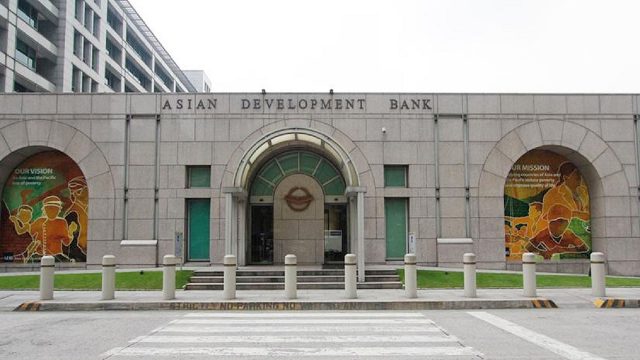
BW FILE PHOTO

THE Asian Development Bank (ADB) said it is ready to provide support to countries in Asia and the Pacific in the face of global economic uncertainty.

“The Middle East conflict is a hit to the global economic engine, and Asia and the Pacific is the region most severely affected,” ADB President Masato Kanda said in a statement on Monday.

“The priority is clear: keep economies running, strengthen domestic economies, and support regional cooperation to build collective resilience. ADB stands ready to support,” he added.

According to the ADB, geopolitical shocks impact Asia and the Pacific through rising fuel, freight and finance costs.

“ADB is acting with speed and scale to stabilize economies via fast-disbursing budget support and expanded trade finance,” it added.

In its Asian Development Outlook for April, the ADB cut its growth projections for developing Asia and the Pacific to 5.1% from 5.4% previously due to the fighting in the Middle East and continuing trade uncertainty.

It slashed growth projections for the Philippines to 4.4% from 5.3% previously, below the Philippine government’s 5-6% gross domestic product target range.

Mr. Kanda also led discussions on strengthening collaboration for resilience at the Multilateral Development Bank Heads meeting.

“The Heads advanced priorities to foster private sector development, collaborate on critical minerals and water security, and improve effectiveness through mutual reliance and a common Value for Money procurement framework,” the ADB said.

Meanwhile, Mr. Kanda discussed the vulnerability of concentrated supply chains at a G7 ministerial event on critical minerals.

The Department of Finance  said on Sunday that the overlapping global instability and climate-related crises continue to put pressure on developing countries like the Philippines.

To address these, Finance Secretary Frederick D. Go cited the need for scaled-up and more flexible financing, deeper mobilization of private capital, sustained support for jobs and human capital, and stronger and faster support for disaster and climate resilience. — Justine Irish D. Tabile

US chip firm ON Semiconductor seeking to expand PHL footprint

FACEBOOK.COM/DOFPH

THE Department of Finance (DoF) said US chipmaker ON Semiconductor Corp. (onsemi) has floated plans to scaling its operations in the Philippines.

In a statement on Monday, the DoF said onsemi President and Chief Executive Officer Hassane El-Khoury discussed plans to expand at its current sites.

“The company highlighted its brownfield expansion strategy, focusing on scaling operations in locations where it has an established manufacturing footprint, positioning the Philippines for further investment,” the DoF said.

The company has been operating in the Philippines for 30 years with staffing of over 6,000. According to its website, the company’s three sites are in Carmona, Cavite, Tarlac City, and Cebu City.

Mr. El-Khoury said that onsemi’s operations in the Philippines support global demand for power chips that enable hyperscale data centers, artificial intelligence infrastructure and advanced storage systems.

“The continued support of the Philippine government has enabled onsemi to establish a strong presence in the Philippines as an integral part of our global manufacturing network,” he said, adding that the support has been instrumental in advancing the company’s business plans and long-term investments in the country.

Finance Secretary Frederick D. Go welcomed the company’s expansion strategy and reaffirmed the government’s support for reinvestment.

“The Marcos Jr. administration remains committed to creating an enabling environment where businesses can expand efficiently and competitively,” he said. “My office stands ready to assist businesses in accelerating their expansion plans in the Philippines.”

In a statement on Sunday, Mr. Go said he considers the semiconductor and electronics industry to be among the drivers of job creation in the Philippines, alongside business process outsourcing and renewable energy. — Justine Irish D. Tabile

ADVERTISEMENT
ADVERTISEMENT