Home Blog Page 2835

Robert Downey, Jr. returns to Marvel as Doctor Doom

IMDB

SAN DIEGO — Robert Downy, Jr. stunned fans as he removed a mask during Saturday’s San Diego Comic-Con Hall H panel, revealing that the Iron Man actor will rejoin the franchise as one of Marvel’s biggest villains named Doctor Doom.

The panel was flooded with hooded figures concealed by masks that resembled the iconic comic book villain known for his skills in both sorcery and science when Mr. Downey Jr. revealed himself.

“I like playing complicated characters,” he said as fans began to chant his name.

The Russo Brothers, who are returning to direct both Fantastic Four: First Steps and Avengers Secret Wars, believe that while Downey Jr. has a “new mask,” he, the rest of the Marvel team, and everyone else has the “same task” of helping to “create the greatest possible experience” at the movie theater.

Another major villain joining the Marvel Cinematic Universe is cosmic entity called Galactus, which will be the antagonist of The Fantastic Four: First Steps.

The panel had plenty more showstopping moments, as it began with a boisterous “Deadpool choir,” inspired by the recent film Deadpool & Wolverine, which Marvel president Kevin Feige said set the box office record for the highest grossing R-rated film ever on Saturday.

Different iterations of the silly red-costumed character named Deadpool danced around the Hall H floor, walking amidst the seated attendees as the film’s anthem “Like a Prayer” by Madonna played.

Deadpool & Wolverine has the largest North American box office opening of 2024, according to industry analysts. US and Canadian sales through Sunday should hit between $175 million and $185 million, said Paul Dergarabedian, senior media analyst at Comscore.

The cast of the upcoming film Captain America: Brave New World, later joined the stage with lead Anthony Mackie sharing how his version of the titular superhero is different from actor Chris Evans’ version.

“Sam is surrounded by a host of intricate characters that help him move through the plot of the story. He’s not so much a muscle-bound guy, he’s more of a cerebral, thoughtful character,” Mr. Mackie said.

Following that, Indiana Jones actor Harrison Ford, who replaces William Hurt’s role as antagonist Thunderbolt Ross, joined the cast and playfully “hulked out” with his arms out and mouth open and then chases Mr. Mackie around the stage.

“It’s been like this for a long time,” Mr. Ford said humorously, adding that he’s proud to become a member of the Marvel universe.

David Harbour later walked into Hall H amidst the seated audience members wearing the costume for his Black Widow character named Alexei Shostakov.

He approached the stage to address the other cast members of the Thunderbolts, which centers on a team of Marvel anti-heroes, with a monologue complaining about them ignoring his idea for them all to dress up for the film. — Reuters

Rates of Treasury bills, bonds likely to be mixed

STOCK PHOTO | Image by RJ Joquico from Unsplash

RATES of Treasury bills (T-bills) and Treasury bonds (T-bonds) to be auctioned off this week may end mixed as the market looks ahead to the Bangko Sentral ng Pilipinas’ (BSP) policy meeting next month, where it is expected to slash benchmark borrowing costs for the first time in over three years.

The Bureau of the Treasury (BTr) will auction off P20 billion in T-bills on Monday, or P6.5 billion each in 91- and 182-day papers, and P7 billion in 364-day debt.

On Tuesday, the government will offer P30 billion in reissued 20-year T-bonds with a remaining life of three years and one month.

Yields on the T-bills and T-bonds on offer this week could track the mixed movements in secondary market yields on Friday after Finance Secretary Ralph G. Recto said the central bank remains on track for a rate cut, Rizal Commercial Banking Corp. Chief Economist Michael L. Ricafort said in a Viber message.

Secondary market yields ended mixed on Friday amid some “two-way interest” after strong US data overnight, a trader said in an e-mail.

The 20-year T-bonds on offer this week could fetch rates ranging from 6% to 6.15% following the release of US June personal consumption expenditures (PCE) index data on Friday, the trader added.

At the secondary market on Friday, the rate of the 91-day T-bill went down by 0.621 basis point (bp) week on week to end at 5.7294%, based on PHP Bloomberg Valuation Service Reference Rates data published on the Philippine Dealing System’s website. Meanwhile, the 182-day and 364-day T-bills went up by 1.67 bps and 5.3 bps to end at 6.0390% and 6.1583%, respectively.

On the other hand, the 20-year bond dropped by 2.46 bps week on week to fetch 6.0893% on Friday, while the three-year debt, the tenor closest to the remaining life of the papers on offer this week, rose by 1.91 bps to yield 6.4019%.

Mr. Recto, who is also a member of the central bank’s policy-setting Monetary Board, said on Tuesday the country is on track for a cut in benchmark interest rates this year due to easing inflation, though the timing would be up to the central bank, Reuters reported.

The central bank, which has kept interest rates steady at 6.5% in its last six meetings, has previously flagged a possible cut of 25 bps at its Aug. 15 meeting as it sees inflation easing in the second half.

BSP Governor Eli M. Remolona, Jr. earlier said the Monetary Board could reduce borrowing costs by 25 bps in the third quarter and by another 25 bps in the fourth quarter. Next month’s review is the only meeting scheduled this quarter.

The central bank last slashed benchmark borrowing costs by 25 bps in November 2020 to bring the policy rate to a record low of 2% to boost economic activity during the height of the coronavirus pandemic.

Meanwhile, US prices increased moderately in June as the declining cost of goods tempered a rise in the cost of services, underscoring an improving inflation environment that could position the Federal Reserve to begin cutting interest rates in September, Reuters reported.

The PCE price index nudged up 0.1% last month after being unchanged in May, the Commerce department’s Bureau of Economic Analysis reported. The increase in PCE inflation was in line with economists’ expectations.

In the 12 months through June, the PCE price index climbed 2.5%. That was the smallest year-on-year gain in four months and followed a 2.6% advance in May.

The Fed tracks the PCE price measures for monetary policy.

The Fed has maintained its benchmark overnight interest rate in the current 5.25%-5.5% range since July 2023. It has hiked its policy rate by 525 bps since 2022.

Last week, the BTr raised P20 billion as planned from the T-bills it auctioned off as total bids reached P47.372 billion, or more than twice the amount on offer.

Broken down, the Treasury borrowed P6.5 billion as programmed from the 91-day T-bills as tenders for the tenor reached P14.86 billion. The average rate of the three-month papers rose by 2.6 bps week on week to end at 5.743%. Accepted rates ranged from 5.724% to 5.755%.

The government likewise made a full P6.5-billion award of the 182-day securities as bids for the tenor reached P15.01 billion. The average rate for the six-month T-bill stood at 5.991%, up by 1.3 bps from the prior week, with accepted rates at 5.98% to 5.998%.

Lastly, the Treasury raised the planned P7 billion via the 364-day debt papers as demand totaled P17.502 billion. The average rate of the one-year debt inched up by 0.9 bp to 6.081%. Accepted yields were from 6.05% to 6.095%.

Meanwhile, the reissued 20-year bonds to be offered on Tuesday were last auctioned off on Nov. 29, 2022, where the government raised just P22.969 billion out of the P35-billion program at an average rate of 6.568%, 205.7 bps below the 8.625% coupon rate.

The BTr wants to raise P215 billion from the domestic market this month, or P100 billion from T-bills and P115 billion via T-bonds.

The government borrows from local and foreign sources to help fund its budget deficit, which is capped at P1.48 trillion or 5.6% of gross domestic product for this year. — A.M.C. Sy with Reuters

Fuel retailer Topline eyes solar-powered stations

CEBU-BASED fuel retailer Top Line Business Development Corp. (Topline) said it plans to install solar systems to energize its fuel stations.

“In terms of the project cost, when you put the solar in the station, I think it’s about 10%, more or less,” Topline President and Chief Executive Officer Eugene Erik C. Lim told reporters on Friday last week.

“The good thing [is] we also have a renewable affiliate. So basically, the one who’s installing solar is also our additional business,” he added.

Topline Energy and Power Development Corp. is among the affiliate companies of the fuel retailer, focusing on “clean and green technology.”

Topline started in the leasing and real estate business but eventually entered the fuel industry in 2017 and is now active in commercial trading, depot operations, and retail fuel in the Visayas region.

Through its subsidiary engaged in the fuel retail sector, Light Fuels Corp., the company introduced its first service station in Mandaue City, Cebu, last year.

The company has allocated approximately P210 million to finance the construction of its nine fuel stations to expand its footprint this year.

Two of the nine stations are set to open next month, while the rest are expected in the fourth quarter.

Asked about its plan to expand outside Cebu, Mr. Lim said that they “would probably focus here for the meantime and then eventually we’ll see.”

For 2023, Topline said that its revenues grew by 33% year on year to P2.8 billion, driven by strong fuel demand in Cebu province and Metro Cebu.

“We are primed for growth and expansion in the Visayas region by serving the underserved segments of the market,” Mr. Lim said.

He said that the company will bolster its efforts to synergize its operations “through vertical integration by expanding in retail and commercial fuel trading while reinforcing our depot operations to meet the growing market demand in Cebu.”

Another subsidiary of the company, Topline Logistics and Development Corp., aims to engage in the importation, trading, distribution, and marketing of petroleum-based products. — Sheldeen Joy Talavera

PHL banana exports up 3.4% amid efforts to curb disease

REUTERS

EXPORTS of banana from the Philippines rose 3.4% in 2023, with the industry’s efforts to curtail the outbreak of Fusarium wilt, also known as Panama disease, apparently paying off, the Food and Agriculture Organization (FAO) said.

In its Banana Market Review, the FAO said that exports of Philippine bananas increased to 2.3 million metric tons (MMT) due to increased investment in containing Panama disease and the rehabilitation of about 4,000 hectares of infected plantations.

Fusarium wilt is a soil-borne fungal disease that blocks the banana plant’s vascular system and deprives it of minerals, nutrients, and moisture. Affected plants turn yellow and die.

The Tropical Race 4 (TR4) strain was first detected in Davao City in 2009 and continues to threaten the Cavendish banana, the main export variety.

“Over the past decade, the country’s banana production has been impacted by adverse growing conditions related to various factors, including the spread of TR4, occasional flooding and occurrences of political unrest,” the FAO said.

Citing the Pilipino Banana Growers and Exporters Association, it added that about 17,000 to 18,000 hectares of banana plantations are affected by TR4, as of February.

The FAO said emerging banana destinations for Philippine bananas like Iran and Saudi Arabia have expanded by 60% and 12% by volume, respectively.

The Philippines is the second top banana exporter next to Ecuador. It accounts for around 60% of Asian banana shipments.

The FAO said logistics issues affected the quality of bananas expected to be exported to Japan.

“These difficulties hampered shipments from the Philippines particularly during the first nine months of (2023), notably to Japan and China, the two key destinations for bananas from the Philippines,” it added.

It added that Asian exports in 2023 rose 5.9% to 4.1 MMT, showing the “first signs of recovery” following three years of consecutive declines in shipments from the region.

The FAO said that exports from Asia had been affected by COVID-19 related difficulties and the impact of TR4 from 2020 to 2022. — Adrian H. Halili

The Chinese EV industry and us

BYD.COM

I have been fascinated by the rise of the Chinese EV (electric vehicle) industry. From being the butt of Elon Musk jokes a decade ago, the Chinese EV industry, led by BYD, is poised to conquer the world.

Chinese manufacturer BYD, or Build Your Dreams, has outstripped Tesla in global sales and is producing product after product, from full EVs to hybrids, that are technologically advanced and, most importantly, affordable. So worried are Western governments about the Chinese EV invasion that they are erecting tariff walls against Chinese cars in a retreat from free trade principles they had been espousing.

The rise of the Chinese EV industry is a testament to the competence and foresight of Chinese bureaucrats who used the transition to EVs to leapfrog Japanese, Korean, European, and American manufacturers. Knowing that carving market share from entrenched ICE (internal combustion engine) producers like Toyota and Ford would be an uphill climb, the Chinese government bet big on the nascent EV industry instead.

From seeding demand through subsidies and tax breaks for consumers to using government procurement contracts for the public transportation system and investing in scientific research and development into batteries, the Chinese government nurtured a fledgling industry into a powerhouse that now accounts for nearly 37% of all new car sales in China.

While the Germans are good at mechanical engineering, I have read that the Chinese poured resources into chemical engineering because the heart of EVs is batteries. Making better and longer-lasting batteries requires chemical manipulation rather than mechanical invention.

However, more importantly, the rise of the Chinese EV industry is also a product of foreign talent, foreign capital, and capitalistic competition.

Many foreign car designers work for Chinese firms. One such designer is Wolfgang Egger, a Director of Design at BYD who previously worked for Alfa Romeo and Lamborghini. Chinese car manufacturer FAW, which produces the luxury brand Hongqi, poached Giles Taylor, a chief designer from Jaguar and Rolls Royce. Other European designers like him work for Chery, NIO, GAC, Dongfeng, Great Wall Motors, and other Chinese brands. This shows that the Chinese are not xenophobic when it comes to business. They don’t see foreigners as displacing local talent but as a source of new technology and knowledge. Here, hiring foreign managers is a pain (except if you are a POGO).

Chinese car manufacturers are open not only to foreign talent but also to foreign capital. It’s well-known that Warren Buffet invested $230 million in Shenzen-based BYD in 2008, which has become highly profitable. However, the second biggest foreign shareholder in BYD after Berkshire Hathaway is BlackRock, one of the world’s biggest asset managers.

We can learn more about how the Chinese handle foreign investment in the automotive industry to boost their local industries. Previously, the Chinese government had a policy that foreign car manufacturers had to have joint ventures to enter the Chinese domestic market. However, it made an exception for Tesla. It allowed Tesla, a 100% foreign-owned EV manufacturer, to set up a Shanghai factory and sell in the Chinese domestic market. Elon Musk didn’t know that the Chinese were learning from the supply chain ecosystem that Tesla set up in China. The know-how and EV supply chain ecosystem then spread to other Chinese EV manufacturers. 
Imagine if that policy against 100% foreign investment were here. It would probably be in the Constitution, and there would be no way to change that policy and learn from foreign know-how.

Another primary reason why the Chinese EV industry developed so fast, marked by rapid innovations from battery technology to design, is because the Chinese government use Schumpterian-style fierce capitalistic competition to drive change. There are hundreds of car manufacturers in China, from state-owned enterprises and privately owned companies to joint ventures. Even if some manufacturers are state-owned or owned by a local government unit, the government doesn’t choose and protect winners.

Nio, for example, a luxury EV manufacturer founded by entrepreneur Bin Li, innovated battery swap technology to stand out from the competition. The company had been losing money for years and nearly went bankrupt due to fierce competition. The Hefei municipal government threw Nio a lifeline by investing in it. Then, after it faced bankruptcy a second time, the Abu Dhabi Investment Fund came to its rescue and injected $2 billion into the company. Nio is listed on the Hong Kong and Singapore stock exchanges and expects to be profitable soon.

We should be as open to foreign talent and capital as the Chinese, but we are not. For example, our Constitutional restrictions on the practice of professions make it hard to hire foreign managers and use foreign talent. Just teaching is considered an exercise of a profession, which is prohibited in the Constitution unless provided by law, so it isn’t easy to hire foreign professors. Our universities will never become world-class if we continue to have this policy.

We seem to have a different attitude when it comes to sports. Our Congress rushes citizenship for foreign basketball players so that they can play for the Philippine team. We allow foreign volleyball players to play regularly in our professional leagues.

There’s a global war for talent, even if we don’t seem to realize it. Other countries, such as the US, provide secure pathways for talented individuals toward citizenship. Indonesia just launched a Golden Visa program wherein investors and talented individuals can get to stay for five to 10 years. Some give permanent residency to entrepreneurs, scientists, and artists. In contrast, we discourage foreign capital from coming here, encourage our talented professionals to seek greener pastures abroad, and make it difficult for foreign professionals to practice here.  (Presently, even Indian graduates of our medical schools aren’t allowed to practice here.)

It’s too bad that talk of Constitutional change is dying down. (President Bongbong Marcos didn’t mention it in his SONA.) We need to remove all those Filipino First and Filipino Only provisions in the Constitution. Even RBH No. 7, passed by the House, opens only public utilities, advertising, and educational institutions to foreign investment.

Watching the rise of the Chinese EV industry, we can only sigh. The Chinese keep doing things right, while our false sense of economic nationalism keeps holding us back.


Calixto V. Chikiamco is a member of the board of IDEA (Institute for Development and Econometric Analysis).

totivchiki@yahoo.com

Rings of Power cast unveils first look into Season 2 at Comic-Con

IMDB

SAN DIEGO — Lord of the Rings: Rings of Power unveiled the first look at Season 2 on Friday as the cast shared insights into what is coming next in the fantasy series at San Diego Comic-Con.

The fantasy series is based on appendices in J.R.R. Tolkien’s original The Lord of the Rings novels and is set thousands of years before the events of The Hobbit and The Lord of the Rings novels and films.

Although the show is called Rings of Power, the first season did not include any of the franchise’s coveted rings, but they will appear at the beginning of the second season.

The cast of the Amazon Prime Video series is led by Morfydd Clark, who plays the almost immortal elf named Galadriel and Ismael Cruz Cordova, who plays the elf named Arondir along with showrunners Patrick McKay and J.D. Payne.

For Ms. Clark, wearing one of the iconic rings with conviction for Season 2 was a more arduous task than she initially expected.

“Weirdly, putting on a ring in an elegant way without looking like you’re trying too hard was much harder than I expected,” she told Reuters in an interview at San Diego Comic-Con.

The upcoming season, which premieres on Aug. 29, will reunite friends as they work together in a war against the corruption of the rings.

At the end of the first season the character, Halbrand, played by Charlie Vickers, was revealed to be the biggest villain in the Lord of the Rings franchise named Sauron, who wishes to rule Middle-Earth. This reveal, according to Mr. Vickers, brings chaos into the second season.

“I think chaos is a good word to describe it, especially towards the latter episodes,” he said.

“A lot of things start happening at once and there are huge battles. There is a battle that lasts for three episodes, I think. It is chaotic, that’s a good word. Sauron is a trigger for a lot of the chaos, I suppose, through his manipulations of people,” he added.

Stars have returned to the San Diego Comic-Con after the 2023 dual writers’ and actors’ strikes led to a subdued Comic-Con last year with no A-list celebrities or Hall H panels, which are known for delivering some of the biggest industry news. — Reuters

Zeekr wants you to rethink electrified luxury

Zeekr Philippines is initially offering the Zeekr 001 and X. — PHOTO BY KAP MACEDA AGUILA

Autohub Group grows portfolio with ‘intelligent premium’ EV brand

IT’S TRULY an automobile buyer’s market. Even if you drill down the various segments, they’re all being saturated with marques and models. And everyone knows that when there are more choices, that’s good news for browsers. There’s a bigger chance of getting best value for our money — features that we want at the pricing we’re comfortable with. And, surprisingly, even the once burgeoning electrified (in all its forms) vehicle space is nicely filling up with challengers and contenders to compete for a spot in your garage.

The Autohub Group recently added to its growing empire with the formal introduction of Zeekr, positioned as a “global intelligent premium electric mobility technology brand.” Under the aegis of the Geely Auto Group, Zeekr was established in 2021 in Ningbo, Zhejiang, China to enshrine the group’s aspiration to compete in the premium electrified space.

Even as the first showroom of Zeekr in the Philippines is set to rise in Bonifacio Global City, Taguig this September, Autohub is already making available two variants of the Zeekr 001 (Long Range and Privilege), and another two grades of the Zeekr X (Premium and Privilege). The 001 is priced from P3.625 million, while the X starts at P2.6 million.

They are decidedly more upscale and luxe than your average EV in both execution and accoutrements, that’s for sure. But that’s not all, says Zeekr Philippines. The Zeekr vehicles can attain, “lightning-fast charging times and feature safety functions, positioning it as a premier sustainable mobility solution. For instance, the Zeekr 001’s charging port boasts a capacity of up to 200kW, allowing (the user) to charge the vehicle from 10% to 80% in just 30 minutes.”

In an exclusive interview with this writer, Autohub Group President Willy Tee Ten said he first heard of the brand through Chinese expats who work for Geely (the Autohub Group is among Geely’s dealers here). “They told me that they have another brand under the group — a brand that’s the favorite of the Geely Holdings owner. That brand is Zeekr,” he revealed.

It piqued his curiosity enough to want to take a closer look at the Zeekr cars himself, and so off to China Mr. Tee Ten went. “Normally, when you choose a brand, you choose the most popular, the most sellable — the one that’s easiest to market,” he insisted. “I thought it might be hard because it’s a Chinese brand that not many people know about. I went to the factory and saw for myself the beauty of the vehicles. It’s what struck me first, after that is the technology behind it. I thought to myself, this is so good. This is one of the few brands that I could say I wanted even if it’s not popular yet.”

The addition of Zeekr to the Autohub portfolio is doubly significant because it is the group’s first all-electric marque. We asked Mr. Tee Ten about the confidence to go this route. “Of course, the interest in EVs has been there since way back. It became even more evident when the President last year signed EO 12, exempting duties for EVs.”

The market that Zeekr is aiming for here, he continued, is the mid-to-luxe segment. Based on pricing, there’s obviously that aspiration to undermine the traditional — and more expensive — premium players. “The good thing about this is that even if we’re in the premium segment, our price is much better than the (present competition) in this space. Yes, we’re going to target the premium segment buyers so that they look for a lower-priced vehicle like ours with the same or even better quality and technology.”

There are also mass-market brands playing in the high-end space, he insisted. “Those are the customers we’d like to capture also. We’re hitting two birds.”

For now, there is no immediate plan for growing the dealership footprint of Zeekr Philippines beyond the aforementioned BGC location (the Autohub Group showroom is getting a renovation to accommodate Zeekr). “We’re doing things deliberately. We also need to wait for our country’s charging infrastructure to grow first before looking at other areas. But since Zeekr is in the premium segment, we’re in the most premium area that is BGC. So, I think this is the best way to start the Zeekr brand,” concluded Mr. Tee Ten.

Lowering cap on credit card charges to support consumption, analysts say

PJCOMP-FREEPIK

By Luisa Maria Jacinta C. Jocson, Reporter

THE BANGKO SENTRAL ng Pilipinas (BSP) can begin lowering the cap on credit card charges amid easing inflation, analysts said, as this would also provide support for private consumption.

“The increased interest rate was a measure to control inflationary expectations. Its main purpose was to decrease aggregate demand that can arise as certain sectors — and the government — might try to cope with increased prices by raising expenditures,” Leonardo A. Lanzona, Jr., an economics professor at the Ateneo de Manila University, said in an e-mail.

“Thus, inflation has indeed been controlled, [so] it will be alright to reduce the interest rates. Otherwise, the lower interest rates can raise expenditures that can aggravate inflation,” he added.

BSP Deputy Governor Chuchi G. Fonacier said in May that they are finalizing their review of the current interest rate cap on credit card transactions. The central bank reviews the rate ceilings every six months.

In August 2023, the BSP kept the maximum interest rate on unpaid outstanding card balance at 3% per month or 36% a year. The existing ceiling on the monthly add-on rate that credit card issuers can charge on installment loans was also maintained at 1%.

The maximum processing fee on the availment of credit card cash advances was likewise retained at P200 per transaction.

The BSP last increased the cap by 100 basis points (bps) in January 2023 from 2% previously following the rate hikes delivered by the Monetary Board amid elevated inflation.

The higher cap was also meant to mitigate the impact of inflation on banks and credit card issuers.

The central bank raised borrowing costs by a cumulative 450 bps from May 2022 to October 2023, bringing its policy rate to a 17-year high of 6.5%.

Mr. Lanzona noted that any decrease in the interest rate cap will “ultimately depend on how much inflation is expected.”

“If some inflation still exists, the decline in interest rates should be low,” he said.

Headline inflation averaged 6% in 2023, above the central bank’s 2-4% goal, but has since eased amid the lagged impact of the BSP’s rate hikes and despite the El Niño weather phenomenon.

In the first six months of 2024, inflation averaged 3.5%, slightly higher than the central bank’s 3.3% full-year forecast but within its 2-4% annual target range.

“When BSP acquiesced to (the) industry proposal to raise the cap the last time, there was at least some macroeconomic basis as BSP itself raised its rate in response to inflation,” Enrico P. Villanueva, a senior lecturer at the University of the Philippines Los Baños Economics Department, said via Messenger.

“Lowering the credit card rate cap now will naturally give retail borrowers some reprieve, but BSP lacks moral anchor to lower the cap now if it has not cut its own rates,” he added.

Mr. Villanueva said that the revision to the credit card rate cap can also be based on the extent of the BSP’s rate cuts.

BSP Governor Eli M. Remolona, Jr. has signaled that the central bank can begin easing its policy stance by next month.

NO NEED TO LOWER RATE CAP

On the other hand, EastWest Bank Chief Executive Officer Jerry G. Ngo said the BSP does not need to lower the credit card rate cap.

“We believe that there should be no downward adjustment in the interest rate cap for credit cards as this is contrary to BSP’s objective of financial inclusion,” Mr. Ngo said in an e-mail.

“Lowering the cap would make it harder for some segments of the population, especially those with low income or poor credit history, to access credit cards.”

Mr. Ngo said this would potentially “limit their options for financing their needs and aspirations, and potentially push them to informal and unregulated lenders that charge exorbitant fees and interest rates.”

“While the proposal’s goal is to alleviate some debt burden, lowering the cap now might limit formal credit availability for vulnerable groups, potentially pushing them towards predatory informal lenders,” Security Bank Corp. Chief Economist Robert Dan J. Roces said in a Viber message.

“As a result, it could undermine the central bank’s goals of fostering a regulated and inclusive financial system,” Mr. Roces added.

Mr. Ngo instead recommended that the central bank should increase and diversify the competition in the credit card market.

“This would encourage more players to enter the market and offer better products and services to consumers. It would also promote better price discovery, as consumers would be able to compare and choose the best deals for their needs and preferences,” he said.

“A more competitive market would also incentivize credit card issuers to lower their interest rates and fees voluntarily, as they seek to attract and retain customers,” he added.

He said the BSP must “work on addressing some of the institutional deficiencies that hamper the development of the credit card market and the financial sector in general.”

“These include the lack of a single ID system, a comprehensive credit bureau, and an effective anti-mule law. These measures would help improve the identification, verification, and screening of credit card applicants, reduce the risks of fraud and default, and enhance the transparency and accountability of the financial system,” Mr. Ngo said.

Megawide’s Saavedra says gov’t push, education key to construction growth

By Revin Mikhael D. Ochave, Reporter

EDGAR B. SAAVEDRA, chairman of Megawide Construction Corp., said that targeted government policies and overhauls in the education system are crucial to addressing the Philippine construction sector’s decades-long lag behind global standards.

“If you compare the construction sector of the Philippines to other countries, we are far behind, by about 30 years. If compared to Japan, we’re behind by over 40 years, same with Germany,” the 49-year-old Mr. Saavedra, who also serves as the company’s chief executive officer and president, said in an interview with BusinessWorld.

“If compared to the United States, the Philippines is maybe behind by 20 years. Germany and Japan are more advanced,” he added.

To bridge this gap, Mr. Saavedra said there has to be a push from the government to improve the construction sector.

“It is more on the macro side. There should be a push from the government. We can be like Singapore, which has criteria and (the Building and Construction Authority). They have qualifiers, incentives, and penalties. There is a system,” he said.

According to its website, the Building and Construction Authority oversees the safety, quality, inclusiveness, sustainability, and productivity of Singapore’s built environment sector, which includes structures that provide people with living, working, and recreational spaces.

Mr. Saavedra also emphasized the need for efforts to improve the Philippine education sector, pointing out a disconnect between academia and the local construction industry.

“There’s no program being implemented to force the industry and the universities to work together. The curriculum is disconnected. It’s a multiplier effect,” he said.

“We need to have changes in the programs of schools, as well as the curriculum,” he added.

Mr. Saavedra earned his engineering degree from De La Salle University and pursued special studies in foundation formworks in Germany. He has over 20 years of engineering experience.

Mr. Saavedra and co-founder Michael C. Cosiquien established Megawide in 1997, and it became a publicly listed company in February 2011.

Years later, Mr. Saavedra now has three publicly listed companies engaged in the construction and renewable energy sectors: Megawide, Citicore Energy REIT Corp., and Citicore Renewable Energy Corp. (CREC).

Despite being a civil engineer by profession, Mr. Saavedra said he is an entrepreneur “at heart,” attributing this to his mother.

Mr. Saavedra hails from Margosatubig town in Zamboanga del Sur.

“We have a family-run shipping business in the province. I grew up in the province. My mother was strict. During summer, she would tell us to help with the business,” he said.

Regarding his goals for his companies, Mr. Saavedra said he aims for Megawide to grow further independently, supported by its real estate unit, PH1 World Developers, Inc.

Megawide acquired PH1 from Citicore Holdings Investment, Inc. in July 2023 for P5.2 billion, as the conglomerate eyes expansion in the below-middle-income and middle-income segments of the real estate market.

“Before, we were contractors only constructing for others. Now, we want to construct also for our own projects. It should be a balance. The impact is larger if the equipment is ours and we are the ones designing the project. The design will be better,” he said.

Megawide’s project portfolio includes the Parañaque Integrated Transport Exchange, Mactan-Cebu International Airport, and portions of the Metro Manila Subway Project.

PH1 World’s projects include the Modan Lofts Ortigas Hills condominium project in Taytay, My Ensō Lofts in Quezon City, The Hive Residences condominium in Taytay, and The Northscapes housing development in Bulacan.

Regarding his renewable energy ventures, Mr.Saavedra believes these have a different approach compared to other players in the sector. “We are purely focused on renewable energy. We have a different approach compared to other companies. We believe that this technology will help us grow,” he said.

CREC officially became the second publicly listed company this year on June 7, raising approximately P5.3 billion from its initial public offering. It aims to become the largest power producer within the next five years.

Meanwhile, Mr. Saavedra said he is not closing his doors to the possibility of having business ventures in other sectors.

“It depends. You will never know. It depends on the market. We need to look at our surroundings and find out the needs of society,” he said.

“I still have five- and ten-year roadmaps. Those are still clear. But I want to give importance to the journey also,” he added.

Innovation competition looks for solutions to combat food insecurity

The United Nations World Food Programme (WFP) and the United States Agency for International Development (USAID), in collaboration with WFP’s Innovation Accelerator, launched the first in-country innovation competition in search of local solutions to tackle food insecurity in the Philippines.

This initiative is part of the Preparedness and Response Excellence in the Philippines (PREP) program, supported by USAID, the Australian Government’s Department of Foreign Affairs and Trade (DFAT) and others. PREP aims to enhance the Philippines’ emergency response and management capacities, supporting vulnerable Filipinos during disasters.

The PREP Innovation Challenge invites local innovators to propose low- and high-tech solutions that will help combat food insecurity in disaster-prone areas of the Philippines. Innovators may apply to one or both of two priority areas: enhancing emergency preparedness to build resilience or increasing efficiency and effectiveness in humanitarian response.

Selected innovations will be showcased at the 2024 PREP Forum in Manila this September.

“At WFP we are asking, ‘Prep ka na ba (Are you ready) to innovate to end hunger in the Philippines?’ This is an opportune time for the PREP Innovation Challenge in the Philippines. It marks WFP’s commitment to help pilot and scale existing innovative approaches to end hunger in the Philippines, in close partnership and support of the government, donors and partners,” said WFP Philippines Country Director Regis Chapman.

All entities, including government (regional, provincial and local government units), local organizations, foundations, academia and others are encouraged to apply. The innovation proposal must target at least one of these provinces: Maguindanao del Sur, Maguindanao del Norte, Surigao del Norte, Dinagat Islands, Albay, Catanduanes, Cagayan and Isabela. The proposal must also align with national, provincial and local plans, as well as with the Sustainable Development Goals.

Learn more about the PREP Innovation Challenge at https://innovation.wfp.org/prep-innovation-challenge and WFP Philippines Facebook Events Page. Interested and eligible innovators may apply at https://airtable.com/appVBhZJ5M40KXWXL/shrdsU21E2tASoQTC by July 31.

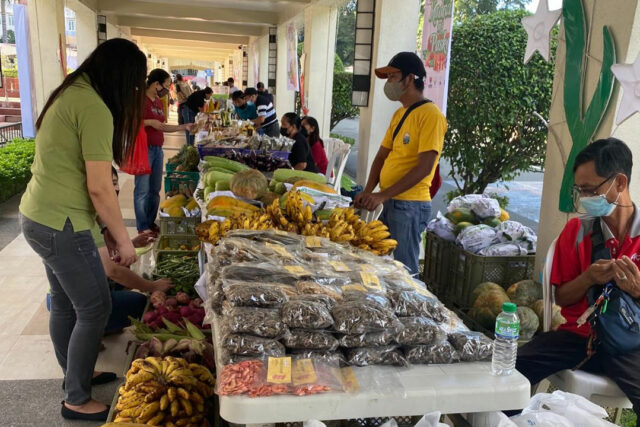
KADIWA store network to tap more suppliers

OFFICE OF THE PRESS SECRETARY PHOTO

THE Department of Agriculture (DA) said it is seeking out more farmer cooperatives and food manufacturers to supply its KADIWA centers.

“Aside from helping consumers, farmer cooperatives will have a rent-free venue to sell their produce while food manufacturers can do this as their corporate social responsibility project,” Agriculture Secretary Francisco P. Tiu Laurel, Jr. said in a statement.

The department said the ‘KADIWA sa BayanAnihan’ program makes available lower-priced basic goods by allowing suppliers to sell directly to the public, bypassing middlemen.

The goods being sought for sale at KADIWA stores include vegetables, eggs, chicken, pork, fish, sugar, spices, canned goods, cooking oil, soy sauce, vinegar and noodles at wholesale prices.

Mr. Laurel said proceeds from KADIWA will help finance the DA’s subsidized rice program for the poor and vulnerable.

“Whatever funds KADIWA centers and the Food Terminal, Inc. make from this ‘Kabayani’ initiative will be utilized to help sustain the P29 rice program,” he added, referring to the intended selling price under the subsidized program.

The target market is estimated at about 34 million vulnerable individuals, including persons with disabilities, solo parents, and senior citizens, as well as those below the poverty line.

The DA has started a large-scale trial of the program to gather data on demand, supply, and logistics, with the trial expected to run for another year.

During the first two weeks of implementation, the subsidized-rice program sold 12.7 metric tons of cheap rice to about 25,000 households.

The KADIWA centers will seek to sell rice at between P45 and P48 per kilo to the general public.

Mr. Laurel has disclosed plans to expand the KADIWA network to 1,500 locations in the next three years. — Adrian H. Halili

Lame arguments to justify the transfer of PhilHealth funds

PHILSTAR FILE PHOTO

The people are angry over the transfer of PhilHealth funds to the National Government. Here is a sample of the furious, fighting words that form public opinion.

Veteran Jarius Bondoc wrote a Philippine Star column (July 17), which he titled “Now they’re stealing our PhilHealth contributions.”

In an interview with Storycon on One News (July 17), Former Finance Undersecretary Cielo Magno said that the provision in the budget law enabling the transfer of funds of government-owned or -controlled corporations (GOCCs) like PhilHealth is “illegal.”

In his July 22 BusinessWorld column (“The P89.9 billion taken from PhilHealth are member contributions, not government subsidies”), Juan A. Perez III asked a rhetorical question: “Pickpockets?”

The July 17 editorial of the Philippine Daily Inquirer was titled: “Immoral fund transfer.”

And on Twitter, economist JC Punongbayan said “nagsimula na ang Marcos admin na mag-extort ng pera mula sa (The Marcos administration has started to extort money from) GOCCs, including PhilHealth and PDIC.” (PDIC stands for the Philippine Deposit Insurance Corp.)

A more sober but still determined call comes from the medical associations and the alliance of health professionals. They have urged the President to “immediately issue a directive to return the entirety of the P89.9 billion in unused funds to PhilHealth.”

Despite the outrage, the administration is digging in. And the Department of Finance (DoF) is the most active in defending the transfer of the PhilHealth funds. It was the DoF that issued the guidelines to implement the controversial provision in the 2024 General Appropriations Act (GAA), leading to the remittance of PhilHealth’s reserve funds to the National Government.

We summarize the DoF’s main arguments, drawn from a statement titled “Mobilizing Unused GOCC Funds for Public Programs,” posted on July 15. And we show how weak the arguments are.

The DoF uses the PhilHealth example, arguing that it and other GOCCs have “billions in unused and idle funds,” which “are being marshalled for projects in health, social services, and infrastructure.” With respect to PhilHealth, the DoF says that the remittances (i.e., what government is taking away) “do not come from their member contributions.” These remittances are the “unutilized National Government subsidies,” and for DoF, “we cannot afford to have excess money sleeping in GOCCs.”

The DoF also takes pride in saying that the remittances from PhilHealth have been used “to pay the 5.04 million claims of COVID pandemic era service allowances of frontliners.”

The DoF likewise assures us that its “move complies with all laws, specifically the General Appropriations Act of 2024.”

The statement of the DoF betrays its ignorance of PhilHealth and the National Health Insurance Program.

PhilHealth is a social health insurance program that pools the resources and risks of the population so that everyone is financially protected from unanticipated, extraordinary, or disruptive expenses arising from sickness, accident, or disability. This kind of financial insurance is about solidarity. My premium or contribution to the fund is not just for my own benefit when I get sick, but it is also for the benefit of others, rich or poor, who get sick. The funds are used not just to cover the medical expenses of the sick but likewise to finance benefits to prevent people from getting sick.

The principles of solidarity and the pooling of resources and risks mean that the program is universal. The whole population is covered. Filipinos above 21 years old are all members of PhilHealth, and they and their dependents are all entitled to PhilHealth benefits. The spectrum of healthcare to be insured by PhilHealth, though constrained by budget or financial resources and the health technology assessment, must be as wide as possible. The goal is to significantly reduce out-of-pocket expenses. Services must be expanding, and the financial benefit package must be increasing.

To be sure, there’s no free lunch. Someone must finance Universal Health Care (UHC) and social insurance. PhilHealth is thus financed through taxes, defined as compulsory contribution to state revenue.

For those with the ability to pay, including minimum wage workers, the contribution takes the form of premiums. Those who pay the premiums, sourced from their own wealth or income, are PhilHealth’s “direct contributors.”

But what about the poor, those without the ability to pay? They also contribute to the pooling of resources and risks by becoming “indirect contributors.” Government provides the indirect contributors the subsidy, so they get enrolled at PhilHealth, become PhilHealth members, and thus claim PhilHealth benefits.

But in essence, the subsidy is still taxpayer’s money, and the poor also pay taxes. Let’s not forget that a substantial part of the subsidy for indirect contributors comes from the earmarking of sin taxes, the burden of which is mainly shouldered by the poor themselves.

To be clear, the government subsidy sourced from the taxpayers becomes the premium of the indirect contributors. This premium is their contribution to the pooling of resources to make the social insurance program work. The pooling of resources from the premiums of both the direct contributors and indirect contributors enables the benefits for all PhilHealth members and dependents.

It follows that the PhilHealth funds are meant to be exclusively used for the benefit of all its members and dependents. The resources, including the excess reserves, cannot be taken away from PhilHealth.

Removing the amount of approximately P90 billion (the premium from the indirect contributors) from the pool of PhilHealth resources destroys the very foundation of the health insurance program and undermines the solidarity of all — the direct and indirect contributors. The removal or transfer of part of the insurance fund impairs the PhilHealth mandate. And it diminishes the benefits for all its members: the Filipino people.

The discussion above is reflected in the Act Instituting Universal Health Care for all Filipinos (Republic Act No. 11223).

Section 8 is about Program Membership. Members consist of the direct contributors and indirect contributors. Under Section 4, the term “indirect contributors” is defined: “Indirect contributors refer to all others not included as direct contributors, as well as their qualified dependents, whose premium [emphasis mine] shall be subsidized by the National Government including those who are subsidized as a result of special laws.”

The law is clear that the subsidy becomes the premium of the indirect contributors. Thus, the DoF is utterly wrong to say that the unused funds are continuing subsidies that government can transfer and use for other purposes. And Juan A. Perez III is spot-on when he said that “The P89.9 billion taken from PhilHealth are member contributions”; they are no longer government subsidies.

In effect, the 2024 GAA and the DoF circular are taking away (or diminishing) the premium and membership of the PhilHealth indirect contributors. Hence, it insults and degrades the poor members of PhilHealth.

But this is also insulting and damaging to the direct contributors. The effect is that the direct contributors now carry the additional burden of supporting the whole PhilHealth membership. (Recently, PhilHealth increased the premium of direct contributors from 4% to 5% and the maximum monthly salary ceiling from P80,000 to P100,000, even as government demanded the transfer of PhilHealth excess reserve funds!) All told, the transfer of PhilHealth reserve funds to the National Government has made every PhilHealth member worse off.

Let’s be clear about this, one more time: The erstwhile subsidy for the indirect contributors becomes their premium. This is treated as an entitlement for the poor. An entitlement cannot be taken away from them, considering that such is an expression of the right to health, which is enshrined in the Constitution. Review the dictionary definition of entitlement: “A government program that guarantees [emphasis supplied] and provides benefits to a particular group.”

Other examples of entitlement are the land reform program and 4Ps (Pantawid Pamilyang Pilipino Program). The government subsidizes the distribution of land for the tiller. Once that subsidy for land is given, government cannot take back the land, lest it be confiscatory. For the 4Ps, once the cash transfers are done, the government cannot reclaim the grants given to the beneficiaries.

But the DoF says it’s better to transfer the PhilHealth’s “idle” or “hibernating” funds to the National Government so they could be used productively.

But this completely ignores the point that PhilHealth funds are for PhilHealth members. The funds must be used to expand the benefits and services and reduce the premiums.

The law is likewise categorical on this. Section 11 of RA 11223 states:

“Reserve Funds: PhilHealth shall set aside a portion of its accumulated revenues not needed to meet the cost of the current year’s expenditures as reserve funds. Provided, that the total amount of reserves shall not exceed a ceiling equivalent to the amount actuarially estimated for two years’ projected Program expenditures: Provided, further, that whenever actual reserves exceed the required ceiling at the end of the fiscal year, the excess of the PhilHealth reserve fund shall be used to increase the program’s benefits and to decrease the amount of members’ contributions.” [Emphasis mine.]

In addition, Section 11 declares that: “No portion of the reserve fund or income thereof shall accrue to the general fund of the National Government or to any of its agencies or instrumentalities, including government-owned or -controlled corporations.”

In truth, increasing the programs benefits can be done immediately. The slogan is “Just do it.” The policies, defined by the law on Universal Health Care, are in place. It is a matter of having the political determination to implement the policies. The bottlenecks relating to registration of members for outpatient benefits, actuarial estimation, and information system are challenging but surmountable.

The excess reserve funds can also be spent immediately. The experts in health financing among the health professionals estimate that for outpatient care alone, an annual budget of P120 billion is needed.

Moreover, the mandate of Philippine universal healthcare is expressed in the globally recognized three dimensions of UHC, namely:

• coverage of the whole population,

•expansion of services or inclusion of other services not covered by existing packages, and,

•continuous reduction of household out-of-pocket expenses (OOP).

Regarding the reduction of OOP, the late Quasi Romualdez envisioned that every Filipino would pay P2 for every P10 on quality healthcare. We are still far from attaining that. In 2022, the household OOP payment stood at 44.61% of total current health expenditure.

The implication of all this is that UHC is a continuous, uninterrupted, and progressive undertaking. Of course, fulfilling this mandate is constrained by resources. But whatever resources are available, they must be used to progressively realize the UHC’s three dimensions. Thus, for UHC and PhilHealth, the concept of “idle” or “hibernating” funds is inapplicable.

Running out of good arguments, the DoF tries to wiggle out of this by invoking the law. It claims that the 2024 GAA allows imposition of “appropriations in excess of what the executive branch has originally proposed.”

But the GAA of 2024 blatantly contradicts and violates the Act Instituting Universal Health Care for all Filipinos. The DoF is using a bad law as a weapon to defeat and knock down another law.

Also abominable is the ploy of the administration to divide and rule, to pit PhilHealth members (well, they are the Filipino people) against others. The DoF is saying that the idle funds from PhilHealth would be used to fund the long-overdue service allowances of health workers or frontliners during the pandemic. For that matter, the DoF is arguing that the “hibernating funds” are better used for worthwhile programs like lands for individual titling, the Comprehensive Automotive Resurgence Strategy, the Nutrition Program, etc.

These programs are worthy of support, but they should be funded not from PhilHealth’s insurance fund but from the budget of the relevant agencies, from the funds that these agencies obtain from the GAA. Shouldn’t the allowances of medical workers be funded from the Department of Health budget? Shouldn’t the nutrition program be funded by the Department of Social Welfare and Development? Shouldn’t the automotive resurgence strategy be funded by the Department of Trade and Industry?

But how come the administration dismissed the appropriations for such worthy programs when the 2024 GAA was passed? Obviously, they were not the government’s priority.

The priority was giving appropriations to the pork insertions of legislators in the budget. In the process, Congress bumped off the good programs. Because of the appropriations for huge pork insertions, previously programmed  were tossed out and moved to the unprogrammed appropriations.

In conclusion, we ask: Is this just a matter of the administration being ignorant of what PhilHealth is all about? Or is the administration engaged in deception to cover up other sin?


Filomeno S. Sta. Ana III coordinates the Action for Economic Reforms.

www.aer.ph